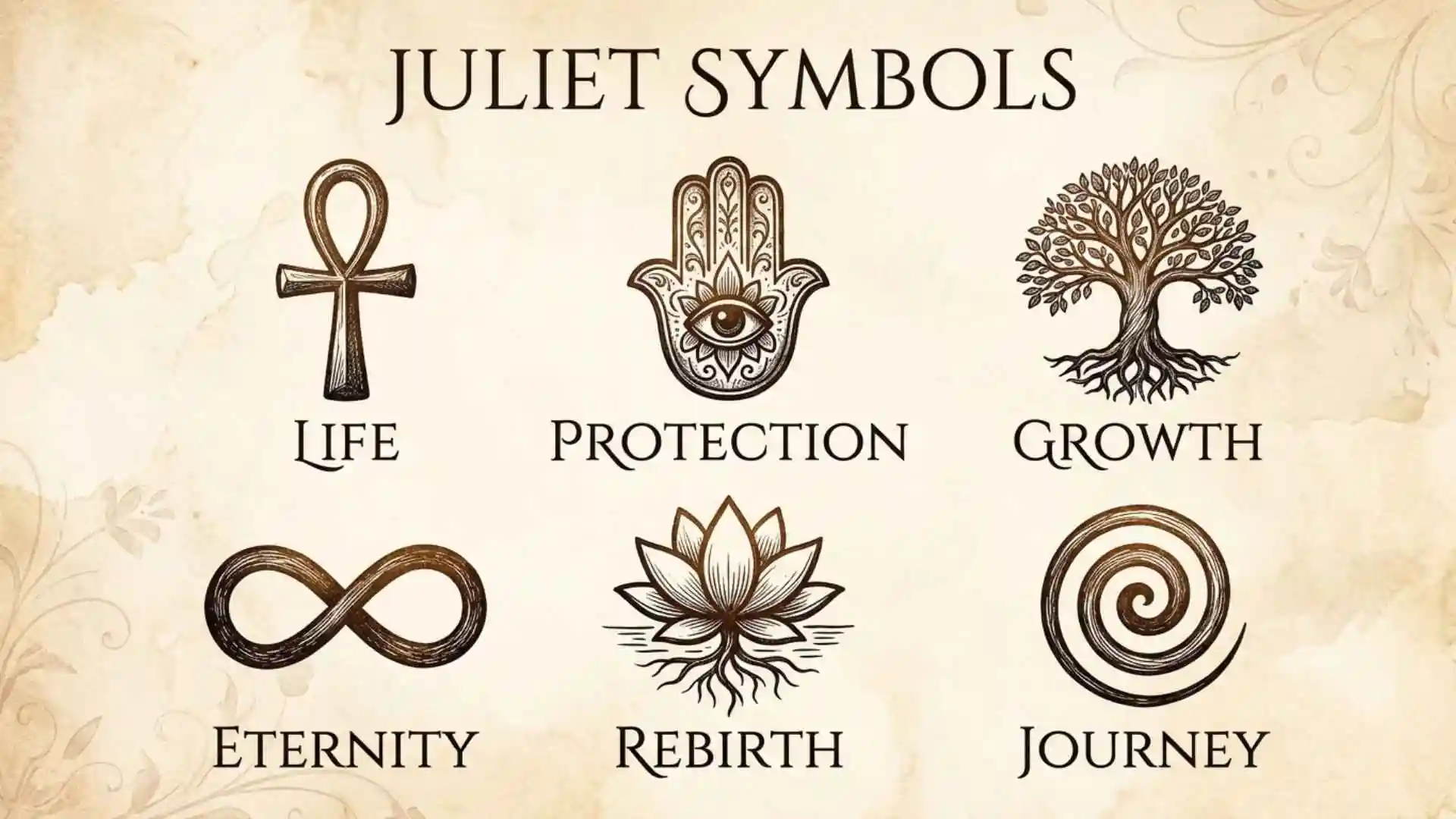
Juliet symbols are the recurring images, objects, and contrasts William Shakespeare uses to reveal Juliet’s love, maturity, fears, and tragic fate in Romeo and Juliet. Light, the sun, stars, roses, birds, poison, daggers, night, and the tomb all deepen the meaning of her story.
These symbols matter because Juliet changes quickly from an obedient daughter into a determined young woman willing to challenge her family and society. Readers encounter the imagery in her balcony speech, wedding plans, separation from Romeo, potion scene, and death in the Capulet tomb.
Understanding Juliet symbols makes the play easier to interpret. They show that her romance is not simply a private love story. It exists within a world shaped by family identity, violence, social expectations, unstable time, and forces the lovers cannot fully control.
Quick Meaning
Juliet symbols primarily represent passionate love, innocence, awakening independence, danger, fate, and death. Shakespeare connects Juliet with light, the sun, stars, flowers, birds, night, medicine, and the tomb. These images show how her love creates hope while the surrounding family feud turns that hope into secrecy, violence, and tragedy.
Juliet Symbols Overview
| Symbol or Image | Primary Meaning | Connection to Juliet | Important Context |
| Light | Beauty, hope, spiritual radiance | Romeo sees Juliet as a source of light | Capulet feast, balcony scene, tomb |
| Sun | Life, warmth, transforming love | Romeo calls Juliet the sun | Balcony scene |
| Stars | Fate, destiny, heavenly beauty | Juliet is linked with the heavens | Prologue and balcony imagery |
| Night | Privacy, protection, secrecy | Night allows Juliet and Romeo to meet | Balcony and wedding-night scenes |
| Moon | Changeability and unstable promises | Juliet rejects the moon as a love oath | Balcony scene |
| Rose | Identity beyond family names | Juliet argues that Romeo remains himself without “Montague” | Balcony scene |
| Birds | Love, dawn, separation, danger | Nightingale and lark mark private love and public reality | After the wedding night |
| Potion | Escape, uncertainty, artificial death | Juliet drinks it to avoid marrying Paris | Friar Laurence’s plan |
| Poison | Hatred, corruption, destructive remedies | It parallels the feud and causes Romeo’s death | Final act |
| Dagger | Choice, violence, self-determination | Juliet uses Romeo’s dagger to die | Tomb scene |
| Tomb | Death, marriage, confinement, reunion | Juliet’s bridal future becomes a grave | Final scenes |
| Pilgrim and saint imagery | Sacred devotion and romantic worship | Juliet participates in a shared religious metaphor | First meeting |
| Clothing and masks | Hidden identity and social role | Juliet’s true desires remain concealed | Feast and secret marriage |
| Gold statues | Memory, reconciliation, material tribute | The families memorialize the lovers | Closing scene |
What Do Juliet Symbols Mean?
Juliet symbols express the conflict between her inner identity and the role society assigns to her. She is expected to obey her parents, marry Paris, preserve the Capulet name, and accept the rules of aristocratic Verona. Instead, she chooses Romeo, questions the importance of family names, and makes increasingly independent decisions.
The symbols surrounding Juliet often carry two meanings at once. Light represents beauty and hope, yet Juliet’s brightest moments happen in darkness. Night protects her love, but it also creates secrecy and danger. The wedding promises life together, but its imagery repeatedly points toward death. Medicine appears capable of solving the lovers’ problem, yet drugs and poison help destroy them.
This duality reflects the play’s tragic structure. Juliet’s love is genuine and life-giving, but it develops inside a violent social system. Shakespeare therefore avoids giving objects fixed meanings. A flower can hold medicine and poison. A tomb can resemble a bridal chamber. A dagger can represent both inherited violence and Juliet’s final act of personal choice.
The symbols do not prove that Juliet is controlled by one simple force. Instead, they reveal relationships among love, fate, chance, family pressure, youthful haste, and human decisions.
History and Literary Origin of Juliet Symbols
The symbolism associated with Juliet comes from several traditions familiar to Shakespeare’s original audience. These include Renaissance love poetry, Christian imagery, classical mythology, astrology, herbal medicine, folklore, and earlier versions of the Romeo and Juliet story.
Shakespeare wrote Romeo and Juliet in the late sixteenth century. Its plot drew heavily from Arthur Brooke’s 1562 narrative poem The Tragical History of Romeus and Juliet, which itself belonged to a longer tradition of Italian tragic romances. Shakespeare transformed that material through dramatic pacing, poetic imagery, characterization, and recurring symbolic contrasts.
Renaissance poets frequently described a beloved woman as a sun, star, jewel, flower, saint, or heavenly being. Romeo initially uses conventional love-poetry language when speaking about Rosaline. His imagery becomes more immediate and interactive when he meets Juliet because she answers him, extends his metaphors, and helps create their shared language.
Religious symbolism also shaped the lovers’ first conversation. Romeo presents himself as a pilgrim approaching Juliet as a holy shrine or saint. Juliet does not remain silent within the comparison. She responds intelligently, controls the pace of the exchange, and permits a kiss through the metaphor they build together.
Astrological beliefs gave the stars another important meaning. Many people in Shakespeare’s culture associated celestial movements with human fortune. Calling Romeo and Juliet “star-crossed” introduces the possibility that their lives are obstructed by hostile destiny. However, the tragedy also depends on human choices, social conflict, failed communication, and disastrous timing.
Natural imagery came from direct observation and established literary traditions. The sun, moon, nightingale, lark, rose, herbs, and changing seasons allow Shakespeare to connect private emotion with the larger natural world.
Major Juliet Symbols and Their Interpretations
Light and Brightness
Light is the most important symbol associated with Juliet. It represents her beauty, emotional energy, youth, hope, and ability to transform Romeo’s perception of the world.
At the Capulet feast, Romeo compares Juliet’s brightness with torches and imagines her as a jewel against darkness. During the balcony scene, he describes light appearing through her window and identifies Juliet with the sun. These images suggest that she has replaced the artificial, melancholy love he once directed toward Rosaline.
Juliet’s light is not merely physical beauty. It symbolizes recognition. Romeo feels that meeting her has given his life new direction. She appears to illuminate a path beyond the feud, even though that path cannot survive within Verona’s existing social order.
The image becomes tragic because Juliet’s light repeatedly appears against darkness. Her radiance does not erase the feud. It makes the surrounding hatred more visible. Even in the tomb, Romeo believes her beauty brings light into the burial vault. Shakespeare therefore uses brightness to connect love with both hope and mortality.
The Sun
The sun symbolizes Juliet’s life-giving presence and Romeo’s belief that she can replace an older emotional world. When he urges the figurative sun to rise, he imagines Juliet overcoming the moon and the darkness around him.
The comparison elevates Juliet, but it also reveals Romeo’s tendency to idealize. He sees her as a cosmic force rather than only as a human being. This does not make his love false, but it shows its emotional intensity.
The sun also creates a painful contradiction. Daylight exposes the lovers to their families and separates them. Juliet may be symbolically associated with the sun, yet she and Romeo can safely be together only at night.
Stars and Fate
Stars symbolize destiny, beauty, distance, and forces beyond human control. The Prologue identifies Romeo and Juliet as “star-crossed lovers,” framing their relationship as one opposed by fortune.
Romeo also imagines Juliet’s eyes in heaven, where their brightness would make birds mistake night for day. The image makes her seem celestial, but it also places her at an unreachable distance.
Juliet’s relationship with the stars is therefore double-sided. They express Romeo’s wonder, but they also remind the audience that the lovers may be trapped within a pattern established before they understand its consequences.
The play does not settle the debate between fate and free will. Stars suggest destiny, while the action shows preventable mistakes: the feud continues, Romeo acts impulsively, the message from Friar Laurence fails to arrive, and the lovers make irreversible decisions.
Night and Darkness
Night symbolizes privacy, protection, intimacy, and temporary freedom from public rules. Under darkness, Romeo enters the Capulet orchard, Juliet speaks honestly, and the lovers create a private identity apart from their family names.
This reverses the usual assumption that darkness represents evil. For Juliet, night can be gentle and protective. Day is often more dangerous because it returns her to parental authority, public conflict, and forced marriage.
Yet darkness also carries risk. It allows concealment, misunderstanding, and isolation. The lovers’ hidden marriage cannot transform the wider community because almost no one knows about it. Their secrecy protects the relationship in the short term while weakening their access to help.
Shakespeare’s use of light and dark is therefore deliberately paradoxical. The lovers are sources of light, but their love must remain hidden in darkness. Critics have long recognized this contrast as one of the play’s central patterns.
The Moon
The moon represents change, inconsistency, and unreliable promises. When Romeo considers swearing his love by the moon, Juliet objects because the moon changes throughout its monthly cycle.
Her response reveals emotional intelligence. Juliet is deeply in love, but she does not want Romeo’s devotion to imitate something unstable. She asks for a love grounded in the lovers themselves rather than a changing object in the sky.
The moment also complicates the idea that Juliet is merely impulsive. Although she agrees to marry Romeo quickly, she recognizes the danger of exaggerated language and worries that their relationship may be moving too fast.
The Rose and the Meaning of Names
The rose symbolizes essential identity. Juliet argues that a rose would smell as sweet even if people called it by another name. Through this image, she questions why “Montague” should define Romeo’s character.
The rose does not mean that names have no social power. Juliet’s argument expresses what she wishes could be true: that a person’s nature matters more than inherited labels. In Verona, however, the names Capulet and Montague carry authority, obligation, memory, and danger.
This creates dramatic irony. Juliet understands that Romeo’s surname should not change his worth, but she underestimates how strongly names organize the world around them. The rose becomes both a hopeful statement about individual identity and a tragic reminder that society may refuse to separate people from their groups.
Pilgrims, Saints, and Sacred Love
Religious imagery symbolizes reverence, equality, ritual, and the lovers’ immediate spiritual connection. During their first meeting, Romeo compares Juliet’s hand to a shrine and himself to a pilgrim. Juliet becomes a saint within the metaphor.
The exchange resembles a shared sonnet. This formal unity suggests harmony between them before they even know each other’s identities. Juliet is not simply praised; she actively develops the imagery and matches Romeo’s verbal skill.
The sacred language raises their kiss above casual attraction. At the same time, it contains playful physical desire. The symbolism blends body and spirit rather than separating them.
Later events make the religious imagery more complicated. Friar Laurence secretly marries the couple, hoping the union will end the feud. The holy ceremony is sincere, but secrecy and haste prevent it from achieving public reconciliation.
Birds: Nightingale, Lark, Dove, and Falcon
Birds symbolize love, time, freedom, vulnerability, and separation. Juliet is compared with a bright dove among crows at the Capulet feast, emphasizing her beauty and distinction.
In the orchard, Romeo imagines Juliet as a bird he wishes to remain close to, while Juliet compares their exchange to calling a trained bird back by a silken thread. The imagery expresses tenderness but also hints at possession and limited freedom.
After their wedding night, Juliet insists that the bird they hear is the nightingale, associated with night. Romeo identifies it as the lark, the messenger of morning. Their disagreement is emotional rather than factual: Juliet wants time to stop because dawn means separation.
The lark becomes a painful symbol of reality. Nature does not adjust itself to the lovers’ wishes. Morning arrives, Romeo must leave, and Juliet returns to the household that plans her marriage to Paris.
Flowers, Herbs, Medicine, and Poison
Plants symbolize the coexistence of healing and destruction. Friar Laurence explains that a single plant may contain both medicinal power and poison. His observation reflects the moral structure of the entire play.
Love may heal the feud, yet passionate haste contributes to disaster. The Friar’s knowledge may save Juliet from immediate forced marriage, yet his potion creates the appearance of death. Romeo purchases poison as a means of joining Juliet, but his action prevents their living reunion.
The symbolism does not suggest that nature itself is evil. It shows that power depends on use, judgment, timing, and proportion. A remedy applied carelessly can become another danger.
Juliet herself is placed between these opposing possibilities. Her marriage could have become a medicine for Verona’s hatred. Instead, the secrecy surrounding it turns the attempted cure into part of the tragedy.
The Sleeping Potion
The potion symbolizes escape, suspended identity, trust, fear, and the dangerous boundary between life and death. Juliet drinks it because every ordinary path appears closed. Her father demands that she marry Paris, Romeo is banished, and revealing the marriage could create further violence.
Before drinking, Juliet imagines several terrifying outcomes. The mixture may be poison. She may awaken too early. She may suffocate in the tomb. She may lose her mind among bones and dead bodies.
This speech shows that she understands the physical horror of the plan. Drinking the potion is not passive surrender. It is a conscious risk taken under extreme pressure.
The potion also turns Juliet into an image others misread. Her family sees a dead daughter, Paris sees a lost bride, and Romeo receives false news of her death. The symbol demonstrates how appearances can become fatal when communication fails.
The Dagger
The dagger symbolizes violence, agency, loyalty, and Juliet’s final refusal to live within a future chosen by others. Unlike Romeo, who dies by poison, Juliet kills herself with a weapon.
The dagger belongs to the violent masculine world of Verona, where swords and challenges protect family honor. Juliet redirects that violence inward. Her act shows how the feud has reached even the most private part of her identity.
At the same time, the dagger represents a final decision. Juliet has repeatedly faced attempts to control her body through marriage, obedience, confinement, and family authority. In the tomb, she chooses death rather than separation from Romeo.
That choice should not be romanticized as a healthy model of love. Within the tragedy, it reveals the complete failure of the adults and institutions that should have protected the young couple.
The Tomb and Bridal Chamber
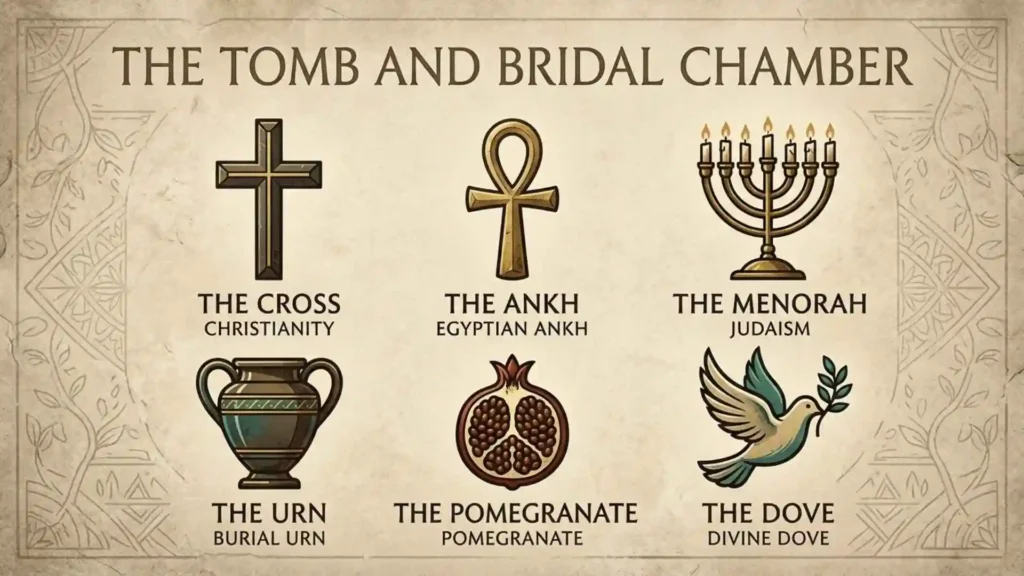
The tomb symbolizes confinement, death, failed communication, and the merging of marriage with burial. Throughout the play, Juliet’s bridal future becomes linked with the grave.
Lord Capulet prepares a wedding for Juliet and Paris, but the household converts the wedding arrangements into funeral preparations when the potion makes her appear dead. Joy and grief exchange places with disturbing speed.
The tomb also becomes the location of the lovers’ final reunion. Romeo enters believing Juliet is dead, while Juliet awakens moments after he drinks poison. Their tragic timing turns the burial chamber into a distorted wedding chamber.
This symbolism exposes the destructive force of the feud. Verona gives the lovers no safe public place in which to build a marriage. Their most complete physical union occurs only in death.
Cultural Significance of Juliet Symbols
Juliet symbols have shaped Western ideas about forbidden love, youthful passion, and family conflict. The balcony, rose, stars, nightingale, potion, and tomb now appear far beyond Shakespeare’s original text.
In literature, Juliet often represents a young woman whose private desires conflict with family or social expectations. Adaptations relocate the feud into divisions based on ethnicity, religion, class, neighborhood, politics, or inherited rivalry.
In theater, lighting design strongly influences Juliet’s symbolic presence. A director may place her in warm light while the wider stage remains dark, reinforcing Romeo’s vision of her as a sun or torch. Other productions use harsh daylight to make the public world feel more dangerous than the night.
In visual art, Juliet commonly appears at a balcony, beside a window, holding a vial, or lying in the tomb. These objects help viewers recognize specific moments even without dialogue.
Modern audiences also interpret Juliet through debates about gender and agency. Some see her as a victim of patriarchal authority. Others emphasize her intelligence, verbal control, courage, and ability to make decisions. Both readings can coexist because her independence develops inside severe social limits.
Religious and Spiritual Meaning
The religious symbolism surrounding Juliet presents love as sacred while questioning whether private devotion can survive without social responsibility.
At the lovers’ first meeting, saint, shrine, pilgrim, prayer, and sin imagery gives their attraction ceremonial form. Their kiss resembles an act of mutual devotion. Yet the metaphor remains romantic and theatrical rather than proof that Juliet possesses literal religious status.
Friar Laurence represents the institutional religious world. He recognizes that the marriage might reconcile the families, but he relies on secrecy and a dangerous plan. His good intentions cannot compensate for weak communication and limited control.
Juliet’s willingness to enter a deathlike state also resembles symbolic death and rebirth. She expects to awaken, leave her former life, and begin again with Romeo. Instead, the intended rebirth becomes actual death.
The play does not present suicide as a sacred union. Its ending emphasizes loss, social failure, and belated reconciliation. The families honor the lovers only after the young people have paid the price of adult hatred.
Where Juliet Symbols Are Used Today
Juliet symbols appear in many artistic and cultural settings:
- Books and poetry: Writers use stars, roses, balconies, and night imagery to signal forbidden or idealized love.
- Theater: Lighting, costume, staging, and props strengthen contrasts between secrecy and public conflict.
- Film: Directors use sunrise, windows, water, religious objects, pills, guns, or modern poisons as symbolic adaptations.
- Paintings: Artists often depict the balcony meeting, Juliet’s potion scene, or the tomb.
- Jewelry: Rose, star, sun, and heart designs may reference romantic devotion.
- Tattoos: Quotations, roses, daggers, potion bottles, and paired celestial symbols can represent love or tragedy.
- Music: Songs invoke Romeo and Juliet as symbols of lovers divided by outside forces.
- Logos and branding: The name Juliet may suggest romance, elegance, youth, or dramatic passion.
- Education: Symbol maps and motif charts help students trace changes in character, tone, and theme.
- Tourism: Verona’s “Juliet balcony” functions as a modern cultural symbol, even though Juliet is a fictional character and the tourist site is not historical proof of the play’s events.
Common Variations and Modern Adaptations
The Balcony or Window
The famous “balcony scene” is often represented by an actual balcony in art and film. Shakespeare’s text places Juliet above Romeo at a window, but later staging traditions made the balcony visually central.
It symbolizes distance, danger, elevation, and the boundary between Juliet’s family home and Romeo’s presence outside it.
Roses and Daggers
A rose paired with a dagger has become a common modern design. The rose represents beauty or love, while the blade represents pain, danger, sacrifice, or death.
This combination captures the play’s connection between tenderness and violence, although it is a modern visual shorthand rather than a single emblem created by Shakespeare.
Sun and Moon Pairings
Modern artwork sometimes represents Juliet as the sun and Romeo as the moon. The play directly links Juliet with the sun, but the moon is not simply Romeo’s personal symbol. Juliet actually warns against using the changing moon as the basis for a promise.
Potion Bottles
Illustrations often portray Juliet’s potion in a decorative glass vial. The exact bottle design is not important in the text. Modern versions may resemble perfume, medicine, or magical elixirs depending on the adaptation.
Stars and Constellations
Star designs emphasize fate and the description of the lovers as star-crossed. Some modern interpretations present the stars as romantic guides, while the play uses them more ambiguously as signs of obstructed destiny.
Common Misconceptions About Juliet Symbols
Juliet Is Not Represented by One Official Symbol
There is no single historical emblem called “the Juliet symbol.” The phrase usually refers to a collection of symbols and images associated with Juliet or Romeo and Juliet.
The Balcony Is Not the Only Important Juliet Symbol
The balcony is culturally famous, but the play’s light, star, rose, bird, potion, dagger, and tomb imagery carries more detailed thematic meaning.
Darkness Does Not Simply Mean Evil
Night often protects Juliet. The public violence of the feud commonly occurs during the day, while darkness gives the lovers privacy and emotional freedom.
The Rose Does Not Prove Names Are Meaningless
Juliet wishes that a name could be separated from a person’s true identity. The tragedy shows that family names remain socially powerful even when they are morally unjust.
The Stars Do Not Remove All Human Responsibility
Fate frames the story, but individual decisions and social failures still matter. The feud, impulsive actions, poor communication, and adult pressure contribute directly to the deaths.
Juliet Is Not Entirely Passive
She faces severe restrictions, but she questions Romeo, proposes practical steps, accepts marriage, refuses Paris, drinks the potion, and acts decisively in the tomb.
Poison and Potion Are Not the Same Object
Juliet drinks a potion intended to create the appearance of death. Romeo drinks actual poison. Their different substances serve related but distinct symbolic purposes.
The Play Does Not Present the Lovers’ Deaths as a Simple Romantic Ideal
Their deaths end the feud, but only through devastating loss. The conclusion condemns the social hatred and failures that made reconciliation arrive too late.
Interesting Facts About Juliet Symbols
- Juliet answers Romeo’s religious imagery. She does not simply receive his praise. Their first conversation becomes a shared poetic structure, showing intellectual and emotional equality.
- The lovers’ first exchange forms a sonnet. The formal pattern creates immediate harmony between two people whose families exist in disorder.
- Juliet questions the moon’s reliability. Her objection shows that she values constancy and understands that beautiful language can hide unstable emotion.
- Light imagery follows Juliet into the tomb. Romeo still associates her with brightness when she appears dead, joining beauty and mortality in one image.
- Night protects love more often than daylight does. Shakespeare reverses common moral associations by making darkness intimate and public daylight violent.
- The rose passage concerns language as well as love. Juliet is asking whether words create identity or merely label something that already has an essential nature.
- Birdsong becomes a clock. The nightingale and lark do more than decorate the scene; they measure the lovers’ shrinking time together.
- The plant imagery mirrors Friar Laurence’s plan. Just as an herb can heal or poison, his strategy contains the possibility of rescue and catastrophe.
- Juliet’s potion scene gives her one of the play’s most psychologically intense speeches. Alone, she considers betrayal, burial, suffocation, madness, and death before acting.
- The dagger connects Juliet with Verona’s culture of violence. A weapon associated with male conflict becomes the instrument of her final choice.
- Marriage and death language repeatedly overlap. This pattern prepares the audience for the transformation of Juliet’s wedding arrangements into funeral rites.
- The symbols remain flexible in adaptation. Modern productions may replace swords, poison, or letters with guns, drugs, phones, or digital messages while preserving their dramatic functions.
Related Symbols
Romeo Symbols
Romeo is connected with stars, night, poison, fire, pilgrimage, exile, and impulsive movement. His imagery often reveals idealism and emotional intensity.
The Capulet and Montague Names
The family names symbolize inherited identity, loyalty, prejudice, and social division. They are labels the lovers attempt to overcome but cannot safely escape.
The Feud
The feud is not a visual symbol in the narrow sense, but it functions as a continuing symbol of inherited hatred. Its origin is less important than the damage caused by preserving it.
Fire
Fire represents intense emotion, desire, anger, and rapid destruction. It can describe romantic passion or the violence that surrounds the lovers.
Blood
Blood symbolizes family connection, honor, injury, and death. The same idea of blood joins relatives while bloodshed tears the community apart.
Gold
Gold carries opposing meanings. Romeo argues that money can act like poison when he purchases the lethal drug. At the end, gold statues become the families’ memorial tribute.
Masks
Masks symbolize hidden identity and temporary freedom. Romeo enters the Capulet feast disguised, allowing the relationship to begin before family names intervene.
The Letter
Friar Laurence’s undelivered message symbolizes failed communication. Unlike cosmic symbols such as stars, the letter points to an ordinary, preventable cause of tragedy.
Frequently Asked Questions
What are the main Juliet symbols?
The main Juliet symbols are light, the sun, stars, night, the moon, the rose, birds, religious imagery, the sleeping potion, the dagger, and the tomb. Together, they represent Juliet’s beauty, love, developing independence, secret identity, fear, vulnerability, and tragic movement from anticipated marriage toward death.
What symbol represents Juliet best?
Light is the strongest overall symbol for Juliet. Romeo repeatedly describes her as brighter than torches, stars, and darkness, and he compares her with the sun. Light captures her beauty and the hope created by her love. Its appearance within darkness also reflects the danger and secrecy surrounding the relationship.
What does the sun symbolize for Juliet?
The sun represents Juliet’s warmth, vitality, beauty, and transformative effect on Romeo. When Romeo identifies her with the rising sun, he imagines her replacing emotional darkness. The symbol is also ironic because daylight exposes the lovers to danger, while night gives them the privacy needed to be together.
What does the rose symbolize in Juliet’s speech?
The rose symbolizes a person’s essential identity apart from an inherited label. Juliet argues that Romeo would remain the same person without the Montague name. However, the tragedy shows that names possess real social power because Verona’s families use them to determine loyalty, marriage, friendship, and hostility.
Why is Juliet associated with stars?
Stars connect Juliet with heavenly beauty, distance, time, and fate. Romeo imagines her eyes shining in heaven, while the Prologue describes the lovers as star-crossed. The symbolism elevates Juliet but also places the romance under the shadow of forces that seem larger than either lover’s wishes.
What does night symbolize for Juliet?
Night symbolizes privacy, protection, honesty, and temporary freedom. Juliet can speak openly with Romeo after darkness separates them from the watching social world. Yet night also encourages secrecy, leaving the lovers isolated. It protects their relationship emotionally while making public support and clear communication more difficult.
What does Juliet’s potion symbolize?
Juliet’s potion symbolizes escape, risk, suspended identity, and the uncertain line between life and death. She uses it to avoid marrying Paris and reunite with Romeo. Because others mistake her artificial death for a real one, the potion also symbolizes the dangerous consequences of appearances and failed communication.
What does Juliet’s dagger symbolize?
The dagger symbolizes Verona’s violence and Juliet’s final exercise of personal agency. By using Romeo’s weapon, she joins love and death in one action. The moment also shows how completely the family conflict has failed her. With no safe future available, she turns the culture’s violence against herself.
How do birds symbolize Juliet’s relationship with Romeo?
Birds symbolize beauty, affection, freedom, control, time, and separation. Juliet is compared with a dove, while the nightingale represents the private night she wants to preserve. The lark announces dawn, forcing Romeo to leave. Bird imagery therefore moves from attraction and playfulness toward unavoidable separation.
Are Juliet symbols the same as the themes of Romeo and Juliet?
Symbols and themes are connected but not identical. Themes are broad ideas such as love, fate, violence, identity, and family conflict. Symbols are images or objects, including stars, roses, poison, and light, that help express those ideas. A single symbol may support several themes at the same time.
Key Takeaways
- Juliet symbols reveal her love, intelligence, independence, fear, and tragic fate.
- Light and the sun represent her beauty, hope, and emotional power.
- Stars connect the lovers with fate, timing, and forces beyond their control.
- Night protects the romance, while daylight exposes it to public danger.
- The moon represents changeability, which Juliet rejects as a model for love.
- The rose questions whether family names define a person’s true identity.
- Birds mark beauty, intimacy, passing time, and painful separation.
- Plants, medicine, poison, and the potion show that remedies can become destructive.
- The dagger represents both Verona’s violence and Juliet’s final decision.
- The tomb unites the play’s marriage and death imagery.
- Juliet’s symbols often carry positive and negative meanings at the same time.
- The tragedy combines fate with human choices, social pressure, and failed communication.
Conclusion
Juliet symbols transform her from a famous romantic heroine into a complex figure caught between personal identity and inherited conflict. Light, stars, roses, birds, night, the potion, the dagger, and the tomb reveal different stages of her emotional journey.
These images show why Juliet’s love feels hopeful and dangerous at once. She imagines a world where names do not determine human worth, promises remain constant, and marriage can end hatred. Verona refuses to create that world until after her death.
The lasting power of Juliet symbols comes from their contradictions. Light exists inside darkness, healing plants contain poison, a wedding leads toward a funeral, and love produces reconciliation only through loss. Through these patterns, Shakespeare makes Juliet’s story a lasting examination of love, identity, time, social division, and the tragic cost of understanding too late.

I am Amelia Carter, an English language educator and educational writer who enjoys making difficult ideas simple and easy to understand. At LearnNestly, I write about English words, grammar, everyday expressions, and language questions that people often find confusing. I believe learning should feel practical, clear, and enjoyable rather than overwhelming. Through my writing, I try to give readers explanations they can understand and use in real life.
Books:
- The Everyday English Handbook
- Words Made Simple
 Ethan Mitchell
 Daniel Brooks