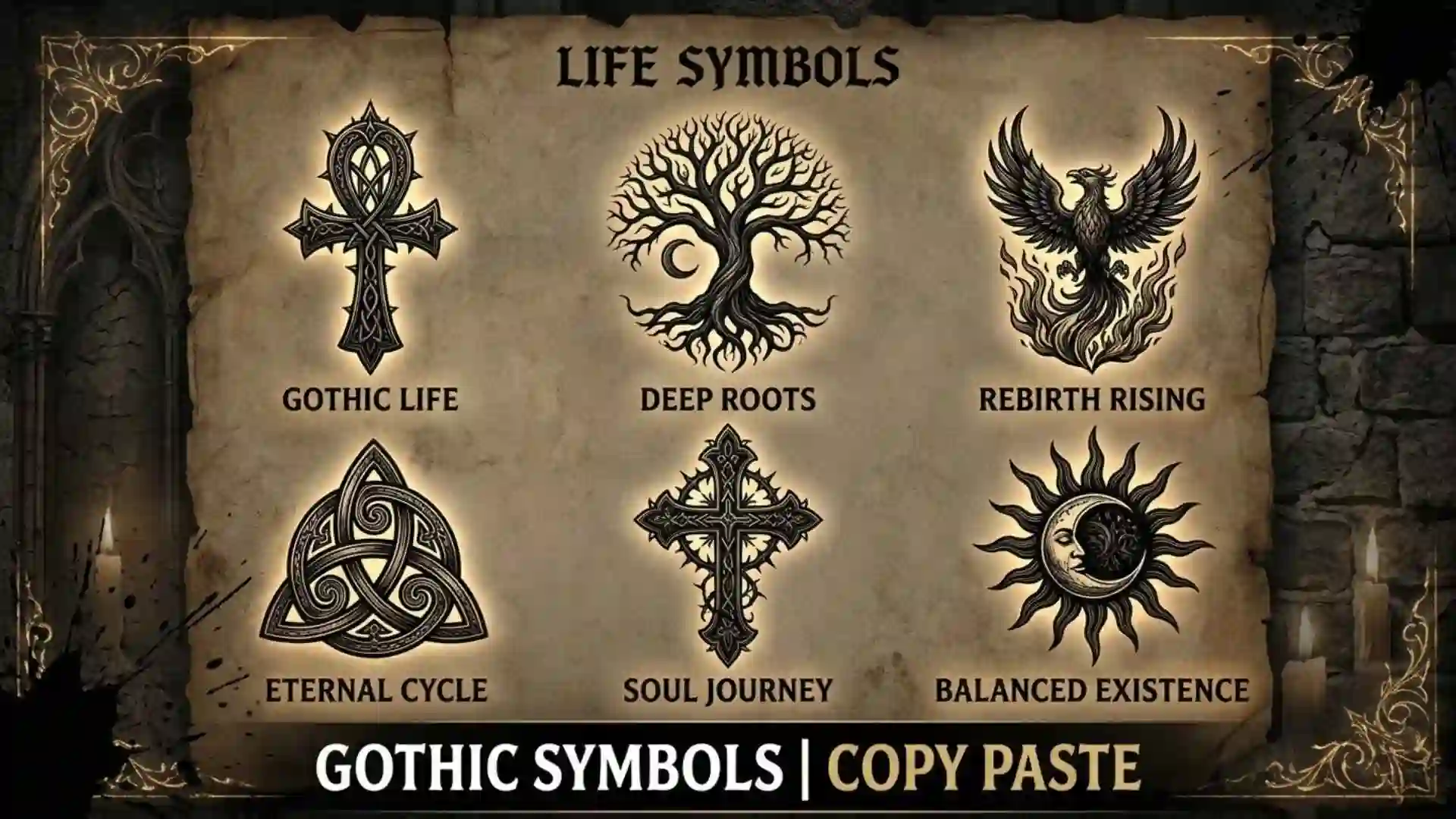
Gothic symbols combine dark beauty, medieval imagery, spiritual themes, and dramatic visual style. Today, people use gothic symbols copy paste collections to decorate usernames, social media bios, captions, gaming profiles, messages, artwork, and digital designs.
These characters may include crosses, moons, stars, daggers, skull-like marks, alchemical signs, blackletter text, and decorative Unicode symbols. Some have documented religious or historical meanings, while others create a Gothic appearance mainly through their shape. Understanding that difference helps you use each symbol accurately and respectfully.
Quick Meaning
Gothic symbols are visual characters associated with medieval architecture, blackletter writing, religion, mortality, mystery, darkness, and modern Gothic subculture. Copy-and-paste Gothic symbols are usually Unicode characters rather than special images, allowing users to place them in usernames, bios, captions, messages, games, and decorative text.
Gothic Symbols Overview Table
| Field | Details |
| Symbol Group | Gothic symbols and decorative characters |
| Primary Meaning | Mystery, mortality, spirituality, darkness, beauty, rebellion, or medieval style |
| Category | Religious, astronomical, occult, literary, architectural, and decorative |
| Historical Influences | Medieval Europe, Christianity, alchemy, astronomy, heraldry, and Romantic literature |
| Modern Culture | Gothic fashion, music, visual art, gaming, social media, and alternative subcultures |
| Common Usage | Usernames, bios, captions, tattoos, jewelry, logos, artwork, and digital decoration |
| Digital Format | Mostly Unicode characters, text symbols, and stylized letters |
| Common Motifs | Crosses, moons, stars, daggers, roses, coffins, skulls, ravens, and blackletter forms |
| Modern Meaning | Individuality, dark elegance, emotional depth, mystery, or alternative identity |
| Related Styles | Victorian Gothic, medieval Gothic, romantic Goth, occult, punk, and dark academia |
Gothic Symbols Copy Paste Collection
The following symbols can be copied and pasted into most websites, apps, messages, documents, and profile fields. Their appearance may vary slightly depending on the device, font, operating system, or platform.
Popular Gothic Symbols
† ‡ ☩ ☨ ☦ ✞ ✟ ✠ ♱ ♰
☾ ☽ ☪︎ ● ◉ ◌ ◍ ◐ ◑
★ ☆ ✦ ✧ ✩ ✪ ✫ ✬ ✭ ✮
⚰ ⚱ ☠︎ ⚔︎ 🗡 🕯 🦇 🕸 🕷
𓆩♡𓆪 𓆩†𓆪 𓆩☾𓆪 𓆩𖤐𓆪
༒ ༺ ༻ ꧁ ꧂ 𖤐 𖤓 𖦹 𖥔
Gothic Cross Symbols
† ‡ ✝ ✞ ✟ ✠
☦ ☩ ☨ ♱ ♰
𓆩†𓆪 ༒†༒ ꧁†꧂
Cross symbols may represent Christianity, sacrifice, faith, death, remembrance, or medieval religious art. Their meanings depend on the specific design and the context in which they appear.
Gothic Moon and Night Symbols
☾ ☽ ☪︎ ◐ ◑
● ◉ ◌ ◍
🌙 🌑 🌒 🌓 🌘
☾⋆。𖦹 °✩
☽༓・*˚⁺‧͙
The moon commonly represents night, cycles, intuition, secrecy, dreams, change, and emotional depth. Crescent moons are especially popular in romantic Gothic and celestial designs.
Gothic Star Symbols
★ ☆ ✦ ✧ ✩
✪ ✫ ✬ ✭ ✮
✯ ✰ ⭑ ⭒ ⋆
𖤐 𖤓 𖦹 𖥔
Stars may symbolize guidance, fate, hope, the night sky, magic, or the unknown. A star’s meaning can change according to its number of points, orientation, historical setting, and surrounding imagery.
Gothic Dagger and Weapon Symbols
† ‡ ⚔︎ 🗡
➶ ➷ ➸ ➹
𓆩🗡𓆪 ꧁⚔꧂
Daggers and swords may represent danger, courage, justice, sacrifice, conflict, protection, or emotional pain. In decorative Gothic writing, a dagger-shaped mark may also function as an ornamental separator.
Gothic Death and Memorial Symbols
⚰ ⚱ ☠︎ 🪦
† ‡ 🕯 🥀
𓆩☠︎𓆪 ༒
Death-related symbols can express mortality, mourning, remembrance, grief, transformation, or fascination with the temporary nature of life. They do not always communicate violence or harmful intent.
Gothic Love Symbols
♡ ♥︎ ❥ ღ
🥀 🖤 ❤️🩹
𓆩♡𓆪 𓆩♥𓆪
†♡† ☾♡☽
༺♡༻ ꧁♥꧂
Gothic love symbols often combine affection with sadness, longing, devotion, heartbreak, or eternal attachment. Black hearts and wilted roses are popular, but their meanings remain personal rather than universal.
Gothic Nature Symbols
🥀 ⚘ ❦ ❧
☘︎ ♧ ☙
🦇 🕷 🕸 🐦⬛
𓆩🥀𓆪 ☾❦☽
Dark nature imagery connects Gothic style with decay, seasonal change, wilderness, night animals, and natural beauty. Ravens, bats, spiders, thorns, and wilted flowers appear frequently in Gothic artwork.
Gothic Decorative Borders
༺────────༻
† ────── †
☾⋆⁺₊⋆ ☀︎ ⋆⁺₊⋆☽
𓆩────────𓆪
꧁༒────────༒꧂
╔══ஓ๑♡๑ஓ══╗
╚══ஓ๑♡๑ஓ══╝
These borders work well for profile headings, captions, short quotations, gaming clan names, and section dividers.
What Do Gothic Symbols Mean?
Gothic symbols generally express themes connected with mystery, mortality, spirituality, medieval history, emotional intensity, and unconventional beauty. However, there is no single meaning shared by every Gothic symbol.
The term “Gothic” can refer to several different subjects. It may describe medieval architecture, Gothic literature, blackletter typography, a modern music-based subculture, or a dark visual style. As a result, symbols described as Gothic may come from very different historical traditions.
A cathedral cross, for example, may have a direct Christian meaning. A crescent moon may represent the night or natural cycles. A black rose may communicate grief or tragic love. A decorative Unicode star may simply make a username look mysterious.
The most accurate interpretation considers three elements:
- The symbol’s documented historical meaning
- The context in which it appears
- The intention of the person using it
Modern users frequently combine symbols for aesthetic reasons. Therefore, a Gothic-looking character should not automatically be treated as a religious, occult, or political statement.
History and Origin of Gothic Symbols

Gothic symbols do not come from one civilization or historical moment. The modern category developed from several overlapping traditions.
Medieval Gothic Influence
The word “Gothic” became strongly associated with a European architectural style that developed during the Middle Ages. Gothic churches and cathedrals often featured pointed arches, ribbed vaults, tall towers, stained glass, carved creatures, crosses, saints, flowers, and biblical imagery.
These buildings were designed to create height, light, drama, and spiritual wonder. Modern Gothic visual culture often borrows their pointed forms, elaborate decoration, religious motifs, and atmosphere of mystery.
Gargoyles and grotesques are especially recognizable. Some served practical architectural purposes by directing rainwater away from walls. Others were decorative carvings representing animals, monsters, human faces, or imaginative creatures.
Blackletter and Medieval Writing
Blackletter is a family of densely formed scripts that became prominent in medieval European manuscripts and later printing. Its angular strokes, heavy vertical lines, and elaborate capitals are now widely called “Gothic lettering.”
Letters such as 𝔄, 𝔊, 𝔐, and 𝔛 can make ordinary words appear medieval or dramatic. These mathematical Fraktur characters are available through Unicode, although they were encoded primarily for specialized mathematical notation rather than for creating an entire decorative alphabet.
Religious Art and Symbols
Many visual elements now labeled Gothic came from Christian art. Crosses, halos, angels, sacred hearts, candles, church windows, and memorial imagery appeared in churches, manuscripts, cemeteries, jewelry, and devotional objects.
These symbols should not be separated from their religious history simply because modern users place them in dark-themed designs. A cross may look Gothic, but it can still carry a serious expression of Christian faith.
Gothic Literature and Romanticism
Gothic literature added another layer of meaning during the eighteenth and nineteenth centuries. Stories featuring castles, ruins, supernatural events, family secrets, isolation, danger, and psychological fear shaped the modern Gothic imagination.
Writers and artists used darkness not merely to frighten audiences but also to explore guilt, desire, mortality, identity, social restrictions, and the unknown. Ravens, storms, moonlight, abandoned buildings, locked rooms, and dying flowers became powerful literary motifs.
Modern Gothic Subculture
The modern Goth subculture developed from the post-punk music scene in the late 1970s and early 1980s. Music, fashion, visual art, makeup, club culture, and personal expression all contributed to its identity.
Modern Gothic symbolism may incorporate religious art, Victorian mourning fashion, punk elements, horror imagery, romantic poetry, medieval designs, and personal symbolism. Not every Goth uses the same imagery or holds the same beliefs.
Symbolism and Interpretation
Gothic imagery is powerful because it often joins ideas that appear opposite: beauty and decay, faith and doubt, love and grief, fear and fascination, life and death.
Traditional Meanings
Traditional Gothic-associated symbols often retain meanings from religion, folklore, heraldry, astronomy, or memorial art.
A candle may represent prayer, hope, remembrance, or the human soul. A cross may express faith and sacrifice. A raven may suggest intelligence, prophecy, death, or mystery depending on the cultural source. A rose may represent love, beauty, secrecy, suffering, or the passing of time.
Modern Meanings
Modern users often employ Gothic symbols to communicate:
- Individuality
- Emotional depth
- Dark elegance
- Interest in history or literature
- Rejection of conventional beauty standards
- Appreciation for mystery and melancholy
- Connection with alternative music or fashion
These meanings are flexible. Two people may use the same black heart for completely different reasons.
Positive Gothic Symbolism
Gothic symbols can carry highly positive meanings. Darkness may represent comfort, privacy, rest, creativity, self-knowledge, or freedom from social expectations.
A skull can remind someone to value life. A ruined building can symbolize endurance. A wilted rose may express love that remains meaningful after loss. A moon can represent renewal because it repeatedly changes and returns.
Negative Gothic Symbolism
Some symbols can also suggest fear, grief, danger, destruction, hopelessness, or death. Context matters greatly.
A dagger beside a romantic quotation may represent heartbreak. The same dagger in a threatening message could communicate danger. Visual appearance alone does not determine intent.
Psychological Interpretation
From a psychological perspective, Gothic imagery can help people explore difficult emotions in a controlled and creative form. Art involving shadows, ruins, graveyards, or supernatural themes may provide language for grief, anxiety, isolation, or uncertainty.
This interpretation should not become a diagnosis. Enjoying Gothic art does not prove that a person is depressed, dangerous, antisocial, or involved in occult practices.
Cultural Significance of Gothic Symbols
Gothic symbols have different meanings across regions, communities, and historical periods. A character that looks mysterious in one setting may have a sacred or ordinary meaning in another.
European Context
In Europe, Gothic imagery is closely connected with medieval cathedrals, manuscript traditions, religious art, cemeteries, castles, folklore, and later Gothic literature.
Historic Gothic architecture was not created as a “dark” subculture style. Its religious buildings often aimed to communicate divine glory, sacred order, and spiritual light.
Christian Context
Crosses, angels, candles, sacred hearts, and church imagery remain active religious symbols for many Christians. Using them as decoration without understanding their significance may cause misunderstanding, especially when they appear beside unrelated occult or mocking imagery.
Literary and Artistic Context
In literature and visual art, Gothic symbols often represent hidden truths, forbidden knowledge, psychological conflict, decaying social systems, supernatural uncertainty, and the return of a suppressed past.
A haunted house may represent more than a frightening location. It can symbolize a family secret, traumatic memory, social oppression, or an unstable mind.
Contemporary Alternative Culture
Within contemporary Gothic communities, symbols frequently express music preferences, fashion identity, creativity, romanticism, and personal independence. Some people prefer religious Gothic imagery, while others focus on nature, Victorian mourning, vampires, fantasy, or minimalist black designs.
There is no single symbol that represents every person within Goth culture.
Religious and Spiritual Meaning
Religious and spiritual interpretations are relevant to many Gothic-looking symbols, but they should be identified carefully.
Crosses
The cross is fundamentally connected with Christianity and the crucifixion of Jesus Christ. Different cross forms may be associated with particular Christian traditions, churches, saints, regions, or historical periods.
Decorative cross symbols include:
- † Latin cross or dagger-shaped character
- ☦ Orthodox cross
- ☩ Cross of Jerusalem-style form
- ☨ Cross of Lorraine-style form
- ✠ Maltese-style cross
Their digital names, visual resemblance, and religious usage are not always identical. Users should research a specific form before assigning it a precise historical meaning.
Candles
Candles may symbolize prayer, divine presence, remembrance, spiritual guidance, mourning, or hope. In memorial settings, a candle often honors someone who has died.
Skulls and Mortality
In religious art, skulls have sometimes functioned as reminders of mortality rather than celebrations of death. The concept commonly called memento mori encourages reflection on life’s temporary nature and the importance of living meaningfully.
Stars and Celestial Symbols
Stars can represent divine guidance, destiny, heaven, wisdom, or spiritual illumination. However, the meaning of a star depends on its design. Different star forms belong to different religious, cultural, mathematical, or decorative systems.
Digital and Technical Meaning
Most copy-and-paste Gothic symbols are text characters encoded in Unicode. Unicode gives characters standardized code points so computers and digital platforms can represent text consistently.
However, Unicode does not guarantee that every symbol will look identical everywhere. The appearance depends on the font and rendering system used by the device or application.
Some Gothic-style collections also contain emoji. Emoji are usually rendered as small colored images, while traditional Unicode symbols may appear as monochrome text.
Decorative Gothic text generators often replace standard letters with characters that resemble special fonts. These characters are not always ordinary alphabetic styling. They may come from mathematical alphabets, symbols, or letters used in other writing systems.
This can cause several practical problems:
- Screen readers may pronounce the text incorrectly.
- Search engines may not treat it as the intended word.
- Some games and websites may reject the characters.
- Symbols may appear as empty boxes on unsupported devices.
- Usernames can become difficult to type or search.
For accessibility and readability, decorative text works best in short names or headings rather than important instructions or long paragraphs.
Where Gothic Symbols Are Used
Gothic symbols appear in both historical objects and modern digital spaces.
Social Media Bios
Users place moons, crosses, stars, black hearts, and ornamental borders around names, quotations, dates, or short descriptions.
Example:
☾ 𝔑𝔦𝔤𝔥𝔱 𝔖𝔬𝔲𝔩 ☽
Gaming Usernames
Gothic symbols can make usernames look dramatic or help create a fantasy, horror, vampire, or medieval identity.
Example:
†ShadowKnight†
Some games restrict unsupported characters, so users may need simpler alternatives.
Tattoos
Popular Gothic tattoo motifs include crosses, cathedral windows, ravens, bats, roses, skulls, swords, moons, thorns, and literary quotations.
Tattoo meanings should be discussed with the wearer rather than assumed from the image alone.
Jewelry and Fashion
Cross necklaces, coffin-shaped pendants, black roses, bats, chains, lockets, and pointed architectural designs appear in Gothic fashion. Materials often include silver-colored metal, black fabric, lace, leather, and dark gemstones.
Architecture
Historic Gothic architecture uses pointed arches, tracery, stained glass, sculptural figures, towers, and highly detailed stonework. These are architectural elements rather than simple digital symbols, but they strongly influence modern Gothic design.
Books and Literature
Ravens, candles, storms, castles, mirrors, portraits, locked doors, and graveyards function as recurring symbols in Gothic fiction. They often reveal a character’s fear, guilt, secret, or emotional condition.
Logos and Album Artwork
Musicians, fashion labels, games, and entertainment brands use blackletter, cathedral-like shapes, thorns, crosses, moons, and symmetrical ornament to create a dramatic identity.
Common Gothic Symbol Variations
Gothic symbols vary according to historical influence, artistic style, and modern subculture.
Medieval Gothic
This style uses cathedral windows, heraldic shields, swords, crosses, manuscript lettering, and architectural ornament.
Victorian Gothic
Victorian-inspired designs feature mourning jewelry, lockets, lace, silhouettes, black roses, cameos, ravens, and elaborate frames.
Romantic Gothic
Romantic Gothic imagery combines moons, roses, hearts, poetry, candles, ruins, and themes of longing or tragic love.
Occult-Inspired Gothic
This style may use alchemical, astrological, magical, or esoteric symbols. Such symbols should not be grouped carelessly because each may come from a separate historical or religious system.
Cyber and Modern Goth
Modern digital styles combine Gothic imagery with futuristic lettering, glitch effects, chains, metallic forms, neon imagery, and gaming culture.
Minimalist Gothic
Minimalist designs use one or two simple characters, such as a small cross, crescent moon, black heart, or star.
Examples:
†
☾
𖤐
🖤
🥀
Common Misconceptions About Gothic Symbols
Every Gothic Symbol Is Occult
This is incorrect. Many Gothic-looking symbols come from Christianity, medieval architecture, astronomy, literature, nature, memorial customs, or modern decoration.
Gothic Culture Promotes Violence
Gothic fashion or symbolism does not automatically express violent beliefs. Daggers, skulls, and graveyards often function as artistic reflections on mortality, emotion, history, or fantasy.
All Crosses Have the Same Meaning
Cross designs differ significantly. Some represent particular Christian traditions, while others function as heraldic, memorial, typographic, or decorative marks.
Black Always Represents Evil
Black may symbolize grief, authority, elegance, privacy, mystery, seriousness, protection, or simplicity. Its interpretation depends on culture and context.
A Symbol Has One Permanent Meaning
Symbols develop multiple meanings as they move between religions, cultures, artistic movements, and digital communities. Historical meaning remains important, but modern interpretation also depends on use.
Decorative Text Is a Special Font
Many copy-and-paste “fonts” are actually collections of separate Unicode characters. That is why the text remains styled when pasted into another application.
Goth and Gothic Mean Exactly the Same Thing
“Gothic” can describe architecture, literature, typography, or visual style. “Goth” often refers more specifically to the modern subculture associated with music, fashion, and community.
Interesting Facts About Gothic Symbols
- The word Gothic has several meanings. It can refer to medieval architecture, a literary genre, blackletter writing, or a modern subculture, so context is essential.
- Historic Gothic churches were designed around light. Although modern audiences may see them as dark or frightening, stained glass and tall windows helped create luminous sacred interiors.
- Not every stone monster is a gargoyle. Strictly speaking, a gargoyle usually functions as a waterspout. A similar decorative carving without that purpose is often called a grotesque.
- The dagger symbol is also a punctuation mark. The character † may indicate a footnote, a deceased person, or editorial information in certain contexts.
- Blackletter is not one single alphabet. It includes several script and type traditions with different regional and historical forms.
- Skulls can symbolize life awareness. In memorial and religious art, a skull may remind viewers to use their limited time wisely.
- Ravens do not have one universal meaning. Different traditions connect them with intelligence, prophecy, warfare, death, memory, creation, or transformation.
- Unicode symbols can change appearance between devices. A decorative star or cross may look heavy, thin, rounded, or angular depending on the font.
- Some Gothic text is difficult for assistive technology. Screen readers may identify each stylized letter by its technical Unicode name instead of reading the intended word naturally.
- Modern Gothic imagery is highly diverse. It can be religious, romantic, futuristic, historical, minimalist, nature-based, or influenced by horror and fantasy.
Related Symbols and Their Meanings
Black Heart
🖤
A black heart may express Gothic style, deep affection, grief, dark humor, emotional pain, or love for the color black. It does not have one fixed emotional meaning.
Wilted Rose
🥀
A wilted rose often represents lost love, fading beauty, grief, memory, disappointment, or the temporary nature of life.
Raven
🐦⬛
The raven may symbolize intelligence, mystery, death, prophecy, memory, or transformation. Its interpretation varies widely across mythology and literature.
Bat
🦇
Bats are associated with night, caves, transformation, secrecy, Halloween, vampire fiction, and the ability to navigate darkness.
Spiderweb
🕸
A spiderweb can represent patience, creativity, entrapment, age, abandonment, complexity, or the passing of time.
Coffin
⚰
A coffin represents death, burial, mourning, mortality, or horror imagery. In some designs, it can also symbolize ending an old identity and beginning a new one.
Candle
🕯
A candle may represent hope, remembrance, prayer, life, spiritual presence, guidance, or light within darkness.
Crescent Moon
☾
The crescent moon commonly symbolizes night, cycles, change, dreams, intuition, femininity, secrecy, or celestial beauty.
Sword
⚔
A sword can represent courage, justice, conflict, authority, protection, sacrifice, or moral struggle.
Thorn
A thorn commonly represents pain, difficulty, defense, sacrifice, or beauty protected by danger. It often appears beside roses in Gothic artwork.
Frequently Asked Questions
What are the best Gothic symbols to copy and paste?
Popular choices include †, ☾, 𖤐, 🖤, 🥀, ⚰, 🦇, ☠︎, ✞, and decorative frames such as ༺༻ or ꧁꧂. The best symbol depends on the intended mood. Moons and stars feel mysterious, while crosses, coffins, and skulls create a stronger medieval or mortality-related style.
How do I copy and paste Gothic symbols?
Highlight the desired symbol, copy it, and paste it into a supported text field. On a computer, use the standard copy and paste commands. On a phone, press and hold the symbol, select “Copy,” and then paste it into a bio, caption, message, username, or document.
Can I use Gothic symbols in my username?
Many platforms allow Unicode symbols in usernames or display names, but rules vary. Some services block decorative characters, limit name length, or require ordinary letters. Even when allowed, excessive symbols may make a username difficult to search, remember, pronounce, or share with other people.
Why do some Gothic symbols appear as boxes?
A box, blank space, or question mark usually means the device, application, or font does not support that character. Try using a more common symbol such as †, ★, ☾, ♥, or ✦. Updating the operating system or switching fonts may also improve compatibility.
Are Gothic symbols religious?
Some are religious, but many are not. Crosses, sacred hearts, angels, and candles may carry Christian meaning. Moons, stars, roses, ravens, swords, and decorative borders can be cultural, literary, natural, or purely aesthetic. Always examine the specific symbol rather than labeling the entire style religious.
Are Gothic symbols satanic?
Gothic symbols are not automatically satanic. Many originate in Christianity, medieval art, literature, astronomy, memorial customs, or modern fashion. Certain symbols may belong to occult or anti-religious systems, but their identity should be verified individually instead of assumed from a dark or unfamiliar appearance.
What Gothic symbol represents love?
The black heart 🖤, wilted rose 🥀, heart-and-dagger combination, and paired moon symbols often represent Gothic love. Depending on context, they may communicate devotion, longing, heartbreak, forbidden love, grief, or an emotional bond that survives loss and change.
What Gothic symbol represents death?
Common death-related symbols include the skull, coffin, grave marker, extinguished candle, hourglass, scythe, and wilted flower. These symbols may represent literal death, mourning, mortality, remembrance, transformation, or the end of a life stage rather than a desire for harm.
What Gothic symbol represents protection?
Swords, shields, certain crosses, protective eyes, thorns, and guardian creatures may represent protection. However, their exact meanings depend on their culture and tradition. A sword can symbolize defense and courage, while thorns may suggest boundaries or protection through deterrence.
Are Gothic copy-and-paste fonts safe to use?
They are generally safe as text, but they may create accessibility and compatibility problems. Screen readers can struggle with stylized letters, and some websites may reject them. Avoid using decorative characters for passwords, legal names, emergency information, instructions, or text that must be easily searchable.
Key Takeaways
- Gothic symbols draw from medieval architecture, religion, literature, nature, memorial art, and modern subcultures.
- There is no single universal meaning shared by every Gothic symbol.
- Popular copy-and-paste symbols include crosses, moons, stars, roses, skulls, coffins, swords, and ornamental borders.
- Many Gothic characters are Unicode text that can be pasted into profiles, captions, messages, and usernames.
- A symbol’s meaning depends on its historical origin, cultural setting, design, and user intention.
- Gothic imagery is not automatically satanic, violent, or harmful.
- Religious symbols should be used with awareness of their sacred meaning.
- Decorative Unicode letters may reduce readability, accessibility, and platform compatibility.
- Dark imagery can communicate beauty, grief, individuality, spirituality, transformation, or reflection on mortality.
- Research unfamiliar symbols before using them in permanent designs such as tattoos or logos.
Conclusion
Gothic imagery is more complex than a collection of dark-looking characters. It connects medieval churches, blackletter manuscripts, religious art, Gothic fiction, memorial traditions, alternative music, digital culture, and personal expression.
A moon may suggest mystery, a candle may preserve remembrance, and a skull may encourage reflection on life’s limits. At the same time, some characters are used simply because they make a name or caption look dramatic.
This gothic symbols copy paste collection gives you practical symbols while explaining the history, meanings, and cultural differences behind them. By considering origin and context, you can create a Gothic style that looks distinctive without assigning inaccurate meanings to sacred, historical, or culturally significant signs.

I am Ethan Mitchell, an English writer and lifelong learner who is fascinated by words and the way language changes over time. At LearnNestly, I share practical explanations designed for readers who want to improve their understanding of English without complicated terminology. I enjoy researching meanings, usage, grammar, and common language mistakes, then presenting the information in a simple and useful format. My purpose is to make every article a small learning experience that readers can actually apply.
Books:
- The Smart Learner’s English Guide
- English in Real Life
 Daniel Brooks
 Amelia Carter