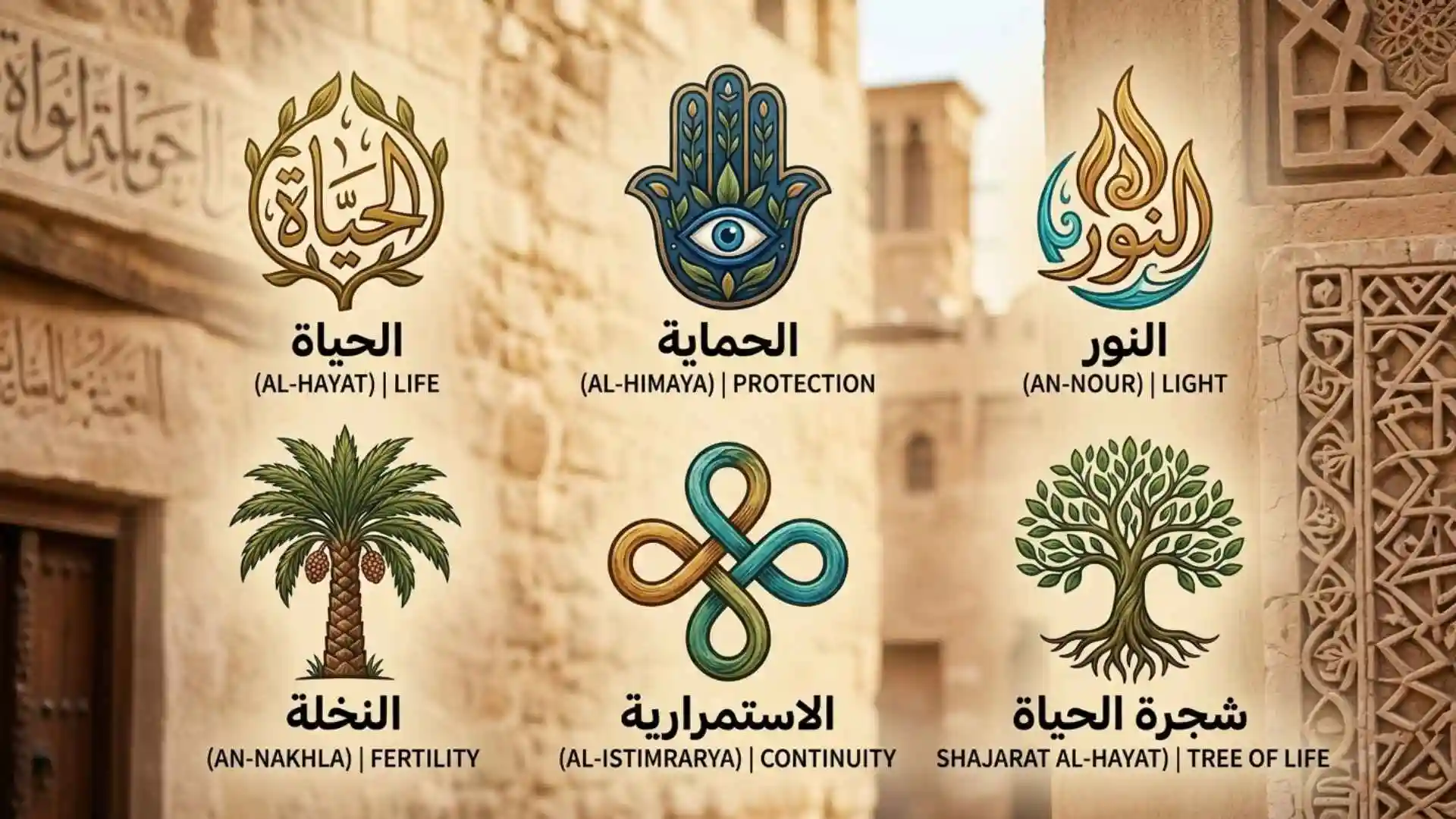
Arab symbols are visual signs, patterns, objects, animals, colors, and forms of writing associated with the peoples and cultures of the Arab world. They include Arabic calligraphy, the crescent and star, geometric patterns, the palm tree, falcons, eagles, swords, coffee pots, and protective hand motifs.
These symbols appear on flags, government emblems, mosques, homes, jewelry, clothing, currency, artwork, architecture, tattoos, and commercial logos. However, no single image represents every Arab person or country. Arab culture stretches across North Africa and Western Asia, so meanings often change according to region, religion, history, and context.
Understanding Arab symbols requires an important distinction: Arab identity is primarily linguistic and cultural, while Islam is a global religion followed by Arab and non-Arab communities. Some symbols belong mainly to Arab heritage, some are Islamic, and others developed through centuries of cultural exchange.
Quick Meaning of Arab Symbols
Arab symbols represent ideas such as identity, faith, hospitality, courage, unity, protection, beauty, ancestry, and connection to the land. Their meanings vary across the Arab world. Arabic calligraphy may express language or sacred text, while falcons suggest honor, palm trees represent life, and coffee pots symbolize generosity.
Arab Symbols Overview Table
| Symbol | Primary Meaning | Cultural Origin or Association | Common Modern Use |
| Arabic calligraphy | Knowledge, beauty, language, faith | Arab and Islamic artistic traditions | Mosques, books, logos, jewelry, art |
| Crescent and star | Faith, guidance, political identity | Older Near Eastern imagery; later Islamic states | Flags, mosques, organizations |
| Palm tree | Life, fertility, endurance, prosperity | Arabian Peninsula and North Africa | National emblems, currency, branding |
| Falcon | Courage, dignity, leadership, freedom | Bedouin and Gulf Arab heritage | Coats of arms, sports, logos |
| Eagle | Power, sovereignty, national strength | Ancient and modern Middle Eastern symbolism | Flags and state emblems |
| Arabian coffee pot | Hospitality, respect, generosity | Arabian social customs | Cultural festivals, logos, decoration |
| Khamsa hand | Protection and good fortune | North African and Middle Eastern traditions | Jewelry, wall art, amulets |
| Geometric patterns | Order, balance, continuity | Islamic art across Arab regions | Architecture, textiles, tiles |
| Arabesque | Growth, rhythm, interconnected life | Islamic and Mediterranean decorative art | Mosques, manuscripts, furniture |
| Crossed swords | Strength, defense, justice | Arabian tribal and state traditions | National emblems and insignia |
| Eight-pointed star | Balance, harmony, renewal | Ancient Near Eastern and Islamic design | Tiles, architecture, decorative art |
| Pan-Arab colors | Unity, history, independence | Modern Arab nationalism | National flags and political imagery |
What Do Arab Symbols Mean?
Arab symbols communicate shared values, historical memories, and regional identities. They can identify a family, tribe, nation, religious tradition, craft, political movement, or social custom.
Their meanings are rarely fixed. A palm tree may represent agriculture in Iraq, desert survival in Arabia, paradise in religious art, or national prosperity on a modern emblem. A falcon may symbolize traditional hunting, aristocratic status, freedom, or governmental authority.
Arab symbols generally fall into several overlapping categories:
Linguistic Symbols
Arabic letters and words are powerful markers of identity because Arabic is one of the strongest cultural connections among Arab societies. A written word may function as ordinary language, visual art, poetry, religious expression, or political communication.
Religious Symbols
Quranic calligraphy, mosque domes, prayer beads, and certain geometric designs may carry Islamic meaning. These should not automatically be described as exclusively Arab because most Muslims worldwide are not Arab.
National Symbols
Modern Arab states use birds, plants, weapons, stars, colors, and architectural forms to express sovereignty. Eagles appear in several republican emblems, while falcons are especially prominent in some Gulf states.
Folk and Protective Symbols
The khamsa, eye motifs, embroidered patterns, and traditional jewelry may express protection, luck, fertility, belonging, or family heritage. Their interpretations often vary between Muslims, Christians, Jews, and local communities.
Environmental Symbols
Desert landscapes, horses, camels, palm trees, and water represent the environments that shaped many Arab societies. They can communicate patience, mobility, endurance, wealth, and survival.
History and Origin of Arab Symbols
Arab symbols developed over thousands of years rather than emerging from one civilization. The modern Arab world includes territories once influenced by ancient Egyptian, Mesopotamian, Nabataean, Phoenician, Roman, Byzantine, Persian, African, and Islamic civilizations.
Pre-Islamic Arabian Heritage
Before Islam arose in the seventh century, Arabian communities used tribal marks, inscriptions, animal imagery, celestial signs, and religious objects. Ancient North Arabian and South Arabian scripts were normally written from right to left, reflecting a wider family of Middle Eastern writing traditions.
Camels and horses represented mobility and wealth, while tribal markings identified ownership or community affiliation. Stars, the moon, and the sun also appeared in regional religious and artistic traditions.
The Development of Arabic Script
Arabic writing evolved from earlier Semitic scripts, particularly forms connected with Nabataean Aramaic. As Arabic became the language of administration, scholarship, literature, and religion across a large territory, its script gained enormous cultural importance.
Arabic is written from right to left. Most letters connect to neighboring letters, changing shape according to their position in a word. The traditional Arabic alphabet contains 28 basic letters.
The script spread far beyond Arab communities. Adapted forms have been used to write Persian, Urdu, Kurdish, Pashto, Malay, and other languages. Therefore, Arabic script is associated with Arab culture but is not limited to the Arabic language.
The Rise of Islamic Art
After the seventh century, Arabic calligraphy became central to Islamic architecture and manuscript production. This importance partly reflected the role of Arabic as the language of the Quran.
Artists also developed complex geometric and vegetal ornament. The three major nonfigural decorative forms in Islamic art are commonly identified as calligraphy, geometric patterns, and vegetal designs. Figural imagery also existed, especially in secular manuscripts, ceramics, palaces, and textiles.
Modern National and Political Symbols
During the nineteenth and twentieth centuries, independence movements and modern states adopted flags, coats of arms, military insignia, and national emblems. Many combined older imagery with contemporary political ideas.
The colors red, white, black, and green became especially important in Pan-Arab symbolism. Their exact historical explanations vary, but they are often linked with Arab dynasties, resistance, independence, and unity.
Symbolism and Interpretation
Arabic Calligraphy
Arabic calligraphy symbolizes language, knowledge, beauty, memory, and cultural continuity. In religious settings, it can communicate reverence because Quranic verses and the names of God may be rendered in artistic script.
Major styles include Kufic, Naskh, Thuluth, Diwani, Ruqʿah, and Maghrebi. Each has its own proportions, visual rhythm, and historical use.
Kufic is angular and strongly associated with early manuscripts and architectural inscriptions. Naskh became widely used for books because of its clarity. Thuluth features large, sweeping forms and often appears in monumental decoration.
UNESCO describes Arabic calligraphy as the artistic practice of handwriting Arabic script fluidly to communicate harmony, grace, and beauty. It was added to the Representative List of the Intangible Cultural Heritage of Humanity in 2021 through a multinational nomination by Arab countries.
The Crescent and Star
The crescent and star are often treated as universal Islamic symbols, but their history is more complicated. Crescent imagery existed in ancient civilizations long before Islam.
The design became closely connected with Islam largely through its use by Muslim-ruled states, especially the Ottoman Empire. It later appeared on the flags of several Muslim-majority countries.
Not every Arab country uses the crescent, and many countries using it are not Arab. The symbol may represent Islam, lunar timekeeping, guidance, state identity, or historical continuity depending on the setting.
Palm Tree
The palm tree represents life, resilience, nourishment, fertility, and prosperity. Date palms have supported communities in the Arabian Peninsula, Iraq, North Africa, and other dry regions for centuries.
Because palms survive in difficult environments and provide food, shade, building material, and trade goods, they became natural signs of endurance. In religious imagery, the palm may also suggest blessing, abundance, or paradise.
Today, palm trees appear on national emblems, coins, municipal logos, tourism campaigns, and commercial brands.
Falcon
The falcon represents bravery, alertness, freedom, nobility, and leadership. Falconry has deep roots in Arabian life, where trained birds helped people hunt in demanding desert environments.
Over time, falconry became associated with patience, discipline, status, and the relationship between people and nature. UNESCO recognizes falconry as a living human heritage practiced by communities across several countries, including Arab states.
Falcons now appear on government seals, airline logos, military insignia, banknotes, sports emblems, and luxury branding.
Eagle
The eagle symbolizes sovereignty, military power, courage, and national authority. One influential modern form is the Eagle of Saladin, named after the medieval ruler Salah al-Din.
Versions of the eagle have appeared in the emblems of Egypt, Iraq, Palestine, Yemen, and other political entities. Its exact design and political meaning have changed over time.
The eagle should not be confused with the Falcon of Quraysh, another heraldic bird used by several Arab states and organizations.
Khamsa Hand
The khamsa is an open hand with five fingers. Its name comes from the Arabic word khamsa, meaning “five.”
People often wear or display it as a sign of protection, blessing, luck, or defense against the evil eye. It may contain an eye in the center, although the eye is not required.
The khamsa is not exclusive to one religion. Muslim communities may call it the Hand of Fatima, while Jewish communities may call it the Hand of Miriam. It also appears in broader North African and Middle Eastern folk culture.
Geometric Patterns
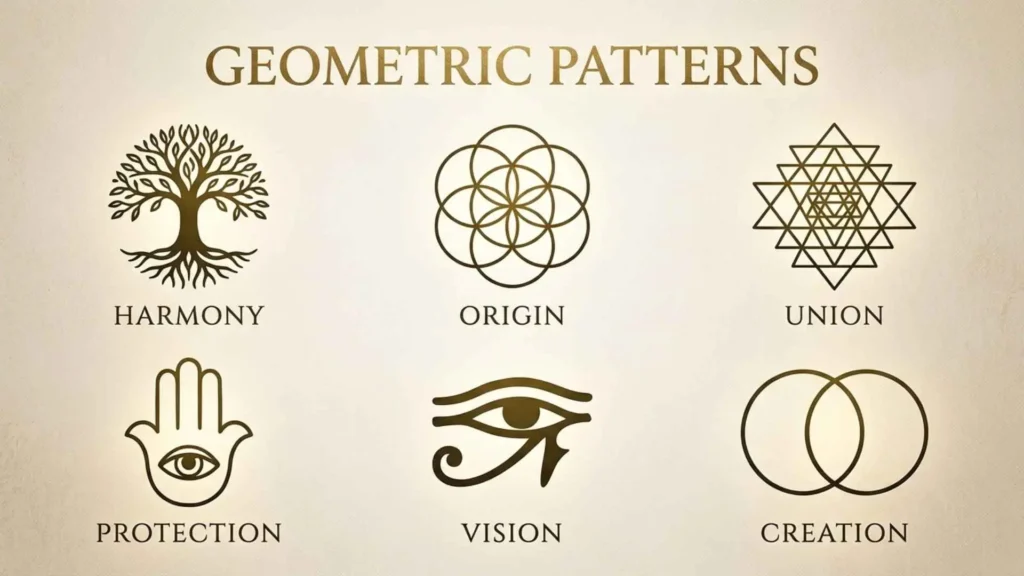
Geometric patterns represent order, balance, repetition, unity, and continuity. Artists create them by repeating circles, squares, stars, polygons, and interlaced lines.
Some viewers interpret repeating patterns as symbols of infinity or divine order. That interpretation can be meaningful, but it should not be treated as the only historical explanation. Geometric decoration also developed because of mathematical knowledge, artistic experimentation, architectural needs, and regional taste.
Such patterns appear in mosques, palaces, schools, fountains, manuscripts, woodwork, ceramics, carpets, and metal objects.
Arabesque and Vegetal Patterns
The arabesque uses curling stems, leaves, vines, flowers, and repeated plant forms. It can symbolize growth, rhythm, renewal, beauty, and the interconnectedness of life.
Arabesque designs are usually stylized rather than realistic. They may flow continuously across a wall, page, or object without a clear beginning or ending.
Although the English term “arabesque” suggests an Arab connection, vegetal ornament developed across many Islamic regions through exchanges involving Byzantine, Persian, Mediterranean, Central Asian, and local traditions.
Cultural Significance Across the Arab World
Arab culture is diverse, so symbols do not have identical meanings everywhere.
Arabian Peninsula
Falcons, camels, horses, palm trees, swords, incense burners, and coffee pots are especially visible in Gulf cultural imagery. They often represent desert heritage, hospitality, honor, leadership, and endurance.
The traditional coffee pot, or dallah, has become a recognizable symbol of welcome. Serving Arabic coffee follows customs involving respect, order, and generosity.
North Africa
In Morocco, Algeria, Tunisia, Libya, and Mauritania, geometric patterns, khamsa hands, eye motifs, Amazigh designs, and regional calligraphic styles frequently overlap.
Not all North African symbols should be labeled Arab. Amazigh communities have distinct languages, identities, and artistic traditions. A responsible interpretation recognizes cultural exchange without erasing those differences.
Egypt and the Nile Valley
Egyptian symbolism combines modern Arab identity with ancient Egyptian, Coptic Christian, Islamic, Mediterranean, and African heritage.
The eagle is prominent in modern state symbolism. The lotus, ankh, scarab, pyramids, and Eye of Horus belong primarily to ancient Egyptian symbolism rather than Arab culture, even though they are used within a modern Arab country.
The Levant
Levantine symbols include olive branches, cedar trees, embroidery patterns, keys, regional architecture, and calligraphy. The olive may represent peace, rootedness, agriculture, survival, and attachment to land.
Iraq and Mesopotamia
Modern Iraqi culture draws from Arab, Kurdish, Assyrian, Turkmen, Islamic, Christian, Yazidi, and ancient Mesopotamian traditions. Date palms, lions, winged figures, calligraphy, and ancient architectural imagery may appear side by side.
Historical Mesopotamian symbols should not automatically be called Arab, although they form part of the cultural heritage of present-day Arab societies.
Religious and Spiritual Meaning
Arab symbols and Islamic symbols overlap, but they are not interchangeable.
Arab Christians may use the cross, Arabic biblical calligraphy, church architecture, and regional devotional images. Arab Muslims may use Quranic inscriptions, prayer beads, mosque imagery, and the word Allah. Arab Jewish communities historically used Hebrew symbols alongside Arabic language and regional artistic forms.
Arabic calligraphy holds special religious importance because Arabic is the language of the Quran. In Islamic art, writing may transform sacred words into a visual experience while preserving their linguistic meaning. The Metropolitan Museum of Art describes calligraphy as one of the most fundamental and highly regarded elements of Islamic art.
The word Allah simply means “God” in Arabic. Arabic-speaking Christians also use it. It should not be treated as the name of a separate Arab deity or as a decorative symbol without considering religious sensitivity.
Scientific, Mathematical, and Digital Meaning
Arabic cultural influence extends into mathematics, writing technology, and digital communication.
Arabic-Indic Numerals
Two major numeral sets are associated with Arabic writing:
- Western Arabic numerals: 0, 1, 2, 3, 4, 5, 6, 7, 8, 9
- Eastern Arabic-Indic numerals: ٠, ١, ٢, ٣, ٤, ٥, ٦, ٧, ٨, ٩
Usage varies by country. Many North African countries commonly use Western numerals, while Eastern Arabic-Indic forms are more visible in parts of the Middle East. Related numeral forms are also used in Persian and Urdu contexts.
Arabic Letters in Mathematics
Arabic letters may appear in regional textbooks as variables, labels, and sequence markers. However, the specific letters and conventions differ according to country and educational system.
Unicode and Digital Text
Arabic letters, diacritics, punctuation, Quranic annotation marks, and extended characters are encoded in Unicode. Digital systems must handle right-to-left direction, joined letter forms, and mixed Arabic-Latin text correctly.
Arabic letters do not have one fixed visual shape in every position. Rendering software selects the appropriate connected form without changing the underlying character.
Where Arab Symbols Are Used
Arab symbols appear throughout daily, ceremonial, political, and artistic life.
Architecture
Mosques, palaces, homes, schools, and public buildings use calligraphy, arches, domes, mosaics, geometric patterns, and vegetal ornament.
Flags and Government Emblems
Stars, crescents, eagles, falcons, swords, palms, and Pan-Arab colors communicate sovereignty and historical identity.
Jewelry
Khamsa hands, eye motifs, Arabic names, Quranic phrases, map outlines, and calligraphic pendants are common.
Tattoos
Popular designs include Arabic words, names, poetry, falcons, geometric stars, and khamsa hands. Anyone choosing Arabic text should verify its spelling, grammar, direction, and cultural meaning with a fluent speaker.
Currency and Stamps
Banknotes and coins may feature rulers, national landmarks, animals, traditional crafts, plants, calligraphy, and historical figures.
Art and Literature
Artists use Arabic letters as readable text, abstract form, political commentary, or cultural memory. Poets and novelists also use symbolic objects such as coffee, deserts, keys, olive trees, and birds.
Logos and Branding
Airlines, banks, sports teams, government bodies, restaurants, and tourism agencies frequently use falcons, palms, calligraphy, and geometric patterns.
Common Variations and Similar Symbols
Eagle and Falcon
Both represent strength, but the eagle is commonly associated with state authority and military sovereignty. The falcon more often evokes hunting heritage, agility, nobility, and Gulf identity.
Crescent Alone and Crescent with Star
A crescent alone may represent the moon, time, or religious identity. Adding a star creates a distinct emblem with stronger historical links to particular states and flags.
Khamsa With and Without an Eye
A plain hand emphasizes the protective power of the five-finger form. An eye adds a more direct reference to protection from harmful attention or the evil eye.
Eight-Pointed Star and Rub el Hizb
An eight-pointed star can serve as a decorative geometric motif. The Rub el Hizb, written ۞, is a specific Quranic division marker formed from overlapping squares. Similar appearance does not always mean identical purpose.
Arabic Calligraphy and Pseudo-Arabic Decoration
Authentic calligraphy contains meaningful Arabic writing. Pseudo-Arabic imitates the appearance of Arabic script without necessarily forming readable words. It appeared in some European artworks because artists admired the script’s visual form.
Common Misconceptions About Arab Symbols
“Every Arab Symbol Is Islamic”
This is incorrect. Arab culture includes Muslim, Christian, Jewish, Druze, secular, and other communities. Some symbols are linguistic, national, tribal, artistic, or regional rather than religious.
“The Crescent and Star Represent All Muslims”
No official universal symbol represents every Muslim. The crescent and star became widely associated with Islam through historical state use, but many Islamic traditions and institutions do not use them.
“All Middle Eastern Symbols Are Arab”
The Middle East includes Persian, Turkish, Kurdish, Armenian, Assyrian, Jewish, Amazigh, and many other cultures. Their symbols may interact with Arab traditions without becoming Arab in origin.
“Arabic and Arab Mean the Same Thing”
Arabic commonly describes the language or script. Arab refers to cultural, linguistic, ethnic, or national identity. Arabic script is also used by millions of non-Arabs.
“Geometric Art Has One Secret Meaning”
Geometric patterns may inspire spiritual interpretations, but they are also products of geometry, craftsmanship, materials, architecture, and regional design. Not every star or polygon encodes a hidden religious message.
“Ancient Egyptian Symbols Are Arab Symbols”
Ancient Egyptian symbols predate Arab identity in Egypt by thousands of years. They form part of Egypt’s heritage but should be identified accurately according to their original civilization.
Interesting Facts About Arab Symbols
- Arabic calligraphy can turn one word into many designs. Calligraphers may stretch, stack, rotate, or interlace letters while preserving the word’s identity.
- Arabic script connects differently depending on letter position. A letter may have isolated, initial, medial, and final forms, although some letters do not connect on both sides.
- The Arabic alphabet has no uppercase and lowercase system. Emphasis comes from scale, style, spacing, color, or decorative structure rather than capital letters.
- The word “khamsa” literally means five. Its name refers directly to the hand’s five fingers.
- Western numerals reached Europe through scholarship in the Islamic world. Their common English name, “Arabic numerals,” reflects this transmission, although their deeper development involved Indian mathematics.
- The Rub el Hizb is a functional symbol. It marks divisions in Quranic text and is not merely an ornamental eight-pointed star.
- Falconry combines symbolism with practical knowledge. It requires training, observation, patience, and an understanding of animal behavior.
- Calligraphy appears on both sacred and ordinary objects. It can decorate Quran manuscripts, bowls, lamps, textiles, coins, buildings, advertisements, and contemporary paintings.
- Pan-Arab colors appear in different arrangements. Red, white, black, and green recur across numerous flags, but each flag has its own national history.
- Arabesque patterns crossed cultural borders. European artists and designers adopted the term and adapted the style in painting, music, architecture, and decorative arts.
- Not every star pattern is a religious emblem. Many stars result naturally from dividing circles and constructing repeated polygons.
- Digital Arabic requires specialized layout rules. Software must correctly display connected letters, diacritics, right-to-left text, and embedded Western numbers.
Related Symbols
Evil Eye
The eye-shaped amulet is associated with protection from envy or harmful attention. It overlaps with the khamsa but remains a separate symbol.
Olive Branch
The olive branch represents peace, endurance, agriculture, and connection to ancestral land, especially in the Levant.
Camel
The camel symbolizes patience, survival, travel, wealth, and adaptation to desert environments.
Arabian Horse
The Arabian horse represents beauty, loyalty, prestige, speed, and tribal heritage.
Dallah Coffee Pot
The dallah represents hospitality and respectful social exchange. It is more culturally specific than a general cup or coffee bean symbol.
Mosque Dome and Minaret
These architectural forms are strongly associated with Islamic worship but are not universal requirements for a mosque.
Rub el Hizb
The Rub el Hizb is an eight-pointed Quranic marker. It differs from decorative stars that carry no textual function.
Pan-Arab Colors
Red, white, black, and green symbolize shared historical and political connections, although interpretations differ among countries.
Frequently Asked Questions About Arab Symbols
What is the most recognizable Arab symbol?
Arabic calligraphy is arguably the most widely recognizable because the Arabic language connects the Arab world across national boundaries. It appears in books, architecture, media, flags, art, and everyday communication. Unlike a single animal or emblem, however, calligraphy can express countless words and meanings.
Is there one official symbol of Arab culture?
No single official symbol represents every Arab community. The Arab world contains many countries, religions, ethnic groups, and local traditions. Arabic language and calligraphy offer broad cultural connections, while symbols such as falcons, palms, eagles, and coffee pots have stronger regional associations.
Is the crescent an Arab or Islamic symbol?
The crescent is neither exclusively Arab nor originally Islamic. Crescent imagery existed before Islam. It became closely associated with Muslim political power through historical states and later appeared on several national flags. Its meaning depends on whether it appears in a religious, political, astronomical, or decorative context.
What does the khamsa hand mean in Arab culture?
The khamsa usually represents protection, blessing, good fortune, or defense against the evil eye. It is especially common in North Africa and parts of the Middle East. Different religious communities use the hand and may connect it with figures such as Fatima or Miriam.
Why is Arabic calligraphy spiritually important?
Arabic calligraphy can carry sacred importance because Arabic is the language of the Quran. Writing Quranic verses beautifully may express respect for revelation and devotion to God. Calligraphy is also used for poetry, names, proverbs, and secular art, so it is not automatically religious.
What does the falcon symbolize in Arab culture?
The falcon commonly represents courage, freedom, alertness, dignity, and leadership. In the Arabian Peninsula, it also recalls traditional falconry and desert hunting. Modern governments, airlines, sports teams, and businesses use falcon imagery to communicate speed, excellence, heritage, and authority.
What do Arab geometric patterns symbolize?
Geometric patterns may suggest unity, balance, order, continuity, or infinity. Yet their meaning is not always symbolic. Artists also created them to display mathematical skill, fill architectural spaces, organize surfaces, and produce visual rhythm. Interpretation should consider the building, object, period, and region.
Are Arabic numerals the same everywhere?
No. Western Arabic numerals, such as 1, 2, and 3, are common globally and in parts of the Arab world. Eastern Arabic-Indic forms, such as ١, ٢, and ٣, are used in several Middle Eastern countries. Local practice varies in education, government, publishing, and technology.
Can non-Arabs wear jewelry with Arab symbols?
Yes, but respectful use requires understanding. Verify Arabic text with a fluent reader, avoid placing sacred verses on inappropriate objects, and learn whether a design belongs to a specific religious or ethnic community. Cultural appreciation begins with accurate identification rather than treating every Middle Eastern motif as interchangeable.
What should I check before getting an Arabic tattoo?
Confirm the exact meaning, spelling, grammar, letter connections, and reading direction. Avoid relying only on automated translation. Ask a fluent Arabic speaker and, ideally, a professional calligrapher to review the final design. Also consider whether the phrase contains sacred language that may require respectful placement.
Key Takeaways
- Arab symbols express language, identity, hospitality, faith, courage, protection, and connection to place.
- No single symbol represents the entire Arab world.
- Arabic calligraphy is one of the broadest and most influential forms of Arab visual culture.
- Arab and Islamic symbols overlap, but the terms are not interchangeable.
- Falcons, palms, coffee pots, and swords have strong associations with Arabian heritage.
- Eagles and Pan-Arab colors frequently appear in modern political symbolism.
- The khamsa belongs to a shared North African and Middle Eastern protective tradition.
- Geometric and vegetal patterns developed through mathematics, craftsmanship, religion, and cultural exchange.
- Meaning changes according to country, community, historical period, and context.
- Accurate interpretation avoids labeling every Middle Eastern image as Arab or every Arab symbol as Islamic.
Conclusion
Arab symbols form a rich visual language shaped by writing, religion, geography, trade, art, politics, and everyday customs. Arabic calligraphy preserves the power of language, while falcons, palms, coffee pots, eagles, hands, and geometric patterns communicate values ranging from hospitality and endurance to protection and sovereignty.
Their diversity reflects the Arab world itself. It includes ancient cities, desert communities, coastal societies, modern nations, and multiple religious traditions. Learning about Arab symbols therefore means looking beyond simple definitions and asking where a design came from, who uses it, and what it means in its specific setting.
When interpreted carefully, Arab symbols reveal not one fixed identity but a connected collection of histories, beliefs, artistic practices, and living cultural traditions.

I am Ethan Mitchell, an English writer and lifelong learner who is fascinated by words and the way language changes over time. At LearnNestly, I share practical explanations designed for readers who want to improve their understanding of English without complicated terminology. I enjoy researching meanings, usage, grammar, and common language mistakes, then presenting the information in a simple and useful format. My purpose is to make every article a small learning experience that readers can actually apply.
Books:
- The Smart Learner’s English Guide
- English in Real Life
 Amelia Carter
 Daniel Brooks