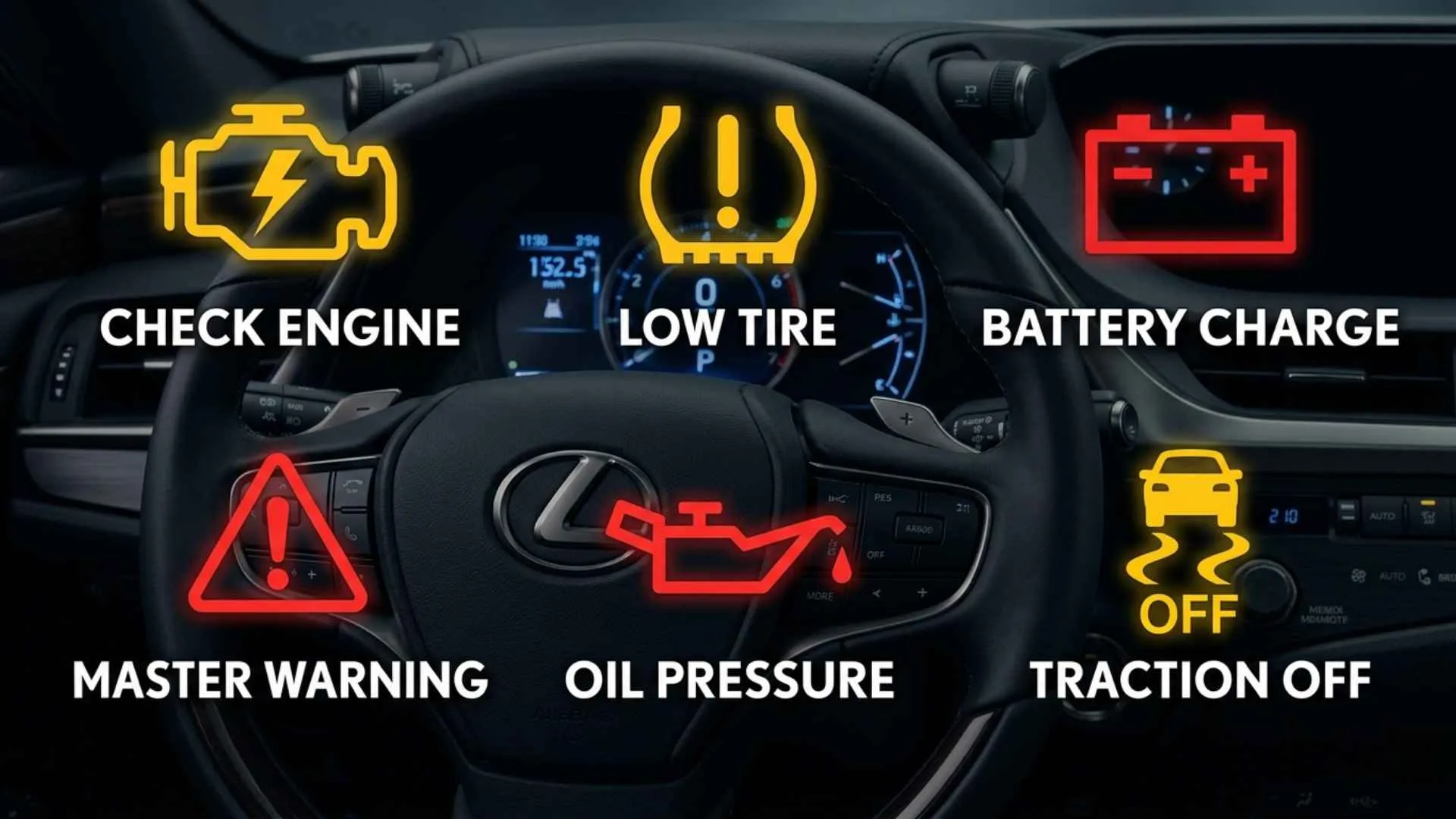
Seeing an unfamiliar Lexus dashboard symbol can be confusing, especially when a warning light suddenly appears while you are driving. Lexus vehicles use different colors, icons, and messages to tell you about everything from normal vehicle functions to issues that may need immediate attention. Knowing what these symbols mean can help you understand your vehicle and respond appropriately.
This guide explains the most common Lexus dashboard symbols and meanings in simple language. You’ll learn what red, yellow, green, and blue lights generally indicate, along with explanations of important warning symbols for the engine, brakes, battery, tire pressure, oil, ABS, airbags, traction control, and other systems. Some symbols can also vary slightly depending on the Lexus model and model year.
If you are trying to identify a warning light on your Lexus dashboard, this complete guide can help you understand what it represents and what to check next. It also explains the difference between warning lights and indicator lights, so you can quickly determine whether a symbol is simply showing that a feature is active or signaling a potential problem that deserves attention.
Quick Meaning
Lexus dashboard lights use colors, icons, text messages, and flashing patterns to communicate vehicle status. Red usually means stop safely and investigate immediately. Amber or yellow normally indicates caution, maintenance, or a system fault. Green, blue, and white lights generally confirm that a feature is active rather than warning of a failure.
Lexus Dashboard Symbol Overview Table
| Symbol or Light | Primary Meaning | Typical Color | Recommended Response |
| Brake warning | Parking brake, low brake fluid, or brake-system problem | Red | Stop safely if it remains on after releasing the brake |
| Check engine | Engine or emissions-control fault | Amber | Inspect soon; stop if flashing or running poorly |
| Oil pressure | Low engine-oil pressure | Red | Stop the engine immediately |
| Coolant temperature | Engine or hybrid system overheating | Red | Pull over and allow the vehicle to cool |
| Charging system | Battery or charging-system fault | Red | Reduce electrical use and seek service |
| ABS warning | Anti-lock braking system fault | Amber | Normal braking may remain, but ABS may not |
| Tire-pressure warning | Low tire pressure or TPMS issue | Amber | Check and adjust all tires |
| Airbag/SRS warning | Airbag or seat-belt pretensioner fault | Red or amber | Arrange inspection promptly |
| Master warning | Important message or multiple-system alert | Red or amber | Read the multi-information display |
| Electric power steering | Steering-assist problem | Red or amber | Stop if steering becomes unusually heavy |
| Slip indicator | Traction or stability control is operating | Amber, flashing | Reduce speed and drive smoothly |
| PCS warning | Pre-Collision System unavailable or faulty | Amber | Clean sensors and check displayed message |
| LTA/LDA indicator | Lane assistance status | Green, white, or amber | Follow the display and remain attentive |
| Radar cruise indicator | Dynamic Radar Cruise Control status | Green or white | Maintain control and monitor traffic |
| Low-fuel warning | Fuel level is low | Amber | Refuel soon |
| Seat-belt reminder | Occupant is not buckled | Red | Fasten the correct seat belt |
| High-beam indicator | High beams are active | Blue | Dim them around other road users |
| Turn-signal indicator | Turn signal or hazards are active | Green | No action unless blinking unusually fast |
| EV-mode indicator | Vehicle is operating electrically | Green | Normal hybrid or electric operation |
| READY indicator | Hybrid or EV system can drive | Green | Vehicle is ready even if the engine is silent |
What Do Lexus Dashboard Symbols Mean?
Lexus dashboard symbols are a visual language that reports the condition of the engine, brakes, tires, safety systems, lights, driver-assistance technology, and hybrid or electric powertrain.
A warning light does not always mean the vehicle must be towed. Its meaning depends on four factors:
- Color: Red is generally more urgent than amber.
- Behavior: A flashing light often requires faster action than a steady one.
- Timing: A light that appears briefly during startup may be a normal self-check.
- Driving symptoms: Smoke, power loss, overheating, noises, or difficult steering increase the seriousness.
Many Lexus vehicles also place a written explanation in the multi-information display. Read the full message instead of relying only on the icon. One master-warning triangle, for example, can accompany many unrelated conditions.
History and Development of Dashboard Warning Symbols
Automotive warning lights developed as vehicles gained electrical systems and more complex mechanical components. Early dashboards mainly displayed speed, fuel level, oil pressure, and engine temperature. Drivers often depended on analog gauges rather than illuminated icons.
As vehicles introduced electronic fuel injection, anti-lock brakes, airbags, emissions controls, and onboard diagnostics, manufacturers needed a faster way to communicate faults. Standardized pictograms allowed drivers to recognize important warnings without reading a long message while driving.
Modern Lexus displays combine traditional warning icons with digital graphics, audible alerts, head-up displays, and text instructions. Newer vehicles may monitor road markings, surrounding traffic, driver attention, tire pressure, radar visibility, and high-voltage battery systems.
This development explains why an older Lexus may show only a basic cruise-control icon while a newer model can display separate symbols for adaptive cruise control, lane tracing, pre-collision assistance, parking support braking, and road-sign recognition.
Color Symbolism and Interpretation
Red Dashboard Lights
A red symbol generally indicates danger, an important safety condition, or a fault that could cause serious damage. Examples include low oil pressure, excessive coolant temperature, brake-system warnings, and charging-system faults.
Red does not always mean a breakdown. A red seat-belt light simply tells an occupant to buckle up, and a red door symbol may show that a door is open. Context matters.
Amber or Yellow Dashboard Lights
Amber means caution. The vehicle may still be drivable, but a system needs attention, inspection, or maintenance.
The check-engine light, tire-pressure warning, ABS light, and many driver-assistance warnings use amber. Ignoring them can allow a small issue to become more serious.
Green and White Dashboard Lights
Green and white symbols normally confirm that a feature is turned on, available, or functioning. Cruise control, parking lights, lane-assistance features, and EV mode may use these colors.
They are status indicators rather than failure warnings, although the icon can change to amber when the system becomes unavailable.
Blue Dashboard Lights
Blue usually identifies the high-beam headlights. A blue coolant-temperature icon on some vehicles can also indicate that the engine is still cold, although the exact presentation varies by model.
Critical Lexus Warning Lights
Brake Warning Light
The brake warning light may appear when the parking brake is engaged, the brake-fluid level is low, or the braking system has developed a fault. Lexus notes that the “BRAKE” indicator can illuminate when the parking brake is not fully released or the fluid level is low.
Release the parking brake completely. If the light stays on, especially with a warning buzzer, reduced braking performance, or a soft pedal, pull over safely and arrange professional assistance.
Do not confuse this light with the amber ABS warning. An ABS fault may disable anti-lock operation while conventional braking remains available. A red brake-system warning can be more urgent.
Engine Oil-Pressure Warning
The red oil-can symbol means the engine may not have enough oil pressure to lubricate internal parts. It does not simply mean that an oil change is due.
Stop in a safe place and turn off the engine. Check the oil level after allowing the vehicle to sit. Even when the level looks normal, do not continue driving if the warning remains because a pump, sensor, filter, or internal oil-flow problem may exist.
High Coolant-Temperature Warning
A red thermometer over waves usually means the engine or powertrain is overheating. Air-conditioning performance may change, power may be limited, or steam may appear from beneath the hood.
Pull over safely, turn off unnecessary accessories, and follow the owner’s-manual procedure. Never remove a hot coolant cap. Escaping pressurized coolant can cause severe burns.
Charging-System Warning
The battery-shaped warning means the charging system is not supplying electricity correctly. The cause may involve the alternator, wiring, drive belt, battery, or a related control circuit.
The vehicle may continue running temporarily on stored battery power, but it can shut down once that power is depleted. Turn off unnecessary electrical accessories and seek assistance promptly.
Check-Engine Light
The amber engine icon indicates that the engine-management or emissions-control system has detected an abnormal condition.
A steady light may result from a loose or damaged fuel cap, sensor fault, ignition issue, air-fuel problem, or emissions-system failure. Tighten the cap if appropriate, but do not assume it is always the cause.
A flashing check-engine light is more urgent because it can indicate severe misfiring that may damage the catalytic converter. Reduce speed, avoid hard acceleration, and arrange immediate inspection.
Master Warning Light
The master-warning symbol is commonly shown as a triangle containing an exclamation mark. It directs your attention to a message in the multi-information display.
It does not identify one specific failure. It may accompany an open door, low washer fluid, key-system issue, hybrid warning, radar obstruction, maintenance message, or a more serious malfunction. Read the accompanying text before deciding what to do.
Safety and Driver-Assistance Symbols
ABS Warning
The amber “ABS” light indicates a problem with the anti-lock braking system. The brakes may still stop the vehicle, but the wheels can lock during hard braking, particularly on wet or slippery roads.
Drive cautiously and have the system checked. If the red brake warning and ABS light appear together, stop driving as soon as it is safe because overall brake control may be affected.
Slip and Stability-Control Indicator
The skidding-car icon flashes when Vehicle Stability Control or traction control is actively correcting wheel slip. This is normal on snow, loose gravel, wet pavement, or during aggressive acceleration.
Ease off the accelerator and steer smoothly. If the symbol stays on continuously, the system may have been switched off or may have a malfunction.
Pre-Collision System Warning
The Pre-Collision System uses sensors such as a forward-facing camera and millimeter-wave radar to detect certain vehicles, pedestrians, or obstacles under supported conditions. It can provide visual and audible warnings and may assist braking, depending on the model and situation.
An amber PCS symbol may mean the system is disabled, blocked, overheated, misaligned, or malfunctioning. Clean snow, ice, mud, or condensation from the windshield camera area and front radar location without damaging them.
Driver-assistance systems support the driver; they do not replace attention, safe following distances, or braking judgment.
Lane Departure Alert and Lane Tracing Assist
Lane-related symbols may resemble a vehicle between two lane lines. White lines can indicate that the system is available, while green lines commonly show that lane markings are recognized. Amber warnings may indicate departure alerts, cancellation, or a fault.
Markings, road construction, heavy rain, snow, glare, and dirty cameras can limit performance. Keep your hands on the steering wheel even when steering assistance is active.
Dynamic Radar Cruise Control
The radar-cruise symbol may show a vehicle, speedometer, or distance bars. It confirms that adaptive cruise control is available or engaged.
The system can help maintain a selected speed and following distance, but drivers must remain ready to brake. Sharp curves, motorcycles, stopped vehicles, poor weather, or obscured sensors can affect detection.
Tire, Airbag, and Steering Warnings
Tire-Pressure Warning Light
The tire-pressure warning resembles a cutaway tire containing an exclamation point. A steady light usually means one or more tires are underinflated. A light that flashes before staying on may indicate a Tire Pressure Monitoring System malfunction.
Check all four road tires when cold and inflate them to the pressure shown on the driver-door placard, not the maximum printed on the tire sidewall. Temperature drops can lower pressure enough to trigger the light.
Do not forget that some Lexus models may also monitor the spare tire, while others do not.
SRS Airbag Warning
The SRS warning shows a seated person with a circle representing an airbag. It can indicate a fault in the airbags, impact sensors, occupant-classification system, wiring, or seat-belt pretensioners.
The vehicle may still drive normally, but one or more restraint components may not operate correctly in a collision. Arrange inspection promptly and avoid modifying seats, connectors, or steering-wheel components.
Electric Power-Steering Warning
A steering-wheel icon with an exclamation mark can indicate reduced or failed electric steering assistance. Steering may become much heavier, especially at low speeds.
Stop safely if vehicle control feels difficult. Turning the vehicle off and restarting may clear a temporary issue, but a recurring light requires diagnosis.
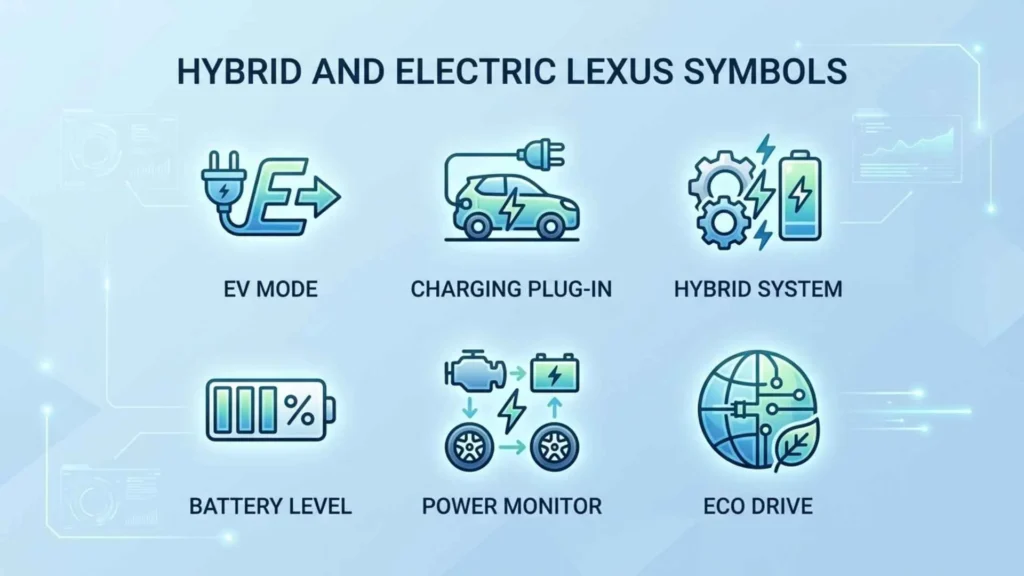
Hybrid and Electric Lexus Symbols
READY Indicator
In a Lexus hybrid or electric vehicle, the green READY indicator means the propulsion system is active and the vehicle can move. The gasoline engine may remain silent, so engine noise is not a reliable sign that the vehicle is off.
Always confirm that READY has disappeared before leaving the vehicle.
EV-Mode Indicator
The EV indicator means the vehicle is operating with electric propulsion under the conditions allowed by the system. In a conventional hybrid, EV operation may end automatically due to speed, acceleration demand, battery charge, temperature, or climate-control use.
It is a normal status light, not proof that the vehicle is a full battery-electric model.
Hybrid-System Warning
A hybrid-system warning may include a car with an exclamation point, a master-warning triangle, or a written message. Causes range from temporary operating conditions to high-voltage, inverter, battery, cooling, or control-system faults.
Stop safely and follow the displayed instructions. Never attempt to open high-voltage components or touch orange electrical cables.
Common Information and Convenience Symbols
Low-Fuel Warning
The fuel-pump icon means the remaining fuel level is low. Refuel soon rather than relying on an estimated remaining range, which can change with speed, traffic, hills, weather, and climate-control use.
Seat-Belt Reminder
A seated-person symbol indicates that the driver or passenger is not correctly buckled. Some Lexus vehicles also monitor rear seats and may sound an alert when a rear belt is released.
Door, Hood, or Trunk Warning
A vehicle outline with an open panel indicates that a door, hood, liftgate, or trunk is not fully latched. Stop and close it securely before driving.
Windshield-Washer Fluid
A windshield with a spray pattern means the washer-fluid level is low. Refill it with an appropriate automotive washer fluid, especially in freezing climates.
Maintenance Required
The maintenance reminder may display “MAINT REQD,” a wrench, or a written service message. It normally tracks mileage or time and does not necessarily indicate a mechanical failure.
Reset it only after the required maintenance has been completed.
Where Lexus Dashboard Symbols Are Used
Lexus warning and indicator symbols can appear in several locations:
- The instrument cluster behind the steering wheel
- The digital multi-information display
- The head-up display projected onto the windshield
- The center multimedia screen
- Buttons for traction control, parking sensors, and safety systems
- Hybrid energy-monitor screens
- Mobile applications and connected-service notifications
- Owner’s manuals and quick-reference guides
A symbol on a control button may show what the button operates, while the same symbol in the instrument cluster may report that the system is active, unavailable, or faulty.
Common Variations Between Lexus Models
Lexus symbols vary because the brand sells gasoline, hybrid, plug-in hybrid, and battery-electric vehicles with different safety packages.
An older RX, ES, LS, IS, GX, or LX may use physical gauges and simple indicator lights. A newer NX, RX, RZ, TX, or UX may show animated graphics and detailed text warnings.
Regional regulations also affect icon design and wording. A U.S. model may display “BRAKE,” while another market may use a circle containing an exclamation mark. Tire-pressure monitoring, rear fog lights, diesel warnings, and speed-limit symbols may also differ by country.
Even closely related lights can change meaning according to color. A green steering icon may indicate active lane assistance, while an amber steering icon may indicate that assistance is unavailable.
Common Misconceptions
Every Red Light Means the Engine Is Failing
Red means urgent attention, but the exact issue may be an unfastened seat belt, open door, engaged parking brake, or serious mechanical problem. Read the icon and message.
An Amber Light Is Safe to Ignore
Amber usually allows time to respond, but ignoring a check-engine, ABS, tire-pressure, or safety-system warning can increase repair costs or reduce protection.
The Oil Light Is an Oil-Change Reminder
The red oil-can icon normally concerns pressure, not routine oil life. Driving with low pressure can destroy an engine quickly.
Disconnecting the Battery Fixes Warning Lights
Battery disconnection may erase temporary data, reset learned settings, or hide a warning briefly. It does not repair the cause and can make diagnosis harder.
Driver-Assistance Lights Mean the Vehicle Drives Itself
Lexus Safety System+ features are designed to support driver awareness and operation under certain conditions, not replace the driver.
One Online Chart Fits Every Lexus
Dashboard symbols change by model, year, market, and equipment. The manual matched to the vehicle identification number or exact model remains the best reference.
Interesting Facts About Lexus Dashboard Symbols
- Many lights illuminate at startup as a self-check. A symbol that turns off after the vehicle starts may be operating normally.
- Flashing can change the urgency. A flashing check-engine light is generally more serious than a steady one.
- The master warning is intentionally broad. It acts as a prompt to read a detailed message rather than identifying one component.
- Cold weather can trigger tire warnings. Tire pressure naturally falls as temperature drops, even without a puncture.
- Hybrids can be ready while silent. The READY light is more important than engine sound when confirming whether a Lexus hybrid can move.
- Sensor blockage can imitate a fault. Snow, mud, heavy rain, glare, or condensation can make safety systems temporarily unavailable.
- Green symbols still require attention. They confirm a system’s status, but the driver must understand what is active.
- One problem can trigger several lights. A low battery voltage or wheel-speed sensor fault may affect multiple electronic systems.
- Warning lights store diagnostic information. Technicians can use scan tools to retrieve fault codes, operating conditions, and system data.
- Icons reduce language barriers. Pictograms allow drivers in different countries to recognize common vehicle functions quickly.
Related Lexus Symbols
- ABS and brake warning: ABS concerns anti-lock control; the red brake light may indicate a more urgent braking issue.
- Slip indicator and traction-control-off symbol: One shows intervention or a fault; the other confirms that assistance has been disabled.
- Check-engine and maintenance reminder: The engine light reports a detected fault; the maintenance reminder tracks scheduled service.
- PCS and radar-cruise symbols: Both may use forward sensors, but they perform different safety and convenience functions.
- Oil-pressure and oil-level warnings: Pressure concerns oil circulation; level concerns the amount of oil present.
- EV and READY indicators: EV describes electric operation; READY confirms that the entire propulsion system can drive.
- High beams and automatic high beams: Blue confirms high beams are illuminated; a separate automatic-high-beam icon shows that automatic control is enabled.
Frequently Asked Questions
What is the most serious Lexus dashboard warning light?
Red oil-pressure, high-temperature, brake-system, charging-system, and hybrid-system warnings can all be serious. There is no single light that is always the worst. Stop safely when a red mechanical warning remains illuminated, read the displayed message, and follow the owner’s manual.
Can I drive my Lexus with the check-engine light on?
A Lexus may remain drivable with a steady check-engine light if it runs normally, but it should be diagnosed soon. Avoid long trips and hard acceleration. If the light flashes, the engine shakes, power drops, or smoke appears, stop driving and obtain professional help.
Why are several Lexus warning lights on at once?
Multiple lights can appear when systems share a sensor, control module, power supply, or communication network. A weak 12-volt battery, wheel-speed sensor failure, charging issue, or engine fault can trigger several warnings. A diagnostic scan is often needed to identify the original cause.
What does the triangle with an exclamation point mean?
The triangle is the master-warning indicator. It tells you that the vehicle has detected a condition requiring attention. Read the message in the instrument display because the triangle alone does not identify the cause or reveal whether it is minor or urgent.
Why does the tire-pressure light stay on after inflation?
The tires may still be below the specified cold pressure, a tire may have a slow leak, the system may need time to update, or a sensor may be faulty. Use the driver-door placard for the correct pressure and check every monitored tire with an accurate gauge.
What does READY mean on a Lexus hybrid?
READY means the hybrid system is turned on and the vehicle can move when a drive position is selected. The gasoline engine may be off, but the electric motor remains capable of propulsion. Shift to Park and turn the system off before exiting.
Why is my Lexus pre-collision warning light on?
The system may be switched off, temporarily unavailable, obstructed, overheated, or faulty. Inspect the windshield camera area and front sensor surfaces for dirt, snow, ice, or condensation. Read the display message and seek service if the warning remains after conditions improve.
Can low battery voltage cause dashboard warnings?
Yes. A weak 12-volt battery or charging problem can disrupt electronic control modules and produce multiple warnings. However, battery replacement should not be treated as an automatic cure. Test the battery and charging system and retrieve diagnostic codes before replacing parts.
How do I reset a Lexus dashboard warning light?
Correct the underlying cause first. Some lights turn off automatically after normal conditions return, while maintenance reminders require a model-specific reset procedure. Safety and malfunction warnings should not be cleared merely to hide them. Use the exact owner’s manual or qualified diagnostic equipment.
Where can I find symbols for my exact Lexus?
Use the owner’s manual and quick-reference guide for the model year, powertrain, trim, and sales region. Lexus provides manuals and warning-light resources through its official owner resources.
Key Takeaways
- Red Lexus dashboard lights usually require immediate attention.
- Amber lights indicate caution, maintenance needs, or system faults.
- Green, white, and blue lights generally show active features.
- A flashing warning can be more urgent than a steady one.
- Read the multi-information display whenever a warning appears.
- Never drive with a persistent oil-pressure or overheating warning.
- Driver-assistance systems support but do not replace attentive driving.
- Lexus symbols vary by model, year, powertrain, trim, and region.
- Diagnose the cause before clearing or resetting a warning.
- Use the owner’s manual for the final model-specific meaning.
Conclusion
Understanding Lexus dashboard symbols and meanings helps you separate normal status indicators from warnings that require immediate action. Color provides the first clue, but the icon, flashing pattern, written message, and vehicle behavior reveal the full level of urgency.
A green cruise-control symbol may simply confirm an active feature, while a red oil or temperature warning can signal a risk of severe damage. When a light is unfamiliar, slow down, read the display, check the correct owner’s manual, and avoid guessing. Responding early protects the vehicle, reduces repair costs, and keeps every journey safer.

I am Amelia Carter, an English language educator and educational writer who enjoys making difficult ideas simple and easy to understand. At LearnNestly, I write about English words, grammar, everyday expressions, and language questions that people often find confusing. I believe learning should feel practical, clear, and enjoyable rather than overwhelming. Through my writing, I try to give readers explanations they can understand and use in real life.
Books:
- The Everyday English Handbook
- Words Made Simple
 Ethan Mitchell
 Daniel Brooks