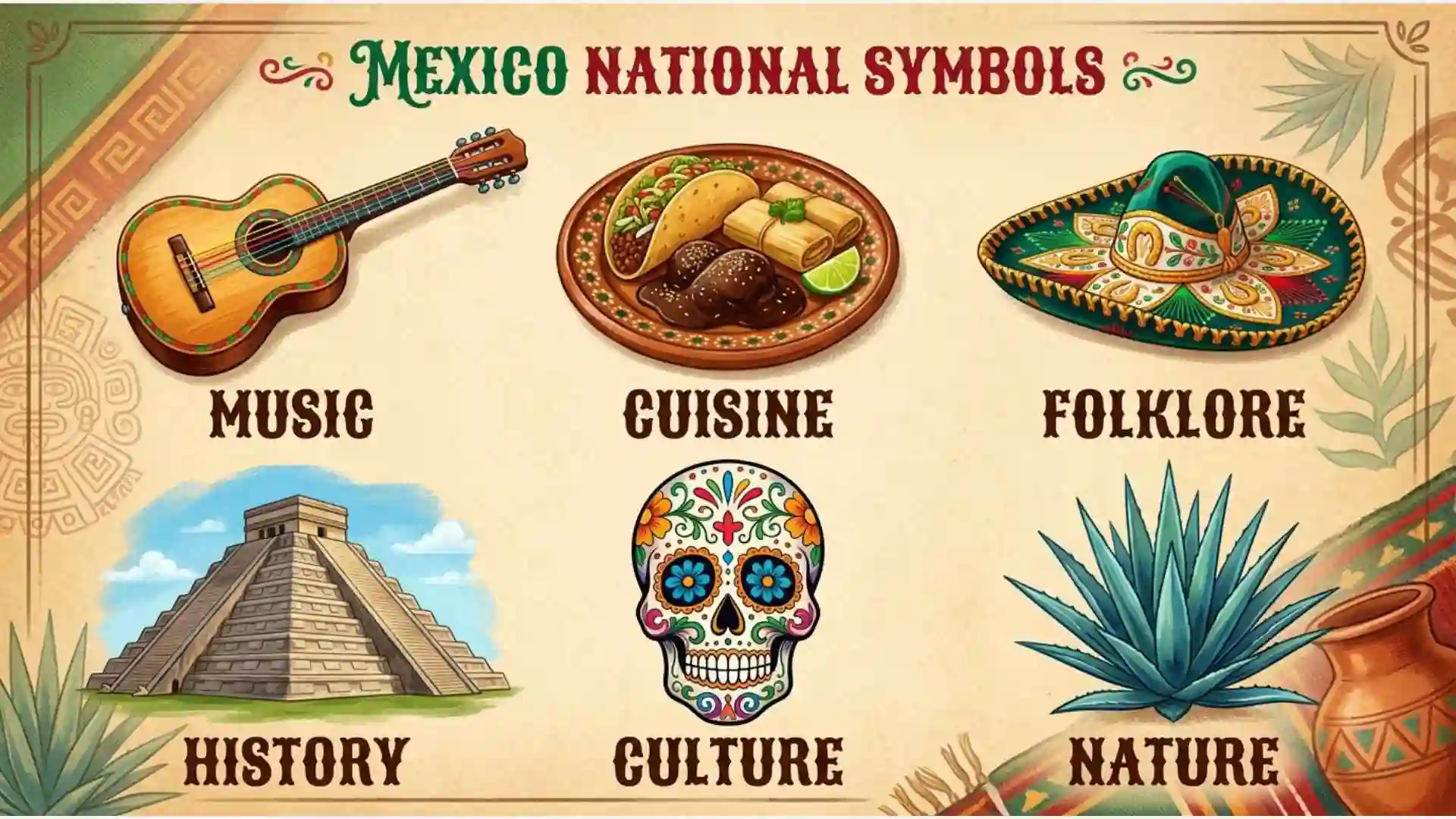
Mexico’s national symbols reflect the country’s rich history, cultural identity, and deep connection to its Indigenous and colonial past. From the famous Mexican flag and golden eagle to the national coat of arms and national anthem, each symbol represents an important part of Mexico’s story. Together, these emblems help express the values, traditions, and identity shared by the Mexican people.
The most recognizable symbol is the Mexican flag, featuring green, white, and red vertical stripes with the national coat of arms at its center. The coat of arms shows an eagle holding a serpent while standing on a cactus, an image connected to the ancient Mexica foundation story of Tenochtitlan. Other national symbols, including the national anthem, national flower, national tree, and national animal, add further layers of cultural and historical meaning.
Understanding Mexico’s national symbols offers more than a look at official emblems. It reveals how Indigenous traditions, Mexican history, independence, nature, and national pride have shaped the country’s identity. In this guide, we’ll explore the major national symbols of Mexico, their meanings, historical origins, and why they remain significant today.
Quick Meaning of Mexico National Symbols
Mexico national symbols represent sovereignty, national unity, independence, historical memory, and pride in the country’s Indigenous and republican heritage. The flag unites the national colors, the coat of arms recalls the founding of Mexico-Tenochtitlan, and the anthem honors courage, defense of the homeland, and collective responsibility.
Mexico National Symbols Overview Table
| Field | Details |
| Official national symbols | National Coat of Arms, National Flag, and National Anthem |
| Spanish term | Símbolos Patrios de México |
| Primary meaning | National identity, sovereignty, unity, freedom, and historical continuity |
| Cultural roots | Indigenous Mesoamerican traditions, the independence movement, and republican history |
| Central emblem | An eagle holding a serpent while standing on a flowering nopal cactus |
| Flag colors | Green, white, and red |
| Flag proportions | 4:7 |
| Anthem lyricist | Francisco González Bocanegra |
| Anthem composer | Jaime Nunó |
| Anthem first performed | September 15, 1854 |
| Present flag design | Officially adopted in 1968 |
| Governing legislation | Law on the National Coat of Arms, Flag, and Anthem |
| Common use | Government institutions, schools, ceremonies, currency, passports, sports, and public holidays |
| Major civic observance | Mexican Flag Day, February 24 |
| Related cultural symbols | Golden eagle, nopal, marigold, jaguar, quetzal, charro, and Virgin of Guadalupe |
| Unicode or emoji | No single emoji represents all three official symbols; 🇲🇽 represents the Mexican flag |
What Do Mexico National Symbols Mean?
Mexico national symbols communicate that the nation is politically independent, historically rooted, and united by a shared civic identity. Each official symbol performs a different role.
The National Coat of Arms tells a foundational story. It shows an eagle gripping a serpent while standing on a nopal cactus growing from a rock surrounded by water. The scene links modern Mexico to the Mexica people and their capital, Mexico-Tenochtitlan.
The National Flag places that emblem at the center of three vertical bands: green, white, and red. The tricolor represents the nation as a unified political community. Although popular explanations assign fixed ideas to each color, their meanings have changed across different historical periods.
The National Anthem, or Himno Nacional Mexicano, gives musical and poetic expression to patriotism. Its language emphasizes courage, honor, sacrifice, peace, and the defense of national sovereignty.
Together, the three symbols create a complete symbolic system. The coat of arms represents origin, the flag represents national presence, and the anthem represents collective voice.
History and Origin of Mexico National Symbols
Indigenous Origins of the National Emblem
The deepest historical layer of Mexico’s national symbolism comes from the Mexica civilization. According to the traditional foundation account, the Mexica were instructed to establish their city where they encountered an eagle on a nopal cactus.
They reportedly found the sign on an island in Lake Texcoco and founded Mexico-Tenochtitlan there, traditionally dated to 1325. The city later became the center of a powerful Mesoamerican state and the location of present-day Mexico City.
Pre-Hispanic representations of the foundation scene do not always match the modern coat of arms. Some early images show an eagle, cactus, stone, water, or other elements in different arrangements. The serpent became especially prominent in later versions.
The modern emblem therefore should not be treated as an unchanged copy of one ancient image. It is a national design created through centuries of Indigenous memory, colonial interpretation, political change, and artistic standardization.
Symbols During the Independence Movement
The Mexican War of Independence began in 1810. Insurgent groups carried several banners rather than one standardized national flag.
One of the most famous was the religious banner associated with Miguel Hidalgo, which displayed the Virgin of Guadalupe. Historians generally describe it as an insurgent emblem rather than Mexico’s first official national flag. Its importance came from its ability to unite religious devotion with resistance to Spanish colonial authority.
José María Morelos later used military banners that included an eagle on a cactus. These designs helped reconnect the independence movement with the land’s Indigenous past.
The Army of the Three Guarantees
The green, white, and red color combination became nationally important in 1821 through the Army of the Three Guarantees. The three guarantees were:
- Religion
- Independence
- Union
Early tricolor flags often displayed diagonal bands, stars, crowns, or imperial symbols. After independence, the colors remained, but their arrangement and political meaning evolved.
The First Mexican Empire and Republic
The flag of the First Mexican Empire featured vertical green, white, and red bands with a crowned eagle in the center. After the empire ended and a federal republic was established in 1823, the crown was removed.
Oak and laurel branches were added below the eagle. These branches remain important parts of the coat of arms. Oak commonly suggests strength, while laurel has long represented victory and honor.
Mexico’s flag and emblem continued to change during periods of political conflict. Different governments altered the eagle’s direction, posture, crown, artistic style, and surrounding details.
The Nineteenth and Twentieth Centuries
During the Second Mexican Empire under Maximilian, the flag included European-style imperial decoration and crowned eagles. Republican forms returned after the empire collapsed.
In 1916, President Venustiano Carranza ordered the eagle to be shown in left-facing profile rather than front-facing. This decision helped shape the modern national coat of arms.
The present flag design was formally adopted on September 16, 1968. Its official proportions and graphic details were later reinforced through federal law. Mexico’s current legislation defines the coat of arms, flag, anthem, approved uses, ceremonies, and standards of respect.
History of the Mexican National Anthem
In 1853, the Mexican government organized a competition for national anthem lyrics. Poet Francisco González Bocanegra submitted the winning text.
A later music competition selected the composition of Jaime Nunó, a Spanish-born musician who had worked in Mexico. The anthem was first performed publicly on September 15, 1854.
The complete original poem contained more verses than are normally performed today. Modern official use centers on the chorus and selected stanzas authorized by law.
Symbolism and Interpretation
The Eagle
The eagle represents strength, vision, courage, sovereignty, and the connection between the earthly and celestial worlds.
In Indigenous Mesoamerican traditions, eagles were associated with the sun, warfare, power, and elite military orders. In modern national symbolism, the eagle is not simply a bird of prey. It represents Mexico itself as a strong and independent nation.
The species depicted is generally identified as the golden eagle, known scientifically as Aquila chrysaetos. The golden eagle also holds official importance as Mexico’s national bird.
The Serpent
The serpent is one of the most debated elements in the emblem.
A common modern interpretation presents the eagle defeating the serpent as the triumph of good over evil. That explanation reflects European and Christian symbolic traditions, where serpents often represent temptation or danger.
However, snakes held more complex meanings in Mesoamerican cultures. They could symbolize water, fertility, earth, renewal, wisdom, political authority, or divine power. The serpent should therefore not automatically be understood as evil.
In the national emblem, it may represent struggle, mastery, balance, or the blending of different symbolic traditions. No single interpretation fully explains every historical layer.
The Nopal Cactus
The nopal, or prickly pear cactus, represents the Mexican landscape, survival, nourishment, and resilience.
It can grow in hot, dry, and rocky environments, making it a natural symbol of endurance. Its edible pads and fruit have also played important roles in Mexican food, agriculture, medicine, and local economies.
In the coat of arms, the nopal grows from a stone in the waters of Lake Texcoco. This detail identifies the setting of the Tenochtitlan foundation story rather than serving as decoration.
The Rock and Water
The rock represents the physical site from which the nopal grows. The surrounding water recalls the lakes of the Valley of Mexico, especially Lake Texcoco.
These elements ground the emblem in a specific place. They show that Mexico’s identity is tied not only to an abstract legend but also to geography, environment, and the history of its capital.
Oak and Laurel Branches
The branches beneath the emblem combine two widely recognized symbolic traditions.
The oak branch suggests strength, stability, endurance, and civic virtue. The laurel branch represents victory, honor, achievement, and glory.
A ribbon in the national colors binds the branches together. This creates a visual message of strength and victory united under the Mexican nation.
Meaning of the Mexican Flag Colors
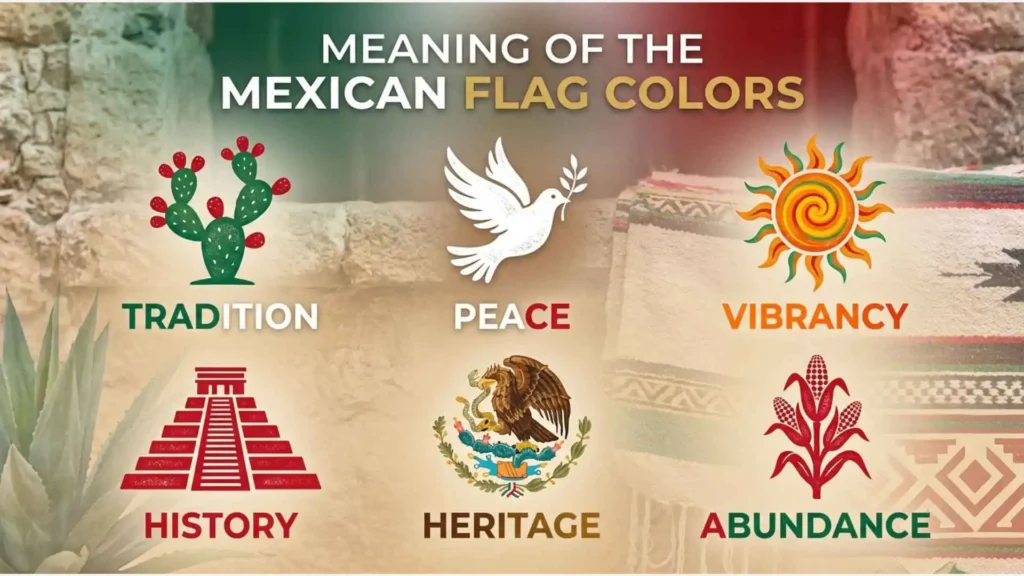
The flag contains three equal vertical bands arranged from the hoist side as green, white, and red.
Under the original Three Guarantees interpretation:
- Green represented independence.
- White represented the Roman Catholic religion.
- Red represented union among Europeans and Americans.
As Mexico developed into a secular republic, unofficial modern meanings became popular:
- Green is often linked with hope.
- White is associated with unity or purity.
- Red recalls the blood of national heroes.
These modern meanings are widely repeated, but the federal law does not assign one mandatory symbolic definition to each color. Treating any one explanation as timeless or legally fixed oversimplifies their history.
Cultural Significance
Mexico national symbols create a shared identity in a country with extraordinary regional, linguistic, ethnic, and cultural diversity.
Mexico includes Indigenous communities with distinct languages and traditions, descendants of European settlers, Afro-Mexican communities, and people of many mixed backgrounds. The national symbols do not erase these differences. Ideally, they provide a civic framework through which different communities belong to the same nation.
The coat of arms is especially significant because it places an Indigenous foundation narrative at the center of the modern state. Unlike many national emblems built primarily around European heraldry, Mexico’s emblem draws its main image from Mesoamerican history.
At the same time, its current form blends multiple traditions. The eagle and nopal reflect the Mexica past, while the wreath-like branches and formal heraldic presentation show European artistic influence.
This combination mirrors Mexico’s broader cultural history: Indigenous civilizations, Spanish colonization, Catholic traditions, independence, republicanism, revolution, and modern nationhood all contributed to the country’s identity.
Religious and Spiritual Meaning
Mexico’s official national symbols are civic rather than religious, but religious history influenced their development.
The Virgin of Guadalupe played a major symbolic role in the independence movement. Miguel Hidalgo’s use of her image helped transform a familiar sacred figure into an emblem of resistance and collective identity.
The eagle, serpent, cactus, water, and stone also carry spiritual associations from Mesoamerican worldviews. Eagles could connect with the sun and sky, while serpents could relate to earth, water, fertility, and supernatural power.
However, the national coat of arms should not be treated as a sacred symbol belonging to one religion. In modern Mexico, it represents the secular state and all citizens, regardless of belief.
Scientific and Technical Meaning
The national emblem also contains scientifically identifiable plants, animals, and geographic features.
The eagle is commonly identified as a golden eagle. The nopal belongs to the genus Opuntia, which includes many prickly pear species. The snake is frequently described in official and educational materials as a rattlesnake, although artistic versions may not always display every identifying feature clearly.
From an environmental perspective, the emblem brings together species associated with Mexico’s ecosystems. It reflects the relationship among wildlife, native plants, water, and the Valley of Mexico.
The flag also follows technical design standards. It has a 4:7 height-to-width ratio, three equal vertical bands, and the coat of arms centered in the white band. Government-approved models regulate its appearance to ensure consistency.
Where Mexico National Symbols Are Used
Mexico national symbols appear throughout civic and public life.
Government and Law
The coat of arms appears on federal documents, official seals, court materials, government buildings, diplomatic communications, and public records. It signals legal authority and state identity.
Schools
Students participate in flag ceremonies, sing the anthem, and learn the history of the national symbols. These practices teach civic responsibility and historical awareness.
Currency and Passports
The eagle-and-serpent emblem appears on Mexican coins, banknotes, passports, identification materials, and official certificates. Its presence confirms national origin and authority.
Public Ceremonies
The flag and anthem are central to Independence Day, Flag Day, military commemorations, presidential events, and other official observances.
During formal honors to the flag, civilians use a prescribed salute while the anthem may be performed. National law establishes ceremonial rules and requires the flag to receive honors before individuals.
Sports
Mexican athletes and supporters display the flag during international competitions. The anthem is performed at medal ceremonies and major matches, turning national symbols into expressions of shared pride.
Art, Clothing, and Popular Culture
Artists reinterpret the flag, eagle, serpent, and cactus in murals, posters, clothing, crafts, tattoos, and graphic design. Such uses may express cultural pride, migration experiences, political ideas, or personal identity.
Legal and respectful-use requirements still apply, especially when reproducing official versions of the symbols.
Common Variations and Modern Adaptations
Historical Eagle Designs
The eagle has appeared crowned and uncrowned, facing forward or sideways, with open or lowered wings, and in realistic or decorative styles. These changes often reflected the government and political values of the period.
Civil and Official Versions
The full coat of arms includes detailed natural elements and branches. Simplified outlines may appear in educational diagrams, logos, or decorative art, but they should not be confused with the legally standardized official design.
Presidential and Military Uses
Government institutions and military organizations may display the national symbols in ceremonial formats, seals, standards, or official insignia. These applications follow specific regulations.
Cultural Adaptations
Mexican and Mexican American artists often combine the eagle, nopal, flag colors, Aztec-inspired imagery, marigolds, or regional symbols. These works may celebrate heritage without claiming to replace the official emblem.
Common Misconceptions About Mexico National Symbols
Misconception 1: The Eagle Always Symbolizes Good Defeating Evil
This interpretation is popular but incomplete. It relies heavily on European religious symbolism. In Mesoamerican traditions, the serpent could represent powerful and positive forces, including fertility, water, earth, and renewal.
Misconception 2: The Mexica Legend Has One Fixed Version
Foundation stories developed through oral traditions, pictorial manuscripts, colonial accounts, and later histories. Details differ among sources. The modern coat of arms is a standardized national interpretation, not a photographic record of one exact event.
Misconception 3: Hidalgo Carried the First Official Mexican Flag
Hidalgo’s Guadalupe banner was an important insurgent symbol, but it was not a standardized flag of an established Mexican nation. Calling it the first national flag can blur the difference between a revolutionary banner and an official state emblem.
Misconception 4: The Flag Colors Have Always Meant Hope, Unity, and Blood
Those meanings are popular today, but the original Trigarante colors represented religion, independence, and union. Their interpretation changed as Mexico’s political and social identity evolved.
Misconception 5: Every Famous Mexican Image Is a National Symbol
Sombreros, tacos, mariachi musicians, sugar skulls, and monarch butterflies may represent aspects of Mexican culture, but they are not official national symbols. Official status belongs to the coat of arms, flag, and anthem.
10 Interesting Facts About Mexico National Symbols
- The coat of arms preserves the memory of a real lake environment.
The water and rock refer to the island setting of Tenochtitlan in Lake Texcoco, linking national identity to the Valley of Mexico’s transformed landscape. - The emblem appears in the center of the flag’s white stripe.
This feature distinguishes Mexico’s tricolor from the superficially similar Italian flag. - Mexico’s flag has an official ratio of 4:7.
The ratio creates a longer rectangular form than many flags that use proportions such as 2:3. - Flag Day is observed on February 24.
The date recalls the 1821 Plan of Iguala and the emergence of the Three Guarantees flag tradition. - The current flag design dates from 1968.
Its adoption occurred during a year when Mexico hosted the Summer Olympics, increasing global visibility of the national emblem. - The eagle has not always faced the same direction.
Earlier governments used front-facing and profile designs. Carranza’s 1916 decree helped establish the left-facing profile used today. - The anthem resulted from two competitions.
Francisco González Bocanegra won the lyrics competition, while Jaime Nunó’s composition won the later music competition. - Only part of the original anthem is normally performed.
The complete nineteenth-century text was longer, but modern ceremonial use follows the official version established by law. - The nopal is both symbolic and practical.
It represents resilience while also serving as a widely consumed food and economically useful plant. - The three official symbols are legally protected.
Mexican law controls their design, reproduction, ceremonial use, translation, performance, and respectful treatment.
Related Symbols of Mexico
Golden Eagle
The golden eagle represents strength, freedom, vision, and the nation’s connection to its Indigenous past. It differs from the complete coat of arms because the coat of arms includes the serpent, cactus, rock, water, and branches.
Nopal Cactus
The nopal symbolizes resilience, food, land, and adaptation to difficult environments. It is both a national cultural emblem and a living part of everyday Mexican cuisine.
Virgin of Guadalupe
The Virgin of Guadalupe represents faith, protection, cultural unity, and Mexican Catholic identity. She influenced the independence movement but is not one of the three official civic symbols.
Marigold
The Mexican marigold, often called cempasúchil, is strongly connected with Day of the Dead traditions. Its color and scent are used to honor and guide the memory of deceased loved ones.
Jaguar
The jaguar represented power, night, rulership, warfare, and sacred authority in several Mesoamerican civilizations. Unlike the eagle in the coat of arms, it is a broader historical and cultural symbol rather than an official national emblem.
Quetzal
The quetzal was associated with beauty, value, sky, rulership, and divinity in Mesoamerica. It is especially prominent in Central American symbolism and is the national bird of Guatemala, not Mexico.
Bell of Dolores
The Bell of Dolores is associated with Miguel Hidalgo’s 1810 call that began the independence uprising. It represents liberation and the beginning of the struggle against colonial rule.
Frequently Asked Questions
What are the three official national symbols of Mexico?
The three official national symbols of Mexico are the National Coat of Arms, the National Flag, and the National Anthem. Federal law defines their form and regulates their use. Other images, such as the nopal, marigold, jaguar, and Virgin of Guadalupe, have major cultural importance but are not part of the official three.
What does the eagle and snake symbolize in Mexico?
The eagle and serpent primarily recall the traditional foundation of Mexico-Tenochtitlan. Modern interpretations often connect the scene with strength, struggle, and national triumph. However, the serpent was not simply an evil figure in Mesoamerican traditions. It could also represent fertility, water, earth, renewal, and sacred power.
Why is the nopal on the Mexican flag?
The nopal appears because the Mexica foundation story describes an eagle encountered on a cactus at the site where Tenochtitlan was established. The plant also represents Mexico’s environment, food traditions, resilience, and ability to thrive under difficult conditions.
What do the colors of the Mexican flag mean?
Originally, green, white, and red were linked with the Three Guarantees of independence, religion, and union. Later popular interpretations connected green with hope, white with unity or purity, and red with the blood of national heroes. Mexican law does not establish one permanent official meaning for each color.
When was the current Mexican flag adopted?
Mexico adopted the current national flag design on September 16, 1968. Its proportions, colors, and coat of arms are regulated by federal law. Earlier Mexican flags used the same basic tricolor but displayed different eagle positions, crowns, wreaths, inscriptions, and artistic details.
Who wrote the Mexican National Anthem?
Francisco González Bocanegra wrote the anthem’s lyrics after winning a national competition in 1853. Jaime Nunó composed the music in a later contest. The anthem received its first major public performance in Mexico City on September 15, 1854.
Is Mexico’s eagle a golden eagle?
The bird in Mexico’s national coat of arms is generally identified as a golden eagle. This large bird of prey is also recognized as Mexico’s national bird. Artistic versions may emphasize symbolic clarity rather than exact biological detail, but the golden eagle remains the accepted identification.
Why does the Mexican flag look similar to Italy’s flag?
Both flags use vertical green, white, and red stripes, but they developed through different histories. Mexico’s colors emerged from the independence era and its flag contains the national coat of arms. The two flags also use different official proportions and shades.
Can the Mexican flag be used in clothing or logos?
The flag and coat of arms are protected by Mexican law, so official reproductions and commercial uses may be regulated. Decorative designs inspired by the national colors are common, but altering, disrespecting, or improperly presenting an official national symbol can raise legal and cultural concerns.
What is Mexico’s most important national symbol?
No law ranks one official symbol above the others, but the flag is often the most visible expression of Mexican nationhood. It brings the national colors and coat of arms together in one design and appears prominently at schools, government buildings, ceremonies, international events, and public celebrations.
Key Takeaways
- Mexico’s official national symbols are the coat of arms, flag, and anthem.
- The coat of arms recalls the foundation of Mexico-Tenochtitlan.
- Its central elements are an eagle, serpent, nopal, rock, water, oak, and laurel.
- The flag uses vertical green, white, and red bands in a 4:7 ratio.
- The meanings of the flag colors have changed over time.
- Francisco González Bocanegra wrote the anthem’s lyrics, and Jaime Nunó composed its music.
- Mexico’s symbols blend Indigenous history, independence, republican identity, and modern civic values.
- Not every famous cultural image associated with Mexico is an official national symbol.
- Federal law regulates the symbols’ design, use, reproduction, and ceremonial treatment.
Conclusion
Mexico national symbols tell a story of origin, survival, independence, and unity. The eagle and serpent recall the foundation of Tenochtitlan, the nopal anchors the image in Mexico’s land, and the flag colors preserve the legacy of the independence era. The national anthem adds a shared voice centered on courage, peace, and defense of the homeland.
Their meanings are powerful because they are layered rather than simple. Indigenous memory, colonial history, religious influence, political struggle, and republican ideals all contributed to their development. Understanding these layers allows people to see Mexico national symbols not merely as decorative images, but as living expressions of the country’s complex history and enduring identity.

I am Daniel Brooks, a language researcher and writer with a strong interest in how people use English in everyday conversations. I contribute to LearnNestly because I enjoy turning confusing language topics into straightforward lessons. My goal is to help readers understand not only what a word or phrase means, but also when and how to use it naturally. I focus on clear examples, practical explanations, and useful language knowledge that readers can remember.
Books:
- The Practical English Guide
- Understanding Everyday Words
 Amelia Carter
 Ethan Mitchell