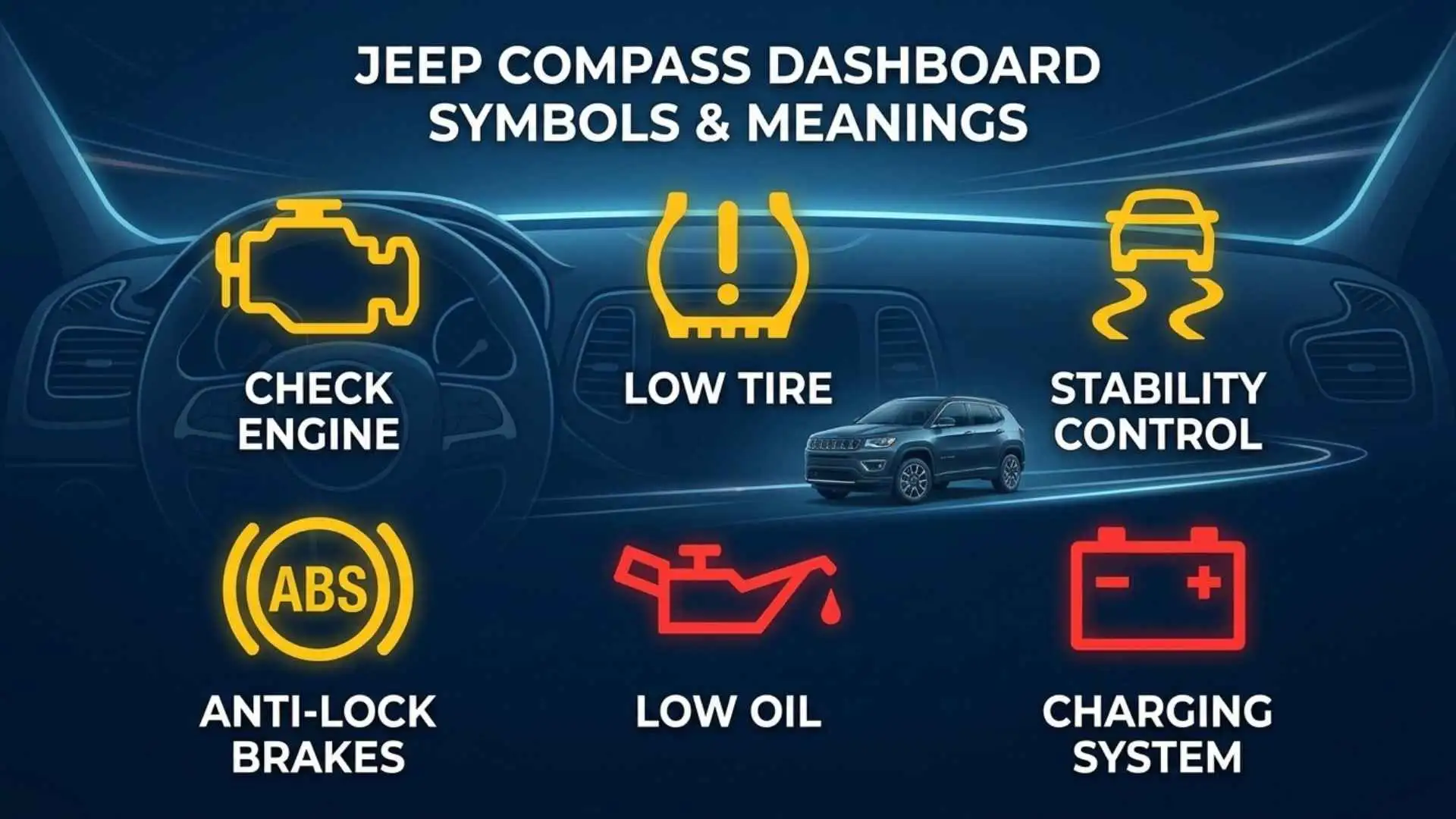
Jeep Compass dashboard symbols communicate the condition of the engine, brakes, tires, safety systems, four-wheel drive, driver-assistance features, and other vehicle functions. Some lights simply confirm that a feature is active, while others warn that the vehicle may need immediate attention.
Understanding Jeep Compass dashboard symbols and meanings can help you avoid unnecessary worry, recognize developing problems, and know when it is unsafe to continue driving. Symbols can vary slightly by model year, trim level, instrument cluster, engine, and optional equipment, so always compare a warning with the owner’s manual for your exact vehicle.
Quick Meaning
Jeep Compass dashboard lights use colors and symbols to show vehicle status. Red usually signals an urgent safety or mechanical problem, yellow indicates a fault or condition that needs attention, green or white confirms an active feature, and blue commonly identifies high-beam headlights. A flashing warning is generally more urgent than a steady light.
Jeep Compass Dashboard Symbol Overview
| Symbol or Light | Primary Meaning | Typical Color | Recommended Response |
| Oil can | Low engine oil pressure | Red | Stop the engine safely |
| Battery | Charging-system fault | Red | Reduce electrical use and seek service |
| Thermometer in liquid | Engine overheating | Red | Stop and allow the engine to cool |
| BRAKE or circle with exclamation mark | Brake-system or parking-brake warning | Red | Check parking brake and brake system |
| ABS | Anti-lock braking system fault | Yellow | Drive cautiously and arrange service |
| Engine outline | Check-engine or emissions fault | Yellow | Diagnose soon; stop if flashing |
| Tire with exclamation mark | Low tire pressure or TPMS fault | Yellow | Inspect and inflate tires |
| Person with airbag | Airbag-system problem | Red | Have the restraint system inspected |
| Steering wheel with exclamation mark | Electric power-steering fault | Red or yellow | Steering may become difficult |
| Skidding vehicle | Electronic Stability Control activity or fault | Yellow | Adjust driving or seek service |
| Fuel pump | Low fuel | Yellow | Refuel soon |
| Windshield spray symbol | Low washer fluid | Yellow | Add washer fluid |
| Seat belt figure | Seat belt not fastened | Red | Fasten seat belt |
| Door, hood, or liftgate outline | Panel is open | Red | Close and latch securely |
| 4WD LOCK | Four-wheel-drive lock active | Yellow | System status indicator |
| SVC 4WD | Four-wheel-drive system fault | Yellow | Arrange inspection |
| Lane lines and vehicle | Active Lane Management status | White, green, or yellow | Follow display message |
| Vehicle with collision star | Forward Collision Warning status | Yellow | Check system or settings |
| A inside circular arrow | Stop/Start system status | Green or yellow | Active or service required |
| Cruise-control speedometer | Cruise control ready or set | White or green | System status indicator |
| Headlamp with straight beams | High beams on | Blue | Dim for approaching traffic |
The official 2025 Jeep Compass Quick Start Guide groups dashboard lights by color and includes brake, battery, oil-pressure, engine-temperature, transmission, four-wheel-drive, TPMS, driver-assistance, lighting, cruise-control, and Stop/Start indicators.
What Do Jeep Compass Dashboard Symbols Mean?
Jeep Compass dashboard symbols are a visual language designed to communicate quickly without requiring the driver to read a long message. The shape identifies the affected system, while the color and behavior of the light indicate severity.
A light appearing briefly when you start the vehicle is not necessarily a problem. During startup, many warning lamps illuminate as part of a self-check. They should usually turn off after the engine starts. A symbol that remains illuminated, appears while driving, flashes, or is accompanied by a warning chime requires closer attention.
The instrument-cluster display may also provide text such as “Service 4WD,” “Low Tire Pressure,” or “Stop Safely Vehicle Will Shut Off Soon.” Always read the message because it can clarify what the symbol means and how urgent the condition is.
What the Dashboard Light Colors Mean
Red dashboard lights indicate an urgent condition, a safety reminder, or a serious system fault. Red oil-pressure, brake, charging-system, or engine-temperature warnings should never be ignored.
Yellow or amber lights usually mean a system needs attention, has been switched off, or is temporarily unavailable. You may often continue driving cautiously, but the cause should be investigated.
Green lights confirm that a feature is operating. Examples include turn signals, front fog lamps, cruise control set, and Stop/Start active.
White lights commonly show that a system is ready, enabled, or waiting to engage. Cruise control and Active Lane Management may use white indicators in certain operating states.
Blue lights normally identify high-beam headlights.
Color meaning is important, but it is not the only factor. A flashing yellow check-engine light can be more serious than a steady red seat-belt reminder. Consider the symbol, color, vehicle behavior, accompanying message, and whether the light flashes.
History and Development of Dashboard Warning Symbols
Automotive dashboard symbols developed as vehicles gained more electrical, mechanical, and safety systems. Early vehicles relied on basic gauges for fuel level, oil pressure, speed, and coolant temperature. As cars became more complex, manufacturers added standardized pictograms that drivers could recognize regardless of language.
Modern Jeep Compass models combine internationally familiar symbols with brand- and system-specific indicators. Basic warnings such as the oil can, battery, fuel pump, and thermometer remain easy to recognize. Newer lights represent technologies that did not exist on earlier dashboards, including Forward Collision Warning, Active Lane Management, adaptive cruise control, electronic parking brakes, and automatic Stop/Start.
The symbols have also evolved from simple bulbs to high-resolution digital graphics. A current Compass cluster can display changing colors, pop-up messages, vehicle diagrams, lane markings, and system animations. This gives drivers more information than a traditional warning lamp alone.
Although many icons look similar across vehicles, their exact operation can differ. Jeep advises owners to use the manual selected for their vehicle’s model year because standard and optional equipment varies.
Red Jeep Compass Warning Lights
Red lights deserve immediate attention. Some are reminders, but several warn of conditions that can damage the vehicle or compromise safety.
Oil Pressure Warning Light
The red oil-can symbol means the engine may not be receiving adequate oil pressure. It does not simply mean that an oil change is due.
Move to a safe location, switch off the engine, and check the oil level after waiting a few minutes. If the level is low, add the correct oil only if you can do so safely. Do not continue driving if the light remains on after the oil level is corrected. Low oil pressure can quickly cause major internal engine damage.
Battery Charge Warning Light
The red battery symbol indicates that the charging system is not operating correctly. Possible causes include an alternator problem, damaged drive belt, wiring fault, weak battery, or poor electrical connection.
Turn off nonessential electrical accessories and drive only as far as necessary to reach a safe place or repair facility. The engine may eventually stop once stored battery power is depleted. Jeep notes that alternator faults and poor electrical connections can prevent proper battery charging.
Engine Temperature Warning Light
A red thermometer over waves means the engine coolant temperature is too high. Turn off the air conditioning, reduce engine load, and pull over safely.
Allow the engine to cool before checking coolant. Never remove a pressurized coolant cap while the engine is hot because scalding fluid and steam can escape. Continuing to drive an overheating vehicle can damage the cylinder head, head gasket, turbocharger, or other engine components.
Brake Warning Light
The red BRAKE symbol or red circle with an exclamation mark may indicate:
- The parking brake is applied
- Brake fluid is low
- A hydraulic brake-system fault exists
- The electronic brake-force system has detected a problem
First make sure the parking brake is fully released. If the warning remains illuminated, stop safely and arrange an inspection. A brake pedal that feels soft, travels unusually far, or provides reduced stopping power requires immediate assistance.
Airbag Warning Light
The airbag symbol shows a seated person with a circle in front. If it stays on after startup, the Supplemental Restraint System may have a fault.
The airbags, seat-belt pretensioners, crash sensors, or associated wiring may not function as intended in a collision. Normal driving may still be possible, but the system should be inspected promptly.
Electric Power Steering Fault
A steering wheel with an exclamation mark signals a problem with the electric power-steering system. Steering assistance may be reduced or lost, making the wheel much harder to turn, especially at low speeds.
Slow down, avoid abrupt maneuvers, and stop safely. Restarting the vehicle may clear a temporary condition, but a persistent warning requires professional diagnosis.
Transmission Fault or Temperature Light
A red gear or transmission symbol indicates a serious transmission fault. A separate temperature symbol may mean the transmission fluid is overheating.
Pull over safely, shift into Park, and follow the cluster message. Towing, steep climbs, heavy traffic, hot weather, or internal transmission problems can raise temperatures. Continuing under severe overheating conditions may damage the transmission.
Door, Hood, or Liftgate Open
A vehicle outline showing an open door, hood, or liftgate means the indicated panel is not securely latched. Stop before entering traffic or reaching higher speeds and close it firmly.
These warnings may appear red because an unlatched panel creates a safety risk, even though the vehicle may not have a mechanical fault.
Seat Belt Reminder
The red seat-belt symbol means a driver or passenger seat belt is not fastened. The warning may flash and sound a chime until the occupied seating position is buckled.
Objects placed on a passenger seat can sometimes activate the occupancy sensor. Secure heavy items rather than placing them loose inside the cabin.
Yellow and Amber Jeep Compass Warning Lights
Yellow lights normally allow more time to react than red warnings, but they should not be ignored.
Check Engine Light
The engine-shaped Malfunction Indicator Light monitors the engine-management and emissions systems.
A steady check-engine light may result from an emissions-control issue, sensor fault, fuel-system problem, ignition problem, or loose fuel cap. The vehicle may continue to operate, but diagnosis should be scheduled.
A flashing check-engine light often indicates active misfiring that can overheat and damage the catalytic converter. Reduce speed and engine load, avoid hard acceleration, and seek service immediately.
Tire Pressure Monitoring System Light
The TPMS symbol resembles a tire cross-section with an exclamation mark. A steady light usually means one or more tires are significantly underinflated.
Check all tires when cold and inflate them to the pressure shown on the driver’s door-jamb label, not the maximum pressure molded into the tire sidewall.
If the light flashes for approximately a minute and then remains on, the monitoring system itself may have a malfunction. Changes in outdoor temperature can also lower tire pressure enough to activate the warning.
Anti-Lock Brake System Light
The yellow ABS light means the anti-lock braking function has detected a fault. Standard braking may remain available, but the wheels could lock during hard braking.
Drive cautiously, leave additional stopping distance, and have the system checked. If the red brake warning also appears, the problem may be more serious and the vehicle should be stopped safely.
Electronic Stability Control Active Light
The skidding-car symbol flashes when Electronic Stability Control is actively helping correct wheel slip or loss of directional control.
A flashing light is usually normal on snow, gravel, mud, wet pavement, or during aggressive cornering. Ease off the accelerator and steer smoothly.
If the light remains on continuously, the system may be disabled or have a fault.
Electronic Stability Control Off
The skidding-car symbol with “OFF” means stability control has been switched off or partially reduced. This may be useful in limited off-road situations, but normal road driving is safer with the system enabled.
Some traction functions may automatically return at higher speeds or after restarting the vehicle.
Electronic Throttle Control Light
The lightning-bolt symbol between curved brackets represents the Electronic Throttle Control system. A fault may affect the accelerator pedal, throttle body, sensors, wiring, or engine-management software.
The engine may enter reduced-power mode. If the light flashes or the vehicle responds poorly to the accelerator, stop in a safe location and seek service.
Low Fuel Light
The yellow fuel-pump icon means the fuel level is low. Refuel as soon as practical.
Frequently driving with very little fuel can leave you stranded and may expose the fuel pump to higher temperatures. The remaining range shown by the vehicle is an estimate, not a guarantee.
Low Washer Fluid Light
A windshield with spray above it means the windshield-washer reservoir is low. Add an appropriate washer solution, especially before driving in rain, snow, dust, or road salt.
This light does not indicate a coolant problem. The windshield shape distinguishes it from the engine-temperature symbol.
Low Coolant Level
A coolant-container or liquid-level symbol means the engine coolant level is low. Check the reservoir only after the engine has cooled.
Low coolant may result from gradual loss, an external leak, a damaged hose, a radiator issue, or another cooling-system problem. Repeatedly adding coolant without finding the cause is not a proper repair.
Electronic Parking Brake Warning
A yellow circle containing a “P” and exclamation mark points to an electronic parking-brake fault. The brake may not apply or release correctly.
Park on level ground when possible and follow the instrument message. Do not assume the vehicle is securely held until the system is confirmed to be working.
Service Stop/Start System
A yellow “A” surrounded by a circular arrow, often with an exclamation mark, indicates that the automatic Stop/Start system requires service.
The normal Stop/Start function shuts the engine off under suitable conditions while the vehicle is stopped. If the system malfunctions, the engine generally continues running instead of entering an automatic stop. Jeep’s Quick Start Guide states that a malfunction prevents automatic engine shutdown and produces a cluster message.
Forward Collision Warning
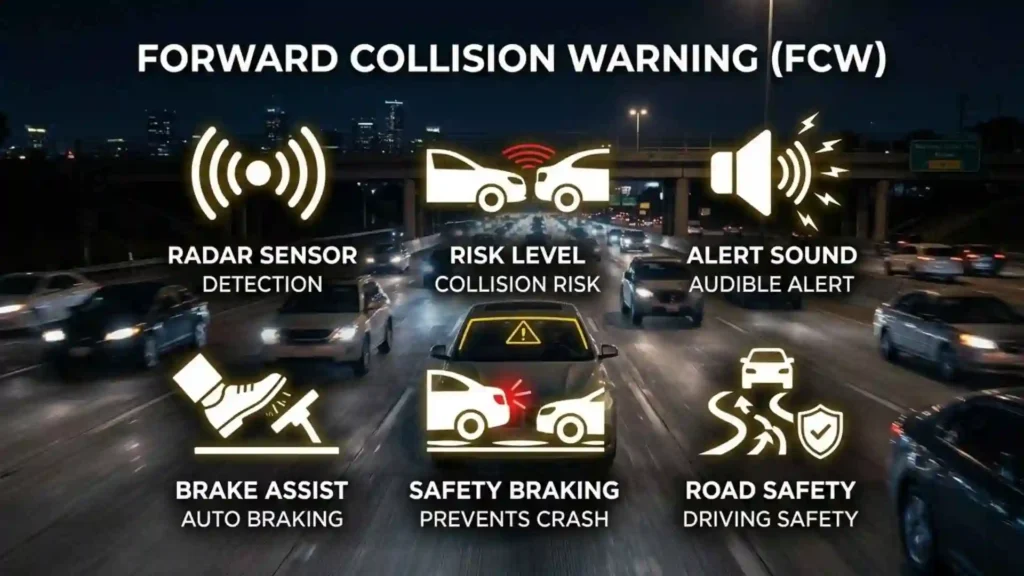
A symbol showing two vehicles or a vehicle approaching a collision star relates to Forward Collision Warning.
A warning may appear when the system detects a possible frontal collision. The system can provide visual and audible alerts and, depending on settings and equipment, limited braking assistance. It does not replace attentive driving.
A yellow FCW OFF light means the feature has been disabled. A “Service Forward Collision Warning” message means the system has detected a fault or is unavailable.
Active Lane Management Warning
A vehicle between lane lines represents Active Lane Management. The icon’s color and lane markings indicate whether the system is available, armed, correcting the vehicle’s path, or requesting driver attention.
The Compass may provide a cluster warning, steering-wheel vibration, steering torque, or steering assistance when it detects an unintended lane departure. Its response depends on visible lane markings, turn-signal use, road conditions, and selected settings.
Snow, heavy rain, dirt, faded markings, construction zones, or blocked cameras can limit operation.
Service Adaptive Cruise Control
A speedometer or vehicle-distance icon accompanied by a service message means Adaptive Cruise Control is unavailable or faulty.
Clean the forward-facing sensor or camera area if road grime, snow, or ice is present. If the warning remains, arrange service. Use normal accelerator and brake control until the system is restored.
Four-Wheel-Drive and Off-Road Symbols
Jeep Compass models equipped with four-wheel drive include indicators that communicate drivetrain modes and faults.
4WD Lock
The “4WD LOCK” symbol means the system has been commanded to distribute power for increased traction. It is a status light rather than a general failure warning.
Use the mode according to road and trail conditions. Four-wheel drive improves traction but does not reduce braking distance on ice or eliminate the risk of skidding.
4WD Low
The “4WD LOW” indicator appears only on versions equipped with a low-range or specialized low-speed off-road function. It confirms that the low-range mode is engaged.
Use it for suitable low-speed conditions, such as steep terrain, loose surfaces, or controlled off-road travel. It is not intended for routine highway driving.
Service 4WD
“SVC 4WD” means the four-wheel-drive system has detected a malfunction. The vehicle may remain drivable, but off-road capability and torque distribution may be limited.
Avoid demanding terrain, deep mud, towing, or other high-load situations until the system is inspected.
Hill Descent Control
The downhill vehicle icon represents Hill Descent Control. When active, the system helps regulate speed on steep descents so the driver can concentrate on steering.
The light may change color or flash if operating conditions are not met. Hill Descent Control supplements careful driving and does not overcome poor traction.
Green, White, and Blue Indicator Lights
These colors normally communicate status rather than faults.
Turn Signal Indicators
Green arrows flash when the left or right turn signal is operating. Both arrows flash with the hazard lights.
A signal that flashes unusually fast may indicate a failed exterior bulb or lighting-system issue.
High-Beam Indicator
The blue headlamp symbol means the high-beam headlights are on. Switch to low beams when approaching other vehicles or following traffic closely.
Automatic High-Beam Indicator
A green headlamp marked with an “A” means the automatic high-beam feature is enabled. The system may switch between high and low beams according to traffic and lighting conditions.
The driver remains responsible for selecting appropriate lighting.
Front Fog Light
A green lamp symbol with angled beams means the front fog lights are on. Fog lights improve near-ground illumination but should not be treated as a substitute for normal headlights.
Parking Lights or Headlights On
A green paired-lamp symbol indicates that the parking lights or exterior headlights are illuminated.
Cruise Control Ready and Set
A white speedometer icon usually means cruise control is switched on but not set. A green icon means a speed has been selected and the system is controlling vehicle speed.
Adaptive Cruise Control may also show whether a target vehicle has been detected.
Stop/Start Active
A green “A” in a circular arrow means the Stop/Start system has automatically stopped the engine. The engine should restart when driving conditions require it, such as when the brake is released.
Active Lane Management Status
A white lane-management symbol often means the system is enabled but not currently armed. Green generally indicates that lane information is detected and assistance is available or active.
Technical Meaning and Diagnostic Importance
Dashboard symbols are outputs from the Compass’s electronic control modules. Sensors monitor wheel speed, tire pressure, battery voltage, engine temperature, oil pressure, emissions, steering angle, braking, cameras, radar units, and drivetrain operation.
When a control module detects a value outside its expected range, it may:
- Illuminate a warning light.
- Store a diagnostic trouble code.
- Display a text message.
- Sound a chime.
- Disable the affected feature.
- Place the vehicle in reduced-power or protective mode.
A warning light identifies the system, but it rarely identifies the failed part. For example, an ABS light does not prove that the ABS control module has failed. The cause might be a wheel-speed sensor, wiring connection, damaged tone ring, low voltage, or communication problem.
Proper diagnosis may require a scan tool that can access Jeep-specific modules rather than only generic engine codes.
Where Jeep Compass Dashboard Symbols Appear
Most symbols appear in the instrument cluster directly behind the steering wheel. Depending on model year and configuration, related information may also appear:
- In the digital driver-information display
- In the Uconnect touchscreen
- Beside gauges or vehicle diagrams
- In warning-message menus
- In stored vehicle-alert screens
- In the Jeep mobile application on supported connected vehicles
- In the owner’s manual or Quick Start Guide
The cluster may combine a symbol with text, such as “Service Stop/Start System,” “Check Fuel Cap,” or “Tire Pressure Low.” Read the full message before dismissing it.
Common Symbol Variations
Jeep Compass warning lights differ across generations and markets. A 2018 Compass may not display exactly the same icon design or driver-assistance indicators as a 2025 model.
Common variations include:
- A word such as “BRAKE” instead of a pictogram
- Red or yellow versions of the same system icon
- A symbol accompanied by an exclamation mark
- White, green, and yellow lane-assistance graphics
- A full-color vehicle diagram instead of a simple door icon
- Text messages that replace or supplement traditional lamps
- Different adaptive-cruise icons depending on whether a target is detected
- Symbols for equipment that is optional or unavailable on some trims
The official 2025 guide, for example, lists separate indicators for adaptive cruise control with a target and without a target, as well as different Active Lane Management states.
Common Misconceptions
Every Red Light Means the Engine Must Be Shut Off
Not always. A red seat-belt or door-open warning may only require fastening or closing something. However, red oil-pressure, temperature, charging, transmission, and brake warnings can signal serious problems.
The Oil Light Means It Is Time for an Oil Change
The red oil-can light normally refers to oil pressure, not routine maintenance. An oil-change reminder is a separate message based on service intervals and operating conditions.
The Battery Symbol Means the Battery Alone Is Bad
The battery light represents the charging system. The alternator, belt, wiring, terminals, control circuits, or battery may be responsible.
ABS Means the Brakes Have Completely Failed
An ABS fault often disables anti-lock operation while basic braking remains available. Nevertheless, braking behavior can change, and a simultaneous red brake light may indicate a more serious condition.
Four-Wheel Drive Prevents All Skids
Four-wheel drive helps the vehicle accelerate on low-traction surfaces. It cannot guarantee grip while braking or cornering.
Clearing a Warning Code Repairs the Problem
Deleting a fault code only turns off the warning temporarily. If the underlying condition remains, the light will return.
Driver-Assistance Lights Mean the Vehicle Can Drive Itself
Forward Collision Warning, Active Lane Management, and Adaptive Cruise Control are support systems. The driver must remain attentive, keep control of the vehicle, and respond to road conditions.
Interesting Facts About Jeep Compass Dashboard Symbols
- Several lights illuminate during startup on purpose. This bulb check helps confirm that warning lamps and cluster electronics are functioning.
- The same symbol can have multiple meanings based on color. A green lane icon may show active assistance, while a yellow version may signal limited operation or a fault.
- Cold weather can trigger TPMS warnings without a puncture. Tire pressure decreases as ambient temperature falls, although the tire should still be checked.
- A flashing light usually carries more urgency. Flashing check-engine, stability-control, or security indicators communicate active or changing conditions.
- Low battery voltage can create multiple warnings. Electronic systems may report unrelated faults when system voltage becomes unstable.
- Camera-based systems can become temporarily unavailable. Snow, fog, dirt, glare, faded lane markings, and heavy rain can prevent proper detection.
- Cruise-control symbols change with system state. The cluster may distinguish between ready, set, adaptive operation, and target-vehicle detection.
- The oil-pressure light is not an oil-level gauge. A vehicle can have oil in the engine yet still lack proper pressure because of a pump, pickup, filter, or internal problem.
- Some yellow lights describe a disabled feature rather than damage. ESC OFF and FCW OFF may appear because the driver intentionally changed a setting.
- The cluster is only the first step in diagnosis. Stored fault codes and live sensor data are often needed to identify the actual cause.
Related Jeep Compass Symbols
Maintenance Reminder
An oil-life or service message indicates scheduled maintenance rather than an immediate loss of oil pressure. Follow the maintenance information for the vehicle’s model year and operating conditions.
Security Indicator
A red security light may flash when the immobilizer or alarm system is armed. If it remains on or flashes unexpectedly while attempting to start, the key or security system may not be recognized.
Fuel Cutoff Indicator
The fuel-cutoff symbol may appear after an impact or event that causes the system to interrupt fuel delivery. Follow the cluster instructions and owner’s manual before attempting a reset.
Towing Hook Breakdown Symbol
Some Compass clusters include a towing-hook or breakdown indicator. It relates to roadside recovery or a vehicle condition requiring assistance, depending on the accompanying message.
Immobilizer or Vehicle Protection System Warning
A key-and-lock symbol can indicate that the immobilizer, key recognition, or vehicle-protection system has detected a fault.
Frequently Asked Questions
What is the most serious Jeep Compass dashboard warning light?
Oil-pressure, engine-temperature, brake-system, charging-system, steering, and transmission warnings can all be serious. The correct response depends on the symbol and vehicle behavior. Stop safely for any red mechanical warning, especially when accompanied by unusual noises, smoke, overheating, weak braking, heavy steering, or loss of power.
Can I drive my Jeep Compass with the check-engine light on?
You can often drive a short distance with a steady check-engine light if the vehicle runs normally. Avoid heavy acceleration and schedule diagnosis promptly. Do not continue normal driving with a flashing light, severe shaking, smoke, overheating, or major power loss because catalytic-converter or engine damage may occur.
Why did several warning lights appear at once?
Multiple warnings can result from low battery voltage, a charging-system fault, a damaged wheel-speed sensor, communication failure, or one system affecting several others. Restarting may clear a temporary glitch, but persistent lights require a scan of all relevant modules rather than guessing from one symbol.
How do I reset Jeep Compass dashboard lights?
A light should be reset only after the cause has been corrected. Some indicators turn off automatically after normal readings return. Others require a completed drive cycle or diagnostic scan tool. Disconnecting the battery or deleting codes may erase useful information without repairing the fault.
What does the exclamation mark on a Jeep Compass mean?
The meaning depends on the surrounding shape. Inside a tire, it indicates low pressure or a TPMS fault. Inside a brake circle, it relates to the brake system or parking brake. Beside a steering wheel, gear, or lane symbol, it identifies a fault in that specific system.
Why is the tire-pressure light still on after inflating the tires?
The pressure may still be below the door-jamb specification, another tire may be low, or the system may need several minutes of driving to update. A flashing-then-steady light suggests a sensor or TPMS malfunction. Check pressures with an accurate gauge when the tires are cold.
What does the lightning-bolt symbol mean on a Jeep Compass?
The lightning bolt between curved lines represents Electronic Throttle Control. It means the system controlling throttle opening has detected a problem. The vehicle may hesitate or enter reduced-power mode. Stop safely if performance is severely affected, and arrange diagnostic service if the light remains on.
Why is the Stop/Start light yellow?
A yellow Stop/Start symbol usually means the system is unavailable or requires service. Temporary conditions such as battery charge, engine temperature, cabin heating or cooling demand, and other operating requirements can also prevent automatic stopping. A service message indicates that inspection may be necessary.
What does “Service 4WD” mean on a Jeep Compass?
“Service 4WD” means the four-wheel-drive control system has detected a malfunction. The vehicle may continue moving, but power distribution or selectable terrain functions may be limited. Avoid difficult terrain and high-load driving until the system is inspected by a qualified technician.
Where can I find the exact meaning for my model year?
Use the owner’s manual or Quick Start Guide issued for the exact year, market, trim, and equipment package. Jeep and Mopar provide online vehicle manuals that include dashboard indicators, system operation, maintenance guidance, and safety warnings.
Key Takeaways
- Red lights often require immediate action, especially oil-pressure, brake, temperature, battery, steering, and transmission warnings.
- Yellow lights usually identify a fault, disabled system, or condition that needs attention.
- Green, white, and blue indicators normally confirm that a feature is ready or active.
- A flashing warning is generally more urgent than a steady warning.
- Read the instrument-cluster message as well as the symbol.
- Do not confuse the oil-pressure warning with an oil-change reminder.
- Four-wheel drive improves traction but cannot prevent every skid.
- Driver-assistance systems do not replace attentive driving.
- Symbol design and availability vary by Jeep Compass model year and equipment.
- Consult the correct owner’s manual whenever a warning remains unclear.
Conclusion
Knowing Jeep Compass dashboard symbols and meanings allows you to separate normal system indicators from warnings that demand immediate action. Green and white lights commonly report feature status, yellow lights signal caution or service needs, and red mechanical warnings may require you to stop the vehicle.
Treat every unfamiliar light as useful information rather than an annoyance. Read the accompanying message, notice how the Compass is behaving, and consult the manual for your exact model year. A quick, informed response can protect the vehicle, reduce repair costs, and keep everyone inside it safer.

I am Daniel Brooks, a language researcher and writer with a strong interest in how people use English in everyday conversations. I contribute to LearnNestly because I enjoy turning confusing language topics into straightforward lessons. My goal is to help readers understand not only what a word or phrase means, but also when and how to use it naturally. I focus on clear examples, practical explanations, and useful language knowledge that readers can remember.
Books:
- The Practical English Guide
- Understanding Everyday Words
 Ethan Mitchell
 Amelia Carter