Guitar symbols help musicians understand how to read music, play chords, follow rhythms, and perform different guitar techniques. Whether you are learning your first song or improving your playing skills, understanding these symbols makes guitar music easier to follow. From musical notes and chord diagrams to guitar tablature (tabs), each symbol provides important information about which notes to play and how to produce the right sound.
There are many types of guitar symbols, and each has a specific purpose. Guitar tab symbols show where to place your fingers on the fretboard, while chord symbols such as C, G, Am, and D tell you which chords to play. Other symbols represent techniques like hammer-ons, pull-offs, slides, bends, palm muting, and vibrato. Learning these signs can help you read guitar tabs accurately, understand sheet music, and play songs with better timing and expression.
In this complete guide to guitar symbols, you will learn the meanings of common music notation signs, guitar tab symbols, chord diagrams, rhythm markings, and playing techniques. You will also discover how to recognize these symbols in guitar lessons, songbooks, and online tabs. Whether you play acoustic or electric guitar, this beginner-friendly guide will help you understand guitar notation and build confidence as you practice your favorite songs.
Quick Meaning of Guitar Symbols
Guitar symbols are written signs used to communicate notes, chords, rhythm, fingering, articulation, and playing techniques. Their exact meaning depends on the notation system. Standard notation shows musical pitch and timing, tablature shows fret positions, chord diagrams show finger placement, and technique symbols explain how a note should sound.
Guitar Symbols Overview Table
| Field | Details |
| Symbol category | Musical and technical notation |
| Primary purpose | To show what and how to play |
| Main systems | Standard notation, tablature, chord diagrams, rhythm notation |
| Historical origin | Western musical notation and instrument-specific tablature |
| Common users | Guitarists, teachers, composers, arrangers, and songwriters |
| Common locations | Sheet music, tabs, lead sheets, lesson books, and music apps |
| Basic elements | Notes, rests, numbers, lines, letters, stems, and technique marks |
| Modern meaning | A visual language for guitar performance |
| Digital use | Notation software, online tab sites, mobile apps, and digital scores |
| Related symbols | Chord names, clefs, time signatures, dynamics, and repeat signs |
What Do Guitar Symbols Mean?
Guitar symbols provide instructions for performing music on an acoustic, electric, classical, or bass guitar. No single symbol system communicates everything equally well, so guitar music often combines several methods.
Standard musical notation communicates pitch, rhythm, tempo, dynamics, and musical structure. It allows musicians to understand the composition even when they do not know the original recording.
Guitar tablature, usually called tab, focuses on the physical location of notes. It tells the player which string and fret to use. Tab is often easier for beginners because it does not require immediate knowledge of note names on the musical staff.
Chord diagrams show the shape of a chord on the fretboard. They help guitarists place their fingers correctly but usually do not communicate exact rhythm.
Technique symbols add performance details. They explain whether the guitarist should bend, slide, mute, tap, sustain, or decorate a note. These marks are especially common in rock, blues, metal, jazz, country, and fingerstyle music.
History and Origin of Guitar Symbols
Guitar notation developed from older systems used for voices and stringed instruments. Medieval European musicians gradually created staff notation to preserve melody and rhythm. Over time, this system became the foundation of modern Western written music.
The Development of Standard Notation
Early musical notation did not show pitch and rhythm with the precision of a modern score. Staff lines, clefs, note shapes, and rhythmic values evolved over centuries as composers needed a more reliable way to preserve increasingly complex music.
The modern guitar normally uses the treble clef. Guitar music is written one octave higher than it sounds, although this difference is not always marked clearly in ordinary scores.
The Origins of Tablature
Tablature existed long before modern online guitar tabs. Musicians used instrument-specific systems for the lute, vihuela, organ, and other instruments during the Renaissance.
Unlike standard notation, tablature represented physical playing actions. It indicated where a musician should place a finger rather than only naming the resulting pitch.
Modern six-line guitar tab follows the same general principle. Each line represents a string, and each number represents a fret.
Chord Symbols and Popular Music
Letter-based chord symbols became increasingly important in jazz, folk, blues, country, and popular music. A symbol such as C, Am, G7, or F♯m7 gives the harmonic identity of a chord without requiring a fully written arrangement.
Lead sheets later combined melody notation, lyrics, and chord names. This flexible format allows performers to create their own accompaniment patterns.
Digital Guitar Notation
Music software and online publishing introduced more standardized layouts for bends, slides, harmonics, and other techniques. However, notation still varies among publishers, websites, and apps. A symbol should always be interpreted in context and checked against any legend provided with the music.
Standard Music Notation Symbols for Guitar
Standard notation gives the most complete description of musical timing and structure. Guitarists should recognize the following basic symbols.
Treble Clef
The treble clef identifies the pitch range shown on the five-line staff. Most guitar music uses this clef.
The lines of the treble staff represent E, G, B, D, and F from bottom to top. The spaces represent F, A, C, and E. Guitar notes sound one octave lower than their written position.
Notes
A note has a head and may also have a stem, flag, or beam. Its vertical position shows pitch, while its shape shows duration.
Common note values include:
- Whole note: four beats in common time
- Half note: two beats
- Quarter note: one beat
- Eighth note: half a beat
- Sixteenth note: one-quarter of a beat
These values depend on the time signature and musical context.
Rests
Rests indicate silence. Each rest corresponds to a note value, such as a whole rest, half rest, quarter rest, or eighth rest.
Silence is part of the rhythm. Ignoring a rest changes the timing just as surely as playing the wrong note.
Time Signature
The time signature appears near the beginning of a piece. In 4/4 time, the top number indicates four beats per measure, while the bottom number indicates that the quarter note receives one beat.
Other common signatures include 3/4, 2/4, 6/8, and 12/8.
Key Signature
Sharps or flats placed after the clef form the key signature. They indicate which notes are normally raised or lowered throughout the piece.
A key signature helps identify the tonal center, but it does not always reveal whether the music is in a major or minor key without additional context.
Sharps, Flats, and Naturals
A sharp symbol raises a note by one semitone. A flat lowers it by one semitone. A natural cancels a previous sharp or flat.
Accidentals usually remain active for the rest of the measure unless another accidental changes the note.
Dots, Ties, and Slurs
A dot after a note adds half of the note’s original duration. A dotted quarter note, for example, lasts one and a half beats in 4/4 time.
A tie connects two notes of the same pitch so their durations combine.
A slur connects different pitches and suggests smooth phrasing. On guitar, a slur may also indicate a hammer-on or pull-off, depending on the passage.
Repeat Signs
Repeat signs tell the musician to play a section again. They look like double bar lines with dots facing the music to be repeated.
First and second endings provide different conclusions for repeated sections. Other navigation terms include D.C., D.S., Coda, and Fine.
Guitar Tablature Symbols and Meanings
A guitar tab usually contains six horizontal lines. The top line represents the high E string, while the bottom line represents the low E string.
Numbers show fret positions:
- 0 means an open string
- 1 means the first fret
- 5 means the fifth fret
- 12 means the twelfth fret
Numbers placed vertically indicate notes played together. Numbers arranged from left to right indicate the order of notes.
h: Hammer-On
The letter h means hammer-on. A tab written as 5h7 instructs the guitarist to pick the fifth fret and forcefully place another finger on the seventh fret without picking again.
The second note should sound through the impact of the fretting finger.
p: Pull-Off
The letter p means pull-off. A figure such as 7p5 tells the guitarist to play the seventh fret and remove that finger so the note at the fifth fret sounds.
A controlled downward or upward release often produces a clearer note than simply lifting the finger.
/ and : Slides
A forward slash generally represents an upward slide, while a backslash represents a downward slide.
For example:
- 5/7 means slide from fret 5 to fret 7
- 7\5 means slide from fret 7 to fret 5
Some tabs use a single slash without giving a starting or ending fret. This may represent sliding into or out of a note.
b: Bend
The letter b indicates a string bend. A figure such as 7b9 means to play the seventh fret and bend the string until it reaches the pitch normally found at the ninth fret.
The target pitch matters more than the physical distance of the bend.
Common bend descriptions include:
- Half-step bend
- Whole-step bend
- One-and-a-half-step bend
- Quarter-tone bend
- Pre-bend
- Bend and release
r: Release
The letter r means release a bent note. For example, 7b9r7 tells the player to bend the seventh-fret note to the pitch of the ninth fret and then return to the original pitch.
~ or Wavy Line: Vibrato
A tilde or wavy line indicates vibrato. The guitarist repeatedly changes the pitch slightly to make the note more expressive.
Wide vibrato creates a dramatic effect, while narrow vibrato sounds more subtle. The musical style should guide the speed and width.
x: Muted or Dead Note
An x indicates a muted note. The player touches the string without pressing it firmly to the fret, producing a short percussive sound rather than a clear pitch.
Muted notes are common in funk, rock, reggae, and rhythm guitar patterns.
PM or P.M.: Palm Muting
The letters PM indicate palm muting. The guitarist places the edge of the picking hand lightly against the strings near the bridge.
Palm muting creates a controlled, heavy, or percussive tone. A dashed line often shows how long the technique should continue.
T or t: Tapping
The letter T usually represents tapping. A finger from the picking hand strikes a fret on the fingerboard to sound a note.
Tapping may be combined with hammer-ons and pull-offs to create rapid legato passages.
Harmonic Symbols
Natural harmonics may appear as <12>, [12], or a diamond-shaped note in standard notation. The player lightly touches the string above a harmonic node rather than pressing it to the fretboard.
Artificial, tapped, and pinch harmonics may use abbreviations such as A.H., T.H., or P.H. The exact format depends on the publisher.
Trill
The abbreviation tr indicates a trill. The guitarist rapidly alternates between two nearby notes, often by repeating hammer-ons and pull-offs.
Tremolo Picking
Repeated diagonal strokes or a written abbreviation may indicate tremolo picking. The player rapidly picks the same note for the marked duration.
This technique appears in classical guitar, surf rock, metal, mandolin-like textures, and dramatic soundtrack music.
Let Ring
The instruction “let ring” means that notes should continue sounding rather than being stopped immediately. Dashed lines may show the length of the sustain.
This marking is common in arpeggios, acoustic patterns, and passages with overlapping harmony.
Chord Diagram Symbols
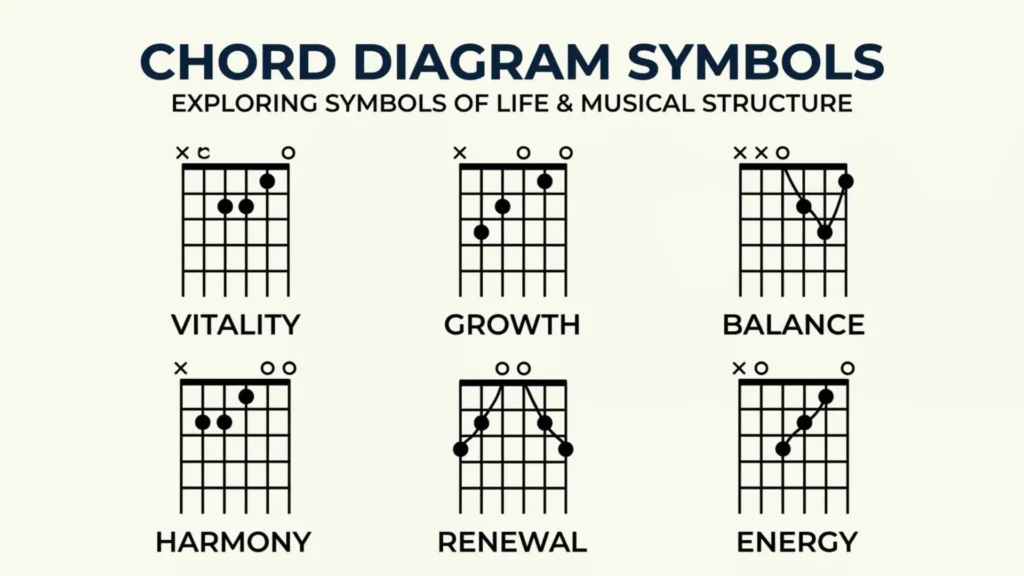
Chord diagrams represent a small section of the guitar neck. Vertical lines stand for strings, and horizontal lines stand for frets.
Black Dots
Black dots show where to place the fretting fingers. Finger numbers may appear inside or below the dots:
- Index finger
- Middle finger
- Ring finger
- Little finger
O Above a String
An open circle means the string should be played open. The player does not press a fret on that string.
X Above a String
An X above a string means the string should not be played. The player may avoid it with the picking hand or lightly mute it with a nearby finger.
Curved or Straight Bar
A bar across several strings indicates a barre. One finger, usually the index finger, presses multiple strings at the same fret.
Fret Position Number
A number beside the diagram may show that the chord shape begins higher than the first fret. This prevents confusion when a movable shape is used farther up the neck.
Symbolism and Interpretation of the Guitar
Beyond written notation, the guitar itself has symbolic meaning. It often represents creativity, personal expression, freedom, rebellion, romance, memory, and cultural identity.
In folk traditions, the guitar can symbolize storytelling and community. In blues music, it often communicates hardship, endurance, and emotional honesty. Rock culture frequently connects the electric guitar with independence, youth, power, and resistance to convention.
These meanings are cultural interpretations rather than fixed universal facts. A classical guitarist may associate the instrument with discipline and refinement, while a singer-songwriter may view it as a symbol of intimacy and personal truth.
The guitar can also carry negative associations in certain contexts, including excessive volume, commercialized rebellion, or destructive celebrity behavior. Such interpretations come from social settings and popular imagery rather than from the instrument itself.
Cultural Significance of Guitar Symbols
Guitar notation reflects the musical cultures that use it. Classical musicians often depend on standard notation because it accurately communicates rhythm, multiple voices, dynamics, and phrasing.
Flamenco notation may include specialized instructions for rasgueado strumming, golpe tapping, and other traditional techniques. The written signs support the music, but performers also learn important details through demonstration and listening.
Blues and rock guitarists commonly use tab because bends, slides, riffs, and fretboard positions are central to the style. Jazz musicians often rely on chord symbols, lead sheets, and rhythmic slashes because improvisation is expected.
Country guitar notation may include signs for bends, pedal-steel-style movement, hybrid picking, and harmonics. Fingerstyle arrangements frequently combine standard notation and tab to show both the musical result and the preferred fingering.
No notation system fully replaces cultural knowledge. Tone, groove, articulation, and style often require listening to experienced performers.
Scientific and Technical Meaning
Guitar symbols function as a form of information encoding. They transform sound-related instructions into visual marks that a musician can interpret.
Standard notation emphasizes acoustic results, including pitch duration and timing. Tablature emphasizes motor actions, such as string and fret selection. Chord diagrams emphasize hand geometry.
This difference explains why two systems can describe the same performance in different ways. A written middle C identifies a pitch, while a tab number identifies one physical place where that pitch can be produced.
Because the guitar contains repeated pitches at multiple fretboard locations, tablature can provide useful information that standard notation alone may not show. Standard notation, however, usually communicates rhythm and musical relationships more clearly.
Where Guitar Symbols Are Used
Guitar symbols appear in many practical settings:
- Printed sheet music and method books
- Online guitar tabs
- Chord and lyric websites
- Lead sheets and fake books
- Music theory courses
- Classroom arrangements
- Studio charts
- Songwriting notebooks
- Guitar lesson apps
- Digital audio workstations
- Scoring and tablature software
- Band rehearsal documents
- Worship music charts
- Classical guitar editions
- Rock, blues, jazz, and metal transcriptions
Symbols also appear on guitar controls and equipment. Pickup selector labels, volume and tone controls, pedal diagrams, amplifier icons, and cable markings form a separate technical language related to guitar performance.
Common Variations in Guitar Symbols
Guitar symbols are not completely universal. Publishers may use different letters, lines, note shapes, or abbreviations for the same technique.
A harmonic may be written with angle brackets in one tab and diamond-shaped notes in another. A bend may appear as the letter “b,” a curved arrow, or a written instruction above the staff.
Rhythm may be shown above tab numbers, through stems attached to the numbers, or on a separate standard staff. Some simplified tabs omit rhythm completely.
Slash chord symbols can also cause confusion. In D/F♯, the letter after the slash identifies the bass note. In tab, a slash between numbers normally indicates a slide. Meaning depends on location and context.
Common Misconceptions About Guitar Symbols
Tab Is Not Always Rhythm-Free
Many basic internet tabs show only fret numbers, but professional tablature can include complete rhythmic notation, rests, ties, tuplets, and dynamics.
A Higher Fret Number Does Not Always Mean a Higher Note
Moving to a higher fret on the same string raises the pitch. However, comparing different strings requires knowledge of the guitar’s tuning.
An X Does Not Always Mean the Same Thing
An X in a chord diagram means “do not play this string.” An X within a rhythmic tab line often means a muted or dead note.
A Slur Does Not Always Mean a Hammer-On
In standard notation, a slur primarily indicates connected phrasing. Guitar editions may use it for hammer-ons or pull-offs, but context determines the exact technique.
Chord Symbols Do Not Specify One Mandatory Shape
A chord such as G major can be played in several positions and voicings. The chord symbol identifies the harmony, not necessarily one fixed fingering.
Tab Is Not an Inferior Form of Notation
Tab and standard notation serve different purposes. Tab provides direct fretboard information, while standard notation communicates broader musical structure. Many professional scores combine both.
10 Interesting Facts About Guitar Symbols
- Guitar music sounds lower than it is written. Standard guitar notation is normally written an octave above the actual sounding pitch, making the music easier to read on the treble staff.
- Tablature is centuries old. It is not an invention of internet guitar communities. Renaissance musicians used tablature for instruments such as the lute and vihuela.
- One pitch can have several tab locations. Because the guitar contains overlapping pitch ranges, the same note may be played on different strings and frets.
- Tab can preserve fingering choices. A standard note identifies the pitch, but tab can show the exact position chosen for tone, ease, or phrasing.
- Chord diagrams are miniature fretboards. Their layout resembles the neck viewed vertically, although beginners sometimes mistakenly interpret them as horizontal.
- Bend notation describes a target pitch. The guitarist does not simply bend the string as far as possible. The bend must reach a musically accurate note.
- An open circle and the number zero have related meanings. Both indicate an open string, but the circle normally appears in chord diagrams while zero appears in tablature.
- Rhythmic slashes can represent freedom. In jazz and pop charts, slashes may tell the guitarist to create an appropriate rhythm instead of playing a fully written part.
- Notation cannot capture every tonal detail. Pickup selection, amplifier settings, finger pressure, pick angle, and room acoustics may change the sound without appearing in the score.
- A legend can override common conventions. Publishers sometimes define special symbols at the beginning of a book or score. That local definition should guide the performer.
Related Guitar and Music Symbols
Chord Names
Symbols such as C, G7, Am, and Dsus4 identify chords. Added numbers and abbreviations describe chord quality and extensions.
Nashville Number System
This system represents chords with scale-degree numbers rather than fixed letter names. It makes transposition easier for studio and touring musicians.
Roman Numerals
Music theory uses Roman numerals to describe a chord’s function within a key. Uppercase and lowercase forms may distinguish major and minor chords.
Dynamic Marks
Symbols such as p, f, crescendo, and diminuendo control volume and intensity. They shape expression rather than fretboard position.
Articulation Marks
Staccato dots, accents, tenuto lines, and marcato signs affect how notes begin, continue, or end.
Capo Instructions
A direction such as “Capo 2” tells the guitarist to place a capo at the second fret. Chord shapes may then be written relative to the capo rather than at concert pitch.
Frequently Asked Questions About Guitar Symbols
What do the six lines in guitar tab represent?
The six horizontal lines represent the guitar strings. The bottom line corresponds to the low E string, and the top line corresponds to the high E string. This orientation can feel reversed because it reflects the player’s view when looking down at a guitar held in playing position.
What does 0 mean in guitar tabs?
The number 0 means to play the string open without pressing any fret. An open string usually rings more freely than a fretted note. Its pitch depends on the tuning. In standard tuning, the open strings are E, A, D, G, B, and E.
What does an X mean in guitar music?
An X may mean either “do not play” or “play a muted note.” Above a chord diagram, it tells the guitarist to avoid that string. Within tablature or rhythmic notation, it usually represents a dead, scratched, or percussively muted sound.
What does a curved line mean in guitar tabs?
A curved line may indicate a hammer-on, pull-off, tie, slur, bend, or sustained phrase. Letters, arrows, note positions, and surrounding symbols help identify the intended technique. Because curved markings vary, players should check the notation legend when one is provided.
What does a slash mean in guitar notation?
Between tab numbers, a slash commonly represents a slide. In a chord name such as C/E, it identifies a chord with a specific bass note. Repeated diagonal slashes in rhythmic notation may tell the guitarist to strum according to the written rhythm.
What do the letters H and P mean in guitar tabs?
H means hammer-on, and P means pull-off. Both are legato techniques that allow notes to sound without a separate pick attack. A hammer-on adds a higher fretted note, while a pull-off removes a finger to reveal a lower note.
What does PM mean in guitar tabs?
PM means palm mute. The guitarist rests the side of the picking hand lightly on the strings near the bridge while playing. The technique shortens the notes and creates a tight, controlled tone commonly heard in rock, punk, and heavy metal.
What does “let ring” mean?
“Let ring” tells the guitarist to allow notes to sustain and overlap instead of stopping each note before playing the next one. The player must avoid accidentally muting the strings with either hand. This instruction is common in arpeggios and atmospheric chord passages.
Are guitar symbols universal?
Many guitar symbols are widely recognized, but they are not completely universal. Different publishers and software programs may use different marks for bends, harmonics, tapping, slides, and vibrato. Always consider the musical context and review the score’s symbol guide.
Should beginners learn tabs or standard notation first?
Beginners can learn both gradually. Tab offers a fast way to locate notes and play familiar riffs. Standard notation develops rhythm, pitch awareness, and broader musical literacy. Combining them gives guitarists both practical fretboard guidance and a deeper understanding of music.
Key Takeaways
- Guitar symbols communicate notes, rhythm, chords, fingering, and technique.
- Standard notation shows musical pitch and timing.
- Tablature shows strings, frets, and guitar-specific movements.
- Chord diagrams show finger placement and playable strings.
- Common tab symbols include h, p, b, r, x, PM, slashes, and vibrato lines.
- The same mark can have different meanings in different contexts.
- Professional guitar music often combines notation systems.
- A publisher’s symbol legend should take priority when conventions differ.
- Listening remains important because notation cannot capture every detail of tone and style.
Conclusion
Guitar symbols form a practical visual language that connects written music to movement, rhythm, sound, and expression. Standard notation explains the musical structure, tablature maps notes onto the fretboard, chord diagrams guide the hands, and technique markings shape the character of every phrase.
Understanding these symbols helps beginners learn songs more confidently and allows experienced players to interpret complex arrangements with greater accuracy. Once the signs become familiar, a page of guitar music no longer looks like a collection of mysterious numbers and marks. It becomes a clear set of instructions for turning ideas into sound.

I am Amelia Carter, an English language educator and educational writer who enjoys making difficult ideas simple and easy to understand. At LearnNestly, I write about English words, grammar, everyday expressions, and language questions that people often find confusing. I believe learning should feel practical, clear, and enjoyable rather than overwhelming. Through my writing, I try to give readers explanations they can understand and use in real life.
Books:
- The Everyday English Handbook
- Words Made Simple
 Ethan Mitchell
 Daniel Brooks