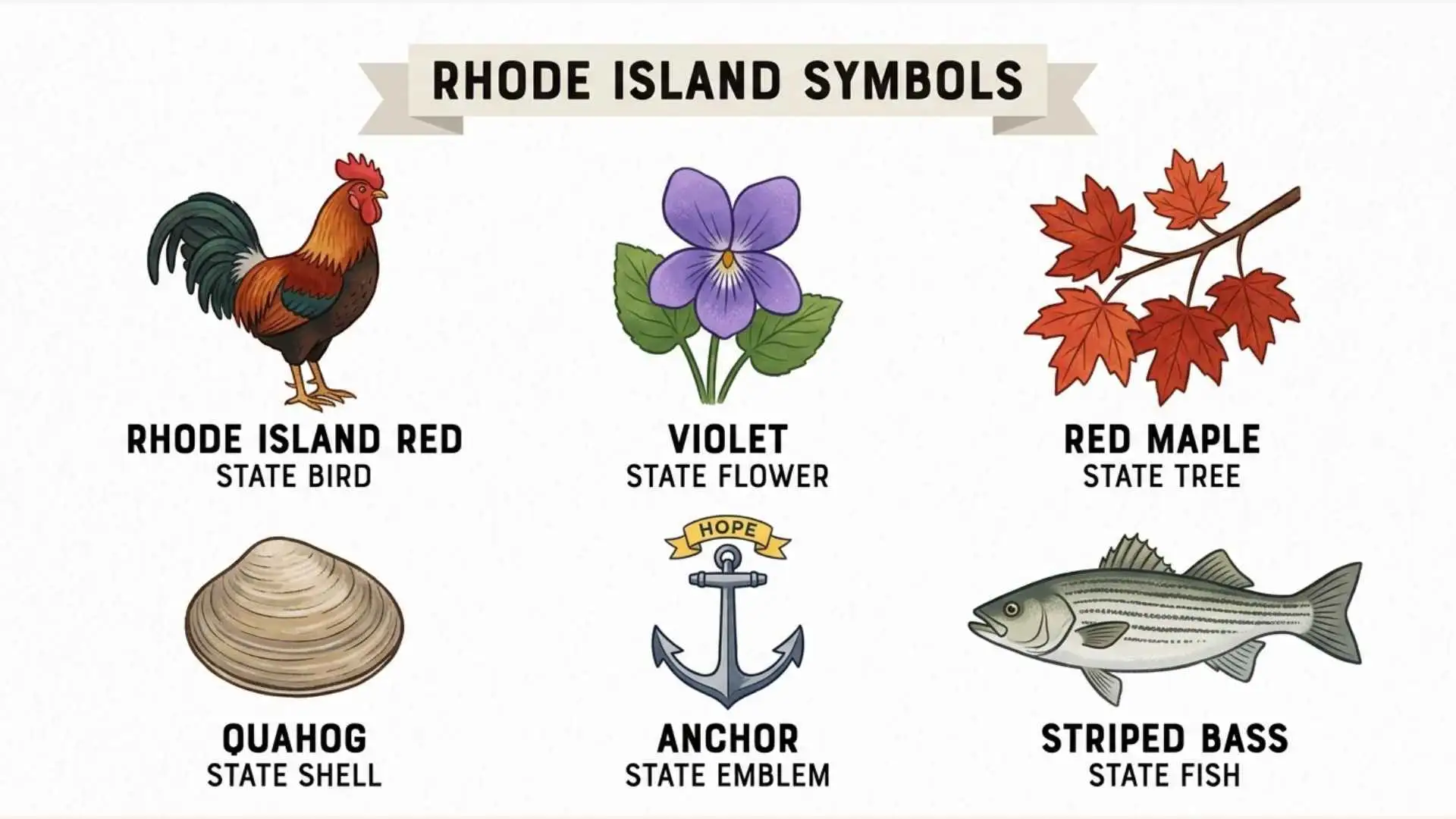
Rhode Island may be the smallest U.S. state, but its symbols reflect a rich history, strong coastal heritage, and a distinct sense of identity. From the state flag and motto to its official bird, flower, tree, and marine animal, each symbol represents an important part of Rhode Island’s story. Together, these symbols help explain how the state’s history, natural environment, and traditions have shaped its identity.
Many Rhode Island symbols have connections to the state’s colonial past, maritime traditions, religious freedom, and relationship with the Atlantic Ocean. The anchor featured on the state flag, for example, has long been associated with hope and stability, while the state motto, “Hope,” reflects an important idea in Rhode Island’s history. Other symbols highlight the plants, animals, and natural features that are closely connected to life in the Ocean State.
Learning the meanings behind Rhode Island’s official symbols offers more than a list of state-designated objects. It provides a simple way to understand the state’s history, culture, geography, and traditions. Whether you are researching Rhode Island for school, exploring U.S. state symbolism, or simply curious about the Ocean State, these symbols reveal how a small state developed a powerful and recognizable identity.
Quick Meaning of Rhode Island Symbols
Rhode Island symbols represent the state’s history, environment, maritime culture, and civic identity. The anchor and motto “Hope” express stability and confidence, while symbols such as the Rhode Island Red, violet, red maple, quahog, striped bass, coffee milk, and calamari celebrate the state’s wildlife, landscape, food traditions, and coastal economy.
Rhode Island Symbols Overview Table
| Category | Official Symbol | Adoption Date | Main Meaning |
| State motto | Hope | 1664 | Faith, perseverance, and confidence |
| State seal | Anchor with “Hope” | 1664 | Maritime identity and steadfastness |
| State flag | Gold anchor, “Hope,” and 13 stars | 1877 | State history and original-colony status |
| State bird | Rhode Island Red | 1954 | Agriculture, usefulness, and local innovation |
| State tree | Red maple | 1964 | Natural beauty and seasonal change |
| State flower | Violet | 1968 | Modesty, loyalty, and springtime |
| State rock | Cumberlandite | 1966 | Geological heritage |
| State mineral | Bowenite | 1966 | Local geology and decorative beauty |
| State shell | Quahog | 1987 | Coastal life and Indigenous history |
| State drink | Coffee milk | 1993 | Local food culture |
| State fruit | Rhode Island Greening apple | 1991 | Agricultural history and regional flavor |
| State fish | Striped bass | 2000 | Recreational fishing and marine ecology |
| State insect | American burying beetle | 2015 | Conservation and biodiversity |
| State marine mammal | Harbor seal | 2016 | Coastal wildlife |
| State appetizer | Calamari | 2014 | Seafood economy and culinary identity |
| State song | “Rhode Island Is It for Me” | 1996 | Pride in place and community |
| State folk-art symbol | Charles I. D. Looff Carousel | 1985 | Craftsmanship and public heritage |
| State yacht | Courageous | 2000 | Sailing history and competition |
| State sailing vessel and flagship | SSV Oliver Hazard Perry | 2012 and 2018 | Maritime education and seafaring tradition |
Rhode Island’s official symbols and emblems are established in state law. The Rhode Island Department of State maintains the official list and adoption information.
What Do Rhode Island Symbols Mean?
Rhode Island symbols mean more than the objects, plants, animals, or foods they depict. Each one connects an important part of the state’s identity to a memorable image.
The anchor represents security, steadiness, and Rhode Island’s relationship with the sea. “Hope” gives the emblem an emotional and moral message. The thirteen stars on the flag recognize Rhode Island as one of the thirteen original states.
Natural symbols express the character of the local environment. The red maple reflects New England’s colorful autumn landscape. The violet represents a familiar spring wildflower. The striped bass, quahog, harbor seal, and calamari connect the state to Narragansett Bay, coastal waters, fishing communities, and seafood traditions.
Other symbols preserve human history. Coffee milk reflects everyday local culture. The Rhode Island Greening apple remembers the state’s agricultural past. The Looff Carousel celebrates handmade public art, while official vessels and yachts recognize Rhode Island’s long association with sailing, shipbuilding, naval history, and maritime education.
History and Origin of Rhode Island Symbols
The Anchor and “Hope”
The anchor is Rhode Island’s oldest and most important emblem. The colonial government adopted a seal containing an anchor and the word “Hope” on May 4, 1664, soon after Rhode Island received its Royal Charter from King Charles II.
No surviving official record states exactly why colonial leaders selected “Hope.” A widely accepted interpretation connects the emblem to Hebrews 6:19, which describes hope as an anchor of the soul. Rhode Island’s official history presents this as a probable explanation rather than a documented certainty.
The anchor also made practical sense for a coastal colony dependent on harbors, fishing, shipping, and Atlantic trade. It therefore combined a possible biblical reference with a recognizable image from daily maritime life.
Development of the State Flag
Rhode Island first adopted its state flag in 1877. The official design uses a white field with a central gold anchor. Beneath the anchor is a blue ribbon bearing the word “Hope” in gold. Thirteen gold stars form a circle around the emblem.
The stars refer to the thirteen original states. Rhode Island was the last of those states to ratify the United States Constitution, joining the Union on May 29, 1790.
Although the anchor had already represented the colony for more than two centuries, the flag created a standardized public design that could appear at government buildings, ceremonies, schools, and civic events.
Expansion of Official State Symbols
Most Rhode Island symbols were adopted during the twentieth and early twenty-first centuries. This pattern reflects a broader American tradition in which state legislatures designate representative birds, trees, flowers, foods, minerals, songs, and cultural objects.
Some symbols resulted from public participation. Rhode Island schoolchildren selected the violet and red maple decades before lawmakers formally adopted them. The violet was chosen by children in 1897 but did not become official until 1968. The red maple was also favored by schoolchildren in the 1890s and officially adopted in 1964.
More recent additions, including calamari, the American burying beetle, and the harbor seal, broaden the collection to represent local industries, conservation, and marine ecology.
Symbolism and Interpretation
Traditional Meanings
The anchor traditionally symbolizes steadiness, safety, loyalty, and the ability to remain secure during difficult conditions. Sailors depend on anchors to keep vessels from drifting, so the image naturally suggests reliability.
“Hope” adds a forward-looking meaning. Together, the words and image communicate the idea of remaining grounded while trusting that conditions can improve.
The circle of thirteen stars suggests unity among the original states. A circle has no clear beginning or end, so it often conveys continuity, equality, and collective identity.
Modern Meanings
Today, Rhode Island’s symbols communicate civic pride and regional character. Residents display the anchor on clothing, jewelry, artwork, tattoos, home décor, business signs, and sports merchandise.
In modern use, the anchor may refer not only to maritime life but also to personal resilience. Someone may wear a Rhode Island anchor necklace because it represents home, family, emotional strength, or a connection to the coast.
Food symbols such as coffee milk and calamari express a different kind of identity. They show how ordinary meals and local preferences can become meaningful parts of community memory.
Positive Symbolism
The main positive themes associated with Rhode Island symbols include:
- Hope: Confidence during uncertainty
- Stability: Remaining firm under pressure
- Independence: Pride in Rhode Island’s distinct history
- Community: Shared traditions and local belonging
- Maritime skill: Sailing, fishing, navigation, and shipbuilding
- Natural beauty: Forests, shorelines, wildlife, and seasonal change
- Conservation: Protection of endangered and native species
Possible Negative Interpretations
Rhode Island’s official symbols are not designed to carry negative meanings. However, symbols can be interpreted differently depending on context.
An anchor may suggest being emotionally stuck or unable to move forward. A historic emblem may also raise questions about which communities and experiences are included in the public story of a state.
The official state name formerly included “Providence Plantations.” Rhode Island voters approved removing those words in 2020, and the current state seal now reads “State of Rhode Island.”
This change demonstrates that public symbols are not frozen in time. They can evolve as communities reconsider how history should be represented.
Cultural Significance of Rhode Island Symbols
Rhode Island’s symbols draw from several overlapping cultural traditions.
Maritime Culture
The anchor, striped bass, quahog, harbor seal, calamari, official vessels, yacht, and “Ocean State” identity all reflect the importance of water. Narragansett Bay has influenced settlement, transportation, fishing, recreation, military activity, tourism, and trade.
Sailing remains especially important. Rhode Island is strongly associated with boatbuilding, yacht racing, marinas, sailing instruction, and waterfront communities such as Newport.
Indigenous Heritage
The quahog carries an important Indigenous connection. The word comes from an Algonquian-language term associated with the hard-shell clam. Narragansett and other Indigenous peoples used parts of quahog shells to produce beads commonly called wampum.
Wampum held ceremonial, social, diplomatic, and economic significance. It should not be described simply as ordinary “money,” because its meaning depended on time, place, design, and cultural context. Rhode Island’s official sources recognize the connection between quahog shells and wampum.
Agricultural Culture
The Rhode Island Red chicken and Rhode Island Greening apple represent the state’s farming history.
The Rhode Island Red became internationally known as a productive dual-purpose chicken valued for eggs and meat. It was officially selected as the state bird in 1954 after defeating the osprey and ruby-throated hummingbird in a public state-bird campaign.
The Greening apple is a tart, firm variety associated with Rhode Island and particularly suited to cooking. It symbolizes local orchards, food preservation, and New England agricultural life.
Immigrant and Food Traditions
Coffee milk and calamari show how food becomes a cultural symbol through repeated community use.
Coffee milk combines milk with sweet coffee syrup. It became popular in Rhode Island during the twentieth century and was declared the official state drink in 1993.
Calamari reflects Rhode Island’s commercial fishing industry and Italian American culinary influence. Its adoption as the state appetizer in 2014 connected a familiar restaurant dish with the state’s working waterfront.
Religious and Spiritual Meaning
The anchor-and-hope emblem has a probable Christian association, although Rhode Island’s government does not define it as an exclusively religious symbol.
Hebrews 6:19 compares hope to an anchor for the soul. This metaphor presents spiritual hope as a stabilizing force during fear, suffering, or uncertainty. Rhode Island historical commentary identifies this passage as a likely inspiration for the colonial seal, but no original record proves the connection conclusively.
The emblem also fits Rhode Island’s history of religious liberty. Roger Williams founded Providence after being expelled from Massachusetts Bay Colony for his religious and political views. Rhode Island later became known for broader religious toleration than many neighboring colonies.
For modern residents, “Hope” may carry Christian, spiritual, secular, emotional, or civic meaning. Its openness helps explain why the motto continues to connect with people from different backgrounds.
Scientific and Natural Meaning
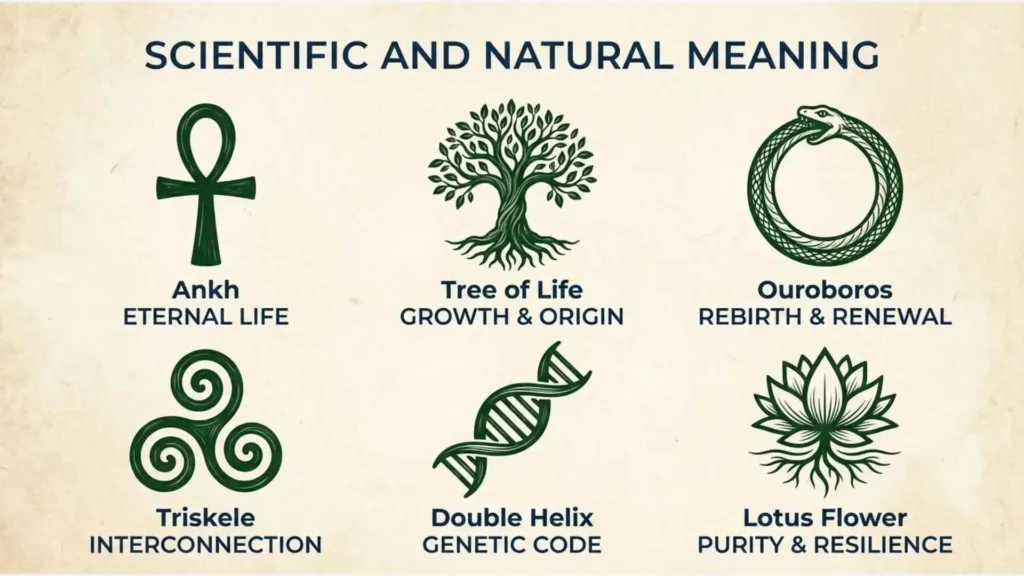
Several Rhode Island symbols have scientific value because they identify local species, rocks, and minerals.
Cumberlandite
Cumberlandite is a dense, dark, iron-rich rock associated closely with Rhode Island. It can attract a magnet because of its mineral content. The state adopted it as the official rock in 1966.
Its symbolic importance comes from rarity and location. Unlike a general image such as an anchor, Cumberlandite represents the physical ground beneath the state.
Bowenite
Bowenite is a hard variety of antigorite serpentine that may resemble jade. Rhode Island recognizes it as the state mineral, and deposits have been found in the northern part of the state. It was officially adopted in 1966.
American Burying Beetle
The American burying beetle is an ecologically important scavenger. It helps recycle nutrients by burying small animal carcasses, which adults prepare as food for their young.
Rhode Island adopted it as the state insect in 2015. Its status makes it a symbol not only of wildlife but also of habitat protection, ecological recovery, and conservation science.
Marine Species
Striped bass, harbor seals, squid, and quahogs reflect different parts of Rhode Island’s marine ecosystem. Their presence in the official symbol collection highlights the relationship between biodiversity, commercial activity, recreation, and environmental stewardship.
Where Rhode Island Symbols Are Used
Rhode Island symbols appear in many public and private settings:
Government and Civic Use
The anchor and “Hope” appear on the state seal, flag, coat of arms, government publications, agency websites, official forms, courtrooms, public buildings, and ceremonial displays.
License Plates
Rhode Island’s standard license plate uses a blue wave design and the words “Ocean State.” The plate connects the state’s official identity with its coastline and maritime reputation. The “Ocean State” license-plate nickname was adopted in 1971.
Coins
The 2001 Rhode Island state quarter depicts a vintage sailboat on Narragansett Bay with the Claiborne Pell Newport Bridge in the background. The design reinforces the state’s sailing culture and coastal geography.
Schools and Museums
Students learn the symbols in state-history lessons, activity books, museum programs, government tours, and civic education projects.
Art, Jewelry, and Tattoos
The anchor is especially common in jewelry and tattoos. In these settings, it may symbolize Rhode Island roots, love of the ocean, family stability, perseverance, or remembrance.
Tourism and Business
Restaurants, souvenir shops, marinas, hotels, breweries, clothing companies, and local organizations frequently use anchors, waves, quahogs, lighthouses, and the word “Hope” to create a recognizable Rhode Island identity.
Common Variations and Similar Designs
Seal, Coat of Arms, and Flag
These three emblems are related but not identical.
The coat of arms consists of a gold anchor on a blue field with the motto “Hope.” The state seal places the anchor and motto within a circular official design that includes the state’s name. The flag uses a white field, gold anchor, blue ribbon, and thirteen stars.
Decorative Anchor Designs
Unofficial versions may use navy blue, weathered wood, rope borders, waves, maps, lighthouses, or the outline of Rhode Island. These adaptations may express state pride, but they are not exact versions of the legally defined flag or seal.
Quahog and Clam Imagery
Quahog symbols range from realistic shell illustrations to purple-and-white wampum patterns. A plain clam image may represent seafood, while a wampum-inspired design can carry deeper Indigenous and historical associations.
Ocean State Imagery
Waves, sailboats, bridges, lighthouses, and shoreline outlines often function as unofficial Rhode Island symbols. They complement the official anchor but should not be confused with formally adopted state emblems.
Common Misconceptions About Rhode Island Symbols
The Anchor Does Not Represent Rhode Island’s Size
The anchor refers to maritime life, steadiness, and hope. It has no connection to Rhode Island being the smallest state by land area.
“Hope” Has No Officially Proven Origin
The biblical anchor-of-the-soul explanation is plausible and widely repeated, but the original government record does not explain why “Hope” was chosen. It should be presented as a likely interpretation, not an established fact.
Rhode Island Is Not Mostly an Island
Most of the state lies on the mainland. The name is historically complicated and does not mean that the entire state is one island.
The State Bird Is a Chicken Breed
The Rhode Island Red is a domesticated chicken rather than a native wild songbird. It was chosen because of its agricultural importance and strong connection to the state.
The Violet Was Not Officially Adopted in 1897
Schoolchildren selected the violet in 1897, but the legislature did not formally adopt it until March 11, 1968.
Quahog and Wampum Are Not the Same Thing
A quahog is a hard-shell clam. Wampum refers to carefully produced shell beads and related cultural objects. Quahog shells provided material for some wampum, but the terms are not interchangeable.
Interesting Facts About Rhode Island Symbols
- The anchor has represented Rhode Island since 1664. It is one of the oldest continuously used state emblems in the United States.
- Rhode Island’s flag contains thirteen stars. They honor the thirteen original states rather than Rhode Island’s order of admission.
- Rhode Island was the last state to adopt an official flower. Children selected the violet in 1897, but lawmakers waited until 1968 to make it official.
- The state bird was chosen through a public campaign. The Rhode Island Red defeated the osprey and ruby-throated hummingbird.
- Cumberlandite responds to a magnet. Its iron-rich composition makes the state rock unusually easy to demonstrate in classrooms.
- Coffee milk is different from iced coffee. It is milk flavored with sweet coffee syrup rather than brewed coffee served over ice.
- The Looff Carousel still operates. Built in 1895, it preserves hand-carved animals, decorative panels, mirrors, lights, and a historic band organ.
- Rhode Island has symbols for both a rock and a mineral. Cumberlandite represents a rock made from multiple minerals, while bowenite is a specific mineral variety.
- The official appetizer recognizes a working industry. Calamari celebrates both local dining and Rhode Island’s squid-fishing fleet.
- One tall ship holds two official roles. The SSV Oliver Hazard Perry serves as both the state sailing education vessel and state flagship.
Related Rhode Island Symbols
Lighthouses
Lighthouses are not the central official emblem, but they represent navigation, safety, coastal communities, and maritime history.
Sailboats
Sailboats symbolize recreation, craftsmanship, international yacht racing, and Rhode Island’s close connection to Narragansett Bay.
The Claiborne Pell Newport Bridge
The bridge is a modern landmark that represents transportation, engineering, and the connection between different parts of the state.
Wampum Designs
Purple-and-white shell patterns relate to Indigenous artistry, diplomacy, memory, and cultural identity. They differ from the official quahog symbol because they refer to crafted beads and their meanings rather than the animal alone.
Ocean Waves
The wave is most visible on Rhode Island license plates. It represents the coast and the “Ocean State” identity but is not the principal emblem used on the state flag.
Frequently Asked Questions
What is the main symbol of Rhode Island?
The main symbol of Rhode Island is a golden anchor accompanied by the motto “Hope.” It appears on the state seal, coat of arms, and flag. The anchor reflects maritime life and stability, while “Hope” expresses perseverance and confidence during hardship.
Why is Rhode Island’s symbol an anchor?
Rhode Island developed around bays, harbors, islands, fishing grounds, and Atlantic shipping routes. An anchor was therefore familiar and meaningful to colonial residents. It also traditionally represents security and steadfastness. A biblical passage comparing hope to an anchor may have influenced the design, although this origin is not proven.
What do the thirteen stars on Rhode Island’s flag mean?
The thirteen gold stars represent the thirteen original American colonies and states. Rhode Island was one of them, although it became the thirteenth to ratify the Constitution. The stars form a circle around the anchor, visually linking Rhode Island to the nation’s founding group.
What is Rhode Island’s official motto?
Rhode Island’s official motto is “Hope.” It is one of the shortest state mottos in the United States. The word has appeared with the anchor since the colonial seal adopted in 1664 and conveys confidence, endurance, and faith in the future.
What is Rhode Island’s official animal?
Rhode Island does not have one general official state animal. Instead, it recognizes several animal symbols, including the Rhode Island Red as the state bird, striped bass as the state fish, American burying beetle as the state insect, and harbor seal as the state marine mammal.
What is Rhode Island’s state flower?
The violet is Rhode Island’s state flower. Schoolchildren selected it in 1897, but it was not officially adopted until 1968. Its small spring blossoms are commonly associated with modesty, loyalty, affection, and the renewal of the landscape after winter.
What is Rhode Island’s state food?
Rhode Island has several official food-related symbols rather than one state food. Calamari is the state appetizer, coffee milk is the state drink, and the Rhode Island Greening is the state fruit. Quahogs also hold official status as the state shell and are central to local cuisine.
What does the quahog symbolize in Rhode Island?
The quahog symbolizes coastal ecology, shellfishing, local cuisine, and Indigenous history. Its shell was used to create certain wampum beads. Today, quahogs remain strongly associated with Narragansett Bay, clam dishes, fishing communities, and Rhode Island’s cultural identity.
Is the Ocean State an official Rhode Island symbol?
“Ocean State” is Rhode Island’s widely recognized official license-plate nickname. It appears on standard plates and reflects the importance of bays, shorelines, sailing, fishing, and tourism. The phrase is not the state motto; the official motto remains “Hope.”
Did Rhode Island change its official seal?
Yes. After Rhode Island voters approved a constitutional amendment in 2020, the words “and Providence Plantations” were removed from the state’s official name. As a result, the current seal identifies the state simply as the “State of Rhode Island.”
Key Takeaways
- Rhode Island’s main emblem is a gold anchor paired with the motto “Hope.”
- The anchor first appeared on the colonial seal in 1664.
- Thirteen stars on the state flag represent the original states.
- Maritime symbols reflect Rhode Island’s bays, fishing industry, sailing culture, and coastal communities.
- Natural symbols include the violet, red maple, striped bass, harbor seal, quahog, bowenite, and Cumberlandite.
- Cultural symbols such as coffee milk, calamari, and the Looff Carousel preserve local traditions.
- Some symbols were selected by schoolchildren or through public campaigns.
- The probable biblical origin of “Hope” is an interpretation, not a documented certainty.
- Rhode Island symbols continue to evolve as the state reexamines history, identity, and public representation.
Conclusion
Rhode Island symbols form a visual and cultural record of the Ocean State. The anchor and “Hope” communicate resilience, stability, and a centuries-old connection to the sea. The Rhode Island Red, violet, red maple, quahog, coffee milk, calamari, Cumberlandite, and other official emblems add stories of farming, wildlife, geology, food, craftsmanship, and community life.
Seen together, these symbols explain how Rhode Island understands itself: independent yet connected, small in area but rich in history, shaped by both land and water, and firmly anchored in hope.

I am Daniel Brooks, a language researcher and writer with a strong interest in how people use English in everyday conversations. I contribute to LearnNestly because I enjoy turning confusing language topics into straightforward lessons. My goal is to help readers understand not only what a word or phrase means, but also when and how to use it naturally. I focus on clear examples, practical explanations, and useful language knowledge that readers can remember.
Books:
- The Practical English Guide
- Understanding Everyday Words
 Amelia Carter
 Ethan Mitchell