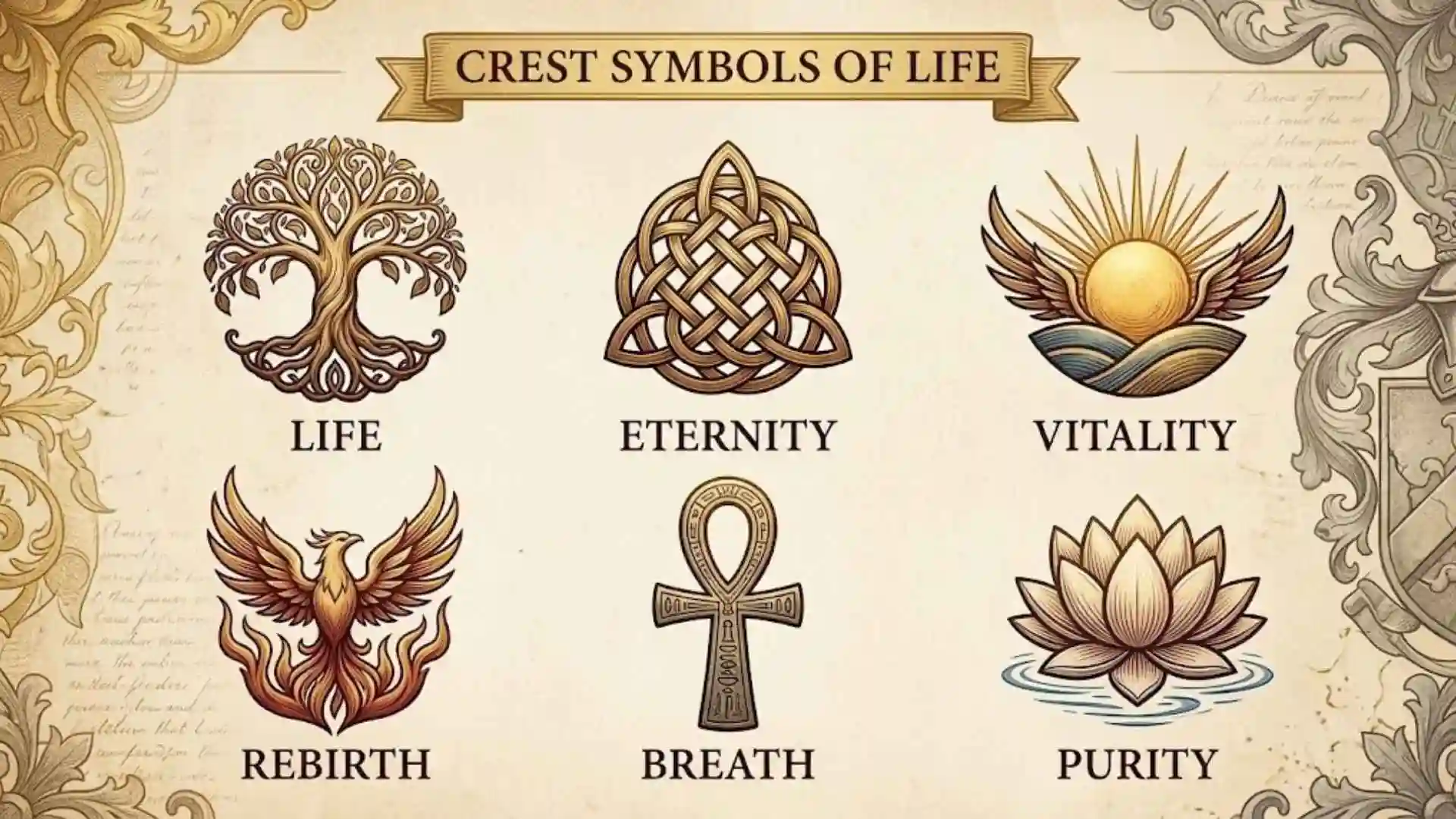
Crest symbols and meanings reveal fascinating stories about family heritage, history, identity, and tradition. From powerful lions and majestic eagles to royal crowns, swords, flowers, and mythical creatures, these designs have been used for centuries to represent courage, loyalty, authority, faith, and achievement. Whether you have seen a crest on an old family document, a historic building, a military badge, or a university emblem, understanding its symbolism can help you discover the history and ideas behind its design.
In heraldry, every detail can contribute to a crest’s appearance and interpretation. Animals may represent strength or protection, wings can suggest freedom or ambition, and anchors often symbolize hope and stability. Colors, shapes, objects, and decorative patterns also play important roles in traditional heraldic designs. However, crest symbols do not have one universal meaning, and their significance often depends on the historical period, cultural background, and individual or family associated with the emblem.
In this complete guide to crest symbols and meanings, you will explore their origins, historical development, popular heraldic animals, religious imagery, cultural significance, and modern uses. You will also learn the difference between a crest and a coat of arms, discover common misconceptions about family crests, and understand how to research an authentic heraldic design. Whether you are interested in genealogy, symbolism, history, or decorative emblems, this guide will help you appreciate the stories these timeless symbols can tell.
Quick Meaning of Crest Symbols
Crest symbols are figures placed above a heraldic helmet as part of a coat of arms. They traditionally identify a person or lineage and may represent virtues, achievements, occupations, alliances, or memorable events. Lions, eagles, crowns, wings, antlers, hands, and mythical creatures are among the most recognizable designs.
Crest Symbols Overview
| Field | Details |
| Symbol name | Heraldic crest |
| Primary meaning | Personal, familial, institutional, or military identity |
| Category | Heraldry and visual insignia |
| Traditional position | Above the helmet in a full heraldic achievement |
| Main components | Figure, object, animal, plant, plume, or combined design |
| Historical origin | Medieval European heraldic practice |
| Early development | Approximately the 12th to 14th centuries |
| Common cultures | English, Scottish, Irish, Welsh, French, German, Spanish, Italian, Polish, and other European traditions |
| Traditional usage | Tournaments, warfare, seals, banners, monuments, and official records |
| Modern usage | Family emblems, military badges, civic seals, school logos, jewelry, and decorative art |
| Related terms | Coat of arms, shield, helm, mantling, wreath, motto, supporters, badge |
| Unicode | No universal Unicode character represents a heraldic crest |
| Emoji equivalent | No exact emoji equivalent |
| Related symbols | Heraldic lion, eagle, crown, shield, fleur-de-lis, cross, griffin, stag |
What Do Crest Symbols Mean?
Crest symbols primarily express identity. Historically, heraldic designs helped distinguish one armiger, meaning a person entitled to bear arms, from another. They could also communicate family connections, political loyalties, territorial claims, military achievements, occupations, aspirations, or personal virtues.
The meaning of a crest cannot always be reduced to a fixed dictionary definition. A lion may suggest courage or sovereignty, but it might also refer to a specific ancestor, region, office, or granted honor. An eagle may symbolize authority and vision, yet its exact significance depends on who used it and why.
A crest is traditionally displayed on top of the helmet. It may repeat a figure from the shield, develop a separate visual theme, or introduce a completely different emblem. A complete heraldic achievement can include:
- A shield bearing the main arms
- A helmet positioned above the shield
- A wreath or coronet
- The crest itself
- Decorative mantling
- A motto
- Supporters in certain traditions
- A compartment beneath the supporters
- Badges or other associated emblems
In everyday speech, people often call the entire design a “family crest.” Heraldically, that usage is imprecise. The crest is the uppermost emblem, while the coat of arms includes the shield and other formally recognized elements.
History and Origin of Crest Symbols
Crest symbols developed from medieval European warfare and tournament culture. Early coats of arms appeared during the 12th century, when armored warriors needed recognizable signs on shields, banners, surcoats, and seals. As helmets increasingly concealed the face, visual identification became especially important.
Early Heraldic Identification
The earliest heraldic systems centered mainly on shields and banners. Designs used strong colors, simple shapes, animals, crosses, stripes, and geometric divisions that could be recognized from a distance.
Heraldry became hereditary over time. A design originally associated with one knight could pass to descendants, although rules of inheritance differed by place and period. Heralds recorded, announced, and regulated arms, particularly in royal courts and tournaments.
The Rise of Helmet Crests
Three-dimensional crests became increasingly prominent during the 13th and 14th centuries. Knights displayed decorative figures above their helmets during tournaments, ceremonies, and pageants. These constructions were often made from lightweight materials such as leather, wood, fabric, parchment, or molded substances.
Because an elaborate crest could be impractical in actual combat, many surviving examples are more closely linked with tournaments, funerary displays, seals, and ceremonial representation than daily battlefield use.
Development Across Europe
Heraldic traditions spread and developed differently across Europe:
- England established formal heraldic regulation through royal heralds and later the College of Arms.
- Scotland developed a distinct legal system governed by the Lord Lyon King of Arms.
- France used heraldry among nobles, cities, religious bodies, and later wider social groups.
- German-speaking territories favored elaborate helmets, multiple crests, wings, horns, feathers, and repeated devices.
- Spain and Portugal developed Iberian conventions shaped by dynastic unions, territorial arms, and quartered shields.
- Poland often used clan-based coats of arms shared by multiple unrelated noble families.
- Italy displayed substantial regional variation because political authority was historically divided among kingdoms, duchies, republics, and city-states.
These systems were never completely uniform. Rules governing inheritance, rank, helmets, supporters, coronets, and eligibility varied significantly.
From Functional Emblems to Heritage Symbols
As armor and tournament culture declined, crests remained important in seals, architecture, manuscripts, silverware, memorials, carriage panels, military insignia, and official stationery.
Today, crest symbols often appear in genealogy, branding, civic identity, schools, sports organizations, military units, and decorative products. Modern usage may preserve authentic heraldry, loosely adapt historic designs, or create entirely new emblems inspired by the heraldic style.
Symbolism and Interpretation of Common Crest Symbols
Crest symbolism often combines traditional associations with personal history. The following interpretations are widely recognized, but they should not be treated as universal explanations for every coat of arms.
Lion
The lion commonly represents courage, strength, nobility, vigilance, and royal authority. It became one of the most widespread animals in European heraldry, even in regions where lions did not naturally live.
Its posture matters. A lion rampant stands upright with raised forepaws, while a lion passant walks with one forepaw raised. Different positions help distinguish designs and may affect interpretation.
Eagle
The eagle often symbolizes power, leadership, vision, victory, and elevated status. Imperial traditions frequently used single-headed or double-headed eagles.
The double-headed eagle has been associated with several empires and states. Its two heads have sometimes been interpreted as authority extending in two directions, although the exact historical meaning differs by context.
Stag or Deer
A stag may represent peace, dignity, regeneration, alertness, or connection with forests and hunting. Its antlers, which are shed and regrown, can suggest renewal.
In Christian art, the stag may also carry spiritual associations, including longing for God or stories of miraculous conversion connected with hunting.
Bear
The bear often represents strength, courage, protection, endurance, or fierce defense. It may also serve as a regional symbol in areas where bears were historically important.
A bear in a crest does not automatically indicate aggression. It can symbolize protective power, perseverance, or guardianship.
Wolf
The wolf may signify courage, resourcefulness, loyalty to a group, perseverance, or military strength. In some traditions, it can also suggest danger, predation, or an enemy defeated by an ancestor.
Its meaning therefore depends heavily on the history of the arms.
Boar
The boar represents courage, determination, ferocity, and refusal to retreat. Medieval hunters regarded the wild boar as a dangerous animal that fought fiercely when cornered.
A boar’s head is common in both crests and shields, especially in British and continental European heraldry.
Horse
The horse commonly symbolizes loyalty, freedom, speed, service, readiness, and martial strength. Horses were central to medieval warfare, transportation, agriculture, and aristocratic life.
A winged horse may add meanings of imagination, spiritual aspiration, poetic inspiration, or transcendence.
Dog or Hound
Dogs and hounds may represent loyalty, faithfulness, vigilance, hunting skill, or service. Different breeds can carry more specific associations.
Greyhounds often suggest speed, nobility, and devotion, while mastiffs may indicate guardianship and defensive strength.
Bull or Ox
A bull may represent strength, courage, fertility, determination, or stubborn resistance. An ox more often suggests patience, labor, sacrifice, and dependable service.
These related animals should not be interpreted identically without considering their specific depiction.
Ram
The ram may symbolize courage, leadership, force, authority, or determination. Its horns create a bold silhouette suitable for both shields and helmet crests.
Ram’s horns may also appear separately as decorative or identifying elements.
Griffin
The griffin combines the body of a lion with the head and wings of an eagle. It unites the symbolic strength of the lion with the vigilance and elevated power of the eagle.
Griffins commonly represent guardianship, courage, authority, and protection of valuable things.
Dragon
Dragons can symbolize power, guardianship, military strength, sovereignty, or a defeated enemy. In Welsh tradition, the red dragon carries a strong national association.
European dragons are often portrayed differently from East Asian dragons. Their symbolism should not be blended without cultural context.
Unicorn
The unicorn traditionally represents purity, virtue, strength, rarity, and untamed independence. In medieval Christian interpretation, it could also carry religious symbolism.
The unicorn is especially famous as a supporter in the royal arms associated with Scotland and the United Kingdom, rather than simply as a crest in every appearance.
Wings
Wings can symbolize speed, protection, spiritual elevation, ambition, freedom, or swift communication. They may appear alone or attached to animals, helmets, wheels, arrows, and mythical beings.
In German heraldic traditions, paired wings became particularly common as crests.
Crown or Coronet
Crowns signify sovereignty, victory, honor, authority, or royal connection. Coronets may also indicate rank in certain heraldic systems.
A crown-shaped object should not automatically be interpreted as proof of royal ancestry. Its form, legal status, and heraldic jurisdiction must be examined.
Hand or Arm
A hand may represent faith, sincerity, justice, service, or a formal pledge. An armored arm can symbolize military readiness, strength, leadership, or a specific deed.
Hands may hold swords, branches, crosses, tools, arrows, or other objects that modify the meaning.
Sword
The sword often symbolizes justice, defense, military honor, courage, or authority. A flaming sword may suggest divine judgment or spiritual guardianship.
Its position matters. A raised sword may indicate readiness, while crossed swords can suggest conflict, military service, or alliance.
Anchor
An anchor commonly represents hope, stability, maritime service, steadfastness, or safe harbor. In Christian symbolism, it became an emblem of hope and firmness in faith.
It is especially relevant to naval families, coastal cities, seafaring institutions, and maritime military units.
Tree
Trees symbolize life, ancestry, growth, stability, fertility, wisdom, and continuity. A specific species may add another level of meaning.
An oak can suggest strength and endurance, while a palm may represent victory, peace, or martyrdom in Christian art.
Rose
The rose can represent beauty, love, hope, secrecy, political allegiance, or dynastic identity. Color and historical setting are essential.
The red and white roses associated with the English houses of Lancaster and York are famous examples of flowers carrying political meaning.
Fleur-de-Lis
The fleur-de-lis is a stylized floral emblem strongly associated with French monarchy and French cultural heritage. It has also appeared in religious, civic, military, and regional designs.
Its interpretation may include royalty, purity, faith, tradition, or French identity.
Positive and Negative Interpretations
Most crest symbols were intended to honor their bearers, but meanings can have both positive and negative sides.
| Symbol | Positive interpretation | Possible negative interpretation |
| Lion | Courage and leadership | Domination or pride |
| Eagle | Vision and authority | Imperial power |
| Wolf | Loyalty and endurance | Predation or danger |
| Bear | Protection and strength | Ferocity |
| Dragon | Guardianship and power | Destruction or chaos |
| Sword | Justice and defense | Violence or conquest |
| Crown | Honor and legitimate rule | Oppression or inherited privilege |
| Serpent | Wisdom and renewal | Deception or danger |
| Tower | Security and resilience | Isolation or imprisonment |
| Chain | Unity and connection | Captivity or restriction |
These contrasts show why symbols should be interpreted within their original context rather than through modern assumptions alone.
Cultural Significance of Crest Symbols

Crest symbols are most closely associated with European heraldry, but visual identity systems exist across the world. Similar-looking emblems should not automatically be called heraldic crests.
British and Irish Traditions
In England, Wales, Northern Ireland, and many countries influenced by British heraldic practice, a crest belongs to a particular armiger. It is not automatically available for use by everyone who shares the same surname.
Scotland has especially strict legal traditions. A Scottish clan crest badge generally combines a chief’s crest with a strap-and-buckle design. Clan members may wear such a badge as a sign of allegiance, but that does not mean each member personally owns the chief’s crest.
Irish heraldry includes arms granted or recorded for individuals, families, institutions, and public bodies. Commercial “surname crest” products may oversimplify these traditions by presenting one design as belonging to every person with a particular family name.
Continental European Traditions
German heraldry frequently features multiple helmets, horns, wings, feathers, hats, animal figures, and repeated shield devices. Some noble achievements contain several crests representing inherited territories or family alliances.
French, Italian, Spanish, Portuguese, Dutch, Scandinavian, Polish, Hungarian, and Central European traditions all developed their own visual conventions. The same symbol may have different legal or social implications across these regions.
Japanese Mon
Japanese mon, or family emblems, identify families, organizations, temples, and historical lineages through highly stylized designs. Common motifs include plants, birds, geometric forms, and household objects.
Although mon can serve an identifying role similar to heraldic emblems, they follow a different artistic and historical system. Calling every mon a “crest” may be convenient in English, but it can hide important cultural distinctions.
Indigenous and Non-European Emblems
Many Indigenous peoples use clan animals, sacred designs, totems, textiles, carvings, and inherited visual identities. These traditions should not be interpreted through European heraldic rules.
A bird, bear, wolf, or serpent may carry meanings grounded in a specific community’s oral history, spirituality, territory, and kinship system. Respectful interpretation requires attention to that community’s own teachings.
Religious and Spiritual Meaning
Crest symbols often incorporate religious imagery because medieval European society connected political authority, family identity, and faith.
Crosses
Heraldry includes many forms of the cross, such as the cross pattée, cross potent, cross moline, and cross fleury. A cross may indicate Christian devotion, an institution’s religious role, participation in a military religious order, or a design chosen for visual reasons.
It should not automatically be taken as evidence that an ancestor joined a crusade. Such claims require independent historical documentation.
Lamb
The lamb may symbolize innocence, gentleness, sacrifice, or Christ as the Lamb of God. A lamb carrying a cross or banner has a more explicitly Christian meaning.
Dove
The dove commonly represents peace, purity, hope, or the Holy Spirit. Its meaning may become clearer when combined with an olive branch, rays of light, or religious inscriptions.
Pelican
In medieval Christian symbolism, the pelican was believed to wound itself to feed its young with its own blood. It therefore became an emblem of sacrifice, charity, and Christ’s redemptive love.
The symbolism came from medieval bestiary traditions rather than accurate zoological observation.
Phoenix
The phoenix represents rebirth, immortality, renewal, and triumph over destruction. Christian writers also used it as a symbol of resurrection.
In a crest, it often appears rising from flames.
Serpent
The serpent can represent wisdom, healing, renewal, danger, temptation, or eternal life. Because snakes shed their skin, they became natural symbols of transformation.
Its meaning varies greatly across religious and cultural traditions.
Where Crest Symbols Are Used
Crest symbols continue to appear in both formal and decorative settings.
Heraldic Records and Grants
Official heraldic authorities record coats of arms, crests, badges, and related insignia. The rules depend on the jurisdiction.
A historically documented crest should be traced through grants, registrations, visitations, seals, pedigrees, or other reliable records.
Architecture and Monuments
Crests appear above doorways, on fireplaces, tombs, churches, castles, civic buildings, bridges, and memorials. Their placement may identify a patron, ruler, builder, institution, donor, or commemorated family.
Seals and Signet Rings
Seals authenticated documents and communicated identity. A signet ring could bear a shield, crest, monogram, badge, or simplified emblem.
Not every ring marketed as a “family crest ring” reproduces historically accurate arms.
Military Insignia
Military units use badges, emblems, mottos, animals, crowns, weapons, and historic symbols to express identity and tradition. In some military systems, the word “crest” is used informally for the entire badge.
Military insignia follows institutional regulations rather than the inheritance rules of personal heraldry.
Schools and Universities
Educational institutions often use shield-shaped logos that include books, lamps, torches, animals, dates, mottos, and local symbols. These designs may be formally heraldic or simply heraldic in style.
Corporate and Sports Logos
Businesses, clubs, and sports teams use crest-style logos to suggest heritage, prestige, unity, and permanence. Many football clubs use shield-shaped badges commonly described as club crests.
These commercial designs are usually trademarks rather than inherited coats of arms.
Jewelry and Tattoos
Crest symbols appear on pendants, rings, cuff links, bracelets, and tattoos. Before choosing one, a person should confirm whether the design is authentic, culturally appropriate, and accurately connected to the intended family or institution.
Common Variations of Crest Symbols
Crests vary by artistic style, geographic tradition, period, and the materials used to display them.
Animal Crests
Animals may appear whole, as heads, as upper bodies, or as isolated wings, claws, horns, and tails. Their posture, direction, color, and accessories distinguish one crest from another.
Human Figures and Body Parts
Common designs include armored arms, hands, heads, saints, warriors, angels, and mythological figures. These may hold weapons, tools, plants, or religious objects.
Horns, Wings, and Feathers
Buffalo horns, wings, plumes, and feathered arrangements are especially prominent in Central and Northern European heraldry. They create height and symmetry above the helmet.
Objects and Tools
Crests may feature towers, ships, anchors, wheels, keys, books, hammers, axes, agricultural tools, musical instruments, or scientific equipment. These can refer to occupations, territories, institutions, saints, or historical events.
Combined Designs
A crest may merge several elements, such as a lion holding a sword, an eagle rising from a crown, or an armored arm grasping an oak branch. Each added object modifies the overall interpretation.
Modern Adaptations
Modern designers often simplify historic crests for websites, embroidery, uniforms, and small screens. Fine details may be removed, colors reduced, and complex figures converted into flat graphics.
Such changes may preserve the general identity while losing heraldic precision.
Common Misconceptions About Crest Symbols
A Crest Is Not the Entire Coat of Arms
The crest sits above the helmet. The shield and its design are separate parts of the complete achievement.
Although “family crest” is widely understood in everyday language, “coat of arms” is usually the more accurate term for the whole composition.
Everyone With the Same Surname Does Not Share One Crest
Traditional arms generally belong to specific individuals and their lawful descendants, depending on the rules of the jurisdiction. A surname alone does not establish a right to use a particular coat of arms.
Unrelated families may share the same surname but possess different histories and heraldic designs.
Every Symbol Does Not Have One Universal Meaning
Popular charts often assign a single definition to each animal or color. Real heraldry is more complex.
A symbol may have been chosen because of a place name, marriage, pun, office, military action, local legend, personal devotion, or visual preference.
A Crown Does Not Prove Royal Descent
Crowns and coronets can represent sovereignty, rank, victory, religious authority, or a decorative feature. Their presence alone does not establish a blood relationship with royalty.
Heraldic Animals Are Not Always Literal Family Traits
A lion does not prove that every member of the family was courageous. Heraldic symbolism expresses ideals, associations, claims, or identity rather than scientifically measurable character.
Similar Designs May Belong to Different Families
Heraldry uses a limited set of colors, animals, shapes, and objects. Small differences in posture, number, placement, borders, and color can distinguish legally separate arms.
10 Interesting Facts About Crest Symbols
1. Crests Were Originally Three-Dimensional
Many medieval crests were physical objects attached to helmets, not flat illustrations. Their later appearance in paintings and manuscripts records the shape of these sculptural designs.
2. Some Crests Were Too Delicate for Battle
Large wings, feathers, horns, and animal figures could interfere with combat. Many were better suited to tournaments, ceremonial entrances, funerals, and displays.
3. A Crest Can Repeat the Shield’s Main Symbol
Repeating a lion, eagle, star, or other charge strengthens visual recognition. However, a crest can also introduce an entirely separate theme.
4. Heraldic Art Values Clarity
Traditional designs rely on strong contrast, recognizable silhouettes, and clear arrangement. Heraldry developed as a practical identification system before it became primarily decorative.
5. Puns Frequently Inspired Heraldic Designs
Canting arms use visual wordplay based on a family or place name. A name sounding like an animal, plant, or object may be represented directly in the arms or crest.
6. One Achievement May Have Several Crests
In some continental European traditions, a noble achievement may display multiple helmets and crests. These can represent inherited territories, offices, or merged lineages.
7. Colors Have Technical Heraldic Names
Heraldic terminology uses words such as gules for red, azure for blue, sable for black, vert for green, or for gold, and argent for silver or white.
These terms describe the formal design rather than creating automatic personality meanings.
8. A Wreath Connects the Crest to the Helmet
The twisted band beneath many crests is called a wreath or torse. It usually displays two principal colors from the arms and visually joins the crest to the helmet.
9. A Badge Is Different From a Crest
A badge is a separate emblem that may be used by followers, retainers, organizations, or members of a group. It does not have to sit above a helmet.
10. Authenticity Requires Genealogical Evidence
Finding a coat of arms attached to a surname online does not prove ownership. A valid connection usually requires tracing descent from the person to whom the arms were granted, confirmed, or historically attributed.
Related Symbols
Coat of Arms
A coat of arms centers on the design displayed on a shield. It may appear alone or as part of a larger achievement that includes the crest.
Heraldic Shield
The shield carries the primary field, divisions, ordinaries, and charges. It is the central visual surface of most European heraldic designs.
Heraldic Badge
A badge is a distinct emblem used for recognition outside the complete coat of arms. It may be worn, displayed on property, or adopted by a group.
Motto
A motto is a short phrase expressing an ideal, aspiration, belief, or historical association. It may appear beneath or above the arms, depending on tradition.
Supporters
Supporters are figures placed beside the shield. They are often animals, humans, or mythical beings and may be restricted to certain ranks or institutions.
Seal
A seal is an impression used to authenticate a document or mark ownership. It may display a coat of arms, crest, badge, monogram, or institutional emblem.
Monogram
A monogram combines letters, usually initials, into a decorative mark. Unlike a heraldic crest, it does not normally follow hereditary heraldic rules.
Japanese Mon
A Japanese mon is a stylized emblem associated with a family, organization, or institution. It serves an identifying role but belongs to a separate cultural tradition.
Frequently Asked Questions About Crest Symbols
What is the difference between a crest and a coat of arms?
A crest is the emblem displayed above the helmet in a heraldic achievement. A coat of arms primarily refers to the design on the shield, although people sometimes use the phrase for the complete arrangement. The full achievement may include the shield, helmet, crest, wreath, mantling, motto, and supporters.
Do crest symbols have fixed meanings?
Crest symbols have traditional associations, but they do not have completely fixed meanings. A lion often suggests courage, while an anchor may represent hope or maritime service. However, the original bearer may have selected the image for a place name, occupation, personal event, alliance, or family story.
Can everyone with the same last name use the same crest?
No. In most formal heraldic traditions, a coat of arms and crest belong to a specific person and eligible descendants, not to everyone sharing a surname. People with identical last names may come from unrelated lineages. Genealogical research is needed to establish a legitimate connection.
What are the most common crest symbols?
Common crest symbols include lions, eagles, stags, boars, bears, wolves, horses, wings, crowns, armored arms, swords, feathers, horns, trees, and mythical creatures. Their popularity reflects medieval ideals, military culture, hunting traditions, religious beliefs, regional identity, and the need for bold, recognizable shapes.
What does a lion mean on a family crest?
A lion commonly represents courage, strength, nobility, sovereignty, or military bravery. Its posture, color, direction, and accessories help distinguish one design from another. However, a lion’s precise meaning should be confirmed through the historical records of the individual or family that used it.
What does an eagle symbolize in heraldry?
An eagle often symbolizes authority, vision, courage, victory, or imperial power. Single-headed and double-headed eagles appear in many European traditions. A double-headed eagle has been associated with several empires, but its meaning differs by period, dynasty, region, and political context.
Are family-crest websites accurate?
Some provide useful clues, but many attach one coat of arms to an entire surname without proving descent. A reliable investigation should examine official heraldic records, genealogical documents, seals, grants of arms, pedigrees, and regional history. Decorative surname products should not be treated as conclusive evidence.
Can a person create a new crest?
A person can design a personal emblem, but creating officially recognized heraldry depends on local law and custom. Some countries have heraldic authorities that grant or register arms. Elsewhere, assumed arms may be permitted. A new design should be original and should not copy existing protected arms.
What do colors mean in crest symbols?
Heraldic colors can carry broad associations, such as red with courage, blue with loyalty, and gold with generosity. However, these meanings are not universal rules. Colors primarily serve visual, technical, and identifying functions. Their interpretation should not replace research into the history of the actual arms.
Are crests still used today?
Yes. Crests appear in official heraldry, military badges, civic seals, schools, universities, sports clubs, jewelry, architecture, memorials, and family-history projects. Modern logos often imitate heraldic style, although they may not follow formal rules or represent legally recognized arms.
Key Takeaways
- Crest symbols traditionally appear above the helmet in a full heraldic achievement.
- A crest is not the same thing as an entire coat of arms.
- Animals, plants, weapons, crowns, wings, and mythical beings are common crest designs.
- Symbols can suggest courage, loyalty, authority, faith, ancestry, occupation, or achievement.
- No heraldic symbol has one universal meaning in every family or culture.
- Historical context, color, posture, placement, and ownership affect interpretation.
- People with the same surname do not automatically share a coat of arms or crest.
- European heraldry, Japanese mon, Indigenous emblems, and other identity systems should be understood within their own cultures.
- Authentic family connections require genealogical and heraldic evidence.
- Modern crest-style logos may reflect heritage without being formal heraldry.
Conclusion
Crest symbols preserve stories of identity, honor, allegiance, ancestry, ambition, and community. Their lions, eagles, crowns, swords, flowers, wings, and mythical creatures may appear easy to interpret, but authentic heraldic meaning depends on much more than a symbol chart.
A crest exists within a larger historical system shaped by inheritance, art, warfare, ceremony, law, religion, and regional custom. By distinguishing a crest from a coat of arms and examining each design in context, readers can understand these emblems without relying on myths or oversimplified claims.
Whether viewed on a medieval seal, a stone monument, a military badge, a university emblem, or a modern ring, crest symbols remain powerful because they turn personal and collective history into a visual language.

I am Ethan Mitchell, an English writer and lifelong learner who is fascinated by words and the way language changes over time. At LearnNestly, I share practical explanations designed for readers who want to improve their understanding of English without complicated terminology. I enjoy researching meanings, usage, grammar, and common language mistakes, then presenting the information in a simple and useful format. My purpose is to make every article a small learning experience that readers can actually apply.
Books:
- The Smart Learner’s English Guide
- English in Real Life
 Daniel Brooks
 Amelia Carter