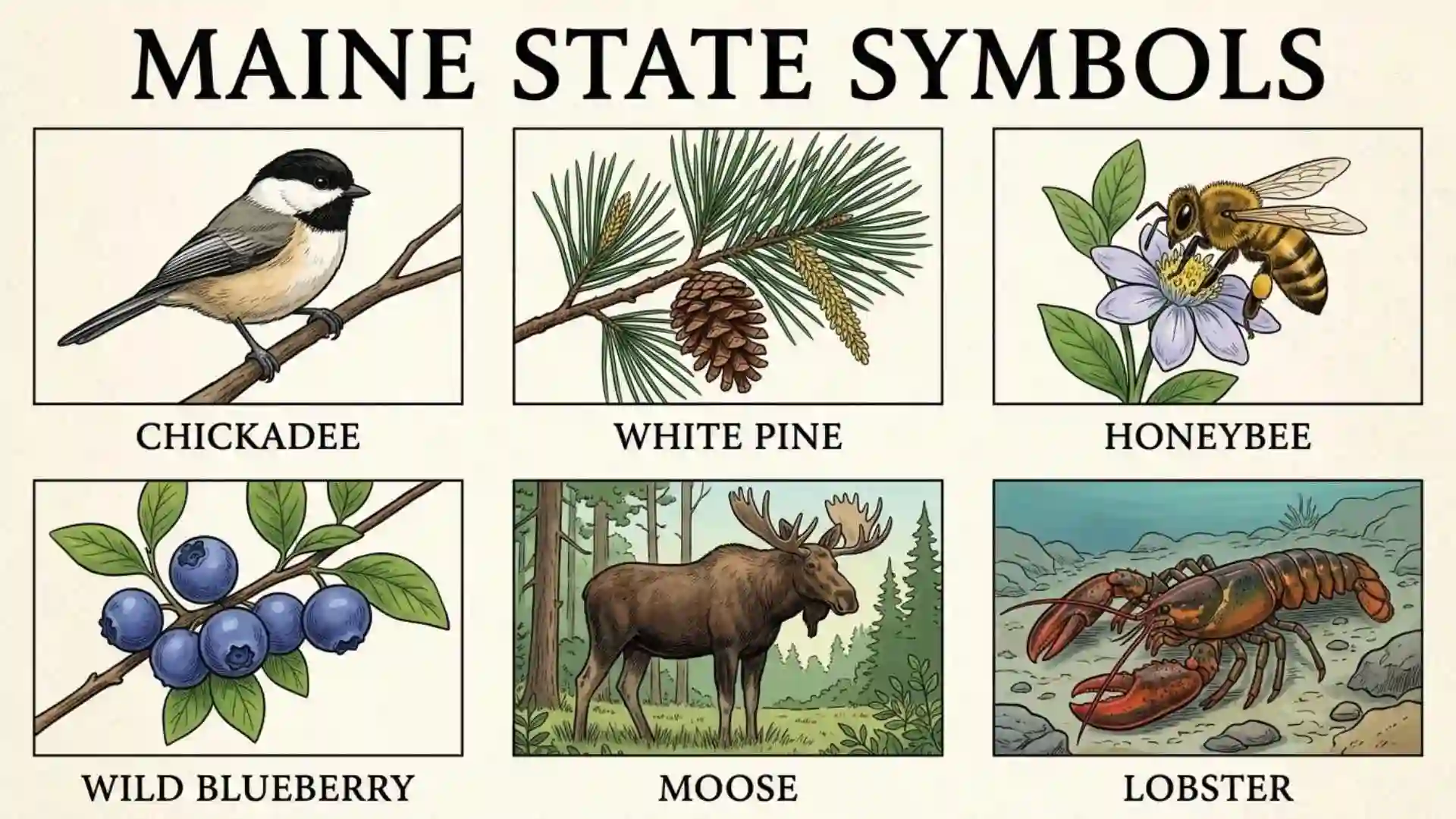
Maine state symbols represent the history, natural beauty, culture, and traditions of the northeasternmost state in the United States. Known for its rocky coastline, towering pine forests, charming fishing villages, and stunning landscapes, Maine has adopted a variety of official symbols that reflect its unique identity. From the state bird and state flower to its official tree, animal, fish, and flag, each symbol tells a story about the people, wildlife, and natural resources that make Maine special.
Every official Maine state symbol has its own meaning and historical background. The white pine tree reflects Maine’s nickname, “The Pine Tree State,” and its long connection to forestry and shipbuilding. The black-capped chickadee represents the state’s birdlife, while the moose highlights its rich wilderness and wildlife heritage. Other symbols, including the state flower, state fish, state animal, and state motto, help explain Maine’s connection to nature, independence, and community traditions.
In this complete guide to Maine state symbols, you will discover the official designations, meanings, and histories behind the state’s most recognizable emblems. You will also learn how these symbols became part of Maine’s identity and why they remain important today. Whether you are a student, teacher, traveler, or simply curious about American state symbols, this guide will help you understand what each emblem represents and how it reflects the character of the Pine Tree State.
Quick Meaning of Maine State Symbols
Maine state symbols are officially recognized animals, plants, foods, minerals, objects, and designs that represent the state’s environment, history, industries, and culture. Important examples include the moose, chickadee, eastern white pine, lobster, wild blueberry, tourmaline, Maine Coon cat, North Star, and the motto Dirigo, meaning “I lead.”
Maine State Symbols Overview Table
| Category | Official Maine Symbol | Main Meaning or Connection |
| State nickname | The Pine Tree State | Maine’s extensive forests and pine heritage |
| State motto | Dirigo | “I lead” or “I direct” |
| State animal | Moose | Northern wilderness and wildlife |
| State bird | Chickadee | Resilience, energy, and woodland life |
| State tree | Eastern white pine | Forest resources, strength, and longevity |
| State floral emblem | White pine cone and tassel | Maine’s pine forests and natural identity |
| State insect | Honeybee | Agriculture, pollination, and cooperation |
| State butterfly | Pink-edged sulphur | Native wildlife and meadow habitats |
| State fish | Landlocked salmon | Lakes, rivers, and outdoor recreation |
| State crustacean | American lobster | Coastal culture and fishing economy |
| State cat | Maine Coon cat | A breed strongly associated with the state |
| State berry | Wild blueberry | Native agriculture and regional food |
| State herb | Wintergreen | Forest groundcover and traditional flavoring |
| State mineral | Tourmaline | Maine’s mineral deposits and gem history |
| State gemstone | Tourmaline | Beauty, geological diversity, and jewelry |
| State rock | Granite | Geology, construction, and durability |
| State fossil | Pertica quadrifaria | Maine’s ancient plant life |
| State soil | Chesuncook soil | Northern forests and natural resources |
| State dessert | Wild Maine blueberry pie | Local harvests and traditional cooking |
| State treat | Whoopie pie | Popular regional baking tradition |
| State soft drink | Moxie | Distinctive Maine commercial heritage |
| State flag | State coat of arms on blue | Government, landscape, labor, and leadership |
| State seal | Pine, moose, farmer, and seaman | Maine’s land, sea, wildlife, and occupations |
| State song | “State of Maine Song” | Pride in Maine’s people and landscape |
Maine’s official symbol list includes natural species, foods, geological resources, cultural products, songs, and government emblems.
What Do Maine State Symbols Mean?
Maine state symbols express the relationship between the state’s people and its environment. Forest symbols represent Maine’s long history of logging, shipbuilding, paper production, and woodland settlement. Marine symbols recognize the importance of the Atlantic Ocean, fishing communities, and coastal commerce.
Wildlife symbols such as the moose and chickadee reflect the state’s northern climate and large natural areas. Food symbols, including blueberry pie and the whoopie pie, celebrate regional agriculture and everyday traditions.
The official seal brings many of these ideas together. Its pine tree and reclining moose represent the natural landscape. A farmer holding a scythe symbolizes agriculture, while a seaman leaning on an anchor represents maritime labor. The North Star and the word Dirigo communicate leadership, direction, and steady purpose.
Maine’s symbols do not form one ancient symbolic system. They were adopted at different times for different reasons. Some recognize species found throughout the state, while others preserve industries, foods, or traditions closely connected with Maine life.
History and Origin of Maine State Symbols
Maine became the 23rd state on March 15, 1820, after separating from Massachusetts. Its early official imagery focused on the land, natural resources, and occupations that supported the new state.
The Great Seal and Coat of Arms
Maine’s Great Seal developed shortly after statehood. Its central shield shows a pine tree with a moose resting beneath it. The shield is supported by a farmer and a seaman, representing the two major economic worlds of early Maine: inland agriculture and maritime work.
Above the shield appears a North Star, traditionally used for navigation, with the word Dirigo. The design presents Maine as a state guided by purpose while remaining rooted in its land and water.
The seal is a legal emblem used to authenticate official state documents. The coat of arms uses the same central imagery and appears on Maine’s present state flag.
The State Flag
Maine’s current official flag places the state coat of arms on a blue field matching the blue used in the United States flag. The legislature adopted this design in 1909.
An earlier 1901 Maine flag used a simpler design: a pine tree and a North Star on a buff-colored field. Although it is not the primary official flag today, that historic design has become popular on clothing, home decorations, boats, signs, and locally made goods.
The Pine Symbols
The Maine Legislature adopted the eastern white pine as the state tree in 1895. The same year, the pine cone and tassel became the state floral emblem. The eastern white pine is one of the largest conifers in northeastern North America, with soft needles arranged in bundles of five.
Choosing a pine-based floral emblem was unusual because a pine cone is not a conventional blossom. However, it directly represented Maine’s landscape and timber heritage more effectively than a decorative garden flower.
Later Symbols
Over time, Maine expanded its symbol collection. Legislators recognized wildlife, geology, agriculture, food, and popular culture. For example, wild Maine blueberry pie became the official state dessert in 2011.
This gradual development shows that state symbolism is not fixed. New emblems can be adopted when residents and lawmakers believe a species, object, product, or tradition deserves formal recognition.
Symbolism and Interpretation
Pine Tree: Endurance and Natural Wealth
The eastern white pine represents strength, height, renewal, and long life. As an evergreen, it retains its needles through winter, making it a natural symbol of endurance.
Historically, white pines also had practical value. Their tall, straight trunks were suitable for ships’ masts, construction, lumber, and later paper production. The tree therefore represents both wilderness and industry.
Moose: Strength and Independence
The moose symbolizes physical power, calm confidence, and the northern forest. Maine has a substantial moose population, particularly in the northern part of the state.
Unlike a lion or eagle, the moose is not normally treated as a symbol of conquest. Its meaning comes from size, self-reliance, adaptability, and its ability to survive in wetlands, forests, deep snow, and cold climates.
Chickadee: Resilience and Alertness
The chickadee is a small bird that remains active through Maine’s winters. It is commonly associated with cheerfulness, curiosity, communication, and resilience.
Its symbolic appeal comes from contrast. Though small and lightweight, the chickadee survives harsh weather through adaptability, food storage, flock behavior, and constant awareness.
Lobster: Coastal Life and Livelihood
The American lobster represents Maine’s rocky coast, working waterfronts, seafood traditions, and fishing economy. Its image appears widely on menus, signs, clothing, souvenirs, and older license plate designs.
The lobster can symbolize toughness because of its hard shell. More importantly, it represents generations of people whose livelihoods depend on cold Atlantic waters.
Wild Blueberry: Humility and Abundance
Wild blueberries grow low to the ground and thrive in acidic, rocky soils. Symbolically, they represent endurance, seasonal abundance, local knowledge, and the ability to flourish under difficult conditions.
Their small size contrasts with their strong cultural importance. They appear in pies, jams, pancakes, drinks, festivals, and locally branded products.
Dirigo and the North Star: Leadership and Guidance
Dirigo is Latin for “I lead” or “I direct.” Combined with the North Star, it suggests navigation, stability, and purposeful leadership.
The phrase does not necessarily claim that Maine rules over others. A more balanced interpretation is that the state follows its own direction and provides a steady example.
Cultural Significance of Maine State Symbols
Maine’s symbols connect official identity with everyday life. Residents see them at schools, town offices, government buildings, roadside businesses, fairs, museums, nature centers, and sporting camps.
Forest Culture
The pine tree reflects more than scenery. Forests have influenced settlement patterns, transportation, logging, woodworking, paper manufacturing, recreation, and conservation. The nickname “Pine Tree State” turns this natural resource into a broad cultural identity.
Maritime Culture
The seaman and anchor on the seal, along with the lobster symbol, recognize Maine’s dependence on the sea. Fishing villages, shipyards, ports, islands, lighthouses, and working harbors remain central to the state’s public image.
Rural and Agricultural Culture
The farmer with a scythe represents cultivation and rural labor. Wild blueberries, honeybees, wintergreen, and blueberry pie expand this agricultural story by highlighting crops, pollination, harvest seasons, and regional cooking.
Indigenous Context
The land now called Maine is the homeland of Wabanaki peoples, including the Penobscot, Passamaquoddy, Mi’kmaq, and Maliseet or Wolastoqiyik communities. Their relationships with forests, rivers, plants, animals, and coastal waters long predate Maine statehood.
Official state emblems were created by the state government and should not be presented as substitutes for Wabanaki cultural symbols. A complete understanding of Maine recognizes both the official symbols established by law and the much older cultural traditions of the region’s Indigenous nations.
Spiritual Meaning of Maine’s Symbols
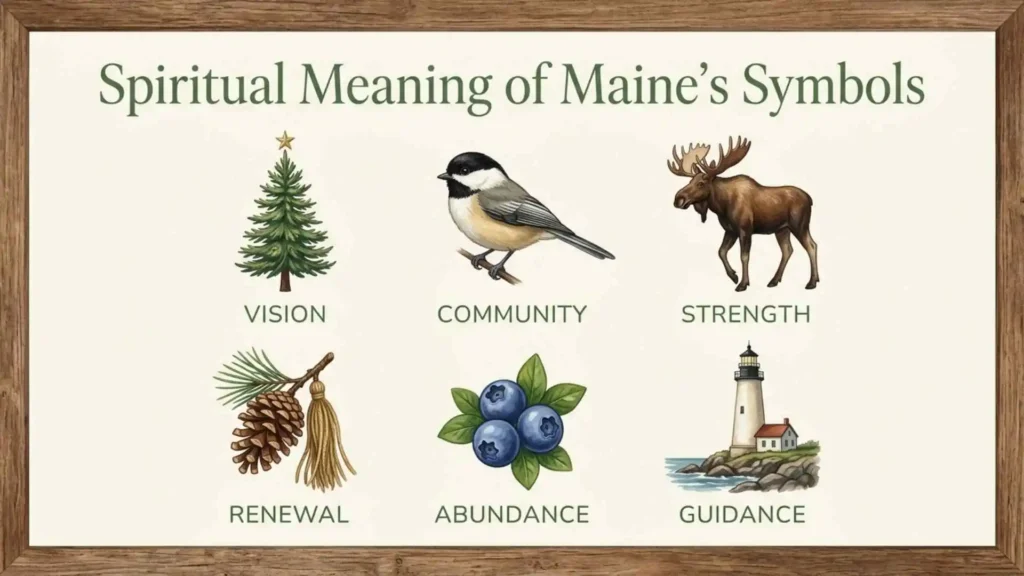
Maine state symbols are civic emblems rather than sacred religious objects. However, several can carry broader spiritual interpretations.
The North Star may represent guidance, constancy, hope, or moral direction. Evergreen pines can suggest life continuing through hardship. The moose may represent grounded strength, while the chickadee can symbolize hope and courage despite vulnerability.
These interpretations are modern or personal rather than official doctrines. Maine law defines the emblems, but it does not assign them universal spiritual meanings.
People may also use Maine symbols in memorial art, tattoos, jewelry, or family designs to express attachment to home, ancestry, wilderness, or a meaningful place.
Scientific and Educational Meaning
Many Maine symbols have value beyond civic identity because they introduce students to biology, geology, ecology, and history.
Biology and Ecology
The eastern white pine, moose, chickadee, honeybee, landlocked salmon, pink-edged sulphur butterfly, lobster, wintergreen, and wild blueberry represent different parts of Maine’s ecosystems.
Studying them helps explain forest succession, freshwater habitats, marine food systems, pollination, migration, seasonal adaptation, and the effects of climate and land use.
Geology
Tourmaline and granite reveal Maine’s complex geological history. Tourmaline forms under particular mineral and temperature conditions, often in pegmatite deposits. Granite reflects the slow cooling of molten rock below Earth’s surface.
The state fossil, Pertica quadrifaria, represents an ancient plant from the Devonian Period. It helps connect present-day Maine with ecosystems that existed hundreds of millions of years ago.
Soil Science
Chesuncook soil is associated with Maine’s northern forest landscape. Recognizing an official state soil helps students understand that soil is not merely dirt. It develops through interactions among rock, climate, water, organisms, vegetation, and time.
Language
The motto Dirigo introduces a Latin verb and demonstrates how classical languages continue to appear in civic language. Latin mottos were common in early American government because they conveyed authority, education, continuity, and concise ideals.
Where Maine State Symbols Are Used
Maine state symbols appear in many public and private settings:
- Government documents: The Great Seal authenticates official acts and records.
- State flags: The coat of arms appears on a blue field.
- License plates: Pine, chickadee, lobster, agriculture, wildlife, and conservation designs have appeared on Maine plates. Maine introduced the Pine Tree Plate as its general-issue plate in 2025, replacing the chickadee design as the standard issue.
- Schools: Teachers use the symbols in history, civics, science, and geography lessons.
- Tourism materials: Moose, pine trees, blueberries, lighthouses, and lobsters help identify Maine destinations.
- Food packaging: Blueberries, lobster, Moxie, and whoopie pies support regional branding.
- Jewelry: Maine tourmaline appears in rings, pendants, earrings, and locally produced gifts.
- Architecture: The seal and coat of arms may appear in courthouses, legislative spaces, monuments, and public buildings.
- Art and tattoos: People use pine trees, state outlines, stars, moose, coordinates, and the word Dirigo to express Maine connections.
- Souvenirs: Clothing, mugs, postcards, stickers, and signs often combine several symbols.
Common Variations and Modern Adaptations
Modern Flag and 1901 Flag
The current flag has a detailed coat of arms on dark blue. The 1901 design uses a simple pine tree and star against a buff background. The older flag is often favored for its clean, recognizable appearance.
Realistic and Simplified Moose Designs
Official artwork may show a detailed reclining moose, while tourism logos often use a silhouette, antlers, or a standing animal. These simplified forms remain recognizable but are not exact copies of the state seal.
Pine Tree and Pine Cone Designs
Some designs feature a full eastern white pine. Others use needles, cones, branches, or a single tree silhouette. Each variation emphasizes a different idea, such as wilderness, forestry, state pride, or natural beauty.
Chickadee Species Variations
The official designation is commonly stated simply as “chickadee.” Maine is strongly associated with the black-capped chickadee, but casual artwork may not show enough detail to distinguish it from closely related species.
Tourmaline Colors
Tourmaline can appear in green, pink, blue, red, black, and multicolored forms. Maine jewelry therefore does not use one fixed “state gemstone color.”
Common Misconceptions About Maine State Symbols
The State Flower Is Not a Conventional Flower
Maine’s floral emblem is the white pine cone and tassel. It does not refer to a showy blossom like a rose or violet. The choice reflects forestry and regional identity.
The Lobster Is Not the State Animal
The moose is Maine’s state animal. The American lobster has a separate category as the state crustacean.
The Whoopie Pie Is Not the Official State Dessert
The whoopie pie is Maine’s official state treat. Wild Maine blueberry pie is the official state dessert.
The Historic 1901 Flag Is Not the Main Current Flag
The pine-and-star flag is historically important and widely used, but Maine’s official modern flag remains the coat of arms on a blue field unless state law changes.
Dirigo Does Not Mean “North Star”
Dirigo means “I lead” or “I direct.” The North Star is the visual symbol placed near the motto.
Every Popular Maine Image Is Not Official
Lighthouses, puffins, potatoes, schooners, and Mount Katahdin are strongly associated with Maine, but popularity alone does not make an object an official state symbol.
Interesting Facts About Maine State Symbols
- Maine has a pine cone as its floral emblem. This unusual choice makes the emblem closely connected with the state’s forests rather than ornamental gardening.
- The state tree and floral emblem come from the same species. Both are based on the eastern white pine, creating a strong visual link across Maine’s official identity.
- The seal balances land and sea. A farmer represents inland labor, while a seaman represents maritime work.
- The moose on the seal is resting. The reclining pose communicates calm natural strength rather than aggression.
- The North Star works as a visual partner to Dirigo. The star gives direction, while the motto expresses leadership.
- Maine recognizes both a dessert and a treat. Blueberry pie holds the dessert title, while the whoopie pie is the state treat.
- Tourmaline is both a mineral and gemstone symbol. Its scientific identity and decorative value allow it to represent geology and jewelry at the same time.
- A prehistoric plant represents Maine’s fossil record. Pertica quadrifaria shows that the state’s symbolic history extends far beyond human settlement.
- The lobster represents more than food. It also symbolizes boats, traps, harbors, fishing knowledge, regulation, and coastal family businesses.
- The chickadee demonstrates that symbolic importance does not depend on size. A very small bird represents resilience in a state known for long winters.
- Maine’s historic flag has experienced a cultural revival. Its simple tree-and-star design appears widely on modern products despite no longer being the main official flag.
- State symbols can change public design. Maine’s shift to a Pine Tree general-issue license plate in 2025 brought one of its oldest symbols back into a highly visible daily setting.
Related Symbols and How They Differ
Mount Katahdin
Mount Katahdin is one of Maine’s most important geographic landmarks and the northern endpoint of the Appalachian Trail. It represents wilderness and achievement, but it is not interchangeable with the official pine tree or moose.
Maine Lighthouses
Lighthouses symbolize navigation, safety, coastal history, and maritime architecture. They are major cultural icons, although no single lighthouse serves as the central official state emblem.
Atlantic Puffin
Puffins are associated with Maine’s coastal islands and conservation programs. However, the chickadee remains the official state bird.
Potato
Aroostook County is famous for potato farming, making the potato an important agricultural image. It differs from the wild blueberry, which holds official berry status.
Anchor
The anchor appears with the seaman on the state seal. It represents maritime labor, security, and connection to the sea rather than Maine wildlife.
Scythe
The farmer’s scythe represents agriculture and physical labor. Unlike the pine tree, it symbolizes human work instead of a natural resource.
Star
The North Star represents guidance and appears above the state coat of arms. It differs from ordinary decorative stars because its placement supports the meaning of Dirigo.
Frequently Asked Questions
What are the most important Maine state symbols?
The most recognizable Maine state symbols are the moose, eastern white pine, pine cone and tassel, chickadee, lobster, wild blueberry, tourmaline, North Star, Great Seal, state flag, and the motto Dirigo. Together, they represent Maine’s forests, wildlife, coast, agriculture, geology, labor, and independent identity.
What is Maine’s official state animal?
The moose is Maine’s official state animal. It represents the state’s northern forests, wetlands, wildlife, and rugged landscape. Moose are especially associated with western and northern Maine, where suitable forest and aquatic habitats provide food, shelter, and space.
What is Maine’s official flower?
Maine’s official floral emblem is the white pine cone and tassel. It comes from the eastern white pine, which is also the state tree. Maine selected it because the pine played a major role in the state’s environment, forestry history, economy, and public identity.
What does Dirigo mean?
Dirigo is a Latin word commonly translated as “I lead” or “I direct.” It appears on Maine’s coat of arms and Great Seal near the North Star. Together, the motto and star suggest guidance, steadiness, leadership, and the willingness to follow an independent course.
Why is Maine called the Pine Tree State?
Maine is called the Pine Tree State because forests, especially pines, have shaped its landscape, settlement, industries, and identity. The eastern white pine is the state tree, while its cone and tassel form the floral emblem. A pine tree also appears prominently on the state seal.
Is the lobster an official Maine symbol?
Yes. The American lobster is Maine’s official state crustacean. It represents the cold waters of the Gulf of Maine, the commercial fishing industry, working harbors, seafood traditions, and coastal communities. It is one of the state’s most widely recognized cultural images.
What is Maine’s official state food?
Maine does not rely on one single all-purpose state food. It recognizes several food-related symbols, including the wild blueberry as the state berry, wild Maine blueberry pie as the state dessert, the whoopie pie as the state treat, wintergreen as the state herb, and Moxie as the state soft drink.
What do the farmer and seaman on Maine’s seal represent?
The farmer represents agriculture and labor on the land, while the seaman represents fishing, shipping, navigation, and work at sea. Their placement beside the shield shows that Maine’s historical economy and culture developed through both inland and coastal livelihoods.
Is the 1901 Maine flag official today?
The 1901 pine-and-star flag is a historic Maine flag and remains popular in modern culture. However, the primary official state flag adopted in 1909 displays Maine’s coat of arms on a blue field. The two designs should not be confused.
Why does Maine have so many state symbols?
Maine has many symbols because each one represents a different part of state identity. Animals explain its ecosystems, plants reflect forests and agriculture, minerals reveal geology, foods preserve regional traditions, and civic emblems communicate history, government, work, leadership, and shared pride.
Key Takeaways
- Maine state symbols represent the state’s forests, coast, wildlife, agriculture, geology, food, and history.
- The moose is the state animal, and the chickadee is the state bird.
- The eastern white pine is the state tree.
- The white pine cone and tassel form Maine’s unusual floral emblem.
- The American lobster represents coastal culture and the fishing industry.
- The wild blueberry reflects Maine agriculture and regional cooking.
- Blueberry pie is the state dessert, while the whoopie pie is the state treat.
- Tourmaline represents Maine’s mineral and gemstone heritage.
- The state seal combines a pine tree, moose, farmer, seaman, North Star, and the motto Dirigo.
- Dirigo means “I lead” or “I direct.”
- Official state symbols should be distinguished from popular but unofficial icons such as lighthouses, puffins, and Mount Katahdin.
- Maine’s symbols continue to appear in government, education, tourism, art, jewelry, food branding, and public design.
Conclusion
Maine state symbols form a visual and cultural map of the Pine Tree State. The pine and moose express the scale of its wilderness. The farmer and seaman honor work on the land and sea. The chickadee, lobster, blueberry, tourmaline, and other emblems highlight the species, resources, and traditions that make the region distinctive.
More than a collection of official objects, these symbols explain how Maine understands itself: resilient, resourceful, connected to nature, and guided by an independent spirit. Whether seen on a flag, seal, license plate, classroom wall, local product, or family keepsake, Maine state symbols preserve the state’s character in forms people can quickly recognize and remember.

I am Amelia Carter, an English language educator and educational writer who enjoys making difficult ideas simple and easy to understand. At LearnNestly, I write about English words, grammar, everyday expressions, and language questions that people often find confusing. I believe learning should feel practical, clear, and enjoyable rather than overwhelming. Through my writing, I try to give readers explanations they can understand and use in real life.
Books:
- The Everyday English Handbook
- Words Made Simple
 Ethan Mitchell
 Daniel Brooks