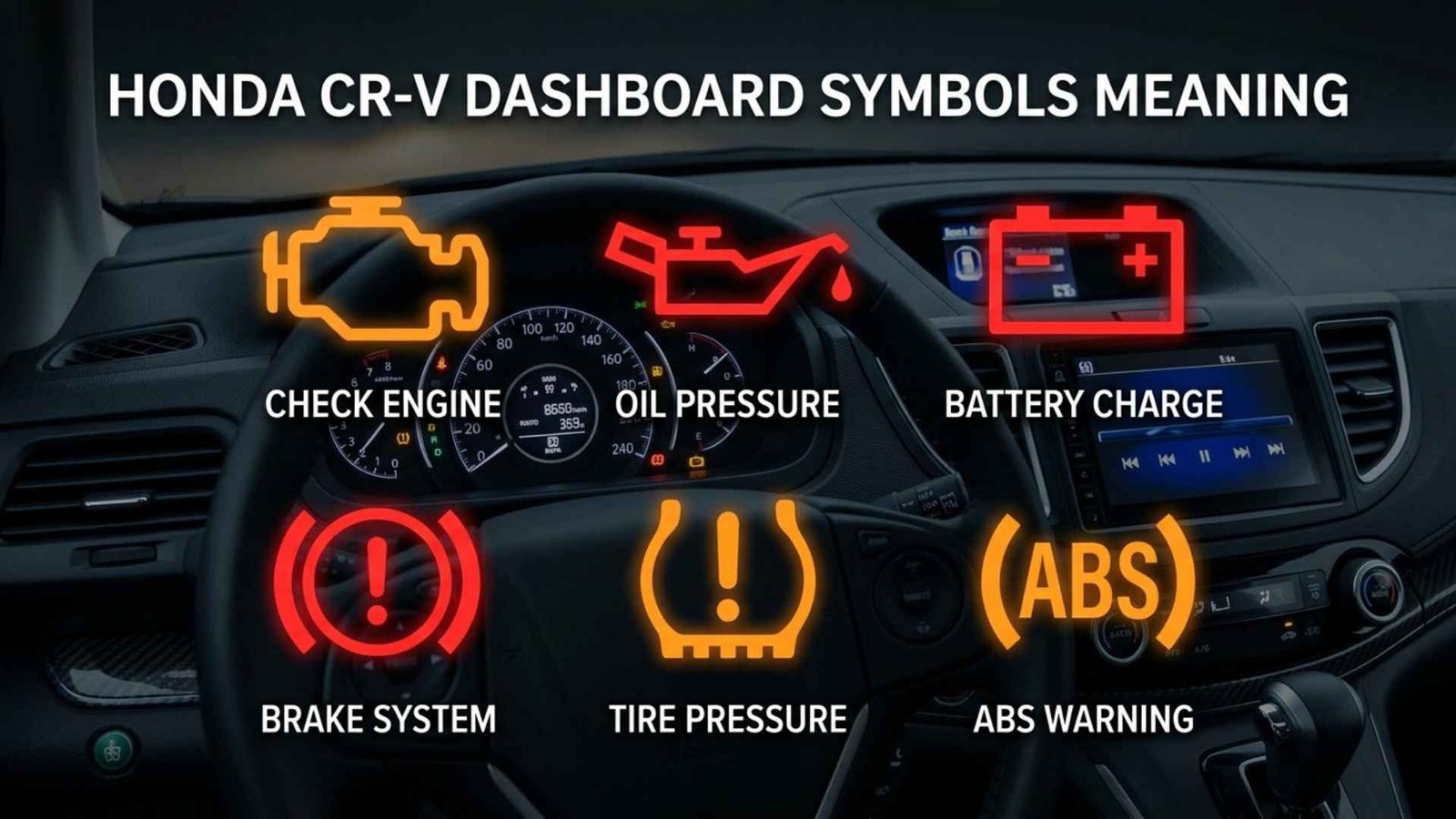
Honda CR-V dashboard symbols communicate the condition of your vehicle, from simple reminders such as an open door to urgent warnings involving oil pressure, brakes, or engine temperature.
Understanding each light helps you decide whether to continue driving, check a basic condition, schedule service, or stop immediately.
The exact Honda CR-V dashboard symbols meaning can vary by model year, trim level, powertrain, and installed safety features. Gasoline, hybrid, front-wheel-drive, and all-wheel-drive models may display different indicators. Always compare an unfamiliar light with the owner’s manual for your specific CR-V.
Quick Meaning
Honda CR-V dashboard symbols use colors and images to report vehicle conditions. Red usually signals an urgent problem, amber indicates a fault or condition requiring attention, and green or blue confirms that a feature is operating. A flashing light generally requires faster action than the same symbol glowing steadily.
Honda CR-V Dashboard Symbol Overview
| Indicator category | Typical color | Primary meaning | Recommended response |
| Critical warning | Red | Serious safety or mechanical concern | Stop safely and investigate immediately |
| Malfunction warning | Amber | A system fault or abnormal condition | Check the message and arrange inspection |
| Condition alert | Amber or red | Driver action is required | Correct the condition as soon as possible |
| Active-system indicator | Green | A feature is switched on or operating | Usually no action needed |
| Lighting indicator | Green or blue | Exterior lights or high beams are active | Confirm the selected lighting mode |
| Driver-assistance indicator | Green, white, or amber | Safety system status, limitation, or fault | Read the accompanying display message |
| Hybrid indicator | Green, blue, white, or amber | Power-flow or hybrid-system status | Follow the display instructions |
| Maintenance reminder | Amber | Scheduled service is due soon or now | Check the Maintenance Minder information |
Honda notes that dashboard indicators normally illuminate briefly when the vehicle starts as part of a system check. Red and amber lights are generally the most important, while blue and green lights usually provide operating information.
What Do Honda CR-V Dashboard Symbols Mean?
Honda CR-V dashboard symbols identify warnings, operating conditions, and active features. Their meaning depends on three details: the symbol itself, its color, and whether it is steady or flashing.
A symbol that appears for a few seconds during startup may simply be completing a self-test. The same symbol remaining on while driving may indicate a malfunction. A message in the Driver Information Interface may provide more specific instructions.
Understanding Honda dashboard light colors
Red dashboard lights usually require immediate attention. They may involve engine oil pressure, the braking system, charging system, airbags, seat belts, or excessive temperature.
Amber or yellow lights normally indicate a problem that should be checked soon. Examples include the check engine light, ABS warning, tire-pressure alert, stability-control malfunction, and driver-assistance system warnings.
Green lights confirm that a feature is active. Turn signals, exterior lights, brake hold, ECON mode, and some cruise-control functions commonly use green indicators.
Blue lights usually identify high beams or certain temperature-related conditions.
White or gray symbols often show that a feature is available, selected, or waiting to become active.
Steady versus flashing indicators
A steady light and a flashing light may not mean the same thing.
For example:
- A steady check engine light may indicate an emissions-related fault.
- A flashing check engine light may indicate an active engine misfire.
- A flashing stability-control symbol may mean the system is currently correcting wheel slip.
- A flashing tire-pressure light followed by steady illumination may indicate a TPMS malfunction rather than merely low tire pressure.
- A flashing AWD warning may indicate overheating and temporary system shutdown.
Always read the accompanying dashboard message before assuming the cause.
Critical Red Honda CR-V Warning Lights
Brake system warning light
The brake warning symbol usually appears as an exclamation mark inside a circle, the word BRAKE, or both.
It may mean:
- The parking brake is applied.
- Brake fluid is low.
- The hydraulic braking system has a fault.
- The electric parking brake system has a problem.
- A brake-related system requires immediate inspection.
First confirm that the parking brake is fully released. If the light remains on, test the brake pedal gently. A soft, unusually low, or ineffective pedal may indicate a serious braking problem. Stop driving and arrange assistance.
Honda advises that a red brake-system warning can indicate low brake fluid or a brake-system problem and may require immediate repair.
Low engine oil pressure light
This red symbol resembles an oil can with a drop coming from its spout.
It warns that the engine is not receiving adequate oil pressure. This is not simply a routine oil-change reminder. Continuing to drive with insufficient oil pressure can cause rapid internal engine damage.
Safely pull over, switch off the engine, and check the oil level after allowing the vehicle to sit. Add the correct oil if the level is low. Do not continue driving if the light remains on after the oil level has been corrected.
Honda instructs drivers to stop safely, check the oil level, add oil if needed, and seek immediate repair if the indicator does not turn off.
Charging system warning
The charging-system symbol looks like a rectangular battery with positive and negative terminals.
It means the 12-volt battery is not being charged correctly. The battery itself may be weak, but the cause could also involve the alternator, drive belt, wiring, voltage regulation, or charging controls.
Turn off unnecessary electrical loads, such as heated seats, audio equipment, and climate-control accessories. Drive only as far as necessary to reach a safe location, because the engine may stop when stored battery power is exhausted.
High engine coolant temperature warning
A red thermometer above wavy lines indicates that the engine coolant temperature is dangerously high.
Move to a safe location and stop the vehicle. Turn off the air conditioner. Do not open the radiator cap while the engine is hot because pressurized coolant can cause severe burns.
Possible causes include low coolant, a failed cooling fan, a coolant leak, thermostat trouble, or water-pump failure.
Some CR-V models use a temperature gauge or dashboard message instead of a dedicated red temperature symbol.
Supplemental Restraint System warning
The SRS or airbag warning symbol normally shows a seated person with a circle representing an airbag.
It indicates a possible problem with:
- Front, side, or curtain airbags
- Seat-belt tensioners
- Occupant-detection components
- Airbag sensors or control modules
The vehicle may still drive normally, but one or more safety restraints may not work correctly during a collision. Arrange inspection promptly. Honda identifies this light as a warning of a problem with an airbag system or seat-belt tensioner.
Seat-belt reminder
The red seat-belt symbol means that the driver or a detected passenger has not fastened a seat belt.
It may flash and sound a chime when the vehicle begins moving. Secure all occupants and check whether a bag or heavy object on a passenger seat is triggering the sensor.
Amber Honda CR-V Warning Symbols
Check engine light
The malfunction indicator lamp resembles an engine outline.
A steady light may indicate a problem involving the engine-management or emissions-control system. Common causes include sensor faults, ignition problems, fuel-delivery issues, evaporative-emissions leaks, or a loose fuel cap on models where the cap is removable.
Reduce hard acceleration and arrange diagnosis.
A flashing check engine light is more urgent because it may indicate a cylinder misfire capable of damaging the catalytic converter. Pull over safely, allow the engine to cool, and seek service. Honda specifically distinguishes a steady emissions-related warning from a flashing misfire warning.
Anti-lock Brake System warning
The ABS symbol displays the letters ABS inside a circle.
It means the anti-lock function may be unavailable. Conventional braking usually remains, but the wheels may lock during hard braking, especially on wet, icy, or loose surfaces.
Drive cautiously and have the system checked. If the ABS light appears together with the red brake warning, treat the situation as more serious.
Tire Pressure Monitoring System light
The low-tire-pressure symbol resembles a horseshoe-shaped tire with an exclamation mark.
A steady light generally means that one or more tires may be underinflated. Stop in a safe area, inspect the tires, and set their pressures according to the driver’s door-jamb label rather than the maximum pressure printed on the tire.
A light that flashes before remaining steady may indicate:
- A TPMS system fault
- A sensor that is not communicating
- A compact spare tire in use
- A recently replaced wheel or sensor requiring attention
Cold weather can lower tire pressure enough to activate the light, but the tires should still be checked with an accurate gauge.
Vehicle Stability Assist indicator
The VSA symbol usually shows a vehicle with wavy skid lines.
Its meaning depends on its behavior:
- Flashing: VSA or traction control is actively correcting wheel slip.
- Steady: The system may have a malfunction.
- VSA OFF: The driver has switched part of the stability system off.
A flashing light on a slippery road is normally expected. A steady malfunction light should be inspected because VSA and hill-start assistance may not operate correctly.
Electric Power Steering warning
The EPS warning may display a steering wheel with an exclamation mark or the letters EPS.
Steering assistance may be reduced or lost, making the wheel feel unusually heavy. Stop safely and restart the vehicle. If the warning remains, arrange service.
The mechanical connection between the steering wheel and road wheels generally remains, but considerably more effort may be required.
All-Wheel Drive warning
The AWD warning appears only on equipped models.
A steady light may indicate a fault in the all-wheel-drive system. A flashing warning can mean that the rear differential or AWD components are overheating. Stop safely and allow the system to cool, usually with the transmission in Park and the engine idling.
During an AWD fault, the CR-V may temporarily operate primarily as a front-wheel-drive vehicle. Honda’s guidance states that a flashing AWD indicator can mean overheating and temporary system inactivity.
Transmission warning
The transmission-system warning may appear as a gear symbol, an amber message, or a flashing gear-position indicator.
Possible causes include:
- Transmission-control faults
- Excessive transmission-fluid temperature
- Electronic shift-system problems
- Sensor or actuator failure
If a transmission-temperature warning appears, stop safely, shift to Park, and allow the fluid to cool. Avoid towing, aggressive acceleration, and steep climbing until the cause is resolved.
Electric parking brake warning
A parking-brake warning may show a P inside a circle, sometimes with an exclamation mark.
A red or green parking-brake light may simply confirm that the brake is applied. An amber warning, a flashing symbol, or the message Electric Parking Brake Problem indicates a malfunction.
Do not assume the brake has applied or released correctly. Park on level ground when possible and follow the message shown on the dashboard.
Honda Sensing and Driver-Assistance Symbols
Newer Honda CR-V models may display symbols for Honda Sensing technologies. Availability and design vary by year and trim.
Collision Mitigation Braking System
The CMBS warning may include a vehicle, collision lines, the word BRAKE, or a system message.
It may indicate:
- The system has detected a possible collision.
- Automatic braking assistance is being applied.
- CMBS has been switched off.
- The camera or radar sensor is blocked.
- High temperature, dirt, snow, rain, or poor visibility is limiting operation.
- The system has a malfunction.
A blocked sensor does not necessarily mean a component has failed. Clean the windshield area in front of the camera and, where applicable, the front radar area.
Lane Keeping Assist System
The LKAS symbol commonly uses lane lines and a steering-wheel image.
White or gray lane lines may mean the system is ready but has not identified both lane boundaries. Green lane lines usually mean the road markings have been detected and steering assistance is available.
An amber warning may indicate blocked sensors, poor road markings, extreme camera temperature, or a system fault.
LKAS does not make the CR-V self-driving. The driver must keep hands on the wheel, watch the road, and remain responsible for steering.
Road Departure Mitigation
The RDM symbol commonly shows a vehicle crossing a lane boundary.
It may flash or display a warning when the CR-V approaches a detected road edge or lane marking without an appropriate turn signal. An RDM OFF indicator means the feature has been disabled.
Adaptive Cruise Control
ACC indicators may show a speedometer, a vehicle, distance bars, or the letters ACC.
The symbols can indicate:
- ACC is available.
- A cruising speed has been set.
- A vehicle is detected ahead.
- Following distance has been selected.
- The radar or camera is obstructed.
- ACC with Low-Speed Follow has a fault.
Heavy rain, fog, snow, road spray, windshield contamination, or sensor blockage can temporarily limit operation.
Blind Spot Information
The blind-spot symbol may appear in the side mirror or as an amber dashboard message.
A mirror indicator normally means a vehicle has been detected beside the CR-V. Rapid flashing, often accompanied by a warning sound, may occur when the turn signal is activated toward the occupied lane.
A dashboard fault message may indicate blocked rear radar sensors or a system problem.
Green, Blue, and Informational Indicators

Turn-signal and hazard lights
Green arrows flash when the left or right turn signal is operating. Both arrows flash together when the hazard warning lights are on.
A turn arrow that flashes unusually fast may indicate a failed exterior bulb on models using replaceable bulbs.
High-beam indicator
A blue headlamp symbol with straight horizontal lines means the high beams are on.
Use low beams when approaching other vehicles or following traffic closely. An automatic high-beam symbol may include the letter A, indicating that automatic control is enabled.
Exterior lights indicator
A green lamp symbol shows that parking lights, taillights, or exterior lighting is active. It does not always confirm that low-beam headlights are on, so verify the headlight-switch position in darkness or poor weather.
ECON mode indicator
A green leaf or ECON symbol means ECON mode is active.
This mode adjusts certain throttle, climate-control, and cruise-control responses to encourage efficient driving. It is not a mechanical warning and does not guarantee a particular fuel-economy result.
Automatic brake hold
The brake-hold symbol may display the words BRAKE HOLD.
One indicator shows that the feature is switched on. Another confirms that it is currently holding the vehicle stationary after the driver has released the brake pedal.
Brake Hold is a convenience feature, not a replacement for selecting Park and applying the parking brake when leaving the vehicle.
Maintenance Minder
The Maintenance Minder symbol commonly appears as a wrench, service code, oil-life percentage, or maintenance message.
It indicates that scheduled maintenance is approaching or due. It is different from the red low-oil-pressure light. The Maintenance Minder concerns service intervals; the red oil-can warning concerns potentially dangerous oil pressure.
Honda CR-V Hybrid Dashboard Symbols
Hybrid CR-V models include additional indicators that do not appear on conventional gasoline versions.
READY indicator
The READY light means the hybrid system is active and the vehicle can move, even when the gasoline engine is silent.
Because the engine may stop automatically, silence does not mean the vehicle is turned off. Always confirm that READY has disappeared before leaving the CR-V unattended.
EV indicator
The EV symbol indicates that the CR-V is moving or operating using electric propulsion under suitable conditions.
The gasoline engine may restart automatically when more power, cabin heating, battery charging, or system temperature control is required.
Power system warning
The power-system indicator warns of a problem within the hybrid propulsion system. It may involve the high-voltage battery, electric motor, power electronics, cooling components, or related controls.
Follow the dashboard instructions and arrange professional diagnosis. Do not attempt to service orange high-voltage cables or hybrid components yourself.
12-volt battery warning
Hybrid models also use a conventional 12-volt electrical system. A battery warning can therefore appear even though the vehicle has a high-voltage traction battery.
The two batteries serve different purposes and are not interchangeable.
Honda’s official indicator list for hybrid CR-V models includes READY, EV, power-system, and 12-volt battery indicators, though available displays differ by model year.
History and Development of CR-V Dashboard Symbols
Honda CR-V dashboard indicators evolved from basic analog warning lamps into a connected information system.
Earlier generations relied mainly on individual bulbs for oil pressure, charging, braking, engine faults, and seat belts. Later CR-V models introduced digital information screens, Maintenance Minder codes, electronic parking-brake indicators, tire-pressure monitoring, and stability-control warnings.
As driver-assistance technology expanded, dashboard communication became more detailed. Modern models can display the status of cameras, radar sensors, adaptive cruise control, lane assistance, collision mitigation, road-departure systems, and hybrid energy flow.
The symbols exist to communicate quickly across language barriers. Standardized pictures allow drivers to recognize oil, brakes, tires, lights, and safety systems without reading long instructions while driving. However, Honda-specific text messages and model-dependent graphics still make the owner’s manual essential.
Common Variations Between Model Years
Honda CR-V warning symbols are not identical across every generation.
Differences may include:
- A word such as BRAKE instead of a pictogram
- Analog warning lamps versus digital screen graphics
- Separate parking-brake and brake-system indicators
- Traditional cruise control versus Adaptive Cruise Control
- Lane Departure Warning on older models and Road Departure Mitigation on newer ones
- Different TPMS behavior and calibration methods
- Hybrid-only READY, EV, battery, and power-flow displays
- Trim-specific AWD, blind-spot, parking-sensor, and fog-light indicators
A symbol guide for a 2014 CR-V may not accurately describe every indicator in a 2025 model. Honda provides manuals organized by model and year, which is the safest reference for an exact dashboard display.
Common Misconceptions
Every red light means the engine must be replaced
Red indicates urgency, not a confirmed diagnosis. A red brake light may simply show that the parking brake is engaged. However, a red warning that remains after the obvious condition is corrected should never be ignored.
The oil light means an oil change is due
The red oil-can symbol usually concerns oil pressure. The wrench or Maintenance Minder concerns routine service. Confusing the two can lead to serious engine damage.
The TPMS light identifies the exact damaged tire
Many CR-V systems warn that tire pressure is low without identifying why. The tire may have a puncture, a slow leak, temperature-related pressure loss, or improper inflation.
ABS failure means there are no brakes
An ABS warning often means normal braking remains but anti-lock operation is unavailable. The red brake warning, abnormal pedal feel, or both lights together may signal a more serious condition.
Driver-assistance symbols mean the vehicle drives itself
Honda Sensing features assist the driver. They do not remove the need to steer, brake, observe traffic, or maintain control.
Clearing a warning fixes the problem
Disconnecting the battery or clearing diagnostic codes may switch off a light temporarily. It does not repair the condition that caused the warning.
Interesting Facts About Honda CR-V Dashboard Symbols
- Many symbols illuminate at startup intentionally. This brief display allows the vehicle to check whether warning circuits and indicators are functioning.
- Color communicates priority before the symbol is recognized. A driver may react to a red warning faster than to an unfamiliar shape.
- A flashing light often changes the diagnosis. Flashing can indicate active intervention, overheating, sensor malfunction, or a severe fault.
- The same symbol can have multiple meanings. The brake symbol may identify an applied parking brake, low brake fluid, or a brake-system malfunction.
- Weather can affect driver-assistance indicators. Heavy rain, snow, fog, glare, dirt, and extreme temperatures may temporarily obstruct cameras or radar sensors.
- Hybrid silence can be misleading. A READY hybrid CR-V can move even when the gasoline engine is not running.
- The wrench and oil can are unrelated warnings. One concerns scheduled maintenance, while the other may warn of dangerously low oil pressure.
- Some amber lights report temporary limitations rather than permanent failure. A blocked camera can disable lane assistance until visibility improves.
- The dashboard message is part of the warning. On digital models, the pictogram may provide only a category, while the Driver Information Interface explains the required action.
- Trim level changes the dashboard vocabulary. A CR-V without AWD, blind-spot monitoring, or certain Honda Sensing features will not use those related indicators.
Related Honda CR-V Symbols
| Related symbol | What it means | How it differs |
| Oil can | Low engine oil pressure | More urgent than an oil-life reminder |
| Wrench | Scheduled maintenance due | Does not normally indicate immediate oil-pressure loss |
| ABS | Anti-lock braking fault | Conventional braking may remain available |
| Red brake symbol | Parking brake or brake-system warning | May involve hydraulic braking and require urgent action |
| Skidding car | VSA or traction-control status | Flashing may mean the system is actively working |
| Tire with exclamation mark | Low tire pressure or TPMS concern | Requires tire inspection or sensor diagnosis |
| Engine outline | Engine or emissions malfunction | Flashing may indicate a severe misfire |
| Steering wheel with exclamation mark | Electric steering fault | Steering may become heavier |
| Vehicle between lane lines | Lane-assistance status | Depends on lane detection and camera visibility |
| Battery | Charging-system fault | Refers to electrical charging, not routine battery age alone |
Frequently Asked Questions
What is the most serious Honda CR-V dashboard warning light?
Several red lights can be equally serious. Low oil pressure, brake-system failure, high coolant temperature, and charging-system warnings may require immediate action. Stop safely, read the dashboard message, and consult the owner’s manual. Do not continue driving when the vehicle shows abnormal braking, overheating, heavy steering, smoke, or severe engine noise.
Can I drive my Honda CR-V with the check engine light on?
A steady check engine light may allow cautious driving for a limited distance if the CR-V runs normally, but diagnosis should not be delayed. A flashing check engine light may indicate a severe misfire. Reduce speed, stop safely, and seek assistance to avoid catalytic-converter or engine damage.
Why did several Honda CR-V warning lights appear at once?
Multiple lights may appear because systems share sensors, electrical power, cameras, radar units, or communication networks. A weak 12-volt battery, wheel-speed sensor fault, blocked camera, or charging problem can trigger several warnings. Read every displayed message and obtain a diagnostic scan rather than assuming that all systems failed independently.
What does the triangle with an exclamation mark mean?
A triangle containing an exclamation mark is usually a master or system-message indicator. It tells you that the Driver Information Interface contains an alert requiring attention. The triangle alone does not identify the exact fault, so read the accompanying message for the affected system and recommended action.
Why is the tire-pressure light on when the tires look normal?
A tire can be significantly underinflated without looking flat. Temperature drops also reduce pressure, and a slow leak may not be visible. Check all tires when cold with a reliable pressure gauge and inflate them to the door-jamb specification. A flashing TPMS light may indicate a system or sensor problem.
What does the green leaf mean on a Honda CR-V?
The green leaf generally represents ECON mode or an efficiency-related display. ECON mode adjusts selected vehicle responses to encourage economical driving. It is informational rather than a warning. Acceleration and climate-control behavior may feel different while the mode is active.
What does the skidding-car symbol mean?
A flashing skidding-car symbol usually means Vehicle Stability Assist or traction control is actively reducing wheel slip. A steady symbol may indicate a fault or that the system has been disabled. Slow down on slippery roads and arrange inspection if the light remains on without an obvious reason.
Why does the dashboard say radar or camera obstructed?
Honda Sensing systems depend on a clear camera view and, on equipped models, unobstructed radar sensing. Dirt, ice, snow, condensation, heavy rain, fog, glare, or extreme temperature can limit operation. Clean the appropriate exterior areas safely. Seek service if the message remains after conditions improve.
How do I reset a Honda CR-V dashboard warning light?
Only reset a reminder after correcting the underlying condition. Maintenance Minder information can be reset after service by following the procedure for the specific model year. Tire-pressure systems may require calibration after correct inflation. Fault warnings should be diagnosed rather than erased, because clearing a code does not repair the problem.
Where can I find the exact meaning for my CR-V model?
Use the owner’s manual matched to the CR-V’s model year, powertrain, and market. Honda’s official owner resources provide model-specific manuals and indicator lists. The Driver Information Interface may also display a detailed message when a symbol appears.
Key Takeaways
- Red lights usually require immediate attention; amber lights normally require inspection or corrective action.
- Green and blue indicators generally confirm that a feature or light is operating.
- A flashing symbol may have a more urgent or different meaning than a steady symbol.
- Stop immediately for low oil pressure, overheating, unsafe braking, or severe steering problems.
- A flashing check engine light can indicate a damaging engine misfire.
- The wrench symbol is a maintenance reminder, not a low-oil-pressure warning.
- Honda Sensing warnings may result from blocked cameras or radar as well as system faults.
- Hybrid CR-V models include READY, EV, power-system, and high-voltage-related displays.
- Symbols vary by year, trim, drivetrain, and country.
- The model-specific Honda owner’s manual is the final authority.
Conclusion
Learning the Honda CR-V dashboard symbols meaning allows you to separate ordinary operating indicators from warnings that demand urgent action. A green lamp or ECON symbol usually confirms normal operation, while a red oil, brake, temperature, or charging light can indicate a serious risk.
Pay attention to the color, whether the light is flashing, and any message displayed beside it. Correct simple conditions such as an open door or low tire pressure promptly, and never ignore a warning involving braking, engine lubrication, overheating, steering, or hybrid power. When the meaning remains unclear, consult the official manual for your exact Honda CR-V model year.

I am Daniel Brooks, a language researcher and writer with a strong interest in how people use English in everyday conversations. I contribute to LearnNestly because I enjoy turning confusing language topics into straightforward lessons. My goal is to help readers understand not only what a word or phrase means, but also when and how to use it naturally. I focus on clear examples, practical explanations, and useful language knowledge that readers can remember.
Books:
- The Practical English Guide
- Understanding Everyday Words
 Amelia Carter