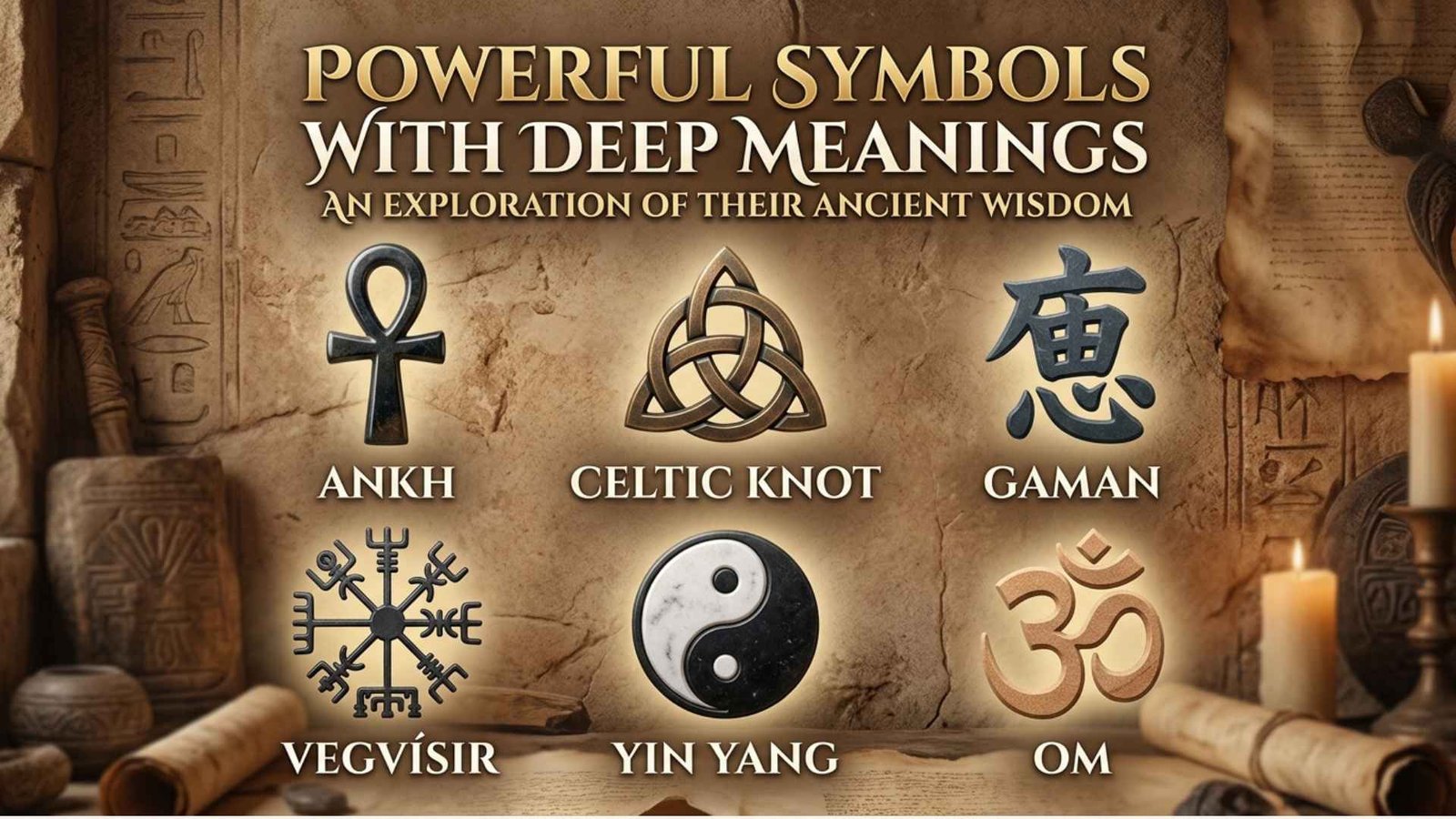
Powerful symbols with deep meanings turn complex human experiences into simple, memorable images. A circle can represent eternity, a lotus can express spiritual growth, and a broken chain can communicate freedom without a single spoken word.
Their power comes from their ability to connect visible forms with invisible ideas such as love, courage, death, rebirth, protection, and hope.
You may encounter these symbols in religious buildings, ancient artifacts, national flags, jewelry, tattoos, literature, architecture, paintings, logos, and digital communication. However, no symbol has one universal meaning. History, culture, religion, personal experience, and context all shape how people interpret it.
Quick Meaning
Powerful symbols with deep meanings are visual signs that represent important human ideas, beliefs, emotions, or experiences. Common examples include the lotus for renewal, the phoenix for rebirth, the tree of life for connection, the infinity sign for endlessness, and the eye for awareness or protection. Their meanings often change across cultures and historical periods.
Symbol Overview Table
| Symbol | Primary Meaning | Cultural or Historical Roots | Common Modern Use |
| Tree of Life | Connection, growth, continuity | Mesopotamia, Norse tradition, Judaism, Christianity | Jewelry, art, family imagery |
| Lotus Flower | Purity, awakening, renewal | Ancient Egypt, Hinduism, Buddhism | Meditation, tattoos, wellness |
| Phoenix | Rebirth and transformation | Greek and Roman traditions; related firebirds appear elsewhere | Literature, logos, tattoos |
| Infinity Symbol | Endlessness and permanence | Mathematical notation developed in early modern Europe | Love jewelry, mathematics, tattoos |
| Yin-Yang | Balance and interdependence | Chinese philosophy and Daoist thought | Wellness, martial arts, design |
| Ouroboros | Cycles, eternity, self-renewal | Ancient Egypt and the Mediterranean world | Alchemy, philosophy, tattoos |
| Eye Symbol | Awareness, protection, divine sight | Egypt, Mediterranean cultures, religious traditions | Amulets, art, jewelry |
| Anchor | Stability, hope, security | Maritime culture and early Christian symbolism | Tattoos, emblems, décor |
| Butterfly | Transformation and freedom | Found in many cultural and spiritual traditions | Memorial art, tattoos, fashion |
| Broken Chain | Liberation and independence | Political, religious, and social movements | Activism, memorials, tattoos |
| Labyrinth | Journey, reflection, spiritual search | Ancient Mediterranean cultures | Meditation, garden design, art |
| Lion | Courage, royalty, strength | Africa, Asia, Europe, the ancient Near East | Heraldry, flags, logos |
| Dove | Peace, hope, spiritual purity | Ancient Mediterranean and Abrahamic traditions | Peace movements, religious art |
| Spiral | Growth, movement, natural cycles | Prehistoric art across many regions | Jewelry, sacred art, design |
| Skull | Mortality, warning, remembrance | Global funerary and artistic traditions | Memento mori art, signs, fashion |
What Do Powerful Symbols With Deep Meanings Represent?
Powerful symbols represent ideas that are too broad, emotional, or abstract to communicate through literal images alone. They often express life’s major themes: birth, death, transformation, identity, belonging, struggle, faith, love, and the passage of time.
A tree, for example, is not only a plant when used symbolically. Its roots may represent ancestry, its trunk may suggest strength, and its branches may symbolize future generations. The image becomes a model of human life.
Symbols also allow people to carry meaning across generations. A community may preserve its beliefs through sacred objects, clothing patterns, monuments, or ritual designs even when language changes. Symbols can therefore function as cultural memory.
Their power depends on three factors:
- Recognition: People can identify the form.
- Association: The form is linked to an idea, story, or belief.
- Context: Its setting guides interpretation.
The same symbol may communicate opposite ideas in different situations. A skull can warn of poison, honor the dead, represent courage, or remind viewers that life is temporary. Meaning is created through both tradition and use.
History and Origin of Symbolic Communication
Symbolic communication began long before formal writing. Prehistoric people used handprints, animal figures, geometric marks, burial objects, pigments, and carved patterns. Scholars cannot always determine the exact meaning of these images, but their repeated use suggests that many carried social, ritual, territorial, or spiritual importance.
As civilizations developed, symbols became part of organized religion, government, trade, warfare, and writing. Ancient Egyptians used recognizable images in hieroglyphic writing and sacred art. Mesopotamian societies used divine emblems, celestial signs, and royal imagery. Greek and Roman cultures connected animals, plants, weapons, and natural forces with gods, heroes, cities, and virtues.
Symbols also developed independently in Africa, Asia, Oceania, and the Americas. Indigenous communities created visual systems tied to local landscapes, ancestors, animals, cosmology, and social identity. These traditions should not be treated as interchangeable. A spiral carved in prehistoric Ireland may not carry the same meaning as a spiral used in Māori art or Indigenous North American design.
Religious expansion, migration, conquest, trade, and translation caused symbols to travel. As they moved, their meanings changed. The lotus, for instance, had important associations in ancient Egyptian religion and later became deeply connected with Hindu and Buddhist teachings in South Asia.
Modern printing, advertising, film, global travel, and the internet have accelerated this process. Today, ancient symbols may appear in fashion or branding far from their original cultural settings. This makes careful interpretation more important than ever.
Symbolism and Interpretation
Traditional Meanings
Traditional meanings grow through repeated use in stories, rituals, art, and social customs. Lions became associated with courage and kingship because of their physical strength and commanding appearance. Anchors represented security because they held ships in place during difficult conditions.
These meanings often feel natural, but they are culturally shaped. People learn symbolic associations from families, schools, religious communities, art, and media.
Modern Meanings
Modern culture often simplifies or personalizes older symbols. The infinity sign is commonly used to represent eternal love, although its familiar sideways figure-eight form became widely known through mathematics. The phoenix now appears in recovery communities, fantasy fiction, business branding, and personal tattoos as a symbol of rebuilding after hardship.
Modern meanings are not automatically false. Symbols naturally evolve. Problems arise when new interpretations are presented as ancient facts without evidence.
Positive Symbolism
Many powerful symbols communicate hope, protection, courage, wisdom, unity, healing, or transformation. Positive interpretations can help people express goals and values. A mountain may represent perseverance, while an open door may suggest opportunity.
Negative Symbolism
Symbols may also represent danger, oppression, chaos, grief, betrayal, or death. Snakes can symbolize healing and renewal because they shed their skin, but they may also represent deception or threat. Darkness may suggest fear and uncertainty, yet it can also symbolize rest, mystery, or creative potential.
Psychological Interpretation
Psychologically, symbols help people organize emotional experiences. Dreams, art, rituals, and personal objects often use images to express feelings that are difficult to name directly.
However, symbols do not have fixed psychological definitions. A river may represent change for one person, loss for another, and home for someone raised near water. Personal history matters as much as general symbolism.
25 Powerful Symbols With Deep Meanings
1. Tree of Life
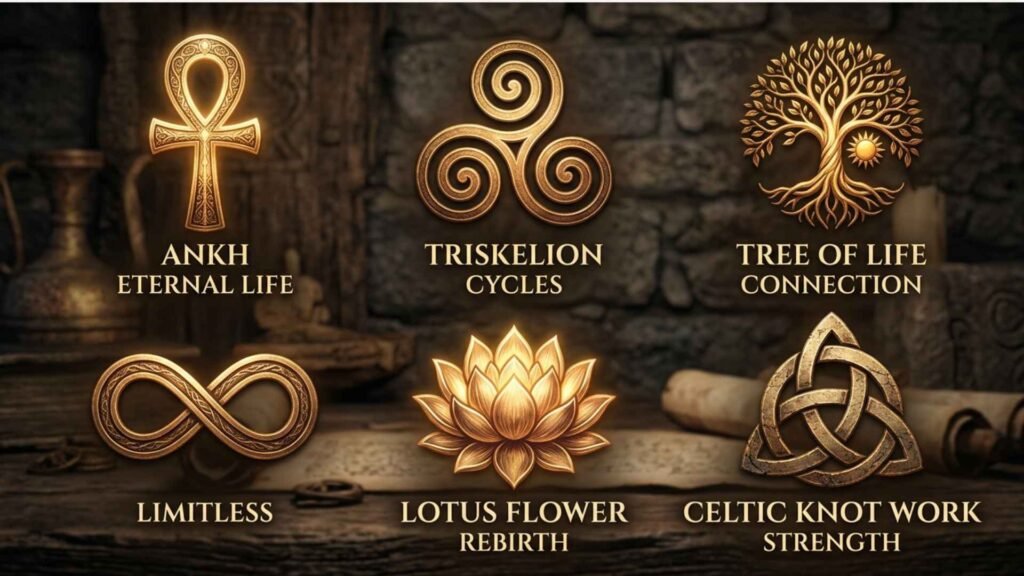
The tree of life represents connection, growth, ancestry, and the continuity of existence. Similar sacred-tree ideas appear in several traditions, including ancient Mesopotamian art, Norse mythology, Jewish thought, Christianity, and other cultural systems.
Its roots suggest origins and stability. Its branches reach outward, representing development, possibility, and future generations. In family jewelry or artwork, it often symbolizes the bond between ancestors, living relatives, and descendants.
2. Lotus Flower
The lotus represents purity, awakening, resilience, and spiritual growth. It rises from muddy water and produces a striking flower, making it a natural image of beauty emerging from difficulty.
In Hindu traditions, the lotus is associated with divinity, creation, beauty, and spiritual realization. In Buddhism, it commonly represents awakening and freedom from attachment. Ancient Egyptian imagery also connected lotus flowers with creation, the sun, and renewal.
3. Phoenix
The phoenix symbolizes destruction followed by renewal. In later Greek and Roman accounts, the legendary bird completes a life cycle connected with fire and then appears again, although versions of the story differ.
Today, the phoenix often represents survival after illness, grief, failure, trauma, or social collapse. It is powerful because it does not deny destruction. Instead, it suggests that a new identity can emerge from what has been lost.
4. Infinity Symbol
The infinity symbol, ∞, represents something without limit or end. The form became established in mathematics during the seventeenth century and is commonly associated with mathematician John Wallis.
Outside mathematics, it represents lasting love, eternal friendship, endless possibility, or spiritual continuity. When names or dates are woven into the design, it often expresses an enduring personal bond.
5. Yin-Yang
The yin-yang symbol represents complementary forces that shape and depend on one another. It is rooted in Chinese philosophical traditions and is closely associated with Daoist thought.
The dark and light areas do not simply mean evil and good. They can represent paired qualities such as stillness and movement, night and day, inward and outward, or receptive and active. Each side contains a small part of the other, showing that opposites are rarely absolute.
6. Ouroboros
The ouroboros is a serpent or dragon biting its own tail. It represents cycles, eternity, self-renewal, destruction, and recreation.
Early examples are known from ancient Egyptian funerary material, and the image later appeared in Greek-influenced texts, alchemy, mysticism, and philosophy. It may symbolize a closed cycle that sustains itself, but it can also suggest being trapped in repetition.
7. Spiral
The spiral is one of the oldest recurring geometric forms in human art. It appears in prehistoric carvings, pottery, architecture, and ceremonial objects across many regions.
Because spirals resemble shells, storms, whirlpools, plant growth, and galaxies, they are often interpreted as symbols of movement, expansion, life cycles, and transformation. Still, the exact meaning of ancient spirals is frequently uncertain and should not be presented as universally known.
8. Butterfly
The butterfly symbolizes transformation because it changes from caterpillar to chrysalis and then into a winged adult. It is also associated with freedom, beauty, impermanence, and the soul.
Butterflies frequently appear in memorial art, where they may represent the continuation of love after death. Their short and delicate lives also make them reminders to value the present.
9. Anchor
The anchor represents stability, safety, hope, and emotional grounding. Its symbolic meaning comes directly from its practical role in securing a vessel.
In early Christian contexts, the anchor could express hope and steadfast faith. In maritime culture, it may represent home, loyalty, or survival at sea. Today, people often use it to honor a person or belief that keeps them steady during uncertain times.
10. Eye of Horus
The Eye of Horus is an ancient Egyptian symbol associated with protection, restoration, royal power, and well-being. It relates to myths involving the god Horus and the injury and restoration of his eye.
The symbol appeared on amulets and funerary objects. It should not be confused with every eye-shaped protection symbol. Its history and mythology are specifically Egyptian.
11. Hamsa
The hamsa is a hand-shaped symbol used in parts of the Middle East and North Africa. It is generally associated with protection, blessing, and defense against harmful attention or the evil eye.
The symbol appears in Jewish, Muslim, and regional folk traditions, though names and interpretations differ. It may be called the Hand of Miriam or Hand of Fatima in particular cultural settings. Its open hand can also suggest generosity or divine care.
12. Evil Eye
The evil eye symbol is commonly used as protection against envy, ill will, or harmful attention. Beliefs involving the evil eye appear in Mediterranean, Middle Eastern, South Asian, Latin American, and other cultures.
The familiar blue eye-shaped amulet is especially associated with Türkiye and surrounding regions, but protective designs vary widely. The amulet represents protection from the evil eye; it does not represent evil itself.
13. Labyrinth
A labyrinth represents a journey toward understanding, spiritual insight, or the center of the self. Unlike a maze, a traditional labyrinth usually has one continuous path rather than multiple deceptive routes.
Labyrinth designs appeared in the ancient Mediterranean world and later in medieval Christian churches. Modern labyrinth walking is used for reflection, prayer, grief work, and meditation.
14. Broken Chain
A broken chain symbolizes freedom from captivity, oppression, addiction, harmful relationships, or limiting beliefs. The image communicates release because chains physically restrain movement.
It has appeared in abolitionist art, political movements, independence imagery, memorials, and personal recovery symbols. Context matters because unbroken chains may instead represent unity, obligation, or imprisonment.
15. Dove
The dove commonly represents peace, innocence, reconciliation, and hope. In biblical tradition, a dove returning to Noah with an olive leaf signals that the floodwaters are receding. In Christian art, the dove may represent the Holy Spirit.
The dove became a major modern peace symbol through art and international peace movements. Its meaning depends on accompanying elements such as an olive branch, light, or religious imagery.
16. Lion
The lion symbolizes courage, authority, protection, and royalty. Lions appear in ancient Near Eastern art, African traditions, Buddhist imagery, European heraldry, national emblems, and religious texts.
Its symbolism comes from its strength, social behavior, and commanding presence. Depending on context, the lion may represent noble leadership or destructive power.
17. Wolf
The wolf can represent loyalty, instinct, wilderness, guardianship, danger, or social connection. Wolves live in family-based groups, which has contributed to modern associations with cooperation and devotion.
Cultural interpretations differ sharply. Roman tradition connects a she-wolf with the founders Romulus and Remus. Norse mythology includes threatening wolves. Some Indigenous traditions hold specific wolf teachings, but these should not be generalized across all nations or communities.
18. Snake
The snake carries some of the most complex symbolic meanings. It can represent healing, rebirth, fertility, wisdom, danger, temptation, or death.
Its ability to shed its skin supports associations with renewal. In Greek tradition, a serpent-entwined staff became linked with Asclepius and healing. In other contexts, snakes appear as guardians, cosmic beings, deceptive figures, or sources of sacred power.
19. Skull
The skull represents mortality, danger, remembrance, equality in death, or defiance. It appears in warning labels because it communicates lethal risk. In art, it may function as a memento mori, reminding viewers that life is temporary.
Skulls can also honor ancestors or the dead. Their use in Mexican Día de los Muertos traditions, for example, should not be reduced to fear or horror.
20. Circle
The circle represents wholeness, unity, eternity, protection, and recurring cycles. Because it has no visible beginning or end, it naturally suggests continuity.
Circular forms appear in wedding rings, halos, mandalas, calendars, ceremonial spaces, and community gatherings. A circle can express equality because no single point is naturally placed above another.
21. Triangle
The triangle represents strength, direction, balance, or groups of three. Its structural stability explains its use in architecture and engineering, while its three sides support religious and philosophical interpretations.
An upward-pointing triangle may suggest ascent, fire, or aspiration in some systems. A downward-pointing triangle may suggest water, descent, or receptivity. These meanings vary by tradition and should not be treated as universal.
22. Cross
The cross has many forms and meanings. In Christianity, it primarily represents the crucifixion of Jesus Christ, sacrifice, salvation, suffering, and resurrection.
Cross-like shapes existed before Christianity and appeared in various ancient cultures. Therefore, not every cross-shaped archaeological object is Christian. Specific forms, dates, locations, and surrounding evidence must guide interpretation.
23. Crescent Moon
The crescent moon represents cycles, change, time, fertility, night, and renewal. Because the visible moon appears to grow and shrink, it naturally became a marker of transformation and recurring time.
The crescent and star are widely associated today with Islam and appear on several national flags, though the symbol is not a universal theological emblem used in every Islamic tradition. Crescent imagery also predates Islam.
24. Compass
The compass symbolizes direction, guidance, purpose, and safe travel. It may represent staying true to personal values or finding one’s path through uncertainty.
Compass designs often appear in travel tattoos, maritime emblems, graduation gifts, and memorial jewelry. When combined with a map, star, or anchor, the symbol may emphasize exploration, destiny, or returning home.
25. Mountain
The mountain symbolizes endurance, spiritual elevation, challenge, strength, and closeness to the divine. Mountains often serve as sacred places because they rise above ordinary landscapes and seem to connect earth with sky.
In modern symbolism, a mountain frequently represents a difficult goal. Reaching the summit suggests achievement, but the path upward may be just as meaningful as the destination.
Cultural Significance
Symbols gain cultural significance through stories, ceremonies, laws, art, and shared memory. A design that represents protection in one society may serve as decoration in another. A sacred symbol may become a national emblem, commercial logo, or fashion pattern when it crosses cultural boundaries.
Regional differences are especially important. The color white is associated with weddings and purity in many Western settings, while it is traditionally linked with mourning in parts of Asia. Owls may represent wisdom in modern Western culture, but other traditions may associate them with death, secrecy, protection, or spiritual messages.
Responsible interpretation requires identifying the symbol’s location, date, community, and purpose. Broad labels such as “ancient symbol” or “Native symbol” often hide major differences between civilizations and peoples.
Religious and Spiritual Meaning
Religious symbols connect visible objects with sacred narratives, divine beings, moral teachings, or spiritual practices. They may identify a faith community, mark holy spaces, guide meditation, or preserve important stories.
The cross, lotus, crescent, menorah, dharma wheel, Om sign, and sacred geometric designs each belong to specific histories and traditions. Their meaning cannot be fully understood through appearance alone.
Spiritual use is often personal, while religious use is usually connected to an established community, text, ritual, or doctrine. A person may wear a tree of life necklace as a private symbol of growth without belonging to any religion. That personal use differs from a sacred tree represented within a particular theological tradition.
Scientific, Mathematical, and Technical Meanings
Some symbols carry precise technical meanings alongside emotional or spiritual ones. The infinity sign represents an unbounded concept in mathematics. Triangles indicate relationships in geometry and provide structural strength in engineering. Spirals describe forms found in shells, storms, plants, and galaxies, though not all natural spirals follow the same mathematical pattern.
Medical symbolism also requires accuracy. The Rod of Asclepius has one snake around a staff and is traditionally associated with healing. The caduceus has two snakes and wings and is linked to Hermes. The two designs are often confused, particularly in modern institutional branding.
Digital culture has created another symbolic layer. Hearts, flames, eyes, broken chains, and moons now appear as icons and emojis. Their meaning may shift with platform, age group, or conversational context.
Where Powerful Symbols Are Used
Powerful symbols appear wherever people need to communicate identity or meaning quickly:
- Jewelry: To express love, protection, faith, remembrance, or family connection.
- Tattoos: To mark personal growth, loss, survival, heritage, or values.
- Religion: To identify sacred spaces, teachings, ceremonies, and communities.
- Architecture: To communicate authority, harmony, protection, or spiritual order.
- Books and films: To reinforce themes, foreshadow events, or reveal character development.
- Flags and emblems: To represent nations, cities, institutions, and movements.
- Technology: To guide users through icons such as power, warning, search, and settings.
- Logos: To associate organizations with trust, speed, strength, unity, or innovation.
- Memorials: To honor lives, losses, victories, or historical struggles.
- Road and safety signs: To communicate warnings and instructions across language barriers.
Common Variations and Similar Designs
Symbols often change in shape while preserving a central idea. The tree of life may appear as a natural tree, a circular Celtic-inspired design, or a family tree diagram. The lotus may have different numbers of petals depending on artistic and religious context.
Orientation can also change meaning. An upright triangle may carry a different association from an inverted one. A broken circle may suggest incompleteness, openness, or movement, while a closed circle suggests unity.
Similar-looking symbols should not automatically be treated as identical. The Eye of Horus, evil eye amulet, all-seeing eye, and ordinary eye icon have different histories. The Rod of Asclepius and caduceus are another common example of visual similarity without identical meaning.
Common Misconceptions
Every Symbol Has One Universal Meaning
Most symbols have several meanings. Culture, time period, placement, color, and surrounding imagery all influence interpretation.
All Ancient Symbols Have Known Definitions
Many prehistoric symbols remain unexplained. Scholars may suggest interpretations, but repeated patterns do not always provide enough evidence for certainty.
Similar Designs Share the Same Origin
Humans can create similar shapes independently. Circles, crosses, spirals, and handprints are simple forms that appear in unrelated cultures.
Modern Meanings Are Always Ancient
Many popular interpretations are recent. A symbol can gain a valid modern meaning, but it should not be falsely described as thousands of years old.
Wearing a Protective Symbol Guarantees Protection
Amulets express faith, identity, tradition, or emotional comfort. Claims of supernatural protection belong to belief rather than scientifically established fact.
Every Cultural Symbol Is Appropriate for Decorative Use
Some designs are sacred, restricted, ceremonial, or connected to living communities. Using them without understanding can be disrespectful.
10 Interesting Facts About Powerful Symbols
- Simple shapes often carry the widest meanings. Circles, lines, crosses, and spirals appear in many cultures because they are easy to create and resemble common natural forms.
- Meaning can change when a symbol rotates. Orientation may alter a symbol’s religious, technical, political, or directional meaning.
- Color can transform interpretation. A rose may represent love, mourning, purity, secrecy, or political identity depending on its color and context.
- Symbols can survive lost languages. People may continue recognizing an emblem even after they can no longer read the original writing around it.
- Some symbols move from practical use to metaphor. Anchors, compasses, keys, bridges, and doors gained symbolic meanings from their physical functions.
- Animals often symbolize observed traits. Lions suggest strength, ants suggest industry, and butterflies suggest transformation, although cultural stories modify these associations.
- National symbols are carefully constructed. Flags and seals combine colors, animals, plants, stars, and tools to communicate political history and collective ideals.
- Personal symbols can differ from public meanings. A snake tattoo may represent healing to its wearer even when others interpret it as danger.
- Commercial use can weaken sacred context. When religious or cultural imagery becomes a fashion trend, its original meaning may be simplified or forgotten.
- Digital icons are modern hieroglyphs in function, not origin. They communicate actions visually, but unlike ancient hieroglyphic systems, most interface icons do not form a full written language.
Related Symbols
- Mandala: Represents cosmic order, wholeness, or meditative focus in specific religious and artistic traditions.
- Dharma Wheel: A Buddhist symbol connected with the Buddha’s teaching and the path toward liberation.
- Om: A sacred sound and written sign important in Hindu traditions and also used in Buddhism and Jainism.
- Ankh: An ancient Egyptian sign associated with life and divine vitality.
- Olive Branch: Represents peace, reconciliation, or victory.
- Key: Symbolizes knowledge, access, secrecy, freedom, or authority.
- Bridge: Represents transition, connection, reconciliation, or movement between life stages.
- Flame: Symbolizes energy, destruction, purification, passion, knowledge, or sacred presence.
- Star: May represent guidance, divinity, hope, achievement, or celestial order.
- Open Hand: Can communicate blessing, protection, peace, generosity, or welcome.
Frequently Asked Questions
What is the most powerful symbol with a deep meaning?
There is no single most powerful symbol because meaning depends on culture and personal experience. The tree of life is among the most widely meaningful because it can represent ancestry, growth, connection, and continuity. The phoenix, lotus, cross, circle, and yin-yang are also powerful within their respective historical and cultural contexts.
What symbol represents strength and courage?
The lion commonly represents strength, courage, authority, and protection. Mountains, bears, oak trees, shields, and swords may also symbolize strength. Their meanings differ: a mountain suggests endurance, an oak suggests stability, a shield emphasizes defense, and a sword may represent disciplined power or conflict.
What symbol represents overcoming struggle?
The phoenix is a strong symbol of overcoming struggle because it represents renewal after destruction. The lotus also communicates resilience by growing through muddy water. Broken chains symbolize release from oppression or limitation, while mountains represent the effort required to overcome difficult challenges.
Which symbol represents life and growth?
The tree of life is one of the clearest symbols of life and growth. Roots represent origin and stability, while branches suggest development and future possibility. The lotus, seed, spiral, sun, and green leaf can also symbolize growth, renewal, fertility, or the life cycle.
What symbol represents protection?
Common protection symbols include the hamsa, evil eye amulet, Eye of Horus, shield, guardian lion, and protective knot designs. Each belongs to a particular cultural or historical setting. A symbol’s protective role should be explained within its own tradition rather than blended with unrelated beliefs.
What symbol means eternal love?
The infinity sign commonly represents eternal love in modern jewelry and tattoos. Circles and rings also symbolize lasting commitment because they have no visible beginning or end. Interlocking circles may express partnership, while a heart combined with an infinity sign emphasizes endless romantic or family love.
What symbol represents a new beginning?
The rising sun, lotus, phoenix, open door, seedling, and butterfly can all represent a new beginning. Each emphasizes a different aspect of change. The phoenix suggests rebuilding after loss, while a seedling represents gradual growth and the open door represents opportunity or a new path.
Can one symbol have both positive and negative meanings?
Yes. A snake may represent healing, wisdom, and renewal, but it may also symbolize danger or deception. Fire can mean warmth, knowledge, purification, destruction, or anger. Symbols reflect human experience, which often contains opposing qualities rather than simple positive or negative categories.
Is it disrespectful to use symbols from another culture?
It can be disrespectful when a sacred, restricted, or culturally important symbol is used carelessly, inaccurately, or purely as decoration. Research its origin, meaning, and ceremonial status before wearing or reproducing it. Appreciation involves context and respect, while appropriation often removes a symbol from the people who created it.
How can I choose a meaningful personal symbol?
Begin with the idea you want to express, such as courage, remembrance, family, healing, or change. Then study several symbols and their histories. Choose one whose meaning matches your experience without misrepresenting its cultural origin. A personal design can combine suitable elements, dates, plants, places, or objects.
Key Takeaways
- Powerful symbols communicate complex ideas through recognizable visual forms.
- Their meanings develop through history, religion, culture, art, and repeated use.
- No symbol should be interpreted without considering context.
- The lotus, phoenix, tree of life, butterfly, and spiral commonly represent transformation or renewal.
- The lion, mountain, anchor, and shield often represent strength or stability.
- Symbols such as the hamsa, evil eye, and Eye of Horus have distinct cultural histories.
- Similar-looking symbols do not necessarily share the same origin or meaning.
- Modern interpretations can be meaningful without being ancient.
- Sacred and cultural symbols should be used with knowledge and respect.
- Personal experience can add meaning, but it does not replace historical evidence.
Conclusion
Powerful symbols with deep meanings endure because they translate life’s largest questions into forms people can see, carry, draw, and remember. A tree can hold the story of a family. A phoenix can represent recovery. An anchor can express stability when words feel inadequate.
Yet symbols are not fixed codes. Their meanings grow through culture, religion, history, and individual experience. Understanding where a symbol came from, how it evolved, and who continues to value it allows us to appreciate its beauty without reducing its significance.

I am Amelia Carter, an English language educator and educational writer who enjoys making difficult ideas simple and easy to understand. At LearnNestly, I write about English words, grammar, everyday expressions, and language questions that people often find confusing. I believe learning should feel practical, clear, and enjoyable rather than overwhelming. Through my writing, I try to give readers explanations they can understand and use in real life.
Books:
- The Everyday English Handbook
- Words Made Simple
 Daniel Brooks