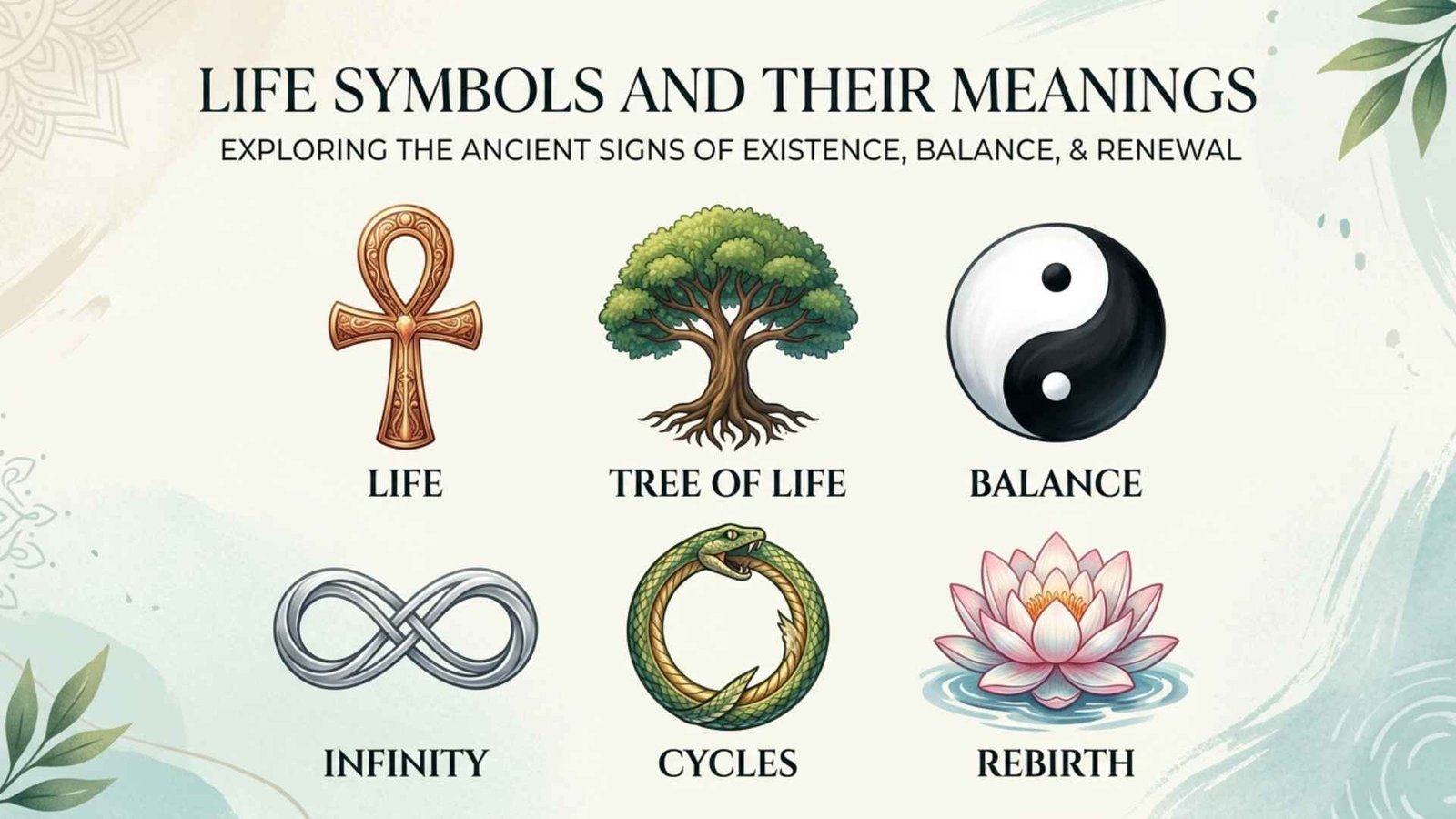
Symbols are all around us, from simple road signs and warning icons to emojis, flags, religious marks, and everyday gestures. We often recognize their meaning instantly without stopping to think about how they communicate ideas. A single shape, color, or image can represent safety, danger, love, peace, identity, or something much deeper.
Understanding symbols and their meaning can make everyday communication easier and more interesting. Some symbols have universal meanings, while others depend on culture, history, religion, or personal experience. The same symbol can even carry different meanings in different countries or situations.
In this complete guide, we’ll explore common symbols, their meanings, origins, and uses in everyday life. You’ll learn how symbols communicate messages without words and discover the hidden ideas behind many familiar signs.
Quick Meaning
Symbols are images, marks, objects, gestures, or signs that represent ideas beyond their literal appearance. They may communicate emotions, beliefs, instructions, identities, warnings, or cultural values. A symbol’s meaning depends on its origin and context, so the same symbol can carry different interpretations across cultures, religions, and historical periods.
Symbol Overview Table
| Symbol | Primary Meaning | Category | Historical or Cultural Origin | Common Modern Use | Related Symbols |
| Heart | Love, affection, emotional life | Emotional | Developed through medieval art and literature | Messages, jewelry, health, social media | Rose, Cupid, infinity |
| Circle | Unity, eternity, completeness | Geometric | Found in many ancient cultures | Spiritual art, logos, diagrams | Wheel, ring, halo |
| Cross | Faith, sacrifice, intersection | Religious and geometric | Ancient form later central to Christianity | Churches, memorials, medicine | Crucifix, ankh, Chi-Rho |
| Crescent | Lunar cycles, change, faith | Celestial and religious | Ancient Near Eastern and Mediterranean cultures | Flags, Islamic imagery, jewelry | Moon, star, solar disk |
| Star | Guidance, hope, achievement | Celestial | Ancient astronomy and religion | Flags, ratings, awards, decoration | Sun, compass rose |
| Eye | Awareness, protection, observation | Spiritual and psychological | Ancient Egypt, Mediterranean cultures, and beyond | Amulets, art, surveillance imagery | Eye of Horus, evil eye |
| Tree | Life, growth, ancestry, connection | Natural | Widespread in ancient mythologies | Family trees, environmental logos, spirituality | Seed, branch, forest |
| Snake | Renewal, healing, danger, wisdom | Animal | Ancient Mesopotamia, Egypt, Greece, and other regions | Medicine, mythology, tattoos | Dragon, ouroboros |
| Dove | Peace, purity, hope | Animal and religious | Ancient Mediterranean and biblical traditions | Peace campaigns, weddings, religious art | Olive branch, white flag |
| Skull | Death, mortality, danger | Human and warning | Used across civilizations | Hazard labels, art, fashion, memorials | Skeleton, hourglass |
| Infinity sign | Endless time or limitless connection | Mathematical and philosophical | Formalized in mathematics during the 17th century | Mathematics, jewelry, relationships | Circle, ouroboros |
| Yin-yang | Balance between complementary forces | Philosophical | Chinese Daoist thought | Philosophy, wellness, art | Taijitu, circle, dual spirals |
| Peace sign | Nuclear disarmament and peace | Political and social | Designed in Britain in 1958 | Activism, fashion, popular culture | Dove, olive branch |
| Ankh | Life and enduring existence | Religious | Ancient Egypt | Historical art, jewelry, spirituality | Cross, djed pillar |
| Om | Sacred sound and ultimate reality | Religious and linguistic | Indian religious traditions | Hindu, Buddhist, and Jain practice | Lotus, mandala |
| Recycling symbol | Material recovery and reuse | Environmental | Designed in 1970 | Packaging and waste systems | Green arrows, leaf |
| Power symbol | Device power control | Technical | Developed from binary notation | Electronics and software | Standby icon, toggle |
| @ sign | Digital address and communication | Linguistic and digital | Commercial accounting use before the internet | Email addresses and social media | Hashtag, ampersand |
What Do Symbols Mean?
Symbols represent ideas that would otherwise require longer explanations. Their purpose is to compress meaning into a recognizable visual, sound, object, gesture, or action.
A symbol has two levels. The first is its visible or literal form. A tree, for example, is a living plant with roots, a trunk, branches, and leaves. The second level is the idea attached to that form. Because a tree grows, changes with the seasons, and connects earth with sky, it can represent life, strength, ancestry, renewal, or spiritual connection.
Symbols gain meaning through repeated use. A single person can assign a private meaning to an object, but cultural symbols develop when communities recognize and pass down the same association. Flags symbolize nations because governments and citizens repeatedly use them in public ceremonies, schools, military settings, and international events.
Context determines interpretation. A skull on a chemical container warns of toxic danger. A skull carved on a tomb refers to death and remembrance. The same image on clothing may express rebellion, toughness, or interest in Gothic art.
For that reason, symbols should not be interpreted in isolation. Their color, position, location, surrounding images, cultural setting, and intended audience all affect their meaning.
History and Origin of Symbols
Symbols began long before formal writing. Early humans used handprints, animal images, geometric marks, carved objects, body decoration, and burial practices to communicate identity, belief, memory, and social status.
Prehistoric cave art provides some of the oldest surviving symbolic imagery. Animals painted on cave walls may have carried practical, ceremonial, spiritual, or social meanings. Scholars can identify patterns in the artwork, but they cannot always prove what individual images meant to their creators.
As settled civilizations developed, symbols became part of government, religion, trade, and writing. Ancient Egyptian hieroglyphs combined pictures, sounds, words, and symbolic ideas. Mesopotamian cuneiform developed from earlier marks used to record goods and transactions. Chinese characters also developed through long historical processes in which visual forms became standardized written signs.
Religious institutions expanded the role of symbols. Temples, sacred objects, ritual clothing, statues, and architectural designs helped communities express ideas about gods, death, creation, morality, and the universe. The ankh represented life in ancient Egypt, while the lotus became associated with purity, awakening, and spiritual development in several Asian traditions.
Political rulers also used symbols to display authority. Crowns, thrones, seals, coats of arms, banners, and royal animals showed status and legitimacy. Later, national flags and emblems helped unite large populations under shared political identities.
The Industrial Revolution created a need for standardized technical symbols. Workers and engineers required marks for machinery, electricity, measurement, transportation, and safety. In the modern world, international organizations continue to develop signs that can be understood across language barriers.
Digital communication has produced another stage in symbolic development. Icons, emojis, hashtags, reaction buttons, and interface symbols now communicate actions and emotions instantly. Many are modern designs, while others adapt ancient ideas such as hearts, stars, faces, hands, and celestial bodies.
Symbolism and Interpretation
Traditional Meanings
Traditional meanings emerge through religion, folklore, mythology, literature, and repeated cultural practices. A crown traditionally represents sovereignty and authority because rulers wore crowns during ceremonies. An olive branch represents peace because it held peaceful and sacred associations in the ancient Mediterranean world.
Traditional symbolism can remain influential even after its original setting changes. People may wear a laurel wreath design to represent victory without knowing its connection to ancient Greek and Roman honors.
Modern Meanings
Modern society frequently adapts older symbols. The heart once appeared mainly in religious, literary, and romantic contexts. Today, it also functions as a social-media reaction, a health icon, and a sign for saving favorite content.
Commercial branding can also reshape meaning. Companies select animals, shapes, and colors to suggest speed, trust, strength, luxury, or friendliness. Over time, a logo may become strongly associated with one organization, even when its design uses a much older symbol.
Positive Symbolism
Many symbols express constructive qualities:
- Light can represent knowledge, truth, hope, or divine presence.
- A rising sun can symbolize beginnings, renewal, and possibility.
- Open hands may communicate generosity, welcome, or honesty.
- A bridge can represent connection, reconciliation, or transition.
- A seed can symbolize potential, growth, and future development.
Negative Symbolism
Symbols can also express fear, conflict, loss, or moral danger:
- Darkness may represent uncertainty, secrecy, ignorance, or death.
- Chains can symbolize imprisonment, oppression, or restriction.
- Broken glass may suggest violence, fragility, or disrupted order.
- A storm can symbolize emotional turmoil or approaching conflict.
- A mask may represent deception, hidden identity, or social pressure.
Negative meanings are not always permanent. Broken chains, for example, usually symbolize liberation rather than captivity because the image emphasizes escape from restriction.
Psychological Interpretation
Psychological interpretation examines how symbols express inner experience. Dreams, art, stories, and personal memories often use symbolic images to represent emotions that are difficult to explain directly.
A house may symbolize safety, identity, family, or the self. Water can suggest emotional depth, uncertainty, cleansing, or change. A locked door may represent exclusion, secrecy, fear, or an unavailable opportunity.
These interpretations are not fixed scientific formulas. Personal history matters. Someone who nearly drowned may associate water with danger, while another person may connect it with peace and freedom. Psychological readings should therefore be treated as possibilities rather than universal facts.
Cultural Significance of Symbols
The meaning of a symbol can change greatly between cultures. Colors provide one of the clearest examples.
White often represents purity, peace, or innocence in Western weddings and religious imagery. In parts of East and South Asia, however, white has traditionally been associated with mourning and funerals. Red can symbolize danger in road systems, love in popular culture, good fortune in Chinese traditions, or sacred power in religious ceremonies.
Animals also carry different meanings. Owls often represent wisdom in Western contexts because of their connection with Athena in ancient Greek tradition. In other settings, owls may be associated with night, death, mystery, or supernatural warnings.
The dragon shows an especially strong contrast. In many European legends, dragons appear as dangerous creatures that guard treasure or threaten communities. In Chinese culture, the dragon has traditionally represented power, vitality, rain, prosperity, and imperial authority.
Hand gestures can also change by region. A gesture considered friendly in one country may be insulting in another. This demonstrates that human actions can function as symbols just as clearly as visual marks.
Cultural borrowing adds another layer of complexity. People often use sacred or traditional designs in fashion, tattoos, and decoration without understanding their original importance. Respectful use requires learning whether the symbol is ceremonial, restricted, connected to a living community, or likely to be misunderstood.
Religious and Spiritual Meaning
Religions use symbols to make abstract beliefs visible. Sacred symbols can identify a faith, represent teachings, mark holy places, guide meditation, or connect believers with important historical events.
The Cross
The cross is Christianity’s most recognized symbol. It represents the crucifixion of Jesus Christ, sacrifice, salvation, and hope in resurrection. Different Christian traditions use plain crosses, crucifixes showing the body of Jesus, and regional forms such as the Orthodox cross.
The cross also existed as a geometric shape before Christianity, so not every cross-shaped design has a Christian meaning.
The Crescent and Star
The crescent and star are widely associated with Islam today, especially because they appear on the flags of several Muslim-majority countries. However, neither symbol serves as a universal theological emblem required by Islamic scripture. Their association developed through historical, political, and regional use.
The Star of David
The six-pointed Star of David, or Magen David, is a major symbol of Jewish identity. Its broad Jewish use developed gradually, becoming especially prominent in recent centuries. Today it appears on synagogues, Jewish ceremonial objects, memorials, and the flag of Israel.
Om
Om, also written Aum, is a sacred sound and written symbol in Indian religious traditions. It is particularly important in Hinduism and also appears in Buddhist and Jain contexts. It can represent ultimate reality, consciousness, sacred vibration, or the totality of existence.
The Lotus
The lotus grows from muddy water but opens as a clean flower. This natural pattern made it a powerful image of purity, awakening, rebirth, and spiritual growth. It has important meanings in Hinduism, Buddhism, Jainism, and ancient Egyptian imagery, although interpretations differ by tradition.
The Wheel
The wheel can represent movement, time, cosmic order, and repeated cycles. In Buddhism, the Dharma wheel symbolizes the Buddha’s teaching and the path toward liberation. In Indian history, the Ashoka Chakra became a symbol of moral law and appears at the center of India’s national flag.
Religious symbols should be interpreted within their own traditions. Similar shapes do not always indicate shared beliefs or common historical origins.
Scientific and Technical Meanings
Scientific and technical symbols allow complex information to be communicated precisely.
Mathematical Symbols
Mathematics uses symbols as a formal language:
- + indicates addition or a positive value.
- − indicates subtraction or a negative value.
- = shows that two expressions have equal value.
- ∞ represents infinity or an unbounded quantity.
- π represents the ratio of a circle’s circumference to its diameter.
- √ indicates a square root or other root operation.
Mathematical symbols have defined functions. Unlike artistic symbols, their meanings should remain consistent within the relevant system.
Scientific Symbols
Chemical elements use standardized abbreviations, such as O for oxygen, Fe for iron, and Au for gold. Scientific units also use symbols, including m for meter, kg for kilogram, and s for second.
Symbols in formulas may change meaning by discipline. The letter “c,” for example, may represent the speed of light in physics, concentration in chemistry, or a constant in mathematics. The surrounding equation provides the correct interpretation.
Medical Symbols
The Rod of Asclepius, a staff with one snake, is an ancient Greek symbol associated with healing and medicine. It differs from the caduceus, which has two snakes and wings and was linked to Hermes. The two are often confused, especially in modern North American contexts.
Medical systems also use warning marks, prescription abbreviations, anatomical diagrams, and standardized safety symbols.
Electrical and Engineering Symbols
Engineers use diagram symbols for resistors, switches, batteries, motors, ground connections, and other components. These marks allow professionals to understand systems without drawing every object realistically.
Digital Symbols
Digital interfaces depend on visual shorthand. A magnifying glass means search, a house means home, a paper clip means attachment, and a trash can means delete. The power symbol combines the binary ideas of one and zero, traditionally associated with on and off.
Where Symbols Are Used
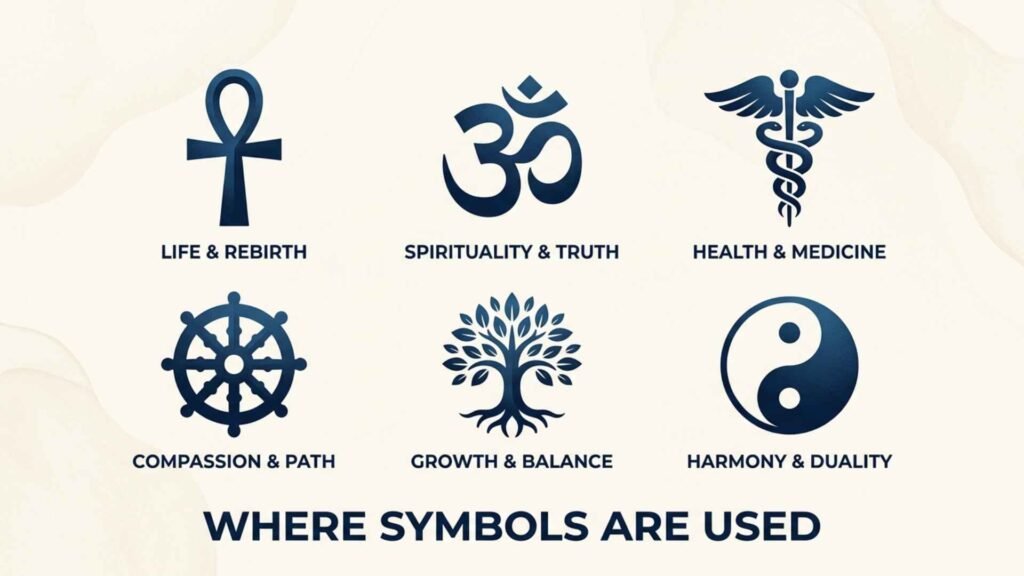
Symbols appear wherever people need to communicate identity, meaning, instructions, or emotion.
Books and Literature
Writers use recurring objects, colors, weather, animals, and places to deepen a story. A journey may represent personal growth. Spring may suggest renewal, while winter may suggest aging, isolation, or death.
A literary symbol gains meaning from the text itself. Readers should examine repetition, character reactions, setting, and plot rather than relying only on general symbol dictionaries.
Maps and Road Signs
Maps use symbols to show roads, rivers, airports, borders, hospitals, railways, and landmarks. Road systems use standardized shapes and colors to communicate warnings and instructions quickly.
Architecture
Buildings may use domes, towers, arches, geometric patterns, sacred directions, and decorative plants or animals. Architectural symbols can express religious belief, political power, wealth, memory, or community identity.
Jewelry and Tattoos
People wear symbols to express faith, love, grief, ancestry, protection, achievement, or personal values. Tattoo meanings are highly individual, even when the design has a well-known cultural history.
Flags and National Emblems
Flags use stars, crosses, suns, moons, animals, weapons, plants, and color patterns to represent nations or communities. Their meanings may refer to geography, independence movements, religion, political ideals, or historical events.
Logos and Branding
Brands use symbols to create quick recognition. Circles can suggest unity, shields may suggest security, and upward arrows often imply growth or progress. However, the final meaning develops through advertising and public experience.
Art and Popular Culture
Artists can preserve, question, reverse, or criticize traditional symbolism. A familiar symbol may be deliberately changed to address war, consumerism, identity, politics, or social injustice.
Common Variations
A symbol’s appearance often changes without completely losing its core meaning.
Design Variations
A heart can be outlined, broken, pierced by an arrow, surrounded by flames, or combined with a lock. Each variation adds a new idea:
- A broken heart represents grief or lost love.
- A heart with an arrow suggests romantic attraction.
- A sacred heart may carry specific Christian meaning.
- A locked heart can represent emotional protection or loyalty.
Regional Variations
Crosses, stars, floral motifs, knots, and protective eyes may take different forms in different regions. These variations can reflect local artistic styles, materials, languages, and religious traditions.
Color Variations
Color can completely change a sign’s message. A red rose usually represents passionate love, while a white rose can suggest innocence, remembrance, or peace. A black flag may signal mourning, protest, rebellion, or danger depending on context.
Modern Adaptations
Emojis adapt older symbols for digital conversation. A flame can mean literal fire, popularity, excellence, or attraction. A skull emoji may represent death, danger, shock, or intense laughter in informal online language.
Similar-Looking Symbols
Some symbols resemble each other but have different meanings. The medical Rod of Asclepius is not the same as the caduceus. The peace sign differs from the Mercedes-style three-point star. A pentagram and a pentacle are related forms, but the pentacle normally includes a surrounding circle.
Common Misconceptions About Symbols
Every Symbol Has One Universal Meaning
Most symbols do not have one meaning everywhere. Their interpretations develop through culture, history, religion, and personal experience.
Ancient Symbols Always Have Mysterious Origins
Some ancient symbols do have uncertain histories, but many served practical or clearly documented purposes. Not every geometric mark is evidence of a secret code, lost civilization, or hidden religious system.
Similar Shapes Must Share an Origin
Two cultures can independently create circles, spirals, crosses, or triangles. Simple geometric forms appear naturally in art and design. Visual similarity alone does not prove historical contact.
All Spiritual Meanings Are Historically Proven
Modern spiritual communities sometimes assign new meanings to old symbols. These interpretations may be meaningful to practitioners, but they should not automatically be presented as ancient facts.
Direction Never Matters
A reversed, rotated, or mirrored symbol can carry a different meaning, but not always. Direction may reflect writing style, artistic choice, religious tradition, or political reinterpretation.
Symbols Are Harmless in Every Context
Some symbols are connected with persecution, extremism, trauma, or sacred restrictions. Using them without context can cause fear or offense, even when the user intends a different meaning.
Interesting Facts About Symbols
- Some of the oldest symbols predate writing.
Geometric marks, handprints, and repeated visual patterns allowed humans to preserve ideas before formal writing systems existed. - The meaning of a symbol can change faster than its shape.
The hashtag sign existed long before social media, but digital platforms transformed it into a tool for categorizing conversations. - Simple shapes often survive across thousands of years.
Circles, spirals, crosses, and triangles remain common because they are easy to create, recognize, and adapt. - Many national symbols began as political tools.
Flags, seals, and emblems helped governments establish authority and unite people around a shared identity. - Nature provides many of humanity’s strongest symbols.
Trees, rivers, mountains, animals, fire, and celestial bodies became symbolic because people directly depended on them for survival. - A symbol can communicate without literacy.
Safety signs and public icons help people navigate airports, hospitals, roads, and buildings even when they cannot read the local language. - Color symbolism is strongly cultural.
No color carries exactly the same emotional or ceremonial meaning in every society. - Commercial logos can become cultural symbols.
Repeated exposure can make a brand mark represent an entire lifestyle, industry, or period of history. - Symbols can be intentionally reclaimed.
Communities sometimes adopt a formerly insulting or oppressive symbol and give it a new meaning of identity, survival, or resistance. - Digital communication creates symbolic grammar.
Emojis, punctuation, reaction icons, and capitalization now help express tone that would otherwise be carried by voice or facial expression. - Absence can function as a symbol.
An empty chair may represent a missing person, loss, remembrance, exclusion, or someone expected to return. - The same object can be both practical and symbolic.
A key opens a lock, but it can also represent knowledge, freedom, authority, access, or a solution.
Related Symbols and How They Differ
| Related Symbol | Common Meaning | Key Difference |
| Spiral | Growth, movement, cycles | Emphasizes development or motion rather than perfect completeness |
| Triangle | Stability, hierarchy, direction | Meaning changes strongly according to its orientation |
| Square | Order, structure, material stability | Often represents fixed boundaries rather than endless continuity |
| Sun | Life, power, clarity | Usually emphasizes energy and illumination |
| Moon | Cycles, intuition, change | Often associated with phases, night, and reflection |
| Rose | Love, beauty, secrecy | Color and cultural setting strongly shape its meaning |
| Butterfly | Transformation, freedom | Focuses on visible change from one life stage to another |
| Phoenix | Rebirth after destruction | Represents renewal through death, fire, or hardship |
| Anchor | Stability, hope, security | Suggests remaining grounded during uncertainty |
| Compass | Direction, guidance, purpose | Emphasizes finding a path or making decisions |
| Knot | Connection, eternity, obligation | Can represent bonds that are difficult or impossible to separate |
| Labyrinth | Journey, confusion, spiritual search | Focuses on movement toward or away from a center |
Frequently Asked Questions
What is the main purpose of a symbol?
The main purpose of a symbol is to represent an idea, instruction, identity, emotion, or belief in a compact form. Symbols help people communicate quickly and remember complex concepts. Their meaning comes from shared cultural use, formal rules, personal experience, or the context in which they appear.
Do symbols have the same meaning in every culture?
No. Symbols often change meaning across cultures, regions, religions, and historical periods. White may suggest purity in one setting and mourning in another. An animal associated with wisdom in one culture may represent danger elsewhere. Reliable interpretation requires attention to cultural and historical context.
What is the difference between a sign and a symbol?
A sign usually communicates a direct message, such as “stop,” “exit,” or “danger.” A symbol often carries broader layers of meaning, such as love, faith, freedom, or mortality. The categories can overlap because a single image may function as a practical sign in one context and a cultural symbol in another.
Why do people use symbols in religion?
Religious symbols make invisible beliefs easier to express, remember, and share. They may represent sacred events, divine qualities, moral teachings, spiritual paths, or membership in a faith community. Symbols also appear in rituals, clothing, architecture, art, meditation, pilgrimage, and ceremonies.
Can a symbol’s meaning change over time?
Yes. Political movements, religious developments, technology, art, and popular culture can all reshape a symbol’s meaning. A mark may gain new associations while retaining older ones. The @ sign, for example, moved from commercial notation into email and later became part of social-media identity.
How can I identify an unfamiliar symbol?
Begin by recording its exact shape, color, direction, location, and surrounding text or images. Then consider where you found it, such as a religious building, machine, map, garment, or historical document. Consult sources related to that specific field instead of relying only on general symbol lists.
Are dream symbols universal?
Dream symbols are not completely universal. Certain images may reflect common human experiences, but personal memories, fears, culture, and circumstances strongly influence dreams. A snake might represent danger, healing, transformation, or a recent real-life encounter. Dream interpretations should be treated as possibilities, not proven predictions.
Why are circles common in symbolism?
Circles have no visible beginning or end, so they naturally suggest unity, eternity, completion, protection, or cycles. Circular forms also appear in the sun, moon, eyes, wheels, rings, and natural movement. These qualities made the circle important in religious art, philosophy, mathematics, and design.
Is it disrespectful to wear a religious or cultural symbol?
It can be disrespectful when a sacred, restricted, or historically sensitive symbol is used carelessly. Before wearing one, learn its meaning, community of origin, ceremonial role, and modern associations. Respectful use avoids mocking alterations, false claims of identity, and designs connected with suffering or discrimination.
How do symbols affect human behavior?
Symbols influence attention, emotion, memory, and decision-making. A warning sign can trigger caution, while a national flag may create feelings of unity or pride. Brands also use symbols to shape trust and recognition. However, reactions vary because people interpret symbols through their own culture and experiences.
Key Takeaways
- Symbols are images, objects, sounds, gestures, or marks that represent larger ideas.
- Their meanings develop through history, culture, religion, politics, science, and repeated social use.
- A symbol rarely has one universal interpretation.
- Context, color, direction, location, and surrounding imagery affect meaning.
- Ancient symbols may gain new religious, political, commercial, or digital associations.
- Scientific and technical symbols usually have more standardized definitions than artistic symbols.
- Similar-looking designs do not automatically share the same origin.
- Personal symbolism can differ from traditional cultural meaning.
- Sacred and culturally sensitive symbols should be used with care.
- Reliable interpretation distinguishes documented history from modern belief or personal opinion.
Conclusion
Learning about symbols and their meaning reveals how people communicate across time, language, and culture. A simple image can preserve religious beliefs, express national identity, warn of danger, represent an emotion, or explain a scientific concept.
The most accurate interpretations consider both history and context. A heart, snake, star, circle, tree, or cross may carry several meanings at once, depending on who uses it and where it appears. By examining origin, culture, design, and modern usage, you can move beyond quick assumptions and understand what a symbol truly communicates.

I am Amelia Carter, an English language educator and educational writer who enjoys making difficult ideas simple and easy to understand. At LearnNestly, I write about English words, grammar, everyday expressions, and language questions that people often find confusing. I believe learning should feel practical, clear, and enjoyable rather than overwhelming. Through my writing, I try to give readers explanations they can understand and use in real life.
Books:
- The Everyday English Handbook
- Words Made Simple
 Daniel Brooks