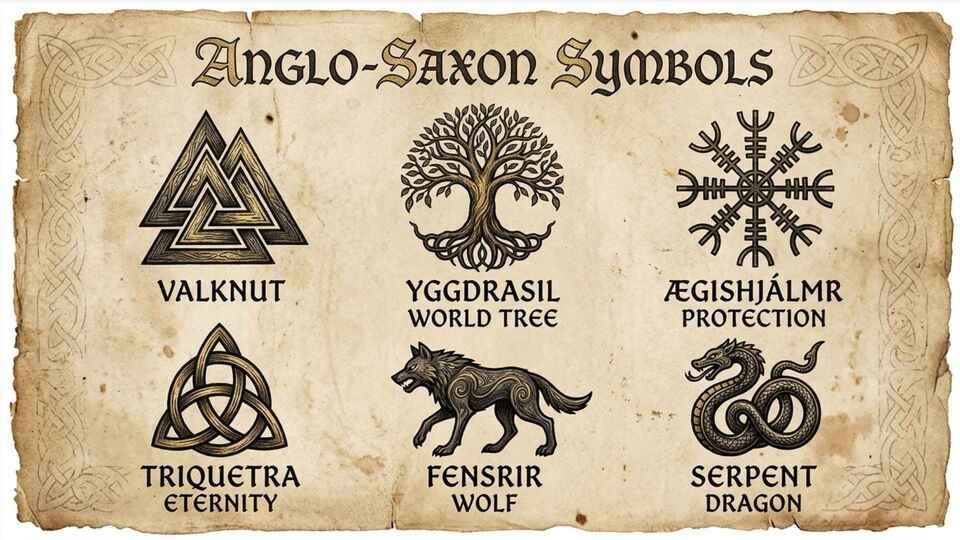
Anglo-Saxon symbols reveal how people in early medieval England understood identity, protection, religion, nature, power, and the unseen world. These symbols appear on weapons, jewelry, coins, manuscripts, carved stones, burial objects, and everyday tools dating from roughly the fifth century to the Norman Conquest of 1066.
The term Anglo-Saxon symbols does not describe one fixed symbolic system. Instead, it includes runic letters, Christian signs, animal imagery, geometric patterns, royal emblems, and decorative motifs.
Their meanings changed as Anglo-Saxon England moved from Germanic pagan traditions toward Christianity and interacted with Celtic, Roman, Scandinavian, and Continental European cultures.
Quick Meaning of Anglo-Saxon Symbols
Anglo-Saxon symbols expressed language, faith, status, ancestry, protection, and cultural identity. Important examples include runes from the Anglo-Saxon futhorc, crosses, interlaced knots, animals, trees, serpents, birds, and geometric designs. Their meanings depended on context, and many served both practical and symbolic purposes rather than carrying one universal interpretation.
Anglo-Saxon Symbols Overview
| Field | Details |
| Symbol group | Anglo-Saxon symbols |
| Primary meanings | Identity, faith, protection, power, memory, ancestry, and social status |
| Main categories | Runes, Christian signs, animals, plants, geometric patterns, and royal emblems |
| Cultural origin | Germanic traditions adapted in early medieval England |
| Main period | Approximately the fifth century to 1066 |
| Geographic center | England, with connections to northern Europe and Scandinavia |
| Common materials | Stone, bone, wood, gold, silver, iron, bronze, parchment, and coins |
| Common uses | Writing, worship, burial, decoration, ownership, commemoration, and authority |
| Main script | Anglo-Saxon futhorc runes and later the Latin alphabet |
| Religious influences | Pre-Christian Germanic belief and Christianity |
| Modern use | Historical reconstruction, jewelry, tattoos, art, fiction, gaming, and heritage design |
| Unicode | Many runic characters appear in the Unicode Runic block, U+16A0–U+16FF |
| Related traditions | Germanic runes, Norse symbols, Insular art, Celtic interlace, and medieval Christian imagery |
What Do Anglo-Saxon Symbols Mean?
Anglo-Saxon symbols generally communicated belonging, belief, protection, authority, or remembrance, but their exact meaning depended on where and how they appeared.
A rune scratched on a comb might identify its owner or maker. The same rune on an amulet could have been intended as a protective sign, a sound, a name, or a meaningful word. A cross on a stone monument clearly reflected Christianity, while a bird or serpent on jewelry could function as decoration, a sign of status, or an image connected with religious ideas.
This context is essential because Anglo-Saxon England had no surviving handbook that assigns one permanent meaning to every image. Modern claims that each design had a precise spiritual definition often go beyond the available evidence.
Symbols as Visual Language
Symbols helped communicate in a society where many people could not read long written texts. A cross could identify a Christian object or sacred place. A ruler’s portrait on a coin could represent political authority. A runic name might declare ownership, while elaborate goldwork could display elite rank.
Visual designs also made stories and beliefs memorable. Biblical scenes carved on stone crosses taught Christian narratives. Animals and interlaced patterns turned ordinary objects into statements about skill, wealth, identity, or sacred order.
Symbols as Marks of Identity
Anglo-Saxon identity was shaped by family, local community, kingdom, language, religion, and loyalty. Symbols could connect a person to these groups.
Names written in runes, royal images on coins, military objects, and regional artistic styles all helped express belonging. However, these identities were not fixed. Different kingdoms, including Wessex, Mercia, Northumbria, Kent, and East Anglia, developed through contact, migration, warfare, marriage, and trade.
History and Origin of Anglo-Saxon Symbols
Anglo-Saxon symbolism developed from several overlapping traditions rather than from a single source.
After Roman rule in Britain ended in the early fifth century, Germanic-speaking groups settled in different parts of the island. They brought artistic habits, religious customs, languages, and runic writing traditions connected with northern Europe. These blended with surviving Romano-British practices and later absorbed strong Christian, Irish, Mediterranean, Frankish, and Scandinavian influences.
Early Germanic Foundations
The earliest Anglo-Saxon communities used symbols found more broadly among Germanic peoples. These included runes, animal forms, geometric decoration, weapon imagery, and objects associated with status or ritual.
Early metalwork often featured creatures with intertwined bodies, gripping limbs, open jaws, or staring eyes. Scholars classify many such designs as forms of Germanic animal art. Their exact messages are difficult to recover, but they likely helped communicate identity, power, danger, protection, or elite taste.
The Development of Anglo-Saxon Runes
The Anglo-Saxon runic alphabet is called the futhorc, named after the sounds of its first six runes. It developed from the older Germanic Elder Futhark and expanded to represent sounds found in Old English and Old Frisian.
The British Museum notes that the Anglo-Saxon futhorc eventually contained 31 characters and survives in inscriptions dating from about the fifth to the eleventh centuries. Runes appear on weapons, jewelry, coins, memorial stones, bone objects, and wooden items. Their straight and diagonal strokes made them practical for carving into hard surfaces.
Although runes are frequently described as magical symbols, they were first and foremost letters. They could spell personal names, labels, prayers, riddles, ownership statements, or ordinary words.
Conversion to Christianity
Christianity transformed Anglo-Saxon symbolism from the late sixth century onward. Missionaries associated with Rome and Irish Christian communities helped establish churches, monasteries, schools, and manuscript centers.
The cross became one of the most visible signs of the new religion. Biblical figures, saints, angels, vines, books, and scenes from Christ’s life appeared in manuscripts and stone sculpture.
Older artistic habits did not disappear. Christian artists often used interlace, animals, and geometric forms alongside crosses and biblical scenes. By around 700, English visual culture was largely Christian, yet it continued to combine local and international styles. English Heritage notes that carved high crosses joined interlace with Christian imagery and sometimes included motifs shaped by Scandinavian influence.
Scandinavian Influence
Viking settlement and political control brought new artistic styles to parts of England from the late eighth century onward. Scandinavian and Anglo-Saxon communities exchanged language, designs, technology, and religious ideas.
Serpents, ribbon-like animals, gripping beasts, and complex interlace became especially prominent in areas with Scandinavian connections. Some monuments combine Christian crosses with imagery that appears influenced by Norse art, showing that cultural change was often gradual rather than immediate.
Major Anglo-Saxon Symbols and Their Meanings
Anglo-Saxon Runes
Runes represented speech sounds, but their names also referred to concepts such as wealth, journey, gift, need, ice, harvest, or humanity. A rune could therefore function as a letter while also suggesting the idea contained in its name.
Common Anglo-Saxon runes include:
| Rune | Name | Sound | Basic Name Meaning |
| ᚠ | Feoh | F | Wealth or livestock |
| ᚢ | Ur | U | Aurochs or wild ox |
| ᚦ | Thorn | TH | Thorn |
| ᚩ | Os | O | God or mouth |
| ᚱ | Rad | R | Riding or journey |
| ᚳ | Cen | C/K | Torch |
| ᚷ | Gyfu | G | Gift |
| ᚹ | Wynn | W | Joy |
| ᚻ | Hægl | H | Hail |
| ᚾ | Nyd | N | Need or hardship |
| ᛁ | Is | I | Ice |
| ᛄ | Ger | Y/J | Year or harvest |
| ᛏ | Tir | T | Glory or a divine name |
| ᛒ | Beorc | B | Birch |
| ᛗ | Mann | M | Person |
| ᛞ | Dæg | D | Day |
| ᛟ | Ethel | OE | Ancestral property |
These brief meanings come from rune names and rune poems, not from a complete fortune-telling system. Turning each rune into a fixed prediction about love, money, or destiny is largely a modern practice.
The Christian Cross
The cross represented Christ’s Crucifixion, salvation, resurrection, Christian faith, and divine protection. It appeared on coins, grave markers, manuscripts, jewelry, reliquaries, churches, and monumental sculpture.
Crosses also marked sacred authority. A cross on a king’s coin could connect royal government with Christian legitimacy. A stone cross could serve as a preaching monument, memorial, boundary marker, or focus for worship.
The ninth-century Sandbach Crosses in Cheshire contain elaborate biblical scenes, including the Nativity and Crucifixion, and may once have belonged to a monastic setting.
Interlace and Knotwork
Interlace consists of ribbons, strands, plants, or animal bodies woven into repeating patterns. It appears in metalwork, manuscripts, stone carving, and decorative borders.
No surviving Anglo-Saxon text states that every knot represented eternity. Still, uninterrupted patterns can reasonably suggest continuity, order, connection, or skilled control. In Christian art, interlace could frame sacred text and turn a manuscript page into a carefully ordered visual space.
Anglo-Saxon interlace is closely related to the wider Insular art of Britain and Ireland. It should not automatically be labeled “Celtic,” because Anglo-Saxon, Irish, Pictish, Roman, Mediterranean, and Scandinavian artists all influenced early medieval ornament.
Serpents and Dragons
Serpentine creatures appear in jewelry, weapons, manuscripts, and stone sculpture. They could suggest danger, guardianship, chaos, evil, or supernatural force.
Christian texts often associated serpents and dragons with sin or Satan. In heroic culture, defeating a dragon represented extraordinary courage. The dragon in Beowulf, for example, guards treasure and becomes the final enemy of the aging king.
Yet not every ribbon-like creature was intended as a literal mythological dragon. Some were ornamental animals shaped to fit the surface of an object.
Birds and Ravens
Birds could symbolize movement between earth and sky, divine creation, wisdom, war, or spiritual elevation. Christian birds might represent the soul or heavenly life.
Ravens are often connected with battle and death in Old English poetry because scavenging birds gathered where warriors fell. However, directly assigning every Anglo-Saxon raven to the Norse god Odin is unsafe. The raven was a wider Germanic and literary image, and its meaning depended on context.
Boars
The boar represented ferocity, strength, courage, and protection. Old English poetry describes boar figures on helmets, suggesting that warriors valued the animal’s defensive and aggressive qualities.
Boar imagery also had broader Germanic associations. It could convey martial identity and possibly supernatural protection, but evidence does not support treating every boar design as a magical talisman.
Wolves
The wolf carried both admired and feared qualities. It could represent wild strength, aggression, exile, destruction, or the dangers beyond settled society.
In heroic poetry, wolves often appear near battlefields alongside ravens and eagles. They emphasize the deadly cost of warfare. Modern interpretations sometimes present the wolf only as a noble symbol of loyalty, but surviving Anglo-Saxon literature often gives it a darker role.
Horses
Horses represented movement, wealth, military power, status, and travel. They played an important role in transport, warfare, farming, elite display, and early religious tradition.
The horse’s symbolic value could therefore be both practical and ceremonial. Horse images should not be assigned one universal meaning, especially because their importance changed after Christian conversion.
Trees, Branches, and Vines
Plant designs could represent growth, life, fertility, ancestry, paradise, or divine order. In Christian art, vines often recalled biblical imagery, including Christ’s description of himself as the true vine.
Tree-like forms may also echo older Germanic ideas about sacred trees or the structure of the world. Direct connections to the Norse world tree Yggdrasil must be made cautiously because surviving Anglo-Saxon evidence is limited.
The Sun, Wheels, and Circular Designs
Circles, rosettes, wheel-like patterns, and spiral forms appear on many early medieval objects. They may represent the sun, movement, celestial order, protection, or simply balanced decoration.
A circular shape does not automatically prove sun worship. Craftspeople also used circles because they fit brooches, shields, pendants, and symmetrical layouts naturally.
Symbolism and Interpretation
Positive Meanings
Anglo-Saxon symbols may express:
- Protection from physical or spiritual danger
- Courage and strength in battle
- Christian salvation and divine favor
- Family identity and inherited status
- Loyalty to a ruler or community
- Prosperity, harvest, and material security
- Wisdom, learning, and sacred knowledge
- Remembrance of the dead
Negative Meanings
Other designs could communicate:
- Chaos or destructive power
- Death and the consequences of warfare
- Exile from human society
- Sin, temptation, or evil
- Hardship, scarcity, or unavoidable fate
- Threats from enemies or supernatural forces
The same image could carry different meanings. A serpent might represent evil in a biblical scene but function as a guardian or decorative creature elsewhere.
Psychological Interpretation
From a modern psychological viewpoint, Anglo-Saxon symbols can be understood as tools for organizing uncertainty. Early medieval people faced warfare, illness, dangerous travel, unstable harvests, and high mortality. Symbols placed on valued objects may have offered identity, reassurance, memory, or a sense of sacred protection.
This is a modern interpretation rather than a recorded Anglo-Saxon theory of psychology. It should not replace archaeological or historical evidence.
Cultural Significance
Anglo-Saxon symbolism reflects a culture formed through contact. England was connected to Scandinavia, Ireland, Frankish Europe, Rome, Byzantium, and the Mediterranean world.
A decorated object might combine Germanic animals, Roman Christian imagery, Irish interlace, and imported materials. The Sutton Hoo burial, for example, contained objects and artistic influences linked to several regions, demonstrating the international connections of elite Anglo-Saxon society.
Regional differences also mattered. Northumbrian art developed through strong contact with Irish Christianity. Kent had close links with Frankish Europe. Scandinavian settlement influenced art in the north and east, while Wessex became increasingly powerful during the later Anglo-Saxon period.
These differences explain why no single design vocabulary represents all Anglo-Saxon communities across six centuries.
Religious and Spiritual Meaning
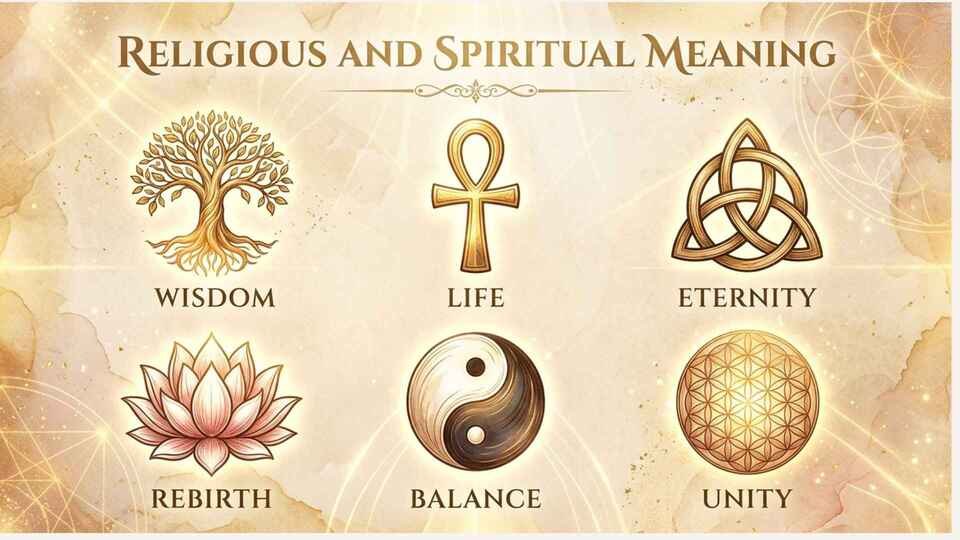
Pre-Christian Beliefs
Before conversion, Anglo-Saxon communities followed polytheistic Germanic religious traditions. Evidence comes from place-names, burials, archaeology, later texts, and comparisons with related Germanic cultures.
Objects placed in graves may have reflected status, memory, beliefs about death, or rituals performed by the living. Weapons, jewelry, vessels, animals, and personal possessions could carry ceremonial importance, but historians cannot confidently explain every burial object as equipment for an afterlife.
Runes may sometimes have had ritual or protective uses. The British Museum describes a runic inscription on a pendant as possibly carrying magical significance, showing that magical interpretation is plausible in particular cases rather than universal.
Christian Symbolism
After conversion, symbols increasingly taught Christian beliefs. Crosses represented salvation. Lambs could represent Christ. Doves could suggest the Holy Spirit or peace. Vines, books, angels, saints, and biblical scenes reinforced Christian teaching.
Monasteries became important centers of art and literacy. Scribes created decorated manuscripts in which letters, patterns, animals, and sacred images worked together. Christian art did not simply erase older traditions. It reshaped familiar artistic forms for new religious purposes.
Symbols During Religious Transition
Conversion took generations. Some objects combine Christian and non-Christian elements, while others are difficult to classify. A person might wear a cross for faith, protection, political belonging, fashion, or several reasons at once.
This mixed evidence warns against dividing every object into purely “pagan” or purely “Christian” categories.
Scientific, Linguistic, and Digital Meaning
Anglo-Saxon runes have an important linguistic role because they preserve evidence about Old English sounds, spelling, vocabulary, and personal names.
The futhorc expanded beyond the 24 characters of the Elder Futhark because Old English contained sounds that required additional signs. Runes were eventually replaced for most writing by the Latin alphabet, although several runic letters influenced manuscript practice.
The letter thorn, written Þ or þ, entered Latin-letter Old English writing and represented the “th” sound. Wynn, Ƿ or ƿ, represented “w” before the modern letter became standard.
Today, runic characters can be represented digitally through Unicode. The Unicode Runic block includes historical Germanic runes and related variants, although choosing the correct rune still requires knowledge of language, period, and inscriptional tradition.
There is no single Unicode character for “Anglo-Saxon symbolism” as a whole, and there is no exact emoji equivalent.
Where Anglo-Saxon Symbols Are Used
Jewelry
Brooches, rings, pendants, buckles, and beads displayed wealth, craftsmanship, belief, and personal identity. Some pieces carry runic inscriptions, while others feature crosses, animals, faces, or geometric designs.
A gold Anglo-Saxon ring in the British Museum carries a runic inscription around its hoop, demonstrating how writing and ornament could become part of a personal object.
Weapons and Armor
Swords, helmets, shields, and fittings could carry animal designs, inscriptions, or decorative patterns. Such imagery displayed status and may have expressed protection, courage, ownership, or loyalty.
Coins
Coins combined economic use with political messaging. Royal names, portraits, crosses, Latin letters, and occasional runes presented the authority of rulers and moneyers. A seventh-century coin in the British Museum includes both Roman letters and a name written in runes.
Manuscripts
Manuscripts used decorated initials, crosses, plants, animals, interlace, and symbolic color. Runes also survived in scholarly and literary contexts. A British Library manuscript copied around the late ninth or early tenth century includes a runic alphabet with some rune names.
Stone Monuments
Carved crosses, grave markers, and architectural fragments used symbols to communicate faith, memory, status, and biblical teaching. Monumental sculpture was especially valuable in communities where books were rare.
Everyday Objects
Runes and patterns appear on combs, bone pieces, containers, writing tablets, tools, and gaming objects. Their presence shows that symbolic communication was not limited to kings, churches, or warriors.
Modern Art, Tattoos, and Logos
Today, Anglo-Saxon-inspired designs appear in historical fiction, reenactment, tattoos, museum merchandise, films, games, and heritage branding.
Modern users should verify a design’s actual source. Many images sold as Anglo-Saxon are modern inventions, Norse symbols, Icelandic magical signs, or Celtic-style knots with no proven Anglo-Saxon origin.
Common Variations
Runic Variations
Rune shapes changed across regions and centuries. The same sound could have several forms, while one shape could develop different values in separate runic traditions.
Anglo-Saxon futhorc should not be treated as identical to Elder Futhark or the Scandinavian Younger Futhark.
Cross Variations
Anglo-Saxon crosses include simple equal-armed forms, Latin crosses, ringed crosses, pectoral crosses, manuscript crosses, and monumental high crosses. Decoration may include plants, figures, animals, interlace, or biblical scenes.
Animal-Style Variations
Animal designs range from recognizable birds, boars, fish, wolves, and serpents to highly abstract creatures. Bodies may be stretched, twisted, interwoven, or broken into separate parts.
Geometric Variations
Common forms include circles, triangles, diamonds, chevrons, spirals, dots, rosettes, and repeated borders. These may be symbolic, decorative, structural, or all three.
Common Misconceptions About Anglo-Saxon Symbols
Every Rune Is a Magical Sign
Runes were letters. Some inscriptions may have served magical, protective, or ritual purposes, but many simply recorded names, words, labels, or messages.
Anglo-Saxon and Viking Symbols Are Identical
The traditions overlap because both came from Germanic cultures and later interacted. However, their alphabets, artistic styles, languages, time periods, and regional contexts were not identical.
Every Knot Means Eternity
Continuous knotwork can inspire ideas of eternity or interconnectedness, but no surviving Anglo-Saxon source gives that meaning to every interlaced pattern.
The Valknut Was a Common Anglo-Saxon Symbol
The modern term “valknut” refers to a design of interlocking triangles known mainly from Scandinavian archaeological contexts. It should not be presented as a standard Anglo-Saxon emblem without specific evidence.
The Helm of Awe Is Anglo-Saxon
The Helm of Awe, or Ægishjálmur, is associated with later Icelandic magical manuscripts. Its familiar form is not a documented Anglo-Saxon symbol.
All Circular Designs Represent the Sun
Circles may have solar associations, but they also suit the shape of brooches, shields, coins, and decorative layouts. Context must guide interpretation.
Symbols Had One Fixed Meaning
Meaning depended on material, location, owner, period, religion, and surrounding imagery. A symbol could carry several meanings at once.
Interesting Facts About Anglo-Saxon Symbols
- Futhorc is named from its first six runes.
The sequence begins with sounds represented as F, U, TH, O, R, and C, just as “alphabet” comes from alpha and beta. - The Anglo-Saxon rune row expanded over time.
New runes helped represent sounds that were not adequately covered by the earlier Germanic system. - Runes and Roman letters coexisted.
Anglo-Saxon people did not suddenly abandon runes when Latin literacy arrived. Both scripts could appear in the same cultural environment. - Some runes entered Latin-script writing.
Thorn and wynn were used alongside Roman letters in Old English manuscripts. - Runes appear on ordinary possessions.
Inscriptions survive not only on monuments and weapons but also on small personal and household objects. - Anglo-Saxon art was internationally connected.
Artists drew from Germanic, Irish, Roman, Mediterranean, Frankish, and Scandinavian traditions. - Crosses could serve several purposes.
They might mark faith, memory, territory, political authority, teaching, or communal gathering places. - The Franks Casket combines scripts and traditions.
This carved whalebone box uses runic and Latin writing alongside scenes from Germanic legend, Roman history, and Christian tradition. Its main runic text even uses encoded substitutions. - Animal imagery was often deliberately abstract.
A viewer might recognize eyes, jaws, legs, or wings while the creature’s body dissolves into interlace. - Modern “rune meanings” often blend different periods.
Online charts frequently mix Anglo-Saxon rune names, Norse mythology, twentieth-century occultism, and modern personal interpretations. - Not all symbols were intended for everyone to understand.
Some inscriptions may have communicated only with literate viewers, members of an elite group, or people familiar with a specific story. - The original appearance of monuments could be brighter than today.
Surviving stone carvings are often bare, but some Anglo-Saxon crosses and sculptures were originally painted.
Related Symbols
Elder Futhark Runes
Elder Futhark is an earlier Germanic rune row traditionally containing 24 characters. Anglo-Saxon futhorc developed from it but added signs for Old English and Old Frisian sounds.
Younger Futhark Runes
Younger Futhark was used mainly in Viking Age Scandinavia. It has fewer primary characters than Anglo-Saxon futhorc and should not be substituted automatically when writing Old English.
Norse Symbols
Norse imagery includes runes, animals, ships, serpents, and mythological scenes. It overlaps with later Anglo-Saxon art but belongs primarily to Scandinavian contexts.
Celtic and Insular Knotwork
Insular art developed through interaction among communities in Britain and Ireland. Its interlace and manuscript decoration influenced Anglo-Saxon Christian art, especially in northern England.
Christian Medieval Symbols
Crosses, lambs, doves, vines, halos, fish, angels, and saints became central to Anglo-Saxon religious culture after conversion.
Roman Symbols
Roman coins, Christianity, architecture, Latin writing, and surviving material culture shaped the visual world of post-Roman Britain.
Frequently Asked Questions
What are the most important Anglo-Saxon symbols?
The most important examples include futhorc runes, Christian crosses, interlace, serpents, birds, boars, wolves, horses, trees, vines, circles, and royal coin imagery. Their importance varies by period. Runes are especially significant for language, while crosses dominate much of the art produced after Christian conversion.
Did Anglo-Saxon runes have magical meanings?
Some runic inscriptions may have been protective, ritual, or magical, but runes primarily formed a writing system. They represented sounds and could spell names, objects, prayers, or messages. A rune’s name also carried a concept, yet this does not mean every inscription functioned as a magical code.
What is the difference between Anglo-Saxon and Viking runes?
Anglo-Saxon communities generally used the expanded futhorc, while Viking Age Scandinavians mainly used Younger Futhark. The systems differ in character number, sound values, forms, languages, regions, and dates. Because of these differences, a Viking rune chart may not accurately represent an Old English word.
What did the Anglo-Saxon cross symbolize?
The cross represented Christ’s Crucifixion, resurrection, salvation, divine authority, and Christian identity. It could also mark graves, sacred places, political legitimacy, or community gathering points. Its exact function depended on whether it appeared on jewelry, coins, manuscripts, buildings, or monumental stone sculpture.
What animals were symbolic to the Anglo-Saxons?
Boars, wolves, birds, horses, serpents, fish, and dragon-like creatures all appear in Anglo-Saxon art or literature. Boars often suggest martial strength, while battlefield birds and wolves evoke warfare and death. Christian animals could communicate biblical teachings. Meanings should always be based on the object’s context.
Did Anglo-Saxons use Celtic knots?
Anglo-Saxon artists used interlace, but describing every example as a Celtic knot oversimplifies early medieval art. Interlaced ornament developed through exchange among Irish, Anglo-Saxon, Pictish, Roman, Continental, and Scandinavian traditions. The design may be Insular without belonging exclusively to one ethnic group.
Is there one Anglo-Saxon symbol for protection?
No single symbol served as a universal protection sign across all Anglo-Saxon communities. Crosses, inscriptions, animal designs, amulets, and certain personal objects may have been viewed as protective in particular settings. Claims that one modern-looking emblem was the official Anglo-Saxon protection symbol are usually unsupported.
Can Anglo-Saxon runes be used in tattoos?
They can be used, but the spelling and rune system should be researched carefully. Translating modern English letter by letter often produces inaccurate results because Old English sounds and spelling differed from modern English. It is also wise to check whether a design has acquired unintended modern political associations.
Are Anglo-Saxon symbols religious or decorative?
They can be religious, decorative, practical, political, or personal. These purposes often overlap. An interlaced cross may teach Christian belief while displaying craftsmanship and status. A rune may identify an owner while also carrying personal or ritual significance. Context determines the most likely interpretation.
Where can authentic Anglo-Saxon symbols be seen?
Authentic examples can be found in museum collections, archaeological reports, manuscripts, churches, carved stone monuments, coins, and excavated objects. Notable collections include the British Museum, the British Library, regional English museums, cathedral libraries, and heritage sites connected with early medieval settlements and monasteries.
Key Takeaways
- Anglo-Saxon symbols include runes, crosses, animals, plants, interlace, and geometric designs.
- They expressed identity, religion, authority, protection, memory, and social status.
- Anglo-Saxon futhorc was a writing system, not merely a collection of magical signs.
- Symbolic meanings changed between pre-Christian and Christian periods.
- Anglo-Saxon art blended Germanic, Roman, Irish, Continental, and Scandinavian influences.
- No surviving source provides one fixed definition for every symbol.
- The object, date, location, and surrounding imagery are essential for interpretation.
- Many designs promoted online as Anglo-Saxon are actually Norse, Icelandic, Celtic-inspired, or modern.
- Authentic symbolism is best studied through archaeological objects, inscriptions, manuscripts, coins, and monuments.
Conclusion
Anglo-Saxon symbols provide a powerful window into the beliefs and experiences of early medieval England. Runes recorded language and identity, crosses expressed Christian faith, animals communicated strength or danger, and interlaced designs transformed useful objects into complex works of art.
Their meanings were never completely fixed. They changed as kingdoms rose, Christianity spread, Scandinavian settlers arrived, and local artists absorbed ideas from across Europe. Understanding Anglo-Saxon symbols therefore requires more than matching pictures with simple definitions. It requires attention to history, material, language, religion, and cultural context.
When interpreted carefully, these symbols reveal a society that was inventive, internationally connected, spiritually complex, and skilled at turning writing and decoration into lasting expressions of identity.

I am Daniel Brooks, a language researcher and writer with a strong interest in how people use English in everyday conversations. I contribute to LearnNestly because I enjoy turning confusing language topics into straightforward lessons. My goal is to help readers understand not only what a word or phrase means, but also when and how to use it naturally. I focus on clear examples, practical explanations, and useful language knowledge that readers can remember.
Books:
- The Practical English Guide
- Understanding Everyday Words
 Amelia Carter