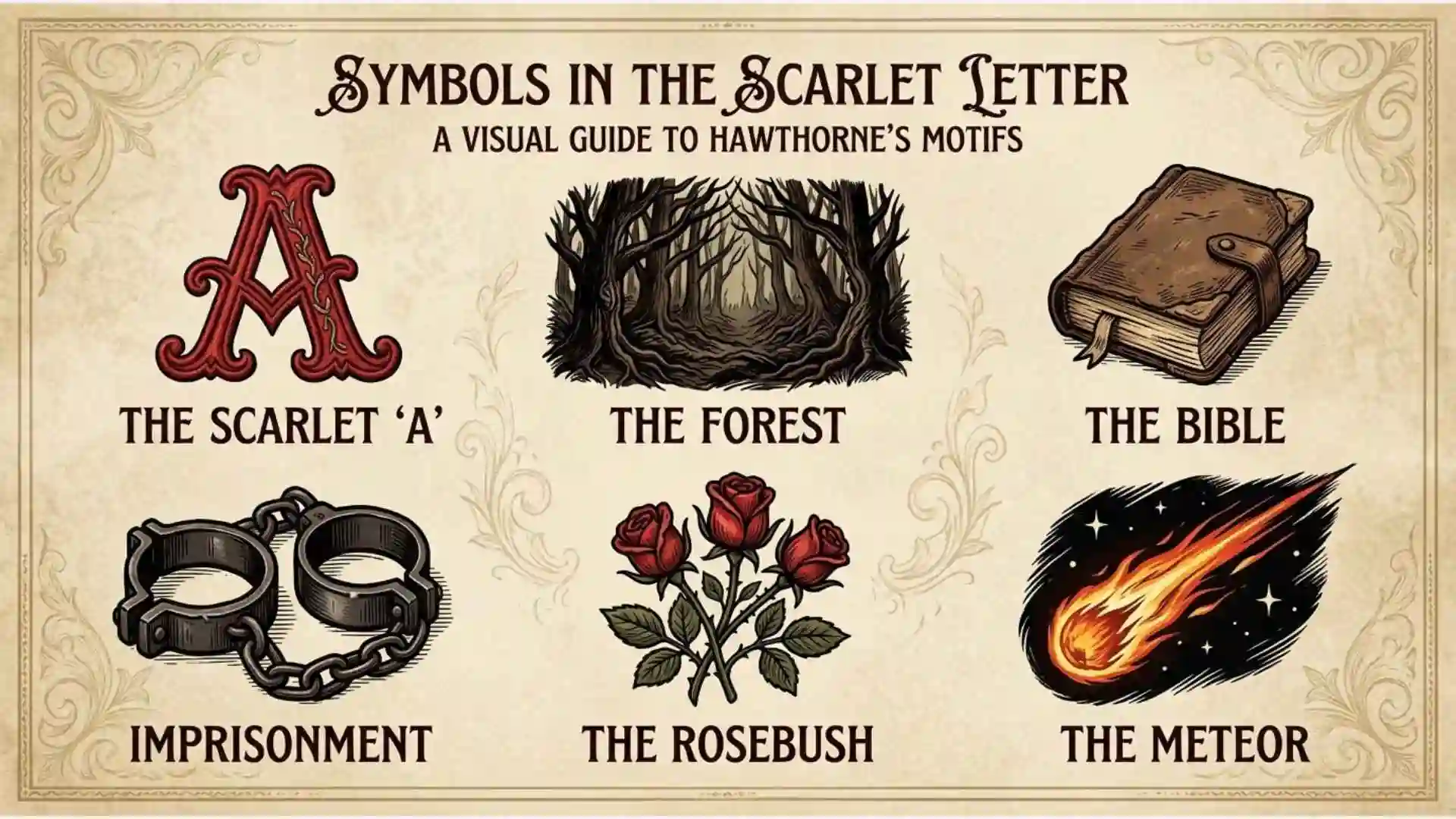
Nathaniel Hawthorne’s The Scarlet Letter is filled with powerful symbols that reveal deeper ideas about sin, guilt, shame, identity, freedom, and society. From the famous scarlet letter “A” to the dark forest and the rosebush, Hawthorne uses objects, places, and characters to communicate meanings that go far beyond the surface of the story.
The scarlet letter “A” is the novel’s most important symbol, but it is not the only one. The forest represents freedom and secrecy, while the rosebush suggests beauty, hope, and the possibility of redemption. Other symbols, including Pearl, light and darkness, the scaffold, and the meteor in the sky, help readers understand the characters’ struggles and Hawthorne’s criticism of strict Puritan society.
Understanding these symbols makes The Scarlet Letter much easier to analyze and appreciate. Each symbol connects to the novel’s major themes and shows how public judgment, personal guilt, love, and individual freedom can shape a person’s life. By examining these hidden meanings, readers can see why Hawthorne’s novel remains an important work of American literature.
Quick Meaning
The main symbols in The Scarlet Letter represent public shame, private guilt, moral judgment, individuality, and the possibility of transformation. The scarlet letter symbolizes Hester Prynne’s changing identity, while Pearl, the scaffold, the forest, sunlight, and other recurring images reveal the conflict between Puritan society and the hidden truth of the human heart.
Symbol Overview Table
| Symbol | Primary Meaning | How It Changes or Functions |
| Scarlet letter “A” | Adultery, shame, identity | Develops into a sign of ability, strength, and complex personal meaning |
| Hester Prynne | Individuality and resistance | Represents dignity under social punishment |
| Pearl | Living consequence of sin | Also symbolizes truth, freedom, nature, and hope |
| Scaffold | Public judgment and confession | Connects three major scenes involving secrecy and revelation |
| Forest | Freedom from social control | Provides space for honesty, instinct, and moral uncertainty |
| Sunlight | Truth, happiness, and grace | Avoids Hester but follows Pearl |
| Darkness and shadow | Secrecy, guilt, and isolation | Surround Dimmesdale and hidden wrongdoing |
| Rosebush | Mercy, beauty, and hope | Softens the harsh setting of the prison |
| Prison | Social control and punishment | Represents the severity of Puritan authority |
| Meteor | Uncertain divine message | Shows how people interpret signs according to their beliefs |
| Black Man | Sin, temptation, and the Devil | Reflects Puritan fear and Pearl’s imaginative understanding |
| Chillingworth | Revenge and moral corruption | Becomes a symbol of destructive obsession |
| Dimmesdale’s body | Hidden guilt | Reveals the physical cost of concealed sin |
| Needlework | Creativity and independence | Turns punishment into artistic and economic power |
| Names | Character and moral role | Suggest symbolic qualities before actions fully reveal them |
What Do the Symbols in The Scarlet Letter Mean?
The symbols in The Scarlet Letter expose the difference between outward appearances and inward reality. Puritan society treats morality as something visible and easily judged. Hester wears a letter that publicly identifies her sin, while Arthur Dimmesdale appears holy despite hiding his involvement in the same act.
Hawthorne repeatedly shows that visible signs do not provide complete moral knowledge. Hester, the publicly condemned sinner, often behaves with courage and compassion. Dimmesdale, the honored minister, suffers because his respected public identity depends on concealment. Roger Chillingworth claims the role of a physician, yet his pursuit of revenge destroys his humanity.
Symbols therefore do more than decorate the story. They question whether society can correctly interpret guilt, holiness, justice, or identity. Their changing meanings suggest that human beings are more complicated than the labels imposed on them.
Historical and Literary Origins of the Symbolism
The symbolism of The Scarlet Letter grows from the religious and social world of seventeenth-century Puritan New England. Puritan communities emphasized moral discipline, public reputation, biblical authority, and collective responsibility. Adultery was treated not merely as a private failure but as an offense against religious and social order.
Hawthorne published the novel in 1850, long after the historical period in which it is set. He examined the Puritan past from the perspective of nineteenth-century America. His own family history included ancestors connected to Puritan authority, including John Hathorne, a judge involved in the Salem witch trials. Hawthorne’s fiction frequently investigates inherited guilt, moral severity, secrecy, and the consequences of judgment.
The novel also belongs to the tradition of Romantic and Gothic literature. Romantic writers often valued emotion, imagination, nature, and individuality, while Gothic writing explored darkness, psychological torment, secrecy, and supernatural uncertainty. Hawthorne combines these traditions with historical fiction.
As a result, the novel’s symbols work on several levels. They belong to the Puritan world of the characters, but they also reflect Hawthorne’s later concerns about conscience, social conformity, and the unstable nature of interpretation.
The Scarlet Letter “A”
The scarlet letter is the central symbol of the novel. At first, Puritan authorities intend the embroidered “A” to mean “adulteress.” Hester must wear it as a visible sign of sexual sin and public disgrace.
However, Hester refuses to let the community control the letter’s appearance or final meaning. She decorates it with elaborate gold embroidery, transforming an instrument of humiliation into a work of beauty. Her artistic design does not erase the punishment, but it reveals imagination, skill, and personal agency.
As time passes, Hester’s service to the poor and suffering changes how people interpret the letter. Some begin to associate the “A” with “able” rather than adultery. The symbol remains connected to pain, but it also comes to represent endurance, independence, compassion, and earned authority.
The letter never receives one final, simple definition. That instability is essential. Hawthorne shows that symbols gain meaning through social judgment, personal experience, memory, and behavior. The “A” means what society intends, what Hester makes of it, and what later observers believe it means.
Hester Prynne as a Symbol of Individuality
Hester symbolizes the individual facing the power of an intolerant society. She stands alone on the scaffold while the community watches, judges, and attempts to define her entire identity through one action.
Yet Hester does not collapse under public shame. She accepts material responsibility for Pearl, supports herself through needlework, helps people in need, and develops her own ideas about society and gender. Her isolation gives her pain, but it also allows her to think beyond accepted rules.
Hester is not presented as flawless. She experiences anger, loneliness, temptation, and despair. Her symbolic importance comes from her complexity. She represents the human capacity to survive punishment without surrendering all freedom of thought.
Her return to the settlement near the end of the novel is especially significant. She does not return because the authorities force her. By voluntarily wearing the letter again, she transforms it from an imposed sentence into a symbol connected to her chosen identity and history.
Pearl as a Living Symbol
Pearl is the living result of Hester and Dimmesdale’s relationship. The Puritan community sees her as evidence of sin, and Hester sometimes describes her as the scarlet letter brought to life.
Pearl’s symbolic role is much broader, however. She represents truth because her presence continually points toward the secret that Dimmesdale hides. She repeatedly asks questions about the letter, the minister, and the Black Man. Her questions expose connections that adults try to conceal.
Pearl also symbolizes nature and freedom. She is energetic, imaginative, unpredictable, and resistant to social control. Unlike the rigid Puritan adults, she responds instinctively to the natural world. Sunlight follows her, flowers interest her, and the forest seems suited to her spirit.
At the same time, Pearl is a child rather than merely an abstract device. Her emotional development matters. Before Dimmesdale’s public confession, she seems almost separated from ordinary human sympathy. After he acknowledges her, she kisses him and cries. This moment suggests that truth allows her to enter more fully into human relationships.
Pearl ultimately becomes associated with possibility. Although she begins life under the shadow of scandal, she is not permanently trapped by her parents’ past.
The Scaffold as a Symbol of Judgment and Revelation
The scaffold represents public punishment, exposure, confession, and moral truth. It appears in three major scenes that structure the novel.
In the first scene, Hester stands on the scaffold with Pearl while Dimmesdale remains hidden among respected leaders. Public judgment falls on Hester, but the complete truth remains concealed.
In the second scene, Dimmesdale climbs the scaffold at night. Hester and Pearl join him, creating the image of a family, but the darkness protects his reputation. His private act of confession brings temporary emotional relief without full public accountability.
In the final scaffold scene, Dimmesdale reveals his connection to Hester and Pearl before the community. The private and public versions of his identity finally meet.
These three scenes trace the movement from punishment through partial acknowledgment to complete revelation. The scaffold is therefore both cruel and necessary. It represents society’s harsh judgment, but it also becomes the place where truth can no longer remain hidden.
The Forest as a Symbol of Freedom
The forest symbolizes freedom from Puritan rules, public identities, and social surveillance. Outside the settlement, Hester and Dimmesdale can speak honestly about their past and imagine a different future.
The town is organized, controlled, and governed by visible authority. The forest is wild, uncertain, and morally ambiguous. It offers release, but it does not automatically provide safety or goodness. Mistress Hibbins and stories of the Black Man connect the forest with temptation and supernatural fear.
For Hester, the forest creates a temporary space where she can remove the scarlet letter and let down her hair. These actions restore parts of her identity that punishment has suppressed. Dimmesdale also feels momentarily renewed there.
However, freedom in the forest cannot resolve every problem. Hester and Dimmesdale must eventually return to the social world. Hawthorne uses this contrast to show that private desire may challenge social law, but escaping responsibility is more difficult than escaping observation.
Sunlight, Darkness, and Shadow
Sunlight symbolizes happiness, openness, truth, and possible grace. Pearl plays in the sunlight easily, while Hester feels that it withdraws from her. This contrast reflects their different relationships to shame. Pearl is connected to the past but does not carry Hester’s conscious guilt.
When Hester removes the letter in the forest, sunlight returns. The moment suggests renewal and the possibility of a life beyond punishment. Yet when she puts the letter back on, the old emotional order returns.
Darkness and shadow often surround secrecy. Dimmesdale’s nighttime scaffold visit takes place under cover of darkness because he cannot confess in daylight. Chillingworth also works in hidden ways, studying the minister’s mind and body while concealing his true purpose.
The light-dark contrast is not entirely simple. Daylight can also expose people to cruelty, while darkness may allow temporary honesty. Hawthorne uses both to explore the tension between revelation and concealment.
The Rosebush and the Prison
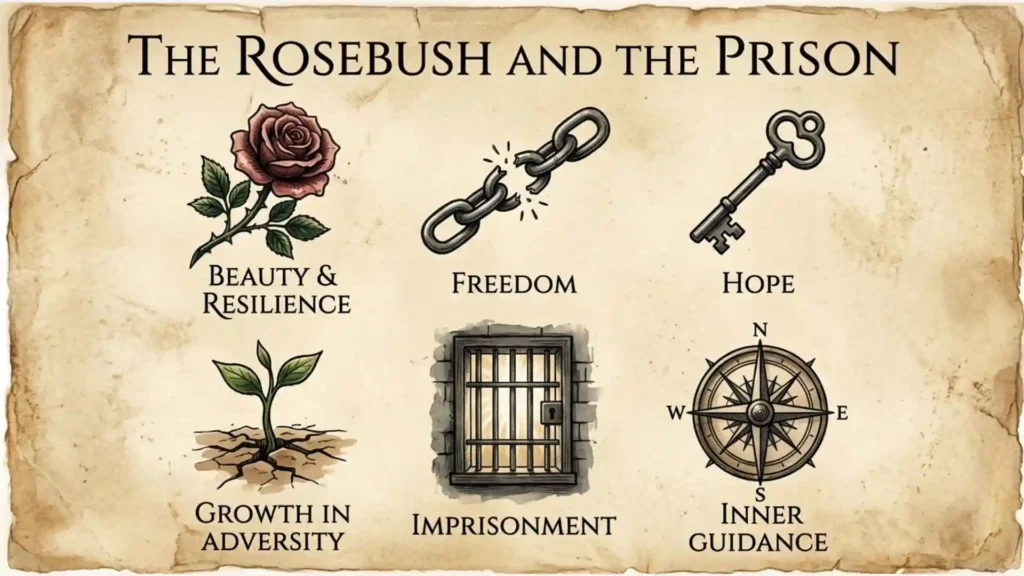
The prison represents the severity of Puritan society. It appears near the beginning of the novel as one of the community’s earliest necessary structures, suggesting that punishment and control were built into the settlement from its foundation.
Beside the prison grows a wild rosebush. It symbolizes beauty, mercy, natural compassion, and hope in a harsh environment. Its blossoms offer emotional relief to prisoners and readers entering a story filled with judgment.
The contrast between the prison and the rosebush introduces one of the novel’s central conflicts. Human institutions may be rigid and punitive, while nature offers sympathy without asking whether a person deserves it.
The rosebush does not eliminate suffering. Instead, it suggests that grace can exist beside punishment. Beauty survives even where society expects only disgrace.
Chillingworth as a Symbol of Revenge
Roger Chillingworth symbolizes revenge, obsession, and moral corruption. When he first appears, he has already suffered hardship, but he still possesses recognizable human qualities. His secret determination to identify and torment Hester’s partner gradually changes him.
Chillingworth attaches himself to Dimmesdale as a physician, yet his true purpose is psychological control. Rather than healing the minister, he feeds on his guilt. His physical appearance becomes increasingly dark and distorted, reflecting his inner transformation.
Hawthorne presents revenge as more destructive than the original act Chillingworth seeks to punish. Hester and Dimmesdale’s sin causes pain, but Chillingworth deliberately makes another person’s suffering his life’s purpose.
After Dimmesdale confesses and dies, Chillingworth rapidly declines. Without revenge, he has no sustaining identity. His fate shows how hatred can consume the person who refuses to release it.
Dimmesdale’s Body as a Symbol of Hidden Guilt
Dimmesdale’s declining health symbolizes the physical and psychological cost of concealed guilt. He appears spiritually powerful to the public, yet he grows weak, pale, and emotionally unstable.
His habit of placing his hand over his heart suggests private pain. The gesture links his hidden suffering to Hester’s visible letter. She bears shame on the outside, while he carries it inwardly.
The novel leaves some details about his body uncertain, especially the nature of the mark reportedly seen on his chest. Different witnesses offer different explanations. This uncertainty prevents readers from reducing the scene to a single supernatural or medical answer.
Dimmesdale’s suffering shows that secret guilt can distort identity. Public admiration cannot protect him because the person being praised is only a partial version of himself.
Needlework as a Symbol of Creativity and Independence
Hester’s needlework symbolizes creativity, economic independence, and resistance within limitation. The community punishes her, but it still depends on her skill to decorate clothing used in important public and private ceremonies.
Her art gives her a means to support herself and Pearl. It also allows her to express beauty in a society that otherwise restricts personal display.
The same ability that decorates the scarlet letter later gives Hester a respected social role. This reversal demonstrates how a condemned person can transform the tools of punishment into sources of survival and influence.
However, she is not permitted to create certain bridal objects. This restriction reminds readers that acceptance remains incomplete. Society values her labor while continuing to regulate her status.
Religious and Spiritual Meaning
The symbols in The Scarlet Letter reflect Puritan beliefs about sin, confession, providence, the Devil, and divine judgment. Characters often interpret natural events as spiritual messages.
The meteor is the clearest example. Dimmesdale sees a glowing “A” in the sky and connects it to his guilt. Other townspeople interpret the same event as meaning “Angel” because Governor Winthrop has died. The event may be natural, supernatural, or psychologically interpreted. Hawthorne does not provide a final answer.
The Black Man represents the Devil in Puritan folklore. Pearl imagines that Hester received her mark after meeting him in the forest. The story turns adult ideas about temptation and sin into a child’s symbolic language.
The novel does not reject spiritual meaning, but it questions human certainty. People frequently assume they understand God’s judgment when they may only be projecting their own fears, desires, or social beliefs onto events.
Cultural Significance of the Symbols
The novel’s symbols have become important in American culture because they address the relationship between personal identity and public labeling. The scarlet letter remains a common expression for a visible mark of shame or social stigma.
Modern readers often connect Hester’s experience to gender inequality. She bears the public consequences of adultery, while the man involved initially avoids exposure. Her treatment reveals how communities may enforce moral rules differently depending on gender and social position.
The symbols also remain relevant to discussions of surveillance, reputation, cancel culture, religious intolerance, and social exclusion. These modern comparisons should not erase the novel’s historical setting, but they help explain its lasting influence.
Hawthorne’s larger cultural contribution lies in showing that public symbols can be unstable. A label intended to reduce someone to a single offense may eventually reveal the limitations of the society that imposed it.
Where Are the Symbols Used?
The symbols appear throughout the novel’s settings, character descriptions, objects, and major events.
The scarlet letter appears on Hester’s clothing and in the community’s imagination. The scaffold stands at the center of public punishment and confession. The forest serves as the setting for private honesty. Pearl’s clothing, behavior, and questions repeatedly echo the letter.
Light and darkness shape the emotional meaning of scenes. The prison and rosebush establish the novel’s moral atmosphere. The meteor introduces uncertain supernatural interpretation. Dimmesdale’s body makes invisible guilt physically visible.
Outside the novel, these symbols appear in classroom discussions, literary criticism, theater, film adaptations, visual art, and conversations about public shame. The “scarlet letter” has also become an idiom for a sign that exposes or stigmatizes someone.
Common Variations and Connected Images
Hawthorne often creates variations by pairing opposing images. The town contrasts with the forest, daylight with darkness, public confession with private guilt, and law with nature.
The scarlet letter itself has several symbolic forms. It exists as embroidered cloth, as Pearl’s imagined play symbol, as a shape associated with the meteor, and possibly as a mark on Dimmesdale’s body. Each version connects to guilt but produces a different interpretation.
Pearl also functions as a variation of the letter. Hester wears one symbol on her chest and raises another beside her. Unlike the embroidered letter, Pearl grows, questions, reacts, and eventually changes.
These variations prevent symbolism from becoming mechanical. Hawthorne does not simply repeat one meaning. He places related images in new situations so readers must reconsider what they signify.
Common Misconceptions
The “A” Always Means Adultery
The community originally assigns that meaning, but the letter changes. It becomes connected with ability, charity, strength, suffering, and Hester’s chosen identity.
Pearl Is Only a Punishment
Pearl represents the consequences of Hester’s actions, but she also symbolizes truth, freedom, imagination, love, and future possibility.
The Forest Is Entirely Good
The forest offers freedom from social restriction, but it also carries uncertainty, danger, temptation, and associations with witchcraft.
The Town Represents Pure Morality
The town claims moral authority, yet it contains hypocrisy, cruelty, secrecy, and unequal judgment. Social order does not guarantee moral wisdom.
Dimmesdale’s Chest Mark Has One Confirmed Cause
The narrator records conflicting accounts. The mark may have resulted from self-punishment, illness, supernatural action, Chillingworth’s influence, or the observers’ imagination.
Hester Completely Rejects Society
Hester questions the community’s values, but she remains connected to other people through work, charity, motherhood, and her eventual return.
Interesting Facts About the Symbolism
- The scarlet letter changes without physically changing. Its appearance remains similar, but people interpret it differently as Hester’s reputation develops.
- The novel contains three major scaffold scenes. Together, they form a structural pattern of punishment, hidden acknowledgment, and public confession.
- Pearl often recognizes truth before adults admit it. Her questions connect Hester’s letter, Dimmesdale’s gesture, and their hidden relationship.
- Nature responds symbolically to characters. Sunlight, shadows, plants, and the forest reflect emotional and moral tensions.
- Names carry symbolic meaning. “Chillingworth” suggests coldness, while “Pearl” suggests something precious created through suffering.
- The meteor demonstrates interpretive bias. Dimmesdale and the townspeople see different messages because they bring different concerns to the same event.
- Hester’s art complicates her punishment. The letter is meant to humiliate her, yet its beauty displays the talent that helps her become independent.
- The rosebush appears before Hester’s full story begins. It prepares readers to look for mercy and beauty beside punishment.
- Dimmesdale and Hester carry parallel symbols. Her guilt is publicly visible, while his is expressed through bodily weakness and the hand over his heart.
- The final tombstone joins Hester and Dimmesdale symbolically. Its dark background and red letter preserve both separation and connection after death.
Related Symbols
The Veil in “The Minister’s Black Veil”
In another Hawthorne work, a black veil represents secrecy, hidden sin, and the inability to know another person completely. Unlike Hester’s forced letter, the minister chooses to wear his veil.
The Birthmark in “The Birth-Mark”
The birthmark symbolizes human imperfection and the danger of demanding impossible purity. Like the scarlet letter, it becomes meaningful because characters obsessively interpret it.
The Crucible in Arthur Miller’s Play
The crucible represents severe testing and purification. Miller’s Salem setting also explores religious authority, accusation, hidden motives, and public reputation.
Chains
Chains commonly symbolize punishment and restriction. Hester’s letter functions like a social chain, although she gradually changes its meaning.
Masks
Masks symbolize concealed identity. Dimmesdale’s public holiness acts like a mask hiding guilt, fear, and emotional conflict.
Frequently Asked Questions
What is the most important symbol in The Scarlet Letter?
The scarlet letter “A” is the novel’s central symbol. Puritan leaders intend it to mark Hester as an adulteress, but its meaning changes through her behavior. It eventually represents ability, endurance, compassion, suffering, and identity, showing that society cannot permanently control how a person or symbol is understood.
What does Pearl symbolize?
Pearl symbolizes the living consequence of Hester and Dimmesdale’s relationship. She also represents truth, nature, freedom, imagination, and hope. Her questions expose the connection between the letter and Dimmesdale. After his confession, her tears suggest emotional growth and release from the symbolic role imposed on her.
What does the scaffold symbolize?
The scaffold symbolizes public judgment, exposure, confession, and revelation. Its three major appearances organize the story’s moral development. Hester first stands there alone, Dimmesdale later joins her secretly at night, and he finally acknowledges Hester and Pearl before the community in daylight.
What does the forest symbolize?
The forest symbolizes freedom from Puritan rules and public observation. Hester and Dimmesdale can speak honestly there and briefly imagine a new life. However, the forest also represents uncertainty, temptation, and danger, so it should not be understood as a completely safe or morally pure place.
What does sunlight represent?
Sunlight represents openness, joy, truth, and possible grace. It seems to avoid Hester while she wears the letter but readily surrounds Pearl. When Hester removes the letter in the forest, sunlight returns, suggesting temporary freedom from shame and the possibility of emotional renewal.
What does the rosebush symbolize?
The rosebush beside the prison symbolizes mercy, beauty, hope, and natural compassion. Its bright flowers contrast with the prison’s darkness and severity. The image suggests that kindness and grace can survive beside punishment, even when human institutions appear rigid and unforgiving.
What does Roger Chillingworth symbolize?
Chillingworth symbolizes revenge and the corruption caused by obsessive hatred. He begins as an injured husband but chooses to make Dimmesdale’s suffering his purpose. As his revenge deepens, he loses sympathy and humanity. His decline after Dimmesdale’s death shows that vengeance has consumed his identity.
What does Dimmesdale’s hand over his heart mean?
The gesture symbolizes hidden guilt, emotional pain, and a possible physical mark. It creates a parallel with Hester’s letter because both signs occupy the chest. Her shame is publicly visible, while his remains concealed. Pearl notices the gesture and repeatedly questions its connection to the scarlet letter.
What does the meteor symbolize?
The meteor symbolizes the uncertainty of signs and the human tendency to interpret events personally. Dimmesdale sees an “A” connected to his guilt, while townspeople understand it as “Angel” after Governor Winthrop’s death. Their conflicting readings show that symbols often reflect the observer’s beliefs.
What is the main message behind the novel’s symbolism?
The symbolism suggests that guilt, innocence, identity, and morality cannot be understood through simple labels. Public judgment may punish one person while protecting another. Truth can cause pain, but secrecy, revenge, and rigid condemnation often create deeper and more lasting harm.
Key Takeaways
- The scarlet letter changes from a mark of adultery into a symbol of strength, ability, suffering, and identity.
- Pearl represents both the consequence of hidden sin and the possibility of truth, freedom, and renewal.
- The scaffold connects public judgment with confession and revelation.
- The forest offers freedom from social control but also contains uncertainty and danger.
- Sunlight represents openness and grace, while darkness often reflects secrecy and guilt.
- The prison and rosebush contrast harsh law with natural mercy.
- Chillingworth symbolizes the destructive power of revenge.
- Dimmesdale’s illness reveals the psychological and physical cost of concealed guilt.
- Hawthorne uses symbolism to question whether society can accurately judge a person’s moral character.
- Most symbols in the novel change according to context, behavior, and interpretation.
Conclusion
The symbols in The Scarlet Letter transform a historical story of adultery and punishment into a deeper examination of identity, conscience, truth, and social judgment. Hawthorne refuses to give most images a single permanent meaning. Instead, the scarlet letter, Pearl, the scaffold, the forest, sunlight, and other symbols evolve alongside the characters.
This changing symbolism is the source of the novel’s lasting power. Hester cannot undo her past, but she can influence what it means. Dimmesdale cannot preserve both truth and reputation forever. Chillingworth cannot pursue revenge without becoming morally damaged himself.
By showing how public labels conflict with private reality, the major symbols in The Scarlet Letter remind readers that no human life can be fully explained by one action, one judgment, or one letter.

I am Amelia Carter, an English language educator and educational writer who enjoys making difficult ideas simple and easy to understand. At LearnNestly, I write about English words, grammar, everyday expressions, and language questions that people often find confusing. I believe learning should feel practical, clear, and enjoyable rather than overwhelming. Through my writing, I try to give readers explanations they can understand and use in real life.
Books:
- The Everyday English Handbook
- Words Made Simple
 Ethan Mitchell
 Daniel Brooks