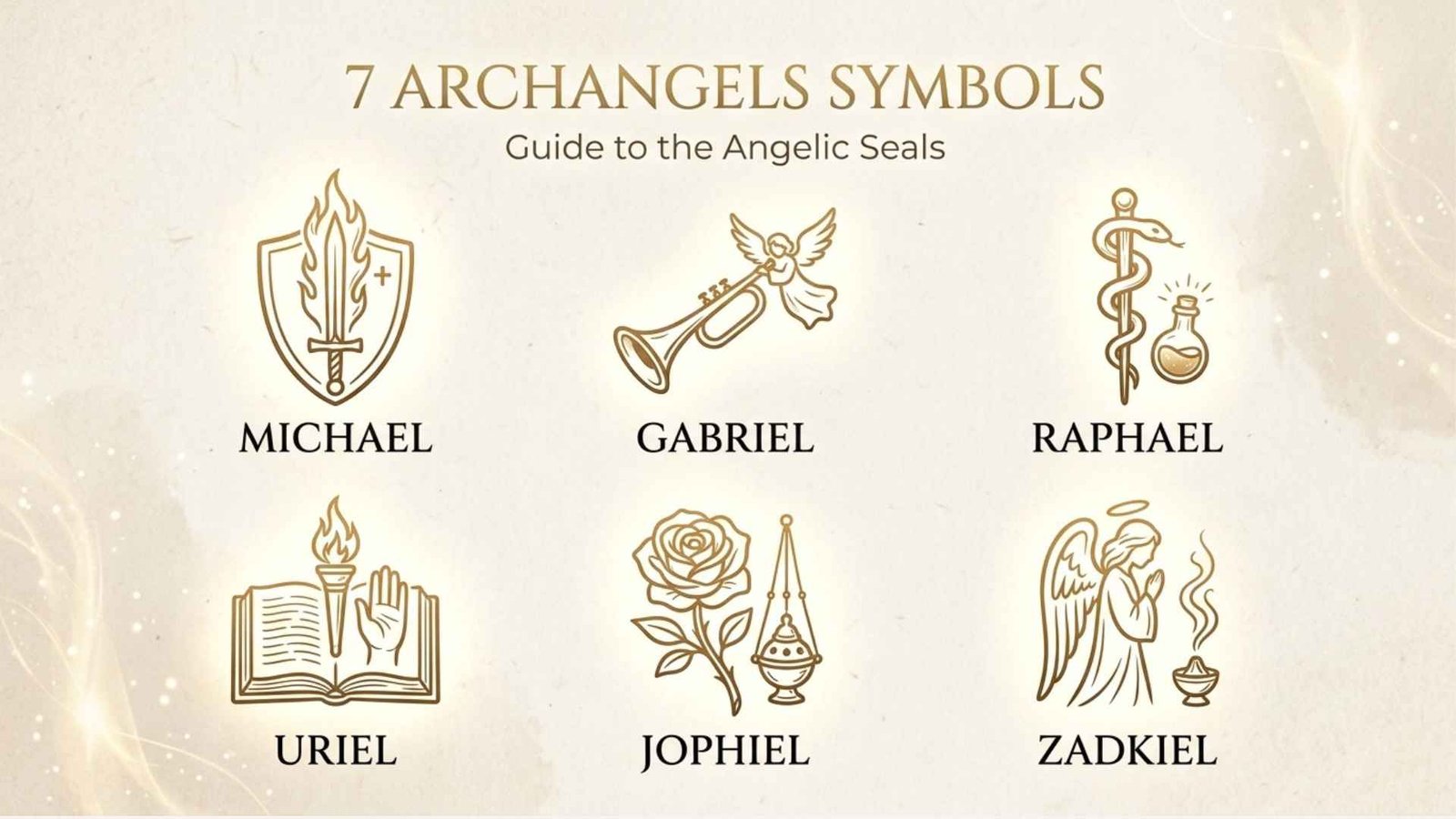
The 7 archangels symbols are sacred attributes used in Christian art to identify seven powerful heavenly messengers. Common examples include Michael’s sword, Gabriel’s lily, Raphael’s medicine vessel, Uriel’s flame, Selaphiel’s prayerful hands, Jegudiel’s crown, and Barachiel’s roses.
You may encounter these symbols in Eastern Orthodox icons, church murals, religious jewelry, prayer cards, stained glass, tattoos, and modern spiritual artwork. However, there is no single list of seven archangels accepted by every Jewish or Christian tradition.
Their names, roles, and visual attributes vary according to scripture, ancient religious literature, local customs, and artistic tradition.
Quick Meaning of the 7 Archangels Symbols
The 7 archangels symbols represent heavenly responsibilities such as protection, revelation, healing, divine wisdom, prayer, faithful service, and blessing. In Byzantine and Eastern Orthodox iconography, each object helps viewers recognize a particular archangel. These symbols are artistic and devotional attributes, not a universal code established in one biblical passage.
7 Archangels Symbols Overview Table
| Archangel | Common Symbol | Primary Meaning | Traditional Role |
| Michael | Sword, spear, shield, scales | Protection, courage, divine justice | Leader and defender of the heavenly hosts |
| Gabriel | Lily, scroll, trumpet, lantern | Revelation, purity, divine messages | Messenger who announces God’s purposes |
| Raphael | Medicine vessel, staff, fish | Healing, safe travel, restoration | Healer and companion of travelers |
| Uriel | Flame, sword, scroll, book | Divine light, wisdom, repentance | Illuminator and interpreter of mysteries |
| Selaphiel | Folded hands, bowed head, censer | Prayer, humility, devotion | Guide and patron of prayer |
| Jegudiel | Crown, whip, staff | Reward, responsibility, faithful work | Encourager of service and perseverance |
| Barachiel | Roses, flowers, white cloth | Blessing, grace, family care | Bearer of divine blessings |
Category: Religious and iconographic symbols
Primary tradition shown: Eastern Orthodox and Byzantine Christian art
Historical roots: Biblical texts, Second Temple Jewish literature, Christian tradition, and later iconography
Common usage: Icons, murals, devotional art, jewelry, prayer materials, and tattoos
Unicode: No official Unicode characters exist for individual archangels
Closest emoji equivalents: ⚔️, 🛡️, 🌸, 📜, 🔥, 🙏, 👑, 🌹
Related symbols: Angel wings, halo, cross, trumpet, scales, flaming sword, and seven-pointed designs
What Do the 7 Archangels Symbols Mean?
The 7 archangels symbols express the different ways divine authority and care are understood to operate in the world. Each archangel represents a particular heavenly mission, while the object held or worn makes that mission visible.
In traditional religious art, symbols function like visual names. An angelic figure with wings and a halo may appear anonymous, but a sword suggests Michael, a healing vessel suggests Raphael, and a lily often indicates Gabriel. These attributes helped worshippers identify sacred figures even when they could not read an inscription.
The seven symbols also form a balanced spiritual pattern:
- Michael represents protection.
- Gabriel represents communication.
- Raphael represents healing.
- Uriel represents illumination.
- Selaphiel represents prayer.
- Jegudiel represents service.
- Barachiel represents blessing.
This arrangement should not be treated as a rigid biblical classification. It is primarily a devotional and iconographic system preserved in certain Christian traditions.
The 7 Archangels and Their Symbols
1. Archangel Michael: Sword, Shield, Spear, and Scales
Michael’s most recognizable symbol is a sword, which represents spiritual protection, courage, authority, and the defeat of evil. He may also carry a spear, wear armor, or hold a shield marked with a cross.
His name comes from a Hebrew expression commonly translated as “Who is like God?” The name functions as a declaration that no created being equals God.
Michael appears in the Book of Daniel as a great prince and protector. The Letter of Jude identifies him as an archangel, while Revelation depicts Michael and his angels fighting the dragon. These passages shaped his later image as commander of the heavenly army.
Artists sometimes show Michael holding scales. The scales symbolize judgment and the weighing of souls, although this imagery developed through later Christian art rather than from a biblical description of Michael’s appearance.
Michael’s symbols represent:
- Protection against evil
- Moral courage
- Justice and accountability
- Leadership
- Spiritual warfare
- Loyalty to God
Michael is often shown standing over a dragon or defeated demon. This scene symbolizes the victory of divine order over rebellion, not violence for personal revenge.
2. Archangel Gabriel: Lily, Scroll, Trumpet, and Lantern
Gabriel is most commonly associated with a white lily, especially in Western paintings of the Annunciation. The flower represents purity, divine favor, and the sacred nature of Gabriel’s message to Mary.
Gabriel’s name is often interpreted as “God is my strength” or “strength of God.” In the Book of Daniel, Gabriel helps explain prophetic visions. In the Gospel of Luke, he announces the births of John the Baptist and Jesus.
A scroll represents revealed knowledge or a message entrusted by God. In some Eastern Christian icons, Gabriel holds a lantern or mirror-like object that signifies divine truth and hidden wisdom.
The trumpet is widely associated with Gabriel in later art, literature, hymns, and popular culture. However, the Bible does not specifically say that Gabriel will blow the final trumpet. Scripture mentions angelic trumpets without naming Gabriel as the trumpeter.
Gabriel’s symbols represent:
- Divine communication
- Truthful speech
- Good news
- Purity of purpose
- Prophecy
- New beginnings
Gabriel’s attributes remind viewers that communication carries responsibility. A divine messenger does not invent or distort the message but delivers it faithfully.
3. Archangel Raphael: Medicine Vessel, Staff, and Fish
Raphael’s principal symbol is a medicine vessel, jar, or box. It represents healing, recovery, and God’s care for physical and spiritual suffering.
His name derives from Hebrew and is commonly understood as “God heals” or “God has healed.” Raphael plays a major role in the Book of Tobit, which belongs to the Catholic and Orthodox biblical canons but is placed among the Apocrypha by many Protestant traditions.
In Tobit, Raphael travels with Tobias, protects him, guides him toward a successful marriage, and provides instructions connected with healing. He later identifies himself as one of the seven angels who stand in God’s presence.
Raphael may carry a traveler’s staff because he accompanied Tobias on a journey. A fish sometimes appears beside him because parts of a fish are used in the story to overcome a demon and restore Tobit’s sight.
Raphael’s symbols represent:
- Healing and recovery
- Safe journeys
- Companionship
- Marriage and family restoration
- Practical wisdom
- Hope during illness
Raphael’s symbolism presents healing as more than the removal of pain. It includes guidance, restored relationships, protection, and the courage to continue a difficult journey.
4. Archangel Uriel: Flame, Book, Scroll, and Sword
Uriel is usually represented by a flame, burning sword, book, or scroll. These objects symbolize divine light, wisdom, understanding, truth, and the illumination of the mind.
The name Uriel is commonly translated as “God is my light,” “light of God,” or “fire of God.” Uriel appears in ancient Jewish and Christian writings outside the biblical canon accepted by most Western churches. He is named in 1 Enoch and 2 Esdras, although the status of these writings differs among religious communities.
In Eastern Christian art, Uriel may hold a flame near his chest or in an open hand. The fire does not simply represent destruction. It can signify the light that exposes falsehood, awakens conscience, and leads a person toward repentance.
A book or scroll emphasizes interpretation and sacred knowledge. A sword of fire may connect Uriel with vigilance, judgment, or the protection of holy truth.
Uriel’s symbols represent:
- Wisdom and understanding
- Divine illumination
- Repentance
- Discernment
- Sacred knowledge
- Truth that reveals hidden things
Uriel is popular in modern spirituality, but many modern claims about his colors, crystals, planets, or supernatural powers come from esoteric systems rather than historic church doctrine.
5. Archangel Selaphiel: Folded Hands, Bowed Head, and Censer
Selaphiel, also spelled Salathiel or Sealtiel, is associated with prayer. He is commonly shown with his hands folded or crossed over his chest and his head bowed in reverence.
His name is generally interpreted as “prayer of God,” “one who prays to God,” or “God has commanded prayer.” Unlike Michael, Gabriel, and Raphael, Selaphiel is not named in the biblical canon used by most Western Christians. His importance comes largely from Eastern Christian tradition.
A bowed posture represents humility and inward attention. Folded hands show submission, concentration, and devotion. In some images, Selaphiel holds a censer. Rising incense has long served as a symbol of prayers ascending to God.
Selaphiel’s symbols represent:
- Prayer and contemplation
- Humility
- Reverence
- Spiritual discipline
- Freedom from distraction
- Dependence on divine help
Selaphiel’s symbolism teaches that prayer is not merely speaking. It also involves silence, listening, self-examination, and the willingness to place personal desires beneath a higher purpose.
6. Archangel Jegudiel: Crown, Whip, and Staff
Jegudiel, also spelled Jehudiel or Yehudiel, commonly holds a golden crown. The crown represents the spiritual reward of faithful service, perseverance, and work performed for a righteous purpose.
His name is often interpreted as “praise of God” or “glorifier of God.” In Eastern Christian devotion, Jegudiel is connected with people who carry serious responsibilities, including leaders, workers, clergy members, and those serving others.
Some icons give Jegudiel a whip or three-thonged scourge. This more severe symbol represents correction, responsibility, and the consequences of negligence. When the crown and whip appear together, they express two sides of moral life: reward for faithfulness and accountability for wrongdoing.
Jegudiel’s symbols represent:
- Faithful work
- Perseverance
- Responsibility
- Just reward
- Leadership
- Accountability
The crown should not be interpreted as material wealth or worldly fame. In Christian symbolism, it more often represents spiritual victory, integrity, and the completion of a worthy task.
7. Archangel Barachiel: Roses, Flowers, and White Cloth
Barachiel is recognized by roses or other flowers, often carried in his hands or gathered in a white cloth. These flowers represent divine blessing, grace, joy, tenderness, and providential care.
His name is commonly translated as “blessing of God” or “God has blessed.” Barachiel is especially prominent in Eastern Christian traditions and later devotional art.
Roses can represent blessings that bring beauty and hope into ordinary life. Their fragrance suggests goodness that spreads beyond its original source. Because roses also have thorns, they may express the idea that grace and difficulty can exist together.
Barachiel is sometimes connected with homes, marriages, children, and family life. These associations are devotional traditions rather than universal doctrines shared by all churches.
Barachiel’s symbols represent:
- Divine blessing
- Grace
- Family care
- Joy
- Gratitude
- Hope in daily life
His flower-filled cloth visually contrasts with the weapons carried by Michael or Uriel. It shows that heavenly assistance is imagined not only as defense and judgment but also as generosity and gentle care.
History and Origin of the Seven Archangels
The idea of seven high-ranking angels developed gradually. It did not begin as one complete list with universally assigned symbols.
Ancient Israelite scripture speaks of heavenly messengers and divine councils, but it does not present the familiar Eastern Orthodox list of Michael, Gabriel, Raphael, Uriel, Selaphiel, Jegudiel, and Barachiel. The Hebrew Bible names Michael and Gabriel, while the Book of Tobit names Raphael.
The Book of Tobit contains one of the clearest references to a heavenly group of seven. Raphael identifies himself as one of seven angels who stand ready before God. Revelation also mentions seven angels standing before God, although it does not provide their names.
Ancient Jewish apocalyptic literature expanded angelic names and duties. Chapter 20 of 1 Enoch lists Uriel, Raphael, Raguel, Michael, Saraqael, Gabriel, and Remiel. Manuscript traditions and translations sometimes differ in spelling and wording. The Ethiopian Orthodox Tewahedo Church receives 1 Enoch as scripture, while most Jewish and Christian communities do not include it in their biblical canon.
Christian communities later developed different lists. Eastern Orthodox and Byzantine traditions commonly honor Michael, Gabriel, Raphael, Uriel, Selaphiel, Jegudiel, and Barachiel, sometimes adding Jeremiel as an eighth archangel.
The familiar physical symbols emerged through iconography. Artists gave each archangel an attribute that communicated identity and function. These visual conventions became especially useful in group icons known as the Synaxis of the Archangel Michael and the other bodiless powers.
Why Different Traditions Name Different Archangels
Different lists exist because religious communities accept different scriptures, translations, liturgical customs, and sources of tradition.
The Roman Catholic Church publicly honors Michael, Gabriel, and Raphael by name. Catholic guidance discourages assigning personal names to angels beyond the three named in its recognized scriptures. Their shared feast is celebrated on September 29.
Eastern Orthodox and Eastern Catholic communities preserve broader traditions that include Uriel, Selaphiel, Jegudiel, Barachiel, and sometimes Jeremiel. Their artistic symbols are particularly visible in Byzantine and Slavic icons.
Many Protestant churches emphasize only angels explicitly named in the biblical canon they use. Michael and Gabriel are widely accepted, while Raphael may be discussed as an apocryphal figure because Tobit is not part of most Protestant Old Testaments.
Jewish texts and traditions recognize angels but do not uniformly endorse the Christian lists or later iconographic roles. Islam teaches belief in angels and names important angels such as Jibril and Mika’il, but the standard Christian group of seven and its artistic attributes should not be imposed on Islamic angelology.
Religious and Spiritual Meaning
The seven archangels collectively represent divine service rather than independent supernatural power. In traditional Christianity, angels are created beings who carry out God’s will. They are not gods, competing cosmic forces, or objects of worship.
Their sevenfold arrangement often suggests completeness. The number seven appears repeatedly in biblical literature through the seven days of creation, seven lamps, seven seals, seven trumpets, and other symbolic groupings. In this setting, seven can communicate fullness, sacred order, or the completion of a divine purpose.
The archangels’ symbols can also be read as a spiritual journey:
- Michael protects the person from destructive forces.
- Gabriel communicates truth.
- Raphael heals what has been wounded.
- Uriel provides understanding.
- Selaphiel teaches prayer.
- Jegudiel encourages faithful action.
- Barachiel represents blessing and gratitude.
This sequence is a modern interpretive framework, not an official ancient doctrine. It is useful because it explains how the seven attributes form a coherent moral pattern.
Psychological Interpretation of the Symbols
From a psychological perspective, the archangels can function as personifications of essential human strengths.
Michael’s sword represents boundaries and the courage to confront danger. Gabriel’s scroll reflects honest communication. Raphael’s medicine vessel expresses care and recovery. Uriel’s flame represents insight. Selaphiel’s folded hands suggest reflection and emotional regulation. Jegudiel’s crown symbolizes meaningful achievement, while Barachiel’s roses evoke gratitude and connection.
This interpretation does not prove that the archangels are merely psychological inventions. It simply explains how religious images can help people focus on abstract qualities by giving them memorable forms.
Symbols become powerful when they connect ideas with emotion. A person facing illness may find Raphael’s staff comforting, while someone experiencing fear may respond strongly to Michael’s shield. The object provides a visible focus for an inner need.
Where Are the 7 Archangels Symbols Used?
Religious Icons and Church Murals
Eastern Orthodox icons often show the archangels standing together beneath Christ. Their clothing, objects, gestures, and inscriptions identify them. These works are devotional images intended to communicate theology through color, posture, and sacred symbolism.
Stained Glass and Architecture
Church windows, mosaics, carved doors, and altar decorations may include Michael’s sword, Gabriel’s lily, or Raphael’s staff. Groups of seven are less common in Western churches than images of the three named Catholic archangels.
Religious Jewelry
Medals and pendants often portray Michael as a protector or Raphael as a healer. Seven-archangel amulets also exist, but their designs may combine Christian imagery with modern esoteric symbols.
Tattoos
Archangel tattoos may represent protection, survival, faith, grief, justice, or personal transformation. A tattoo’s meaning depends on the wearer. Michael’s sword, for example, can represent courage without necessarily expressing a formal religious belief.
Books, Film, and Popular Culture
Fantasy novels, games, films, comics, and television often reinvent archangels as warriors with specialized powers. These portrayals may borrow names from religious traditions while changing their roles substantially.
Modern Spiritual Practices
Some contemporary systems assign the archangels colors, weekdays, crystals, chakras, zodiac signs, planets, or energy rays. Such associations vary widely and generally come from occult, New Age, magical, or later esoteric teachings rather than early biblical sources.
Common Variations of the 7 Archangels Symbols
Alternative Seven from 1 Enoch
A well-known ancient list includes:
- Uriel
- Raphael
- Raguel
- Michael
- Saraqael
- Gabriel
- Remiel
This group differs from the common Byzantine iconographic list. Raguel is associated with justice among the heavenly beings, Saraqael with spirits who sin, and Remiel with those who rise or await judgment, depending on the translation and manuscript tradition.
Jeremiel as an Eighth Archangel
Some Eastern traditions include Jeremiel, also called Jerahmeel or Remiel, in addition to the usual seven. He may be shown holding scales or contemplating the soul’s moral condition.
Gabriel’s Lily or Trumpet
The lily comes from Annunciation art and symbolizes purity. The trumpet became famous through later Western religious culture. Both are recognizable, but neither serves as Gabriel’s only universal symbol.
Raphael’s Fish or Medicine Vessel
Western art often emphasizes the fish and travel staff from Tobit. Eastern icons more commonly use a medicine vessel, reflecting Raphael’s healing role.
Color Associations
Modern sources frequently assign colors such as blue to Michael, white to Gabriel, green to Raphael, and gold or red to Uriel. These color systems are inconsistent and should not be presented as universal ancient teachings.
Common Misconceptions About the 7 Archangels
Misconception 1: The Bible Names All Seven Archangels
It does not. Different biblical canons name different angels. Michael and Gabriel appear in widely accepted biblical books, while Raphael appears in Tobit. The complete lists of seven come from additional literature and religious tradition.
Misconception 2: Every Religion Recognizes the Same Seven
Judaism, Christianity, Islam, and newer spiritual movements have different teachings about angels. Even Christian churches disagree about which texts and names carry authority.
Misconception 3: Each Archangel Has One Official Symbol
Most attributes developed through art and devotion. Symbols may vary by century, region, church, and artist.
Misconception 4: Gabriel Is Biblically Identified as the Final Trumpeter
The Bible associates trumpets with angels, but it does not name Gabriel as the angel who sounds the final trumpet.
Misconception 5: Archangels Are Gods or Independent Powers
In Jewish, Christian, and Islamic monotheistic traditions, angels are created servants of God. They do not possess divine authority independently.
Misconception 6: Online Color and Crystal Charts Are Ancient Doctrine
Many popular charts are modern esoteric constructions. They may hold personal meaning, but they should not be confused with biblical teaching or established historical iconography.
Interesting Facts About the 7 Archangels Symbols
- The number seven appears before a fixed list of names.
Tobit and Revelation refer to seven angels in God’s presence, but neither passage supplies the familiar Byzantine list. - Raphael directly identifies himself as one of seven.
This makes him particularly important when tracing the religious basis for the concept. - Michael is the only figure explicitly called an archangel in most standard Christian Bibles.
Jude uses the title for Michael, while Gabriel is called an angel or heavenly messenger. - The sword is not Michael’s only attribute.
He may carry a spear, shield, scales, orb, banner, or cross depending on the scene. - Gabriel’s lily developed through Annunciation art.
The flower visualizes purity and divine favor even though Luke’s account does not mention Gabriel carrying one. - Raphael’s fish comes from a specific narrative.
It refers to Tobias catching a fish whose organs later play a role in deliverance and healing. - Uriel’s popularity varies sharply between churches.
He is prominent in some Eastern traditions but is not officially named in Roman Catholic liturgical devotion. - Selaphiel’s posture is itself a symbol.
His bowed head and folded hands identify him even when he carries no separate object. - Jegudiel’s crown and whip form a moral contrast.
One represents reward, while the other represents correction and accountability. - Barachiel’s flowers make him visually distinctive.
They express blessing and grace rather than battle, prophecy, or judgment. - The seven are sometimes depicted with an eighth archangel.
Jeremiel appears in some Eastern lists, showing that religious classifications can remain flexible. - No official emoji represents an archangel.
Swords, shields, flowers, fire, books, and prayer hands can suggest their attributes, but these emojis have no fixed theological meaning.
Related Angelic Symbols
Angel Wings
Wings represent swift movement between heaven and earth. Biblical angels are not always described with wings, but winged figures became the dominant artistic convention.
Halo
A halo indicates holiness or heavenly glory. It identifies a sacred figure but does not distinguish one archangel from another.
Flaming Sword
The flaming sword can represent guarded holiness, divine judgment, purification, or revealed truth. It is connected with the guardians of Eden and is sometimes used for Michael or Uriel.
Trumpet
A trumpet symbolizes proclamation, warning, resurrection, and divine intervention. It may appear with Gabriel or with unnamed angels from Revelation.
Scales
Scales represent justice, moral judgment, and accountability. They are frequently connected with Michael and sometimes Jeremiel.
Seven-Pointed Star
A seven-pointed star can symbolize sacred completeness, the seven days of creation, or sevenfold heavenly order. It is not a universal emblem of the seven archangels.
Seraphim and Cherubim
Seraphim and cherubim are distinct categories of heavenly beings in biblical and Christian tradition. They should not automatically be treated as alternative names for archangels.
Frequently Asked Questions
What are the symbols of the 7 archangels?
The most common Eastern Christian symbols are Michael’s sword, Gabriel’s lily or scroll, Raphael’s medicine vessel, Uriel’s flame, Selaphiel’s folded hands, Jegudiel’s crown, and Barachiel’s roses. Artistic details vary, so the same archangel may hold different objects in different icons.
Who are the seven archangels?
A common Eastern Orthodox list names Michael, Gabriel, Raphael, Uriel, Selaphiel, Jegudiel, and Barachiel. The Book of Enoch gives a different list: Uriel, Raphael, Raguel, Michael, Saraqael, Gabriel, and Remiel. No list is universally accepted across all Christian traditions.
Are all seven archangels named in the Bible?
No. Michael and Gabriel appear in biblical books accepted by nearly all Christian churches. Raphael appears in Tobit, which Catholics and Orthodox Christians accept as scripture but most Protestants classify as Apocrypha. Other names come from additional sacred literature and tradition.
What is Archangel Michael’s main symbol?
Michael’s main symbol is the sword, representing spiritual defense, courage, justice, and victory over evil. He may also carry a shield or spear and stand over a dragon. Scales sometimes appear in later art to represent judgment and moral accountability.
Why does Archangel Raphael carry a fish?
Raphael carries a fish because of the Book of Tobit. During Tobias’s journey, a fish attacks him, and Raphael instructs him to preserve parts of it. These later play a role in overcoming a demon and healing Tobias’s father, making the fish a symbol of deliverance and restoration.
Why is Gabriel shown holding a lily?
The lily symbolizes purity, grace, and the sacred nature of Gabriel’s announcement to Mary. It became common in Western Annunciation paintings. The Gospel of Luke does not describe Gabriel carrying a lily, so the flower is an artistic interpretation rather than a scriptural detail.
Which archangel is represented by fire?
Uriel is most often represented by fire, a flame, or a flaming sword. The symbol reflects the meaning of his name and his traditional association with divine light, wisdom, truth, and repentance. Michael may also carry a flaming weapon in some works, so context remains important.
Do the seven archangels have official colors?
No universal system of official colors exists. Icon painters use color symbolically, but modern lists linking each archangel to one specific color differ considerably. Blue for Michael and green for Raphael are popular associations, yet they should not be described as binding historical doctrine.
Can the symbols be used in tattoos or jewelry?
Yes, but their meaning depends on context and personal intention. Michael’s sword may express protection, Raphael’s staff may represent healing, and Barachiel’s roses may express gratitude. Religious wearers may treat them devotionally, while others use them as cultural or personal symbols.
Are the seven archangels worshipped?
Traditional Christianity does not worship archangels as gods. Some churches honor or venerate angels and ask for their prayers, while others avoid such practices. In every mainstream Christian framework, worship belongs to God alone, and angels remain created servants who carry out divine commands.
Key Takeaways
- The 7 archangels symbols identify heavenly roles through recognizable objects and gestures.
- Michael’s sword represents protection and justice.
- Gabriel’s lily or scroll represents revelation and sacred messages.
- Raphael’s medicine vessel, staff, and fish represent healing and safe travel.
- Uriel’s flame represents divine light, wisdom, and repentance.
- Selaphiel’s folded hands represent prayer and humility.
- Jegudiel’s crown represents faithful work and spiritual reward.
- Barachiel’s roses represent blessing, grace, and family care.
- Different scriptures and churches preserve different lists of seven archangels.
- The symbols developed mainly through religious art and tradition rather than one biblical chart.
- Modern color, crystal, zodiac, and planetary associations are not universally accepted teachings.
- Archangels are understood as servants of God, not independent divine beings.
Conclusion
The 7 archangels symbols turn invisible spiritual ideas into memorable visual forms. A sword communicates protection, a lily announces sacred truth, a medicine vessel offers healing, and a flame reveals wisdom. Folded hands, a crown, and roses complete the pattern through prayer, faithful service, and blessing.
Their meaning becomes clearer when history and tradition are kept separate from modern invention. Not every church accepts the same names, and no single source provides every familiar symbol. The best-known set comes from Eastern Christian iconography, while other ancient writings preserve different groups of seven.
Together, these images present a rich vision of heavenly service. They remind viewers that strength should defend what is good, knowledge should illuminate, healing should restore, prayer should deepen humility, work should remain faithful, and every blessing should inspire gratitude.
I am Daniel Brooks, a language researcher and writer with a strong interest in how people use English in everyday conversations. I contribute to LearnNestly because I enjoy turning confusing language topics into straightforward lessons. My goal is to help readers understand not only what a word or phrase means, but also when and how to use it naturally. I focus on clear examples, practical explanations, and useful language knowledge that readers can remember.
Books:
- The Practical English Guide
- Understanding Everyday Words
 Amelia Carter