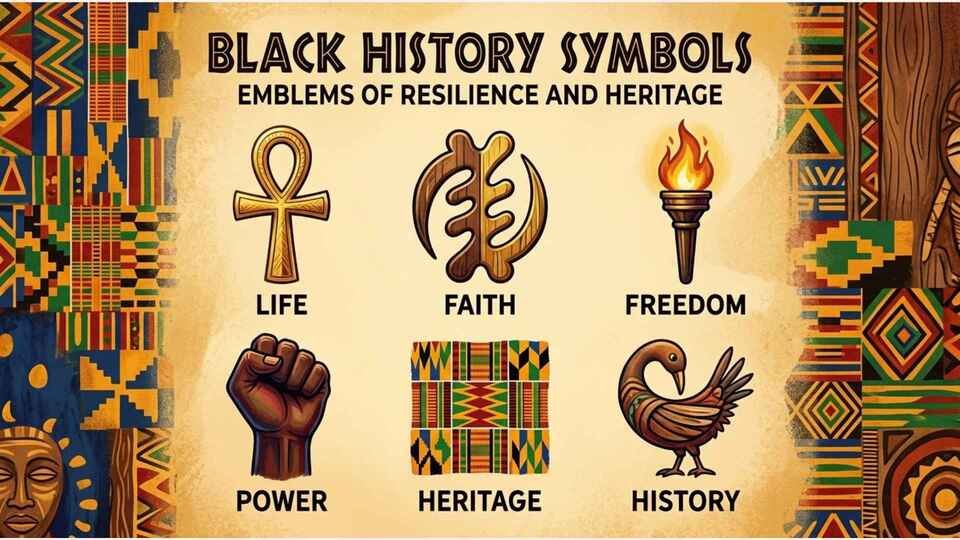
Black history symbols represent freedom, identity, resistance, remembrance, unity, and cultural pride. They appear on flags, clothing, protest signs, monuments, murals, jewelry, books, and social media. Some arose from African traditions, while others developed during slavery, emancipation, the civil rights movement, Pan-Africanism, and modern struggles for racial justice.
Understanding these symbols requires more than recognizing an image. Each one carries a history shaped by particular people, places, and movements. The Pan-African flag expresses global Black unity. Broken chains celebrate liberation. The raised fist communicates collective resistance. Sankofa encourages people to recover wisdom from the past.
Together, these black history symbols create a visual language through which communities preserve memory, honor sacrifice, celebrate achievement, and express hopes for the future.
Quick Meaning of Black History Symbols
Black history symbols are images, colors, gestures, objects, and patterns associated with African heritage and the Black freedom struggle. Their central meanings include liberation, solidarity, cultural identity, remembrance, resilience, and self-determination. Their exact meaning depends on their historical origin, cultural setting, and modern use.
Black History Symbols Overview
| Symbol | Primary Meaning | Origin or Cultural Connection | Common Modern Use |
| Pan-African flag | Unity, liberation, shared African heritage | Universal Negro Improvement Association, 1920 | Flags, clothing, celebrations, protests |
| Red, black, and green | Struggle, Black people, hope and land | Pan-African and Black liberation movements | Art, branding, community events |
| Raised fist | Resistance, solidarity, collective power | Global labor and political movements; adopted by Black freedom groups | Protest signs, murals, logos |
| Broken chains | Freedom from slavery and oppression | Abolitionist and emancipation imagery | Memorials, tattoos, educational art |
| Sankofa | Learning from the past | Akan culture of Ghana | Jewelry, education, African American cultural programs |
| Kente cloth | Heritage, status, identity, community values | Akan and Ewe weaving traditions of Ghana | Graduation stoles, ceremonies, fashion |
| Adinkra symbols | Wisdom, values, proverbs, social principles | Akan culture of Ghana and Côte d’Ivoire | Textiles, architecture, logos, tattoos |
| North Star | Guidance toward freedom | Navigation and Underground Railroad memory | Museums, literature, memorial designs |
| Juneteenth flag | Freedom, renewal, national recognition | United States, designed in 1997 | Juneteenth celebrations and education |
| Black Power fist | Political empowerment and resistance | Black Power movement of the 1960s and 1970s | Posters, apparel, activist art |
| Afro hairstyle | Natural beauty, pride, rejection of imposed standards | African diaspora and Black pride movements | Fashion, art, political identity |
| African continent silhouette | Ancestry, homeland, diaspora connection | Pan-African cultural expression | Jewelry, logos, maps, clothing |
| Kinara | Family, community, heritage, shared responsibility | Kwanzaa, created in 1966 | Kwanzaa observances |
| Drum | Communication, ceremony, continuity | Numerous African societies and diaspora traditions | Music, festivals, visual art |
What Do Black History Symbols Mean?
Black history symbols express the experiences, values, and aspirations of Black communities across different periods and regions. They do not all carry one universal message. Instead, they form a connected vocabulary of freedom, identity, survival, memory, and collective responsibility.
Freedom and liberation
Many symbols developed from experiences of enslavement, colonialism, segregation, and political exclusion. Broken chains, open hands, freedom paths, and emancipation imagery communicate release from physical bondage and oppressive systems.
Freedom symbols may refer to the abolition of slavery, but their meaning often extends further. They can also represent freedom from discrimination, economic exploitation, cultural erasure, or restrictions on political participation.
Pride and cultural identity
Kente cloth, Adinkra symbols, African maps, natural hairstyles, and Pan-African colors express pride in African ancestry and Black cultural achievement.
These symbols became especially important in societies where African history was ignored, distorted, or presented only through slavery. Wearing or displaying them can affirm that Black history includes kingdoms, art, philosophy, spirituality, scholarship, resistance, and innovation.
Resistance and solidarity
The raised fist represents people joining together against injustice. Its power comes from the difference between an open, separate hand and a closed fist formed by united fingers.
In Black history, the fist has represented resistance to racism, support for civil rights, community defense, political power, and international solidarity. Its meaning can vary depending on the organization, event, or artwork in which it appears.
Memory and remembrance
Some symbols preserve the memory of people who suffered, resisted, organized, or died in the struggle for freedom. Memorial chains, empty chairs, candles, names, portraits, and commemorative flags turn historical loss into public remembrance.
Such symbols do not merely look backward. They often ask viewers to connect past injustice with present responsibilities.
History and Origin of Black History Symbols
Black history symbols come from several historical sources rather than one single tradition.
African cultural traditions
Many widely recognized symbols have roots in specific African societies. Sankofa and numerous Adinkra designs come from Akan cultural traditions in West Africa. Kente developed through the weaving traditions of Akan and Ewe communities in present-day Ghana and neighboring areas.
These designs existed before their modern use within African American culture. Their contemporary adoption reflects connections between Africa and its global diaspora, but their original cultural meanings should not be erased.
Slavery and abolition
During the Atlantic slave trade and slavery in the Americas, freedom became a powerful symbolic theme. Abolitionist publications used images of chains, kneeling captives, clasped hands, and rising suns to communicate the cruelty of slavery and the demand for emancipation.
Some historical images are now viewed critically because they portrayed enslaved people as passive rather than as active agents in their own liberation. Modern artists frequently reinterpret these symbols to emphasize resistance, dignity, and self-emancipation.
Emancipation and Reconstruction
After the abolition of slavery in the United States, public celebrations used banners, parades, military uniforms, portraits, and copies of emancipation documents to symbolize citizenship and freedom.
Yet emancipation did not produce immediate equality. During Reconstruction and the Jim Crow era, Black institutions such as churches, schools, newspapers, mutual-aid societies, and fraternal organizations developed their own visual symbols of progress, education, faith, and community strength.
Pan-Africanism
Pan-Africanism encouraged people of African descent to recognize shared historical and political interests across national borders.
The red, black, and green Pan-African flag was adopted by the Universal Negro Improvement Association in 1920 under the leadership of Marcus Garvey. Smithsonian materials describe it as a major source for later Black liberation imagery and for artworks such as David Hammons’s African-American Flag.
The flag gave Black communities a visual emblem that did not depend on the national symbols of countries shaped by slavery or colonial rule.
The civil rights and Black Power eras
The civil rights movement used symbols that emphasized moral courage, faith, nonviolent protest, citizenship, and equality. Marchers carried American flags, church banners, crosses, freedom signs, and portraits of movement leaders.
The Black Power movement placed stronger emphasis on self-determination, political power, natural beauty, cultural pride, and resistance. The raised fist, Afro, African clothing, and bold red, black, and green designs became especially visible.
The black-gloved fists raised by U.S. athletes Tommie Smith and John Carlos during the 1968 Olympic medal ceremony became one of the most recognized protest images of the era.
Contemporary movements
Modern racial justice movements use both historical and newly adapted symbols. Raised fists, names of victims, memorial portraits, hashtags, murals, and protest signs allow physical and digital communities to communicate quickly.
Collections documenting the Black Lives Matter Memorial Fence in Washington, D.C., show how the raised fist continues to appear in art addressing racial injustice, police violence, grief, and solidarity.
Major Black History Symbols and Their Meanings
The Pan-African flag
The Pan-African flag has three horizontal bands: red, black, and green. It is also called the Black liberation flag, UNIA flag, or Afro-American flag.
Common interpretations are:
- Red: blood, sacrifice, or the struggle for liberation
- Black: Black people collectively
- Green: Africa’s land, natural abundance, hope, or the future
The precise wording varies among communities. During Kwanzaa, the colors are often explained as red for struggle, black for the people, and green for the future.
The raised fist
A raised fist symbolizes unity, defiance, strength, and organized resistance. It has appeared in labor, antifascist, anticolonial, feminist, racial justice, and other political movements.
Within Black history, it is closely linked to the Black Power era and later racial justice campaigns. It does not belong exclusively to one organization, so its meaning should be interpreted through context.
Broken chains
Broken chains represent freedom from enslavement, captivity, and oppression. A chain with separated links suggests that a system once used to control people has lost its power.
The symbol appears in abolitionist imagery, emancipation monuments, tattoos, public art, and educational materials. It may honor legal emancipation while also expressing an ongoing desire to break social, economic, or psychological forms of bondage.
Sankofa
Sankofa is an Akan concept commonly translated as “go back and get it.” It teaches that people can return to the past to recover knowledge needed for the present and future.
The concept may appear as a stylized bird turning its head backward while moving forward, often carrying an egg on its back or in its beak. It may also appear as a heart-like Adinkra design.
In Black history education, Sankofa supports the recovery of overlooked stories, family histories, languages, artistic traditions, and community knowledge.
Kente cloth
Kente is a woven textile associated especially with Akan and Ewe traditions in Ghana. Its colors and patterns can communicate identity, status, history, values, or commemorative meaning.
In the United States, kente-style graduation stoles often celebrate achievement and African heritage. However, not every brightly colored African-inspired fabric is authentic kente. True kente belongs to specific weaving traditions and carries cultural knowledge beyond its appearance.
Adinkra symbols
Adinkra symbols express ideas through visual designs linked to proverbs, moral teachings, historical events, and social values.
Examples include:
- Gye Nyame: the supremacy of God
- Dwennimmen: strength joined with humility
- Aya: endurance and resourcefulness
- Fawohodie: independence and freedom
- Eban: safety, love, and protection
- Sankofa: learning from the past
Their meanings can be simplified online, so reliable cultural sources are preferable when choosing an Adinkra symbol for permanent use.
The North Star
The North Star symbolizes guidance, direction, hope, and freedom. Because it remains near the same location in the northern sky, travelers can use it to identify north.
It is associated in public memory with freedom seekers moving northward from slavery. The National Park Service discusses the role of the night sky and North Star in stories connected with Harriet Tubman and the Underground Railroad.
The symbol should not be treated as proof that every escape followed one route or relied on one method. Freedom seekers used varied knowledge, networks, landscapes, waterways, roads, and assistance.
The Juneteenth flag
The Juneteenth flag was created by Ben Haith in 1997 and later refined with illustrator Lisa Jeanne Graf. Its design includes a star, a burst or nova, a curved horizon, and the colors red, white, and blue.
The star represents Texas, where General Order No. 3 was announced in Galveston on June 19, 1865. It also represents the freedom of Black Americans throughout the nation. The burst suggests a new beginning, while the horizon points toward future possibilities.
Juneteenth commemorates the enforcement of emancipation in Texas, not the day all enslaved people in the United States instantly became free. The holiday’s history is rooted in the June 19, 1865, announcement in Galveston.
The Afro
The Afro became a major symbol of Black pride, natural beauty, and cultural self-acceptance during the 1960s and 1970s.
Rejecting pressure to imitate Eurocentric hair standards could become a personal and political statement. The hairstyle communicated that natural Black hair did not need to be hidden or changed to deserve respect.
Not every person who wears an Afro intends a political message. Its significance depends on individual choice, period, and setting.
The African continent silhouette
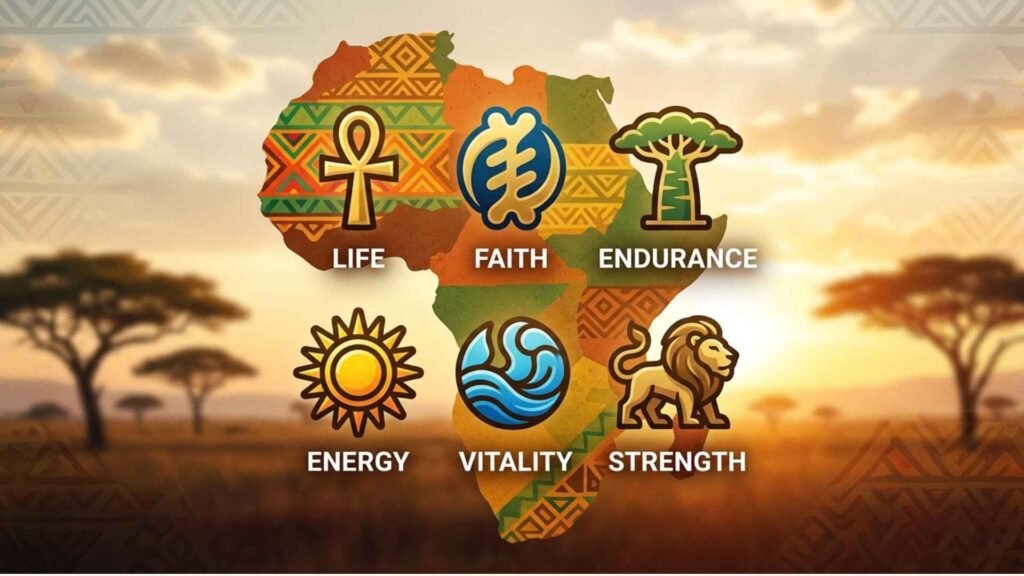
The outline of Africa represents ancestry, homeland, origin, diaspora identity, and Pan-African connection.
It often appears in pendants, logos, tattoos, educational materials, and cultural organizations. However, Africa is a continent containing many nations, peoples, languages, and histories. The silhouette can express unity, but it should not suggest that all African cultures are identical.
Cultural Significance
Black history symbols connect communities across geography while preserving distinct local meanings.
In the United States
Symbols often focus on slavery, emancipation, Reconstruction, civil rights, Black Power, Juneteenth, cultural pride, and continuing struggles for equal protection.
Churches, historically Black colleges and universities, museums, civic organizations, and families use symbols to connect national history with personal memory.
In Africa
Kente, Adinkra, drums, royal emblems, masks, stools, colors, and other designs belong to particular societies and may carry political, spiritual, family, or ceremonial meanings.
Their significance should be understood within their original cultural setting rather than labeled simply as “African symbols.”
In the Caribbean
Black history symbolism may combine African heritage, emancipation, anticolonial struggle, national independence, Rastafari, Carnival traditions, labor movements, and local religious practices.
Colors and images can have meanings that differ from their use in the United States.
Across the African diaspora
Diaspora communities often use common images to express connection despite different national histories. The Pan-African flag, African map, raised fist, and Sankofa symbol are especially effective because they connect heritage with forward-looking political or cultural goals.
Religious and Spiritual Meaning
Religion has played an important role in Black history, but no single faith represents all Black communities.
The Black church tradition
In the United States, the cross, Bible, church building, choir robe, pulpit, and spiritual song can symbolize faith, refuge, education, organization, and civil rights leadership.
Black churches often served not only as places of worship but also as meeting spaces, schools, mutual-aid centers, and organizing institutions.
African spiritual traditions
Some Adinkra symbols express ideas about God, destiny, protection, mortality, and the relationship between the physical and spiritual worlds.
These meanings are culturally specific. They should not be reduced to generalized claims about “African spirituality.”
Kwanzaa symbols
Kwanzaa is a cultural observance rather than a religion. Its central symbols include the kinara, seven candles, mat, crops, corn, unity cup, and gifts.
The Smithsonian identifies the kinara, mkeka, muhindi, mazao, and zawadi among the essential items used during Kwanzaa.
The seven candles correspond to the Nguzo Saba, or Seven Principles, including unity, self-determination, collective work and responsibility, cooperative economics, purpose, creativity, and faith.
Where Black History Symbols Are Used
Black history symbols appear in many settings:
Flags and public celebrations
The Pan-African and Juneteenth flags are displayed at festivals, schools, government buildings, community centers, parades, and cultural programs.
Clothing and fashion
Red, black, and green clothing, kente stoles, African-print garments, natural hairstyles, and symbolic jewelry can communicate heritage or solidarity.
Protest art
Raised fists, broken chains, portraits, and movement slogans appear on banners, posters, street murals, and digital graphics.
Monuments and museums
Memorials use chains, pathways, doors, water, stars, names, and human figures to tell stories of captivity, migration, resistance, and freedom.
Tattoos and jewelry
People choose Sankofa, Africa outlines, Adinkra symbols, fists, stars, and broken chains to express personal identity. Research is important because cultural designs may have meanings more specific than popular summaries suggest.
Books, films, and literature
Authors and filmmakers use roads, rivers, trains, stars, quilts, doors, trees, and chains as recurring visual metaphors for escape, memory, ancestry, danger, and liberation.
Common Variations and Modern Adaptations
African-American flag designs
Artist David Hammons’s African-American Flag combines the structure of the United States flag with red, black, and green. The work creates tension between African American identity, patriotism, pride, exclusion, and the nation’s unfinished promises.
Raised-fist variations
The fist may appear in black, red, multicolored, patterned, outlined, or combined with words and faces. A black fist usually emphasizes Black identity or racial justice, while other designs may represent broader solidarity.
Sankofa variations
Sankofa appears as either a backward-looking bird or an abstract heart-shaped design. Both relate to recovering valuable knowledge from the past.
Broken-chain variations
Chains may break around wrists, between hands, above a crowd, or beside a rising sun. The added imagery changes the emphasis from individual escape to collective liberation or a new beginning.
Common Misconceptions
There is one official symbol of Black history
No single symbol represents the full history of all Black people. Black history includes many nations, languages, religions, political movements, and cultural traditions.
Every African pattern has a fixed universal meaning
Textile patterns and symbols come from particular communities. Meanings may depend on the maker, occasion, region, color combination, or historical context.
The Pan-African flag is a national flag
The red, black, and green flag represents Pan-African unity and Black liberation. It is not the national flag of one African country.
The raised fist always means violence
The raised fist usually represents unity, resistance, determination, or political power. Its meaning depends on context and does not automatically communicate violence.
Underground Railroad quilts carried a proven secret code
The popular claim that quilts displayed coded directions for freedom seekers lacks strong historical documentation. The National Park Service notes that quilt-code stories are controversial and no longer widely accepted by scholars because supporting evidence is insufficient.
Quilting remains an important part of African American artistic and family history, but that importance does not confirm a universal Underground Railroad code.
Juneteenth marks the legal end of all U.S. slavery
Juneteenth commemorates the June 19, 1865, announcement and enforcement of emancipation in Texas. Slavery persisted in some forms and locations afterward, and the Thirteenth Amendment was ratified later that year.
Interesting Facts About Black History Symbols
- The Pan-African flag is more than a color scheme. It was developed as a deliberate political emblem through the UNIA in 1920, giving people of African descent a shared flag of identity and liberation.
- Black history symbols often combine memory and action. Broken chains recall enslavement while demanding that present-day systems of oppression also be confronted.
- Sankofa faces backward but moves forward. Its form visually communicates that studying history should support progress rather than trap people in the past.
- The Juneteenth flag uses American colors intentionally. Its red, white, and blue design presents Juneteenth as part of United States history, not as a story separate from the nation.
- A raised fist is powerful because it is visually simple. Its clear shape can be recognized from a distance, reproduced cheaply, and adapted across posters, murals, pins, and digital icons.
- Kente patterns can function like visual language. Names, colors, and arrangements may carry associations with leadership, history, moral values, or important occasions.
- The Afro turned personal appearance into cultural communication. In the Black pride era, natural hair challenged standards that treated Black features as inferior or unprofessional.
- The North Star joins science and symbolism. Its practical navigational value helped it become a metaphor for moral direction, hope, and freedom.
- Artists frequently revise national symbols. Works such as Hammons’s flag use familiar forms to ask who is fully represented by the nation and whose history remains overlooked.
- Symbols can change meaning across generations. A design first used in a political movement may later appear in education, fashion, memorials, advertising, or family celebrations.
Related Symbols
The dove
The dove represents peace and hope. Unlike the raised fist, it emphasizes reconciliation and nonviolence rather than resistance or collective power.
The torch
A torch symbolizes knowledge, liberty, enlightenment, and leadership. It often appears in educational institutions and freedom monuments.
The rising sun
The rising sun suggests renewal, freedom, opportunity, and the beginning of a new era. It often accompanies broken chains or emancipation scenes.
The crossroads
Crossroads can represent decision, transformation, migration, destiny, or contact between worlds. Their spiritual meaning differs across African and diaspora traditions.
The freedom door
An open door represents movement from confinement into possibility. It is common in memorial architecture and literature.
Clasped hands
Clasped hands symbolize cooperation, equality, mutual aid, or alliance. The meaning differs from a fist because it emphasizes partnership rather than defiance.
Frequently Asked Questions
What is the most recognized Black history symbol?
The raised fist and Pan-African flag are among the most widely recognized. The fist represents solidarity, resistance, and collective power. The red, black, and green flag represents Black people, struggle, African heritage, and hope for the future. Recognition varies by country, generation, and cultural setting.
What colors represent Black history?
Red, black, and green are the colors most strongly associated with Pan-Africanism and Black liberation. Red commonly represents struggle or sacrifice, black represents Black people, and green represents Africa, growth, hope, or the future. Gold may also appear to represent prosperity, heritage, achievement, or natural wealth.
What symbol represents freedom from slavery?
Broken chains are the clearest symbol of freedom from slavery. They represent the destruction of physical bondage and oppressive control. The North Star, open doors, rising suns, and birds in flight can also symbolize escape, emancipation, direction, and the hope of living freely.
What does the black raised fist mean?
A black raised fist generally represents Black unity, resistance to racism, political strength, and solidarity. It became closely associated with the Black Power movement and continues to appear in racial justice campaigns. Because the raised fist is used by many movements, surrounding words, colors, and historical context help determine its precise meaning.
What does Sankofa symbolize in Black history?
Sankofa symbolizes the responsibility to recover valuable knowledge from the past. In Black history, it supports the study of African heritage, family ancestry, suppressed stories, and earlier freedom struggles. Its message is not simply to remember history, but to use historical understanding to make wiser decisions in the present.
Is kente cloth a Black history symbol?
Kente can function as a symbol of African heritage and Black cultural pride, especially in diaspora communities. However, it is first a culturally specific textile tradition associated with Ghanaian peoples, particularly Akan and Ewe weavers. Respectful use recognizes its craftsmanship, historical roots, and meanings beyond decorative fashion.
What does the Juneteenth star represent?
The star represents Texas, often called the Lone Star State, where the June 19, 1865, emancipation announcement took place. It also represents the freedom of Black Americans across the United States. The burst around it suggests a new beginning, while the curved horizon symbolizes future opportunity.
Are Underground Railroad quilt symbols historically proven?
Historians have not found sufficient documentation proving that a standardized quilt code guided freedom seekers. The story remains popular, but major historical organizations describe it as disputed or unsupported. Quilts still hold genuine artistic, social, and family importance in African American history without requiring the code story to be factual.
Can anyone wear Pan-African colors?
People may wear red, black, and green to show respect, solidarity, cultural connection, or support for Black history. Responsible use involves understanding their association with Pan-Africanism and Black liberation. Using them only as a trend while ignoring their history can weaken or commercialize their meaning.
Why are symbols important during Black History Month?
Symbols make complex history visible and memorable. They help schools, museums, families, and communities discuss identity, oppression, resistance, achievement, and freedom. Their strongest educational use includes explaining their origins and limitations rather than presenting them as decorations without historical context.
Key Takeaways
- Black history symbols represent freedom, identity, resistance, remembrance, unity, and hope.
- The Pan-African flag was adopted by the UNIA in 1920 and uses red, black, and green.
- The raised fist symbolizes solidarity, collective strength, and resistance to injustice.
- Broken chains are a central image of emancipation and liberation.
- Sankofa teaches that knowledge from the past can guide future progress.
- Kente and Adinkra designs come from specific West African cultural traditions.
- The North Star represents guidance and is connected to memories of freedom seeking.
- The Juneteenth flag commemorates the June 19, 1865, emancipation announcement in Texas.
- Not every popular story about a symbol is historically supported, including claims of a universal Underground Railroad quilt code.
- Symbols should always be interpreted through their cultural and historical context.
Conclusion
Black history symbols preserve stories that words alone cannot always carry. A raised fist can express collective courage. Broken chains can turn a history of captivity into a declaration of freedom. The Pan-African flag can connect people across borders, while Sankofa reminds each generation that progress requires an honest relationship with the past.
These symbols are powerful because they hold both memory and possibility. They honor people who endured injustice, celebrate communities that created beauty and knowledge, and challenge future generations to continue the work of freedom.
Learning the origins and meanings of black history symbols helps prevent shallow or inaccurate interpretations. More importantly, it reveals how art, color, gesture, clothing, faith, and public memory have helped Black communities defend dignity, preserve identity, and imagine a more just future.

I am Amelia Carter, an English language educator and educational writer who enjoys making difficult ideas simple and easy to understand. At LearnNestly, I write about English words, grammar, everyday expressions, and language questions that people often find confusing. I believe learning should feel practical, clear, and enjoyable rather than overwhelming. Through my writing, I try to give readers explanations they can understand and use in real life.
Books:
- The Everyday English Handbook
- Words Made Simple
 Daniel Brooks