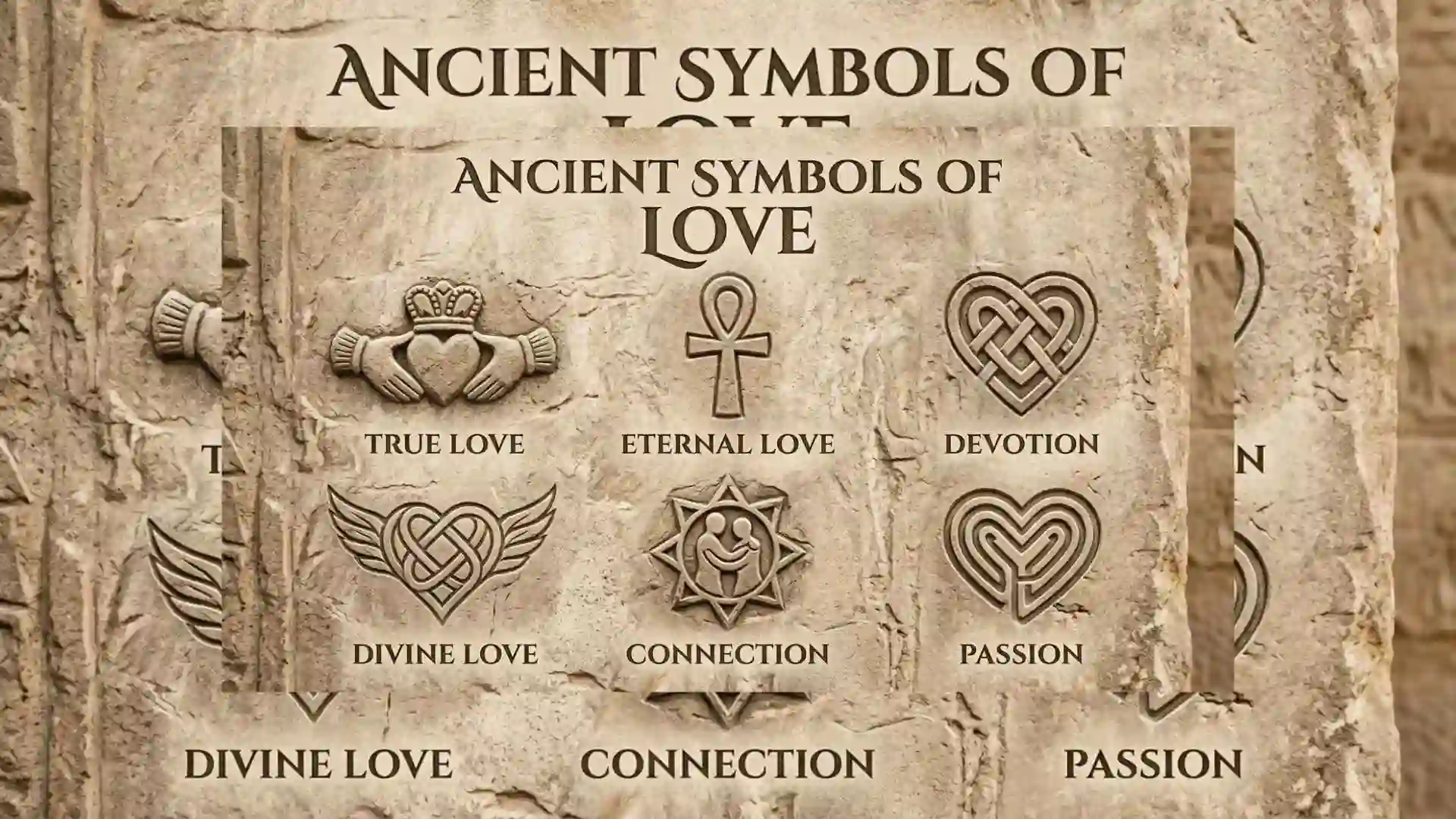
Ancient symbols of love reveal that people have always searched for visible ways to express invisible emotions. Long before the familiar heart icon became popular, civilizations represented love through deities, plants, animals, knots, rings, joined hands, and sacred objects.
These symbols appeared on jewelry, wedding garments, pottery, temples, funerary objects, coins, sculptures, and household decorations. Some represented romantic attraction, while others expressed marriage, fertility, loyalty, protection, family affection, or divine love.
Understanding ancient symbols of love requires careful interpretation. A rose, dove, knot, or heart did not carry one universal meaning. Its significance depended on the culture, historical period, religious beliefs, and setting in which it appeared.
Quick Meaning
Ancient symbols of love included the heart, Eros and his arrows, Aphrodite’s dove and myrtle, the Herakles knot, clasped hands, wedding rings, roses, apples, and swans. These images represented emotional attachment, desire, fertility, marriage, loyalty, beauty, protection, and the binding of two people.
Ancient Symbols of Love Overview
| Symbol | Primary Meaning | Culture or Civilization | Historical Use | Modern Interpretation |
| Heart | Emotion, character, inner life | Ancient Egypt and later cultures | Amulets, funerary objects, religious texts | Romantic and emotional love |
| Eros with bow and arrows | Desire and irresistible attraction | Ancient Greece | Sculpture, pottery, jewelry, literature | Falling in love |
| Cupid | Romantic desire and affection | Ancient Rome | Art, mosaics, sculpture, poetry | Valentine’s Day and romance |
| Dove | Love, beauty, peace, divine favor | Greek and Roman traditions | Aphrodite and Venus imagery | Faithful or peaceful love |
| Myrtle | Love, marriage, beauty, fertility | Ancient Greece and Rome | Wreaths, weddings, religious rituals | Devotion and marital love |
| Rose | Beauty, passion, desire | Greek and Roman traditions | Festivals, poetry, decoration | Romantic love |
| Apple | Desire, courtship, beauty, choice | Ancient Greece | Myth, courtship customs, art | Temptation and affection |
| Herakles knot | Strong union, protection, fertility | Greek and Roman worlds | Bridal clothing and jewelry | Unbreakable relationship |
| Clasped hands | Agreement, loyalty, marriage | Ancient Rome | Rings, coins, sarcophagi | Commitment and partnership |
| Ring | Continuity, contract, union | Egypt, Greece, and Rome | Marriage and betrothal jewelry | Eternal commitment |
| Swan | Beauty, desire, partnership | Greek and Roman mythology | Poetry, pottery, divine imagery | Graceful and lasting love |
| Shell | Birth, beauty, sexuality | Mediterranean cultures | Aphrodite imagery and decoration | Feminine beauty and romance |
What Do Ancient Symbols of Love Mean?
Ancient symbols of love represent different forms of human connection rather than one simple idea. Romantic desire was only one part of their meaning.
Many symbols expressed eros, the Greek concept of passionate or desirous love. Eros could feel exciting, creative, dangerous, or overwhelming. The winged god Eros embodied this emotional force, and his bow and arrows represented love’s ability to strike suddenly.
Other symbols focused on marriage and social commitment. Rings, knots, wreaths, and clasped hands communicated that two individuals had entered a recognized union. These objects often represented trust, agreement, fertility, household stability, and family continuity.
Some symbols connected love with divine protection. A bride might wear a sacred plant or protective knot not simply as decoration but as a request for safety, fertility, and harmony.
Ancient imagery therefore treated love as a combination of emotion, physical desire, spiritual power, family responsibility, and public commitment.
History and Origin of Ancient Love Symbols
Love Symbols in Ancient Egypt
Ancient Egyptian symbolism centered heavily on the heart, called the ib. Egyptians viewed the heart as the seat of intelligence, memory, feelings, intention, and moral character. Heart-shaped amulets were placed with the dead to protect this essential part of the person during judgment in the afterlife.
The Egyptian heart was not primarily a romantic icon in the modern sense. It represented the complete inner person. Because emotions were believed to arise from the heart, however, it became an important ancestor of later emotional symbolism.
The ankh is also sometimes marketed today as an ancient symbol of romantic love. Historically, its central meaning was life or continued life, not romance. Its form could express the union of complementary forces, but calling it a direct Egyptian “love symbol” oversimplifies its purpose.
The tyet, often called the Knot of Isis, represented protection and security associated with the goddess Isis. It may be connected with ideas of motherhood, divine care, and the protective devotion Isis showed toward Osiris and Horus, but it should not be treated as a universal Egyptian romance emblem.
Love Symbols in Ancient Greece
The ancient Greeks gave love a powerful divine form through Eros. Early literary traditions did not always portray him as a harmless child. He could be a commanding, unpredictable force capable of overpowering gods and mortals.
Classical Greek art commonly represented Eros as a winged youth. Over time, especially during the Hellenistic period, artists increasingly portrayed him as a younger boy. His wings suggested speed and instability, while his bow and arrows visualized the sudden wound of desire.
Aphrodite, goddess of love, beauty, sexuality, and attraction, was associated with several natural objects. Museum educational materials identify the apple, myrtle, and dove among her recognized symbols.
These objects did not all mean exactly the same thing. Myrtle emphasized beauty, marriage, and fertility. The apple could represent desire, courtship, or erotic choice. The dove reflected the goddess’s divine identity and became connected with gentler forms of affection.
Love Symbols in Ancient Rome
Romans adapted Eros as Cupid or Amor. Roman artists often depicted him as a winged child carrying a bow, quiver, or torch. These attributes represented desire, emotional heat, attraction, and the power of love to disturb rational judgment.
Roman love symbolism also emphasized marriage as a social agreement. The image known as dextrarum iunctio, the joining of right hands, appeared on rings and other objects connected with marriage. Surviving Roman rings show couples clasping hands as an image of union, trust, agreement, or betrothal.
This gesture later influenced the European fede ring, named from an Italian expression associated with hands joined in faith or trust.
Major Ancient Symbols of Love and Their Interpretations
The Heart
The heart symbolizes the emotional and moral center of a person. Ancient Egyptians believed it preserved memory, intention, intelligence, and feeling. During judgment after death, the heart could testify about its owner’s life.
The familiar symmetrical heart icon used today does not directly reproduce the anatomical Egyptian heart. Its modern romantic meaning developed gradually through later artistic and literary traditions.
Still, the Egyptian belief that feelings belonged to the heart helped establish one of humanity’s most enduring symbolic associations: love comes from within.
Eros, Cupid, and the Bow and Arrow
Eros and Cupid symbolize attraction that feels sudden, involuntary, and difficult to resist.
The arrow provides a vivid metaphor. A person does not carefully choose to be struck; the experience happens unexpectedly. Love can wound, weaken, excite, or transform the individual.
Ancient images often show Eros with wings, arrows, a bow, or a quiver. One Greek ring in the British Museum depicts Eros holding an iynx, a spinning love charm associated with desire and longing.
Modern Cupid is usually playful and innocent. Ancient Eros could be far more serious, representing a force capable of disrupting families, cities, divine plans, and personal self-control.
The Dove
The dove became a symbol of love through its connection with Aphrodite and Venus.
In ancient Mediterranean art, an animal beside a deity could help viewers recognize that deity. Doves accompanying Aphrodite therefore functioned first as divine attributes. Their association with love developed from the goddess they represented.
Today, two doves often symbolize partnership, peace, weddings, and mutual devotion. However, the popular claim that all doves mate faithfully for life simplifies the varied behavior of different dove species.
Myrtle
Myrtle was one of the strongest botanical symbols of ancient love. It was sacred to Aphrodite and associated with beauty, desire, marriage, and fertility.
Greeks wore real myrtle wreaths during weddings, banquets, and other ceremonies. Artists also produced precious metal wreaths shaped like myrtle leaves and blossoms. A surviving Greek myrtle wreath dated roughly to 330–250 BCE reflects this connection between the plant and the language of love.
The plant’s evergreen leaves made it especially suitable for expressing continuity. Its fragrance added associations with beauty, sensuality, and celebration.
The Rose
The rose symbolized beauty, pleasure, fragility, passion, and the temporary nature of youth.
Greek and Roman writers and artists connected roses with Aphrodite or Venus. The flower’s softness and fragrance suggested attraction, while its thorns could suggest pain or danger. Its short blooming period also made it a natural metaphor for beauty that should be appreciated before it fades.
The rose later became one of the world’s most recognizable romantic symbols, especially in European and Middle Eastern poetry. Ancient Mediterranean traditions contributed to this development, but no single civilization created all its modern meanings.
The Apple
The apple represented desire, beauty, courtship, fertility, and choice in several Greek traditions.
In the Judgment of Paris, a golden apple became the prize awarded to the most beautiful goddess. Paris gave it to Aphrodite after she promised him Helen, setting in motion the events associated with the Trojan War.
Because of stories like this, the apple could express both attraction and dangerous consequences. It showed that desire may offer pleasure while also creating rivalry, conflict, or loss.
Apples were also linked with courtship in Greek culture. Depending on the literary context, offering or throwing an apple could function as a gesture of desire.
The Herakles Knot
The Herakles knot, also called the Hercules knot, consisted of interlocking loops resembling a strong square or reef knot.
The design appeared in Greek and Roman jewelry, including rings, necklaces, bracelets, and bridal ornaments. Surviving examples show that it could serve protective, decorative, marital, or fertility-related purposes. A Hellenistic gold ring in the British Museum features a Herakles-knot bezel, while other ancient jewelry used the knot as a central clasp.
Its strength made it an effective metaphor for a secure union. In wedding contexts, it could suggest that marriage joined two lives together while protecting the couple.
Not every ancient knot was a love knot, however. Context determines whether a knot represented marriage, protection, healing, status, or simple ornament.
Clasped Hands
Clasped right hands symbolized agreement, fidelity, partnership, friendship, or marriage in Roman imagery.
On a marriage ring, the gesture could represent the couple’s public consent and mutual obligation. On funerary art, it might symbolize the bond between spouses or the hope that death would not erase their relationship.
The motif’s clarity helped it survive for centuries. Medieval and Renaissance fede rings continued to use joined hands as symbols of trust, betrothal, and marital loyalty.
Rings and Circles
Rings represented continuity, public commitment, legal agreement, status, and personal connection.
Their circular shape naturally encouraged later interpretations involving eternity because a circle has no visible beginning or end. However, ancient rings served many purposes, including sealing documents, displaying identity, showing wealth, and protecting the wearer.
A ring becomes a love symbol when its imagery, inscription, exchange, or ceremonial setting connects it with courtship or marriage. The object’s shape alone does not prove romantic meaning.
Swans and Shells
Swans entered love symbolism through mythology, beauty, music, and their associations with deities. In Greek art and myth, swans could appear near Aphrodite or in stories involving divine transformation.
Shells, especially scallop-like forms, became associated with Aphrodite’s birth from the sea. They represented the sea, fertility, sexuality, beauty, and feminine creative power.
The famous image of Aphrodite standing in a shell became especially influential in later European art. Ancient evidence connects the goddess strongly with the sea, although some familiar shell compositions became more prominent after antiquity.
Cultural Significance
Ancient cultures interpreted love according to their social and religious values.
In Egypt, love belonged to a broader understanding of the heart, life, family, fertility, divine protection, and moral identity. Egyptian love poetry shows that romantic emotion was openly expressed, but funerary symbols such as heart amulets had religious purposes rather than decorative romantic ones.
In Greece, love could appear as divine beauty through Aphrodite, irresistible desire through Eros, marital fertility through myrtle, or dangerous competition through the apple.
Roman culture preserved these ideas while placing greater visual emphasis on marriage, legal union, household continuity, and public loyalty. Clasped hands and inscribed rings could communicate that love involved obligations as well as emotion.
These regional differences matter because ancient societies did not separate romance, religion, family, politics, inheritance, and social status as sharply as many people do today.
Religious and Spiritual Meaning
Ancient love symbols often operated within religious life.
Aphrodite was not merely a fictional character used in decorative art. She received worship across the Mediterranean and was connected with beauty, sexuality, marriage, fertility, civic harmony, seafaring, and, in some locations, warfare.
Eros could represent a divine or cosmic power of generation as well as personal passion. His influence reminded worshippers that desire could exceed human control.
In Egypt, Isis came to represent powerful forms of marital devotion, motherhood, protection, healing, and restoration. Her search for and care of Osiris contributed to later interpretations of her as a model of faithful love. Yet symbols linked with Isis should be described according to their documented meanings, such as protection and security, rather than labeled automatically as romance symbols.
Where Ancient Symbols of Love Are Used Today
Ancient love symbols remain visible in:
- Jewelry: Knot rings, dove pendants, heart charms, myrtle designs, and clasped-hand rings.
- Weddings: Circular rings, floral wreaths, joined hands, roses, and doves.
- Tattoos: Eros, Cupid, hearts, knots, swans, and Aphrodite imagery.
- Literature: Arrows of love, wounded hearts, blooming roses, and binding knots.
- Fine art: Classical paintings and sculptures of Venus, Cupid, Eros, and Psyche.
- Logos: Hearts, wings, rings, and paired birds representing care or connection.
- Architecture: Floral ornaments, paired figures, knots, and divine love scenes.
- Digital communication: Heart symbols and emojis used for affection, approval, sympathy, or enthusiasm.
No ancient love symbol has one fixed modern meaning. A heart in a medical logo differs from a heart in a wedding invitation, just as a knot in jewelry differs from a knot in navigation or engineering.
Common Variations
Winged Eros and Child Cupid
Greek Eros was often shown as a winged youth, while later Hellenistic and Roman art increasingly favored a childlike figure. Modern Valentine imagery usually follows the younger Roman form.
Single and Paired Doves
A single dove may represent Aphrodite, peace, purity, or divine presence. Two doves more clearly suggest partnership or mutual affection.
Botanical and Geometric Myrtle
Ancient artists represented myrtle as natural wreaths, gold leaves, floral borders, and stylized ornaments. Modern designers may simplify the leaves into symmetrical branches.
Protective and Romantic Knots
Ancient knots often had protective or ceremonial meanings. Modern “love knots” tend to emphasize emotional permanence, even when their designs do not match a specific ancient artifact.
Clasped Hands and Fede Rings
Roman clasped-hand imagery evolved into medieval and later fede rings. Modern Irish Claddagh rings add a crowned heart to two hands, but the Claddagh design is not an ancient Celtic symbol.
Common Misconceptions
The Modern Heart Was the Universal Ancient Love Symbol
Ancient people connected the physical or spiritual heart with emotion, but the modern heart icon did not function everywhere as today’s standard romance logo.
The Ankh Specifically Means Romantic Love
The ankh primarily represented life and continued existence. Using it to represent love today is a modern personal interpretation, not its central ancient meaning.
Every Celtic Knot Is an Ancient Love Knot
Many products labeled “Celtic love knots” are modern designs or modern interpretations. Interlaced ornament has ancient and medieval roots, but specific romantic meanings are often undocumented.
The Claddagh Ring Is Ancient
The Claddagh ring is historically Irish, but it is not an artifact of prehistoric Celtic civilization. Its recognizable design belongs to a much later period.
Cupid Was Always a Harmless Baby
Ancient Eros could be powerful, dangerous, and emotionally disruptive. The cheerful baby Cupid is only one stage in a long artistic development.
Ancient Symbols Had Universal Meanings
A symbol’s meaning changed according to place, period, material, inscription, and ritual setting. A dove, ring, rose, or knot must be interpreted in context.
Interesting Facts About Ancient Symbols of Love
- The Egyptian heart represented thought as well as feeling. Egyptians did not separate the mind and heart in the same way many modern cultures do.
- Eros was once shown as a youth rather than a baby. The childlike Cupid familiar today became especially common in later Greek and Roman art.
- Love’s arrow represented loss of control. The metaphor explained why attraction could feel sudden, painful, and irrational.
- Ancient jewelry carried messages. Images of Aphrodite, Eros, knots, and joined hands allowed jewelry to communicate beauty, desire, protection, or commitment.
- Myrtle was worn at celebrations. Its connection with Aphrodite made it suitable for weddings and banquets as well as religious use.
- Clasped hands could symbolize more than marriage. They also represented friendship, trust, agreement, or a formal contract.
- A knot could protect as well as bind. Herakles-knot jewelry combined the ideas of strength, security, fertility, and union.
- The apple had an uncertain emotional edge. It could express courtship, but myths also connected it with rivalry and destructive desire.
- Roses united beauty with mortality. Their fragrance and short life made them symbols of both pleasure and impermanence.
- Some ancient love symbols were worn after death. Jewelry, wreaths, and paired-spouse imagery could preserve identity, status, and emotional bonds in funerary settings.
Related Symbols
Psyche and the Butterfly
Psyche represents the soul and is often shown with butterfly wings in later classical art. Her story with Eros symbolizes love tested by secrecy, separation, hardship, and reconciliation.
The Torch
A torch held by Eros or Cupid can symbolize burning desire, awakened passion, marriage, or life. An extinguished or inverted torch may instead suggest death or love brought to an end.
Pomegranate
The pomegranate represents fertility, sexuality, marriage, death, and rebirth. Its meaning is broader and more complex than romantic affection.
Lotus
The lotus symbolizes creation, rebirth, beauty, and spiritual renewal, especially in Egyptian traditions. Modern users may associate it with self-love or purity, but these are not identical to every ancient meaning.
Ivy
Ivy can symbolize attachment and persistence because it clings to supporting surfaces. In antiquity, however, it was strongly associated with Dionysus and should not be treated only as a love plant.
Infinity Symbol
The infinity sign is commonly used today for endless love. Although related visual ideas such as circles and looping forms are ancient, the mathematical infinity symbol itself belongs to a much later historical period.
Frequently Asked Questions
What is the oldest ancient symbol of love?
There is no single proven “oldest” love symbol. Very early cultures represented fertility, family, sexuality, and partnership in art, but scholars cannot always determine whether an image expressed romantic love. The Egyptian heart is among the oldest well-documented symbols connected with feelings and inner identity.
What was the ancient Greek symbol of love?
Ancient Greece had several love symbols rather than one. Eros and his bow represented desire, while Aphrodite’s dove, myrtle, apple, and rose reflected beauty, attraction, marriage, and fertility. The Herakles knot could also appear in bridal or protective contexts.
What was the Roman symbol of marriage?
Clasped right hands, known as dextrarum iunctio, were an important Roman image of marriage, agreement, and fidelity. The motif appeared on rings, funerary monuments, and other artworks. Rings, garlands, and paired portraits also communicated marital union.
Is the heart really an ancient love symbol?
The heart has ancient associations with emotion, character, memory, and inner life, especially in Egypt. However, the modern heart shape and its nearly exclusive connection with romance developed later. It is ancient in concept but not identical in appearance or use.
What ancient symbol represents eternal love?
A ring or circle can represent continuity because it has no visible beginning or end. Knots can express a strong bond, while clasped hands suggest loyalty and commitment. Describing any one of them as a universal ancient symbol of “eternal love” would be too broad.
Is the Celtic love knot historically authentic?
Interlaced Celtic and Insular designs are historically authentic, but many patterns marketed as specific “ancient Celtic love knots” have modern names and interpretations. A design should not be assigned a documented romantic meaning unless historical evidence supports that claim.
What flower symbolized love in ancient Greece?
Myrtle had a particularly strong connection with Aphrodite, marriage, beauty, and fertility. Roses also became associated with the goddess and with passion or beauty. Different flowers could carry several meanings depending on the ritual, myth, or artistic setting.
Why did Cupid carry a bow and arrows?
Cupid’s weapons represented the sudden and penetrating force of desire. Being struck by an arrow offered an understandable metaphor for falling in love without planning or consent. Ancient stories also used the image to explore love’s ability to overpower reason.
Did ancient Egyptians use the ankh as a love symbol?
The ankh represented life, vitality, and continued existence. It could appear in contexts involving divine relationships or complementary forces, but it was not primarily a symbol of romantic love. Its use as a modern love emblem is a newer interpretation.
Which ancient symbol is best for a love tattoo?
The best choice depends on the intended meaning. Myrtle suits marital devotion, clasped hands represent trust, Eros symbolizes passion, a ring suggests commitment, and a Herakles knot conveys strength and union. Historical accuracy also requires understanding the symbol’s original culture and context.
Key Takeaways
- Ancient civilizations used many symbols for love rather than one universal emblem.
- The Egyptian heart represented emotion, intelligence, memory, and moral identity.
- Eros and Cupid personified the sudden, powerful force of desire.
- Aphrodite’s dove, myrtle, rose, and apple expressed different aspects of attraction and beauty.
- The Herakles knot symbolized strength, protection, fertility, and union in certain contexts.
- Roman clasped hands represented trust, agreement, friendship, betrothal, or marriage.
- Rings communicated commitment, identity, status, and continuity.
- Many modern “ancient love symbols” have meanings that were invented or expanded later.
- Historical context is essential because the same image can carry several interpretations.
- Ancient love symbolism included passion, marriage, fertility, family duty, divine power, and protection.
Conclusion
Ancient symbols of love show that affection has never been expressed through emotion alone. Egyptians placed feeling and identity in the heart. Greeks personified desire through Eros and honored Aphrodite with doves, myrtle, roses, and apples. Romans used rings and clasped hands to make commitment visible.
These images survived because they translate complex relationships into memorable forms. A knot can bind, an arrow can wound, a ring can continue without end, and two hands can demonstrate trust without words.
By studying ancient symbols of love in their original settings, we gain more than attractive designs. We discover how earlier societies understood desire, loyalty, marriage, fertility, beauty, protection, and the lasting human need to connect with others.

I am Amelia Carter, an English language educator and educational writer who enjoys making difficult ideas simple and easy to understand. At LearnNestly, I write about English words, grammar, everyday expressions, and language questions that people often find confusing. I believe learning should feel practical, clear, and enjoyable rather than overwhelming. Through my writing, I try to give readers explanations they can understand and use in real life.
Books:
- The Everyday English Handbook
- Words Made Simple
 Ethan Mitchell
 Daniel Brooks