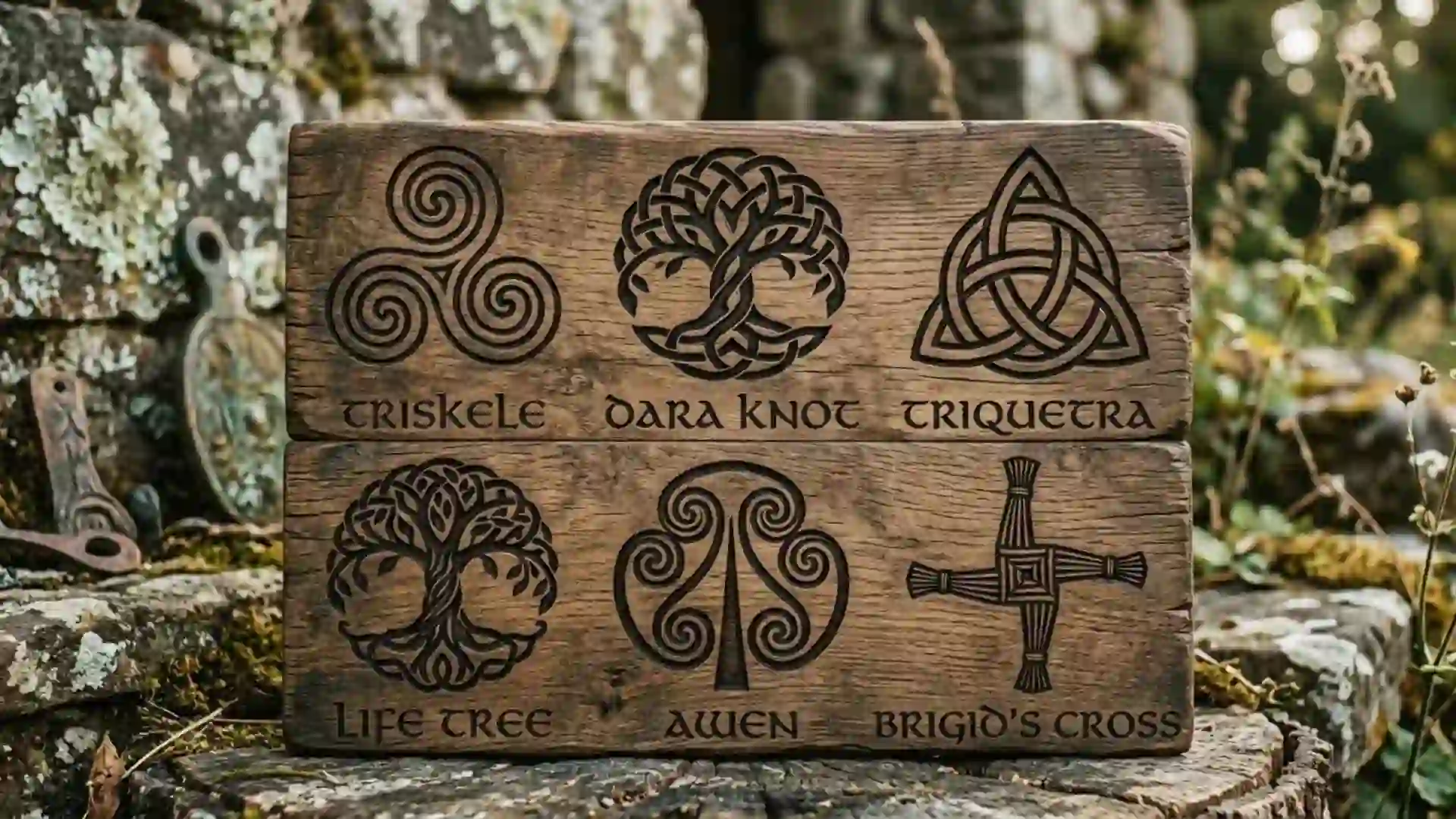
Celtic pagan symbols are designs associated with the pre-Christian cultures, religious traditions, art, and mythology of Celtic-speaking peoples. Common examples include the triskele, spiral, wheel, sacred tree, animals, torcs, and later knotwork designs. However, no single symbol system represented every ancient Celtic community, and many meanings promoted today come from modern interpretation rather than surviving historical evidence.
You may encounter these symbols on Iron Age artifacts, carved stones, illuminated manuscripts, jewelry, tattoos, religious objects, festival decorations, and modern Pagan altars. Their flowing forms often suggest movement, natural cycles, spiritual relationships, protection, ancestry, and the close connection between the human and supernatural worlds.
Understanding Celtic pagan symbols requires separating three different layers: prehistoric European imagery, documented Celtic-era art, and meanings developed by medieval Christians or modern Celtic Pagan movements. That distinction makes the symbols more fascinating, not less, because it reveals how each generation reshaped them.
Quick Meaning
Celtic pagan symbols generally represent natural forces, sacred cycles, protection, divine power, ancestry, transformation, and relationships between the human world and the Otherworld. Their exact ancient meanings are often uncertain because early Celtic religious knowledge was mainly transmitted orally. Modern interpretations should therefore be treated as meaningful traditions, but not always as proven historical facts.
Celtic Pagan Symbols Overview
| Symbol | Common Meaning | Historical Context | Modern Use |
| Triskele | Movement, threefold unity, life cycles | Found in prehistoric and Iron Age European art | Jewelry, tattoos, Pagan spirituality |
| Single spiral | Growth, motion, continuity | Common in prehistoric carving and Celtic art | Meditation, decoration, sacred art |
| Double spiral | Balance, transition, opposing forces | Prehistoric and later ornamental traditions | Seasonal and spiritual symbolism |
| Wheel or sun wheel | Solar power, time, divine authority | Iron Age religious imagery and wheel-associated deities | Seasonal rituals and solar symbolism |
| Tree of Life | Connection, ancestry, natural order | Trees were important in Celtic tradition; the familiar symmetrical design is largely modern | Jewelry, family symbols, Pagan practice |
| Celtic knot | Eternity, interconnection, continuity | Primarily developed in Insular Christian art | Weddings, tattoos, spirituality |
| Awen | Inspiration, poetry, spiritual illumination | Modern Welsh Druidic emblem | Druidry, creativity, modern Paganism |
| Oak | Strength, sacred knowledge, endurance | Associated with later accounts of Druids and sacred groves | Druidic and nature-centered practice |
| Raven | Prophecy, battle, sovereignty, transformation | Connected with figures such as the Morrígan in Irish literature | Divination, protection, shadow symbolism |
| Stag | Wild nature, status, vitality | Appears in European and Celtic religious imagery | Masculine energy, wilderness, renewal |
| Boar | Courage, ferocity, abundance | Appears on Celtic artifacts and in mythology | Warrior symbolism and protection |
| Torc | Status, power, divine or elite identity | Worn and depicted throughout Iron Age Celtic Europe | Heritage jewelry and ceremonial identity |
| Brigid’s cross | Protection and blessing | Christian folk tradition with possible seasonal cultural continuities | Imbolc, home blessing, Irish identity |
| Green Man | Vegetation and seasonal renewal | Mainly medieval European architectural imagery | Modern Pagan nature symbolism |
What Do Celtic Pagan Symbols Mean?
Celtic pagan symbols do not have one universal meaning. They belong to different periods, regions, materials, and religious settings.
Ancient Celtic-speaking societies extended across large areas of Europe, including regions of present-day Ireland, Britain, France, Spain, Germany, Central Europe, and Anatolia. These communities shared related languages and some artistic or religious patterns, but they did not form a single nation with one official collection of sacred signs.
Many authentic Iron Age designs are curving, balanced, and dynamic. Spirals, trumpet shapes, S-curves, plant-like forms, animal bodies, and three-limbed patterns appear on weapons, vessels, mirrors, shields, horse equipment, ornaments, and ceremonial objects. This decorative tradition is commonly associated with La Tène art, which spread across parts of Europe beginning around the fifth century BCE. Modern scholars increasingly emphasize that artistic styles traveled between communities and cannot always prove a single ethnic identity.
The most responsible interpretation is therefore contextual. A spiral on a burial monument may not have meant exactly the same thing as a spiral on a shield or drinking vessel. A boar depicted on a military standard may communicate aggression and group identity, while a boar in a myth may represent abundance, danger, or supernatural power.
History and Origin of Celtic Pagan Symbols
Celtic pagan symbolism developed from several overlapping cultural traditions rather than appearing at one moment.
Prehistoric Foundations
Some designs now called Celtic are older than historically recognizable Celtic cultures. Spirals, concentric circles, cup marks, solar forms, and triple patterns occur in Neolithic and Bronze Age monuments built centuries or millennia before the Iron Age.
Newgrange in Ireland, constructed around 3200 BCE, contains spiral and triple-spiral carvings. Its famous triple spiral is often presented as a Celtic emblem, but the monument predates Iron Age Celtic culture by more than two thousand years. Heritage Ireland confirms that triple-spiral designs appear on the entrance stone and within the passage, but their original meaning remains unknown.
This does not make modern Celtic use illegitimate. It simply means the symbol moved through several cultural layers before becoming associated with Celtic identity.
Hallstatt and La Tène Art
The Hallstatt culture of Central Europe, roughly dated from the late Bronze Age into the early Iron Age, is often connected with early Celtic-speaking elites. It was followed by the La Tène artistic tradition, which flourished from around the fifth century BCE.
La Tène art favored abstract movement over realistic representation. Artists transformed plants, animals, faces, and geometric shapes into flowing patterns. Designs could hide one image inside another, creating an effect that appears different as the object turns.
The triskele became an important motif within this artistic world. A notable bronze plaque from Iron Age Wales, dated approximately 200 BCE to 50 CE, carries a raised three-limbed design. Museum Wales describes it as a major example of Celtic art and notes that such imagery may have conveyed powerful religious messages, although its precise meaning is uncertain.
Roman Contact and Cultural Change
Roman conquest did not immediately erase local beliefs. Celtic religious images, deities, artistic habits, and ritual practices continued, sometimes blending with Roman customs.
A local god might be identified with a Roman deity, while still retaining regional characteristics. Religious objects could combine Roman materials or forms with native curving decoration. The triskele, for example, remained visible in Britain during the Iron Age and Roman periods. Museum Wales notes that the design is strongly associated with Celtic art, although similar threefold motifs also appeared in earlier European and Mediterranean traditions.
Medieval Christian Transformation
Christianity changed the religious environment of Ireland, Britain, and other Celtic-speaking regions. Yet older artistic habits did not disappear.
Interlace, spirals, animal forms, and complex geometric patterns appeared in manuscripts, stone crosses, metalwork, and church objects. These designs are often called Celtic today, but many famous examples belong to medieval Christian culture rather than ancient pagan worship.
The Celtic knot is the clearest example. Endless knotwork may suggest eternity or interconnection to modern viewers, but elaborate interlace became especially prominent in Insular Christian art. It should not automatically be described as an ancient Druid symbol.
Modern Celtic Paganism
From the eighteenth century onward, antiquarians, poets, artists, national revival movements, occult writers, and modern Druids renewed public interest in Celtic heritage.
Contemporary Celtic Paganism includes several different paths. Some practitioners attempt historical reconstruction using archaeology, early literature, folklore, and comparative religion. Others follow modern Druidry, eclectic Paganism, nature spirituality, or personal ancestral traditions.
As a result, ancient designs now carry new meanings related to ecological awareness, personal transformation, equality, creativity, seasonal celebration, and cultural identity.
Major Celtic Pagan Symbols and Their Meanings
The Triskele
The triskele, or triskelion, consists of three curved arms, legs, or spirals extending from a central point. In Celtic-style art, it often creates a strong sense of rotation.
Its exact ancient meaning is unknown. Museum Wales explains that archaeologists have proposed possibilities such as birth, life, and death; the living, the dead, and the gods; or elemental and divine groupings. These are interpretations rather than confirmed translations.
Modern Pagans commonly associate it with:
- Mind, body, and spirit
- Land, sea, and sky
- Past, present, and future
- Birth, death, and rebirth
- Three stages of life
- Movement and spiritual development
Its threefold structure is especially attractive because triads frequently appear in later Celtic literature, poetry, storytelling, and spiritual teaching.
The Spiral
The spiral is one of the oldest visual forms used by humans. It appears in prehistoric monuments and later Celtic art.
Because the line moves outward or inward without losing connection to its center, modern interpretations link the spiral with growth, inward reflection, expanding consciousness, journeys, and cycles. Historically, it may also have conveyed movement, energy, or sacred power.
A clockwise spiral is sometimes described as expansion or manifestation, while a counterclockwise spiral is described as inward movement. Ancient evidence does not establish a universal directional code, so such readings belong mainly to modern spiritual practice.
The Double Spiral
A double spiral contains two connected coils, often moving in opposite directions. Modern users interpret it as balance between complementary forces.
It can represent:
- Light and darkness
- Life and death
- Summer and winter
- Inner and outer worlds
- Action and rest
- Arrival and departure
Its practical spiritual value lies in its reminder that natural cycles contain both growth and decline.
The Wheel and Sun Wheel
Wheel imagery appears in European Iron Age religion and is often linked with the sun, time, travel, rulership, or divine power. The Gaulish deity commonly called Taranis is sometimes shown with a wheel, although surviving evidence does not provide one complete explanation of the emblem.
Modern Celtic Pagans may connect the wheel with the changing seasons and the ritual year. The popular “Wheel of the Year,” with eight festivals, is a modern Pagan framework combining observances from different traditions. It is useful in contemporary practice but should not be presented as a single ancient Celtic calendar used identically across Europe.
The Sacred Tree
Trees held social, economic, legal, mythological, and spiritual importance in Celtic-speaking societies. They marked places, provided materials, shaped landscapes, and appeared frequently in medieval Irish and Welsh literature.
The familiar modern “Celtic Tree of Life” usually shows symmetrical branches and roots enclosed within a circle. This exact design is largely a recent artistic emblem rather than a standard ancient religious sign.
Today it represents:
- The relationship between heaven, earth, and the underworld
- Family ancestry
- Ecological interdependence
- Wisdom gained through growth
- Seasonal death and renewal
- Stability and adaptation
The Oak
The oak symbolizes endurance, authority, strength, hospitality, and sacred knowledge in many European traditions.
Classical writers associated Druids with ritual leadership and religious learning, but much of what Druids taught was transmitted orally. Because no securely identifiable ancient Druidic religious manual survives, claims about a complete Druid symbol system should be treated cautiously.
In modern Druidry, the oak often represents wisdom, grounded leadership, and a mature relationship with the natural world.
The Awen
The Awen symbol usually consists of three rays or lines descending between three points, sometimes enclosed by circles.
It is not an Iron Age emblem. The modern design emerged from the Welsh antiquarian and poet Iolo Morganwg’s Druidic revival tradition. Today, Awen means poetic inspiration, flowing spirit, creativity, and illumination.
Its three lines receive many interpretations, including knowledge, truth, and experience or earth, sea, and sky. No single explanation is binding across all Druid groups.
The Torc
A torc is a rigid neck ring, usually open at the front. Archaeologists have found gold, bronze, silver, and iron examples across Iron Age Europe.
Torcs communicated high status, wealth, leadership, warrior identity, or sacred association. Deities and elite figures sometimes appear wearing them in ancient imagery.
Unlike many purely graphic symbols, the torc functioned as both an object and a social sign. Its weight, material, craftsmanship, and visibility made power physically present on the body.
The Raven
Ravens and crows appear in Celtic-language myths as intelligent, dangerous, prophetic, or battlefield-associated birds.
In medieval Irish tradition, the Morrígan is connected with warfare, sovereignty, fate, and crow-like forms. Modern practitioners may therefore use raven imagery for prophecy, protection, shadow work, transformation, or confronting difficult truths.
Not every raven image is a reference to the Morrígan. The bird’s symbolism varies by story and cultural setting.
The Stag
The stag represents wild nature, alertness, fertility, status, and the boundary between settled land and wilderness.
The antlered figure often called Cernunnos appears in ancient Gaulish religious imagery, most famously on the Gundestrup Cauldron, although scholars continue to debate the figure’s identity and meaning. Modern Pagans frequently associate the stag with masculine vitality, forest wisdom, seasonal renewal, and guardianship of animals.
The Boar
Boars appear in Celtic art, coins, military imagery, and heroic literature. Their strength and unpredictability made them effective symbols of courage and danger.
In stories, supernatural boars can challenge heroes, destroy landscapes, or lead hunters into encounters with the Otherworld. Pork also carried associations with feasting, hospitality, and abundance.
Modern symbolism combines these themes into bravery, protection, prosperity, and fierce independence.
Brigid’s Cross
Brigid’s cross is generally made from rushes and placed in homes for blessing and protection. It is strongly connected with Saint Brigid and her feast day on February 1.
Some modern Pagans connect the cross with the goddess Brigid and the seasonal festival of Imbolc. Cultural continuity is possible because Christian and pre-Christian traditions often interacted, but historians cannot confirm that the familiar woven cross existed as an ancient Pagan emblem in its current form.
It is best understood as an Irish Christian folk symbol that has also gained a meaningful place in modern Pagan practice.
Symbolism and Interpretation
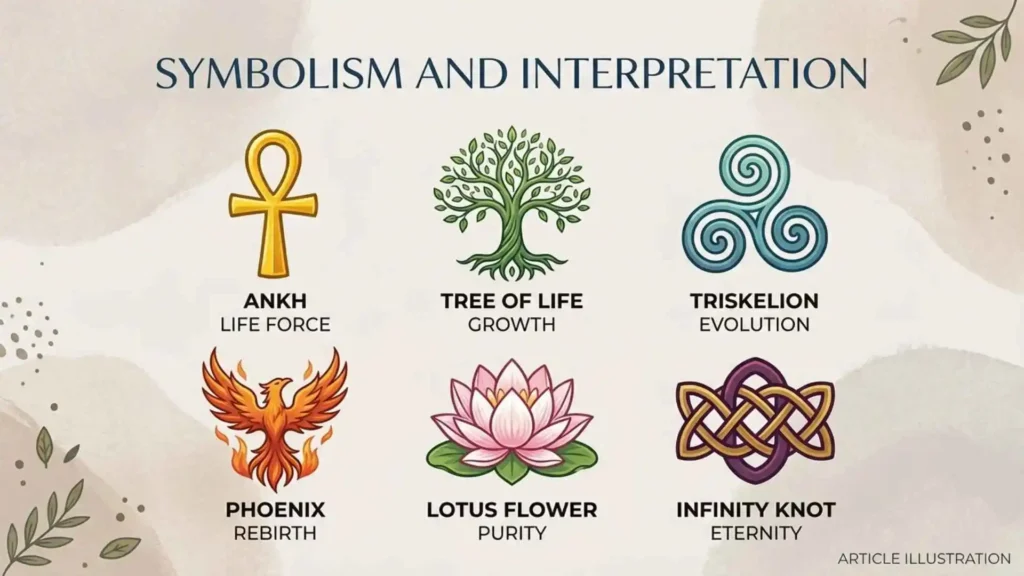
Celtic pagan symbols commonly express relationships rather than fixed dictionary definitions.
Cycles and Movement
Spirals, wheels, and rotating triple forms visually communicate movement. Modern interpretations connect this movement to seasons, aging, death, regeneration, and spiritual development.
Sacred Threes
Threefold patterns are especially prominent in modern Celtic symbolism. Triads also appear frequently in medieval Celtic literature, where ideas are organized into groups of three.
However, the presence of three elements does not prove that every ancient triskele had the same sacred meaning.
Nature and Place
Trees, rivers, wells, animals, mountains, and boundaries were central to Celtic religious landscapes. Spiritual power often belonged to a specific place rather than to a symbol that could be used everywhere.
This helps explain why modern nature-based interpretations feel culturally appropriate, even when their exact wording is new.
Protection and Identity
Jewelry, weapons, shields, brooches, standards, and household items could display signs of rank, belonging, prestige, or spiritual protection.
A design could be beautiful, socially meaningful, and religious at the same time. Modern categories such as “art,” “religion,” and “status symbol” do not always separate cleanly in ancient objects.
Positive and Negative Meanings
Many Celtic symbols contain both constructive and threatening qualities.
The raven may represent insight but also death. The boar suggests abundance but also violence. The spiral can symbolize growth or the unavoidable movement toward decline. The Otherworld can offer wisdom, yet stories also portray it as dangerous and unpredictable.
This duality reflects a worldview in which sacred power is not automatically gentle.
Cultural and Regional Significance
Celtic symbolism differs across Ireland, Scotland, Wales, Cornwall, Brittany, the Isle of Man, ancient Gaul, and other regions.
Irish traditions preserve extensive medieval literature about deities, heroes, kingship, sacred landscapes, and the Otherworld. Welsh literature contains its own mythic figures and narrative patterns. Continental Celtic religion is known largely through archaeology, inscriptions, coins, sculpture, and Greek or Roman accounts.
These sources should not be blended carelessly. A symbol associated with an Irish goddess should not automatically be assigned to every Celtic people. Likewise, Scottish tartan culture, Welsh Druidic revival imagery, Breton crosses, and ancient Gaulish religious art come from different historical settings.
The word “Celtic” remains useful, but it describes a family of languages and related cultural traditions rather than one unchanged civilization.
Religious and Spiritual Meaning
In ancient settings, symbols may have helped communicate divine presence, ritual identity, protection, status, or cosmological relationships. Yet early Celtic religions left no single sacred book explaining every design.
Classical authors describe Druids as religious specialists, judges, teachers, and ritual authorities. Their teachings were said to rely heavily on memory and oral instruction, which limits what can be reconstructed with certainty today.
Modern spiritual uses include:
- Marking seasonal festivals
- Honoring deities or ancestors
- Decorating altars
- Creating protective charms
- Supporting meditation
- Expressing cultural heritage
- Representing vows or personal values
- Connecting spirituality with nature
Practitioners should distinguish personal meaning from documented ancient meaning. A symbol can be spiritually powerful today without needing an invented historical claim.
Where Celtic Pagan Symbols Are Used
Jewelry
Triskeles, spirals, torcs, trees, ravens, and knotwork appear on pendants, rings, bracelets, brooches, and earrings. Jewelry makes the symbol portable and personal.
Tattoos
Popular tattoo designs include the triskele, tree, spiral, raven, stag, boar, Awen, and combinations of knots with animals.
Before choosing a tattoo, the wearer should research whether the design is archaeological, medieval Christian, modern Druidic, or entirely contemporary.
Altars and Ritual Tools
Modern Pagans place symbols on altar cloths, candles, bowls, staffs, drums, divination tools, and seasonal decorations.
Art and Architecture
Celtic-style curves, interlace, animals, and spirals appear in sculpture, illustration, memorials, garden art, churches, and public monuments.
Literature and Entertainment
Fantasy novels, games, films, and television frequently use “Celtic” imagery to suggest magic, forests, ancient wisdom, or warrior cultures. These uses often combine authentic motifs with fictional inventions.
Logos and Branding
Businesses, sports organizations, heritage groups, and tourism projects use knots, triskeles, trees, and spirals to communicate endurance, unity, regional identity, or tradition.
Common Variations and Similar Designs
Three-Legged and Triple-Spiral Triskeles
Some triskeles use human legs, while others use curved arms or spirals. Similar structures occur in Greek, Sicilian, Manx, and other traditions.
Closed and Open Spirals
Some spiral patterns end clearly, while others merge into continuous interlace. Their visual effect may change from growth and direction to continuity and enclosure.
Knotwork
Knot designs range from simple loops to complex animal interlace. Most intricate surviving forms are associated with early medieval Christian art.
Tree Designs
Modern Tree of Life symbols may use knots, circles, exposed roots, seasonal leaves, or animal figures. These variations usually reflect recent artistic or spiritual preferences.
Solar Crosses
A cross within a circle may be called a sun cross, wheel cross, solar wheel, or Celtic cross depending on context. These terms should not be treated as interchangeable without examining the period and design.
Common Misconceptions
Every Celtic Symbol Has a Fixed Meaning
Most do not. Museums and archaeologists can identify recurring designs, but exact ancient meanings are often lost.
Newgrange Was Built by Celtic Druids
Newgrange predates the Iron Age and historical Druids by thousands of years. Later Celtic communities may have known or reused ancient monuments, but they did not build the original passage tomb.
Celtic Knots Were Universal Pagan Protection Signs
Elaborate knotwork is especially associated with medieval Insular Christian art. Modern protective interpretations are meaningful but not always ancient.
Awen Is an Ancient Iron Age Symbol
The Awen emblem belongs to modern Welsh Druidic revival history, although the Welsh word and concept of poetic inspiration have deeper linguistic and literary roots.
The Green Man Was a Standard Celtic God
The leafy face called the Green Man appears widely in medieval European architecture. Its name and modern Pagan interpretation are relatively recent. There is no solid evidence that every leafy head represents one ancient Celtic deity.
Every Triple Symbol Represents a Triple Goddess
Some modern Pagans interpret triple forms through the Maiden, Mother, and Crone model. That framework is influential today, but it is not a proven universal doctrine of ancient Celtic religions.
Clockwise and Counterclockwise Spirals Had One Universal Code
Direction may matter in particular designs or modern rituals, but no complete ancient Celtic rulebook survives.
Interesting Facts About Celtic Pagan Symbols
- The oldest famous “Celtic” spiral monuments are not Celtic in date. Newgrange demonstrates how modern cultural identity can adopt much older regional heritage.
- The triskele crossed many cultures. Threefold rotating designs appeared in prehistoric Europe, Greek art, Iron Age Celtic decoration, and later heraldry.
- Celtic artists favored transformation. A plant curve may become an animal head, while a face can emerge only when the object is viewed from a particular angle.
- Symbols often appeared on functional objects. Bowls, strainers, horse equipment, shields, and mirrors carried complex designs, showing that sacred or prestigious imagery was part of material life. A Late Iron Age strainer from Wales, for example, contains a perforated triskele pattern.
- Ancient symbolism was not necessarily readable to everyone. Certain forms may have communicated rank, ritual knowledge, group identity, or divine associations understood only within particular communities.
- Movement is a defining artistic quality. Even stationary metalwork can appear to rotate, unfold, or change shape.
- Animals were rarely simple decorations. Boars, birds, horses, stags, snakes, and bulls could communicate power, divine presence, status, danger, or mythic identity.
- Modern symbolism often joins separate historical periods. A contemporary pendant may combine a prehistoric triskele, medieval knotwork, and a modern Pagan moon motif.
- The absence of written explanations matters. Early Celtic peoples rarely recorded their religious beliefs in their own surviving texts, so archaeological context is essential.
- Uncertainty can be historically valuable. Rather than treating an unknown meaning as a failure, scholars use location, material, wear, burial context, and comparison to understand how an object functioned.
Related Symbols
Celtic Cross
The Celtic cross combines a Christian cross with a ring. It belongs mainly to Christian art and monuments, although the circle may resemble earlier wheel imagery.
Triquetra
The triquetra consists of three connected arcs. It appears in medieval art and is now widely used for unity, eternity, protection, or threefold spiritual concepts.
Ogham
Ogham is an early medieval alphabet used mainly for inscriptions in the Irish linguistic world. It is a writing system, not a single magical symbol, though modern Pagans may use individual letters symbolically.
Labyrinth
The labyrinth represents a journey toward and away from a center. It appears in many cultures and is not uniquely Celtic.
Valknut
The Valknut is associated with Norse archaeological contexts, not Celtic religion. It is frequently confused with Celtic knotwork because both use interlocking geometry.
Pentacle
The pentacle has a long history in Western esotericism and modern Paganism, but it is not specifically an ancient Celtic emblem.
Frequently Asked Questions
What are the most important Celtic pagan symbols?
The most widely recognized examples are the triskele, spiral, sacred tree, solar wheel, torc, raven, stag, boar, oak, and modern Awen emblem. Their importance differs by historical period and spiritual tradition. Some are supported by Iron Age artifacts, while others developed through medieval art, folklore, or modern Pagan revival movements.
What is the main Celtic symbol for protection?
No single historically documented symbol served as the universal Celtic sign of protection. Modern people use knots, triskeles, Brigid’s crosses, rowan imagery, shields, and protective animals. Historically, protection could also come from ritual actions, sacred objects, spoken formulas, offerings, amulets, or relationships with particular deities and places.
What does the Celtic triskele symbolize?
The triskele is commonly associated with movement, cycles, progress, and threefold relationships. Popular interpretations include life, death, and rebirth or land, sea, and sky. Archaeologists recognize it as an important Iron Age design, but no surviving ancient text provides one definitive meaning that applied everywhere.
Are Celtic knots pagan?
Most elaborate Celtic knot patterns are best known from early medieval Christian manuscripts, stone crosses, and metalwork. Their artistic roots may draw from older interlace and curving traditions, but calling every knot an ancient Pagan emblem is inaccurate. Modern Pagans often use knots to represent eternity, connection, ancestry, or spiritual continuity.
Is the Tree of Life an authentic Celtic pagan symbol?
Trees were unquestionably important in Celtic landscapes, law, stories, and religion. However, the familiar circular design with mirrored roots and branches is largely modern. It expresses ideas consistent with nature-based spirituality, but it should not be presented as a standardized ancient symbol used identically by all Celtic peoples.
Did Druids use written symbols?
Classical writers stated that Druids relied heavily on oral teaching, although Celtic communities used writing for some practical and commemorative purposes. Ogham inscriptions appeared later, especially in Ireland and western Britain. No complete, reliably ancient Druidic symbol chart or magical alphabet has survived.
What Celtic symbol represents family?
The modern Tree of Life is frequently used to represent family roots, ancestry, growth, and future generations. Knotwork is also popular because connected lines suggest enduring relationships. These are modern symbolic choices rather than proof that ancient Celtic societies used one official family emblem.
What Celtic symbol represents strength?
The oak, boar, stag, bull, torc, shield, and certain warrior images can all represent strength. Each emphasizes a different kind of power: the oak suggests endurance, the boar ferocity, the stag vitality, and the torc authority or elite status. Context determines which symbol is most appropriate.
Can anyone wear Celtic pagan symbols?
People can generally wear Celtic-inspired symbols respectfully, especially when they understand the design’s history. Avoid claiming invented ancient meanings or using living cultural traditions carelessly. Research whether the image is prehistoric, Celtic, Christian, modern Druidic, or fictional before presenting it as historically authentic.
Are Celtic pagan symbols still used in religion today?
Yes. Modern Druids, Celtic reconstructionists, Wiccans, eclectic Pagans, and nature-centered spiritual communities use them in jewelry, rituals, altars, meditation, art, and seasonal celebrations. Contemporary meanings vary widely, and responsible practitioners usually distinguish modern spiritual interpretation from historically verified ancient usage.
Key Takeaways
- Celtic pagan symbols come from several periods, including prehistory, the Iron Age, medieval Christianity, folklore, and modern Pagan revival.
- No universal ancient Celtic symbol dictionary survives.
- The triskele, spiral, wheel, tree, torc, raven, stag, boar, and oak are among the most significant designs and images.
- Exact meanings should be based on archaeological and literary context.
- Newgrange spirals are prehistoric and much older than Iron Age Celtic culture.
- Celtic knots are strongly associated with medieval Christian art.
- Awen is a modern Druidic emblem, not an Iron Age artifact.
- Modern interpretations can be spiritually meaningful without being falsely presented as ancient facts.
- Regional Irish, Welsh, Scottish, British, and Continental traditions should not be treated as identical.
- The strongest recurring themes are movement, nature, sacred relationships, identity, power, ancestry, and transformation.
Conclusion
Celtic pagan symbols offer a powerful visual connection to ancient art, sacred landscapes, mythology, cultural memory, and modern spirituality. Their spirals, animals, trees, wheels, and flowing patterns continue to inspire because they express relationships that still matter: life and death, humanity and nature, past and present, order and mystery.
Their history also calls for care. Some symbols are genuinely rooted in Iron Age Celtic art, some come from much older monuments, and others were shaped by medieval Christianity or modern Druidic movements. Recognizing these differences allows Celtic pagan symbols to be appreciated with both spiritual openness and historical honesty.
I am Daniel Brooks, a language researcher and writer with a strong interest in how people use English in everyday conversations. I contribute to LearnNestly because I enjoy turning confusing language topics into straightforward lessons. My goal is to help readers understand not only what a word or phrase means, but also when and how to use it naturally. I focus on clear examples, practical explanations, and useful language knowledge that readers can remember.
Books:
- The Practical English Guide
- Understanding Everyday Words
 Ethan Mitchell
 Amelia Carter