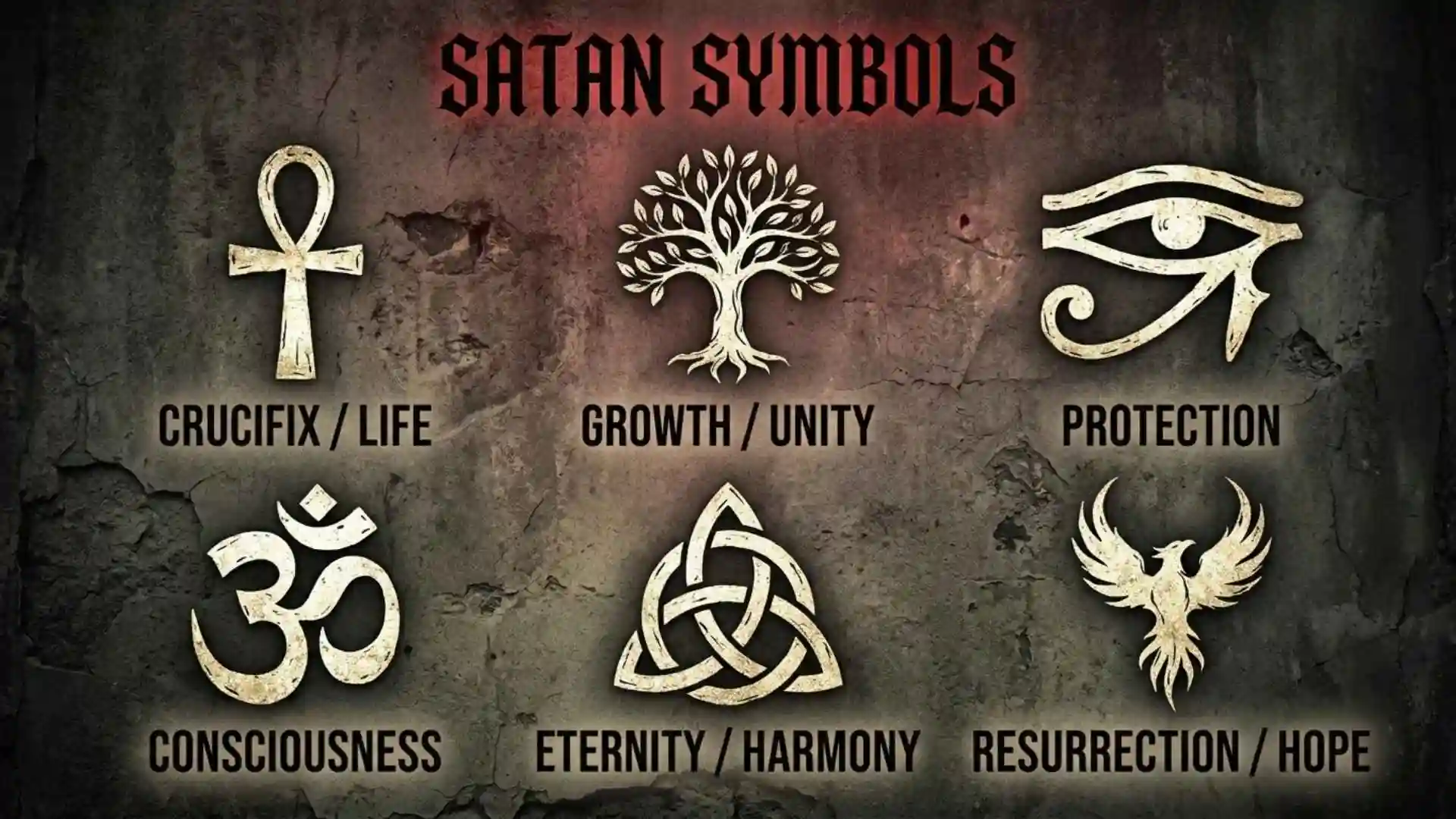
Satan symbols have fascinated, frightened, and puzzled people for centuries. From the famous inverted pentagram and Baphomet to the Sigil of Lucifer and the number 666, these symbols appear in religious texts, historical artwork, popular culture, music, films, and modern spiritual movements. While they are often associated with evil, rebellion, or darkness, their meanings can vary significantly depending on the historical period, religious tradition, and people who use them.
The origins of Satan-related symbols are more complex than many people realize. Some images developed from ancient religious beliefs, while others became associated with Satan through medieval Christian interpretations, Renaissance occult traditions, or modern movements such as Satanism. For example, the pentagram has appeared in different cultures with meanings linked to protection, balance, and spirituality, while its inverted form later became associated with Satanic imagery in certain contexts. A symbol’s meaning depends on its history, design, and cultural context, rather than appearance alone.
In this complete guide to Satan symbols and their meanings, you will discover the history, origins, religious associations, and modern interpretations of the most recognizable emblems linked to Satan. You will also learn how symbols such as the inverted pentagram, Baphomet, the Sigil of Lucifer, and 666 became connected with Satanic imagery. By exploring historical evidence and common misconceptions, you can better understand the difference between traditional religious symbolism, occult practices, modern Satanism, and fictional portrayals in popular culture.
Quick Meaning
Satan symbols generally represent rebellion against religious authority, individualism, earthly existence, forbidden knowledge, temptation, or opposition to Christianity. Their meanings depend heavily on context. The Sigil of Baphomet is a recognized symbol of modern Satanism, while inverted crosses, serpents, pentagrams, and the number 666 have broader histories and are not automatically Satanic.
Satan Symbols Overview Table
| Field | Details |
| General name | Satan symbols or Satanic symbols |
| Best-known symbol | Sigil of Baphomet |
| Primary meanings | Rebellion, individualism, inversion, material existence, temptation, opposition, or personal freedom |
| Main categories | Religious, philosophical, occult, artistic, literary, and popular-cultural |
| Historical roots | Biblical imagery, medieval Christian art, ceremonial magic, folklore, and modern religious movements |
| Modern development | Especially influential after the founding of the Church of Satan in 1966 |
| Common uses | Religious identification, artwork, jewelry, tattoos, music, film, literature, fashion, and protest imagery |
| Important distinction | A symbol’s meaning depends on its design, history, user, and setting |
| Pentagram Unicode | ⛤ U+26E4 |
| Inverted pentagram Unicode | ⛧ U+26E7 |
| Related figures | Satan, Lucifer, Baphomet, Leviathan, the serpent, and the goat |
| Commonly confused symbols | Pentacle, Cross of Saint Peter, hexagram, occult sigils, and heavy-metal imagery |
Unicode officially lists separate characters for the upright pentagram and inverted pentagram, although their appearance can vary by font and device.
What Do Satan Symbols Mean?
Satan symbols do not have one universal meaning. Their interpretation depends on who displays them and why.
In traditional Christianity, Satan represents the spiritual adversary, temptation, deception, pride, and rebellion against God. Symbols connected with Satan may therefore communicate danger, sin, disorder, or spiritual opposition.
In modern non-theistic Satanism, Satan is often treated as a literary or philosophical symbol rather than a literal supernatural being. In that setting, Satan may represent independence, skepticism, self-determination, resistance to imposed authority, or acceptance of human nature.
In films, novels, video games, and album artwork, Satanic-looking signs often function as visual shortcuts for fear, secrecy, supernatural danger, rebellion, or forbidden power. These fictional uses may combine unrelated symbols without respecting their historical meanings.
The most important rule is simple: identify the exact symbol and examine its context before deciding what it means.
History and Origin of Satan Symbols
Biblical and Early Christian Foundations
The Hebrew Bible does not present one standardized graphic sign for Satan. The Hebrew word satan can mean an adversary, opponent, or accuser. Later Jewish and Christian traditions developed more detailed ideas about a personal spiritual enemy.
Early Christians also did not use a single official “Satan symbol.” Instead, Christian scripture and art connected evil with figures such as the serpent, dragon, tempter, beast, and fallen angel.
The serpent in the Book of Genesis became closely associated with temptation in later Christian interpretation. The Book of Revelation identifies the great dragon with “the ancient serpent,” the Devil, and Satan. These connections shaped medieval and modern religious imagery.
Medieval Christian Art
During the Middle Ages, European artists developed recognizable visual features for the Devil. Satan was frequently shown with horns, animal feet, wings, claws, a tail, or a distorted human body.
These features came from several sources rather than one biblical description. Artists borrowed imagery from classical nature deities, animals associated with wilderness, Christian teachings about spiritual corruption, and local folklore.
The medieval Devil was designed to appear disorderly and unnatural. His mixed body communicated the belief that evil disrupted the proper order of creation.
Ceremonial Magic and Occult Texts
Renaissance and early modern occult traditions used complex diagrams, planetary signs, divine names, seals, and protective circles. Many such symbols were intended to command, restrain, or defend against spirits rather than worship Satan.
Later popular culture frequently labeled almost any magical diagram “Satanic.” This created lasting confusion between Satanism, ceremonial magic, astrology, alchemy, witchcraft, and esoteric religious traditions.
The Nineteenth-Century Baphomet Image
One of the most influential occult images was created by French writer Éliphas Lévi in the nineteenth century. His famous Baphomet illustration showed a winged, goat-headed figure with human and animal traits.
Lévi’s figure was intended to express paired opposites, including light and darkness, male and female, above and below, and spiritual and material existence. It was not originally designed as the official emblem of a Satanist organization.
Over time, audiences increasingly connected Baphomet with the Devil because of the goat’s head, horns, occult setting, and later use by Satanist groups.
Modern Satanism
Anton LaVey founded the Church of Satan in San Francisco in 1966. The organization adopted the goat-headed inverted pentagram that became known as the Sigil of Baphomet.
An early version appeared on the Church of Satan’s The Satanic Mass recording in 1968 and on The Satanic Bible in 1969. The image later became the organization’s official insignia.
The modern emblem did not appear from nowhere. Its design developed from earlier occult illustrations and printed works. The Church of Satan’s specific version helped turn it into the most internationally recognizable symbol of organized Satanism.
Major Satan Symbols and Their Interpretations
The Sigil of Baphomet
The Sigil of Baphomet contains four main elements:
- An inverted five-pointed star
- A goat’s head placed inside the star
- Two surrounding circles
- Five Hebrew letters associated with the name Leviathan
The goat’s horns fill the two upper points, its ears extend toward the side points, and its beard reaches the lower point. This creates a carefully balanced design.
For the Church of Satan, the emblem represents its philosophy and identity. The organization describes it as the visual symbol of its form of Satanism rather than a general sign for every movement using the Satan label.
The Hebrew letters around the design spell Leviathan. In biblical literature, Leviathan is a powerful sea creature associated with chaos and forces opposed by God.
The Inverted Pentagram
An inverted pentagram is a five-pointed star with two points facing upward and one point facing downward.
Modern Satanic interpretation often treats the downward point as a rejection of spiritual authority or as the placement of physical, instinctive, and earthly concerns above conventional spirituality. When combined with a goat’s head, it becomes much more specifically associated with the Sigil of Baphomet.
Yet an inverted pentagram by itself is not always Satanic. Five-pointed stars have appeared in mathematics, architecture, heraldry, protective magic, Christianity, and many other traditions.
Orientation matters, but context matters more.
The Goat or Goat’s Head
The goat became associated with Satan through several overlapping traditions.
In the New Testament’s separation of sheep and goats, sheep represent the righteous while goats represent those condemned. Medieval artists also emphasized horns, hooves, and animal traits when portraying demons.
Goats additionally symbolize untamed nature, fertility, stubbornness, sexual energy, and independence. These meanings made the animal useful to artists and movements interested in challenging religious restraint.
A goat image is therefore not automatically Satanic. Farm emblems, zodiac artwork, mythology, sports mascots, and nature symbolism commonly use goats without any connection to Satan.
Baphomet
Baphomet is often mistaken for an ancient god universally worshiped by Satanists. Historical evidence does not support that simple claim.
The name became famous through accusations directed at the Knights Templar during the fourteenth century. Confessions produced during their persecution included inconsistent claims about mysterious heads, idols, or a figure called Baphomet. Historians treat these statements cautiously because interrogations involved coercion and political pressure.
Éliphas Lévi’s nineteenth-century goat-headed image later gave Baphomet its best-known visual form. Modern groups have interpreted the figure in different ways, including balance, hidden knowledge, freedom, duality, and opposition to religious authority.
The Number 666
The number 666 comes from the Book of Revelation, where it is called the number of the beast. Within its original apocalyptic setting, it is connected with oppressive power, false worship, and resistance to God.
Many scholars interpret the number through ancient letter-number systems and connect it to the Roman emperor Nero, although religious interpretations differ.
Modern culture frequently uses 666 as shorthand for Satan, evil, danger, rebellion, or shock value. Musicians, filmmakers, clothing designers, and social media users may display it for theatrical reasons rather than religious commitment.
It is a biblical symbol associated with the beast, but it is not the official emblem of every Satanist movement.
The Inverted Cross
An upside-down Latin cross is widely viewed in horror films as a rejection or mockery of Christianity. In anti-Christian or deliberately provocative settings, it may be used that way.
However, the same shape is also known as the Cross of Saint Peter. Christian tradition holds that the apostle Peter was crucified upside down, and the inverted cross became an emblem of his humility and martyrdom.
This is one of the clearest examples of why context is essential. An inverted cross in a church dedicated to Saint Peter may have a Christian meaning, while the same image in horror artwork may signal sacrilege or supernatural evil.
The Serpent
The serpent is associated with Satan mainly because of later interpretations of the Genesis temptation story and the imagery of Revelation.
Yet serpents have an unusually wide range of meanings. They can symbolize wisdom, healing, renewal, immortality, fertility, danger, deception, or protection. Their ability to shed their skin made them natural symbols of rebirth in many cultures.
Calling every serpent a Satan symbol ignores its major role in ancient Egyptian, Greek, Mesopotamian, Hindu, Buddhist, Indigenous, medical, and royal traditions.
Leviathan
Leviathan is a sea monster appearing in several books of the Hebrew Bible. It represents overwhelming power, the untamed sea, and forces of chaos that divine authority defeats or controls.
In the Sigil of Baphomet, the name appears in Hebrew letters around the inverted pentagram. This gives the biblical creature a specific place within modern Satanic symbolism.
Outside that emblem, Leviathan also appears in theology, political philosophy, fantasy literature, video games, and sea-monster folklore. Its meaning must therefore be interpreted within the work in which it appears.
The Black Flame
Some Satanist writers and communities use the black flame as a metaphor for consciousness, individuality, intellect, self-awareness, or the inner force that separates a person from unthinking conformity.
Unlike the Sigil of Baphomet, the black flame does not have one universally fixed design. It may appear as a dark fire, a flame inside a circle, or a literary phrase.
Its meaning is mainly philosophical rather than historical or biblical.
Positive and Negative Interpretations
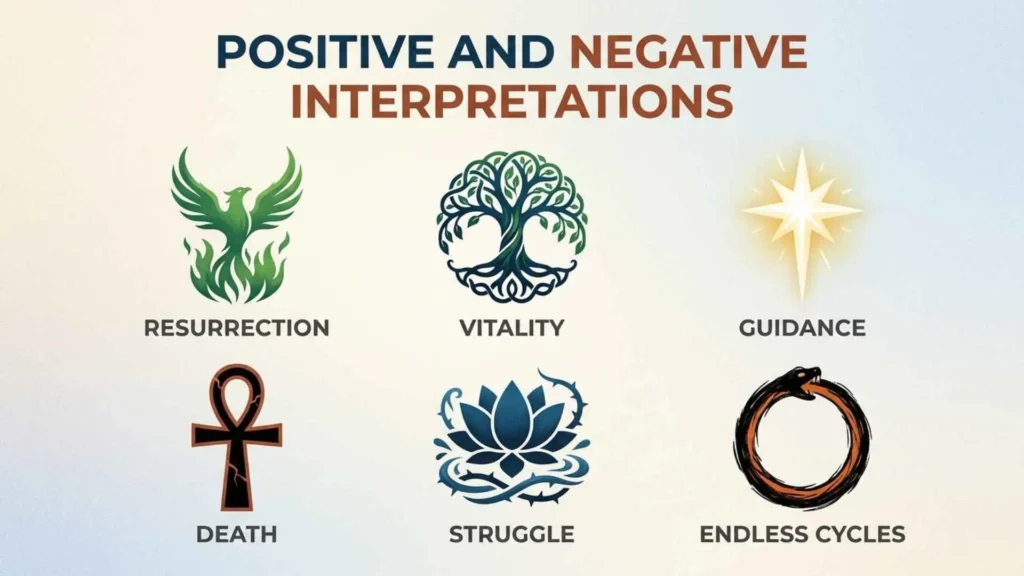
Satan symbols carry sharply different meanings because viewers approach them through different belief systems.
From a traditional Christian perspective, these symbols may represent temptation, pride, deception, spiritual danger, rebellion against God, or the inversion of sacred order.
From the perspective of some modern Satanists, the same imagery may express self-ownership, personal liberty, rational inquiry, resistance to hypocrisy, bodily autonomy, or rejection of supernatural authority.
In psychology and art, Satanic imagery may symbolize the “shadow,” meaning rejected desires, fears, anger, or socially forbidden parts of the personality. This is an interpretation rather than a universal religious teaching.
Negative uses can include deliberate intimidation, vandalism, threats, or attempts to provoke religious communities. Positive interpretations claimed by users may include empowerment, individuality, and freedom from unwanted authority.
Neither interpretation should be assumed without evidence.
Cultural Significance
Christianity
Christian cultures usually understand Satan as the opponent of God and the tempter of humanity. Images linked with Satan therefore tend to carry strongly negative meanings.
Nevertheless, Christian symbolism can overlap with imagery later labeled Satanic. Pentagrams appeared historically in Christian contexts, and the inverted cross can honor Saint Peter.
Judaism
Judaism has its own historical understandings of ha-satan, angels, evil inclinations, demons, and biblical monsters. These ideas should not be treated as identical to later Christian demonology.
Hebrew letters in the Sigil of Baphomet do not make the symbol Jewish. They spell Leviathan and were incorporated into a modern occult and Satanist design.
Islam
Islam recognizes Iblis or al-Shaytan as the being who refused God’s command concerning Adam and became a tempter of human beings. Islamic art generally does not use the Sigil of Baphomet as a traditional religious sign.
Western Satanic imagery may be recognized in Muslim societies through global media, but it does not represent classical Islamic visual tradition.
Western Popular Culture
Horror movies, heavy-metal artwork, Gothic fashion, fantasy games, and television have spread Satanic imagery far beyond formal religious settings.
Entertainment often combines 666, inverted crosses, candles, Latin phrases, pentagrams, and goat imagery to create an immediate atmosphere of danger. These combinations may be historically inaccurate but visually effective.
Regional and Personal Differences
In highly religious communities, wearing an inverted pentagram may be interpreted as a serious declaration against the dominant faith. In less religious settings, the same necklace may be understood as fashion, music fandom, political protest, or personal identity.
The user’s intention and the community’s interpretation may not match.
Religious and Spiritual Meaning
Satanic symbolism does not belong to one unified religion. Organizations and individuals using the Satan label can differ significantly in theology, ethics, rituals, and political priorities.
The Church of Satan promotes an atheistic philosophy in which Satan functions symbolically rather than as a literal deity. Its official Sigil of Baphomet represents that organizational identity.
Other Satanist, Luciferian, occult, and esoteric groups may understand Satan, Lucifer, Baphomet, or related figures differently. Some use them metaphorically, some spiritually, and some as models of enlightenment or rebellion.
It is inaccurate to assume that every person using Satanic imagery believes in or worships a literal Devil.
Digital and Technical Meaning
Pentagrams have official Unicode characters:
- ⛤ — U+26E4, Pentagram
- ⛧ — U+26E7, Inverted Pentagram
These are text symbols, not dedicated emojis on every platform. Their shape and availability depend on the installed font, operating system, and application.
Online, users may place them in usernames, profile biographies, digital art, gaming communities, or religious discussions. Their presence alone does not reveal the user’s exact beliefs.
Where Satan Symbols Are Used
Satan symbols appear in many settings:
Religious Organizations
Formal Satanist groups may display specific emblems on membership materials, websites, altars, publications, and ceremonial objects.
Books and Literature
Authors use Satanic imagery to explore temptation, pride, freedom, evil, social rebellion, forbidden knowledge, and moral conflict.
Film and Television
Directors use pentagrams, goats, and inverted crosses as quick visual signals for occult danger, even when the designs have little historical basis.
Music
Heavy metal, punk, industrial, and other genres may use Satanic imagery to challenge social norms, create a dark aesthetic, criticize organized religion, or attract attention.
Jewelry and Fashion
Rings, pendants, shirts, patches, and accessories may express religious identity, alternative fashion, artistic taste, or rebellion.
Tattoos
A Satanic tattoo can represent commitment to a philosophy, independence, survival, anger at religious authority, or simply admiration for dark artwork. Its meaning should come from the wearer.
Art and Protest
Artists use Satan as a symbol of the outsider, rebel, forbidden thinker, or opponent of authoritarian power. Protesters may use Satanic imagery to defend secularism or deliberately expose unequal treatment of religions.
Common Variations and Similar Symbols
Pentagram and Pentacle
A pentagram is a five-pointed star. A pentacle is commonly a pentagram enclosed within a circle, although historical terminology varies.
Upright versions are widely used in modern Paganism and Wicca, often representing the elements, balance, protection, or nature. They should not automatically be labeled Satanic.
Goat Pentagram Variations
Some designs simplify the Sigil of Baphomet by removing the Hebrew letters or outer circle. Others change the goat’s expression, line thickness, or decorative details.
A similar appearance does not necessarily mean that a design is the Church of Satan’s official version.
Lucifer Sigils
Several modern occult signs are called sigils of Lucifer. Their designs and claimed histories vary. They are connected more specifically with Luciferian or ceremonial traditions than with the Sigil of Baphomet.
Inverted Cross Designs
The cross may appear plain, broken, decorated, or combined with flames and pentagrams. Additional imagery usually determines whether it represents Saint Peter, anti-Christian protest, horror, or artistic rebellion.
Common Misconceptions About Satan Symbols
“Every Pentagram Is Satanic”
False. Pentagrams have appeared in religious, mathematical, magical, architectural, military, and decorative contexts for centuries.
“Baphomet Is an Ancient Satanic God”
This is misleading. The name has medieval roots, but the familiar goat-headed image comes mainly from Éliphas Lévi’s nineteenth-century work.
“The Inverted Cross Always Insults Christianity”
False. It can represent Saint Peter and Christian martyrdom.
“Anyone Wearing 666 Worships the Devil”
Not necessarily. The number may indicate music fandom, humor, fictional interests, rebellion, or an attempt to provoke a reaction.
“Satanism and Witchcraft Are the Same”
They are not. Witchcraft can describe a spiritual practice, folk tradition, magical technique, or modern religion. Many witches do not believe in Satan, and many Satanists do not practice witchcraft.
“All Satanists Believe in a Literal Satan”
False. Some modern Satanist traditions are non-theistic and use Satan as a symbol.
“Occult Means Satanic”
Occult broadly refers to hidden, esoteric, or specialized knowledge. Astrology, alchemy, ceremonial magic, mysticism, and divination may be called occult without being Satanic.
Interesting Facts About Satan Symbols
- The most recognizable modern Satanic emblem is relatively recent.
The Church of Satan popularized its specific Sigil of Baphomet during the late 1960s rather than inheriting an unchanged emblem from antiquity. - The Sigil of Baphomet contains Hebrew letters.
The letters spell Leviathan, connecting the emblem with a biblical symbol of powerful chaos. - The upright pentagram once appeared in Christian symbolism.
It has been connected with the five wounds of Christ and other Christian interpretations, showing how dramatically meanings can change. - An upside-down cross can be Christian.
The Cross of Saint Peter represents the apostle’s traditional upside-down crucifixion. - Baphomet and Satan are not historically identical figures.
Their association developed through occult literature, religious controversy, and modern popular culture. - Goat imagery combines several traditions.
Biblical interpretation, medieval demon art, rural symbolism, and ideas about untamed nature all contributed to its modern meaning. - Hollywood created many false “ancient” symbols.
Films often invent diagrams or combine unrelated alphabets and signs because visual drama matters more than historical accuracy. - Pentagrams have dedicated Unicode characters.
Digital text can represent upright and inverted pentagrams without using image files. - Symbol orientation does not settle meaning by itself.
A star’s direction is important, but surrounding images, text, location, and user intention are often more decisive. - Satanic imagery can be religious or secular.
The same design may function as a faith symbol, philosophical statement, political protest, fashion accessory, or fictional device.
Related Symbols
Pentacle
A five-pointed star inside a circle, commonly associated with modern Paganism, Wicca, elemental balance, and protection rather than Satanism.
Cross of Saint Peter
An inverted Christian cross linked to Peter’s martyrdom. It resembles an anti-Christian inverted cross but has a very different traditional meaning.
Hexagram
A six-pointed star formed from two triangles. It appears in Jewish identity, ceremonial magic, Islamic art, and other traditions. It should not be confused with the pentagram.
Ouroboros
A serpent eating its own tail. It usually represents eternity, cycles, renewal, self-containment, or transformation rather than Satan.
Leviathan Cross
A modern occult symbol combining a double cross with an infinity-like form. It is sometimes associated with Satanism, sulfur, or alchemical imagery, though interpretations vary.
Sigils of Lucifer
Occult emblems associated with Luciferian traditions. They differ visually and historically from the Church of Satan’s Sigil of Baphomet.
Frequently Asked Questions
What is the main symbol of Satan?
The most widely recognized modern Satanic symbol is the Sigil of Baphomet. It shows a goat’s head inside an inverted pentagram, surrounded by two circles and Hebrew letters spelling Leviathan. It is especially associated with the Church of Satan and should not be confused with every pentagram or goat design.
Is a pentagram always a Satan symbol?
No. Pentagrams have appeared in Christianity, ceremonial magic, mathematics, architecture, heraldry, modern Paganism, and decorative art. An inverted pentagram containing a goat’s head has a clearer connection to modern Satanism, but even then the complete context should be considered before assigning a meaning.
What does the goat represent in Satanic symbolism?
The goat can represent instinct, earthly existence, independence, untamed nature, sexuality, or opposition to conventional religious restraint. Its association with Satan also developed through Christian sheep-and-goat imagery and medieval depictions of demons with horns and hooves.
Is Baphomet another name for Satan?
Not exactly. Baphomet has a separate and complicated history involving medieval accusations against the Knights Templar and Éliphas Lévi’s nineteenth-century occult illustration. Modern culture often treats Baphomet as Satanic, but the two figures were not originally identical.
What does an upside-down cross mean?
An upside-down cross can represent anti-Christian rebellion in horror or provocative artwork. It can also be the Cross of Saint Peter, a traditional Christian emblem associated with the apostle’s upside-down crucifixion. Its meaning depends on its setting, accompanying imagery, and the intention of the person using it.
Why is 666 associated with Satan?
The number 666 appears in the Book of Revelation as the number of the beast. Christian tradition connected the beast with opposition to God, persecution, and evil power. Modern entertainment later turned 666 into a general visual code for Satan, danger, rebellion, and supernatural horror.
Do Satanists worship the Devil?
Some individuals may hold theistic beliefs, but many modern Satanists do not worship or believe in a literal Devil. Non-theistic movements use Satan symbolically to represent individualism, skepticism, autonomy, resistance, or human nature. Different organizations should not be treated as if they share one theology.
Are Satan symbols dangerous?
A printed or worn symbol has no proven physical power by itself. However, symbols can affect people socially and emotionally. They may express identity, provoke fear, offend religious communities, or communicate threats when used in an intimidating context. Meaning and risk depend on behavior, intention, and circumstances.
What should I do if I find a Satanic-looking symbol?
First, avoid making immediate assumptions. Photograph or document it if it appears on your property, and examine whether it is graffiti, art, a religious sign, or a fictional design. Report it to property owners or authorities only when it accompanies threats, vandalism, trespassing, harassment, or other harmful conduct.
Can someone wear Satanic symbols only for fashion?
Yes. Some people wear pentagrams, goat imagery, inverted crosses, or 666 because they enjoy Gothic fashion, metal music, horror films, or provocative art. Others use the same symbols as sincere religious or philosophical identifiers. Appearance alone cannot reveal a person’s exact beliefs or character.
Key Takeaways
- Satan symbols have no single meaning that applies in every context.
- The Sigil of Baphomet is the best-known emblem of modern Satanism.
- A plain pentagram is not automatically Satanic.
- Baphomet’s familiar goat-headed form developed mainly in the nineteenth century.
- The inverted cross can represent either anti-Christian imagery or Saint Peter.
- The number 666 comes from the Book of Revelation.
- Serpents, goats, and stars have meanings far beyond Satanism.
- Many modern Satanists use Satan metaphorically rather than worshiping a literal Devil.
- Films and music often combine unrelated symbols for dramatic effect.
- Accurate interpretation requires attention to design, history, location, and user intent.
Conclusion
Satan symbols are best understood as a diverse group of religious, philosophical, artistic, and cultural signs rather than a single secret visual language. The Sigil of Baphomet has a clear place in modern Satanism, but many related images, including pentagrams, serpents, goats, inverted crosses, and 666, possess much broader histories.
Their meanings have changed as biblical interpretation, medieval art, occult literature, organized Satanism, music, fashion, and film reshaped them. Studying those layers prevents fear-based assumptions and reveals how societies use symbols to express evil, rebellion, individuality, temptation, freedom, and opposition. When interpreting satan symbols, context remains more reliable than appearance alone.

I am Ethan Mitchell, an English writer and lifelong learner who is fascinated by words and the way language changes over time. At LearnNestly, I share practical explanations designed for readers who want to improve their understanding of English without complicated terminology. I enjoy researching meanings, usage, grammar, and common language mistakes, then presenting the information in a simple and useful format. My purpose is to make every article a small learning experience that readers can actually apply.
Books:
- The Smart Learner’s English Guide
- English in Real Life
 Daniel Brooks
 Amelia Carter