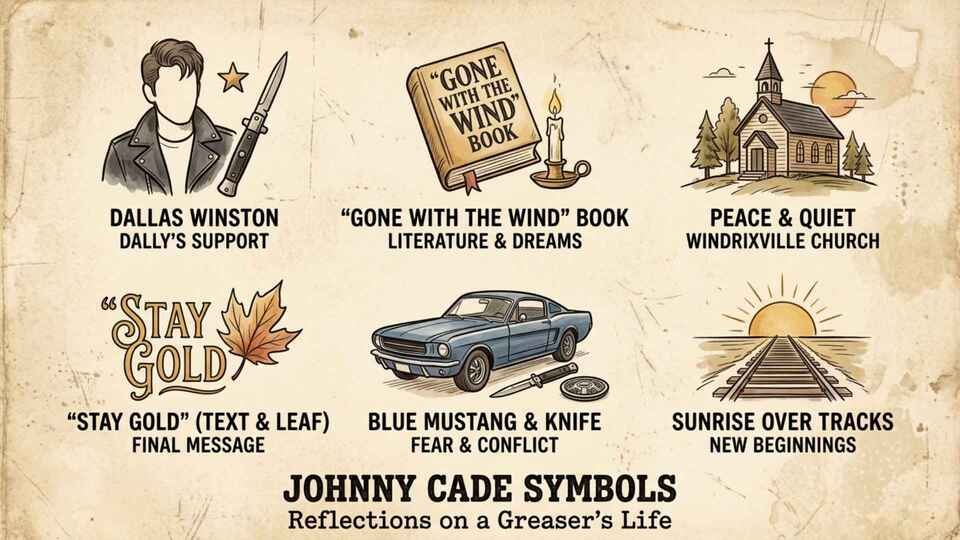
Johnny Cade symbols in The Outsiders reveal the novel’s deepest ideas about innocence, violence, loyalty, courage, and social neglect. Although Johnny is a character rather than a single visual emblem, S. E. Hinton connects him with recurring objects and images, including the switchblade, the burning church, cut hair, sunsets, gold, Gone with the Wind, and his final letter.
These symbols matter because they show that Johnny is more than a frightened Greaser. His choices expose the difference between a person’s public label and private character.
Society sees him as a delinquent, but the story gradually reveals a sensitive, selfless teenager who risks everything to protect others.
Quick Meaning of Johnny Cade Symbols
Johnny Cade primarily symbolizes lost innocence, abused youth, quiet courage, and the human cost of violence. His switchblade represents fear and self-defense, while the burning church reveals sacrifice and heroism. Gold, sunsets, and his final message connect him with beauty, hope, and the need to protect innocence before it disappears.
Johnny Cade Symbol Overview
| Symbol or Image | Primary Meaning | Connection to Johnny | Role in the Novel |
| Johnny Cade himself | Abused and neglected youth | His home and social environment fail to protect him | Humanizes young people labeled as delinquents |
| Switchblade | Fear, defense, and destructive violence | Johnny carries it after being attacked by the Socs | Saves Ponyboy but causes Bob’s death |
| Scars and fearful eyes | Lasting trauma | His appearance reflects previous abuse | Shows that violence leaves emotional as well as physical wounds |
| Greaser hair | Identity and belonging | His hair connects him to the Greaser group | Cutting it represents lost identity and forced change |
| Abandoned church | Refuge, moral testing, and transformation | Johnny hides there and later enters it to save children | Changes him from fugitive to recognized hero |
| Fire | Destruction, sacrifice, and revelation | Johnny is critically injured during the rescue | Reveals his true courage while destroying his future |
| Children in the church | Innocence and vulnerability | Johnny risks his life to save them | Mirrors the protection Johnny never received |
| Gone with the Wind | Courage, honor, and imagined heroism | Johnny admires the Southern gentlemen in the novel | Helps him understand bravery and sacrifice |
| Sunrise and sunset | Shared beauty and common humanity | Johnny and Ponyboy respond deeply to nature | Shows that social divisions cannot erase human connection |
| Gold | Innocence, wonder, and goodness | Johnny interprets Robert Frost’s poem for Ponyboy | Becomes the basis of his final advice |
| Hospital bed | Consequences and powerlessness | Johnny cannot escape the results of violence | Shows the physical cost of the gang conflict |
| Final letter | Legacy, hope, and moral guidance | Johnny explains what he learned before dying | Encourages Ponyboy to preserve his sensitivity |
What Do Johnny Cade Symbols Mean?
Johnny Cade symbols show how a vulnerable person can contain fear, goodness, anger, and courage at the same time. Johnny is not presented as naturally violent. His violence develops within a world of parental abuse, gang rivalry, poverty, and repeated danger.
At the beginning of the novel, Johnny appears nervous and physically small. He expects harm because harm has become normal in his life. His parents mistreat or neglect him, and a previous attack by the Socs has left him deeply frightened. The Greasers become his chosen family because they offer the protection he cannot find at home.
This background gives Johnny’s symbols two sides. The switchblade can protect life or take it. The church can hide fugitives or reveal heroes. Fire can destroy a body while exposing a person’s moral strength. Gold can fade, yet the desire to preserve goodness can survive.
Johnny therefore represents contradiction. He is both a victim and a killer, a fugitive and a rescuer, a frightened boy and a courageous hero. Hinton uses these tensions to challenge simple labels such as “good kid,” “bad kid,” “Greaser,” and “Soc.”
History and Literary Origin of Johnny Cade’s Symbolism
Johnny Cade first appeared in S. E. Hinton’s 1967 novel The Outsiders. The story follows teenagers divided mainly into two social groups: the working-class Greasers and the wealthier Socs, short for Socials. Johnny belongs to the Greasers, but his personal situation makes him especially vulnerable.
His symbolism develops through the structure of the plot. Early descriptions establish him as a traumatized teenager who has been harmed at home and attacked by members of the rival group. His fear later shapes his response when Socs confront him and Ponyboy in the park.
When Bob attempts to drown Ponyboy, Johnny uses his switchblade and kills Bob. This event turns Johnny and Ponyboy into fugitives. They hide in an abandoned church, cut their hair, read Gone with the Wind, watch the sunrise, and discuss Robert Frost’s poem “Nothing Gold Can Stay.”
The church later catches fire while children are inside. Johnny and Ponyboy enter the building to rescue them. Johnny suffers devastating injuries when part of the structure falls on him. The rescue transforms the public understanding of the boys: people who were treated as criminals are suddenly praised as heroes.
Johnny’s symbolic development follows a clear path:
Victim → defender → fugitive → rescuer → moral guide
This progression does not erase his mistakes. Instead, it shows that one act cannot fully define a human life.
Johnny Cade as a Symbol of Lost Innocence
Johnny most strongly symbolizes innocence damaged by forces beyond a child’s control. He has not received the safety, affection, or stability that young people need. His nervous behavior reflects a childhood shaped by fear rather than trust.
His innocence is not complete ignorance. Johnny understands violence because he has experienced it. However, he still responds to beauty, stories, friendship, and acts of kindness. That ability to care shows that cruelty has wounded him without completely destroying his goodness.
This interpretation makes Johnny’s life especially tragic. The novel does not present innocence as something that disappears naturally with age. In Johnny’s case, adults, social prejudice, and gang conflict tear it away too soon.
The children trapped in the church strengthen this symbolism. They are physically endangered and need someone to protect them. Johnny becomes the protector he never had. By saving them, he prevents other children from suffering the abandonment and helplessness that shaped his own life.
The Switchblade: Fear, Protection, and Violence
Johnny’s switchblade symbolizes how fear can turn protection into destruction. He begins carrying the weapon after a brutal attack by the Socs. It gives him a sense of control in situations where he otherwise feels powerless.
The knife is therefore not merely a sign of criminal behavior. It represents the defensive habits of a traumatized person. Johnny expects another attack, so he prepares himself for one.
However, the switchblade also shows the danger of relying on violence for safety. When Johnny kills Bob to stop Ponyboy from being drowned, he acts during an immediate crisis. His intervention saves Ponyboy, but it also ends Bob’s life and changes every life connected to the incident.
The knife carries three related meanings:
- Fear: Johnny carries it because he believes violence may return at any moment.
- Power: The weapon allows a physically smaller teenager to resist stronger attackers.
- Irreversible consequences: Once used, it creates damage that cannot be undone.
The switchblade does not prove that Johnny is evil. It shows what can happen when a frightened teenager is left to manage serious danger without dependable adult protection.
Johnny’s Scars and Eyes: The Visible Signs of Trauma
Johnny’s scars and constantly alert expression symbolize trauma that remains after an attack has ended. His body and behavior record what has happened to him.
Other characters can see that Johnny is afraid, but they cannot fully remove that fear. The Greasers protect him and care for him, yet their support cannot repair everything his parents and attackers have damaged.
His appearance also creates a contrast with stereotypical images of toughness. The Greasers value strength, loyalty, and readiness to fight, but Johnny looks fragile and uncertain. His later heroism proves that courage does not always look confident.
Psychologically, Johnny’s watchfulness suggests that he has learned to scan his surroundings for danger. The novel predates much modern public discussion of trauma, but his behavior can be read as the emotional result of repeated abuse and violent victimization.
This does not amount to a medical diagnosis. It is a literary interpretation based on how Johnny reacts to threats, authority, affection, and physical conflict.
Greaser Hair: Identity, Pride, and Forced Change
Long, carefully styled hair functions as a symbol of Greaser identity throughout The Outsiders. For Johnny, it represents belonging to the group that has become his true family.
After Bob’s death, Johnny and Ponyboy cut their hair to disguise themselves. The practical purpose is clear: changing their appearance may help them avoid recognition. Symbolically, however, the haircut removes part of their public identity.
Johnny’s cut hair represents:
- Separation from the Greasers
- Loss of control over his appearance
- The end of his former life
- Movement from ordinary teenager to fugitive
- The unstable nature of social identity
Hair also reveals the power of labels. Before the haircut, strangers can identify the boys as Greasers based largely on appearance. Afterward, the boys remain the same people, but others may see them differently.
The transformation suggests that class identity is partly performed through clothing, hairstyle, speech, neighborhood, and reputation. Changing the surface can alter public judgment even when the person underneath has not changed.
The Abandoned Church: Refuge and Moral Transformation
The abandoned church symbolizes temporary safety, isolation, and spiritual testing. Johnny and Ponyboy first use it as a hiding place after Bob’s death. It shelters them from the police, but it also separates them from their families, friends, and familiar social conflict.
Inside the church, the boys experience a quieter world. They read, talk, smoke, watch the landscape, and think about what has happened. This pause gives Johnny room to reflect rather than simply react.
The building’s religious identity adds another symbolic layer. A church traditionally suggests sanctuary, conscience, sacrifice, forgiveness, and moral responsibility. Yet readers should avoid claiming that Johnny is a direct religious figure or that the novel presents a formal Christian allegory. The text supports broader moral associations more clearly than a specific theological interpretation.
The church changes meaning when it catches fire. It stops being a place where Johnny hides from responsibility and becomes a place where he accepts responsibility for others. He enters the danger voluntarily because children are trapped inside.
The same location therefore represents both escape and moral action. Johnny arrives as a fugitive but leaves as a hero.
Fire: Destruction, Sacrifice, and Revelation
Fire symbolizes destruction, transformation, and the revelation of character. It destroys the boys’ hiding place and causes Johnny’s fatal injuries, but it also exposes the courage that society had failed to see.
Before the rescue, Johnny is known mainly as a Greaser involved in Bob’s death. After he enters the burning building, the public must confront evidence that he is capable of extraordinary selflessness.
The fire does not magically cleanse Johnny of responsibility. Instead, it reveals that a person can commit a terrible act in one situation and perform a heroic act in another. Human character cannot always be reduced to a single moral category.
Fire also transforms Johnny internally. During the rescue, his usual fear does not control him. He acts quickly and focuses on the children rather than himself. The frightened boy becomes decisive when another vulnerable person needs help.
The tragic irony is that Johnny discovers his courage at the moment his future is destroyed. His heroic action gives his life meaning, but the injuries prevent him from building a new life afterward.
The Children: Innocence Johnny Chooses to Protect
The trapped children symbolize unprotected innocence. Their danger reflects Johnny’s own emotional condition: he, too, is young, vulnerable, and dependent on adults who fail to keep him safe.
Johnny’s decision to enter the church can therefore be understood as an act of identification. He does not stop to ask whether the children belong to his neighborhood, social class, or group. Their helplessness is enough.
By protecting them, Johnny breaks the cycle of neglect. He cannot rewrite his own childhood, but he can give other children the rescue he needed.
This makes the scene more than a conventional heroic moment. It reveals Johnny’s core values. Beneath his fear and defensive violence, he possesses a strong instinct to protect innocent life.
The children also challenge the label “juvenile delinquent.” A society that judges Johnny by his class, appearance, and criminal involvement must reconsider that judgment when he sacrifices himself for strangers.
Gone with the Wind: Courage, Honor, and Heroic Identity
The copy of Gone with the Wind symbolizes Johnny’s search for a language of courage. While hiding in the church, Ponyboy reads the novel aloud, and Johnny becomes interested in its heroic figures.
Johnny admires the bravery and dignity he associates with the story’s gentlemen. His response is important because he does not normally view himself as powerful, educated, or heroic. Literature gives him another model of identity.
There is also an intentional gap between romantic heroism and real violence. Stories may make courage appear grand, controlled, and noble. Johnny’s reality is painful, confused, and physically destructive.
Still, the book helps him recognize that heroism can involve sacrifice. When he later enters the church, he performs the kind of courageous act he had admired, but without glamour or reward.
The novel-within-the-novel also connects Johnny to Ponyboy. Reading becomes a form of friendship and education. It allows two frightened teenagers to imagine possibilities beyond gang conflict.
Sunrises, Sunsets, and Shared Humanity

Sunrises and sunsets symbolize beauty that exists beyond social divisions. Johnny and Ponyboy can appreciate the natural world even while living under harsh conditions.
The sunset is especially important throughout The Outsiders because characters from opposite social groups can see the same sky. Cherry and Ponyboy’s discussion of sunsets suggests that Greasers and Socs inhabit different neighborhoods but share basic human experiences.
For Johnny, the sunrise near the church offers a rare moment of peace. Nature does not label him a criminal, judge his family, or rank him according to income. Its beauty is available without social permission.
Sunrise also suggests renewal. Johnny and Ponyboy briefly imagine that life may contain more than violence and fear. However, the moment is temporary, which connects it to the novel’s larger image of fading gold.
These natural images remind readers that sensitivity is not weakness. Johnny and Ponyboy’s ability to notice beauty helps preserve their humanity in a world that repeatedly pressures them to become hard.
Gold and “Stay Gold”: Innocence Worth Protecting
Gold symbolizes innocence, wonder, sensitivity, and the ability to recognize goodness. This meaning develops through Robert Frost’s poem “Nothing Gold Can Stay,” which Ponyboy recites while he and Johnny are hiding.
Johnny later connects the poem with childhood, sunrise, and Ponyboy’s appreciation of beauty. His final advice urges Ponyboy to preserve that part of himself rather than allowing violence and grief to destroy it.
“Stay gold” does not mean remaining childish or refusing to mature. It means protecting qualities that harsh experience often weakens:
- Compassion
- Curiosity
- Emotional openness
- Appreciation of beauty
- Hope
- Moral sensitivity
Johnny knows that innocence cannot remain untouched forever. His own life proves how quickly it can be damaged. Yet he believes a person can choose not to become cruel.
Gold is therefore both temporary and enduring. Youth fades, but the values associated with youth can survive through memory, art, friendship, and conscious choice.
The Hospital Bed: Consequences and Lost Possibility
Johnny’s hospital bed symbolizes physical powerlessness and the final consequences of the novel’s violence. After acting with remarkable courage, he becomes unable to move freely or control what happens to him.
The setting strips away romantic ideas about fighting. Gang violence may be discussed in terms of pride, reputation, revenge, or loyalty, but the hospital shows its material results: pain, disability, fear, grief, and death.
Johnny’s condition also represents lost possibility. He begins to understand that life contains beauty and purpose just as his opportunity to experience more of it disappears.
His fear of dying is important. Johnny is not a fearless martyr who welcomes death. He wants more time. That desire makes his sacrifice more meaningful because he values life and still risks his own to save others.
The hospital also forces the other characters to confront their emotions. Dally, who tries to appear hardened, cannot accept Johnny’s death. Johnny’s suffering exposes the vulnerability hidden beneath the Greasers’ tough behavior.
Johnny’s Final Letter: Voice, Legacy, and Hope
Johnny’s letter symbolizes the survival of his moral influence after his death. While alive, Johnny is often quiet and hesitant. In writing, he expresses his understanding with unusual clarity.
The letter transforms him from someone Ponyboy protects into someone who guides Ponyboy. Johnny explains that saving the children was meaningful and urges his friend to hold on to what is good.
This message gives Ponyboy a reason to tell their story. Rather than responding to trauma only through denial or revenge, he turns his experiences into writing. Johnny’s words therefore help create the novel itself within the story’s frame.
The letter also prevents Johnny from being remembered only through his death. His body does not survive, but his insight continues to shape Ponyboy’s decisions.
Symbolically, Johnny becomes a moral legacy. He shows that a short, painful life can still influence others through courage, compassion, and truthful communication.
Positive and Negative Interpretations of Johnny Cade
Johnny’s symbolism contains both hope and warning.
Positive Symbolism
Johnny represents quiet courage because he acts bravely without seeking praise. He symbolizes loyalty through his devotion to Ponyboy and the Greasers. His rescue of the children represents selflessness, while his final message preserves hope.
He also symbolizes the possibility of seeing beyond labels. A teenager dismissed as a dangerous Greaser performs one of the novel’s most morally admirable acts.
Negative Symbolism
Johnny also represents the consequences of social failure. His parents fail him, rival teenagers traumatize him, and the wider community judges his group without understanding its members.
His death symbolizes wasted potential. Johnny begins to discover his worth only when it is too late for him to build a safer future.
The switchblade and hospital bed warn that violence rarely remains limited to one moment. It spreads through families, friendships, bodies, and future choices.
Cultural Significance of Johnny Cade
Johnny Cade has become a lasting figure in American young adult literature because he gives a human face to neglected and misunderstood teenagers. His story asks readers to consider what lies behind behavior that society quickly labels as delinquent.
The novel emerged from an American setting shaped by class divisions, youth subcultures, neighborhood identity, and concern about juvenile crime. Johnny’s experiences challenge the idea that teenagers involved in violence are simply born dangerous.
His character remains relevant because communities still debate how poverty, family instability, abuse, peer groups, and unequal opportunity influence young lives. Johnny does not offer a simple social formula, but he encourages readers to ask better questions.
Instead of asking only, “What did this teenager do?” his story also asks:
- What happened to him?
- Who failed to protect him?
- Where did he find belonging?
- What choices remained available?
- What good qualities did others overlook?
Johnny’s appeal also crosses generational boundaries. Young readers may identify with his fear, loneliness, or loyalty. Adult readers may see the responsibility that families, schools, and communities have toward vulnerable children.
Religious and Spiritual Interpretations
Johnny has no clearly defined religious identity, but several images connected with him support spiritual interpretation. The abandoned church evokes sanctuary, conscience, sacrifice, and the possibility of transformation.
His rescue of the children resembles a self-sacrificial moral act: he accepts danger to save innocent lives. However, calling Johnny a direct Christ figure would overstate the evidence. The novel does not construct a complete religious parallel or present his death as a formal act of salvation.
A more balanced interpretation is that the church setting gives his decision moral weight. In a place associated with worship and protection, Johnny demonstrates compassion through action.
His final message also has a spiritual quality because it encourages Ponyboy to preserve goodness despite suffering. The advice does not depend on a particular doctrine. It expresses faith in the value of beauty, innocence, and human care.
Where Johnny Cade Symbols Are Used
Johnny’s symbols appear across several forms of interpretation and adaptation.
In the Novel
The original novel develops the full symbolic network through Ponyboy’s narration. Objects such as the knife, book, hair, church, and letter gain meaning as Johnny changes.
In the 1983 Film
Francis Ford Coppola’s film adaptation presents Johnny’s fear, injuries, rescue, and friendship visually. Ralph Macchio’s performance emphasizes Johnny’s physical vulnerability and emotional intensity.
In Classroom Analysis
Students often study Johnny while examining themes such as class conflict, identity, loyalty, violence, family, innocence, and heroism.
In Theater and Musical Adaptations
Stage versions use lighting, fire effects, music, movement, and costume to represent Johnny’s transformation and the contrast between public labels and private character.
In Fan Art and Tattoos
Readers sometimes use sunsets, gold lettering, church imagery, switchblades, or short references to Johnny’s final advice. These designs usually emphasize loyalty, survival, innocence, or remembrance.
In Discussions of Youth and Society
Johnny’s experiences often support conversations about bullying, abuse, trauma, chosen family, juvenile justice, and the social conditions surrounding youth violence.
Common Variations and Related Images
Johnny does not have one officially assigned emblem. Different readers select symbols based on the aspect of his character they wish to emphasize.
The Switchblade
This variation emphasizes fear, defense, danger, and moral consequences.
The Burning Church
The church and fire emphasize transformation, sacrifice, redemption, and public misunderstanding.
A Golden Sunset
Sunset imagery focuses on beauty, shared humanity, and the preservation of innocence.
Cut Greaser Hair
Hair symbolizes group identity, pride, disguise, and the loss of a former self.
An Open Book
A book, especially Gone with the Wind, represents imagination, education, friendship, and Johnny’s developing idea of courage.
A Handwritten Letter
The letter symbolizes memory, communication, and the ability of a person’s values to survive death.
These variations are not competing definitions. Together, they reveal different stages of Johnny’s development.
Common Misconceptions About Johnny Cade Symbols
Johnny Is Only a Symbol of Innocence
Johnny represents innocence, but he is not morally simple. He makes difficult choices, participates in gang life, kills Bob, saves Ponyboy, rescues children, and reflects on his actions. His complexity is central to his meaning.
The Switchblade Symbolizes Evil
The knife symbolizes violence, but it also represents fear and self-defense. Its meaning depends on Johnny’s history and the immediate threat to Ponyboy.
The Church Fire Erases Bob’s Death
Johnny’s rescue does not cancel the killing as though one action balances another. Instead, it shows that a human being can be responsible for harm and still possess courage and compassion.
Johnny Wants to Die
Johnny’s sacrifice should not be confused with a desire for death. In the hospital, he expresses fear and a wish to keep living. He values life, which makes his loss more tragic.
“Stay Gold” Means Never Growing Up
The message does not require Ponyboy to remain naive. It encourages him to mature without losing empathy, hope, curiosity, and sensitivity.
Johnny Is Weak Because He Is Afraid
Fear and courage are not opposites. Courage appears when a person acts despite fear. Johnny’s rescue demonstrates that visible toughness is not the only form of strength.
The Church Makes Johnny a Definite Religious Allegory
The church supports moral and spiritual associations, but the evidence does not establish a complete one-to-one religious allegory. Interpretations should distinguish textual evidence from personal symbolism.
10 Interesting Facts About Johnny Cade Symbols
1. Johnny’s Most Dangerous Symbol Begins as Protection
The switchblade is not introduced simply as a weapon for aggression. Johnny carries it because a previous attack has convinced him that he may need to defend himself.
2. His Haircut Changes How Others May Read Him
Cutting his hair does not change his personality, yet it changes a major sign of Greaser identity. This demonstrates how strongly people judge class and character through appearance.
3. The Church Has Opposite Functions
The abandoned building first hides Johnny from society and later reveals his true character to society. Few locations in the novel change meaning so dramatically.
4. Johnny Saves Children Who Mirror His Vulnerability
The trapped children are dependent on others for protection, just as Johnny has always been. Unlike the adults who failed him, Johnny responds immediately.
5. Fire Both Creates and Destroys His Future
The rescue gives Johnny public honor and personal purpose, but his injuries remove the possibility of enjoying that changed reputation.
6. Literature Helps Johnny Understand Himself
Through Gone with the Wind and Robert Frost’s poem, Johnny gains words for courage, sacrifice, beauty, and innocence. Books help him interpret experiences that ordinary conversation cannot fully explain.
7. Johnny’s Quietness Makes His Final Message Stronger
Because he often struggles to speak openly, his letter carries special importance. Writing allows him to communicate without fear or interruption.
8. Gold Connects Johnny to Ponyboy’s Future
Johnny cannot preserve his own youth, but he asks Ponyboy to protect his sensitivity. Gold becomes something one friend passes symbolically to another.
9. Johnny Reveals Dally’s Hidden Vulnerability
Dally presents himself as hardened and emotionally untouchable. His reaction to Johnny’s death shows that Johnny represents the goodness and connection Dally secretly needs.
10. His Symbols Move From Darkness Toward Light
Johnny begins in fear, nighttime violence, and secrecy. His central images later include fire, sunrise, sunset, and gold. The movement toward light reflects growing moral clarity, even though his story ends tragically.
Related Symbols in The Outsiders
Ponyboy’s Hair
Ponyboy’s hair also represents Greaser identity, but its meaning focuses more strongly on his conflict between group membership and individuality.
Sunsets
Sunsets represent shared humanity across class lines. For Johnny, they also connect beauty with innocence and his final guidance to Ponyboy.
Bob’s Rings
Bob’s rings symbolize wealth, social power, and violence. Unlike Johnny’s switchblade, which grows from fear, the rings initially show how privilege can become a weapon.
The Blue Mustang
The Mustang represents the Socs’ wealth, mobility, and threatening presence. Johnny often associates it with danger because it recalls his attackers.
Greaser Hair
As a collective symbol, Greaser hair expresses pride and group solidarity. Johnny’s haircut shows what it costs to separate from that identity.
Fire
Fire represents transformation for several characters, but its connection with Johnny is especially tragic because it reveals his courage while causing his death.
Gold
Gold represents goodness that is difficult to preserve. Johnny becomes its clearest interpreter when he turns Frost’s poem into personal advice.
The East and West Sides
The two sides of town symbolize economic division. Johnny’s life shows the human consequences hidden beneath that geographic separation.
Frequently Asked Questions
What does Johnny Cade symbolize in The Outsiders?
Johnny Cade symbolizes abused youth, damaged innocence, quiet courage, and the cost of social violence. His life demonstrates how neglect and fear can shape behavior, while his rescue of the children proves that compassion can survive even in someone who has experienced severe cruelty.
What objects symbolize Johnny Cade?
The main objects connected with Johnny include his switchblade, cut hair, the abandoned church, fire, Gone with the Wind, Robert Frost’s poem, sunsets, gold, his hospital bed, and his final letter. Each object represents a different part of his emotional and moral development.
Why is the switchblade important to Johnny?
The switchblade gives Johnny a sense of protection after he is attacked by the Socs. It symbolizes fear, power, and the dangerous consequences of defensive violence. Johnny uses it to save Ponyboy from drowning, but that act kills Bob and transforms both boys into fugitives.
What does the burning church symbolize for Johnny?
The burning church symbolizes moral transformation, sacrifice, and revealed character. Johnny first enters the church as a hiding fugitive and later enters it as a rescuer. His actions show that the label of “delinquent” cannot explain the full truth about his character.
Why does Johnny save the children?
Johnny saves the children because he recognizes their immediate vulnerability and responds instinctively. Symbolically, they resemble the unprotected child within Johnny himself. By rescuing them, he provides the safety and care that his parents and community failed to provide for him.
What does Johnny’s hair symbolize?
Johnny’s long hair symbolizes Greaser identity, pride, belonging, and connection with his chosen family. Cutting it helps disguise him, but it also represents separation from his old life. The change shows how appearance influences social identity and public judgment.
What does “stay gold” mean when connected to Johnny?
“Stay gold” means preserving compassion, wonder, hope, and appreciation of beauty despite painful experience. Johnny does not ask Ponyboy to avoid maturity. He asks him not to let violence, grief, or social hatred destroy the sensitive qualities that make him humane.
Is Johnny Cade a symbol of heroism?
Yes, but Johnny symbolizes an unglamorous form of heroism. He does not appear confident or fearless, and he does not seek recognition. His heroism comes from acting to protect others despite terror, injury, and a lifetime of being treated as powerless.
Does Johnny’s heroic act redeem him?
The rescue gives Johnny moral purpose and reveals his compassion, but it does not erase Bob’s death. The novel presents redemption as increased understanding and meaningful action rather than a simple exchange in which one good deed cancels one harmful act.
Why is Johnny’s death symbolically important?
Johnny’s death symbolizes wasted potential and the irreversible cost of violence. Just as he begins to recognize life’s beauty and his own value, he loses the chance to create a better future. His influence survives through his letter and Ponyboy’s decision to tell the story.
Key Takeaways
- Johnny Cade symbolizes abused youth, damaged innocence, courage, loyalty, and neglected potential.
- His switchblade represents fear, self-defense, power, and irreversible violence.
- His scars and watchful eyes reveal the lasting effects of trauma.
- Cutting his hair symbolizes lost identity, separation, and forced transformation.
- The abandoned church represents refuge, conscience, and moral testing.
- The church fire reveals Johnny’s heroism while causing his fatal injuries.
- The trapped children mirror the vulnerability Johnny experienced throughout his life.
- Gone with the Wind helps Johnny form an idea of courage and honorable sacrifice.
- Sunsets and sunrises represent beauty, renewal, and shared humanity.
- Gold symbolizes the innocence and sensitivity Johnny wants Ponyboy to preserve.
- His hospital bed exposes the physical cost of violence and the loss of future possibilities.
- His final letter turns Johnny into a lasting moral guide rather than merely a tragic victim.
Conclusion
Johnny Cade symbols transform one of The Outsiders’ most vulnerable characters into the novel’s moral center. The switchblade reveals fear shaped by trauma. His cut hair reflects unstable identity. The abandoned church becomes a place of refuge and transformation, while its fire exposes a courage that social labels had hidden.
Sunsets, books, poetry, and gold reveal another side of Johnny: a teenager who still recognizes beauty despite living with cruelty. His final message asks Ponyboy, and the reader, to protect that sensitivity.
Together, the Johnny Cade symbols deliver a lasting warning and a source of hope. Neglect and violence can destroy young lives, but fear does not eliminate goodness. Johnny’s story shows that true courage may exist inside the person society understands least.

I am Sophie Bennett, an educational content writer who loves exploring language, communication, and the small details that make English interesting. I write for LearnNestly with the aim of helping readers find quick, reliable, and easy-to-follow answers to their language questions. I enjoy explaining confusing spellings, grammar choices, meanings, and expressions in a friendly way. For me, good educational writing should leave the reader feeling more confident than when they started.
Books:
- English Without Confusion
- A Clear Guide to Modern English
 Daniel Brooks
 Amelia Carter