
Antifa symbols usually express opposition to fascism, Nazism, white supremacy, racism, and authoritarian politics. The best-known design shows two waving flags inside a circle, often in red and black. However, antifa is a decentralized political movement rather than a single organization, so it has no universally controlled logo, membership badge, or official visual system.
You may encounter these symbols on protest banners, stickers, clothing, social media profiles, graffiti, posters, and political artwork. Understanding their history matters because similar colors, flags, arrows, and raised fists can carry different meanings in different settings. A symbol alone rarely reveals exactly what a person believes or how that person acts.
Quick Meaning
Antifa symbols represent militant or direct opposition to fascism and related far-right ideologies. The most recognizable emblem contains red and black flags inside a circle. Red commonly reflects socialist or communist traditions, while black is associated with anarchism. Its exact meaning depends on the group, location, design, and political context.
Antifa Symbol Overview
| Field | Details |
| Symbol name | Antifascist Action emblem, antifa logo, two-flags symbol |
| Primary meaning | Organized or personal opposition to fascism |
| Category | Political and protest symbolism |
| Historical origin | Germany during the final years of the Weimar Republic |
| Early organization | Antifaschistische Aktion |
| First known use | 1932 |
| Original political connection | Communist Party of Germany, commonly known as the KPD |
| Main design | Two waving flags enclosed by a circular border |
| Common colors | Red, black, and white |
| Modern usage | Protests, posters, clothing, stickers, online graphics, and antifascist organizing |
| Unicode | No dedicated Unicode character |
| Emoji equivalent | No official equivalent; users may combine red, black, or triangular flag emojis |
| Related symbols | Three Arrows, raised fist, anarchist black flag, red flag, crossed-out swastika |
| Important context | No single organization controls all antifa imagery |
The original Antifaschistische Aktion campaign appeared in Germany in 1932. A surviving propaganda poster from that year is held by the German Historical Museum, confirming the design’s roots in the political struggles of the Weimar era.
What Do Antifa Symbols Mean?
Antifa symbols primarily communicate resistance to fascism. In modern use, they may also express opposition to neo-Nazism, racial supremacy, political authoritarianism, ultranationalism, or organized far-right violence.
The word “antifa” is a shortened form of “antifascist.” It may refer broadly to antifascist beliefs, loosely connected activist networks, local collectives, or people who take part in antifascist actions. It does not refer to one worldwide institution with a headquarters, central leader, standard membership process, or universally accepted platform.
This decentralized structure affects the meaning of antifa imagery. A person displaying the two-flags emblem may support peaceful education, community defense, research into extremist groups, protest organizing, direct action, or more confrontational tactics. The image alone does not establish which methods the person accepts.
In the United States, former FBI Director Christopher Wray described antifa as more of an ideology or movement than a formal organization. Researchers have likewise described American antifa activity as decentralized and composed of independent groups and individuals.
Meaning of the Two Flags
The two flags represent political traditions that historically participated in antifascist struggles.
The red flag is associated with socialism, communism, labor movements, and revolutionary left-wing politics. Red had already served as a political color long before the creation of the 1932 emblem.
The black flag is most closely associated with anarchism, anti-authoritarianism, and rejection of centralized state power. Black became especially prominent in later versions of the emblem as modern antifascist movements drew heavily from anarchist and autonomist traditions.
Together, the flags commonly suggest cooperation among different parts of the political left against fascism. Their combination does not mean every user holds identical views about government, economics, revolution, or political strategy.
Meaning of the Circle
The circular border makes the design compact and recognizable. It visually unites the flags and allows the emblem to function effectively on badges, stickers, patches, banners, and digital avatars.
Some people interpret the circle as unity, solidarity, collective defense, or an ongoing struggle. These interpretations are reasonable modern readings, but they should not be presented as a single historically documented definition. The circle also serves the practical purpose of creating a clear logo.
History and Origin of Antifa Symbols
Modern antifa symbolism grew from the political crisis of Germany’s Weimar Republic. During the early 1930s, communists, social democrats, conservatives, monarchists, and National Socialists competed for power as parliamentary government weakened and political violence increased.
Antifaschistische Aktion in 1932
The Communist Party of Germany announced Antifaschistische Aktion in May 1932. It was promoted as a campaign or united front against fascism rather than an independent organization separated from the party.
Its two-flags emblem was designed in the visual culture of Germany’s revolutionary left. Historical accounts commonly credit artists Max Gebhard and Max Keilson, who were connected with the Association of Revolutionary Visual Artists. The emblem appeared on posters promoting antifascist mobilization.
The original design often showed two red flags. This reflected the campaign’s communist leadership and its effort to create a united working-class front under KPD influence. The German Historical Museum preserves a 1932 Antifaschistische Aktion poster from this period.
Political Divisions in Weimar Germany
It is misleading to imagine that all German opponents of Adolf Hitler belonged to one unified movement. The Communist Party and the Social Democratic Party were major rivals. Each developed its own political organizations, strategies, and visual language.
The Social Democratic-aligned Iron Front used the Three Arrows, another symbol created in 1932. The arrows represented resistance to political forces viewed as threats to democracy. Common historical interpretations connect them with opposition to Nazism, monarchist reaction, and communism.
The Three Arrows were also designed for practical propaganda. They could be painted over a swastika in a way that made the arrows appear to strike through or dominate it. Research published by Cambridge University Press describes the symbol’s role in the Iron Front’s organized campaign against Nazi propaganda.
Suppression Under Nazi Rule
After Hitler became chancellor in January 1933, the Nazi government dismantled political opposition. Communist, socialist, labor, and democratic organizations were banned or suppressed. Activists were arrested, forced underground, driven into exile, or imprisoned.
The original Antifaschistische Aktion campaign therefore had a brief public existence. Its symbol later survived through political memory, printed materials, historical archives, and postwar reinterpretation.
Postwar Revival and Modern Adaptation
Antifascist committees appeared in parts of Germany immediately after World War II, but modern antifa culture did not develop as a continuous centralized organization descending directly from the 1932 campaign.
The current visual tradition was strongly shaped by West German autonomous movements, squatter communities, radical youth cultures, and left-wing activism during the late twentieth century. Modern groups revived the historic name and redesigned the emblem, frequently replacing one of the red flags with a black one.
This red-and-black version spread internationally through punk scenes, anti-racist networks, demonstrations, independent publications, political art, and later the internet. Historians therefore distinguish between the original KPD-linked campaign and the diverse movements that later adopted its name and visual identity.
Symbolism and Interpretation
Antifa imagery combines historical memory, political identity, emotional communication, and practical protest branding. Its meaning changes according to who displays it and why.
Traditional Meaning
Historically, the 1932 two-flags emblem represented a communist-led campaign calling for united opposition to fascism. It emerged during direct political conflict with the rising Nazi movement.
The traditional emblem should therefore be understood within a specific German context. It was not created as a timeless, politically neutral symbol of all opposition to tyranny. It belonged to a left-wing campaign with clear party connections.
Modern Meaning
Today, the emblem usually communicates antifascism more broadly. It can identify:
- A local antifascist collective
- An anti-racist protest campaign
- Opposition to neo-Nazi organizing
- Solidarity with communities threatened by extremist violence
- Anarchist or socialist political identity
- Support for direct action against far-right groups
Because no central authority licenses the symbol, different users may attach different priorities to it.
Positive Interpretations
Supporters often associate antifa symbols with solidarity, mutual protection, resistance to racial hatred, community defense, historical awareness, and refusal to remain passive when fascist groups organize.
From this perspective, the emblem carries a warning drawn from twentieth-century history: authoritarian movements can grow when institutions and communities fail to oppose them early.
Negative Interpretations
Critics associate the same imagery with political intimidation, property destruction, masked confrontation, harassment, or street violence. These perceptions developed partly from clashes involving self-described antifascists, far-right activists, police, and other participants at public demonstrations.
Some individuals identifying with antifa have used confrontational or unlawful tactics. Others focus on peaceful protest, research, education, mutual aid, or community organizing. It is inaccurate to assign every action committed under the label to every person who uses the symbol.
Psychological Interpretation
Like many protest symbols, antifa imagery creates a strong boundary between an “in-group” and an opposing force. The bold colors, moving flags, circular frame, and historical reference communicate urgency and collective identity.
For supporters, the emblem may create courage, solidarity, and moral purpose. For opponents, it may produce fear, anger, or expectations of conflict. These responses show that political symbols do not merely identify ideas; they also shape emotion and group behavior.
Cultural Significance
The meaning of antifa symbols varies across Europe, North America, and other regions because each place has its own history of fascism, war, racism, protest, and political violence.
Germany
In Germany, the imagery has direct connections to the collapse of the Weimar Republic, the rise of Nazism, postwar memory, and later radical-left movements. The term “antifa” may refer to a wide range of groups, from educational initiatives to militant autonomous collectives.
Because Nazi history occupies a central place in German civic culture, antifascist symbolism can carry historical seriousness beyond ordinary party politics. At the same time, disputes continue over tactics, ideology, and the relationship between antifascism and radical left-wing politics.
United States
In the United States, antifa symbols became especially visible during protests involving white supremacists, neo-Nazis, nationalist groups, police conduct, and racial justice.
American interpretations are highly polarized. Supporters often view the imagery as community opposition to organized racism. Critics may treat it as a symbol of radicalism, disorder, or political violence. The lack of a centralized organization makes broad claims about all American antifa participants difficult to verify.
United Kingdom and Europe
Across the United Kingdom and continental Europe, the symbol appears in anti-racist campaigns, football supporter cultures, punk and music scenes, labor activism, migrant-solidarity movements, and opposition to far-right political organizations.
Local history changes its meaning. In countries that experienced fascist rule or occupation, the emblem may invoke wartime resistance. Elsewhere, it may relate more closely to modern immigration debates, nationalism, or street-level political conflict.
Global Digital Culture
Online platforms have separated the symbol from its original German setting. Users can reproduce, recolor, remix, or attach local names to the logo within minutes.
This flexibility has helped the emblem spread, but it has also weakened any single definition. A profile image using antifa colors may express general antifascism, membership in a local group, aesthetic identification with radical politics, or support for a specific campaign.
Where Antifa Symbols Are Used
Antifa symbols appear in both physical and digital environments.
Protests and Demonstrations
Banners, shields, flags, armbands, signs, and clothing may display the two-flags emblem. At demonstrations, it helps participants identify a political position and create visual unity.
Posters, Stickers, and Graffiti
The compact circular design works well in street art. Local versions often replace the original wording with the name of a city, neighborhood, collective, or campaign.
Clothing and Patches
The emblem appears on shirts, jackets, hats, masks, pins, and embroidered patches. Wearing it may signal ideological support, subcultural identity, or affiliation with a particular local network.
Music and Youth Subcultures
Antifascist imagery has circulated through punk, hardcore, ska, metal, and football-supporter scenes. In these settings, it may communicate rejection of racist recruitment or far-right participation within the subculture.
Books and Political Publications
Publishers and activists use the emblem on pamphlets, zines, historical works, event notices, and educational material about fascism and antifascist movements.
Social Media
Digital versions appear in usernames, avatars, hashtags, memes, event graphics, and campaign announcements. Online use is particularly difficult to interpret because images can be shared ironically, critically, deceptively, or without formal group involvement.
Tattoos
Some people choose antifa tattoos as permanent declarations of antifascist identity. Tattoo designs may incorporate the two flags, Three Arrows, raised fists, broken swastikas, or local political imagery.
Common Variations of Antifa Symbols
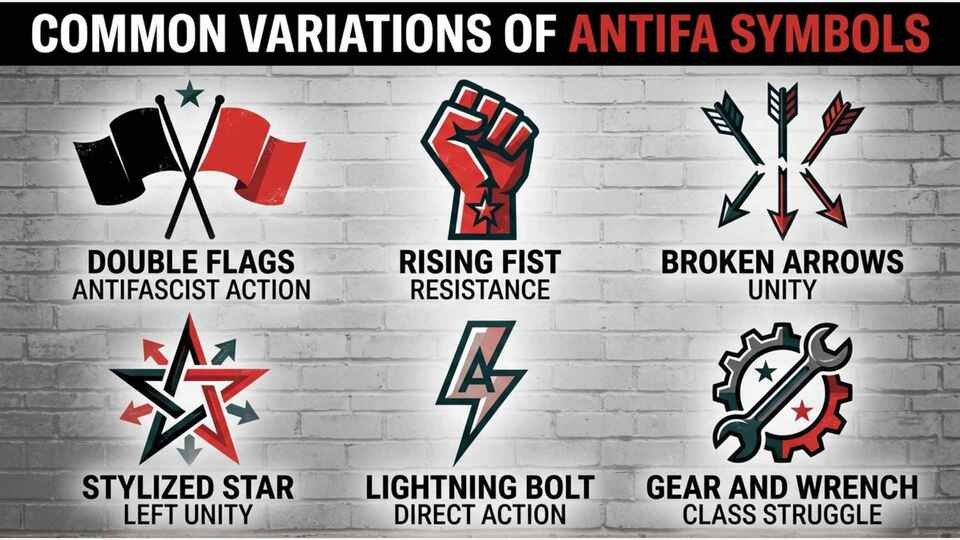
No single version is mandatory. Design changes often reveal ideological, regional, or artistic preferences.
Two Red Flags
This variation most closely resembles the original 1932 emblem. It emphasizes the symbol’s communist and working-class revolutionary origins.
Red and Black Flags
This is the most familiar modern version. Red represents socialist or communist traditions, while black generally represents anarchism.
Reversed Flag Order
Some logos place the black flag in front and the red flag behind it. Others reverse the arrangement. The order may reflect local design choices or ideological emphasis, but it does not have one universal interpretation.
Localized Text
Designers often replace “Antifaschistische Aktion” with phrases such as “Antifascist Action,” “Anti-Fascist Network,” or the name of a city. This identifies a local campaign without proving that it belongs to a wider organization.
Crossed-Out Fascist Symbols
A swastika, fasces, or other far-right emblem may appear inside a prohibition sign or beneath a slash. These designs communicate rejection more directly than the two-flags emblem.
Three Arrows
The Three Arrows are often grouped with antifa imagery, but they have a different origin. They came from the Social Democratic-aligned Iron Front rather than the Communist Party’s Antifaschistische Aktion.
Raised Fist
The raised fist represents solidarity, resistance, labor, liberation, or collective struggle in many political traditions. It is not exclusively an antifa symbol.
Common Misconceptions About Antifa Symbols
“The logo belongs to one worldwide organization.”
No global authority owns or controls all antifa imagery. Local collectives may organize themselves, but the broader movement is decentralized.
“Anyone wearing the symbol belongs to a formal group.”
A person may wear the emblem to express a belief, support a cause, participate in a subculture, or provoke a reaction. Visual identification alone does not establish membership.
“The modern logo is unchanged from 1932.”
The historic campaign commonly used two red flags. The widely recognized red-and-black version is a later adaptation shaped by anarchist and autonomous movements.
“The Three Arrows and two-flags logo are the same symbol.”
They are related through antifascist history but came from rival political traditions. The Three Arrows were connected to the Iron Front and German Social Democrats, while the two flags originated with the KPD-backed Antifaschistische Aktion.
“The symbol automatically proves violent intent.”
A symbol can indicate political sympathy, but it cannot by itself prove that a person plans violence or supports illegal conduct. Meaning must be evaluated through words, actions, affiliations, and context.
“Every red-and-black flag is antifa.”
Red-and-black flags also appear in anarchism, anarcho-syndicalism, labor movements, sports culture, music, and unrelated graphic design. Color alone is insufficient for identification.
Interesting Facts About Antifa Symbols
- The best-known emblem is older than the modern antifa movement. It first appeared in 1932, while many present-day antifa networks developed decades later.
- The original flags were often both red. The modern black flag reflects the increased influence of anarchism and autonomous politics.
- The logo emerged during the same year as the Three Arrows. Both symbols responded to Germany’s political crisis, but they represented competing left-wing traditions.
- The circular design makes localization easy. Groups can change the surrounding text while keeping the central flags recognizable.
- There is no dedicated antifa emoji. Online users rely on ordinary flag emojis, colored shapes, or uploaded graphics.
- Displaying the emblem does not prove organizational membership. The broader movement has no universal membership list or central registration system.
- The flags communicate alliance as well as ideology. Their pairing suggests cooperation among different left-wing currents against a shared opponent.
- The Three Arrows were designed partly for visual combat. They could be painted over swastikas, turning political graffiti into counter-propaganda.
- Antifa imagery often changes by city. Localized designs reflect the movement’s emphasis on autonomous regional organizing.
- Historical and modern meanings overlap but are not identical. The 1932 emblem belonged to a communist-led campaign, while modern users may be anarchists, socialists, social democrats, or people without a fixed ideology.
- Context is essential when identifying political symbols. A raised fist, black flag, or red star can have many meanings outside antifascist activism.
Related Symbols
Three Arrows
Three downward-left arrows represent the Iron Front’s resistance to political extremism during the Weimar Republic. Unlike the two-flags logo, the symbol developed in a social democratic movement that also opposed communism.
Crossed-Out Swastika
A swastika covered by a slash directly communicates rejection of Nazism. Its meaning is usually clearer than the more historically layered two-flags emblem.
Raised Fist
The raised fist symbolizes unity, resistance, labor power, and collective struggle. It has been used by civil rights, socialist, feminist, anti-colonial, labor, and revolutionary movements.
Black Flag
The black flag is strongly associated with anarchism and anti-authoritarian politics. It may appear independently or as one half of the modern antifa logo.
Red Flag
The red flag represents socialism, communism, labor struggle, and revolutionary politics. Its meaning predates Antifaschistische Aktion by many decades.
Red-and-Black Diagonal Flag
This flag is commonly connected with anarcho-syndicalism or anarchist communism. It shares antifa’s typical colors but has its own ideological history.
Broken or Smashed Fasces
The fasces became closely linked to Benito Mussolini’s Italian Fascist movement. Images showing it broken or crossed out symbolize rejection of fascist power.
Frequently Asked Questions
What is the main antifa symbol?
The most recognizable antifa symbol contains two waving flags inside a circular frame. Modern versions usually use one red flag and one black flag. The design comes from the 1932 German Antifaschistische Aktion emblem, although the red-and-black color combination became more common in later antifascist movements.
What do the red and black antifa flags mean?
The red flag generally represents socialist, communist, revolutionary, or labor traditions. The black flag represents anarchism and anti-authoritarian politics. Together, they often symbolize cooperation among different left-wing groups against fascism, although individual users may interpret the colors differently.
Is the antifa symbol a hate symbol?
The emblem is not inherently a racial or religious hate symbol. Its stated meaning is opposition to fascism. However, it remains politically controversial because some people associated with antifa have engaged in intimidation, property damage, or violence. Classification should focus on context and conduct rather than the image alone.
Is there an official antifa flag?
There is no universally official flag because antifa is not governed by one central organization. The red-and-black two-flags design is widely recognized, but local groups create their own colors, wording, and adaptations. No single authority approves or rejects these versions.
Who designed the original antifa logo?
Historical accounts generally credit German artists Max Gebhard and Max Keilson with the 1932 Antifaschistische Aktion emblem. They were associated with revolutionary visual artists working within Germany’s communist political culture. The design originally promoted a KPD-backed campaign during the final crisis of the Weimar Republic.
Are the Three Arrows an antifa symbol?
The Three Arrows are an antifascist symbol, but they did not originate with Antifaschistische Aktion. They were created for the Social Democratic-aligned Iron Front in 1932. Modern antifascists sometimes use them, although their original meaning included opposition to communism as well as Nazism and monarchist reaction.
Does wearing an antifa symbol mean someone supports violence?
Not necessarily. It may express general opposition to fascism, support for anti-racist activism, identification with radical-left politics, or affiliation with a local group. Determining whether someone supports violence requires additional evidence, including statements, conduct, planning, and organizational relationships.
Why do some antifa activists wear black?
Black clothing is associated with anarchist symbolism and with the “black bloc” protest tactic, in which participants dress similarly to reduce individual visibility and create a unified appearance. Not everyone wearing black at a demonstration is an antifa activist, and not every antifascist participant uses black bloc tactics.
Does antifa have a leader or headquarters?
Antifa does not have one worldwide leader, headquarters, or governing body. Some local groups have organizers and established names, but they operate independently. This decentralized structure makes it inaccurate to treat every self-described antifascist as part of a single command system.
Can antifa symbols have different meanings in different countries?
Yes. In Germany, the imagery carries direct connections to Weimar politics, Nazism, and postwar memory. In the United States, it is often linked with modern protests against white supremacy and far-right organizing. Elsewhere, it may connect with labor, football, punk, anti-racist, or anti-authoritarian cultures.
Key Takeaways
- Antifa symbols primarily express opposition to fascism and related far-right ideologies.
- The best-known emblem contains two waving flags inside a circle.
- The original Antifaschistische Aktion campaign began in Germany in 1932.
- Early versions commonly displayed two red flags.
- Modern designs often combine red socialist symbolism with black anarchist symbolism.
- Antifa is decentralized, so no single authority controls its symbols.
- The Three Arrows are historically related but originated with the rival Iron Front.
- A symbol alone does not prove group membership, violent intent, or criminal activity.
- Political, historical, regional, and personal context determines how the imagery should be interpreted.
Conclusion
Antifa symbols are products of political conflict, historical memory, and changing protest cultures. The famous two-flags emblem began with a communist-led German campaign in 1932, but later movements adapted it into the red-and-black design recognized around the world today.
Its central message is opposition to fascism, yet its wider meaning is not fixed. Supporters may view it as a sign of solidarity and community defense, while critics may associate it with confrontation and political disorder. The most accurate interpretation considers the specific design, its historical origin, the person or group using it, and the actions surrounding it.
Understanding antifa symbols therefore requires more than recognizing two flags or a set of colors. It requires distinguishing documented history from modern interpretation and political identity from individual behavior.

I am Daniel Brooks, a language researcher and writer with a strong interest in how people use English in everyday conversations. I contribute to LearnNestly because I enjoy turning confusing language topics into straightforward lessons. My goal is to help readers understand not only what a word or phrase means, but also when and how to use it naturally. I focus on clear examples, practical explanations, and useful language knowledge that readers can remember.
Books:
- The Practical English Guide
- Understanding Everyday Words
 Amelia Carter