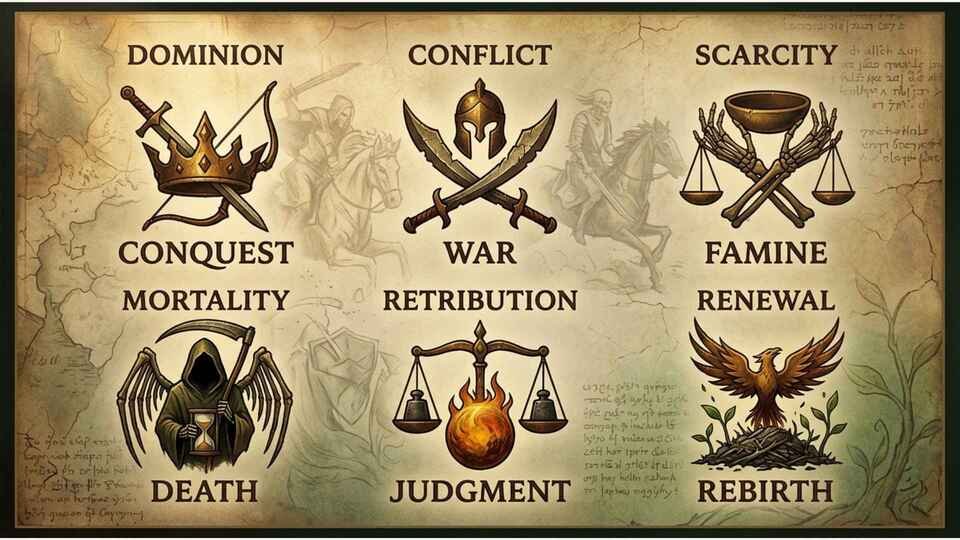
The four horsemen symbols represent a sequence of destructive forces unleashed in Revelation 6:1–8: conquest, war, famine, and death. Each rider appears on a different-colored horse and carries an identifying object, such as a bow, sword, scales, or the authority of Death.
Together, they symbolize escalating crisis, divine judgment, human violence, scarcity, mortality, and the collapse of social order.
You may encounter the Four Horsemen in Christian art, sermons, literature, films, tattoos, political cartoons, video games, and discussions about global catastrophe. Although their basic imagery comes from the New Testament, their exact interpretation varies among biblical scholars and Christian traditions.
Quick Meaning of the Four Horsemen Symbols
The Four Horsemen symbolize conquest, warfare, famine, and death. The white horse carries a crowned archer, the red horse carries a great sword, the black horse carries weighing scales, and the pale green horse carries Death. Together, they portray a chain of disasters that follows the opening of the first four seals in Revelation.
Four Horsemen Symbol Overview
| Field | Details |
| Symbol name | Four Horsemen of the Apocalypse |
| Primary meaning | Conquest, war, famine, death, judgment, and widespread crisis |
| Category | Biblical, apocalyptic, religious, literary, and artistic symbolism |
| Origin | Revelation 6:1–8 in the New Testament |
| Original language | Koine Greek |
| Cultural tradition | Early Christianity within the Roman world |
| Approximate period | Revelation is commonly dated to the late first century CE |
| Number of riders | Four |
| Horse colors | White, fiery red, black, and pale green |
| Key objects | Bow and crown, great sword, scales, and the power of Death |
| Religious setting | Opening of the first four seals of a seven-sealed scroll |
| Common modern meaning | Approaching catastrophe or a group of four destructive forces |
| Unicode | No single official Four Horsemen character |
| Emoji equivalents | 🏇 🏹 ⚔️ ⚖️ 💀 |
| Related symbols | Seven seals, Lamb of God, sword, scales, crown, Hades, and apocalyptic beasts |
What Do the Four Horsemen Symbols Mean?
The four horsemen symbols portray destructive forces moving across the earth under divine permission. They are not four unrelated characters. Revelation presents them as a sequence in which one crisis leads naturally into another.
Conquest and political expansion often produce war. War disrupts farming, trade, transportation, and daily life. Those disruptions create food shortages and extreme prices. Famine, violence, disease, and social breakdown then increase death.
This progression gives the vision much of its power. The riders represent both supernatural judgment and recognizable patterns of human history.
The White Horse: Conquest and Ambiguous Victory
The first rider appears on a white horse. He carries a bow, receives a crown, and rides out “conquering and to conquer.”
His main symbols are:
- White horse: victory, authority, purity, or deceptive appearance
- Bow: military force, long-range power, or threatened violence
- Crown: granted authority and successful conquest
- Forward movement: continuing expansion or domination
The white rider is the most debated of the four. Many interpreters identify him as Conquest, military empire, false peace, or an imitation of righteous authority. Others understand him as Christ, the gospel, or divine victory because Revelation later portrays Christ riding a white horse in chapter 19.
However, the surrounding sequence favors a destructive reading for many scholars. The first rider appears alongside war, famine, and death, suggesting that his conquest begins the cycle of catastrophe.
The text does not explicitly call him “Pestilence.” That label became common through later traditions that wanted four distinct figures named Pestilence, War, Famine, and Death.
The Red Horse: War and Bloodshed
The second rider appears on a fiery red horse. He receives power to remove peace from the earth so that people kill one another. He also receives a great sword.
His symbols are direct:
- Red color: blood, violence, rage, fire, and conflict
- Great sword: organized warfare and large-scale killing
- Removal of peace: breakdown of security and social trust
- People killing one another: civil conflict as well as international war
The red horseman represents more than a single battle. He symbolizes the condition of war itself: fear, aggression, revenge, political instability, and the collapse of peaceful relationships.
The wording also suggests that peace is fragile. Once it is removed, violence spreads through human choices. The rider receives authority, but people participate in the killing.
The Black Horse: Famine and Economic Inequality
The third rider appears on a black horse and carries a pair of scales. A voice announces extremely high prices for wheat and barley while commanding that oil and wine not be harmed.
His symbols include:
- Black horse: hunger, grief, scarcity, and deprivation
- Scales: rationing, measurement, prices, and economic control
- Wheat and barley: essential food supplies
- High prices: inflation and desperate living conditions
- Protected oil and wine: unequal access to resources or limits placed on destruction
The black horseman symbolizes famine, but the scales show that his meaning includes economics. Food still exists, yet ordinary people can barely afford it. A full day’s pay buys only a small amount of grain.
This is not simply an image of empty fields. It portrays a market in crisis, where basic survival consumes a person’s income.
The instruction not to damage oil and wine has several interpretations. It may suggest that some crops remain available, that luxury goods survive while staple foods become costly, or that the devastation has defined limits. The passage does not explain the command fully, so interpretations should remain cautious.
The Pale Horse: Death and Hades
The fourth horse is described with the Greek word chlōros, which can refer to a pale green, yellow-green, or sickly green color. The rider is explicitly named Death, and Hades follows behind him.
His symbols are:
- Pale green color: sickness, decay, corpses, and loss of life
- Named rider: unlike the others, this rider is directly called Death
- Hades: the realm of the dead, not necessarily the later image of fiery hell
- Multiple causes of death: sword, hunger, disease, and wild animals
The fourth rider gathers the consequences of the earlier horsemen. Conquest, violence, and food scarcity culminate in mass death.
Revelation states that Death and Hades receive authority over a fourth of the earth to kill through several means. The pale rider therefore symbolizes mortality on a vast scale rather than one particular way of dying.
History and Origin of the Four Horsemen
The Four Horsemen originated in the Book of Revelation, the final book of the Christian New Testament. Revelation belongs to the literary genre known as apocalyptic literature, which uses visions, heavenly beings, symbolic numbers, dramatic disasters, and cosmic conflict to reveal the meaning of history.
The Vision in Revelation 6
The riders appear when the Lamb opens the first four seals of a seven-sealed scroll. Each opening is followed by a command from one of the four living creatures near God’s throne.
The sequence is:
- A crowned archer on a white horse
- A sword-bearing rider on a red horse
- A rider with scales on a black horse
- Death on a pale green horse, followed by Hades
The riders do not appear at random. They form the first stage of a larger series of judgments involving seven seals, seven trumpets, and seven bowls.
Earlier Biblical Background
Revelation’s horse imagery has an important background in the Hebrew Bible, especially the Book of Zechariah.
Zechariah describes groups of colored horses sent out across the earth. In one vision, the horses are red, sorrel, and white. In another, four chariots are pulled by red, black, white, and dappled horses.
Revelation reworks this older prophetic imagery. However, it gives each horse and rider a more specific role connected with conquest, war, food scarcity, and death.
The image of measuring food carefully also echoes earlier biblical descriptions of siege and famine. When grain must be weighed instead of freely eaten, ordinary life has collapsed into survival.
Historical Context of the Roman World
Revelation was written for Christian communities living under Roman rule. Its imagery would have resonated in a world familiar with military conquest, imperial crowns, swords, taxation, disrupted food supplies, epidemics, and public displays of power.
The horse itself was associated with speed, warfare, authority, and imperial expansion. A mounted conqueror could travel quickly and strike with force. By placing disaster on horseback, Revelation makes catastrophe appear organized, mobile, and nearly impossible to stop.
Development Through Christian History
Early Christian commentators interpreted the riders in different ways. Some connected the white rider with Christ or the spread of the gospel. Others treated all four as destructive judgments.
During the Middle Ages, the riders became important subjects in illuminated manuscripts, church art, biblical commentaries, and sermons. Epidemics, warfare, crop failures, and political upheaval gave the imagery immediate emotional power.
The Black Death encouraged later audiences to associate one of the horsemen specifically with pestilence. Over time, the popular list became:
- Pestilence or Conquest
- War
- Famine
- Death
This naming system is useful in popular culture, but it does not reproduce the biblical text exactly.
Albrecht Dürer and the Iconic Visual Form
German artist Albrecht Dürer created the most influential image of the riders in his 1498 woodcut, The Four Horsemen, from The Apocalypse. It was part of a series illustrating Revelation.
Dürer compressed all four riders into a single charging group. Their horses rush forward while people beneath them are trampled and swallowed. The composition creates speed, pressure, and unavoidable destruction. The Metropolitan Museum of Art describes it as the most famous woodcut in Dürer’s Apocalypse series.
Dürer’s print shaped later paintings, engravings, political cartoons, book illustrations, films, album art, and modern fantasy imagery. The Cleveland Museum of Art notes how the riders’ clothing, clouds, and victims intensify the sense of violent motion.
Symbolism and Interpretation
The Four Horsemen can be interpreted on theological, historical, political, psychological, and literary levels.
Traditional Christian Meaning
Traditionally, the riders symbolize judgments that precede the completion of God’s plan. They expose the instability of human power and show what happens when conquest, violence, scarcity, and death spread across society.
In this reading, evil is dangerous but not unlimited. Each rider is permitted to act only after a seal is opened, and the fourth receives authority over a defined portion of the earth. The vision therefore presents judgment under divine sovereignty rather than chaos outside all control.
Futurist Interpretation
Futurist readings view the riders as events that will unfold during a future period of tribulation. The white rider may be interpreted as an end-times ruler, deceptive peacemaker, or Antichrist figure, followed by global war, famine, and mass death.
This interpretation is common in some evangelical and dispensational Christian traditions.
Preterist Interpretation
Preterist readings connect the riders primarily with events near the time Revelation was written. They may represent Roman conquest, civil wars, food shortages, disease, persecution, and instability within the first-century empire.
This approach emphasizes how the original audience may have understood the vision.
Historicist Interpretation
Historicist readings interpret Revelation as a symbolic outline of long periods in church and world history. Different interpreters have linked the riders with empires, invasions, religious movements, epidemics, or political eras.
Because these identifications vary widely, historicist claims often depend on the interpreter’s own historical framework.
Idealist Interpretation
Idealist readings understand the horsemen as recurring forces present throughout human history. Conquest leads to war, war contributes to scarcity, and all three produce death.
This interpretation does not require the riders to correspond to four isolated events. They symbolize patterns that appear whenever societies pursue domination and violence.
Positive Symbolism
The riders are overwhelmingly threatening, yet the complete vision contains several constructive themes:
- Moral warning: destructive choices have consequences.
- Exposure of injustice: famine and unequal prices reveal economic suffering.
- Limits on evil: the riders operate within boundaries.
- Call to endurance: believers are encouraged to remain faithful during crisis.
- Hope beyond judgment: Revelation eventually moves toward renewal and restored creation.
The horsemen themselves are not positive symbols, but their literary purpose includes warning, accountability, perseverance, and hope.
Negative Symbolism
The negative meanings are clearer:
- Imperial aggression
- Militarism
- Civil disorder
- Bloodshed
- Food insecurity
- Inflation and rationing
- Disease
- Social collapse
- Fear of death
- Large-scale catastrophe
In modern speech, calling something “one of the Four Horsemen” usually means it is a major cause or warning sign of destruction.
Psychological Interpretation
Psychologically, the horsemen can represent fears that individuals and societies struggle to control.
The white rider reflects ambition, domination, and the desire to expand power. The red rider reflects aggression and conflict. The black rider reflects anxiety about resources, survival, and inequality. The pale rider represents the universal fear of death.
Their sequence also mirrors the way one crisis multiplies into others. A political act can lead to violence, economic instability, hunger, illness, grief, and lasting trauma.
Cultural Significance of the Four Horsemen
The Four Horsemen belong specifically to Christian scripture, but their imagery has spread far beyond churches.
Western Christian Culture
In Europe and the Americas, the horsemen became a visual shorthand for the end of the world. They appeared in Bibles, church decorations, sermons, poems, paintings, prints, and later political cartoons.
Artists often adapted the riders to address contemporary fears, including war, plague, revolution, nuclear weapons, environmental destruction, and economic collapse.
Eastern Christian Traditions
Eastern Orthodox interpretation places the passage within the broader theology of Revelation rather than treating it merely as a prediction chart. Icons and commentaries may emphasize divine judgment, spiritual vigilance, repentance, and the final victory of God.
As in Western Christianity, the white rider has received more than one interpretation.
Modern Secular Culture
In secular culture, “the Four Horsemen” has become an adaptable metaphor. Writers use the phrase for any group of four destructive conditions, powerful opponents, or signs of impending failure.
The term may describe:
- Four harmful social trends
- Four military leaders
- Four severe risks
- Four stages of organizational collapse
- Four especially dominant athletes or performers
- Four fictional villains
These uses borrow the emotional force of Revelation without necessarily carrying a religious message.
Global Interpretation
Cultures without a strong Christian background may recognize the horsemen mainly through films, comics, games, or translated literature. In such settings, they often function as fantasy characters representing supernatural disaster.
This popular form can simplify the biblical imagery. The riders may become independent demons or gods, even though Revelation portrays them as figures released through the Lamb’s opening of the seals.
Religious and Spiritual Meaning
The religious meaning of the Four Horsemen centers on judgment, human responsibility, limited suffering, and hope beyond catastrophe.
Judgment
The riders emerge as part of a heavenly sequence. Their appearance suggests that injustice, violence, and oppression will not continue without judgment.
The vision does not present judgment as emotionally easy. Its images are disturbing because war, hunger, and death are genuinely destructive.
Human Responsibility
Although the riders receive authority, the passage does not remove human responsibility. The red horseman takes peace, but people kill one another. The black horseman reveals an economic system in which food is measured and priced beyond ordinary reach.
The imagery therefore joins divine judgment with the consequences of human violence and injustice.
Spiritual Vigilance
For Christian readers, the horsemen can serve as a warning against placing complete trust in military power, political authority, wealth, or social stability. These systems can change quickly.
The passage calls readers to spiritual endurance rather than panic or endless date-setting.
Hope Beyond the Horsemen
Revelation does not end with the pale horse. Its larger story moves through judgment toward the defeat of evil, the resurrection of the dead, final justice, and a renewed creation.
The horsemen symbolize a terrible stage in the vision, not its final message.
Where Are the Four Horsemen Symbols Used?
Religious Art
The riders appear in manuscript illustrations, cathedral art, engravings, paintings, stained glass, sculptures, and modern devotional imagery.
Artists usually identify them through horse colors and objects:
- White horse with bow and crown
- Red horse with sword
- Black horse with scales
- Pale horse with a skeletal or corpse-like rider
Literature
Authors use the horsemen to create a sense of prophecy, disaster, moral crisis, or approaching doom. They appear in biblical retellings, fantasy novels, horror fiction, satire, poetry, and political allegory.
Film, Television, Comics, and Games
Modern entertainment often turns the riders into named supernatural characters. Their weapons and personalities vary, and Pestilence frequently replaces Conquest.
These adaptations are creative rather than strictly biblical.
Political Cartoons
Cartoonists have adapted the Four Horsemen to represent war, dictatorship, famine, disease, pollution, nuclear destruction, or failed policies.
The image works especially well because viewers can recognize four connected dangers at a glance.
Tattoos
Four Horsemen tattoos may symbolize mortality, power, rebellion, religious belief, survival, or acceptance of life’s uncertainty.
A tattoo showing only one rider can carry a narrower meaning. For example, scales may emphasize famine or economic injustice, while the pale rider may express awareness of death.
Music and Popular Branding
The phrase appears in song titles, band names, wrestling groups, motorcycle culture, sports nicknames, and fictional organizations.
In these settings, it usually communicates power, fearlessness, danger, or unstoppable momentum.
Common Variations of the Four Horsemen
Conquest, War, Famine, and Death
This version follows the details of Revelation most closely. The white rider conquers, the red rider removes peace, the black rider brings scarcity, and the pale rider is Death.
Pestilence, War, Famine, and Death
This is the best-known popular variation. Pestilence may replace Conquest because disease is included among the causes of death associated with the fourth rider or because later epidemics shaped the tradition.
Christ as the White Rider
Some Christian interpretations identify the first rider with Christ or the victorious gospel. The white horse, crown, and conquest can support this reading.
Others reject it because the rider appears in a sequence of calamities and carries a bow, while Christ in Revelation 19 is described differently.
Different Horse Colors
The fourth horse is often painted gray, beige, white-green, or ghostly blue. These variations attempt to represent the difficult Greek color term chlōros.
A vivid green horse may be linguistically defensible, but artists often prefer a corpse-like gray-green tone.
Individualized Fantasy Riders
Games and comics may give each horseman unique armor, magical weapons, names, personalities, or kingdoms. These designs are modern inventions rather than details from Revelation.
Common Misconceptions About the Four Horsemen
Misconception 1: The Bible Names All Four Riders
It does not. Only the fourth rider is explicitly named Death. The others are identified by their actions, objects, and effects.
Misconception 2: Pestilence Is Clearly the First Rider
Revelation never calls the white rider Pestilence. The text describes him as a crowned conqueror carrying a bow.
Misconception 3: The Fourth Horse Is Simply White or Gray
The original Greek suggests a pale green or yellow-green shade associated with vegetation in some contexts and sickly flesh in this vision.
Misconception 4: The Horsemen Act Independently of God
In Revelation, they appear only after the Lamb opens the seals. Their authority is granted and limited.
Misconception 5: The Horsemen Are the Entire Apocalypse
They are only part of the opening of the seven seals. Revelation contains many later visions, judgments, conflicts, and scenes of restoration.
Misconception 6: The Four Horsemen Always Predict a Specific Date
The passage gives no calendar date for their arrival. Attempts to connect them with precise modern dates rely on interpretation, not an explicit statement in the text.
Misconception 7: The Horsemen Are Satan’s Four Generals
Popular fiction often depicts them that way, but Revelation does not identify them as Satan’s commanders.
Interesting Facts About the Four Horsemen
- Only Death has a stated name.
Conquest, War, and Famine are interpretive titles based on each rider’s actions. - The fourth horse may be green rather than gray.
The Greek word chlōros describes a greenish or sickly pale color, helping create the image of a corpse. - The riders form a cause-and-effect pattern.
Conquest encourages war, war disrupts food production, famine weakens populations, and death follows. - The black rider symbolizes prices as well as hunger.
His scales and the announced grain prices make him a symbol of economic crisis, rationing, and unequal access to food. - The white rider remains disputed.
Interpretations include Conquest, Christ, the gospel, false peace, imperial power, and a future deceiver. - The imagery has roots in Zechariah.
Revelation transforms earlier biblical visions of colored horses and heavenly patrols into a sequence of judgments. - Dürer made the riders visually inseparable.
His 1498 woodcut places them in a tightly packed charge, strengthening the idea that the disasters arrive together. - The phrase now applies to nonreligious groups.
Any four dangerous forces can be called “the Four Horsemen,” even when the subject has no direct connection to Revelation. - Hades follows Death rather than riding another horse.
Hades acts as Death’s companion, receiving those who die. - The destruction is limited.
Revelation assigns authority over a fourth of the earth, showing that the riders are powerful but not unlimited. - Oil and wine create an intentional puzzle.
Their protection may reflect preserved luxury goods, limited judgment, agricultural differences, or symbolic boundaries. - The horsemen are warnings, not the final image of Revelation.
The book ends with renewal, divine presence, and the New Jerusalem rather than permanent rule by death.
Related Symbols and Their Meanings
| Related symbol | Meaning | Difference from the Four Horsemen |
| Seven seals | Stages in the unfolding of divine judgment | The horsemen appear only during the first four seals |
| Lamb of God | Christ as sacrifice, victor, and worthy ruler | The Lamb opens the seals and controls the sequence |
| White horse of Revelation 19 | Victorious returning Christ | This rider is clearly identified and differs from the debated rider in chapter 6 |
| Sword | War, judgment, violence, or authority | It specifically identifies the red rider’s destructive role |
| Scales | Justice, measurement, trade, or rationing | In Revelation 6, they point toward scarcity and food prices |
| Crown | Rule, victory, or granted authority | The white rider receives a crown before conquering |
| Hades | The realm of the dead | Hades follows Death rather than serving as one of the four riders |
| Grim Reaper | Personification of death | It developed in later European culture and is not identical to the pale rider |
| Four living creatures | Heavenly beings surrounding God’s throne | They summon the riders but are not horsemen themselves |
| Beast of Revelation | Oppressive political and religious power | It appears later and has a separate role in the vision |
Frequently Asked Questions
What are the four horsemen symbols?
The four horsemen symbols are the white horse with a bow and crown, the red horse with a great sword, the black horse with scales, and the pale green horse ridden by Death. They represent conquest, war, famine, and death within the opening of the first four seals in Revelation 6.
What does the white horseman symbolize?
The white horseman most commonly symbolizes conquest or expanding political power. His bow, crown, and mission to conquer support that interpretation. However, some Christian commentators identify him with Christ or the spread of the gospel. The passage does not directly name him, so the debate remains unresolved.
Why is Pestilence called one of the Four Horsemen?
Pestilence became part of the popular list through later interpretation rather than direct biblical naming. Revelation includes disease or plague among the forces of death, while the white rider represents conquest. Artists and writers later separated pestilence into its own character, often replacing Conquest.
What does the red horse symbolize?
The red horse symbolizes war, bloodshed, and the removal of peace. Its rider receives a great sword and causes people to kill one another. The symbol can include international warfare, civil conflict, social division, revenge, and any violent breakdown of peaceful order.
Why does the black horseman carry scales?
The scales represent careful measurement, rationing, commerce, and high food prices. The announced cost of grain suggests that a worker’s daily wage can purchase only a small amount of food. The black horse therefore symbolizes famine combined with inflation, scarcity, and economic inequality.
What color is Death’s horse?
Death’s horse is described using the Greek word chlōros, meaning pale green, yellow-green, or sickly green. Many artists portray it as gray-green or corpse-colored. Calling it simply “pale” captures its unhealthy appearance but does not fully communicate the greenish shade of the original term.
Are the Four Horsemen evil?
They represent destructive forces, but Revelation does not describe them as independent demons serving their own purposes. They appear when the Lamb opens the seals, and their authority is granted and limited. Theologically, they function as agents or images of judgment rather than uncontrolled rivals to God.
Have the Four Horsemen already appeared?
The answer depends on the interpretive tradition. Preterists connect them with first-century events, futurists expect a future fulfillment, historicists associate them with periods of history, and idealists see them as recurring patterns. Revelation itself does not provide a simple modern date by which everyone can identify their appearance.
What do Four Horsemen tattoos mean?
A Four Horsemen tattoo may represent mortality, faith, danger, judgment, resilience, or the destructive cycles of history. Its meaning depends on the design and wearer. A biblical composition may express religious belief, while a fantasy version may symbolize strength, rebellion, or fascination with apocalyptic imagery.
Are the Four Horsemen mentioned anywhere besides Revelation?
The Four Horsemen as a group appear in Revelation 6. Their imagery, however, draws from earlier biblical visions, especially the colored horses and chariots in Zechariah. Later Christian art, literature, theology, and popular culture expanded them into a widely recognized symbolic group.
Key Takeaways
- The Four Horsemen appear in Revelation 6:1–8.
- They symbolize conquest, war, famine, and death.
- The white rider carries a bow and crown but is not explicitly named.
- The red rider removes peace and carries a great sword.
- The black rider carries scales representing scarcity and extreme food prices.
- The pale green rider is directly named Death, with Hades following him.
- “Pestilence” is a later popular replacement for Conquest.
- Their imagery draws partly from the colored horses in Zechariah.
- Interpretations include futurist, preterist, historicist, and idealist approaches.
- Albrecht Dürer’s 1498 woodcut strongly shaped their modern visual identity.
- The horsemen symbolize connected crises rather than four isolated disasters.
- Revelation’s final message extends beyond destruction toward judgment, hope, and renewal.
Conclusion
The four horsemen symbols endure because they transform complex human disasters into four unforgettable images. A crowned conqueror begins the advance, a sword removes peace, scales measure scarce food, and Death follows on a corpse-colored horse.
Their meaning is both religious and deeply human. They represent the way ambition can become conquest, conquest can become war, war can produce hunger, and hunger and violence can end in death. At the same time, Revelation places these forces within a larger vision in which suffering is limited, injustice is judged, and death does not receive the final word.

I am Sophie Bennett, an educational content writer who loves exploring language, communication, and the small details that make English interesting. I write for LearnNestly with the aim of helping readers find quick, reliable, and easy-to-follow answers to their language questions. I enjoy explaining confusing spellings, grammar choices, meanings, and expressions in a friendly way. For me, good educational writing should leave the reader feeling more confident than when they started.
Books:
- English Without Confusion
- A Clear Guide to Modern English
 Daniel Brooks
 Amelia Carter