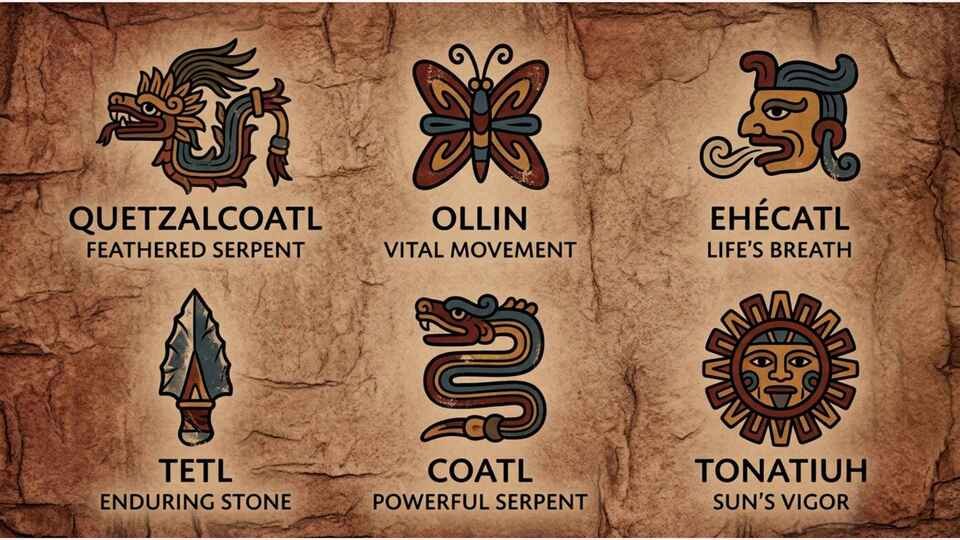
Aztec symbols for war were not limited to one image. The Mexica, the dominant people of the Aztec Empire, used eagles, jaguars, shields, weapons, banners, fire-and-water imagery, and sacred gods to express military power. These symbols represented courage, rank, conquest, sacrifice, political authority, and service to the sun.
You may encounter them in surviving sculptures, painted manuscripts, temple carvings, ceremonial drums, museum objects, jewelry, tattoos, and modern Mexican-inspired art.
However, understanding them requires more than identifying a fierce animal or weapon. In Aztec culture, warfare connected religion, government, social advancement, tribute, and the cosmic duty to sustain the gods.
Quick Meaning of Aztec Symbols for War
Aztec symbols for war represented courage, military rank, conquest, sacred duty, and the capture of enemies. Important examples included the eagle, jaguar, shield, macuahuitl, atlatl, military banners, Huitzilopochtli, and the paired image of water and fire known as atl-tlachinolli. Together, they expressed both physical combat and sacred power.
Aztec War Symbols Overview
| Symbol | Nahuatl Name | Primary Meaning | Common Context |
| Eagle | Cuāuhtli | Solar strength, bravery, elite warrior status | Warrior clothing, sculpture, military orders |
| Jaguar | Ocēlōtl | Night power, courage, danger, elite rank | Jaguar-warrior suits, ritual art, military imagery |
| Eagle-jaguar pair | Cuāuhtli-ocēlōtl | Elite military power and opposing cosmic forces | Poetry, ceremonies, warrior organizations |
| Shield | Chīmalli | Protection, rank, identity, warfare | Battle equipment, tribute, ceremonial display |
| Macuahuitl | Mācuahuitl | Close combat, military force | Warfare, warrior depictions |
| Spear-thrower | Atlatl | Long-range attack and martial skill | Battle scenes, elite weaponry |
| Water and fire | Ātl-tlachinōlli | War, conflict, devastation | Manuscripts, sculpture, speech-scroll imagery |
| Military banner | Various names | Rank, unit identity, command | Battlefield communication and ceremonial dress |
| Huitzilopochtli | “Hummingbird of the Left” | Sun, war, Mexica destiny | Temples, ceremonies, imperial ideology |
| Fire serpent | Xiuhcōātl | Divine weapon, fire and solar force | Images of Huitzilopochtli and cosmic battle |
| Flint knife | Tēcpatl | Sacrifice, blood, warrior destiny | Ritual art, calendar signs, sacrificial ceremonies |
| Skull and bones | Tzompantli imagery | Death, victory, sacrifice, warning | Skull racks, temple precincts, sculpture |
There is no Unicode character or official emoji for the historical system of Aztec war symbolism. Modern users sometimes substitute eagle, jaguar, shield, fire, or crossed-weapon emojis, but these do not reproduce the original meanings.
What Do Aztec Symbols for War Mean?
Aztec symbols for war communicated a warrior’s identity, accomplishments, status, and sacred obligations. They could identify an elite military group, display the number of captives a fighter had taken, honor a deity, or proclaim the power of a city-state.
Warfare was known in Nahuatl as yāōyōtl. It served several purposes. Armies defended territory, expanded political influence, collected tribute, suppressed resistance, and captured opponents. Captives were especially important because some were presented in religious ceremonies.
This does not mean every battle existed only to obtain sacrificial victims. Aztec warfare also involved practical goals such as controlling trade routes, gaining agricultural land, enforcing alliances, and securing valuable resources. Religious and political purposes often operated together.
War symbols therefore carried several connected meanings:
- Personal courage: A warrior proved himself through action.
- Military achievement: Clothing and insignia could reflect battlefield success.
- Social advancement: Commoners could sometimes improve their status by capturing enemies.
- Imperial authority: Military images advertised the strength of Tenochtitlan and its allies.
- Sacred responsibility: War supported ceremonies associated with the sun, gods, and cosmic order.
- Collective identity: Banners, costumes, and shields helped distinguish ranks and groups.
Rather than functioning as decorative emblems, these images formed a visual language understood within Mexica society.
History and Origin of Aztec War Symbolism
Aztec war symbolism developed from older Mesoamerican traditions. Eagles, jaguars, serpents, shields, sacrificial knives, and warrior gods appeared in cultures that existed centuries before the rise of Tenochtitlan.
The Mexica entered the Basin of Mexico during the Postclassic period and founded Tenochtitlan in the 14th century. In 1428, Tenochtitlan, Texcoco, and Tlacopan formed the political alliance now commonly called the Aztec Triple Alliance. As Mexica power expanded, military institutions and symbols became increasingly important.
Many surviving examples date from the 14th through early 16th centuries. They appear in stone monuments, ceramics, featherwork, painted codices, wooden drums, shields, costumes, and colonial manuscripts that preserved Indigenous knowledge after the Spanish conquest.
The eagle and jaguar became especially associated with prestigious warriors. Historical objects show that warriors received distinctive insignia, cloaks, helmets, or costumes after demonstrating skill and taking captives. The British Museum identifies eagle and jaguar warriors as prestigious military groups whose members earned recognition through brave actions, particularly the capture of opponents.
The conquest and destruction of Tenochtitlan in 1521 disrupted these institutions. Spanish colonial authorities suppressed many ceremonies, dismantled temples, and introduced European religious and political systems. Nevertheless, Indigenous artists and writers preserved elements of Mexica symbolism in colonial codices, community traditions, manuscripts, and hybrid works of art.
Today, Aztec-inspired war imagery appears in Mexican national identity, murals, sports branding, tattoos, clothing, video games, films, and historical reconstruction. Modern use, however, often separates symbols from their original ceremonial and political setting.
Major Aztec Symbols for War and Their Interpretations
The Eagle
The eagle represented solar force, height, bravery, aggression, and elite military identity. Its connection with the sky and sun made it suitable for warriors whose victories supported the sacred order.
Elite eagle warriors wore costumes designed to resemble the bird. Surviving images show feathered suits and helmets shaped like an eagle’s head, with the warrior’s face appearing through the open beak.
In Aztec belief, the eagle could express the power of daylight and the sun’s movement through the heavens. The British Museum notes that it represented the power of day and was believed to help carry the sun upward from the underworld.
The eagle did not simply mean “freedom,” as it often does in modern Western symbolism. In a Mexica context, it more directly suggested solar strength, military excellence, noble authority, and readiness for sacrifice.
The Jaguar
The jaguar represented courage, danger, night, the earth, hidden power, and elite warrior status. As a powerful nocturnal predator, it expressed a form of force different from the eagle’s daylight and celestial associations.
Jaguar warriors wore spotted suits and helmets shaped like the animal’s head. The costume transformed the fighter visually and symbolically into a dangerous predator. Historical descriptions and surviving art connect these warriors with high military achievement.
The jaguar could also carry associations with caves, darkness, rulership, and the interior of the earth. Its military meaning was therefore not limited to physical strength. It conveyed fearlessness, mystery, and the ability to move through dangerous spaces.
The British Museum describes the jaguar, together with the eagle, as a symbol of power and courage associated with elite Aztec warriors.
The Eagle and Jaguar Together
The paired eagle and jaguar formed one of the strongest expressions of warrior identity. In Nahuatl poetry and ceremonial language, “eagle and jaguar” could refer collectively to accomplished warriors.
The pair also joined complementary forces:
- Eagle and jaguar
- Sky and earth
- Day and night
- Sunlight and darkness
- Open power and concealed power
These opposites were not necessarily enemies. Together, they expressed completeness and balanced military strength. The combination suggested that an ideal warrior required more than aggression. He needed discipline, courage, awareness, endurance, and sacred purpose.
Modern descriptions sometimes call these groups “knights.” That translation can be useful as a loose comparison, but Aztec military organizations were not equivalent to European medieval knighthood. Their ranks, social expectations, religious duties, equipment, and systems of advancement developed within Mesoamerican society.
The Chimalli Shield
The chīmalli, or shield, represented defense, warfare, status, and personal achievement. Shields were practical battlefield equipment, but elaborate examples also served as ceremonial objects and displays of rank.
A typical fighting shield could be made from wood, reeds, hide, woven fibers, or layered materials. More prestigious shields included feathers, painted designs, hanging elements, and symbolic patterns. Some were too ornate or delicate for ordinary combat and likely served ceremonial or diplomatic purposes.
A shield design could communicate information about the person carrying it. Colors, geometric forms, feathers, and attached devices could connect the warrior with a military rank, ruler, deity, or community.
For this reason, the shield was both protective equipment and a visual statement. It showed that defense, identity, and reputation were inseparable in Aztec warfare.
The Macuahuitl
The mācuahuitl was a wooden weapon fitted with sharp obsidian blades along its edges. It is often described as a sword-club because it combined the striking force of a club with sharp cutting surfaces.
As a symbol, the macuahuitl represents close combat, military force, discipline, and the physical danger of Aztec warfare. Warriors needed control when using it because capturing an opponent could be more valuable than killing him immediately.
Modern illustrations sometimes exaggerate its size or present it as a magical weapon. Historical examples and descriptions show that it was a carefully constructed battlefield tool based on Mesoamerican woodworking and stone-blade technology.
Its symbolism came from actual use rather than from a single sacred myth. It represented the trained warrior’s ability to defeat, disable, or capture an enemy at close range.
The Atlatl
The atlatl was a spear-thrower that increased the speed and distance of a dart. It had a long history in Mesoamerica and appeared in both military and sacred imagery.
In war symbolism, the atlatl represented accuracy, reach, skill, and controlled aggression. It allowed warriors to attack before entering close combat.
Some deities were shown carrying spear-throwers, linking the weapon with supernatural authority. Its inclusion in elite art elevated it beyond a practical tool and turned it into a sign of divine or royal power.
Unlike the modern bow-shaped “Sagittarius” symbol, the atlatl has no universal graphic sign. It must be identified by its physical form in a painting, sculpture, or manuscript.
Atl-Tlachinolli: Water and Fire
Ātl-tlachinōlli, commonly translated as “water and scorched earth” or “water and fire,” was a Nahuatl metaphor for war. In visual art, it often appears as intertwined streams or speech-like forms representing water and flame.
The pairing may seem contradictory because water extinguishes fire. In Nahua thought, however, joined opposites could express transformation, conflict, and overwhelming force.
Atl-tlachinolli did not merely symbolize a battlefield weapon. It represented war as a total condition involving destruction, conquest, sacred duty, and political change. It could appear near rulers, warriors, gods, or scenes of military authority.
Scholars must interpret each example in context because not every paired stream automatically means war. The surrounding figures, objects, colors, and manuscript captions matter.
Military Banners and Back Devices
Aztec armies used highly visible banners and back-mounted insignia to identify commanders, units, ranks, or distinguished warriors. These devices were practical on crowded battlefields where verbal commands could be difficult to hear.
Some rose above the wearer’s head and featured feathers, animals, gods, geometric forms, or community emblems. They made experienced fighters easy to recognize.
That visibility communicated authority but also created danger. During the fighting surrounding the fall of Tenochtitlan, conspicuous elite clothing and insignia could help enemies identify military leaders.
Banners therefore symbolized reputation, leadership, organization, and responsibility. They were not simply flags in the modern national sense.
Huitzilopochtli
Huitzilopochtli was the patron deity of the Mexica and one of the most important divine figures connected with war and the sun. His name is often translated as “Hummingbird of the Left” or “Hummingbird of the South.”
He was associated with warriors, rulers, solar power, migration, conquest, and the destiny of Tenochtitlan. His shrine stood on the Templo Mayor beside the shrine of Tlaloc, the rain and agricultural deity.
This architectural pairing reflected the foundations of imperial life: warfare and tribute on one side, rain and agricultural fertility on the other.
Huitzilopochtli’s symbolism made war part of a sacred historical mission. Mexica victories could be interpreted as evidence of divine favor, while ceremonies maintained the relationship between the city, its warriors, and the sun. Huitzilopochtli was closely associated with war, solar power, rulers, gold, and the eagle.
The Xiuhcoatl Fire Serpent
The Xiuhcōātl, or fire serpent, represented flame, solar force, divine weaponry, and destructive transformation. It appears in the mythic story of Huitzilopochtli’s birth and battle against his sister Coyolxauhqui and her allies.
In that story, Huitzilopochtli uses the fire serpent as a weapon. The image therefore connects divine combat with the victory of the sun over darkness and disorder.
Xiuhcoatl should not be confused with every feathered or horned serpent in Mesoamerican art. Serpent symbols had many meanings, and identification depends on attributes, setting, and associated deities.
The Flint Knife
The flint knife, or tēcpatl, symbolized cutting power, sacrifice, blood, fate, and ritual obligation. It was also one of the day signs in the sacred calendar.
Its relationship with war arose primarily through the fate of captives and the ceremonial system supported by military conquest. A knife in Aztec art does not always signify battlefield combat. It may instead indicate sacrifice, calendrical identity, divine power, or ritual death.
The distinction matters. Weapons used to capture enemies and instruments used in ceremonies belonged to connected but separate stages of the military-religious system.
Skulls and the Tzompantli
Skulls represented death, sacrifice, captured enemies, ancestral power, and the consequences of defeat. The tzompantli, or skull rack, displayed human skulls in major ceremonial centers.
To modern viewers, skull imagery may appear to celebrate violence alone. Within Aztec religious thought, death also belonged to cycles of nourishment, regeneration, cosmic debt, and the continuation of life.
Even so, skull displays carried a clear political message. They demonstrated the power of the state, honored the gods, and warned enemies of the consequences of resistance.
Symbolism and Interpretation
Traditional Meaning
Traditionally, Aztec war imagery represented proven action rather than a vague warrior personality. A man did not become an elite fighter simply by wearing an eagle or jaguar image. Military recognition had to be earned through training, bravery, and success in combat.
War symbolism also joined individual accomplishment with collective responsibility. Warriors fought for their city-state, ruler, household, social group, and gods.
Positive Symbolism
In its historical context, positive meanings included:
- Courage under pressure
- Discipline and training
- Protection of the community
- Loyalty and service
- Social advancement through achievement
- Strategic intelligence
- Endurance
- Sacred responsibility
Modern people often choose eagle, jaguar, or shield designs to express confidence, resilience, heritage, or personal strength.
Negative Symbolism
War symbols could also communicate:
- Violence
- Domination
- Imperial expansion
- Forced tribute
- Captivity
- Death
- Political intimidation
- Human sacrifice
A balanced interpretation must recognize both sides. Romanticizing Aztec warfare as purely heroic ignores the suffering caused by conquest. Describing it only as cruelty, however, removes its political, social, and religious complexity.
Psychological Interpretation
From a modern psychological perspective, eagle and jaguar imagery can represent different forms of personal power. The eagle may suggest vision, ambition, public leadership, and decisive action. The jaguar may suggest instinct, patience, confidence, and hidden strength.
These are contemporary interpretations, not proven Aztec psychological theories. They may be meaningful in modern art or tattoos, but they should not be presented as direct translations of ancient belief.
Cultural and Religious Significance
Aztec war symbols belonged to the wider Nahua and Mesoamerican world. Neighboring peoples shared many animals, weapons, gods, and visual conventions, but they did not always interpret them in exactly the same way.
Eagles and jaguars appeared in earlier cultures, including Teotihuacan, Toltec, Maya, and other regional traditions. The Mexica inherited, adapted, and reorganized this imagery according to their own political and religious institutions.
Warfare also had ceremonial importance. Military success supplied tribute, expanded sacred authority, and brought some captives into ritual events. Warriors participated in festivals, processions, dances, and offerings.
The relationship between war and religion was especially visible at the Templo Mayor. Huitzilopochtli’s shrine represented solar and military power, while Tlaloc’s shrine represented rain and fertility. Together, they expressed the two essential supports of the imperial capital: agricultural production and military expansion.
Aztec religion did not divide sacred and political life as sharply as many modern societies do. A military emblem could be practical, social, political, and religious at the same time.
Where Aztec War Symbols Are Used
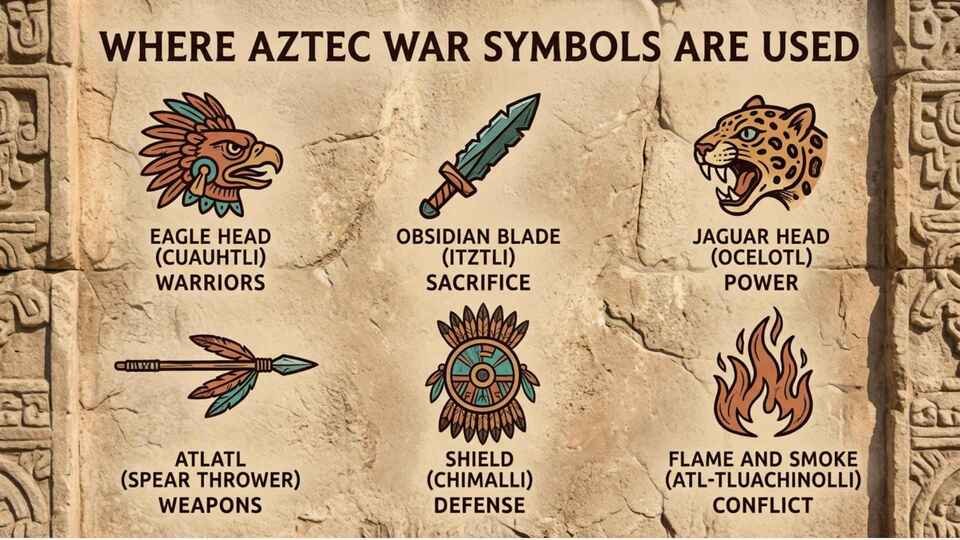
Painted Manuscripts
Codices show warriors, conquests, tribute, weapons, costumes, banners, and place signs. Some were produced before the conquest, while others were painted during the colonial period using Indigenous artistic traditions.
Temple Sculpture
War gods, eagles, serpents, skulls, shields, and sacrificial images appeared in temple precincts. Their placement linked imperial authority with sacred space.
Ceremonial Drums
The carved drum from Malinalco is decorated with eagles, jaguars, and imagery related to warfare and sacrifice. Such instruments combined sound, performance, religion, and visual symbolism.
Warrior Clothing
Animal suits, feathered costumes, helmets, cloaks, and back devices identified military achievement. Their materials and designs communicated rank.
Shields and Weapons
Functional equipment could carry symbolic designs. Ceremonial versions displayed wealth, craftsmanship, and political power.
Poetry and Speech
Nahua poetry used flowers, shields, eagles, jaguars, dust, and battlefield imagery as metaphors for honor, danger, death, and glory.
Modern Tattoos
Modern tattoos commonly feature eagle warriors, jaguar warriors, Huitzilopochtli, macuahuitls, shields, or geometric designs inspired by codices. Their current meanings may include strength, ancestry, cultural pride, survival, or resistance.
Murals, Logos, and Entertainment
Aztec-inspired war imagery appears in public murals, team names, clothing brands, films, games, and fantasy art. These designs often combine symbols from different periods or cultures, so they should not automatically be treated as historically accurate.
Common Variations and Similar Designs
Eagle-Warrior Designs
These may show a full human figure in a feathered suit, a helmet with an open beak, or a simplified eagle head. Historically accurate examples should include features based on codices or archaeological objects rather than generic Roman or modern military armor.
Jaguar-Warrior Designs
These often use spotted skin, claw imagery, fangs, or a feline helmet. Modern designs may resemble Maya jaguar imagery, so cultural attribution requires care.
Decorated Chimalli Shields
Shield designs vary widely. Some have geometric patterns, feathers, tassels, animal forms, or deity-related imagery. There was no single universal “Aztec war shield” pattern.
Weapon Combinations
Modern art often crosses two macuahuitls behind a shield. This arrangement resembles later heraldic or military-logo conventions and should not be assumed to be an ancient Aztec emblem.
Calendar-Stone Adaptations
The famous Sun Stone is frequently used as a general “Aztec warrior symbol.” Although it contains powerful cosmological imagery, it is not simply a war emblem. Using its entire design to mean “war” oversimplifies its calendrical, solar, political, and ritual meanings.
Common Misconceptions About Aztec War Symbols
There Was One Official Aztec Symbol for War
No single image functioned exactly like a modern military logo. Aztec war symbolism consisted of animals, weapons, costumes, metaphors, gods, banners, and ritual objects.
Every Eagle Image Represents an Eagle Warrior
Eagles also had solar, calendrical, sacrificial, divine, and political meanings. The surrounding context determines whether an image refers to a military order.
Jaguar Warriors Were Ordinary Soldiers
Jaguar warriors were associated with achievement and elite status. Their clothing was not a standard uniform for every member of an Aztec army.
Aztec Warriors Always Fought to Kill
Killing occurred, but taking captives could be an important measure of success. Military tactics and goals varied according to the battle.
All Aztec Wars Were “Flower Wars”
Flower wars were a particular form of organized conflict involving certain rival states. The term should not be applied to every campaign, rebellion, siege, or territorial conquest.
The Sun Stone Is an Aztec War Calendar
The Sun Stone is neither a simple war symbol nor an ordinary wall calendar. It is a complex monument involving cosmic eras, solar power, calendrical signs, sacred time, and state authority.
Modern Crossed-Weapon Tattoos Are Ancient Emblems
Many crossed-macuahuitl or shield-and-weapon compositions are modern inventions. They may draw on authentic objects without reproducing a documented pre-Hispanic symbol.
Aztec and Maya Warrior Symbols Are Interchangeable
The Aztec and Maya civilizations shared broad Mesoamerican traditions but had distinct languages, histories, governments, gods, artistic systems, and military institutions.
Interesting Facts About Aztec War Symbols
- Warrior clothing recorded achievement.
Costumes and insignia could communicate rank and success, making clothing a visible military record. - Eagle and jaguar imagery expressed complementary power.
The eagle suggested daylight and the sky, while the jaguar evoked night and the earth. - Capturing an enemy could matter more than killing one.
Captives provided evidence of courage and could support social advancement and ceremonial obligations. - Some shields were works of luxury art.
Feathered ceremonial shields displayed extraordinary craftsmanship and were not merely defensive equipment. - Battlefield insignia had a practical purpose.
Tall banners and back devices helped soldiers locate leaders and units during crowded combat. - War had its own poetic language.
Nahua poets referred to shields, flowers, eagles, jaguars, dust, and burning water when describing conflict and honor. - Atl-tlachinolli combined opposites.
The joining of water and fire expressed the disruptive and transformative force of war. - The hummingbird had a warrior connection.
Hummingbirds are small, but their speed, territorial behavior, and association with Huitzilopochtli gave them martial importance. - Obsidian supplied exceptionally sharp edges.
Aztec weapons used carefully shaped volcanic glass, although its brittleness required skilled construction and maintenance. - Elite costumes could become battlefield targets.
The same clothing that displayed command and prestige could help opponents identify leaders. - War imagery appeared on musical instruments.
Ceremonial drums joined military symbolism with dance, sound, ritual performance, and public memory. - Modern meanings often differ from ancient ones.
A jaguar tattoo may now represent independence, while its historical meaning involved elite status, nocturnal power, warfare, and ritual duty.
Related Aztec and Mesoamerican Symbols
Quetzalcoatl
The Feathered Serpent represented wind, knowledge, priestly authority, creation, and other concepts depending on the period and region. He was not primarily an Aztec war symbol.
Tezcatlipoca
Tezcatlipoca was associated with rulership, conflict, fate, night, sorcery, and the jaguar. His imagery can overlap with warrior themes but carries broader divine meanings.
Mixcoatl
Mixcoatl, the Cloud Serpent, was linked with hunting, stars, ancestry, and warrior traditions. His symbolism is more closely tied to hunting and celestial identity than to the main Mexica imperial cult.
Coyolxauhqui
Coyolxauhqui appears in the myth of Huitzilopochtli’s birth and victory. Her dismembered stone monument communicated defeat, cosmic order, and the consequences of opposing the patron god of the Mexica.
Tlaloc
Tlaloc represented rain, storms, agricultural fertility, and dangerous natural power. Although not primarily a war deity, his shrine beside Huitzilopochtli’s showed how agriculture and conquest supported the state together.
The Sun
Solar imagery represented time, life, rulership, sacrifice, and cosmic struggle. Its relationship with war came through the belief that the sun required divine and human support.
The Skull
The skull symbolized death and sacrifice more directly than military rank. It could refer to captives, ritual power, mortality, or the renewal of life through death.
Frequently Asked Questions
What is the main Aztec symbol for war?
There was no single official Aztec symbol for war. The clearest direct metaphor was atl-tlachinolli, the joining of water and fire. Eagles, jaguars, shields, weapons, military banners, Huitzilopochtli, and fire-serpent imagery also expressed warfare, courage, rank, conquest, or sacred military duty.
What did the Aztec eagle warrior symbolize?
The eagle warrior symbolized bravery, solar power, military achievement, and elite status. Eagle imagery connected warriors with daylight, the sky, and the sun. The costume also showed that its wearer had earned recognition through training and battlefield accomplishments rather than simply choosing the eagle as a personal emblem.
What did the Aztec jaguar warrior symbolize?
The jaguar warrior represented courage, danger, nocturnal power, the earth, and elite military identity. The jaguar’s stealth and strength made it a fitting model for an accomplished fighter. Its symbolism also connected warfare with darkness, caves, rulership, sacrifice, and forces hidden beneath the visible world.
What does atl-tlachinolli mean?
Atl-tlachinolli is a Nahuatl expression commonly translated as “water and scorched earth” or “water and fire.” It functioned as a metaphor for war. In art, it may appear as intertwined streams, sometimes emerging near a ruler, warrior, deity, weapon, or speech scroll.
Was Huitzilopochtli the Aztec god of war?
Yes. Huitzilopochtli was a major Mexica god associated with war, the sun, rulers, warriors, migration, and Tenochtitlan. Calling him only a war god is incomplete, however. His mythology also explained Mexica identity, sacred history, political authority, and the sun’s triumph over hostile cosmic forces.
What did Aztec shields symbolize?
Aztec shields symbolized protection, combat, rank, identity, achievement, and ceremonial prestige. Functional shields defended warriors, while richly decorated feathered examples could serve as regalia, diplomatic gifts, tribute goods, or ritual objects. Their patterns and materials could communicate far more than simple readiness for battle.
Are eagle and jaguar warrior tattoos historically accurate?
They can be historically inspired, but accuracy depends on the design. Many modern tattoos mix authentic Aztec details with Maya art, European armor, fantasy weapons, or invented geometric patterns. Designs based on archaeological sculptures and documented codex images usually provide a more reliable connection to historical Mexica imagery.
Did Aztec warriors use symbols to show military rank?
Yes. Clothing, cloaks, helmets, shields, banners, hairstyles, featherwork, and back-mounted devices could indicate military accomplishment or position. These signs helped communicate status during ceremonies and made important fighters or commanders recognizable on the battlefield.
Were Aztec war symbols purely religious?
No. They were religious, political, social, and practical at the same time. A banner could guide soldiers, identify a commander, display rank, honor a deity, and advertise imperial authority. Modern categories often separate these functions more sharply than Mexica society did.
What is the difference between Aztec and Maya war symbols?
Aztec and Maya war symbols developed within different civilizations, languages, periods, and political systems. Both used jaguars, eagles, serpents, shields, captives, and gods, but the artistic forms and cultural meanings differed. A symbol should be identified through its date, region, inscriptions, clothing, and archaeological context.
Key Takeaways
- Aztec symbols for war formed a visual system rather than one official emblem.
- The eagle represented solar power, courage, daylight, and elite warrior status.
- The jaguar represented night, danger, earth, hidden strength, and military prestige.
- Eagle and jaguar imagery together expressed complementary forms of warrior power.
- The chimalli shield symbolized defense, identity, rank, and ceremonial status.
- The macuahuitl and atlatl represented trained military force and battlefield skill.
- Atl-tlachinolli, the pairing of water and fire, was a direct metaphor for war.
- Huitzilopochtli connected warfare with the sun, Tenochtitlan, rulership, and Mexica identity.
- Military clothing and banners communicated real achievements and battlefield roles.
- Modern tattoos and logos often alter or combine historical meanings.
- Aztec warfare had political, economic, social, and religious purposes.
- Accurate interpretation requires attention to the symbol’s original context.
Conclusion
Aztec symbols for war reveal a culture in which military power could not be separated from religion, government, social status, art, and cosmic responsibility. Eagles and jaguars represented elite forms of courage. Shields and weapons expressed practical skill. Banners displayed rank, while Huitzilopochtli and the fire serpent connected human conflict with sacred history.
The most important lesson is that these symbols did not carry one simple meaning. Their significance depended on where they appeared, who used them, and what event they described. Studied in context, Aztec symbols for war offer a deeper view of how the Mexica understood courage, conquest, sacrifice, leadership, death, and the fragile order of the universe.

I am Amelia Carter, an English language educator and educational writer who enjoys making difficult ideas simple and easy to understand. At LearnNestly, I write about English words, grammar, everyday expressions, and language questions that people often find confusing. I believe learning should feel practical, clear, and enjoyable rather than overwhelming. Through my writing, I try to give readers explanations they can understand and use in real life.
Books:
- The Everyday English Handbook
- Words Made Simple
 Daniel Brooks