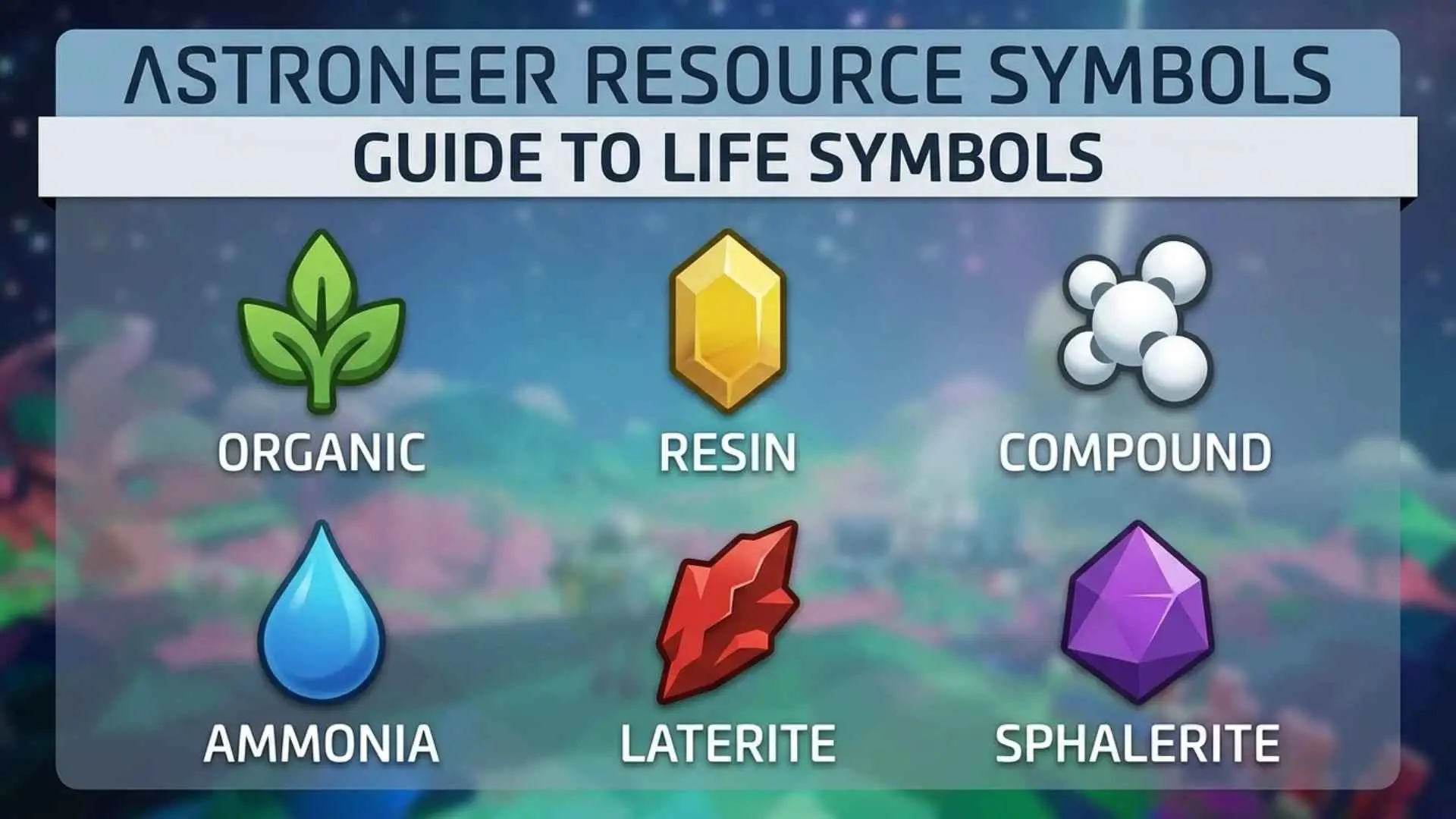
Astroneer resource symbols help players identify materials, minerals, gases, and other essential items while exploring mysterious planets. In Astroneer, every resource has a specific purpose, from crafting basic tools and building platforms to powering machines and unlocking advanced technology. Learning to recognize these icons makes it easier to manage your backpack, understand storage containers, identify gathered materials, and keep your exploration organized.
The game features many different resources, including compounds, resin, organic materials, quartz, laterite, ammonium, graphite, and rare planetary resources. Each resource icon provides a quick visual clue that helps you distinguish one material from another. You will also encounter symbols associated with atmospheric gases, refined materials, bytes, power, and research items. Understanding these resource icons can save time, prevent crafting mistakes, and help you collect the materials you need for your next project.
In this complete guide to Astroneer resource symbols, you will learn how to identify common resource icons, understand their uses, and recognize the differences between natural resources, refined materials, atmospheric gases, and special items. Whether you are a beginner exploring Sylva or an experienced astronaut traveling to distant planets, this guide will help you understand the game’s resource system and make smarter decisions as you gather, craft, research, and build across the solar system.
Quick Meaning
Astroneer resource symbols are in-game pictograms representing specific materials or requirements. Each icon corresponds to a resource such as Compound, Resin, Aluminum, Copper, or Hydrogen. They act as a universal visual language across crafting menus, research containers, missions, storage, and production systems.
Astroneer Resource Symbols Overview
| Field | Details |
| Symbol system | Astroneer resource icons |
| Primary meaning | Identifies a material, gas, item, or operational requirement |
| Category | Video game user-interface symbols |
| Origin | Created for Astroneer by System Era Softworks |
| Common locations | Astropedia, printers, Research Aids, missions, storage, event panels |
| Main purpose | Fast resource identification without long text labels |
| Symbol style | Simplified geometric pictograms |
| Major groups | Natural, refined, atmospheric, composite, special, and utility resources |
| First practical use | Resource collection, crafting, and research progression |
| Unicode | Not applicable |
| Emoji equivalent | No official equivalent |
| Related symbols | Power icon, oxygen icon, Bytes symbol, item tier indicators |
Astroneer classifies resources into natural, refined, atmospheric, composite, and other functional groups. The official resource system also includes power, oxygen, research-related items, and special event materials.
What Do Astroneer Resource Symbols Mean?
Astroneer resource symbols tell the player which substance is present, required, produced, or accepted by a machine or interface.
For example, a symbol displayed beside a printer recipe shows which material must be inserted before crafting can begin. A symbol on an EXO Dynamics Research Aid indicates which resource must be placed in its input slot. The resource is consumed when the container opens.
The icons perform several related functions:
- Identifying loose resource nuggets
- Showing crafting ingredients
- Labeling machine inputs and outputs
- Marking required materials on Research Aids
- Displaying mission objectives
- Identifying Trade Platform exchanges
- Representing atmospheric gases
- Distinguishing event-specific resources
These symbols are not decorative emblems with hidden spiritual meanings. They are functional interface elements designed to communicate information quickly.
Why the Symbols Are Necessary
Astroneer contains many materials with different sources, processing methods, and uses. Writing every resource name beside every slot would make the interface crowded, especially on smaller screens.
Icons allow the same interface to remain readable on PC, Xbox, PlayStation, and Nintendo Switch. They also help players recognize resources regardless of the language selected in the game.
Major Astroneer Resource Symbol Categories
The easiest way to understand the icon system is to divide it into resource families.
Natural Resource Symbols
Natural resources are collected directly from planetary terrain, deposits, plants, wrecks, or special locations. Some can be used immediately, while others must be processed in a Smelting Furnace or another machine.
Common natural resources include:
| Resource | How to Recognize It | Primary Use |
| Compound | Clustered gray spheres | Basic printers, platforms, and tools |
| Resin | Yellow rounded forms | Platforms, storage, and base equipment |
| Organic | Green plant-like shape | Fuel and Carbon production |
| Clay | Brown irregular lump | Smelted into Ceramic |
| Quartz | Pink crystal shape | Smelted into Glass |
| Graphite | Dark layered or tubular form | Packagers and Graphene |
| Ammonium | Green-yellow angular cluster | Hydrazine and thrusters |
| Laterite | Red-blue mineral form | Smelted into Aluminum |
| Malachite | Green-orange mineral form | Smelted into Copper |
| Sphalerite | Purple-yellow mineral form | Smelted into Zinc |
| Wolframite | Dark green-orange mineral | Smelted into Tungsten |
| Hematite | Red metallic mineral | Smelted into Iron |
| Titanite | Green-gray crystalline mineral | Smelted into Titanium |
| Lithium | Pink-white mineral cluster | Batteries and alloys |
| Astronium | Bright blue-violet crystalline form | Trading and advanced uses |
Visual appearance may vary slightly because icons simplify the three-dimensional resource model. Players should therefore compare the general silhouette rather than expecting an exact picture of the nugget.
Refined Resource Symbols
Refined resources are usually created by placing raw minerals in a Smelting Furnace.
| Refined Resource | Source Material |
| Carbon | Organic |
| Ceramic | Clay |
| Glass | Quartz |
| Aluminum | Laterite |
| Copper | Malachite |
| Zinc | Sphalerite |
| Tungsten | Wolframite |
| Iron | Hematite |
| Titanium | Titanite |
These icons commonly appear in printer recipes because refined metals and processed materials form the foundation of advanced base construction.
Aluminum, for example, is used in vehicles, platforms, and machinery. Copper appears in electrical and technological equipment. Iron and Titanium become increasingly important as the player unlocks larger modules and more advanced production chains.
Atmospheric Resource Symbols
Atmospheric resources are gases collected by an Atmospheric Condenser. Their icons usually look more abstract than mineral symbols because gases do not have solid nugget models in the natural environment.
The main atmospheric resources are:
- Hydrogen
- Argon
- Methane
- Nitrogen
- Sulfur
- Helium
Gas availability depends on the planet. Some planets provide a high concentration of a gas, while others offer a lower collection rate or none at all.
Atmospheric symbols often appear in Chemistry Lab recipes. Hydrogen, for example, is combined with Ammonium to produce Hydrazine. Argon is required for Steel, while Helium is associated with some of the game’s most advanced composite materials.
Composite Resource Symbols
Composite resources are manufactured in the Chemistry Lab by combining two resources, sometimes with an atmospheric gas.
Important composite materials include:
| Composite Resource | Typical Ingredients |
| Rubber | Organic and Resin |
| Plastic | Carbon and Compound |
| Aluminum Alloy | Aluminum and Copper |
| Tungsten Carbide | Tungsten and Carbon |
| Graphene | Graphite and Hydrazine |
| Diamond | Graphene and Graphene |
| Hydrazine | Ammonium and Hydrogen |
| Silicone | Resin, Quartz, and Methane |
| Explosive Powder | Carbon, Carbon, and Sulfur |
| Steel | Iron, Carbon, and Argon |
| Titanium Alloy | Titanium, Graphene, and Nitrogen |
| Nanocarbon Alloy | Titanium Alloy, Steel, and Helium |
Composite symbols represent technological progression. They appear frequently in recipes for advanced vehicles, large storage systems, automation devices, portable tools, rockets, and endgame equipment.
Special and Utility Symbols
Not every resource-like icon represents a conventional crafting material.
Players may also see symbols for:
- Soil
- Scrap
- Oxygen
- Power
- Bytes
- Research Samples
- EXO Chips
- Seeds
- Event materials
- Mission-specific objects
Scrap is produced by shredding debris and unwanted equipment. It can be exchanged through the Trade Platform for other resources.
Soil is stored in canisters while using the Terrain Tool. It can later be processed through a Soil Centrifuge to produce selected basic resources.
EXO Chips are rare technological items found in certain caches, wrecks, and other sources. They are required for several advanced recipes. Astronium may also be exchanged for EXO Chips through the Trade Platform.
Where Astroneer Resource Symbols Came From
Astroneer resource symbols originated as part of the game’s interface and crafting language rather than from any historical alphabet or ancient symbolic tradition.
Astroneer is an aerospace exploration, survival, crafting, and base-building game. Its setting emphasizes planetary discovery, industrial production, terrain manipulation, and technological progress. The symbol system supports these activities by giving every important material a recognizable visual identity.
The official game describes Astroneers as explorers operating during an interplanetary age of discovery, building bases and vehicles while uncovering planetary mysteries.
Development of the Icon System
As Astroneer expanded, its resource economy became more complex. The game introduced:
- Additional planets and resource distributions
- Atmospheric gases
- Chemistry Lab materials
- Automation equipment
- Trade systems
- EXO events
- Mission-related resources
- Advanced composite substances
The icon library grew with these systems. Resource symbols now function as a compact vocabulary that connects exploration, manufacturing, research, logistics, and mission progression.
Why the Designs Look Abstract
Many icons use simplified forms because they must remain readable at small sizes. A detailed mineral illustration would become unclear on a printer screen or Research Aid panel.
The designers therefore emphasize:
- Strong silhouettes
- Limited internal detail
- Distinct shapes
- Recognizable color combinations
- Consistency with the resource model
This approach allows players to identify a symbol after seeing it only a few times.
Symbolism and Interpretation

Astroneer resource symbols primarily have practical meanings, but their design also reflects broader themes within the game.
Exploration
Raw resource icons represent discovery. Players must leave the safety of their base, travel through different terrain layers, and visit other planets to obtain materials that do not exist locally.
Transformation
Refined and composite symbols represent transformation. A raw deposit becomes a metal, and several processed materials become a more advanced substance.
This visual progression mirrors the player’s development from a survivor gathering Compound and Resin to an engineer producing Nanocarbon Alloy.
Scarcity and Value
Rare-resource icons communicate value because players associate them with difficult environments, deeper cave layers, distant planets, or complicated recipes.
Astronium, Lithium, Helium, and Nanocarbon Alloy often feel more significant than basic resources because obtaining them requires greater preparation.
Order and Industrial Organization
The icon system also supports organization. A well-designed base may use dedicated storage for each resource, allowing the repeated icons and physical nugget shapes to form an understandable inventory network.
Positive and Negative Associations
The icons themselves are neutral, but players may develop positive or negative associations with them.
A Nanocarbon Alloy symbol may represent achievement because it marks access to advanced technology. An Ammonium symbol may cause frustration when a player needs fuel but cannot locate enough deposits.
These reactions come from gameplay experience rather than fixed symbolic meanings.
Cultural and Community Significance
Astroneer resource symbols belong mainly to gaming culture. Their meanings are shared by the game’s player community rather than by a particular nation, religion, or historical civilization.
Players use the icons in:
- Community-made resource charts
- Base organization labels
- Tutorial videos
- Wiki pages
- Fan art
- Printable reference sheets
- Multiplayer communication
- Memes and discussion posts
The symbols can act as shorthand between experienced players. Instead of explaining a complete recipe, one player may refer to the familiar icons for Graphite, Hydrazine, and Graphene.
Cross-Language Communication
Because the icons remain visually consistent, players who speak different languages can still identify the same resource. This makes them useful in international communities and multiplayer sessions.
The names may change through localization, but the shapes and colors generally preserve the resource’s identity.
Scientific and Technical Meaning
Astroneer resource symbols relate loosely to real scientific and industrial materials, but the icons do not function as formal chemical notation.
Resource Names Based on Real Materials
Many resource names come from real minerals, elements, gases, or manufactured materials:
- Hematite is a major iron-bearing mineral.
- Malachite is a copper carbonate mineral.
- Sphalerite is an important zinc ore.
- Wolframite is associated with tungsten extraction.
- Titanite is a naturally occurring mineral containing titanium.
- Argon, Helium, Hydrogen, Methane, Nitrogen, and Sulfur are real chemical substances or elements.
- Graphite, Graphene, Diamond, Steel, and Silicone have real scientific or industrial meanings.
However, Astroneer simplifies their extraction and production for gameplay. Real refining usually requires far more complicated equipment, temperatures, chemical reactions, and safety procedures.
Icons Are Not Chemical Symbols
The resource icons should not be confused with periodic-table abbreviations such as Fe for iron, Cu for copper, or Ti for titanium.
Astroneer uses pictures because players must identify materials quickly through the interface. The symbols are proprietary game graphics, not internationally standardized scientific notation.
Digital User-Interface Function
Technically, the symbols are interface assets. Each icon connects a visual image to an internal resource identity used by the game’s crafting, storage, mission, research, and trading systems.
The official resource icon category includes images for natural materials, refined products, gases, composite resources, power, oxygen, Scrap, Soil, and other items.
Where Astroneer Resource Symbols Are Used
EXO Dynamics Research Aids
Research Aids are large containers found on planets. Some require power, while others display a resource icon.
When a resource symbol appears, place the matching material into the input slot. The container consumes it and opens, revealing a Research Sample, Research Item, or another useful object.
Resource requirements may become more demanding in deeper planetary layers. The icon is therefore an important clue about whether the player has brought the correct materials.
Printers
Backpack, Small, Medium, and Large Printers display resource icons in their recipes. These symbols show exactly what must be attached or supplied before an item can be produced.
Astropedia
The Astropedia acts as an in-game reference for planets, materials, and discoveries. Players can compare an unfamiliar symbol with the resource information displayed there.
Chemistry Lab
The Chemistry Lab uses icons to show input resources, required gases, and the composite material that will be produced.
Smelting Furnace
The Smelting Furnace connects raw-resource icons with their refined outputs, such as Laterite becoming Aluminum or Hematite becoming Iron.
Atmospheric Condenser
The condenser displays atmospheric gas symbols and collection rates available on the current planet.
Trade Platform
The Trade Platform uses symbols to show which resources can be obtained and how much Scrap or Astronium an exchange requires.
Missions and Events
Mission logs and EXO event interfaces may display icons for requested resources, rewards, or shipment items. During limited-time events, special symbols may appear that are not part of the normal crafting economy.
Storage and Automation
Automated arms, canisters, sensors, and storage systems rely on recognizable resource models and icons. Understanding the symbols helps players build efficient sorting and production lines.
Common Variations
Full-Color Resource Icons
These are the standard icons shown in the Astropedia, crafting screens, and online references. They use color and shape together.
Monochrome or Holographic Displays
Some machine panels and holograms may reduce the color detail. In these cases, silhouette becomes more important than color.
Three-Dimensional Resource Nuggets
The physical item attached to a storage slot is not identical to the flat icon. It is a three-dimensional interpretation of the same material.
Event Resource Symbols
Limited-time events may introduce temporary substances with unique icons. These symbols can disappear from normal gameplay after the event or remain relevant only to special machines.
Resipound is one example of an event-related material associated with special Research Aids. Certain colored Research Aids can be opened with it.
Power and Resource Requirements
A lightning-bolt-style power symbol does not request a material nugget. It indicates that the object needs an electrical supply.
Similarly, an oxygen symbol represents breathable oxygen rather than a collectible crafting material in the usual sense.
Common Misconceptions
Every Icon Represents a Solid Resource
Some icons represent gases, power, oxygen, Soil, Scrap, Bytes, or event objectives. Do not assume every symbol requires a solid nugget.
The Symbol Shows the Reward
On a resource-gated Research Aid, the icon normally shows what must be inserted, not what the container will give you.
Color Alone Identifies the Resource
Several icons use similar colors. Shape is often the better clue. Compare the full silhouette rather than relying only on green, purple, gray, or yellow tones.
The Symbols Are Real Scientific Notation
The icons are inspired by materials but are not official mineralogical or chemical symbols.
Every Resource Is Available on Every Planet
Planets share some universal resources, but most have specific primary and secondary ores. Atrox is an exception to the usual primary-and-secondary-resource pattern.
Similar Icons Mean Interchangeable Materials
Graphite, Graphene, and Diamond are connected through crafting, but they are separate materials. One cannot replace another in a recipe.
An Unfamiliar Icon Must Be a Normal Resource
Temporary events can add unusual symbols. If an icon does not match the normal Astropedia list, it may belong to an active or past event.
Interesting Facts About Astroneer Resource Symbols
- The symbols form a complete crafting vocabulary. Players can follow many recipes by reading icons alone, even without focusing on text labels.
- Raw and refined resources are visually separated. Their different designs help players distinguish mined materials from smelted products.
- Research Aid icons are functional locks. The displayed symbol tells the player which material acts as the key for opening the container.
- The icons support localization. A stable pictogram can communicate the same resource across several written languages.
- Many materials have real scientific names. Hematite, Wolframite, Graphene, Argon, and Titanium are based on real substances, although their production is simplified.
- Resource difficulty follows progression. Early icons such as Compound and Resin appear in basic recipes, while advanced icons represent multi-stage manufacturing.
- Some icons represent processes rather than minerals. Power, oxygen, Soil, Scrap, and Bytes function differently from standard ores.
- Event icons can deliberately look unfamiliar. Their unusual appearance separates temporary activities from ordinary production.
- The same symbol may appear in several contexts. An Aluminum icon can represent a printer ingredient, a stored item, a mission requirement, or a Trade Platform result.
- Silhouette matters more than fine detail. This helps the symbols remain visible on small interfaces and distant holographic panels.
- The symbol system encourages visual memory. Experienced players often recognize recipes without reading their names.
- Icons help expose production relationships. Seeing Graphite, Hydrazine, Graphene, and Diamond in sequence teaches the player how materials connect.
Related Astroneer Symbols
Power Symbol
The power symbol indicates electricity generation, consumption, or a required power supply. Unlike a resource icon, it usually does not ask for a material.
Oxygen Symbol
This symbol represents breathable oxygen, oxygen production, or the player’s life-support network.
Bytes Symbol
Bytes are the research currency used to unlock schematics. The symbol represents knowledge progression rather than a physical substance.
Research Symbol
Research-related icons identify samples, research items, or objects that can produce Bytes through a Research Chamber.
Research Items vary in shape, color, location, and research value. They are placed in a Research Chamber to generate Bytes.
Scrap Symbol
Scrap represents recyclable material produced by shredding debris or unwanted items. It functions as a trading currency on the Trade Platform.
EXO Chip Symbol
The EXO Chip icon represents rare technology used in advanced crafting. It differs from the Bytes symbol because an EXO Chip is a physical inventory item.
Item Tier Indicators
Tier labels describe object size and slot requirements. They do not identify the material from which the item is made.
Frequently Asked Questions
What are Astroneer resource symbols?
Astroneer resource symbols are visual icons assigned to materials, gases, crafted substances, and utility resources. They appear in crafting menus, the Astropedia, Research Aids, missions, trading interfaces, and production machines. Each icon lets players recognize a resource without depending entirely on written labels.
How do I identify a resource symbol in Astroneer?
Open the in-game Astropedia and compare the unfamiliar icon with the listed resources. Pay attention to both silhouette and color. You can also examine printer recipes or storage items. For Research Aids, the displayed symbol identifies the resource that must be inserted into the slot.
What does the symbol on an EXO Research Aid mean?
A resource symbol on an EXO Dynamics Research Aid shows which material the container requires. Attach the matching resource to its input slot. The resource is consumed, the container opens, and the player can collect the research object or other contents stored inside.
Why does a Research Aid show a lightning symbol?
The lightning or power symbol means the Research Aid requires electrical power instead of a resource nugget. Connect an appropriate power source and meet the displayed power condition. Some containers require a sustained supply, while others respond to a particular level of power input.
Are Astroneer resource symbols chemical symbols?
No. Astroneer icons are game-specific pictograms, not official chemical abbreviations. Aluminum may be represented scientifically as Al and iron as Fe, but the game uses illustrated icons. The names often refer to real minerals or substances, while their collection and processing are simplified.
What is the rarest resource symbol in Astroneer?
Rarity depends on the player’s stage, planet access, and production setup. Naturally occurring Astronium and Lithium may initially feel rare, while Helium and Nanocarbon Alloy represent late-game access and advanced manufacturing. EXO Chips are also uncommon because they come from special sources rather than ordinary terrain deposits.
Why can’t I find the resource shown by the icon?
The resource may occur on another planet, in a deeper terrain layer, as an atmospheric gas, or as a crafted composite. It may also be connected to a limited-time event. Check whether the symbol represents a raw ore, refined material, gas, special item, or manufactured resource.
Do resource icons change between planets?
The core icon assigned to each resource remains consistent. What changes is the resource’s availability. Different planets have different primary ores, secondary ores, gases, terrain layers, and collection conditions, so the same symbol may be common on one world and unavailable on another.
What is the difference between Graphite and Graphene symbols?
Graphite is a naturally collected dark resource used for Packagers and as a Chemistry Lab ingredient. Graphene is an advanced composite made from Graphite and Hydrazine. Their icons are related visually, but they represent different stages of processing and cannot be substituted for one another.
Can I label storage with resource symbols?
Astroneer does not treat the icons as ordinary editable text characters or Unicode symbols. However, players can organize storage by attaching one example resource, using dedicated canisters, arranging platforms consistently, or creating physical signs and color-coded sections around a base.
Key Takeaways
- Astroneer resource symbols identify materials, gases, utilities, and special items.
- They appear on printers, Research Aids, missions, production machines, and trading interfaces.
- Symbols should be recognized by shape and color together.
- Natural, refined, atmospheric, and composite resources form the main icon groups.
- A symbol on a resource-gated Research Aid shows the required input.
- Power and oxygen icons do not represent ordinary crafting nuggets.
- Many resource names come from real science, but the icons are game-specific.
- Unfamiliar symbols may belong to limited-time events or special missions.
- The Astropedia is the best in-game reference for checking resource identities.
- Learning the icons makes crafting, exploration, storage, and automation faster.
Conclusion
Astroneer resource symbols create a clear visual language for the game’s entire exploration and manufacturing system. Each icon connects a material to its source, processing method, recipes, machines, and practical uses.
By learning the differences among natural resources, refined metals, atmospheric gases, composite materials, and utility symbols, players can understand Research Aids, manage storage, follow crafting recipes, and plan interplanetary expeditions more efficiently. Mastering Astroneer resource symbols ultimately turns a confusing collection of shapes into an intuitive map of the game’s technological progression.

I am Ethan Mitchell, an English writer and lifelong learner who is fascinated by words and the way language changes over time. At LearnNestly, I share practical explanations designed for readers who want to improve their understanding of English without complicated terminology. I enjoy researching meanings, usage, grammar, and common language mistakes, then presenting the information in a simple and useful format. My purpose is to make every article a small learning experience that readers can actually apply.
Books:
- The Smart Learner’s English Guide
- English in Real Life
 Daniel Brooks
 Amelia Carter