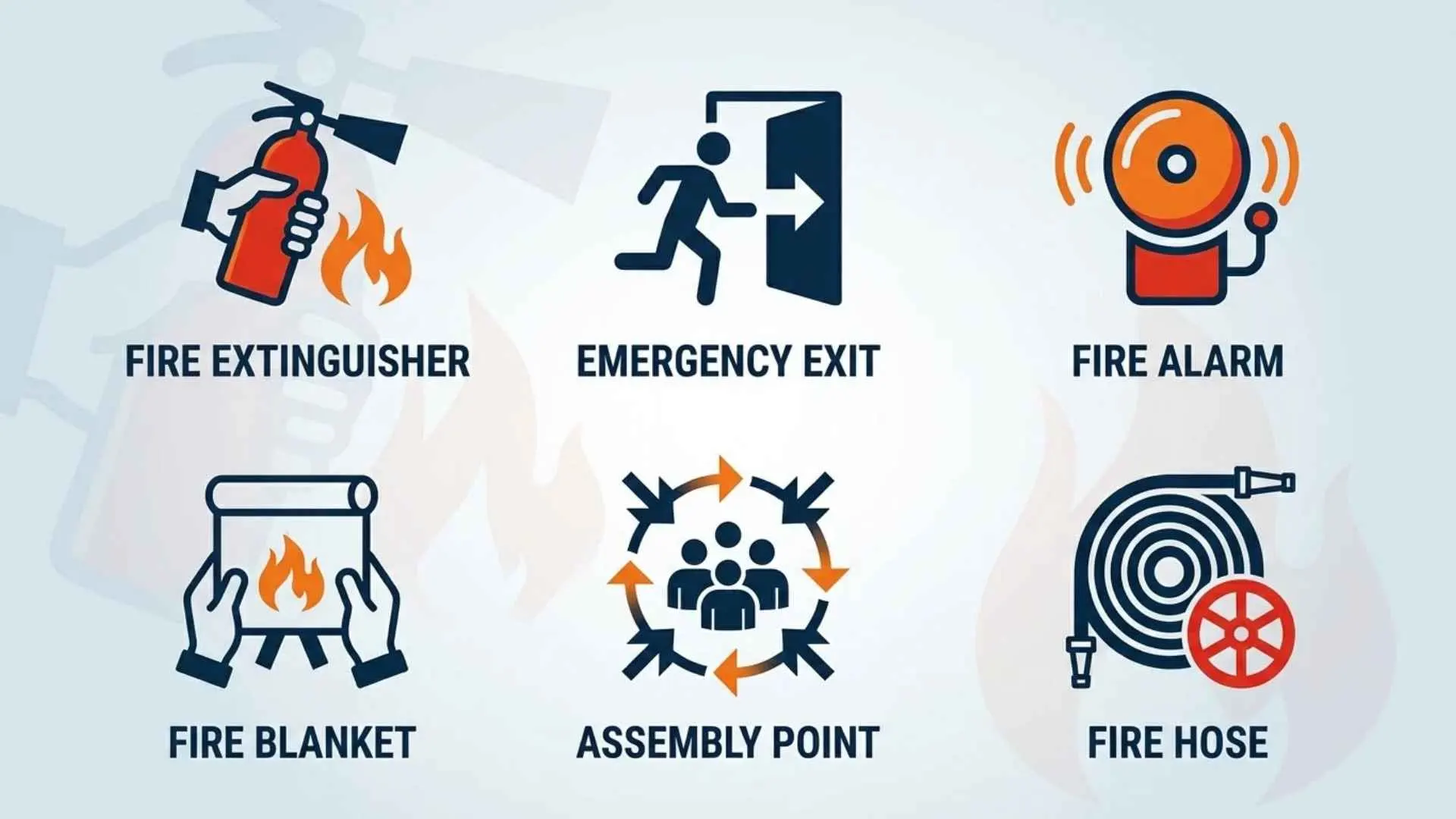
Fire extinguisher symbols help people identify which types of fires an extinguisher can safely handle. These symbols are usually displayed on the extinguisher’s label and use letters, pictures, colors, or simple diagrams to communicate important safety information. Whether you are at home, in an office, at school, or in an industrial workplace, understanding these markings can help you recognize the correct extinguisher during an emergency and avoid using the wrong type.
Different fire extinguisher symbols represent different fire classes, including fires involving ordinary combustible materials, flammable liquids, gases, cooking oils, and electrical equipment. For example, Class A typically covers materials such as wood and paper, while Class B covers flammable liquids. Other symbols identify extinguishers designed for specific hazards, such as cooking oil fires or combustible metal fires. Understanding these symbols is essential for fire safety, because using an unsuitable extinguisher can increase the danger or expose people to additional risks.
In this complete guide to fire extinguisher symbols, you will learn what each symbol means, how fire classes differ, and how to identify the right extinguisher for common hazards. You will also discover the meaning of extinguisher labels, color markings, operating instructions, and safety warnings. Because fire classification systems vary by country, this guide will explain important differences between common standards and help you understand why checking the extinguisher label and following local fire safety guidance are essential.
Quick Meaning
Fire extinguisher symbols communicate two essential messages: where an extinguisher is located and what kinds of fires it can safely fight. In the United States, the letters A, B, C, D, and K identify fire classes. International safety signs commonly use a white extinguisher pictogram on a red background.
Fire Extinguisher Symbol Overview
| Field | Explanation |
| Symbol name | Fire extinguisher location symbol or fire-class symbol |
| Primary meaning | Identifies firefighting equipment and suitable fire hazards |
| Category | Fire safety and emergency equipment |
| Main location symbol | White extinguisher pictogram on a red field |
| International designation | ISO 7010-F001 |
| U.S. fire classes | A, B, C, D, and K |
| Common usage | Buildings, workplaces, vehicles, vessels, kitchens, maps, and extinguisher labels |
| Modern purpose | Rapid recognition during the early stage of a fire |
| Standardization | National fire codes, product-testing standards, and international safety-sign systems |
| Unicode | No dedicated universal fire extinguisher symbol |
| Emoji equivalent | 🧯 Fire Extinguisher |
| Related symbols | Fire hose reel, fire alarm, emergency exit, flame warning, and no-smoking signs |
The International Organization for Standardization identifies the fire extinguisher location sign as ISO 7010-F001, a fire-equipment safety sign designed for consistent recognition across languages.
What Do Fire Extinguisher Symbols Mean?
Fire extinguisher symbols tell users where equipment is located, what fire hazards it is designed for, and sometimes which hazards must not be attacked with it.
There are three main groups of symbols to understand.
The Fire Extinguisher Location Symbol
The location symbol usually shows the silhouette of a portable extinguisher in white against a red square or rectangular background. It may appear alone or with a white directional arrow.
Its purpose is not to identify the extinguishing agent. Instead, it guides people toward the equipment.
A right-pointing arrow means the extinguisher is located in that direction. An upward arrow may indicate that it is straight ahead, while a downward arrow can identify equipment directly below the sign. The exact interpretation should be confirmed by the building’s sign system because arrow placement varies.
Fire-Class Letters
Letters on an extinguisher identify the classes of fire for which the unit has been tested and classified. OSHA defines an extinguisher classification as the letter designation showing the class or classes of fire on which the extinguisher is effective.
The five principal U.S. classes are:
| Class | Fire involves | Common examples |
| A | Ordinary combustible materials | Wood, paper, cloth, rubber, and many plastics |
| B | Flammable or combustible liquids | Gasoline, oil, solvents, paint, and some greases |
| C | Energized electrical equipment | Wiring, fuse boxes, motors, appliances, and computers |
| D | Combustible metals | Magnesium, titanium, sodium, potassium, and similar metals |
| K | Cooking oils and fats | Deep fryers and commercial cooking appliances |
The U.S. Fire Administration and OSHA use these classifications to help users match extinguishers to hazards.
Pictograms on Extinguisher Labels
Modern extinguisher labels often pair letters with simple drawings. A symbol may show a trash can and wood for Class A, a fuel container for Class B, an electrical plug for Class C, a burning metal object for Class D, or a cooking pan for Class K.
Some labels also use a red diagonal slash across a pictogram. This means the extinguisher must not be used on that type of fire.
The slash is particularly important on water extinguishers. Water may spread burning liquid and can expose the user to electrical hazards when applied to energized equipment.
Meaning of Each Fire Extinguisher Class Symbol
Class A Fire Extinguisher Symbol
The Class A symbol means the extinguisher can be used on ordinary solid combustible materials.
Common Class A fuels include:
- Wood
- Paper
- Cardboard
- Cloth
- Rubber
- Some plastics
- Household trash
A traditional Class A identification system may show the letter A inside a green triangle. Newer labels are more likely to use the letter beside a pictogram of burning wood or a waste container.
Class A extinguishers primarily work by cooling the fuel, soaking it, or interrupting combustion. Water extinguishers are a familiar Class A option, while multipurpose dry-chemical extinguishers may carry an A rating along with B and C classifications.
A Class A symbol does not mean the extinguisher is safe for every solid material. Combustible metals are Class D hazards and require specialized agents.
Class B Fire Extinguisher Symbol
The Class B symbol indicates protection against flammable and combustible liquid fires.
Examples include:
- Gasoline
- Diesel fuel
- Oil
- Alcohol
- Solvents
- Lacquers
- Oil-based paints
- Certain petroleum products
The traditional geometric marking is the letter B inside a red square. Pictorial labels may show a burning fuel can or a pool of burning liquid.
Class B extinguishers work by separating the fuel from oxygen, interrupting the chemical chain reaction, or covering the liquid with a suppressing layer.
Water should not normally be directed at a flammable-liquid fire. A forceful water stream can splash the liquid and spread burning fuel across a larger area.
Class C Fire Extinguisher Symbol
The Class C symbol means the extinguisher is suitable for a fire involving energized electrical equipment.
Typical hazards include:
- Electrical panels
- Wiring
- Circuit breakers
- Motors
- Office equipment
- Appliances
- Computers
- Energized machinery
The older geometric symbol is a blue circle containing the letter C. A modern pictogram may show an electrical plug, outlet, or sparking equipment.
Class C describes the presence of energized electricity, not a unique fuel. Once power is disconnected, the remaining fire is usually treated according to the actual burning material, such as Class A plastic insulation or Class B oil.
An extinguisher used on energized equipment must contain an agent that does not create an unacceptable electrical-conduction hazard. Carbon dioxide, dry chemical, and certain clean-agent extinguishers may carry Class C ratings.
Class D Fire Extinguisher Symbol
The Class D symbol identifies an extinguisher intended for combustible-metal fires.
Hazardous metals may include:
- Magnesium
- Titanium
- Sodium
- Potassium
- Zirconium
- Lithium in certain forms
- Finely divided aluminum
The traditional Class D marking is a yellow star containing the letter D. Current labels may use a pictogram representing burning metal, gears, laboratory material, or metal shavings.
Class D fires behave differently from ordinary material fires. Some burning metals reach extremely high temperatures and can react violently with water, carbon dioxide, or unsuitable dry chemicals.
The correct agent depends on the particular metal. A Class D extinguisher intended for magnesium may not necessarily be appropriate for every other combustible metal. Workplaces with these hazards require extinguisher selection based on the exact material and process.
Class K Fire Extinguisher Symbol
The Class K symbol means the extinguisher is intended for fires involving vegetable oils, animal fats, and other high-temperature cooking media.
Class K hazards commonly occur around:
- Commercial deep fryers
- Restaurant ranges
- Institutional kitchens
- Food trucks
- Cafeterias
- Industrial food-processing equipment
Class K extinguishers usually contain a wet-chemical solution. The agent cools the burning oil and reacts with the fat to form a foam-like surface layer that helps prevent oxygen from reaching the fuel and reduces the risk of reignition.
NFPA explains that Class K extinguishers are designed for deep-fat and cooking-oil fires, which can behave differently from shallow flammable-liquid hazards.
Where a commercial cooking appliance is protected by a fixed suppression system, the system should be activated before the portable Class K extinguisher is applied.
What Do Numbers Such as 2-A or 10-B Mean?
Numbers indicate the extinguisher’s tested firefighting capability; they do not represent the amount of agent in the cylinder.
OSHA distinguishes between a classification and a rating. The letter identifies the fire class, while the numerical rating represents extinguishing potential based on standardized testing.
Understanding an A Rating
A rating such as 1-A, 2-A, or 4-A relates to performance against Class A test fires.
A higher number generally represents greater tested extinguishing capability. It does not guarantee that an untrained person can control a larger fire safely.
Understanding a B Rating
A marking such as 10-B, 20-B, or 60-B indicates tested effectiveness against Class B liquid-fire hazards.
Again, a larger number means more tested capability, but real performance depends on the operator, wind, fuel arrangement, discharge range, and speed of response.
Why Class C Has No Number
Class C usually appears beside an A or B rating, as in 2-A:10-B.
The C confirms that the extinguishing agent is suitable for use where energized electrical equipment is involved. The fire itself still contains Class A or Class B fuel, so the numerical capability comes from those classifications.
Why Some Extinguishers Show ABC
An ABC extinguisher can be used on ordinary combustibles, flammable liquids, and energized electrical equipment. Multipurpose dry-chemical extinguishers are common in homes, offices, schools, workshops, and many commercial buildings.
However, “multipurpose” does not mean universal. A standard ABC extinguisher is not automatically suitable for combustible-metal fires or high-temperature cooking-oil fires.
History and Origin of Fire Extinguisher Symbols
Fire extinguisher symbols are products of modern industrial safety rather than ancient religious, cultural, or heraldic traditions.
Early extinguishers relied heavily on written instructions, manufacturer labels, and locally developed markings. As factories, ships, public buildings, transportation systems, and electrical installations became more complex, users needed faster ways to identify equipment and match it to a hazard.
Development of Letter-Based Fire Classes
Fire classes developed to organize fires by the type of fuel involved. This approach allowed safety authorities and manufacturers to connect each hazard with a suitable extinguishing method.
The letters were practical identifiers rather than abbreviations with hidden meanings. Class A does not officially stand for “ash,” and Class B does not formally stand for “barrel,” although such words are sometimes taught as memory aids.
Growth of Pictorial Labels
Letters work well for trained users, but pictures can communicate more quickly across literacy and language differences. Extinguisher labels therefore began combining letters, colors, shapes, and hazard illustrations.
Modern labels favor pictograms because a person may recognize burning wood, an electrical plug, or a frying pan faster than they can interpret a technical description during an emergency.
International Standardization
International travel, trade, construction, and workplace safety created a need for recognizable signs across national borders. ISO 7010 provides standardized registered safety signs, including F001 for a fire extinguisher. The red background identifies the sign as fire-equipment information, while the white pictogram depicts the equipment.
This standardization reduces dependence on written language, although national regulations and local building codes still determine how signs must be installed.
Symbolism and Interpretation
Fire extinguisher symbols are functional safety signs, but their colors and visual structure carry recognizable associations.
Red as a Fire-Equipment Color
Red attracts attention and is strongly associated with fire, emergency response, danger, and immediate action. On a fire-equipment sign, however, red does not simply mean “danger.” It identifies the location of equipment intended for firefighting.
This distinction matters because red has several safety uses. Depending on the sign system, it can indicate prohibition, emergency stopping, danger, or fire protection.
White as a Contrast Color
The white extinguisher silhouette creates strong contrast against the red field. High contrast improves recognition at a distance and in visually busy environments.
The simple shape also avoids unnecessary detail. A safety pictogram must remain understandable when printed small, mounted high on a wall, or viewed quickly.
Geometric Shapes as Secondary Codes
The older North American class symbols used shape and color as additional identification:
| Fire class | Traditional shape | Traditional color |
| A | Triangle | Green |
| B | Square | Red |
| C | Circle | Blue |
| D | Star | Yellow |
| K | Usually identified by letter and pictogram | Varies by label system |
These combinations supported recognition, but users should always read the current extinguisher label rather than relying only on color or shape.
Psychological Meaning
Psychologically, the symbol represents preparedness and controlled response. It reassures occupants that emergency equipment is available, but it should not create false confidence.
A portable extinguisher is intended for a small, early-stage fire when the user has a safe escape route and understands the equipment. It is not a replacement for evacuation, alarms, sprinklers, or professional firefighters.
Cultural and Regional Significance
Fire extinguisher symbols have no sacred or traditional cultural meaning. Their significance comes from international cooperation and regional safety practices.
United States
The United States commonly uses the classes A, B, C, D, and K. Extinguisher labels often combine class letters with hazard pictograms and numerical performance ratings.
Workplace placement and employee-use requirements may fall under OSHA regulations, while installation, inspection, maintenance, and selection are also influenced by fire codes and standards such as NFPA 10. OSHA requires extinguishers to be selected and distributed according to the types and severity of anticipated workplace fires.
Europe and Other Regions
Many countries use international or regional class systems that are similar but not identical to the North American model.
In parts of Europe and elsewhere:
- Class A covers solid combustible materials.
- Class B covers flammable liquids.
- Class C may refer to flammable gases rather than energized electrical equipment.
- Class D covers combustible metals.
- Class F commonly covers cooking oils and fats.
This difference is critical. A Class C label does not carry exactly the same meaning in every national system.
Australia and New Zealand
Australia and New Zealand commonly recognize classes A, B, C, D, E, and F. In that system, Class E relates to energized electrical equipment, while Class C refers to flammable gases.
Travelers, imported-equipment users, and multinational companies should therefore follow the classification system printed on the local extinguisher and required by the local authority.
Why Regional Differences Exist
Fire classification systems developed through different national standards organizations, fire services, industries, and legal frameworks. Although the underlying science of combustion is universal, the letters assigned to hazard categories are not completely universal.
The safest practice is to match the extinguisher’s label to the actual fuel and follow local fire-safety instructions.
Scientific and Technical Meaning
Fire extinguisher symbols are based on combustion science and standardized product testing.
Relationship to the Fire Tetrahedron
Fire requires several interacting elements:
- Fuel
- Heat
- Oxygen
- A sustaining chemical chain reaction
Extinguishing agents work by removing or interrupting one or more of these elements.
Water mainly cools. Foam can separate fuel from oxygen. Carbon dioxide reduces oxygen around the flame. Dry chemicals interfere with the chemical chain reaction. Wet chemicals cool hot cooking oil and form a protective layer.
The class symbol therefore connects the burning material with an agent capable of interrupting its combustion safely.
Certification and Testing Marks
An extinguisher label may include a certification or classification mark from an independent testing organization. Such marks are different from fire-class symbols.
UL Solutions tests extinguishers under standards covering products such as water, carbon-dioxide, dry-chemical, clean-agent, and foam units. It also identifies UL 711 as a standard used for rating and fire testing of extinguishers.
A certification mark indicates evaluation under specified standards. The A, B, C, D, or K markings explain the fire hazards for which the extinguisher is classified.
Pressure-Gauge Symbols
Many stored-pressure extinguishers have a gauge with a normal operating zone, often shown in green. A needle below or above that zone may indicate a pressure problem.
Not every extinguisher has a gauge. Carbon-dioxide extinguishers, for example, are commonly checked by weight rather than a standard pressure dial.
A gauge in the normal range also does not prove that the extinguisher is fully serviceable. Damage, corrosion, blockage, missing seals, or expired maintenance may still make the unit unreliable.
Where Fire Extinguisher Symbols Are Used
Fire extinguisher symbols appear wherever people need to identify equipment or plan emergency response.
On Extinguisher Cylinders
The cylinder label shows the classes, operating instructions, warnings, extinguishing agent, rating, certification information, and maintenance details.
On Walls and Overhead Signs
Location signs help occupants find extinguishers that may be recessed, hidden by furniture, placed around corners, or blocked from direct view by machinery.
On Building and Evacuation Maps
Floor plans may use a small extinguisher pictogram or an abbreviation such as “FE.” A map legend should explain the exact symbol.
In Commercial Kitchens
Class K signs and placards identify wet-chemical extinguishers near cooking hazards. Instructions may also remind workers to activate the fixed hood-suppression system before using the portable extinguisher.
In Factories and Laboratories
Industrial facilities use specialized markings for combustible metals, solvents, electrical installations, and process-specific hazards.
On Vehicles, Boats, and Aircraft
Extinguisher symbols may mark storage compartments or equipment locations. The correct unit depends on the fuels, electrical systems, regulations, and operating environment involved.
In Safety Training
Training materials use the symbols to teach fire classification, extinguisher selection, and the PASS method: Pull the pin, Aim at the base, Squeeze the handle, and Sweep from side to side. The U.S. Fire Administration recommends training and teaches PASS for portable-extinguisher operation.
Common Variations
Fire extinguisher symbols vary according to their function, standard, and region.
Red Location Sign
The most recognizable version shows a white extinguisher on a red square or rectangle. It identifies equipment location rather than fire class.
Directional Location Sign
This design adds an arrow. It is used when the extinguisher is not immediately visible from the normal approach route.
Letter-Only Classification
Some labels prominently display A, B, C, D, or K without traditional colored shapes.
Letter-and-Pictogram Label
This common design combines the class letter with an image of the associated fuel or hazard.
Prohibited-Use Pictogram
A pictogram crossed by a diagonal slash warns that the extinguisher is unsuitable for that hazard.
Photoluminescent Symbol
Some signs use materials that remain visible after lighting fails. Their appearance may differ in normal light, but the underlying extinguisher pictogram remains recognizable.
Map Icon
Architectural plans and emergency diagrams may simplify the symbol into a small cylinder, outline, or abbreviation.
Common Misconceptions
Every Red Extinguisher Is the Same
Cylinder color alone does not reliably identify the agent or classification. Always read the label.
ABC Means the Unit Can Fight Every Fire
An ABC extinguisher is not automatically suitable for Class D metals or Class K cooking-oil fires.
The Location Symbol Shows the Fire Class
The white extinguisher on a red background marks equipment location. The label on the cylinder identifies its fire classes.
Class C Always Means Electrical Fire
Class C refers to energized electrical equipment in the U.S. system, but it refers to flammable gases in several other national systems.
A Higher Rating Makes Any Fire Safe to Fight
A larger numerical rating means greater tested capability, not permission to attack a growing or dangerous fire.
The Gauge Is a Complete Safety Check
A normal gauge reading does not confirm that the hose, pin, seal, cylinder, agent, and maintenance status are acceptable.
The Fire Extinguisher Emoji Is an Official Safety Sign
The 🧯 emoji represents a fire extinguisher in digital communication, but it does not replace a code-compliant safety sign.
Anyone Should Use an Extinguisher During a Fire
A person should attempt extinguisher use only when the fire is small, an alarm has been raised, the correct unit is available, and a safe exit remains behind the user. Otherwise, evacuation is the priority.
10 Interesting Facts About Fire Extinguisher Symbols
- The location symbol and class symbols perform different jobs. One helps you find the cylinder; the others help you choose the correct cylinder.
- The extinguisher pictogram has an international registration. ISO identifies the fire extinguisher sign as F001, placing it within the fire-equipment category.
- Letters are not completely international. Class C means electrical hazards in the United States but flammable gases in several other systems.
- Class K was created for modern cooking hazards. High-temperature vegetable oils used in commercial fryers behave differently from many traditional flammable-liquid fuels.
- Numbers do not show cylinder capacity. In a rating such as 4-A:80-B, the numbers describe tested extinguishing performance rather than the extinguisher’s weight.
- Class C usually loses its special status when power is removed. After electrical energy is isolated, the remaining fire is classified by the burning fuel.
- Combustible-metal extinguishers can be material-specific. The appropriate Class D agent depends on the reactive metal involved.
- An extinguisher symbol may appear above equipment rather than directly on it. Elevated signs remain visible when crowds, furniture, vehicles, or machinery block the cylinder.
- A certification mark is not a fire-class mark. Certification shows evaluation to a standard, while class markings identify suitable hazards.
- Color should never be the only selection method. Lighting, fading, regional conventions, and manufacturer designs can make color-based identification unreliable.
Related Fire Safety Symbols
Fire Hose Reel Symbol
This sign identifies a hose reel or firefighting hose. It is related to the extinguisher symbol but points to different equipment that may require specific training.
Fire Alarm Call Point Symbol
The call-point symbol marks a manual device used to activate the fire alarm. It does not indicate firefighting equipment.
Fire Alarm Bell or Sounder Symbol
This identifies an alarm or warning system that alerts occupants to evacuate or follow emergency procedures.
Emergency Exit Symbol
The exit sign directs people toward a safe escape route. During a fire, knowing the exit location is more important than attempting to save property.
Flame Warning Symbol
A flame pictogram may warn of flammable materials or fire hazards. It does not necessarily show the location of an extinguisher.
No-Smoking Symbol
This prohibition sign helps prevent ignition in areas containing combustible or flammable materials.
Fire Blanket Symbol
The fire blanket symbol identifies a blanket designed to smother certain small fires or wrap around a person whose clothing is burning.
Frequently Asked Questions
What is the main fire extinguisher symbol?
The main location symbol is a white silhouette of a portable fire extinguisher on a red background. Under ISO 7010, it is identified as F001. It tells people where an extinguisher is located but does not reveal which fire classes the extinguisher can handle.
What do A, B, C, D, and K mean on an extinguisher?
In the United States, A covers ordinary combustibles, B covers flammable liquids, C covers energized electrical equipment, D covers combustible metals, and K covers cooking oils and fats. An extinguisher may show more than one letter when it is suitable for several classes.
What does the triangle symbol on a fire extinguisher mean?
A green triangle containing the letter A is a traditional North American symbol for Class A fires. These fires involve ordinary combustible materials such as wood, paper, cloth, rubber, and many plastics. Many modern labels use pictograms instead of relying solely on the triangle.
What does a circle with a C mean?
A blue circle containing the letter C traditionally identifies suitability for fires involving energized electrical equipment in the United States. Because electrical energy is the special hazard, the extinguisher must use an agent appropriate for energized equipment. Other countries may classify electrical hazards differently.
What does 2-A:10-B mean?
The label means the extinguisher has tested capability against Class A and Class B fires and is also suitable for energized electrical equipment. The numbers represent standardized performance ratings. They do not mean that the cylinder contains two or ten units of extinguishing agent.
What does a crossed-out pictogram mean?
A pictogram covered by a red diagonal slash means the extinguisher should not be used on that hazard. For example, a water extinguisher may show crossed-out liquid-fire and electrical symbols because water can spread burning liquid and create an electrical danger.
Is there a fire extinguisher emoji?
Yes. The fire extinguisher emoji is 🧯. It can represent firefighting, emergency preparedness, safety equipment, or controlling a figurative problem. However, an emoji is not a standardized replacement for an approved fire-equipment sign in a building or workplace.
Are fire extinguisher symbols the same worldwide?
The location pictogram is widely standardized, but fire-class letters differ by region. For example, Class C represents energized electrical equipment in the United States but commonly represents flammable gases in Europe. Users should follow local classifications and read the complete label.
Which symbol should be used for a grease fire?
In a U.S. commercial kitchen, a Class K symbol identifies an extinguisher designed for high-temperature cooking oils and fats. Small residential cooking incidents may require different action depending on the appliance and fuel. Never apply water to burning cooking oil.
When should you not use a fire extinguisher?
Do not attempt to fight a fire that is spreading, producing heavy smoke, blocking your exit, involving an unknown substance, or exceeding your training. Evacuate, close doors when possible, activate the alarm, and contact emergency services. Personal safety always takes priority over property.
Key Takeaways
- The red-and-white extinguisher pictogram identifies the location of firefighting equipment.
- Letters A, B, C, D, and K identify fire classes in the United States.
- Class A covers ordinary combustibles, while Class B covers flammable liquids.
- Class C applies to energized electrical equipment in the U.S. classification system.
- Class D covers combustible metals, and Class K covers cooking oils and fats.
- Numerical ratings describe tested firefighting capability, not cylinder size.
- Crossed-out pictograms identify hazards on which an extinguisher must not be used.
- Fire-class letters can have different meanings in different countries.
- Cylinder color alone is not a reliable way to select an extinguisher.
- Portable extinguishers are intended for small, early-stage fires when a safe escape route remains available.
Conclusion
Fire extinguisher symbols turn complex safety information into visual instructions that can be understood quickly during an emergency. The red-and-white location sign helps people find equipment, while class letters, numbers, and pictograms explain what the extinguisher can and cannot safely control.
Recognizing these markings is useful, but correct action also requires judgment. Always read the cylinder label, understand local fire classifications, maintain a safe escape route, and never attempt to fight a fire that is growing beyond its earliest stage. When understood properly, fire extinguisher symbols become an essential part of safer homes, workplaces, vehicles, and public buildings.

I am Daniel Brooks, a language researcher and writer with a strong interest in how people use English in everyday conversations. I contribute to LearnNestly because I enjoy turning confusing language topics into straightforward lessons. My goal is to help readers understand not only what a word or phrase means, but also when and how to use it naturally. I focus on clear examples, practical explanations, and useful language knowledge that readers can remember.
Books:
- The Practical English Guide
- Understanding Everyday Words
 Ethan Mitchell
 Amelia Carter