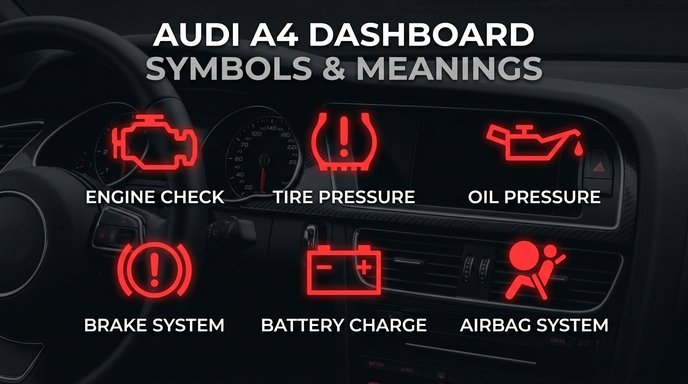
Audi A4 dashboard symbols communicate the condition of your engine, brakes, tires, safety systems, lighting, and driver-assistance features. Some lights simply confirm that a function is active, while red or flashing warnings may signal an immediate safety risk.
Understanding these indicators helps you decide whether to continue driving, schedule an inspection, or stop the vehicle safely.
Because the exact symbols and messages vary by model year, engine, equipment package, and country, use this guide alongside the owner’s manual written specifically for your Audi A4.
Quick Meaning
Audi A4 dashboard symbols use colors and pictograms to report vehicle conditions. Red usually means stop or act immediately, yellow indicates a fault or condition requiring attention, green and blue confirm active functions, and white or gray provide status information. Always read the accompanying driver-information display message before deciding what to do.
Audi A4 Dashboard Symbol Overview
| Dashboard category | Primary meaning | Typical color | Recommended response |
| Critical warning | Serious fault or immediate safety risk | Red | Stop safely and investigate |
| Caution warning | Fault, low fluid, or limited system operation | Yellow or amber | Check soon and arrange service if needed |
| Active function | Feature is switched on and operating | Green | Continue normally |
| Lighting confirmation | Exterior lighting status | Green or blue | No action unless unexpected |
| Information notice | System status, reminder, or temporary condition | White or gray | Read the displayed message |
| Driver-assistance alert | Assistance system active, unavailable, or intervening | Green, white, yellow, or red | Follow the cluster message and take control |
| Maintenance reminder | Service or inspection is due | White or yellow | Schedule maintenance |
| Electric or hybrid system | Battery, charging, or drive-system condition | Green, yellow, or red | Follow the urgency indicated by the color |
Audi states that its online owner’s manuals provide vehicle-specific information for models from model year 2008 onward. The company recommends using the manual matched to the vehicle’s identification number because indicators can differ among vehicles.
What Do Audi A4 Dashboard Symbols Mean?
Audi A4 dashboard symbols are visual messages from the vehicle’s monitoring and control systems. Sensors and electronic control modules continually check mechanical, electrical, braking, emissions, safety, and driver-assistance functions.
When the vehicle detects a condition that requires attention, it displays an icon in the instrument cluster. Newer Audi A4 models may also show a written explanation, warning tone, or recommended action in the Audi virtual cockpit or driver-information display.
The meaning depends on four factors:
- The shape of the symbol
- Its color
- Whether it stays on or flashes
- The message displayed beside it
For example, a steady yellow engine symbol usually indicates an emissions or engine-management fault. A flashing engine symbol may indicate a more serious misfire that could damage the catalytic converter. Likewise, a red oil-can symbol generally represents an oil-pressure problem, not merely a routine reminder to add oil.
Never interpret an icon by shape alone. Read the full instrument-cluster message whenever one appears.
Understanding Audi Dashboard Warning-Light Colors
Red Symbols Mean Stop or Respond Immediately
A red Audi A4 dashboard symbol usually identifies a serious problem, an unsafe condition, or an essential action that cannot be delayed.
Examples include:
- Low engine-oil pressure
- Excessive coolant temperature
- Brake-system failure
- Charging-system malfunction
- Steering-system failure
- An unfastened seat belt
- An open door, hood, or trunk
- A serious drive-system malfunction
When a red mechanical warning appears, reduce speed, avoid hard acceleration, and stop in a safe location as soon as possible. Shut off the engine when the display instructs you to do so.
Yellow or Amber Symbols Mean Check the Vehicle
A yellow light usually means the car has detected a fault, limited operation, or maintenance-related condition. The vehicle may remain drivable, but the issue should not be ignored.
Common examples include:
- Check-engine warning
- Low tire pressure
- Anti-lock braking system fault
- Electronic stabilization control fault
- Low washer fluid
- Brake-pad wear
- Adaptive-lighting malfunction
- Driver-assistance system unavailable
A yellow warning may become more serious if it flashes, appears with a red message, or accompanies unusual sounds, odors, smoke, vibration, poor braking, or reduced engine power.
Green Symbols Confirm Active Features
Green indicators generally show that a feature is switched on and operating normally. Examples include turn signals, low-beam headlights, cruise control, lane guidance, and certain driver-assistance functions.
A green symbol is usually informational rather than a warning.
Blue Symbols Identify Special Lighting Functions
The most familiar blue indicator is the high-beam headlight symbol. It means the high beams are currently active.
Blue may also be used for certain temperature or system-status messages in some model years, but drivers should rely on the accompanying text rather than color alone.
White and Gray Symbols Provide Status Information
White or gray icons commonly represent standby modes, reminders, unavailable functions, or settings that are selected but not actively controlling the vehicle.
For example, a driver-assistance icon may appear white when the system is switched on but not currently intervening. Audi explains that some lane-guidance displays use different colors to show whether a system is active, passive, or switched off.
Red Audi A4 Dashboard Symbols and Meanings
Brake System Warning
Appearance: A circle containing an exclamation mark or the word “BRAKE,” often surrounded by curved brackets.
Meaning: The parking brake may be applied, the brake-fluid level may be low, or the hydraulic braking system may have a fault.
First, confirm that the parking brake is fully released. If the warning remains on, stop driving as soon as it is safe. Low brake fluid or a hydraulic failure can reduce braking ability.
Do not confuse this warning with the yellow ABS light. If the red brake warning and yellow ABS warning appear together, important braking functions may be limited.
Engine Oil Pressure Warning
Appearance: A red oil can, sometimes with a dripping line.
Meaning: The engine may not be receiving sufficient oil pressure.
Stop the engine as soon as it is safe. Check the oil level according to the owner’s manual, but do not assume adding oil will solve the problem. A pressure warning may result from a failed oil pump, blocked oil passage, sensor fault, or severe oil loss.
Continuing to drive with inadequate oil pressure can cause major engine damage.
Coolant Temperature or Coolant-System Warning
Appearance: A thermometer above wavy lines.
Meaning: The engine coolant may be too hot, the coolant level may be low, or the cooling system may have malfunctioned.
Stop safely, switch off the engine, and allow it to cool. Never open the coolant reservoir while the system is hot because pressurized coolant can cause serious burns.
If steam is visible, keep away from the engine compartment until the vehicle cools.
Battery or Charging-System Warning
Appearance: A battery with positive and negative terminals.
Meaning: The alternator, belt drive, battery connection, or electrical charging system may not be working correctly.
The engine may continue running temporarily on stored battery power, but it could shut down once that power is exhausted. Turn off unnecessary electrical equipment and arrange assistance.
This symbol does not always mean the battery itself needs replacement.
Steering-System Warning
Appearance: A steering wheel, sometimes with an exclamation mark.
Meaning: Power-steering assistance may be severely reduced or unavailable.
The steering wheel can become much harder to turn, especially at low speed. Stop safely and restart the vehicle only if the displayed instructions permit it. If the red warning remains, do not continue driving without professional guidance.
Safety-Belt Warning
Appearance: A seated person wearing a belt.
Meaning: The driver or a passenger has not fastened a seat belt, or an object on a seat is activating the occupancy sensor.
Fasten all occupied-seat belts before driving. Secure heavy objects in the cargo area rather than placing them on a passenger seat.
Door, Hood, or Trunk Open
Appearance: A vehicle diagram showing an open panel.
Meaning: A door, the hood, or the trunk is not fully latched.
Stop and close the indicated opening. An improperly secured hood is especially dangerous because it could rise and block the driver’s view.
Airbag or Restraint-System Red Warning
Depending on the A4 generation, restraint-system problems may appear in red or yellow.
Meaning: An airbag, seat-belt pretensioner, passenger-detection system, or related safety component may have malfunctioned.
The airbags may not operate as designed in a collision. Arrange diagnosis promptly. Audi notes that an illuminated airbag warning requires professional inspection and is not automatically connected to a particular recall.
Yellow Audi A4 Dashboard Symbols and Meanings
Check-Engine Light
Appearance: An outline shaped like an engine.
Meaning: The engine-management or emissions-control system has detected a fault.
A steady light may result from an emissions problem, sensor fault, ignition issue, fuel-system problem, or loose fuel cap. Check that the fuel cap is properly secured if your A4 uses one.
A flashing light is more urgent. Reduce speed, avoid heavy acceleration, and obtain service because an active misfire may damage emissions components.
Electronic Power Control Warning
Appearance: The letters “EPC.”
Meaning: The Electronic Power Control system has detected a fault involving the throttle, engine management, accelerator pedal, brake-light switch, or related electronics.
The vehicle may enter reduced-power mode. Drive gently if the car remains safe and responsive, then have the fault diagnosed.
Tire-Pressure Monitoring Warning
Appearance: An exclamation mark inside a tire-shaped outline.
Meaning: One or more tires may be underinflated, or the tire-pressure monitoring system may need to be stored, reset, or repaired.
Slow down and inspect every tire. A puncture may not always be visually obvious. Check pressures when the tires are cold and use the specifications on the vehicle’s tire-information label.
Audi explains that the indicator can report low pressure, a monitoring-system malfunction, or a system that was not reset correctly.
Anti-Lock Braking System Warning
Appearance: “ABS” inside a circle.
Meaning: The anti-lock braking system has malfunctioned.
Normal braking may remain available, but the wheels can lock during hard braking. Electronic stability and traction functions may also be affected.
Drive cautiously and arrange service. Treat the situation as more urgent when the red brake warning appears at the same time.
Electronic Stabilization Control
Appearance: A car with wavy skid lines.
Flashing meaning: The system is actively helping control wheelspin or vehicle stability.
Steady meaning: The system may be switched off, limited, or malfunctioning.
When the light flashes on a slippery road, reduce acceleration and drive smoothly. A steady light requires checking the vehicle settings and, if it remains illuminated, arranging an inspection.
Brake-Pad Wear Warning
Appearance: A circle with segmented or broken curved lines around it.
Meaning: The monitored brake pads have reached their wear threshold.
Schedule a brake inspection soon. The symbol does not measure every pad directly, so technicians should inspect the complete braking system rather than replacing only one monitored component.
Low Engine-Oil Level
Appearance: A yellow oil can, sometimes with a level line or “MIN” message.
Meaning: The engine-oil level may be low, or the oil-level sensor may be faulty.
Check the oil level on level ground using the procedure specified for your model. Add only oil that meets the correct Audi or Volkswagen specification. Do not overfill.
A yellow oil-level warning differs from a red oil-pressure warning. Red requires immediate action.
Low Coolant Level
A yellow coolant symbol or written message may appear when the coolant is below the recommended level.
Wait until the engine is completely cool before inspecting the reservoir. Use only the coolant type specified for the vehicle. Repeated coolant loss can indicate a leak and requires professional diagnosis.
Diesel Particulate Filter Warning
Appearance: A rectangular filter containing dots or exhaust lines.
Meaning: The diesel particulate filter in a diesel-powered A4 has accumulated soot and may need regeneration.
Some models may permit a controlled drive to help regenerate the filter. Follow the exact cluster and manual instructions. Do not attempt regeneration when a red warning, overheating condition, or serious engine fault is present.
AdBlue or Diesel Exhaust Fluid Warning
Appearance: A fluid-container, exhaust-related symbol, or written AdBlue message.
Meaning: The diesel exhaust fluid level is low, the quality is incorrect, or the selective catalytic reduction system has a fault.
Add approved diesel exhaust fluid before the displayed countdown reaches zero. Some diesel vehicles may not restart after the remaining range is exhausted.
Fuel-Level Warning
Appearance: A fuel pump.
Meaning: The fuel supply has reached the reserve level.
Refuel soon. Repeatedly driving a gasoline or diesel vehicle with very little fuel may expose the fuel pump to unnecessary heat and can make fuel delivery unreliable on steep slopes.
Washer-Fluid Warning
Appearance: A windshield with spray above it.
Meaning: The windshield-washer reservoir is low.
Add a suitable washer fluid. Use a winter-rated product where freezing conditions occur.
Exterior Bulb Failure
Appearance: A light bulb, often with an exclamation mark.
Meaning: One or more exterior lights may not be working, or an adaptive lighting component has malfunctioned.
Inspect headlights, brake lights, turn signals, taillights, and license-plate lighting. LED-equipped vehicles may require professional diagnosis rather than a simple bulb replacement.
Airbag and Safety-System Warning
Appearance: A seated person facing a circular airbag.
Meaning: A fault may exist in the airbags, belt pretensioners, occupancy detection, or restraint electronics.
The car may still drive normally, but crash protection could be reduced. Have the system checked promptly.
Key Not Detected or Key-System Warning
Appearance: A key, key outline, or written key message.
Meaning: The vehicle cannot detect the remote key, the key battery is weak, or the keyless-access system has malfunctioned.
Move the key away from phones or other electronic devices, try the designated emergency key position, and replace the key battery when necessary.
Green, Blue, and White Audi A4 Indicators
Turn-Signal Indicators
Green arrows flash when the turn signals or hazard lights are operating.
A rapidly flashing arrow commonly suggests that an exterior turn-signal light is not working correctly. Inspect the relevant lights.
Low-Beam Headlights
A green headlamp symbol with downward-angled beams indicates that the low-beam headlights are on.
High-Beam Headlights
A blue headlamp symbol with straight horizontal beams means the high beams are active. Dim them when approaching or following other road users.
Front or Rear Fog Lights
Fog-light icons use a lamp shape crossed by a wavy vertical line. Front and rear fog indicators point in different directions and may use different colors.
Rear fog lamps are bright and can dazzle drivers behind you. Use them only in severely reduced visibility and switch them off when conditions improve.
Cruise Control and Adaptive Cruise Assist
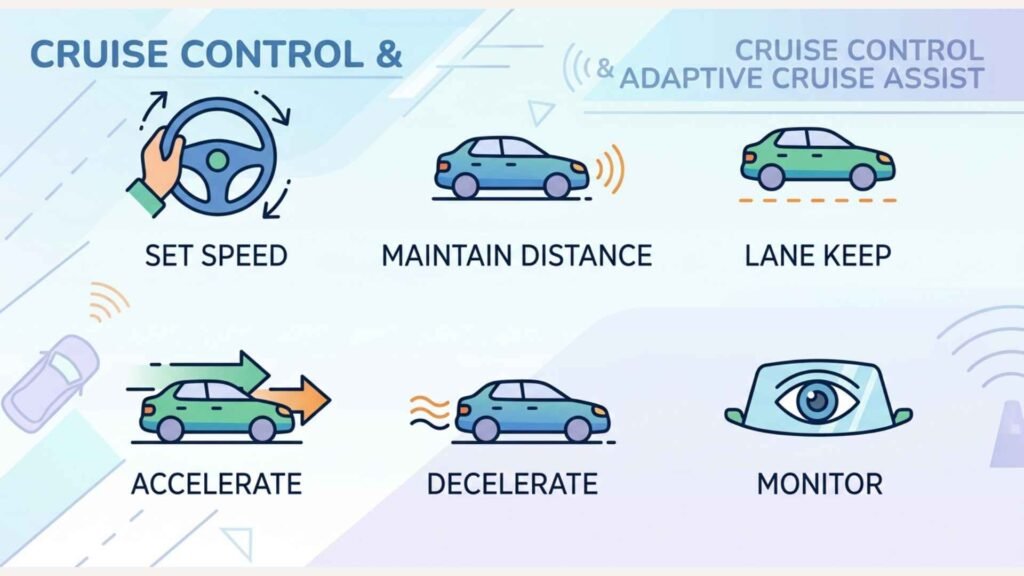
A speedometer, vehicle, or distance-bars symbol may indicate that cruise control or adaptive cruise assist is selected or active.
Green typically means the system is regulating speed or distance. White or gray may mean it is selected but not actively controlling the vehicle. Yellow or red can identify limited operation or a request for driver intervention.
Audi describes adaptive cruise assist as a system that can regulate speed and following distance, while reminding drivers that road conditions and tire grip can affect braking performance.
Lane-Departure Warning or Lane Guidance
Appearance: A vehicle between lane markings.
Green lane lines usually mean the system recognizes the road markings and is active. White or gray lines can mean the feature is on but not currently available. Yellow or red may signal a warning, fault, or need for immediate steering input.
The system does not replace attentive driving. Faded markings, construction zones, snow, glare, and heavy rain can restrict camera performance.
Start-Stop System
Appearance: The letter “A” inside a circular arrow.
Green generally means the engine has been stopped automatically to save fuel. A crossed-out, white, or yellow version may indicate that automatic stop is unavailable or that the system has a fault.
The feature may remain inactive when the engine is cold, battery charge is low, climate demand is high, or other operating conditions are not met.
Parking Assistance
A “P,” steering wheel, sensor waves, or vehicle-and-space graphic may identify parking sensors or automated parking assistance.
Newer systems can display a parking space and guidance instructions in the MMI. Audi notes that Park Assist Plus can assist with steering, acceleration, and braking when equipped, but the driver must remain responsible and ready to intervene.
History and Development of Audi A4 Dashboard Symbols
The warning icons in the Audi A4 did not develop as cultural or religious symbols. They evolved as part of automotive safety, engineering, and international efforts to communicate information without long written messages.
Early automobiles relied on mechanical gauges and a small number of warning lamps. As vehicles gained electronic fuel injection, anti-lock brakes, airbags, emissions controls, and computerized driver-assistance systems, the number of indicators increased.
The Audi A4 first appeared in the 1990s as the successor to the Audi 80. Earlier A4 generations used mainly analog gauges with individual indicator lamps. Later generations added multifunction displays, more detailed text warnings, color screens, and the Audi virtual cockpit.
Modern symbols serve three purposes:
- They communicate across different languages.
- They help drivers recognize problems quickly.
- They connect icons with detailed electronic diagnostic messages.
Their designs often follow familiar automotive conventions, but the exact presentation, color, wording, and urgency may vary by model year and market.
Technical Meaning of Audi Dashboard Symbols
Audi A4 dashboard symbols represent information gathered from a network of sensors and control modules.
These systems may monitor:
- Engine speed, temperature, pressure, combustion, and emissions
- Wheel speed and tire-pressure changes
- Brake-fluid level and brake-pad wear
- Steering angle and steering assistance
- Battery voltage and charging performance
- Seat occupancy, seat belts, and airbags
- Cameras, radar, ultrasonic sensors, and parking systems
- Exterior lights and electrical circuits
A warning light does not always identify the failed part. It often identifies the system in which the vehicle detected an abnormal value.
For example, a tire-pressure warning may result from low pressure, a puncture, an incorrect stored baseline, or a monitoring fault. A check-engine light can correspond to many different diagnostic trouble codes. Proper diagnosis may require a compatible scan tool, testing equipment, and inspection by a trained technician.
Where Audi A4 Symbols Appear
Audi A4 indicators may appear in several locations:
Instrument Cluster
The main cluster displays speed, engine data, warning icons, and driver messages. Depending on the model, it may use analog dials, a central screen, or the fully digital Audi virtual cockpit.
Head-Up Display
Equipped models can project selected speed, navigation, and assistance information into the driver’s field of view.
MMI Display
The Multi Media Interface may show parking graphics, camera views, vehicle settings, maintenance information, and detailed explanations of certain conditions.
Buttons and Controls
Symbols also appear on switches for the lights, defrosters, hazard flashers, parking systems, electronic stability control, climate control, and drive-select functions.
myAudi Services
Compatible vehicles may provide selected status information through connected services. Audi advises drivers to use the vehicle’s current warning and indicator lights for diagnostic status and to consult the owner’s manual for maintenance guidance.
Common Variations Between Audi A4 Models
Audi A4 dashboard symbols vary because the A4 has been produced across multiple generations, body styles, powertrains, equipment levels, and markets.
Differences may involve:
- Analog cluster versus virtual cockpit
- Gasoline versus diesel engines
- Mild-hybrid equipment
- Front-wheel drive versus quattro
- Manual versus automatic transmission
- Standard cruise control versus adaptive cruise assist
- Halogen, xenon, or LED lighting
- Basic parking sensors versus automated parking assistance
- Regional language and regulatory requirements
The same condition may appear as an icon in one model and as an icon plus detailed text in another. Some older A4 vehicles also use small liquid-crystal display graphics that look different from newer high-resolution versions.
For an exact match, enter the vehicle identification number in Audi’s digital owner’s manual system. Audi says this provides information tailored to the specific vehicle.
Common Misconceptions About Audi A4 Warning Lights
“Every Red Light Means the Engine Has Failed”
Red indicates urgency, but it does not always mean mechanical failure. A red seat-belt light or open-door warning may simply require an immediate safety action.
“A Yellow Light Is Safe to Ignore”
Yellow usually allows more time than red, but it still requires attention. Ignoring low tire pressure, brake-pad wear, or an engine fault can create a larger and more expensive problem.
“The Battery Symbol Means Buy a New Battery”
The battery icon normally describes a charging-system problem. The alternator, belt, wiring, terminals, or voltage-control system may be responsible.
“The Oil Light Always Means Add Oil”
A yellow level warning may call for an oil-level check. A red oil-pressure warning can indicate loss of lubrication even when the oil level appears acceptable. Adding oil does not repair a failed oil pump.
“Turning the Car Off Fixes the Fault”
Restarting may clear a temporary display, but it does not prove the underlying problem has disappeared. Stored diagnostic codes can remain even when the symbol switches off.
“Driver Assistance Can Drive the Car by Itself”
Adaptive cruise control, lane guidance, parking assistance, and collision-warning systems support the driver. They have operating limits and do not remove the driver’s responsibility to watch the road and control the vehicle.
Interesting Facts About Audi A4 Dashboard Symbols
- Color can be as important as shape. A similar icon may communicate normal operation in green, limited operation in yellow, and an urgent condition in red.
- Many symbols are language-independent. Pictograms allow drivers in different countries to understand essential warnings without translating a full sentence.
- A flashing light is often more urgent than a steady one. Flashing can indicate active intervention, rapid deterioration, or a condition requiring immediate attention.
- Some warnings appear only during the startup test. When the ignition is switched on, several lights briefly illuminate so the driver can confirm that the indicators work.
- An indicator that never appears may also signal a problem. If a safety light fails to illuminate during its normal startup check, the lamp, display, or monitoring circuit may require inspection.
- One fault can trigger several symbols. A failed wheel-speed sensor may affect the ABS, stability control, traction control, and certain driver-assistance functions at the same time.
- Weather can temporarily limit assistance systems. Snow, ice, mud, fog, glare, or heavy rain can block cameras and radar sensors without indicating permanent component failure.
- Some tire-pressure systems use wheel-speed data. Rather than measuring pressure directly inside every tire, certain systems detect changes in tire rotation and require a new baseline to be stored after pressure adjustment.
- Written messages determine urgency. Two vehicles may display similar icons but provide different instructions, such as “drive to workshop,” “stop vehicle,” or “function currently unavailable.”
- The owner’s manual is vehicle-specific for a reason. Engine, transmission, lighting, and assistance equipment can change the symbol set even within the same A4 model year.
Related Audi A4 Symbols
ABS and Brake-System Symbols
The yellow ABS icon concerns anti-lock operation. The red brake warning can indicate a more serious hydraulic, fluid-level, or parking-brake condition.
Oil Level and Oil Pressure
A yellow oil can generally relates to oil quantity or a level sensor. A red oil can relates to pressure and demands immediate action.
Stability Control and Tire Pressure
Both symbols can appear after traction is lost or tire work is completed, but they monitor different systems. Stability control manages wheelspin and vehicle motion; tire-pressure monitoring looks for pressure-related changes.
Lane Guidance and Adaptive Cruise Assist
Lane guidance helps with road-position awareness or steering support. Adaptive cruise assist manages selected speed and distance. Equipped vehicles may combine them, but each function has separate availability conditions.
Bulb Failure and Adaptive-Lighting Fault
A bulb warning may identify an exterior lamp failure. An adaptive-light warning may indicate that swiveling, automatic leveling, high-beam assistance, or another lighting function is unavailable.
Frequently Asked Questions
What is the most serious warning light on an Audi A4?
Any red warning accompanied by a stop instruction should be treated as serious. Red oil-pressure, coolant-temperature, brake-system, charging-system, and steering warnings can indicate conditions that make continued driving unsafe or risk major damage. Stop in a safe location and follow the exact instrument-cluster message.
Can I drive my Audi A4 with a yellow warning light?
It depends on the symbol and the vehicle’s behavior. Many yellow warnings allow careful driving for a limited time, but they still require investigation. Stop if the car loses power, overheats, handles poorly, brakes abnormally, produces smoke, or displays a red warning alongside the yellow light.
Why did several Audi warning lights turn on at once?
Multiple systems may depend on one sensor, electrical circuit, or control module. A wheel-speed sensor fault, weak battery, low system voltage, or communication failure can trigger several indicators. A diagnostic scan can identify the stored fault codes and reveal whether the warnings share one cause.
What should I do when the tire-pressure light appears?
Reduce speed, avoid sudden steering or braking, and inspect all four tires. Check cold tire pressures against the label on the vehicle, not the maximum pressure printed on the tire sidewall. Repair leaks before resetting or storing new pressure values in the vehicle system.
Why is my check-engine light flashing?
A flashing check-engine light can indicate an active combustion misfire or another serious engine-management problem. Reduce speed and engine load immediately. Do not continue driving aggressively. Arrange diagnosis as soon as possible because unburned fuel may overheat and damage the catalytic converter.
What does EPC mean on an Audi A4?
EPC means Electronic Power Control. The warning identifies a fault involving electronically controlled engine or throttle functions. Possible causes include the accelerator pedal, throttle body, engine sensors, wiring, or brake-light switch. The A4 may restrict engine power until the issue is repaired.
Why does the lane-assist symbol change color?
The color reflects system status. Green commonly means lane guidance is actively available, while white or gray may mean the feature is selected but cannot currently assist. Yellow or red may indicate a fault or request for driver action. Road markings, weather, and camera visibility affect availability.
How do I reset an Audi A4 warning light?
Do not reset a warning before correcting its cause. Tire pressure, service reminders, and some user-controlled systems may have reset procedures in the MMI. Engine, airbag, ABS, and safety faults usually require diagnosis and code clearing after repair. Disconnecting the battery is not a proper repair method.
Where can I find the exact symbols for my Audi A4?
Use the printed manual supplied with the vehicle or Audi’s official online owner’s manual. Search by vehicle identification number whenever possible because the display, engine, features, and regional specifications can change the symbols and instructions. Audi’s online manual covers supported vehicles from model year 2008 onward.
Should I call roadside assistance for a dashboard warning?
Roadside assistance is appropriate when a red mechanical warning appears, the vehicle cannot be driven safely, the engine overheats, steering or braking changes, a tire is severely damaged, or the display instructs you to stop. Move away from traffic and avoid attempting repairs in an unsafe location.
Key Takeaways
- Red Audi A4 dashboard symbols usually require immediate action.
- Yellow or amber lights indicate a fault, maintenance need, or limited system.
- Green, blue, white, and gray indicators usually report active features or system status.
- Read the full driver-information message, not just the pictogram.
- A flashing warning is often more urgent than a steady light.
- Never continue driving with a red oil-pressure or overheating warning.
- Check tire pressure promptly when the TPMS symbol appears.
- Driver-assistance systems support the driver but do not replace attention or control.
- Symbols differ by A4 generation, engine, options, and country.
- Use the VIN-specific Audi owner’s manual for the exact meaning and response.
Conclusion
Audi A4 dashboard symbols and meanings become easier to understand when you read them as a color-coded communication system. Red identifies urgent safety or mechanical conditions, yellow calls for investigation, and green or blue usually confirms normal feature operation.
The symbol is only the first part of the message. Its color, behavior, accompanying text, and the way the vehicle feels all help determine the correct response. When a warning is unclear, treat safety as the priority and consult the owner’s manual matched to your exact Audi A4.

I am Ethan Mitchell, an English writer and lifelong learner who is fascinated by words and the way language changes over time. At LearnNestly, I share practical explanations designed for readers who want to improve their understanding of English without complicated terminology. I enjoy researching meanings, usage, grammar, and common language mistakes, then presenting the information in a simple and useful format. My purpose is to make every article a small learning experience that readers can actually apply.
Books:
- The Smart Learner’s English Guide
- English in Real Life
 Daniel Brooks
 Amelia Carter