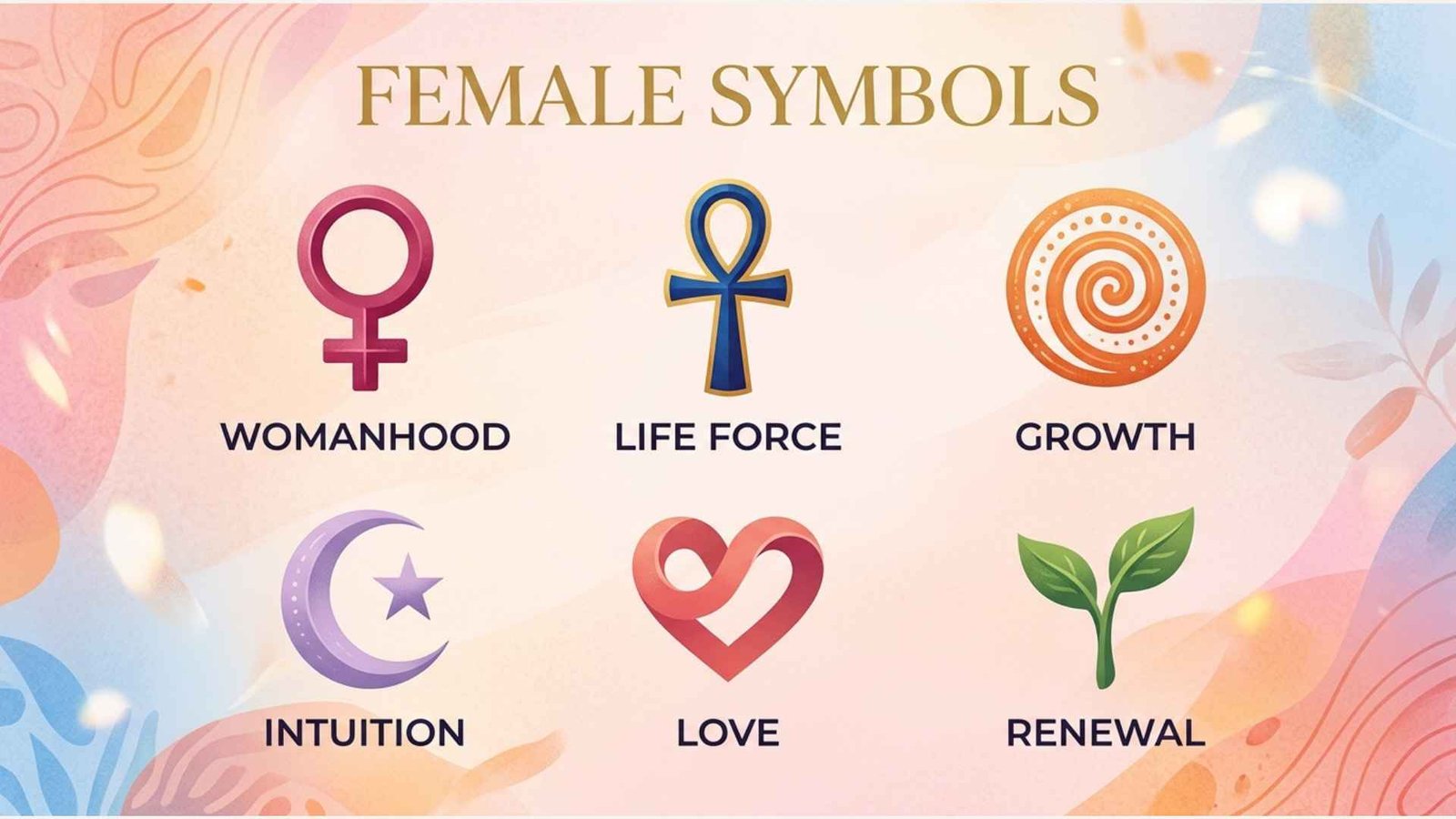
Female symbols appear in biology textbooks, medical forms, family trees, jewelry, tattoos, public signs, feminist artwork, and digital messages. The most widely recognized is ♀, a circle with a small cross extending downward. Today, it commonly represents the female sex, women, femininity, and the planet Venus.
However, the symbol did not begin as a modern gender marker. Its story passes through ancient astronomy, Greco-Roman mythology, astrology, alchemy, botany, medicine, and social movements.
Understanding these layers explains why one simple mark can carry scientific, cultural, spiritual, and political meanings.
Quick Meaning of the Female Symbol
The female symbol ♀ primarily represents the female sex, women, or femininity. It is also the traditional astronomical and astrological sign for the planet Venus and the alchemical symbol for copper. In modern contexts, it may express womanhood, female identity, feminism, reproductive health, or women’s rights.
Female Symbol Overview
| Field | Details |
| Symbol | ♀ |
| Common Names | Female symbol, female sign, Venus symbol |
| Primary Meaning | Female sex, women, femininity |
| Original Association | Planet Venus |
| Cultural Background | Greco-Roman astronomy and astrology |
| Mythological Connection | Venus, Roman goddess of love and beauty |
| Scientific Uses | Biology, genetics, botany, zoology, medicine |
| Historical Alchemical Meaning | Copper |
| Modern Social Meaning | Womanhood, feminism, women’s rights |
| Unicode | U+2640 |
| Unicode Name | FEMALE SIGN |
| Emoji Form | ♀️ |
| Related Symbols | ♂, ⚥, ⚧, ⚢, ☿ |
| Common Design | Circle with a cross below |
Unicode officially identifies ♀ as “FEMALE SIGN” at code point U+2640, and the character also appears in the Unicode emoji system.
What Does the Female Symbol Mean?
The female symbol usually means female, woman, or feminine. Its exact meaning depends on where it appears.
In biology, it identifies a female organism. In medicine, it may refer to a female patient, female reproductive anatomy, or sex-related health information. On a family tree, it may mark a female family member. In activism, it can represent women’s equality, empowerment, and resistance to discrimination.
The symbol also retains its older meaning as the sign of Venus. Astronomers and astrologers use it for the planet associated with the Roman goddess Venus. Because Venus became culturally connected with beauty, attraction, fertility, and love, these associations gradually influenced the symbol’s later interpretation.
The Shape of the Symbol
The standard female sign consists of:
- A circle at the top
- A short vertical line beneath it
- A horizontal line crossing the vertical line
It is often described as resembling a handheld mirror. According to this popular interpretation, the circle forms the reflective surface while the cross forms the handle.
The “mirror of Venus” explanation is culturally familiar, but scholars do not treat it as a proven account of the symbol’s earliest origin. Another historical theory suggests that planetary signs developed from abbreviated Greek names or letter forms that changed as scribes repeatedly copied them.
Therefore, it is more accurate to say that ♀ became associated with Venus long before it became a universal female marker, while the precise reason for its shape remains debated.
History and Origin of Female Symbols
The history of female symbols begins with the observation of the sky rather than with modern ideas about gender.
Ancient Venus Associations
Venus is one of the brightest objects visible in the night sky. Ancient civilizations observed it as both a “morning star” and an “evening star,” although these appearances belong to the same planet.
The ancient Greeks associated the planet with Aphrodite, goddess of love, beauty, desire, and fertility. The Romans later connected it with Venus, their corresponding goddess. NASA notes that Venus is the only planet in the solar system named after a female deity.
The planetary sign eventually known as ♀ developed within traditions of astronomy and astrology. In those systems, each visible planet had its own sign and a network of mythological qualities.
Venus in Astrology
Astrology connected Venus with:
- Love
- Attraction
- Beauty
- Harmony
- Pleasure
- Relationships
- Artistic taste
- Sensuality
- Social connection
These ideas did not mean that the symbol represented every woman. Instead, Venus represented a group of qualities ancient and medieval cultures often classified as feminine.
Over time, the association between Venus and femininity made the planetary sign a natural candidate for identifying the female sex.
Venus and Copper in Alchemy
European alchemists connected planets with metals. Venus corresponded to copper, while Mars corresponded to iron.
This relationship may have developed partly because copper was used to make polished mirrors and decorative objects. Copper was also connected with beauty, ornament, and the goddess Venus in classical and later European traditions.
As a result, ♀ could mean the planet Venus, the goddess Venus, astrological Venus, or the metal copper, depending on the document in which it appeared.
Adoption in Biology
The transition from planetary sign to biological sex marker became especially important during the development of modern natural history.
Swedish naturalist Carl Linnaeus used planetary symbols in botanical classification. During the 18th century, he regularly applied the Venus symbol to female plant structures, the Mars symbol to male structures, and the Mercury symbol to flowers containing both reproductive types.
This scientific use helped establish ♀ as a concise marker for female organisms and reproductive roles. Linnaeus’s works from the 1760s are often identified as major steps in standardizing these symbols in biology.
From botany, the practice spread into zoology, genetics, medicine, genealogy, and demographic records.
Development into a Modern Gender Symbol
By the 19th and 20th centuries, ♀ was widely recognized beyond scientific writing. It appeared in charts, medical records, educational materials, public information systems, and social campaigns.
Women’s movements later adopted the symbol as an emblem of solidarity and equal rights. Artists and activists sometimes altered it by adding a raised fist, an equality sign, a heart, or other visual elements.
Today, the symbol can represent biological sex, social identity, cultural femininity, or political advocacy. Context determines which meaning is intended.
Symbolism and Interpretation
Female symbols carry both inherited meanings and modern interpretations. Some meanings are descriptive, while others come from mythology, social convention, psychology, or activism.
Traditional Meanings
Historically, the Venus symbol has been linked with:
- Womanhood
- Fertility
- Love
- Beauty
- Sexuality
- Partnership
- Motherhood
- Receptivity
- Creativity
- Nature
These meanings reflect cultural traditions rather than qualities shared by all women. For example, not every woman is a mother, and femininity cannot be reduced to beauty, romance, or fertility.
Modern Meanings
In modern communication, ♀ may symbolize:
- Female sex
- Female gender identity
- Women as a social group
- Women’s history
- Feminist movements
- Reproductive health
- Gender equality
- Female leadership
- Women in science
- Women’s athletic teams
The symbol may also appear in inclusive discussions that distinguish sex, gender identity, gender expression, and reproductive anatomy.
Positive Symbolism
Positive interpretations often emphasize strength and community rather than older stereotypes.
The female symbol can communicate:
- Empowerment
- Resilience
- Independence
- Solidarity
- Equality
- Protection
- Confidence
- Leadership
- Creative power
- Bodily autonomy
In jewelry or tattoos, people may wear it as an affirmation of personal identity, pride in womanhood, respect for women, or commitment to equal rights.
Negative or Restrictive Interpretations
The symbol itself is not inherently negative. However, it can become restrictive when people use it to suggest that all women must share the same appearance, personality, role, anatomy, or life experience.
Some common limitations include:
- Reducing women to reproductive functions
- Treating femininity as weakness or passivity
- Assuming all females identify as women
- Assuming every woman is biologically female
- Associating womanhood only with motherhood
- Enforcing narrow beauty standards
A responsible interpretation recognizes that biological sex and gender are related but not always identical concepts.
Psychological Interpretation
Psychologically, symbols help people compress complex ideas into recognizable images. The female sign can serve as a visual cue for identity, belonging, protection, or group solidarity.
Its meaning also depends on personal experience. One person may connect it with maternal care, another with feminism, another with medical classification, and another with the planet Venus.
Psychological interpretations should not be treated as universal truths. The symbol does not prove personality traits, emotional tendencies, or behavior.
Cultural Significance of Female Symbols
The symbol ♀ emerged from Mediterranean and European traditions, but it now functions internationally.
Western Cultural Use
In Europe and North America, the female sign frequently appears in:
- Biology education
- Healthcare
- Women’s organizations
- Feminist art
- Reproductive-rights campaigns
- Gender studies
- Fashion and jewelry
- Digital communication
Its close pairing with the male symbol ♂ makes it useful in charts and signs where limited space requires quick recognition.
Global Adoption
Scientific publishing, international medicine, digital encoding, and mass media helped spread the sign worldwide. It is now understood in many regions regardless of local language.
However, communities do not always use it in the same way. Some treat it mainly as a biological marker. Others see it as a feminist emblem or a sign of women’s identity.
Local traditions may also have their own symbols for womanhood, fertility, motherhood, goddesses, or feminine power. These should not automatically be treated as versions of the Venus symbol because their histories may be unrelated.
Feminist Symbolism
During modern feminist movements, the female sign became a powerful political emblem. A common adaptation places a clenched fist inside the upper circle, combining womanhood with resistance and collective action.
This modified symbol can represent:
- Women’s liberation
- Equal pay
- Voting rights
- Reproductive freedom
- Freedom from violence
- Educational access
- Workplace equality
- Political representation
Different feminist movements may interpret the sign differently, especially when discussing race, class, disability, sexuality, and transgender inclusion.
Religious and Spiritual Meaning
The female symbol is not a sacred sign belonging to one universal religion. Its spiritual meaning usually comes from its association with Venus, goddesses, femininity, nature, and contemporary spiritual practice.
Venus and Aphrodite
In Roman religion, Venus had several roles connected with love, beauty, fertility, victory, and civic life. Her Greek counterpart, Aphrodite, was associated with desire, attraction, sexuality, marriage, and divine beauty.
The modern symbol ♀ may therefore appear in art or spiritual practices inspired by these goddesses.
Modern Pagan and Goddess Traditions
Some modern Pagan, Wiccan, and goddess-centered communities use the female sign to represent:
- The divine feminine
- Goddess spirituality
- Fertility
- Earth
- Birth and renewal
- Female creative energy
- Sacred sexuality
- Cycles of life
These interpretations belong to particular modern traditions and should not be presented as a single ancient belief shared by all cultures.
Astrological Spirituality
In astrology, Venus represents how a person relates to affection, pleasure, aesthetics, values, and partnership. The symbol may appear in natal charts to show the planet’s location at the time of birth.
Astrological meaning is a symbolic or spiritual system, not an established scientific method for predicting personality or events.
Scientific and Technical Meaning
The female symbol has several practical uses in science and technology.
Biology and Zoology
Biologists use ♀ to label a female organism in:
- Breeding records
- Field studies
- Animal pedigrees
- Genetic diagrams
- Population tables
- Behavioral observations
- Veterinary records
For example, “3♀” may indicate three female specimens, although formatting conventions differ among publications.
Botany
In botany, the sign may identify female flowers, female plants, or structures that produce ovules. This use continues the tradition associated with Linnaean classification.
Species differ greatly in reproductive organization. Some plants have separate male and female individuals, while others contain both types of reproductive structures.
Medicine and Healthcare
Medical contexts may use the female sign for:
- Sex recorded in patient data
- Female reproductive anatomy
- Gynecological services
- Menstrual-health information
- Pregnancy-related care
- Sex-specific research categories
Healthcare professionals increasingly use more precise language when anatomy, hormones, chromosomes, sex assigned at birth, and gender identity do not align neatly.
Genetics and Pedigree Charts
In pedigree diagrams, a circle commonly represents a female individual, while a square commonly represents a male individual. This circle is not always drawn with the cross found in ♀.
Additional marks may indicate whether a person has a studied trait, carries a genetic variant, or is deceased. The meaning depends on the chart legend.
Astronomy
♀ remains the astronomical sign for Venus, although professional astronomy often uses the planet’s written name or abbreviation instead.
The symbol may appear in:
- Historical star charts
- Planetary tables
- Astronomy guides
- Astrological charts
- Educational diagrams
- Calendars of planetary motion
Computing and Digital Use
The character is encoded as U+2640 FEMALE SIGN. Users can type, copy, display, and search it across compatible digital systems. Its appearance varies by font and platform.
The text form is usually shown as ♀, while an emoji-style variation may appear as ♀️. Unicode’s emoji documentation includes the female sign among standardized emoji characters.
Where Are Female Symbols Used?
Female symbols appear in many settings because they communicate meaning quickly.
Education
Science textbooks use ♀ in lessons about reproduction, genetics, botany, zoology, and human biology.
Healthcare
Clinics, research forms, medical illustrations, and health campaigns may use the symbol to identify female-related services or data.
Genealogy
Family trees and pedigree records use circles or female signs to identify women and girls within family relationships.
Jewelry
Necklaces, rings, bracelets, and earrings may feature ♀ as a sign of womanhood, personal identity, friendship, or empowerment.
Tattoos
A female-symbol tattoo can represent self-respect, feminism, motherhood, sisterhood, survival, or connection to Venus. The meaning should be interpreted through the wearer’s stated intention.
Art and Literature
Artists may use the sign to explore beauty standards, gender roles, sexuality, motherhood, power, discrimination, or women’s history.
Logos and Campaigns
Women’s organizations, health programs, sports groups, and advocacy campaigns often incorporate the symbol into logos.
Public Signs and Maps
Although restroom signs usually use human figures rather than ♀, the symbol can still appear in directories, diagrams, maps, and facilities connected with women’s services.
Social Media
Users place ♀ or ♀️ in usernames, captions, biographies, campaign hashtags, and posts about women’s issues.
Common Variations of Female Symbols
Standard Female Sign: ♀
This is the best-known form. It represents Venus, the female sex, women, or femininity.
Doubled Female Sign: ⚢
Two linked female symbols are often associated with lesbian identity or relationships between women. Unicode names this character “DOUBLED FEMALE SIGN.”
Male and Female Sign: ⚥
This combines male and female forms. Depending on context, it may represent heterosexual relationships, combined sexes, or broader gender-related concepts.
Transgender Symbol: ⚧
The transgender sign combines elements of male, female, and additional gender symbolism. It represents transgender identity or gender diversity.
Feminist Fist Symbol
This design places a raised fist inside the circle of the female sign. It commonly represents feminism, resistance, liberation, and collective power.
Venus Mirror Designs
Decorative versions may emphasize the “hand mirror” interpretation by enlarging the circle, lengthening the stem, or adding ornamental details.
Common Misconceptions About Female Symbols
Misconception 1: The Symbol Was Invented for Women
The sign first represented Venus in astronomical and astrological traditions. Its use as a female-sex marker developed later.
Misconception 2: Its Mirror Shape Has a Proven Origin
The idea that ♀ depicts Venus’s hand mirror is popular, but it is not definitively established as the symbol’s original source.
Misconception 3: It Represents Motherhood Only
The female symbol may be used in discussions of motherhood, but its meaning is much broader. It can represent women, girls, female organisms, feminism, Venus, or copper.
Misconception 4: It Always Means Biological Sex
In a scientific chart, it may indicate biological sex. In jewelry, art, or activism, it may instead express gender identity, cultural femininity, or women’s rights.
Misconception 5: It Represents Every Woman’s Experience
No single symbol can capture the lives, bodies, cultures, and identities of all women. It is a general visual sign, not a complete definition of womanhood.
Misconception 6: It Is a Universal Ancient Religious Symbol
The sign has ancient planetary roots, but its modern use as a global female marker resulted from later scientific and cultural adoption.
Interesting Facts About Female Symbols
- The female sign is older than its biological use.
It represented Venus before scientists adopted it as shorthand for female organisms. - The symbol once represented a metal.
Alchemists used ♀ for copper because they associated metals with planets and deities. - Botany helped standardize its modern meaning.
Linnaeus’s use of planetary signs for plant reproduction helped transform ♀ into a scientific sex marker. - Its official digital identity is U+2640.
Unicode gives the female sign a universal code so compatible devices can represent the same character. - The symbol has text and emoji presentations.
Depending on software and formatting, it may appear as a plain black character or a colored emoji-style image. - The mirror explanation is not certain.
Although often called the mirror of Venus, the sign may have developed from older written abbreviations rather than a literal drawing. - Venus links mythology with science.
One sign connects a visible planet, a Roman goddess, an astrological concept, a chemical metal, and biological classification. - A circle alone may represent female in genetics.
Pedigree charts often use a plain circle instead of the full Venus sign. - The feminist version changes the message.
Adding a raised fist shifts the emphasis from classification to political solidarity and empowerment. - Not all female-related symbols have the same origin.
Goddess figures, fertility marks, lunar signs, flowers, and womb-shaped designs may symbolize femininity without being historically related to ♀. - Its meaning depends strongly on context.
On a telescope chart it means Venus; in a laboratory it may mean a female specimen; on a protest sign it may represent women’s rights. - It is one of several gender-related Unicode characters.
Related encoded signs include doubled female, combined male-and-female, and transgender symbols.
Related Symbols and Their Meanings
| Symbol | Name | Meaning | Difference from ♀ |
| ♂ | Male or Mars sign | Male sex, men, masculinity, Mars | Uses a circle with an arrow |
| ⚢ | Doubled female sign | Lesbian identity or female partnership | Joins two female signs |
| ⚥ | Male and female sign | Combined male and female symbolism | Includes both forms |
| ⚧ | Transgender symbol | Transgender identity and gender diversity | Combines several gender elements |
| ☿ | Mercury sign | Planet Mercury; historically mixed reproductive qualities | Has horns above and a cross below |
| ♀ with fist | Feminist symbol | Women’s liberation and resistance | Adds an activist emblem |
| ☾ | Crescent moon | Lunar cycles, night, and sometimes femininity | Has separate astronomical and cultural origins |
| ♁ | Earth sign | Planet Earth | Circle contains a cross rather than placing it below |
Frequently Asked Questions
What is the main female symbol?
The main female symbol is ♀, a circle with a small cross beneath it. It commonly represents the female sex, women, femininity, or womanhood. It is also the traditional sign for the planet Venus and was historically used by alchemists to represent copper.
Why is the female symbol shaped like a mirror?
A popular explanation says that the symbol resembles the handheld mirror of Venus, the Roman goddess of love and beauty. However, this interpretation is not historically certain. Some scholars argue that planetary symbols developed from abbreviated Greek names or handwritten letter forms that changed over centuries.
What does the female symbol mean in biology?
In biology, ♀ identifies a female organism, specimen, plant, or reproductive role. Researchers may use it in breeding records, genetic studies, field notes, and population tables. The exact biological meaning depends on the species and the scientific subject being studied.
Is the female symbol the same as the Venus symbol?
Yes. The same sign, ♀, represents both Venus and the female sex. Its Venus meaning is older. Astronomical and astrological traditions used it for the planet before naturalists adopted it to identify female reproductive structures and organisms.
What does the female symbol mean in a tattoo?
A female-symbol tattoo may express womanhood, feminism, strength, independence, motherhood, sisterhood, survival, or connection with Venus. Some wearers add flowers, fists, names, dates, or other elements. The wearer’s personal explanation is the most reliable guide to its meaning.
What is the feminist female symbol?
The feminist version usually places a clenched or raised fist inside the circle of ♀. It combines the female sign with a symbol of resistance. The design commonly represents women’s liberation, equality, collective action, bodily autonomy, and opposition to gender-based discrimination.
Does the female symbol represent fertility?
It can represent fertility because Venus and many traditional ideas about femininity were connected with reproduction and love. However, fertility is only one possible meaning. The symbol also represents women who do not want children, cannot have children, or do not define themselves through motherhood.
Can the female symbol represent gender identity?
Yes. In modern social contexts, people may use ♀ to express a female or woman identity. In medical or biological contexts, it may instead classify sex. Because gender identity and biological traits are not always identical, responsible communication should make the intended meaning clear.
What is the Unicode for the female symbol?
The Unicode code point is U+2640, and its official Unicode name is FEMALE SIGN. A variation selector may produce an emoji-style display, commonly seen as ♀️. The exact design depends on the device, operating system, application, and font.
What do two female symbols mean?
Two linked female symbols, shown as ⚢, are commonly associated with lesbian identity, love between women, or female partnership. Their meaning can vary in historical diagrams, community artwork, and personal designs, so context still matters.
Key Takeaways
- The standard female symbol is ♀.
- It commonly represents females, women, femininity, or womanhood.
- It originally served as the sign of the planet Venus.
- Ancient mythology connected Venus with love, beauty, desire, and fertility.
- Alchemists used the sign to represent copper.
- Naturalists helped establish it as a biological sex marker.
- Carl Linnaeus used planetary signs in plant classification.
- Modern uses include science, medicine, genealogy, jewelry, tattoos, art, and activism.
- The “mirror of Venus” explanation is popular but not historically proven.
- The symbol’s meaning changes according to scientific, cultural, spiritual, or political context.
- It should not be used to reduce all women to one body type, personality, or social role.
- Related signs include ♂, ⚢, ⚥, and ⚧.
Conclusion
Female symbols reveal how visual language can evolve across thousands of years. The familiar ♀ began as a planetary sign connected with Venus, passed through astrology and alchemy, entered biological classification, and eventually became an international emblem of women and femininity.
Today, it may identify a female organism, mark the planet Venus, express womanhood, support women’s rights, or symbolize personal strength. Its meaning is not fixed in every setting. By considering its historical origin and modern context, readers can interpret female symbols more accurately and respectfully.

I am Daniel Brooks, a language researcher and writer with a strong interest in how people use English in everyday conversations. I contribute to LearnNestly because I enjoy turning confusing language topics into straightforward lessons. My goal is to help readers understand not only what a word or phrase means, but also when and how to use it naturally. I focus on clear examples, practical explanations, and useful language knowledge that readers can remember.
Books:
- The Practical English Guide
- Understanding Everyday Words
 Amelia Carter