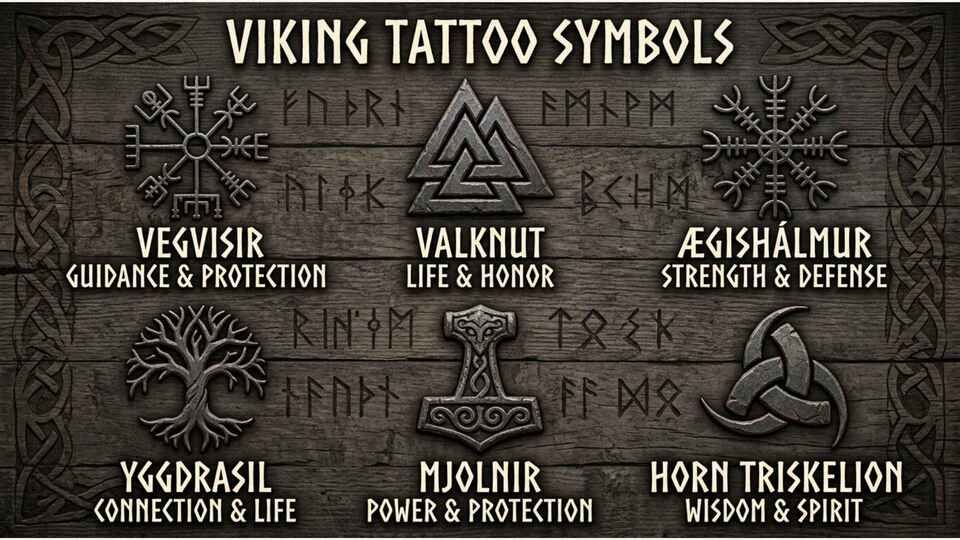
Viking tattoo symbols often represent protection, courage, fate, strength, wisdom, loyalty, or a connection to Norse mythology. Popular designs include Thor’s hammer, runes, ravens, wolves, ships, and the mysterious three-triangle symbol now called the valknut.
However, not every design marketed as “Viking” actually comes from the Viking Age. Some symbols are historically documented on jewelry, weapons, runestones, picture stones, and burial objects. Others entered popular culture centuries later. Understanding this difference can help you choose a tattoo that is meaningful, respectful, and historically informed.
Today, you may encounter Viking tattoo symbols in body art, jewelry, clothing, television, video games, historical reenactment, modern Heathenry, and Scandinavian-inspired artwork. Their appeal comes from more than their bold appearance. Each design can tell a story about identity, struggle, family, spirituality, or personal transformation.
Quick Meaning of Viking Tattoo Symbols
Viking tattoo symbols commonly express courage, protection, destiny, loyalty, wisdom, exploration, or devotion to Norse gods and myths. Their meanings depend on the chosen image. Mjölnir may suggest protection, ravens may represent knowledge, and runes may communicate names or ideas. Historical authenticity varies widely between designs.
Viking Tattoo Symbols Overview
| Symbol | Primary Meaning | Historical Connection | Common Modern Meaning |
| Mjölnir | Protection, strength, sacred power | Viking Age hammer pendants | Courage and spiritual protection |
| Valknut | Death, warriors, Odin | Found on several Germanic archaeological objects | Bravery, sacrifice, connection to Odin |
| Ravens | Wisdom, memory, observation | Associated with Odin in Norse literature and imagery | Intelligence and guidance |
| Wolves | Wild power, danger, fate | Fenrir, Geri, and Freki appear in Norse mythology | Independence and controlled strength |
| Yggdrasil | Cosmic order and connected worlds | Central concept in Old Norse cosmology | Growth, ancestry, and connection |
| Runes | Writing, names, memorials, identity | Used throughout Germanic and Viking societies | Personal messages and symbolic intention |
| Longship | Travel, trade, warfare, exploration | Essential to Viking mobility | Adventure and perseverance |
| Helm of Awe | Magical protection and intimidation | Recorded in later Icelandic magical tradition | Confidence and protection |
| Vegvísir | Guidance through difficult conditions | Appears in a 19th-century Icelandic manuscript | Finding one’s path |
| Ouroboros-like serpent | Cycles, boundaries, destruction | Often linked with Jörmungandr | Renewal and life’s cycles |
| Axe | Labor, warfare, status | Common tool and weapon | Strength and self-reliance |
| Bear | Ferocity, resilience, warrior power | Connected with berserkr traditions | Courage and endurance |
What Do Viking Tattoo Symbols Mean?
Viking tattoo symbols do not share one universal meaning. Each symbol comes from a different myth, object, animal, deity, story, or cultural practice.
Some designs represent protective powers. Thor’s hammer, for example, was worn as a pendant during the Viking Age and became strongly associated with Thor, divine protection, and the defense of the human and divine worlds. Thor was widely worshipped in Scandinavia, particularly during the later Viking Age.
Other symbols relate to death, destiny, or heroic identity. The valknut appears near scenes that scholars have connected with warriors, burial practices, and possibly Odin. Its exact Viking Age meaning remains uncertain, so interpretations such as “the warrior’s knot” should be treated as modern theories rather than proven translations.
Animals add another layer of meaning. Ravens may symbolize perception and thought because Odin’s ravens, Huginn and Muninn, travel through the world and bring him information. Wolves may represent loyalty, predatory power, uncontrolled destruction, or fate, depending on whether the design references Odin’s wolves or the monstrous Fenrir.
Modern wearers often personalize these themes. A longship may honor migration rather than raiding. A rune may represent a loved one’s initial. Yggdrasil may symbolize family roots, emotional growth, or the idea that all life is connected.
History and Origin of Viking Tattoo Symbols
Viking tattoo imagery draws mainly from the art, religion, writing, objects, and myths of Scandinavian communities during the Viking Age, generally dated from the late eighth century to the middle or late eleventh century. The Swedish History Museum uses approximately AD 793–1050, while other historical summaries extend the period to 1066.
The Norse world included farmers, traders, craftspeople, settlers, sailors, warriors, rulers, and enslaved people. Viking ships traveled across the Baltic, Atlantic, North Sea, and major river routes. These contacts carried Scandinavian designs into the British Isles, Iceland, Greenland, Eastern Europe, and beyond.
Did Vikings Actually Have Tattoos?
There is no surviving tattooed Viking body that proves exactly what Scandinavian tattoos looked like. Skin rarely survives in Viking Age burials, and archaeological objects cannot directly show whether their patterns were copied onto human bodies.
The most frequently cited written description comes from Ahmad ibn Fadlan, a tenth-century traveler who encountered Rus traders near the Volga River. His account has often been interpreted as describing dark designs extending from the men’s fingertips toward their necks. However, scholars debate whether the markings were tattoos, body paint, staining, or something else. They also caution against assuming that all Rus customs represented all Scandinavian communities.
Therefore, it is reasonable to say that some Viking-connected people may have practiced body marking, but claims about a standard Viking tattoo tradition remain unproven.
Where Authentic Designs Come From
Historically grounded tattoo designs are usually adapted from:
- Runestones and memorial inscriptions
- Metal pendants and jewelry
- Weapons and tools
- Wooden carvings
- Picture stones
- Ship decoration
- Textiles and tapestry fragments
- Animal ornamentation
- Burial objects
- Medieval Icelandic literature
Viking Age artists frequently used interlaced animals, gripping beasts, serpents, birds, ribbon-shaped bodies, and plant-like patterns. Modern tattoos often simplify or combine these designs, sometimes adding symbols from much later periods.
Major Viking Tattoo Symbols and Their Meanings
Mjölnir: Thor’s Hammer
Mjölnir is one of the best-documented Norse symbols. Archaeologists have found many hammer-shaped pendants from the Viking Age, including examples associated with graves and ritual contexts.
In mythology, Thor uses his hammer to fight giants and protect both gods and humans from destructive forces.
A Mjölnir tattoo may represent:
- Protection
- Physical and moral strength
- Courage during hardship
- Loyalty to family or community
- Commitment to Norse spirituality
- Resistance against chaos
Hammer pendants also became especially meaningful during the gradual Christianization of Scandinavia. In some settings, wearing a hammer may have expressed attachment to traditional Norse beliefs, just as Christians wore crosses. This interpretation depends on archaeological context and should not be treated as the meaning of every pendant.
Valknut: The Three Interlocked Triangles
The valknut consists of three connected triangles. The modern word comes from Norwegian terms associated with the slain and a knot, but historians do not know what Viking Age people called it.
The symbol appears on objects including the Stora Hammars picture stone, the Tängelgårda stone, and material from the Oseberg ship burial. It is frequently found near imagery involving death, warriors, horses, or a figure interpreted as Odin.
Possible tattoo meanings include:
- Acceptance of mortality
- Courage before danger
- Loyalty to Odin
- Sacrifice
- Fate
- Transition between life and death
Its precise ancient meaning is unknown. A responsible explanation should say that the Odin and warrior interpretations are plausible scholarly theories, not confirmed definitions.
Runes
Runes were letters, not a single magical code. Germanic peoples used runic alphabets for names, memorials, ownership marks, short messages, and inscriptions. The Younger Futhark was the primary runic system during much of the Viking Age.
Individual runes may have had names and associations, but modern “rune meanings” often mix historical evidence with later divination systems. A rune tattoo is most authentic when it uses the correct alphabet, language, spelling, and historical period.
Common modern rune tattoo purposes include:
- Writing a personal name
- Honoring an ancestor
- Recording a meaningful word
- Representing heritage
- Creating a short memorial inscription
Before tattooing runes, check the translation carefully. English words cannot always be converted accurately by replacing each Latin letter with a visually similar rune.
Huginn and Muninn: Odin’s Ravens
Huginn and Muninn are Odin’s two ravens. Their names are commonly interpreted as “thought” and “memory” or “mind” and “memory.” They fly across the world and return to Odin with knowledge.
Raven tattoos may symbolize:
- Wisdom
- Observation
- Memory
- Strategy
- Messages from distant places
- The search for truth
- Odin’s presence
A pair of ravens often emphasizes balance between thinking and remembering. A single raven may carry broader meanings such as intelligence, death, mystery, or transformation.
Yggdrasil: The World Tree
Yggdrasil is the immense tree that structures the mythological cosmos. Gods, humans, giants, the dead, and other beings exist within worlds connected through this cosmic system.
A Yggdrasil tattoo can represent:
- The connection between all life
- Family roots
- Ancestry
- Personal growth
- Cosmic order
- Life, death, and renewal
- Responsibility across generations
Modern designs often place runes, ravens, serpents, or the nine worlds around the tree. These combinations are artistic interpretations rather than standardized ancient emblems.
Fenrir and Other Wolves
Fenrir is a monstrous wolf whose fate is tied to Ragnarök. The gods bind him because they fear his growing power, but prophecy says he will eventually break free and kill Odin.
A Fenrir tattoo may symbolize:
- Uncontainable power
- Rebellion against restraint
- Anger
- Fate that cannot be avoided
- The danger of suppressed forces
- Survival after betrayal
Not every Norse wolf has a negative role. Odin is accompanied by Geri and Freki, whose names are associated with hunger or greed. Wolves can therefore suggest companionship, warrior identity, hunger for knowledge, danger, or wild independence.
Jörmungandr: The World Serpent
Jörmungandr is the immense serpent that encircles the human world. It is one of Loki’s children and Thor’s great enemy.
When shown biting its tail, Jörmungandr resembles an ouroboros, although the two traditions should not be treated as identical. A Jörmungandr tattoo may represent:
- Cycles
- Boundaries
- Hidden danger
- The balance between order and chaos
- An unavoidable confrontation
- Destruction followed by renewal
Viking Longship
Longships allowed Scandinavian crews to raid, trade, explore, migrate, and settle across enormous distances. They could cross seas and navigate relatively shallow rivers.
A longship tattoo commonly symbolizes:
- Adventure
- Leadership
- Exploration
- Migration
- Teamwork
- Courage in uncertain conditions
- Returning home after hardship
Although popular culture focuses heavily on warfare, ships also supported commerce, diplomacy, colonization, fishing, communication, and cultural exchange.
Viking Axe
Axes were practical tools as well as weapons. Designs ranged from small working axes to specialized fighting forms.
An axe tattoo may represent:
- Readiness
- Hard work
- Self-reliance
- Defense
- Warrior strength
- Cutting ties with the past
- Decisive action
An elaborate axe does not automatically represent a berserker. Its meaning depends on the complete composition.
Bear and Berserker Imagery
The Old Norse word berserkr is commonly interpreted as either “bear-shirt” or “bare-shirt,” and the exact origin remains debated. Later stories describe berserkers as terrifying fighters connected with unusual fury.
Bear tattoos may represent:
- Endurance
- Fearlessness
- Protection
- Solitary strength
- Warrior transformation
- Controlled aggression
Modern claims that every bear symbol belonged to a secret Viking warrior cult go beyond the available evidence.
Religious and Spiritual Meaning
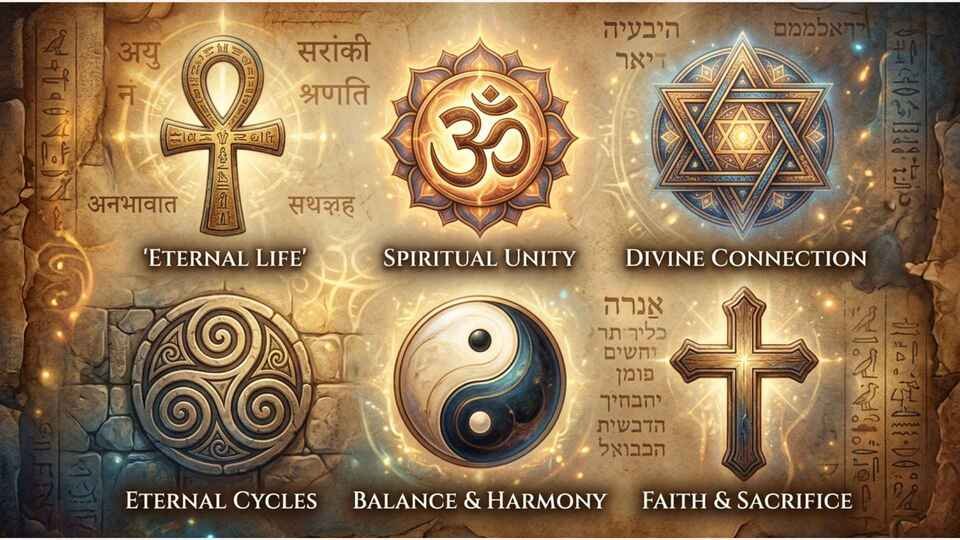
Historically, Norse symbols belonged to a religious world that included many gods, local spirits, ancestors, sacred places, offerings, feasts, burials, and ritual specialists. Norse religion was not governed by one central scripture or one universally enforced system.
Thor, Odin, Freyja, Freyr, and other deities had different roles. Thor protected gods and humans. Odin was associated with rulership, war, poetry, knowledge, magic, and the dead. Freyja was linked with love, fertility, beauty, war, and seiðr magic.
Today, people may use Viking-inspired tattoos as:
- Expressions of modern Heathen faith
- Memorials to ancestors
- Symbols of personal spirituality
- Reminders of courage or discipline
- Celebrations of Scandinavian heritage
- Artistic references to mythology
A mythological tattoo does not automatically identify someone as a religious practitioner. Many wearers choose Norse designs for historical, aesthetic, literary, or personal reasons.
Cultural Significance and Modern Interpretation
Viking tattoo symbols now exist at the meeting point of archaeology, Scandinavian heritage, entertainment, spirituality, fashion, and individual identity.
In Nordic countries, these designs may be connected with regional history and cultural heritage. Elsewhere, people may associate them primarily with adventure, toughness, independence, or television portrayals of Viking warriors.
Modern interpretation can differ sharply from historical context. A hammer pendant once connected with Thor’s cult may now symbolize resilience after illness. A longship may honor an immigrant family. A raven may represent a person’s commitment to learning rather than devotion to Odin.
This flexibility makes the imagery personally powerful, but it also creates confusion. Tattoo studios and social media posts often assign exact meanings to symbols whose historical significance remains uncertain.
Later Symbols Often Mistaken for Viking Designs
Vegvísir
Vegvísir is a circular Icelandic magical sign often called the “Viking compass.” It is commonly understood today as a symbol of guidance and finding one’s way through difficult circumstances.
However, it is not documented as a Viking Age navigation device. Its best-known appearance is in the nineteenth-century Icelandic Huld manuscript, many centuries after the Viking Age.
A Vegvísir tattoo can still carry meaningful Icelandic or personal symbolism. It should simply be described as a later Icelandic magical stave rather than an authenticated Viking compass.
Helm of Awe
The Helm of Awe, or Ægishjálmur, is another striking radial design often marketed as ancient Viking protection. The name appears in medieval Norse literature, including traditions connected with the dragon Fáfnir. However, the familiar symmetrical stave design belongs to later Icelandic magical manuscript culture.
Modern meanings include:
- Protection
- Fearlessness
- Psychological strength
- Intimidation
- Concentration under pressure
Calling the modern graphic a confirmed Viking Age tattoo design overstates the evidence.
Troll Cross
The looped iron “troll cross” is frequently sold as an old Scandinavian protective symbol. Its status as a Viking Age emblem is doubtful. The popular jewelry form appears to be a modern design inspired by Scandinavian folklore rather than a well-documented archaeological symbol.
Where Viking Tattoo Symbols Are Used
Viking and Norse imagery appears in many settings beyond tattoos:
- Museum exhibitions
- Historical reenactment
- Pendants and rings
- Clothing and accessories
- Album artwork
- Fantasy novels
- Television and film
- Video games
- Sports branding
- Modern religious objects
- Family memorials
- Wood carving and metalwork
- Scandinavian tourism
- Heritage festivals
These modern settings often combine historically separate symbols. A design may place Younger Futhark runes beside a later Icelandic magical stave and a modern fantasy helmet. The result may be visually powerful without representing one authentic Viking Age composition.
Common Design Variations
Minimalist Symbols
Minimalist tattoos reduce a hammer, rune, raven, ship, or triangle design to clean black lines. They are easy to place on the wrist, forearm, ankle, or behind the ear.
Norse Knotwork
Knotwork tattoos use interlaced bands, animals, and serpents. Some draw from genuine Scandinavian art styles, while others borrow heavily from Celtic designs. Norse and Celtic cultures interacted, but their art traditions are not interchangeable.
Rune Bands
Rune bands wrap around the arm, wrist, leg, or finger. They may imitate runestones or contain a modern phrase transliterated into runes.
Mythological Sleeves
Large compositions may combine Odin, ravens, wolves, Yggdrasil, ships, mountains, and battle scenes. These are modern narrative artworks rather than copied archaeological designs.
Dotwork and Blackwork
Black ink, heavy contrast, geometric patterns, and dot shading suit the angular form of runes and magical staves. This style is modern even when the central symbol has ancient roots.
Common Misconceptions About Viking Tattoos
“Every Norse Symbol Was a Tattoo”
Most surviving symbols appear on objects, stones, jewelry, tools, or manuscripts. Their use on skin is usually speculative.
“Vegvísir Was a Viking Compass”
Vegvísir is a later Icelandic magical sign. No evidence shows Viking sailors using it as a physical navigation instrument.
“Every Rune Has One Fixed Spiritual Meaning”
Runes were letters with linguistic functions. Modern spiritual keywords assigned to each rune may draw partly from rune names and poems, but they are not universal ancient definitions.
“The Valknut Definitely Means Valhalla”
The symbol may relate to Odin, death, or mortuary ritual, but no surviving Viking text defines it. “Symbol of Valhalla” is a modern simplification.
“Horned Helmets Were Standard Viking Equipment”
Archaeological evidence does not support the image of Viking warriors routinely wearing horned battle helmets. The stereotype developed much later through art, costume design, and popular entertainment.
“All Norse Symbols Are Politically Neutral”
Most people use Norse imagery for heritage, religion, art, or personal meaning. However, some extremist movements have appropriated selected Germanic symbols. Context matters. Research a design’s modern associations before permanently tattooing it.
Interesting Facts About Viking Tattoo Symbols
- No complete Viking tattoo catalog survives.
Historians reconstruct possible imagery from art and written descriptions rather than preserved tattooed bodies. - Thor’s hammer has unusually strong archaeological support.
Hammer pendants exist in many forms, making Mjölnir one of the safest choices for someone seeking a documented Viking Age emblem. - The word “valknut” is modern.
The ancient name and exact meaning of the three-triangle design remain unknown. - Runes changed over time.
The Elder Futhark predates the Viking Age, while the Younger Futhark was widely used during it. A tattoo can accidentally mix centuries if the alphabet is chosen carelessly. - Not all Vikings were warriors.
Scandinavian society also included farmers, craftspeople, traders, sailors, poets, and settlers. - Longships symbolize more than raiding.
They made trade, migration, exploration, political expansion, and communication possible. - Norse mythology survives mostly through later sources.
Many detailed myths were written down in medieval Iceland after Scandinavia’s conversion to Christianity. - Animal ornament was central to Scandinavian art.
Artists transformed snakes, birds, wolves, and imaginary beasts into complex interlaced patterns. - Mjölnir could express religious identity.
In some late Viking Age contexts, hammer pendants may have marked devotion to Thor during increasing Christian influence. - Modern tattoo compositions are usually new creations.
Even historically accurate symbols are often arranged in ways that have no known Viking Age equivalent.
Related Norse and Germanic Symbols
Triquetra
The triquetra consists of three connected arcs. It appears in different European artistic and religious contexts. Although visually similar to some valknut forms, it has a different structure and history.
Triskelion
A triskelion contains three rotating arms or spirals. It can suggest motion, cycles, or threefold unity. It should not automatically be identified as a Norse symbol.
Sun Wheel
Wheel-like solar motifs appear across prehistoric and historic European cultures. Their meanings vary by time and location, so a generic sun wheel should not be given one universal Viking interpretation.
Irminsul
Irminsul is associated with Saxon religious tradition rather than specifically with Viking Scandinavia. Modern representations vary because its historical appearance is uncertain.
Christian Cross
Christian crosses became increasingly common in Scandinavia as rulers and communities converted. Crosses and Thor’s hammers sometimes existed within the same broad period of religious transition.
Frequently Asked Questions
What is the most powerful Viking tattoo symbol?
Mjölnir is often considered one of the most powerful choices because it represents Thor’s protective strength and has strong archaeological support. However, symbolic power is personal. A rune inscription, raven, ship, wolf, or world tree may feel more meaningful depending on the wearer’s experiences and beliefs.
Which Viking symbol means protection?
Thor’s hammer is the most historically grounded Norse symbol of protection. The Helm of Awe and Vegvísir are also used as protective or guiding signs today, but their familiar forms come from later Icelandic magical traditions rather than confirmed Viking Age tattoo practice.
What Viking symbol represents strength?
Mjölnir, bears, wolves, axes, and strong runic inscriptions can all communicate strength. They emphasize different forms of it. Thor’s hammer suggests protective power, the bear suggests endurance, the wolf suggests wild force, and the axe may represent practical ability and decisive action.
What does a valknut tattoo mean?
A valknut tattoo commonly represents Odin, warriors, death, sacrifice, courage, or the transition between life and death. Archaeological context supports a possible connection with death and Odin, but no surviving source gives the symbol a definitive ancient meaning.
What do Viking rune tattoos mean?
Rune tattoos may spell names, memorial phrases, personal values, or religious words. Historically, runes functioned as letters, although some inscriptions also had ritual or magical purposes. Accurate meaning depends on the alphabet, language, grammar, spelling, and historical period used.
Is Vegvísir an authentic Viking symbol?
Vegvísir is not documented as a Viking Age symbol. It appears in a nineteenth-century Icelandic manuscript and belongs to a later magical tradition. People may still choose it as a meaningful symbol of guidance, but describing it as an ancient Viking compass is historically inaccurate.
Did Vikings tattoo their faces?
There is no conclusive archaeological evidence showing that Scandinavian Vikings tattooed their faces. A written description of Rus traders may refer to body markings, but scholars debate whether these were tattoos and whether the account can be applied broadly to Viking Age Scandinavia.
What Viking tattoo symbolizes family?
Yggdrasil is a popular symbol for family because its roots and branches can represent ancestors, living relatives, and future generations. Interwoven knotwork, paired ravens, family names written in runes, or a ship carrying several figures can also communicate kinship and shared identity.
Are Viking symbols offensive?
Most Viking and Norse symbols are not inherently offensive. They are widely used for history, spirituality, heritage, and art. However, extremist groups have appropriated some Germanic imagery. Researching current associations, placement, accompanying symbols, and local context can help prevent misunderstanding.
How can I choose an authentic Viking tattoo?
Start with a documented object, runestone, pendant, carving, or art style from a museum collection. Confirm the date and location, verify any rune translation, and separate Viking Age symbols from later Icelandic magical staves. A tattoo artist experienced in historical ornament can then adapt the source without distorting it.
Key Takeaways
- Viking tattoo symbols may represent protection, courage, wisdom, fate, ancestry, exploration, or spiritual identity.
- Mjölnir, runes, ships, animals, and certain archaeological motifs have genuine Viking Age connections.
- There is no conclusive evidence showing exactly how Scandinavian Viking tattoos looked.
- The valknut’s original name and precise meaning remain unknown.
- Runes were writing systems, not merely magical icons.
- Vegvísir and the familiar Helm of Awe design come from later Icelandic traditions.
- Modern meanings can be personally valid even when they differ from historical interpretations.
- Historical accuracy requires checking dates, alphabets, translations, and archaeological sources.
- Modern political appropriation makes contextual research important.
- A meaningful tattoo should balance personal significance with cultural and historical understanding.
Conclusion
Viking tattoo symbols remain compelling because they connect bold visual forms with stories about gods, monsters, travelers, warriors, families, death, knowledge, and survival. Yet their true value becomes clearer when historical evidence is separated from modern invention.
Thor’s hammer, runes, ravens, wolves, ships, Yggdrasil, and the valknut can all create powerful tattoos, but they do not carry identical messages. Some have well-documented Viking Age roots, while others reflect later Icelandic magic or contemporary artistic interpretation.
The best Viking tattoo symbols are not simply the most dramatic designs. They are the ones chosen with accurate research, thoughtful intention, and a clear understanding of what the imagery can and cannot prove about the past.

I am Amelia Carter, an English language educator and educational writer who enjoys making difficult ideas simple and easy to understand. At LearnNestly, I write about English words, grammar, everyday expressions, and language questions that people often find confusing. I believe learning should feel practical, clear, and enjoyable rather than overwhelming. Through my writing, I try to give readers explanations they can understand and use in real life.
Books:
- The Everyday English Handbook
- Words Made Simple
 Daniel Brooks