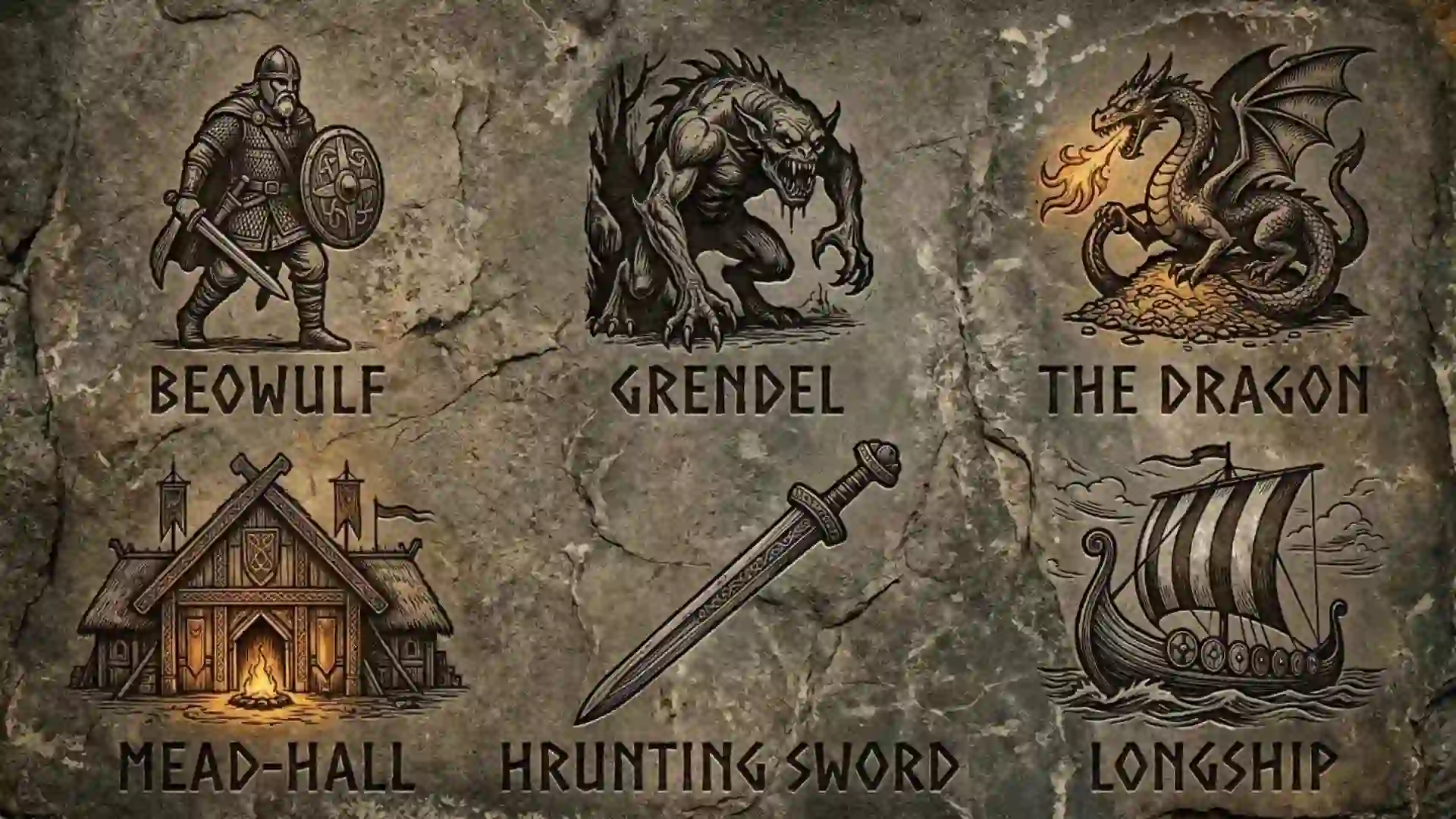
Beowulf uses powerful symbols to explore courage, loyalty, leadership, revenge, mortality, and the struggle between civilization and chaos.
Heorot, Grendel, the dragon, treasure, weapons, light, darkness, and Beowulf’s funeral are more than story details. Each one reveals something important about Anglo-Saxon society and the difficult responsibilities of being a hero or king.
Readers commonly encounter Beowulf symbols in literature classes, essays, examinations, translations, and discussions of Old English culture. Understanding these symbols makes the poem easier to interpret because they connect its monster battles to deeper questions: What makes a good leader? Can fame defeat death? Does wealth protect a society, or can it destroy one?
Quick Meaning
The main symbols in Beowulf represent the conflict between human civilization and destructive forces. Heorot symbolizes community, Grendel represents isolation and social disorder, the dragon reflects greed and inevitable death, treasure represents both generosity and corruption, and Beowulf’s funeral symbolizes the end of heroic leadership and the uncertain future of his people.
Beowulf Symbol Overview
| Symbol | Primary Meaning | Literary Role | Positive Interpretation | Negative Interpretation |
| Heorot | Civilization and community | Center of Danish social life | Unity, generosity, order | Pride, vulnerability, temporary power |
| Grendel | Exile and destructive resentment | Enemy of Heorot | Warning against social isolation | Violence, envy, chaos |
| Grendel’s mother | Revenge and the feud system | Avenger of her son | Family loyalty | Endless retaliation |
| The mere | The unknown and threatening world | Home of the Grendel family | A place of testing | Fear, disorder, spiritual danger |
| Grendel’s arm and head | Victory over evil | Trophies displayed in Heorot | Heroic achievement | Violence and humiliation |
| The dragon | Death, greed, and destruction | Beowulf’s final enemy | Final heroic test | Hoarding, isolation, mortality |
| Treasure and gold | Social bonds and material power | Rewards warriors and marks status | Generosity, loyalty, inheritance | Greed, useless wealth, conflict |
| Swords and armor | Heroic identity and human limitation | Tools of battle | Courage, ancestry, duty | Failure, dependence, pride |
| Light and darkness | Safety versus danger | Shapes the poem’s moral atmosphere | Hope, knowledge, fellowship | Fear, secrecy, exile |
| The sea | Transition, danger, and destiny | Connects lands and heroic journeys | Opportunity, courage | Uncertainty, death |
| Beowulf’s funeral | Mortality and political loss | Closes the poem | Honor and remembrance | Fear, instability, national decline |
What Do the Symbols in Beowulf Mean?
The symbols in Beowulf transform a heroic adventure into a meditation on society, power, and mortality. Although the poem includes monsters, magical weapons, treasure hoards, and spectacular battles, these elements also reflect recognizable human concerns.
The poem repeatedly contrasts places of fellowship with places of isolation. Heorot is filled with music, speech, gift-giving, and shared memory. Grendel’s territory is dark, lonely, and separated from human society. The dragon lives alone with treasure that benefits no one. Through these contrasts, the poem suggests that a meaningful life depends on relationships, obligations, and service to a community.
The symbols also reveal the limits of heroic strength. Beowulf defeats Grendel when he is young, but he cannot escape aging or death. His final victory over the dragon costs him his life. The poem therefore honors heroism while questioning whether individual bravery can permanently protect a nation.
Heorot as a Symbol of Civilization and Community
Heorot symbolizes organized human society. King Hrothgar builds the great mead hall as a gathering place where warriors eat, drink, listen to poetry, receive gifts, and strengthen their loyalty to the king.
In Anglo-Saxon heroic culture, a hall was more than a building. It represented the political and emotional center of a community. The king rewarded loyal warriors with rings, weapons, and treasure. In return, the warriors promised military support. This relationship helped maintain social order.
Heorot’s music and celebration torment Grendel because they represent everything from which he is excluded. He hears songs about creation and human joy but cannot participate in them. His attacks are therefore not random acts of violence. They are attacks on fellowship, memory, culture, and shared identity.
However, Heorot also symbolizes the fragility of civilization. It appears magnificent, yet the poem anticipates its eventual destruction through future conflict. Human achievements may seem permanent, but violence, betrayal, and time can destroy them.
Grendel as a Symbol of Isolation and Social Disorder
Grendel symbolizes alienation, resentment, and hostility toward community. The poem connects him to the biblical Cain, who murdered his brother Abel and became associated with exile and inherited violence.
This connection gives Grendel both religious and social significance. He stands outside the bonds that hold heroic society together. He has no king, hall, companions, or accepted place in the human world. Rather than seeking reconciliation, he responds to his exclusion by attacking others.
Grendel’s hatred of Heorot’s music suggests that loneliness can become destructive when it turns into envy. He does not merely want solitude. He wants to silence the happiness of others.
It is important, however, not to reduce Grendel to a simple symbol of evil. The poem’s language also makes him a figure of suffering and exclusion. Modern readers sometimes interpret him as an outsider rejected by society. That interpretation does not excuse his violence, but it helps explain why he remains one of literature’s most complex monsters.
Grendel’s Mother as a Symbol of Revenge
Grendel’s mother symbolizes the destructive power of the feud system. After Beowulf kills Grendel, she attacks Heorot to avenge her son. Her actions mirror the revenge expected within the warrior culture of the poem.
This creates a moral complication. The Danes view her as a monster, but her desire for vengeance resembles the behavior of human warriors. In the heroic code, families were expected to respond to a killing through revenge or compensation. Grendel’s mother follows that logic when she enters Heorot and kills Hrothgar’s adviser, Æschere.
She therefore represents both maternal loyalty and uncontrolled retaliation. Her grief has a recognizable cause, but her response continues the cycle of violence.
The episode shows that revenge rarely restores true order. One death produces another, and each act creates a new obligation to retaliate. Beowulf ends the immediate threat by killing her, but the poem continues to describe feuds that will trouble human kingdoms long after the monsters are gone.
The Mere as a Symbol of the Unknown
The mere, or haunted lake where Grendel and his mother live, symbolizes the dangerous world beyond civilization. It is described as dark, unnatural, and frightening, with strange creatures moving beneath its surface.
Unlike Heorot, which is built, illuminated, and socially organized, the mere belongs to an older and less controllable landscape. It represents everything that human communities fear but cannot fully understand.
Beowulf’s descent into the water resembles a journey into an underworld. He leaves the visible human world and enters a hidden realm where ordinary rules and weapons become unreliable. His return from the mere therefore resembles symbolic rebirth.
Psychologically, the mere can also represent confrontation with buried fear. Beowulf must enter darkness rather than wait for darkness to come to him. His courage lies not only in physical strength but also in his willingness to face what others avoid.
Grendel’s Arm and Head as Symbols of Victory
Grendel’s severed arm and head symbolize Beowulf’s victory, reputation, and physical power. After defeating Grendel, Beowulf displays the monster’s arm in Heorot as proof that the threat has been overcome.
The arm is especially meaningful because Beowulf defeats Grendel without a sword. His hand-to-hand victory proves that his strength is extraordinary. Displaying the arm transforms a terrifying enemy into visible evidence of restored order.
Later, Beowulf returns from the mere carrying Grendel’s head. It requires several warriors to transport it, which emphasizes the monster’s size and Beowulf’s achievement.
The trophy also has a darker meaning. A severed head represents humiliation, punishment, and the violent treatment of defeated enemies. One scholarly interpretation connects Grendel’s head with the poem’s larger concern about kin-killing and feud, making it more than a simple victory symbol.
The Dragon as a Symbol of Death and Destructive Greed
The dragon symbolizes mortality, hoarded wealth, isolation, and the final limits of heroic power. It appears late in the poem, after Beowulf has ruled the Geats successfully for many years.
Unlike Grendel, who attacks a social community he envies, the dragon guards treasure that it cannot meaningfully use. When a thief removes a cup from the hoard, the dragon responds by burning homes and threatening Beowulf’s kingdom.
Its treasure represents wealth separated from social purpose. In the heroic economy, a good king distributes gold to loyal followers. The dragon does the opposite. It keeps wealth underground, where it strengthens no relationships and supports no community.
The dragon also represents death itself. Beowulf knows that his age makes the battle dangerous, but he enters the fight because he feels responsible for his people. He kills the dragon, yet he receives a fatal wound.
The victory is therefore both triumphant and tragic. Beowulf can defeat the creature, but he cannot defeat mortality.
Treasure and Gold as Symbols of Loyalty and Corruption
Treasure in Beowulf has two opposing meanings. When shared, it symbolizes generosity, loyalty, and responsible leadership. When hoarded, it symbolizes isolation, greed, and wasted power.
Kings such as Hrothgar distribute rings, armor, weapons, and valuable objects to reward warriors. This gift-giving is not merely personal kindness. It is a political system. Gifts create bonds between the ruler and his followers.
A king who gives treasure earns the title of “ring-giver.” His generosity proves that he recognizes service and accepts responsibility for his people. Warriors receive material rewards, but they also receive honor and public recognition.
The dragon’s hoard represents the failure of this system. The treasure has been buried and removed from circulation. It cannot build loyalty, feed a community, or protect a kingdom.
After Beowulf dies, the Geats bury much of the treasure with him. This choice reinforces the poem’s tragic mood. The gold survives, but the social order that could have used it is collapsing.
Swords, Armor, and Weapons as Symbols
Weapons symbolize ancestry, heroic status, human effort, and the limits of material power. Many weapons have names, histories, and connections to previous owners. Carrying such an object links a warrior to family memory and earlier acts of courage.
Yet weapons frequently fail at decisive moments. Beowulf’s sword cannot harm Grendel’s mother. His sword Naegling breaks during the dragon battle. These failures remind readers that reputation and equipment cannot guarantee success.
The giant-made sword Beowulf discovers in the mere represents help beyond ordinary human ability. He uses it to kill Grendel’s mother, but its blade later melts after coming into contact with the monsters’ blood.
Armor also carries mixed meaning. It protects the body and displays status, but it cannot prevent aging, betrayal, or fate. The poem respects military equipment while refusing to treat it as a source of absolute security.
Light and Darkness as Moral Symbols
Light symbolizes safety, knowledge, fellowship, and cultural order. Darkness symbolizes fear, secrecy, exile, and the presence of threatening forces.
Heorot glows with celebration, music, and human activity. Grendel attacks at night, when the warriors are sleeping and the hall is most vulnerable. His movement through darkness reflects his separation from ordinary social life.
The mere also belongs to a shadowed world. Beowulf must pass through dark water before reaching the monsters’ hall. When a supernatural light appears after his victory over Grendel’s mother, it suggests the restoration of order and understanding.
The poem does not claim that everything natural or dark is morally evil. Instead, it uses darkness to express uncertainty. People fear what they cannot see, predict, or control.
The Sea as a Symbol of Destiny and Transition
The sea symbolizes danger, movement, courage, and the uncertain path between different stages of life. Beowulf crosses the sea from Geatland to Denmark to help Hrothgar. His voyage marks the beginning of his public heroic career.
The ocean separates kingdoms, but it also connects them. Through sea travel, news, alliances, warriors, gifts, and stories move across the northern European world.
Beowulf’s earlier swimming contest with Breca also connects the sea with testing and reputation. The story allows Beowulf to defend his courage when Unferth challenges him.
Like life itself, the sea is unpredictable. It can carry a hero toward opportunity or expose him to death. The voyage symbol therefore supports the poem’s wider interest in fate, risk, and personal choice.
Beowulf’s Funeral as a Symbol of Mortality and Political Decline
Beowulf’s funeral symbolizes the end of a heroic life and the weakening of the Geatish nation. His people build a funeral pyre and later raise a burial mound near the sea so travelers can see it.
The monument preserves Beowulf’s fame, fulfilling the heroic desire to be remembered after death. However, remembrance cannot replace leadership. The Geats fear that neighboring enemies will attack now that their protector is gone.
A mourning woman expresses anxiety about invasion, slavery, and national disaster. Her grief expands the meaning of the funeral. Beowulf’s death is not only a personal loss. It creates a political crisis.
The ending therefore questions hero-centered leadership. A kingdom that depends too heavily on one exceptional individual becomes vulnerable when that person dies.
History and Origin of Beowulf’s Symbolism
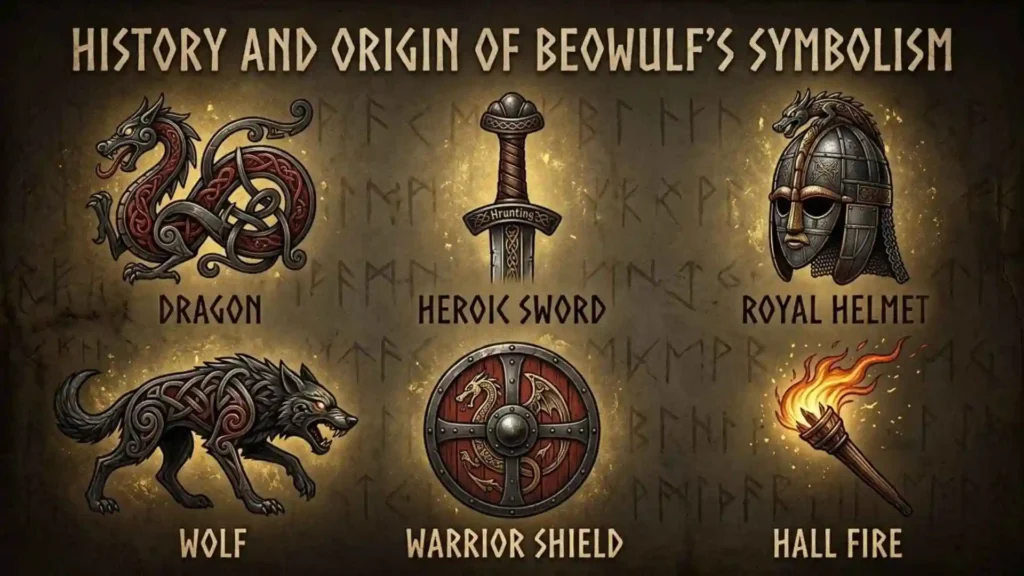
The symbolism of Beowulf developed from a mixture of Germanic heroic culture and Christian interpretation. The story is set among Scandinavian peoples, including the Danes and Geats, but the surviving poem was composed in Old English.
The poem survives in a single medieval manuscript now held by the British Library. The manuscript, known as Cotton MS Vitellius A XV and associated with the Nowell Codex, contains more than 3,000 lines of the poem.
Its heroic world emphasizes loyalty, reputation, gift-giving, revenge, kinship, and warfare. At the same time, its narrator refers to God, Cain, biblical history, divine judgment, and the dangers of pride.
This combination creates layered symbols. Grendel can be understood as both a Germanic monster and a descendant of Cain. Treasure can represent heroic generosity while also warning against attachment to worldly possessions. Fate and divine providence sometimes appear side by side.
The poem’s symbols evolved further through translation, scholarship, classroom study, visual art, film, and modern fiction. Contemporary readers often focus more strongly on exclusion, trauma, environmental danger, gender, or political instability than earlier audiences may have done.
Cultural Significance of Beowulf Symbols
The symbols in Beowulf preserve important ideas about early medieval northern European society. The mead hall reflects communal leadership, the ring-giver reflects political generosity, and the warrior’s weapon reflects inherited identity.
However, the poem does not simply celebrate warrior culture. It also exposes its weaknesses. Feuds continue across generations. Peace-making marriages may fail. Treasure cannot stop invasion. Great halls can burn. Even the strongest king must die.
Modern Western culture often uses Beowulf as a model for the monster-slayer: a hero who enters danger to protect others. Grendel, meanwhile, has become a symbol of the misunderstood outsider in many retellings.
The dragon-and-hoard image has also influenced modern fantasy. Later stories frequently connect dragons with gold, ruined kingdoms, underground chambers, and heroic sacrifice.
Religious and Spiritual Meaning
The religious symbolism in Beowulf reflects a Christian poet looking back at a pre-Christian heroic world. The characters belong to a Germanic past, but the narrator frequently interprets events through Christian ideas.
Grendel’s descent from Cain associates him with the first biblical murder and the spiritual consequences of violence. His exile reflects separation from both God and human society.
The poem also warns against pride. Hrothgar advises Beowulf not to let success make him arrogant. Strength, youth, wealth, and power are temporary gifts rather than permanent possessions.
At the same time, the poem retains older ideas about fate, often expressed through the Old English concept of wyrd. Human beings must act bravely even though they cannot control every outcome.
The result is not a simple theological system. It is a literary conversation between heroic fatalism and Christian moral judgment.
Where Beowulf Symbols Are Used Today
Beowulf’s symbols continue to appear in several settings:
- Literature classes: Students analyze Heorot, Grendel, the dragon, treasure, and the funeral.
- Fantasy fiction: Writers adapt the monster-slayer, haunted landscape, magical sword, and guarded-hoard patterns.
- Film and television: Visual adaptations often emphasize the contrast between the bright hall and the monsters’ dark environments.
- Art and illustration: Artists depict Grendel’s arm, the dragon, the mere, Beowulf’s ship, and the burial mound.
- Games: Role-playing and fantasy games use heroic warriors, named weapons, treasure-guarding dragons, and underground lairs.
- Tattoos: Images of Beowulf, dragons, swords, ravens, helmets, or Old English lettering may symbolize courage and endurance.
- Leadership discussions: Heorot and the ring-giver model are sometimes used to discuss generosity, loyalty, and communal responsibility.
- Psychological interpretation: Grendel and the mere may represent alienation, hidden fear, or confrontation with the shadow self.
Common Variations and Modern Adaptations
Modern retellings often change the meaning of Beowulf symbols. Grendel may become a victim, environmental force, wounded outsider, or misunderstood being rather than an entirely evil monster.
Grendel’s mother is sometimes portrayed as a seductive supernatural figure, but that image is far more prominent in modern adaptations than in the original poem. In the Old English text, she is primarily a dangerous avenger.
The dragon may represent industrial destruction, nuclear power, political greed, ecological crisis, or the fear of aging. These interpretations extend the original symbol rather than replacing it.
Heorot can also become a symbol of privilege or exclusion. From this perspective, the hall’s warmth is meaningful partly because some beings remain permanently outside it.
Common Misconceptions About Beowulf Symbols
Grendel is not clearly described as a modern fantasy troll
The poem uses several terms for Grendel but does not give readers a complete anatomical description. Artists and filmmakers therefore portray him in very different ways.
The poem does not present treasure as entirely evil
Gold supports loyalty and responsible kingship when rulers distribute it. The moral problem arises when wealth is hoarded, misused, or treated as more valuable than human responsibility.
Grendel’s mother is not given a personal name
She is identified through her relationship to Grendel. Modern adaptations sometimes invent names or greatly expand her character.
Beowulf is not a purely Christian allegory
Christian ideas shape the narration, but the poem also preserves Germanic heroic values, fatalism, feud customs, and pre-Christian cultural memory.
The dragon is not only a symbol of greed
It also represents death, retaliation, destructive power, failed leadership, and the vulnerability of a kingdom without a secure future.
Heorot is not permanently safe
The hall represents civilization, but the poem reminds readers that buildings and political systems can be destroyed. Its greatness is real but temporary.
10 Interesting Facts About Beowulf Symbols
- Heorot means “hart” or “stag.”
The name connects the hall with strength, nobility, and royal identity, although the poem focuses more on the building’s social function. - Grendel attacks sound as much as people.
The music and storytelling inside Heorot symbolize a shared culture that he cannot tolerate. - Beowulf’s bare hands carry symbolic importance.
Defeating Grendel without a weapon proves that the victory comes from the hero’s personal strength. - The monsters inhabit border spaces.
Grendel and his mother live away from settled society, reinforcing their symbolic position between the human world and the unknown. - The dragon’s treasure once belonged to a vanished people.
Before the dragon guards it, the hoard is buried by the last survivor of a dead community, connecting wealth with grief and extinction. - Several important swords fail.
Weapon failure prevents the poem from suggesting that inherited objects or technology can replace courage and judgment. - The dragon and Beowulf both protect treasure.
Their different motives create an uncomfortable parallel between the hero and his final enemy. - Beowulf’s burial mound faces the sea.
Its location turns his grave into a public landmark and allows his reputation to remain visible to future travelers. - The poem repeatedly predicts future disasters.
These references make victory feel temporary and place individual events inside a larger pattern of political decline. - Grendel’s head is called a sign of glory.
The trophy celebrates Beowulf, but its violent display also reminds readers that heroic fame is built through the destruction of enemies.
Related Symbols in Beowulf
The Ring-Giver
The ring-giver symbolizes an ideal king who distributes wealth and earns loyalty. Unlike the dragon, he keeps treasure moving through the community.
The Mead Hall
The mead hall symbolizes fellowship, government, memory, and cultural identity. Heorot is the poem’s most important example.
The Burial Mound
The mound symbolizes remembrance and the attempt to preserve fame. It also marks the boundary between a living community and its heroic past.
The Named Sword
A named sword symbolizes ancestry and inherited reputation. Its failure may show that the present generation cannot depend entirely on past glory.
The Monster
Monsters symbolize threats that society cannot easily absorb. They may represent violence, exile, revenge, fear, or uncomfortable similarities between heroes and enemies.
Fire
Fire symbolizes both celebration and destruction. It warms the hall and burns on the funeral pyre, but the dragon also uses it to devastate Beowulf’s kingdom.
Frequently Asked Questions About Beowulf Symbols
What is the most important symbol in Beowulf?
Heorot is often considered the poem’s central symbol because it represents civilization, social unity, generosity, and political order. Grendel’s attacks on the hall are therefore attacks on the entire human community. The hall also reveals that civilization is fragile, since even magnificent institutions can eventually be destroyed.
What does Grendel symbolize in Beowulf?
Grendel symbolizes exile, resentment, violence, and rejection of social order. His hatred of Heorot’s music shows his hostility toward fellowship and shared culture. Because the poem links him to Cain, he also represents inherited conflict and the spiritual consequences of kin-killing.
What does the dragon symbolize in Beowulf?
The dragon symbolizes death, destructive anger, hoarded wealth, and the limits of heroic strength. Beowulf defeats it but dies from his wounds, showing that even the greatest warrior cannot escape mortality. The dragon’s unused treasure also contrasts with the generous gift-giving expected from a good king.
What does Heorot symbolize?
Heorot symbolizes community, kingship, safety, storytelling, and social order. It is where warriors receive gifts, renew loyalty, and celebrate collective identity. Its vulnerability to Grendel and future political violence shows that civilization requires constant protection and can never be assumed permanent.
What does the treasure symbolize?
Treasure symbolizes both healthy social exchange and dangerous isolation. A generous ruler distributes wealth to reward loyalty and support the community. A dragon hoards wealth that benefits no one. The meaning of treasure therefore depends on whether it strengthens human relationships or remains separated from social responsibility.
What does Grendel’s mother symbolize?
Grendel’s mother symbolizes maternal loyalty, vengeance, and the destructive cycle of feud. Her desire to avenge her son resembles the revenge obligations practiced by human warriors. This similarity complicates the moral division between monsters and people, even though her attack remains violent and threatening.
What does the mere symbolize?
The mere symbolizes fear, mystery, hidden danger, and the world beyond civilized control. Beowulf’s descent into it resembles a journey into an underworld. By entering the monsters’ home, he confronts danger at its source and undergoes a symbolic test of courage and identity.
What do swords symbolize in Beowulf?
Swords symbolize military status, ancestry, reputation, and human effort. Because important swords break or fail, they also symbolize the limits of material protection. Beowulf cannot rely solely on inherited weapons; he must combine strength with courage, judgment, and acceptance of fate.
What does Beowulf’s funeral symbolize?
Beowulf’s funeral symbolizes honor, mortality, remembrance, and political uncertainty. The burial mound preserves his reputation, but his death leaves the Geats exposed to their enemies. The scene shows that heroic fame can survive death while a hero’s community may remain dangerously vulnerable.
Is Beowulf himself a symbol?
Beowulf symbolizes the heroic ideal of courage, loyalty, service, and fame. As he ages, he also symbolizes the burdens of leadership and the limits of individual power. His life suggests that true heroism involves protecting others, but his death questions whether one person can secure a nation’s future.
Key Takeaways
- Heorot symbolizes civilization, fellowship, generosity, and political order.
- Grendel represents alienation, envy, violence, and rejection of community.
- Grendel’s mother embodies revenge and the continuing cycle of feud.
- The mere symbolizes fear, mystery, and confrontation with the unknown.
- Grendel’s arm and head serve as symbols of victory, glory, and violent punishment.
- The dragon represents mortality, destructive power, and hoarded wealth.
- Treasure is positive when shared but destructive when isolated from social purpose.
- Weapons symbolize heroic identity while revealing the limits of human power.
- Light and darkness distinguish community from exile and safety from uncertainty.
- Beowulf’s funeral represents both lasting fame and the decline of political security.
Conclusion
The major Beowulf symbols give the poem its lasting emotional and intellectual power. Heorot, Grendel, the mere, the dragon, treasure, weapons, and the funeral mound connect dramatic battles with questions about belonging, leadership, revenge, generosity, aging, and death.
The poem celebrates extraordinary courage, but it never pretends that courage solves every human problem. Monsters can be defeated, yet feuds continue. Treasure can reward loyalty, yet it can also become useless. A hero can save a kingdom, yet no hero can live forever.
By understanding these symbols, readers can see Beowulf not simply as an ancient monster story but as a thoughtful exploration of how communities are built, threatened, remembered, and lost.

I am Ethan Mitchell, an English writer and lifelong learner who is fascinated by words and the way language changes over time. At LearnNestly, I share practical explanations designed for readers who want to improve their understanding of English without complicated terminology. I enjoy researching meanings, usage, grammar, and common language mistakes, then presenting the information in a simple and useful format. My purpose is to make every article a small learning experience that readers can actually apply.
Books:
- The Smart Learner’s English Guide
- English in Real Life
 Daniel Brooks
 Amelia Carter