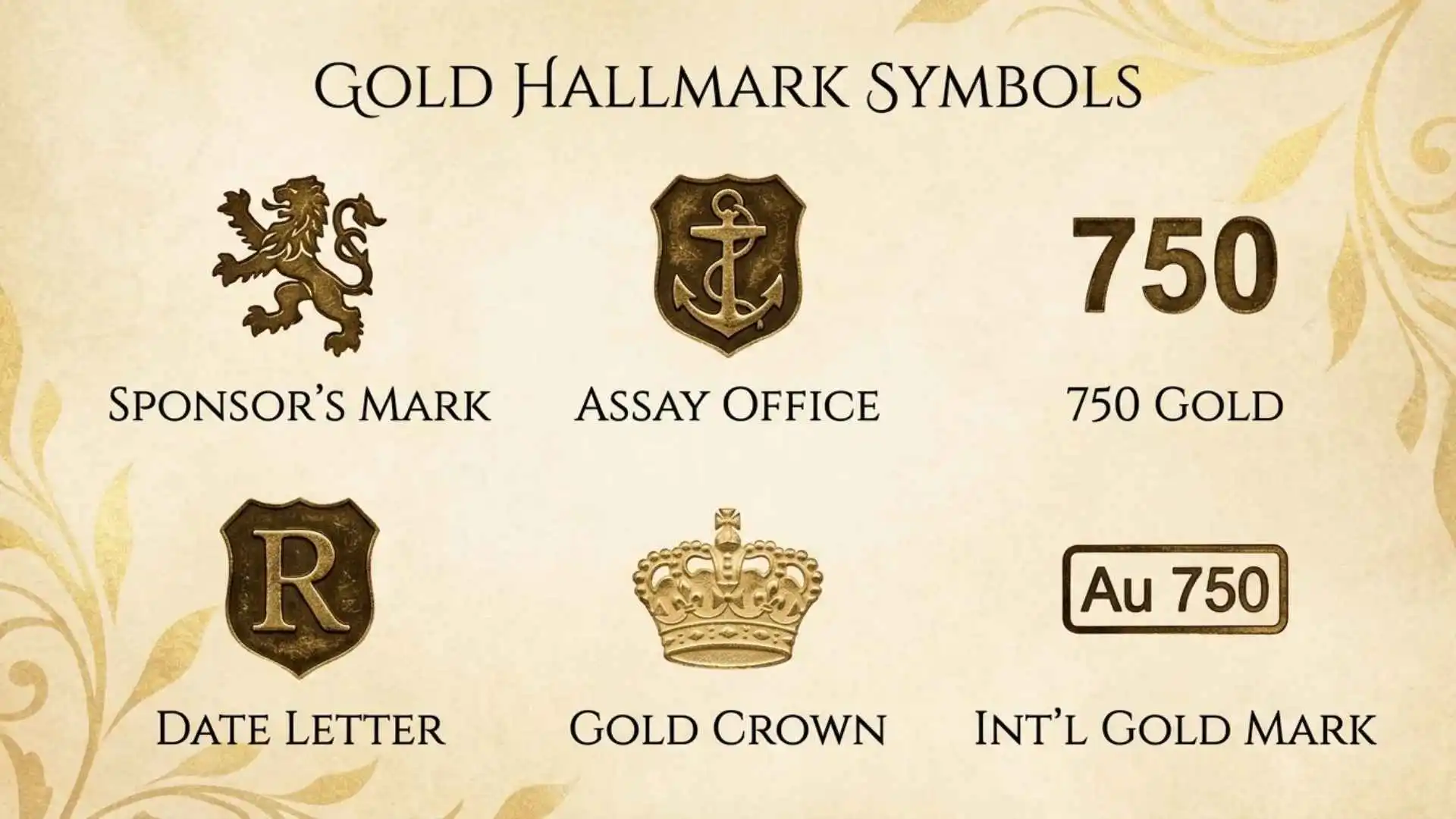
Gold hallmarks symbols are small stamps that reveal important facts about a gold item, including its purity, maker, testing authority, and sometimes its place or year of manufacture. You may find them inside rings, near necklace clasps, on bracelet links, behind pendants, or on the cases of gold watches.
These tiny impressions matter because gold jewelry is rarely made from completely pure gold. It is normally mixed with metals such as silver, copper, zinc, nickel, or palladium to improve strength, color, and durability. A hallmark helps identify how much actual gold the alloy contains.
However, not every stamp is an official hallmark. Some are simple manufacturer marks, karat claims, plating descriptions, model numbers, or decorative symbols. Understanding the complete group of marks is therefore more reliable than judging an item by one number alone.
Quick Meaning
Gold hallmarks symbols identify the purity, origin, maker, or official testing status of a gold item. Numbers such as 375, 585, 750, 916, and 999 show gold content in parts per thousand, while marks such as initials, assay-office symbols, date letters, and certification logos provide additional identification.
Gold Hallmarks Symbols Overview
| Hallmark or Symbol | Primary Meaning | Common Example | What It Tells You |
| Millesimal fineness mark | Gold purity per 1,000 parts | 375, 585, 750, 916, 999 | Percentage of pure gold in the alloy |
| Karat mark | Gold purity out of 24 parts | 9K, 10K, 14K, 18K, 22K, 24K | Traditional gold-quality measurement |
| Sponsor’s or maker’s mark | Responsible business or person | Initials inside a shaped shield | Who made or submitted the item |
| Assay-office mark | Official testing location | Anchor, leopard’s head, rose, castle | Where the item was tested and hallmarked |
| Date letter | Hallmarking year | A letter in a particular shield | Approximate date of official marking |
| Traditional gold symbol | Metal identification | Crown in British hallmarking | Indicates gold rather than another metal |
| Common Control Mark | International conformity | Balance scales over intersecting circles | Testing under Hallmarking Convention rules |
| BIS mark | Indian standards certification | BIS logo | Official Indian hallmarking system |
| HUID | Unique Indian hallmark identity | Six-character alphanumeric code | Identifies an individually hallmarked article |
| Trademark | Manufacturer or retailer identity | Name, logo, or registered initials | Commercial responsibility or brand |
| Plating mark | Thin gold surface over base metal | GP, GEP, HGE, RGP | Item is not solid gold throughout |
| Gold-filled mark | Mechanically bonded gold layer | 1/20 14K GF | Proportion and quality of bonded gold |
| Chemical symbol | Elemental reference | Au | Gold as chemical element 79 |
Official hallmarking systems use marks to record precious-metal fineness and help protect buyers against adulteration. The exact required symbols differ among countries, so a valid British, Indian, Swiss, Irish, or American marking sequence may look very different.
What Do Gold Hallmarks Symbols Mean?
Gold hallmarks symbols function as a compact identification record. Instead of serving as one universal logo, a hallmark often consists of several neighboring stamps, each answering a separate question.
A complete hallmark may tell you:
- What proportion of the alloy is pure gold
- Who made, imported, or submitted the item
- Which authority tested it
- Where it was tested
- When it was marked
- Whether it met national or international standards
The purity number is usually the most useful mark for consumers. A stamp of 750 means that 750 of every 1,000 parts of the alloy are pure gold. The remaining 250 parts consist of other metals.
This means 750 gold is 75% pure, while 585 gold is 58.5% pure. The added metals affect hardness, color, cost, and resistance to everyday wear.
Common Gold Purity Numbers
| Fineness Mark | Gold Percentage | Approximate Karat |
| 333 | 33.3% | 8 karat |
| 375 | 37.5% | 9 karat |
| 417 | 41.7% | 10 karat |
| 585 | 58.5% | 14 karat |
| 625 | 62.5% | 15 karat |
| 750 | 75.0% | 18 karat |
| 833 | 83.3% | 20 karat |
| 875 | 87.5% | 21 karat |
| 916 | 91.6% | 22 karat |
| 958 | 95.8% | 23 karat |
| 990 | 99.0% | Near-pure gold |
| 999 | 99.9% | 24 karat fine gold |
The relationship between karats and percentage can be calculated as:
Gold percentage = karat ÷ 24 × 100
For example, 18 ÷ 24 × 100 equals 75%, which corresponds to the 750 fineness mark.
History and Origin of Gold Hallmarking
Gold hallmarking developed because precious metals could easily be diluted with cheaper materials. A gold object might appear valuable while containing less gold than its seller claimed.
Authorities therefore introduced systems that required precious-metal objects to be tested and officially marked. These systems protected customers, supported fair taxation, regulated goldsmiths, and created confidence in trade.
The English word “hallmark” is connected with Goldsmiths’ Hall in London, where precious-metal articles were historically submitted for testing. Over time, the term expanded beyond precious metals and came to mean a distinguishing sign of quality or authenticity.
Early European systems often combined a town mark, maker’s mark, date letter, and quality indicator. These marks became especially valuable to later historians because they could connect an object with a particular workshop, location, and period.
Modern hallmarking relies on more standardized measurements. Millesimal fineness expresses purity in parts per thousand, allowing marks such as 585 or 750 to communicate gold content without depending on local karat terminology.
In the United Kingdom, the compulsory components of a modern domestic hallmark are the sponsor’s mark, millesimal fineness mark, and assay-office mark. A traditional fineness symbol and date letter may also appear, but they are optional.
International trade encouraged another important development: the Common Control Mark. Under the Convention on the Control and Marking of Articles of Precious Metals, authorized assay offices can apply this shared conformity mark after testing an item under agreed requirements.
Understanding the Main Gold Hallmark Symbols
Millesimal Fineness Numbers
Millesimal numbers show how many parts of pure gold exist in 1,000 parts of alloy. They provide a precise and widely understood way to describe gold purity.
For example:
- 375 means 375 parts gold and 625 parts other metals.
- 585 means 585 parts gold and 415 parts other metals.
- 750 means 750 parts gold and 250 parts other metals.
- 916 means 916 parts gold and 84 parts other metals.
- 999 means approximately 999 parts gold and one part other material.
A millesimal number describes composition, not craftsmanship, age, beauty, or market value. Two pieces marked 750 can differ greatly in workmanship, weight, gemstones, brand, and historical importance.
Karat Marks
Karat marks describe purity on a 24-part scale. They commonly appear as K, KT, or sometimes C or CT in older British contexts.
Typical examples include:
- 9K or 9CT
- 10K
- 14K or 14KT
- 18K or 18CT
- 22K or 22CT
- 24K
The word karat measures gold purity. It should not be confused with carat, which commonly measures gemstone weight, although British English traditionally uses “carat” for both concepts.
Sponsor’s or Maker’s Marks
A sponsor’s mark identifies the person or business responsible for submitting an article for hallmarking. It may belong to a goldsmith, manufacturer, importer, wholesaler, retailer, or another registered party.
In British hallmarking, the sponsor’s mark normally contains at least two letters inside a distinctive surrounding shape. The shape and lettering together help distinguish one registration from another.
People often call every set of initials a maker’s mark, but the registered sponsor was not necessarily the craftsperson who physically made the piece. An importer or retailer may have submitted it.
Assay-Office Symbols
An assay-office symbol identifies the office that tested and marked the article. British examples include:
- Leopard’s head: London
- Anchor: Birmingham
- Rose: Sheffield
- Castle: Edinburgh
Historical assay offices used other symbols, and some marks changed over time. The outline surrounding a symbol may also help determine its period and metal category.
The presence of an official-looking picture should not be interpreted alone. It must match the expected design, period, and surrounding marks.
Date Letters
A date letter can indicate when an item was hallmarked. British date-letter systems generally use a cycle of letters whose typeface, capitalization, and surrounding shield change over time.
A letter by itself is therefore insufficient for dating. The researcher must identify:
- The assay office
- The letter’s font
- Whether it is uppercase or lowercase
- The shape surrounding it
- The correct date cycle
Date letters are useful for dating jewelry and commemorating special occasions, but they are not currently compulsory in the United Kingdom.
Traditional Gold Marks
Traditional pictorial marks identify the precious-metal category. The British traditional mark for gold is a crown.
This symbol does not replace the fineness number. A crown indicates that the hallmark relates to gold, while a number such as 750 specifies the tested purity.
Common Control Mark
The Common Control Mark, or CCM, supports recognition of precious-metal articles among participating countries. For gold, its design uses balance scales superimposed on two intersecting circles.
A Convention hallmark also includes a responsibility mark, fineness mark, and authorized assay-office mark. The CCM indicates that the article was controlled according to the Convention’s requirements rather than merely being decorated with an international-looking symbol.
Symbolism and Interpretation

Gold hallmarks are primarily technical and legal signs, but they also carry broader symbolic meanings.
Trust and Accountability
A properly administered hallmark symbolizes accountability. It connects an anonymous-looking object to a responsible sponsor and, in official systems, a recognized testing authority.
Purity and Transparency
Fineness numbers represent measurable purity rather than a vague promise. They make an invisible material property visible to the buyer.
Craftsmanship and Heritage
Historical maker’s marks can connect jewelry with individual workshops, design movements, and regional craft traditions. Collectors may value a rare maker’s stamp even when the object’s gold content is modest.
Ownership and Status
Gold has long symbolized wealth, power, permanence, and social standing. Hallmarks strengthened those associations by recording that an object met a recognized material standard.
Negative Associations
False or misleading marks can symbolize deception rather than trust. Counterfeit hallmarks, altered stamps, and marks transferred from another object may be used to make low-purity or plated items appear more valuable.
Cultural Significance and Regional Differences
Gold hallmarking has no single worldwide format. Each region developed laws and conventions suited to its trade, institutions, and jewelry traditions.
United Kingdom
British hallmarks are among the most detailed and historically useful. Modern compulsory marks identify the sponsor, millesimal fineness, and assay office. Optional marks may identify the traditional metal category, date, commemorative event, or Convention compliance.
Gold articles below certain statutory weight thresholds may be exempt from compulsory hallmarking. Therefore, the absence of a hallmark on a very small British item does not automatically prove that it is counterfeit.
United States
The United States commonly uses karat marks such as 10K, 14K, and 18K. The American system is not identical to compulsory independent assay-office systems used in some European countries.
Federal Trade Commission guidance addresses representations concerning gold, precious-metal alloys, plating, and related jewelry descriptions. A purity stamp should therefore be considered alongside the seller’s identity, documentation, reputation, and independent testing when necessary.
India
India’s Bureau of Indian Standards operates a hallmarking system intended to confirm precious-metal purity and protect buyers against adulteration. BIS describes hallmarking as the accurate determination and official recording of the proportionate precious-metal content in an article.
Modern Indian gold jewelry may display the BIS logo, purity in karat and millesimal form, and a six-character Hallmark Unique Identification code. The HUID connects the article with its hallmarking record and can be checked through official BIS services.
Continental Europe
Many European items use millesimal numbers such as 585, 750, or 916. National control symbols, maker’s marks, import marks, town marks, or Convention marks may accompany the purity figure.
Older European hallmarks can be difficult to interpret because national borders, governments, legal standards, and assay institutions changed over time.
Middle Eastern and Asian Markets
High-purity gold, especially 21K, 22K, and 24K, is culturally important in many Middle Eastern and South Asian communities. Wedding jewelry, dowry traditions, family wealth, and ceremonial gifts often favor higher gold content.
However, regional preference does not guarantee purity. Buyers should still examine official certification, purchase documentation, weight, testing results, and seller credentials.
Scientific and Technical Meaning
Gold is the chemical element Au, from the Latin word aurum, and has atomic number 79. The symbol Au may appear in technical records, refinery documents, bullion descriptions, and scientific contexts, but it is not by itself proof of purity.
Gold Alloy Composition
Pure gold is soft and highly malleable. Jewelers combine it with other metals to adjust practical properties:
- Copper can increase hardness and produce warmer or redder tones.
- Silver can lighten the alloy and contribute to greenish or pale shades.
- Palladium may be used in some white-gold alloys.
- Nickel has historically been used in white gold but can cause sensitivity in some wearers.
- Zinc may improve casting behavior or modify color.
The fineness mark records gold content, not the exact identity of every added metal.
Assaying Methods
Professional laboratories may assess gold using methods such as touchstone testing, cupellation or fire assay, and X-ray fluorescence. Each method has advantages and limitations.
X-ray fluorescence can analyze surface composition without major damage, while fire assay is highly accurate but requires removing and processing a sample. Surface-only testing may be misleading when an item is heavily plated or compositionally uneven.
Hallmark Versus Assay Result
A hallmark records a claim or official determination made under a particular system. A current assay examines the material that exists now.
This distinction matters because old objects may have been repaired, resized, plated, soldered, or assembled from components of different fineness.
Where Gold Hallmarks Symbols Are Used
Gold hallmarks appear on many types of precious-metal objects, including:
- Rings and wedding bands
- Earrings
- Necklace clasps
- Bracelet links
- Pendants
- Brooches
- Watch cases
- Pocket-watch chains
- Gold cutlery
- Decorative boxes
- Religious objects
- Medals and presentation pieces
- Antique tableware
- Bullion bars and coins
The location is usually discreet. Inside a ring, the mark is protected from view and excessive wear. On chains, it may appear on a clasp, terminal tag, or connecting ring. Watch hallmarks may be found inside the case rather than on the movement.
A magnifying loupe, soft lighting, and photographs taken from several angles can make shallow stamps easier to examine. Harsh polishing should be avoided because it may erase historically valuable details.
Common Variations and Similar Marks
GP, GEP, and HGE
These abbreviations usually describe gold plating:
- GP: Gold plated
- GEP: Gold electroplated
- HGE: Heavy gold electroplate
Such items have a base metal covered with a gold layer. They should not be valued as solid gold based on total weight.
GF and RGP
GF means gold filled. A comparatively substantial gold layer is mechanically bonded to a base metal.
RGP means rolled gold plate. Its construction resembles gold-filled material, although terminology and legal definitions vary by market and period.
A mark such as 1/20 14K GF indicates that the bonded gold portion represents a stated fraction of the item’s metal weight and that the gold layer is 14-karat quality.
P, KP, and Plumb Gold
A mark such as 14KP may mean 14-karat plumb, indicating that the gold is intended to meet the stated karat level rather than fall within a permitted negative tolerance.
The letter P should not automatically be read as “plated.” Its meaning depends on its position and the complete stamp.
Two-Tone and Mixed-Metal Marks
A piece combining gold with platinum, silver, or another metal may contain several fineness marks. Each number may refer to a different component rather than the entire object.
Import and Export Marks
Imported jewelry may carry marks from its country of origin, an importer’s mark, and additional marks required by the destination country. Repeated or overlapping stamps may therefore reflect legal trade history rather than forgery.
Laser Hallmarks
Modern marks may be applied by laser instead of a traditional punch. Laser marking is useful for delicate, hollow, or finished items that might be distorted by impact.
Common Misconceptions About Gold Hallmarks
“A 750 Stamp Proves the Item Is Genuine”
A 750 stamp claims 75% gold, but stamps can be copied. Authenticity depends on the mark’s credibility, the item’s construction, seller documentation, and testing where appropriate.
“All Genuine Gold Must Have a Hallmark”
Rules vary by country, date, weight, and object type. Antique pieces, small exempt articles, privately made jewelry, worn items, and products from regions without compulsory hallmarking may lack clear marks.
“A Hallmark Identifies the Exact Maker”
A sponsor’s mark may identify the party that submitted the item, not the individual craftsperson who fabricated it.
“24K Gold Is Always Marked 24K”
Near-pure gold may instead be marked 999, 999.9, 990, or with a locally recognized control mark. Bullion and jewelry also follow different marking practices.
“White Gold Is Platinum”
White gold is a gold alloy formulated to appear pale and may be plated with rhodium. Platinum is a separate element with its own fineness marks, commonly including 950.
“An Acid Test Confirms the Whole Item”
An acid test generally assesses a small exposed area. Thick plating, solder, filled construction, or mixed components can produce incomplete conclusions.
“Old Marks Are Always More Valuable”
Age can increase historical interest, but value depends on condition, rarity, maker, design, provenance, weight, and demand. An old hallmark alone does not guarantee high value.
Interesting Facts About Gold Hallmarks Symbols
- The purity number is a mathematical statement. A 585 stamp directly represents 58.5% gold rather than an arbitrary grade name.
- The same karat can have different colors. Yellow, rose, green, and white 18K gold may all bear 750 because color depends on the remaining 25% of alloying metals.
- Hallmarks can help date antiques. An assay symbol combined with the correct date-letter font and shield can narrow the marking year.
- A date letter dates hallmarking, not necessarily design. An item may have been made shortly before it was submitted, or an older object may have received later marks after import or alteration.
- Wear can remove genuine marks. Ring resizing, repeated polishing, clasp replacement, and decades of friction may partially or completely erase a stamp.
- One item may contain several gold purities. Solder, decorative sections, replacement components, and mixed-color construction can differ from the main body.
- Hallmark order is informative. The sequence and spacing can help determine whether stamps belong to one official group or were applied separately.
- The Common Control Mark supports cross-border recognition. It operates as an additional conformity mark for qualifying precious-metal articles tested by authorized offices.
- Tiny objects can hold extensive records. A narrow ring may carry a sponsor’s initials, fineness number, assay symbol, date letter, and commemorative mark within a few millimeters.
- Counterfeiters may imitate genuine-looking numbers. Correct typography, shield shape, depth, spacing, and supporting marks can be as important as the number itself.
- Repairs can complicate identification. A genuine antique clasp may be attached to a later chain, or a hallmarked section may be joined to lower-purity material.
- Hallmarks are historical evidence. Beyond purity, they can reveal trade routes, workshop relationships, government regulation, imports, and changing standards.
Related Symbols and Marks
Silver Hallmarks
Silver commonly uses marks such as 800, 925, 958, or 999. The number 925 means sterling silver, not gold.
Platinum Marks
Platinum jewelry may bear 850, 900, 950, or 999, often with Pt or Plat. A 950 mark must be interpreted with its accompanying metal identifier.
Palladium Marks
Palladium can carry fineness numbers such as 500, 950, or 999. Its marks may resemble those used for platinum or silver, so context matters.
Maker’s Trademarks
A trademark identifies a company or brand but does not independently state purity. It may appear beside an official hallmark or commercial karat stamp.
Assay-Office Marks
These official symbols identify the institution that tested an article. They differ from decorative logos because they operate within a regulated hallmarking framework.
Mint Marks
Mint marks identify the facility responsible for producing a coin or bullion product. They should not be confused with jewelry assay-office symbols.
Copyright and Design Marks
Symbols such as © or registration marks concern intellectual-property rights. They do not certify precious-metal content.
Frequently Asked Questions
What do the numbers on gold jewelry mean?
Numbers such as 375, 585, 750, 916, and 999 normally show gold fineness in parts per thousand. For example, 750 means the alloy contains 750 parts gold per 1,000, or 75% pure gold. That is approximately equal to 18-karat gold.
Is 585 gold real gold?
Yes. A genuine 585 alloy contains 58.5% pure gold and is approximately equivalent to 14-karat gold. The remaining 41.5% consists of other metals added for strength, color, and workability. Because stamps can be falsified, testing may still be appropriate for valuable purchases.
What does 750 mean on a ring?
A 750 mark means the ring is represented as 75% pure gold, equivalent to 18 karats. The other 25% consists of alloying metals. The mark describes metal composition, but it does not by itself prove authenticity, identify the gemstones, or determine the item’s total value.
What does 916 mean on gold?
The number 916 represents 91.6% pure gold, which corresponds closely to 22-karat gold. It is common in South Asian and Middle Eastern jewelry. Because 22K gold is softer than 14K or 18K gold, designs may require greater care during everyday wear.
Does a hallmark guarantee that gold is genuine?
An official hallmark provides strong evidence that an item met a recognized standard when tested and marked. However, buyers should still consider the complete hallmark, seller credibility, paperwork, condition, and possible later alterations. A single copied number is not the same as a verifiable official hallmark.
How can I find a hallmark on jewelry?
Examine protected areas such as the inside of a ring, the back of a pendant, the post of an earring, a bracelet’s clasp, or a necklace’s terminal tag. Use a jeweler’s loupe and angled lighting. Avoid scratching, filing, or aggressively polishing the item.
What does Au mean on jewelry?
Au is the chemical symbol for gold, derived from the Latin aurum. It may identify gold in technical or commercial markings, but Au alone does not state purity. Look for an accompanying fineness number, karat designation, official hallmark, or reliable assay documentation.
Why does my gold ring have several symbols?
Several marks may form one identification sequence. They can represent the sponsor, purity, assay office, date, traditional metal symbol, or international control mark. Additional stamps may record patents, model numbers, importers, repairs, or later testing. Their order and shapes help establish meaning.
Can fake jewelry have a gold hallmark?
Yes. A dishonest producer can stamp numbers or symbols onto plated or low-purity metal. Warning signs include crude lettering, inconsistent spacing, an impossible combination of national marks, visible plating wear, magnetic base components, and a price far below realistic market value.
Should I test gold that already has a hallmark?
Testing may be sensible when the item is expensive, the seller is unknown, the marks appear unusual, or repairs may have changed its composition. A qualified jeweler, accredited laboratory, assay office, or precious-metal specialist can choose a method appropriate to the item’s value and condition.
Key Takeaways
- Gold hallmarks symbols communicate purity, responsibility, origin, testing authority, or date.
- Millesimal marks show gold content in parts per thousand.
- The most familiar fineness numbers include 375, 585, 750, 916, and 999.
- Karat marks express purity on a 24-part scale.
- A sponsor’s mark does not always identify the individual craftsperson.
- Official hallmark formats differ among countries.
- GP, GEP, HGE, GF, and RGP do not describe solid-gold construction.
- A purity stamp alone cannot guarantee authenticity.
- Date letters must be interpreted with their font, shield, and assay-office symbol.
- Professional testing is advisable when value, authenticity, or composition remains uncertain.
Conclusion
Gold hallmarks symbols turn tiny stamped impressions into valuable information about an object’s material, origin, maker, and history. Purity numbers such as 585, 750, and 916 explain how much gold the alloy contains, while sponsor marks, assay-office symbols, date letters, and certification marks reveal how the item entered a regulated system.
The safest interpretation comes from reading every mark together rather than trusting one familiar number. Once you understand how hallmark groups work, you can evaluate jewelry more confidently, recognize plated materials, research antique pieces, and ask better questions before buying or selling gold.

I am Daniel Brooks, a language researcher and writer with a strong interest in how people use English in everyday conversations. I contribute to LearnNestly because I enjoy turning confusing language topics into straightforward lessons. My goal is to help readers understand not only what a word or phrase means, but also when and how to use it naturally. I focus on clear examples, practical explanations, and useful language knowledge that readers can remember.
Books:
- The Practical English Guide
- Understanding Everyday Words
 Ethan Mitchell
 Amelia Carter