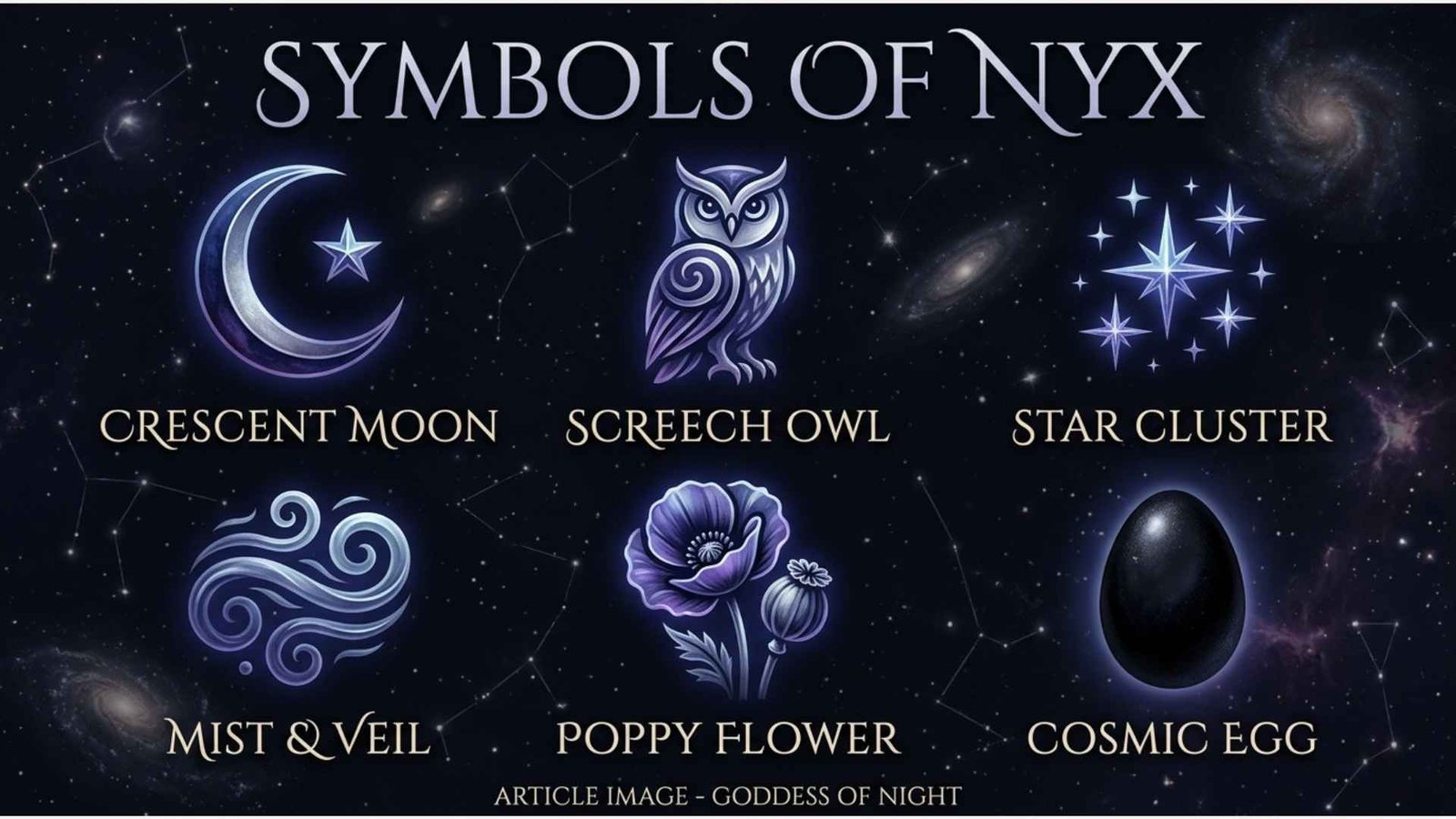
Nyx goddess symbols represent night, primordial darkness, cosmic mystery, dreams, sleep, fate, and the hidden forces of existence. Her strongest historically supported symbols are the star-covered veil, dark mist, wings, chariot, and torches. Modern artwork also connects her with crescent moons, ravens, owls, and black flowers, although these were not exclusive ancient attributes of Nyx.
Nyx was not simply a goddess who ruled the night. In Greek mythology, she was the divine personification of Night itself. Ancient poets described her as a primordial power born near the beginning of creation, while artists portrayed her moving across the heavens as daylight disappeared.
Readers may encounter her symbols in Greek vase paintings, mythology books, poetry, jewelry, tattoos, fantasy stories, spiritual art, and modern popular culture.
Quick Meaning of Nyx Goddess Symbols
Nyx goddess symbols primarily express the arrival and power of night. Her dark or starry veil represents the nighttime sky, wings suggest her swift movement across the heavens, and her chariot shows the daily passage from light to darkness. Torches, mist, stars, and shadow further symbolize mystery, sleep, dreams, fate, and unseen cosmic forces.
Nyx Goddess Symbols Overview
| Symbol or Attribute | Primary Meaning | Historical Status | Typical Appearance |
| Dark or starry veil | The night sky covering the world | Strongly associated | Black, blue, or star-covered mantle |
| Dark mist | Night obscuring heavenly light | Strong literary association | Shadow, fog, or dark clouds |
| Wings | Swift movement and supernatural power | Ancient artistic association | Wings on her back or shoulders |
| Chariot | Night traveling across the sky | Ancient artistic association | Horse-drawn heavenly chariot |
| Torches | Nocturnal movement and transition | Appears in ancient art | One or two burning torches |
| Stars | The visible heavens at night | Natural symbolic association | Stars on clothing or surrounding her |
| Black or deep blue | Darkness, secrecy, and the unknown | Modern visual convention | Clothing, backgrounds, candles |
| Crescent moon | Night and lunar cycles | Mostly modern association | Moon crown, pendant, or background |
| Owl or raven | Night, secrecy, and hidden knowledge | Modern adaptation | Companion animal or decorative image |
| Poppy | Sleep, dreams, and rest | Indirect association | Flower in modern devotional art |
| Roman name | Nox | Roman equivalent | Personification of Night |
| Unicode symbol | None | Not applicable | No official Nyx character |
| Emoji equivalent | No exact equivalent | Modern approximation | 🌌, 🌙, ⭐, 🌑 |
What Do Nyx Goddess Symbols Mean?
Nyx goddess symbols mean more than ordinary darkness. They represent the ancient Greek idea that night was a living cosmic force with its own identity, movement, family, and place in the structure of the universe.
Unlike Zeus, who carries a recognizable thunderbolt, or Poseidon, who holds a trident, Nyx does not have one universally fixed emblem. Her identity is communicated through several visual elements that describe what she is: Night personified.
The Dark or Starry Veil
The dark veil is the clearest symbol of Nyx. It represents the nighttime sky spreading over the earth and hiding the brightness of the heavens.
In mythological imagery, night could be understood as a mantle, curtain, or mass of darkness drawn across the world. A star-covered cloak makes this idea visible. Nyx does not merely wear the night; her clothing suggests that she embodies it.
The veil may symbolize:
- The separation between the visible and invisible
- Mystery and secrecy
- Rest after daily activity
- Protection from exposure
- Fear of the unknown
- The boundary between waking and dreaming
Modern artists often show Nyx wearing a flowing black or midnight-blue gown filled with stars. Although the exact designs vary, the image follows the ancient idea of Nyx as the substance or personification of night.
Dark Mist and Shadow
Dark mist represents the physical arrival of night. Some Greek cosmological traditions imagined darkness spreading across the sky and concealing the bright upper air known as Aether.
This symbol gives Nyx an active role in the daily cycle. Night does not appear as an empty absence of sunlight. It moves, covers, surrounds, and transforms the visible world.
Psychologically, dark mist can represent uncertainty. Familiar shapes become difficult to recognize at night, so darkness naturally became associated with hidden possibilities, dreams, danger, imagination, and spiritual mystery.
Wings
Ancient artists sometimes portrayed Nyx as a winged woman. Wings communicate speed, divine mobility, and the movement of night across the sky.
Her wings also connect her visually with other winged divine figures, including Eos, the goddess of dawn, and certain personified spirits. However, wings alone do not identify Nyx. The surrounding context, such as stars, darkness, other nocturnal gods, or the transition from day to night, is necessary.
Symbolically, Nyx’s wings can mean:
- Freedom from earthly limitations
- The rapid arrival of darkness
- Movement between cosmic regions
- Passage from consciousness into sleep
- The unseen approach of fate
The Chariot
Nyx’s chariot represents the regular journey of night across the heavens. Greek art frequently used divine chariots to explain celestial movement. Helios traveled as the sun, Eos announced dawn, and Nyx could appear as a charioteer bringing darkness.
The chariot makes night part of an ordered cycle rather than a random event. Darkness arrives, remains for a measured period, and withdraws as dawn and day return.
A sixth-century BCE Attic oil flask attributed to the Amasis Painter presents Helios, Nyx, and Eos as part of a visual account of changing time. The object demonstrates how Greek artists used divine figures to make sunrise, sunset, and the movement of the heavens understandable.
Torches
Torches appear with Nyx in some ancient imagery, but they require careful interpretation. Torches identify movement through darkness and may mark the transition between night and dawn.
An ancient vase scene shows Nyx holding a pair of torches while looking back toward Eos, the approaching Dawn. Torches are more famously connected with Hecate, so their appearance does not automatically identify a figure as Nyx. In Nyx’s case, the surrounding celestial scene provides the identification.
For modern readers, her torches can symbolize guidance within darkness rather than the destruction of darkness. They suggest that mystery can be entered with awareness, patience, and limited light.
History and Origin of Nyx Goddess Symbols
Nyx originated in ancient Greek cosmogony, the collection of stories explaining how the universe and its divine powers came into being. Her Greek name, Νύξ, simply means “Night.”
In Hesiod’s Theogony, Nyx belongs to the earliest generation of beings. She emerges from Chaos and produces or becomes connected with powers that shape human existence, including Sleep, Death, Dreams, Strife, Old Age, and Fate. This genealogy reflects an ancient effort to explain why many powerful experiences seem to arise from darkness or remain beyond human control.
Nyx is therefore classified among the Protogenoi, or primordial deities. These beings were not merely humanlike rulers with limited responsibilities. They personified basic structures of reality, such as Earth, Sky, Sea, Darkness, and Night.
From Cosmic Force to Human Form
The earliest concept of Nyx was abstract: she was Night itself. Greek poets and artists also gave her human form so audiences could imagine her actions and relationships.
This process is called personification. An invisible condition becomes a figure who can travel, speak, give birth, oppose another deity, or influence events.
As Nyx became anthropomorphic, artists represented her through:
- Flowing dark clothing
- Wings
- A heavenly chariot
- Torches
- Stars or an aura of darkness
- Scenes involving Eos, Helios, Selene, or Hesperus
These images did not replace her cosmic nature. They translated it into forms that could be painted on pottery, described in poetry, or understood through storytelling.
Nyx and the Cycle of Day and Night
Nyx is closely related to Hemera, the personification of Day, and Eos, the goddess of Dawn. Mythological traditions often describe Night and Day as succeeding one another rather than occupying the sky together.
This relationship explains why Nyx frequently appears in transitional scenes. Her symbols become most meaningful at sunset or dawn, when one cosmic state gives way to another.
The Metropolitan Museum of Art notes that Athenian vase painters used nocturnal deities such as Nyx and Selene to indicate night, while Helios and Eos signaled daytime. Their presence functioned almost like a visual time marker.
Symbolism and Interpretation
Nyx’s symbolism developed from observable features of night and from the myths surrounding her family.
Traditional Meaning
Traditionally, Nyx represents:
- Primordial night
- Cosmic order
- Darkness before creation
- Sleep and dreams
- Death and mortality
- Fate and necessity
- Secrecy and uncertainty
- The limits of human knowledge
These meanings do not imply that Nyx was purely evil. Greek mythology did not always divide divine powers into simple categories of good and bad. Night could frighten people, but it also provided sleep, recovery, privacy, dreams, and relief from labor.
Positive Symbolism
In a positive interpretation, Nyx symbolizes rest, renewal, introspection, protection, imagination, and acceptance of life’s natural cycles.
Her darkness may be seen as a shelter from constant activity. Just as seeds develop beneath soil and dreams form during sleep, unseen processes can produce meaningful change.
For this reason, modern admirers sometimes interpret Nyx as a symbol of:
- Inner strength
- Independence
- Emotional depth
- Feminine authority
- Comfort with uncertainty
- Personal transformation
- Creative imagination
These interpretations are modern applications rather than fixed ancient doctrines.
Negative Symbolism
Nyx can also represent fear, isolation, death, confusion, concealed danger, and the inability to see what lies ahead.
Many of her mythological children personify difficult experiences. Thanatos represents Death, Moros represents Doom, Geras represents Old Age, and Eris represents Strife. Their association with Night reflects the ancient observation that danger, anxiety, troubling dreams, and uncertain thoughts often intensify in darkness.
However, this genealogy should not be simplified into the claim that Nyx was a goddess of evil. She contains both restorative and threatening dimensions because night itself can be peaceful or frightening.
Psychological Interpretation
Psychologically, Nyx can represent the unconscious mind: memories, instincts, fears, desires, and ideas that remain outside immediate awareness.
Her veil resembles the boundary between what a person knows and what remains hidden. Her stars suggest small points of understanding within a much larger unknown. Her movement toward dawn can symbolize the gradual recognition of feelings or truths that were previously difficult to see.
This is a modern interpretive framework, not a documented ancient Greek psychological teaching.
Cultural Significance
Nyx held a distinct place in Greek culture because she represented a universal experience rather than a local activity. Every community experienced the arrival of night, yet artistic and literary attention to her was less common than worship of major civic gods such as Athena, Apollo, or Zeus.
Ancient Greece
In Greek poetry, Nyx carries extraordinary authority. A famous episode in Homer’s Iliad describes Zeus refraining from offending Night when she protects Hypnos, the god of Sleep. The passage emphasizes the respect or awe associated with her ancient cosmic status.
In visual art, Nyx often helps identify the time of a scene. Her presence may be narrative rather than devotional. She tells viewers that darkness is arriving, departing, or surrounding an event.
Ancient Rome
The Romans knew the personification of Night as Nox. Roman poets inherited and adapted Greek mythological traditions, so Nox could appear in cosmological poetry and literary descriptions of darkness.
Nyx and Nox are closely equivalent, but their names belong to different languages and literary cultures. “Nyx” is Greek, while “Nox” is Latin.
Modern Western Culture
Modern culture has expanded Nyx’s imagery far beyond the surviving ancient evidence. Fantasy novels, video games, comics, cosmetics, jewelry, and tattoo designs frequently present her as a powerful queen of darkness.
These adaptations often combine Greek elements with Gothic imagery, astrology, modern witchcraft, or fantasy aesthetics. Common additions include horned crowns, ravens, crescent moons, crystals, black roses, and elaborate celestial gowns.
Such designs can be meaningful, but they should not automatically be described as historically established symbols of Nyx.
Religious and Spiritual Meaning
Nyx had a religious identity in ancient Greek tradition, but evidence for a large, independent public cult devoted to her is limited compared with the evidence for Olympian gods.
She appears in myth, poetry, cosmology, and Orphic religious literature. In the Orphic tradition, Night could possess elevated wisdom and cosmic authority. Different ancient texts did not always present the same genealogy or theological structure, so claims about her worship should be made carefully.
Primordial Sacred Power
Spiritually, Nyx represents a reality older than ordinary divine government. She belongs to the cosmic order that existed before Zeus became ruler of the gods.
Her position suggests that some forces cannot simply be conquered. Night returns regardless of political power, personal preference, or divine conflict. It is part of the structure of existence.
Modern Spiritual Interpretations
Some modern Hellenic polytheists, Pagans, and spiritually eclectic practitioners honor Nyx through nighttime reflection, hymns, dark-colored candles, celestial imagery, incense, or offerings.
These are contemporary practices and can differ widely. No single modern ritual should be presented as the universal or unchanged practice of ancient Greece.
Modern devotees may associate Nyx with:
- Meditation after sunset
- Dream journaling
- Shadow work
- Protection at night
- Acceptance of uncertainty
- Respect for cosmic cycles
These associations reflect present-day spiritual interpretation as much as ancient mythology.
Where Nyx Goddess Symbols Are Used
Nyx goddess symbols appear wherever creators want to communicate night, mystery, cosmic femininity, or primordial power.
Ancient Pottery and Art
Greek vase painters used Nyx in scenes involving dawn, sunset, stars, or the movement of celestial gods. Her wings, chariot, torches, or position among nocturnal figures helped viewers identify her.
One ancient procession shows Nyx with Hesperus, the Evening Star, and Selene, the Moon. Their arrangement creates a visual map of nighttime powers moving through the sky.
Literature and Poetry
Nyx appears in ancient cosmogonies, epic poetry, hymns, later classical writing, and modern fantasy. Writers use her name to personify darkness or to create a sense of ancient, majestic power.
Tattoos
Nyx tattoos often feature:
- A winged woman
- A star-filled cloak
- A crescent moon
- Black wings
- A chariot
- Ravens or owls
- Night-blooming flowers
- The Greek word Νύξ
A historically informed tattoo usually emphasizes the starry veil, wings, chariot, or transition between Night and Dawn. Moon crowns and ravens create an attractive modern design but are not uniquely documented ancient emblems of Nyx.
Jewelry
Nyx-inspired jewelry commonly uses black stones, stars, moons, wings, and dark metals. These pieces usually express personal themes such as mystery, independence, resilience, or love of nighttime rather than formal ancient religious identity.
Fantasy, Games, and Popular Culture
Fantasy creators frequently transform Nyx into a queen, sorceress, mother of monsters, or ruler of a shadow realm. These portrayals draw inspiration from her primordial status but often change her personality, family, and powers to fit a new story.
Common Variations and Modern Adaptations
No single standardized Nyx symbol exists. Instead, artists combine several attributes.
Winged Nyx
A winged female figure is among the most historically grounded forms. She may be shown flying, driving a chariot, or moving away as dawn approaches.
Celestial Queen Nyx
Modern art often gives Nyx a crown, long dark robes, constellations, and a regal throne. This design emphasizes authority but owes much to modern fantasy aesthetics.
Moon-Crowned Nyx
A crescent moon placed on her head is popular in contemporary art. It communicates night immediately, but the moon belongs more directly to Selene, the Greek personification of the Moon, and is also associated with Artemis and Hecate in different contexts.
Shadow or Silhouette Nyx
Some designs portray Nyx as a dark silhouette filled with stars. This interpretation effectively expresses her identity as the night sky rather than merely a woman who governs it.
Animal-Companion Nyx
Owls, bats, wolves, and ravens are frequently added because they are active at night or carry modern associations with darkness. They should be treated as symbolic adaptations rather than securely documented sacred animals of Nyx.
Common Misconceptions About Nyx Goddess Symbols
Nyx Has One Official Symbol
Nyx has no single official emblem comparable to Zeus’s thunderbolt. Her identity comes from a group of attributes, especially darkness, the veil of night, wings, chariot travel, and celestial context.
The Crescent Moon Belongs Exclusively to Nyx
The crescent moon is a modern shorthand for night, but Selene is the direct Greek personification of the Moon. Hecate and Artemis also developed lunar associations. A moon can accompany Nyx in artwork without being her exclusive ancient symbol.
Nyx and Hecate Are the Same Goddess
Nyx and Hecate are separate deities. Nyx personifies primordial Night. Hecate is associated with magic, crossroads, ghosts, torches, and other liminal or chthonic themes. Their imagery overlaps because both can appear in nocturnal settings.
Nyx Is an Olympian
Nyx is not one of the twelve Olympians. She belongs to an earlier primordial generation of divine beings.
Nyx Is the Goddess of the Moon
Nyx is the goddess or personification of Night, not the Moon. Selene personifies the Moon, while Nyx represents the entire condition of nighttime darkness.
Nyx Is Purely Evil
Ancient sources portray Nyx as powerful and potentially frightening, but not as a simple embodiment of evil. Night produces fear and death, yet it also brings sleep, dreams, recovery, and natural balance.
10 Interesting Facts About Nyx and Her Symbols
- Her name literally means “Night.”
Nyx is not merely a poetic title. It directly identifies her with the natural and cosmic phenomenon she personifies. - She belongs to the primordial generation.
Nyx existed before the Olympian order, which makes her symbolically older than familiar gods such as Athena, Apollo, and Hermes. - Her family explains much of her symbolism.
Sleep, Death, Dreams, Doom, Strife, and Old Age are counted among her children in important traditions. This connects night with experiences that reduce human control. - Ancient artists used her as a time marker.
Nyx’s appearance on a vase could tell viewers that a scene occurred at night, just as Helios or Eos could indicate daylight. - Wings were more historically grounded than ravens.
Winged images of Nyx appear in ancient artistic descriptions, while ravens are largely modern additions based on general dark symbolism. - Torches do not always indicate Hecate.
Although Hecate is strongly associated with torches, Nyx can also hold them in a scene depicting the transition between Night and Dawn. - Nyx and Selene represent different things.
Nyx is Night as a whole, while Selene is the Moon. This distinction explains why both figures can appear together in the same celestial scene. - Her veil can symbolize both concealment and protection.
Darkness hides danger, but it also hides people from exposure and creates conditions for sleep, privacy, and restoration. - Her Roman equivalent is Nox.
Modern English words such as “nocturnal” come from the Latin family associated with night, while “Nyx” preserves the Greek name. - Her strongest modern image combines ancient and new elements.
A winged woman in a star-filled cloak reflects ancient ideas, while crowns, ravens, black roses, and crystals usually come from later artistic traditions.
Related Symbols and Deities
| Related Figure or Symbol | Connection to Nyx | Key Difference |
| Selene | Associated with the night sky | Selene personifies the Moon |
| Hecate | Connected with darkness, torches, and liminal spaces | Hecate governs magic and crossroads, not Night itself |
| Hemera | Personification of Day | Represents Nyx’s cosmic opposite |
| Eos | Goddess of Dawn | Ends or follows the period of night |
| Erebus | Primordial Darkness | Represents deep darkness rather than night’s daily cycle |
| Hypnos | God of Sleep and child of Nyx | Personifies sleep rather than nighttime |
| Thanatos | God of Death and child of Nyx | Personifies peaceful death |
| Oneiroi | Dream spirits associated with Nyx | Represent dreams experienced during sleep |
| Stars | Visible feature of night | Celestial bodies rather than a deity |
| Dark veil | Nyx’s most recognizable visual metaphor | Represents the covering of the sky |
Frequently Asked Questions
What is the main symbol of Nyx?
The closest thing to a main symbol of Nyx is a dark or star-covered veil representing the night sky. Wings and a heavenly chariot are also historically supported attributes. Unlike many Olympian gods, however, Nyx does not have one universally recognized object that identifies her in every surviving image.
What animal symbolizes Nyx?
No animal is securely established as Nyx’s exclusive sacred animal in major surviving ancient evidence. Modern artists often pair her with ravens, owls, bats, wolves, or black horses because these animals suggest darkness or nocturnal activity. Such pairings are modern symbolic choices rather than fixed ancient attributes.
Is the moon a symbol of Nyx?
The moon can symbolize Nyx in modern artwork because it immediately suggests nighttime. Historically, however, the Moon was personified by Selene. A crescent moon is therefore a suitable general night symbol, but it should not be described as an exclusive or definitive ancient emblem of Nyx.
What colors represent Nyx?
Black, midnight blue, deep violet, silver, and dark gray commonly represent Nyx today. Black and blue suggest darkness, while silver evokes starlight or moonlight. Ancient art did not establish a mandatory color code, so these colors are best understood as modern visual conventions based on her nocturnal identity.
What flowers are associated with Nyx?
Black roses, night-blooming jasmine, moonflowers, and poppies are sometimes connected with Nyx in modern symbolism. Poppies suggest sleep, while night-blooming flowers reflect darkness. These associations are creative and meaningful, but they are not well-established as exclusive sacred plants of Nyx in ancient Greek tradition.
What does a Nyx tattoo symbolize?
A Nyx tattoo may symbolize mystery, inner power, independence, protection, acceptance of darkness, or comfort with the unknown. A starry veil, wings, chariot, or Greek lettering creates a stronger historical connection. Moons, ravens, and black flowers add recognizable modern symbolism but are not uniquely ancient attributes.
Are Nyx and Nox the same goddess?
Nyx and Nox are corresponding personifications of Night in Greek and Roman traditions. Nyx is the Greek name, while Nox is Latin. Roman writers adapted much Greek mythology, but the two names belong to distinct languages and cultural settings, so they should not be treated as identical in every literary detail.
Is Nyx more powerful than Zeus?
Ancient literature presents Nyx as a being whom Zeus respects or fears offending, which highlights her primordial authority. That does not create a measurable ranking in which she is always “stronger” than Zeus. Greek myths describe power through status, age, domain, relationships, and narrative circumstances rather than a fixed scale.
Is Nyx a symbol of death?
Nyx can be associated with death because Thanatos, the personification of Death, is her child in Hesiodic tradition. However, Nyx symbolizes Night more broadly. Her meaning also includes sleep, dreams, rest, mystery, fate, cosmic order, and the daily transition between darkness and light.
Is Nyx the same as darkness?
Nyx personifies Night, while Erebus personifies primordial or deep Darkness. The concepts overlap, but ancient genealogy treats them as distinguishable beings. Nyx is especially connected with the recurring night that covers the sky, whereas Erebus represents a darker cosmic region or condition.
Key Takeaways
- Nyx is the ancient Greek personification of Night.
- Her strongest symbols are the starry veil, dark mist, wings, chariot, torches, and stars.
- She has no single official emblem comparable to a thunderbolt or trident.
- The crescent moon is popular in modern art but belongs more directly to Selene.
- Ravens, owls, bats, black roses, and crystals are mainly modern adaptations.
- Nyx symbolizes mystery, sleep, dreams, fate, rest, fear, and cosmic balance.
- She is a primordial deity, not an Olympian goddess.
- Nyx and Hecate are separate figures despite their overlapping nighttime imagery.
- Ancient artists sometimes used Nyx to show that a scene occurred at night.
- Historically accurate interpretations should distinguish ancient evidence from modern spiritual and artistic symbolism.
Conclusion
Nyx goddess symbols reveal how the ancient Greeks transformed night from an ordinary daily event into a powerful divine presence. Her star-covered veil represents the sky, her dark mist conceals the light, her wings carry her across the heavens, and her chariot expresses the dependable cycle of night and day.
Modern imagery has added moons, ravens, owls, flowers, crystals, and Gothic crowns, giving Nyx new meanings connected with independence, self-discovery, and hidden strength. These adaptations can be valuable when they are clearly distinguished from ancient evidence.
Ultimately, the meaning of Nyx is found not in one fixed emblem but in a complete symbolic landscape. Darkness, stars, movement, sleep, mystery, and renewal work together to present Night as something ancient, necessary, beautiful, and worthy of respect.

I am Daniel Brooks, a language researcher and writer with a strong interest in how people use English in everyday conversations. I contribute to LearnNestly because I enjoy turning confusing language topics into straightforward lessons. My goal is to help readers understand not only what a word or phrase means, but also when and how to use it naturally. I focus on clear examples, practical explanations, and useful language knowledge that readers can remember.
Books:
- The Practical English Guide
- Understanding Everyday Words
 Amelia Carter