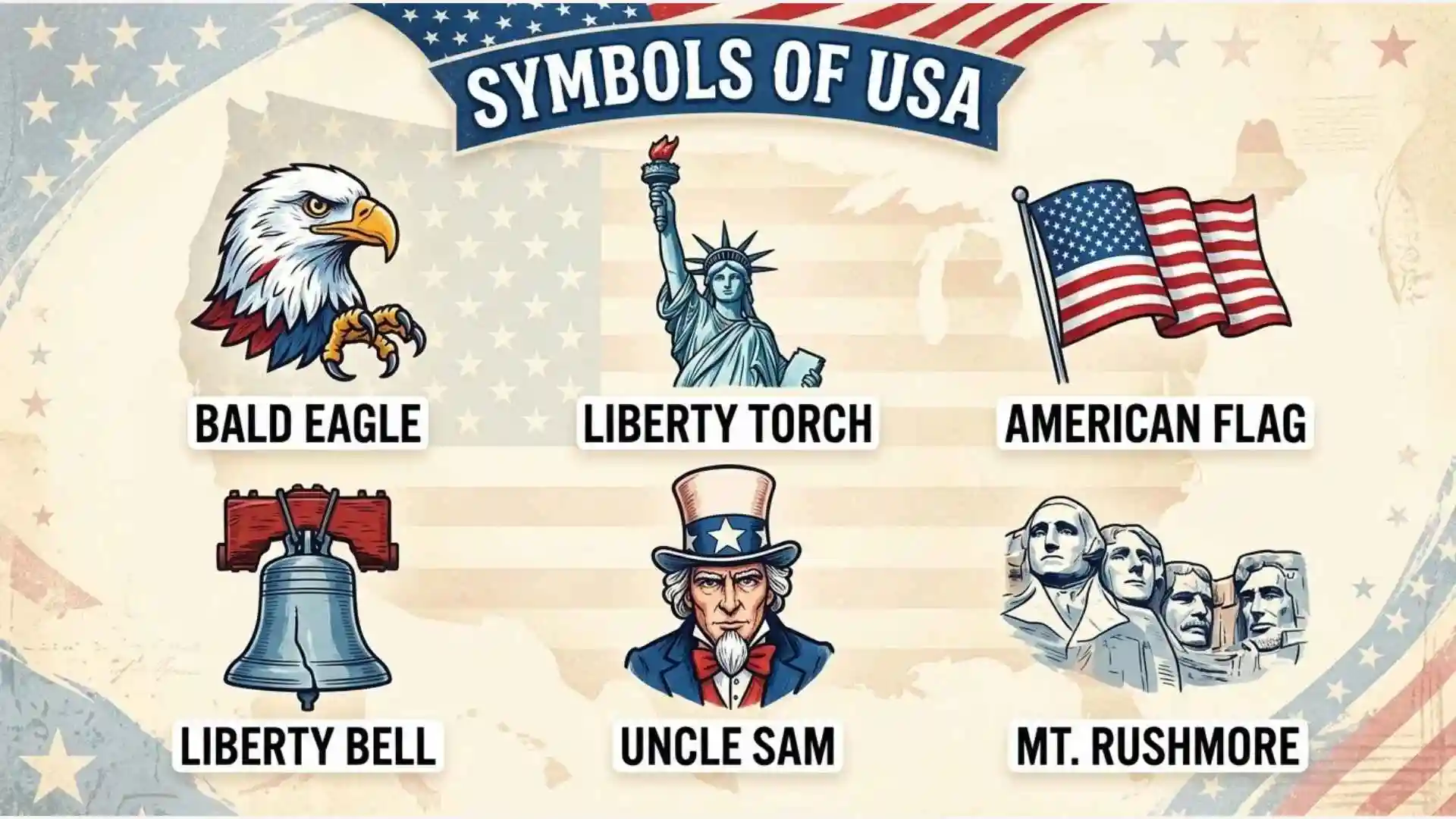
The symbols of USA represent the country’s history, government, ideals, natural heritage, and national identity. The American flag, bald eagle, Great Seal, Statue of Liberty, Liberty Bell, Uncle Sam, and other emblems communicate ideas such as freedom, unity, independence, democracy, strength, sacrifice, and hope.
People encounter these symbols on government buildings, currency, passports, military uniforms, monuments, classrooms, official documents, stamps, artwork, political posters, and public memorials. Some are legally recognized national emblems, while others became powerful cultural symbols through history and public use.
Understanding these symbols also reveals an important truth: national imagery does not have only one fixed meaning. A symbol may express pride and belonging while also encouraging discussion about whether the nation is fully living up to the principles it represents.
Quick Meaning
The symbols of USA collectively represent American independence, unity, liberty, democracy, national authority, resilience, and cultural identity. The flag symbolizes the states and original colonies, the bald eagle represents strength and sovereignty, the Statue of Liberty signifies freedom and hope, and the Great Seal expresses the nation’s commitment to unity, peace, and defense.
Symbols of USA Overview Table
| Symbol | Primary Meaning | Origin or Adoption | Common Usage |
| American flag | Unity, independence, and national identity | Current 50-star design adopted in 1960 | Government buildings, schools, ceremonies, uniforms |
| Bald eagle | Strength, freedom, and sovereignty | Chosen for the Great Seal in 1782 | Seals, currency, military insignia, federal emblems |
| Great Seal | Official authority and national unity | Approved in 1782 | Treaties, presidential documents, passports |
| Statue of Liberty | Liberty, hope, democracy, and welcome | Dedicated in 1886 | Monuments, art, tourism, immigration imagery |
| Liberty Bell | Independence and the continuing pursuit of liberty | Cast in 1752 | Museums, textbooks, civic artwork |
| Uncle Sam | Personification of the U.S. government | Became popular during the 19th century | Posters, cartoons, recruitment campaigns |
| “The Star-Spangled Banner” | Patriotism, endurance, and national defense | Became the national anthem in 1931 | Sporting events, ceremonies, official occasions |
| American bison | Resilience, conservation, and natural heritage | Named national mammal in 2016 | Parks, coins, conservation programs |
| Rose | Beauty, love, remembrance, and national life | Named national floral emblem in 1986 | Gardens, ceremonies, public events |
| Oak tree | Strength, endurance, and historical continuity | Named national tree in 2004 | Civic landscapes, education, conservation |
| “In God We Trust” | National faith tradition and public trust | Established as national motto in 1956 | Currency, government spaces, public inscriptions |
| “E Pluribus Unum” | Unity formed from diversity | Included on the Great Seal in 1782 | Coins, seals, government imagery |
The Library of Congress commonly presents the flag, bald eagle, Liberty Bell, national anthem, Uncle Sam, and Statue of Liberty as major American symbols. Federal law and government practice recognize additional emblems, including the rose, oak, American bison, national motto, and Great Seal.
What Do the Symbols of USA Mean?
The symbols of USA express the principles, experiences, and institutions associated with the United States. No single emblem can represent the entire country, so Americans use several symbols to communicate different aspects of national identity.
The flag represents the union of the states and the country’s historical foundations. The Great Seal communicates federal authority. The bald eagle suggests independence and strength. The Statue of Liberty presents freedom as an ideal that can guide both citizens and newcomers.
Other symbols preserve memories of particular periods. The Liberty Bell connects modern Americans with the founding era. Uncle Sam gives the federal government a human form. The national anthem recalls a moment of survival during war, while the American bison represents both the nation’s natural environment and the possibility of ecological recovery.
These symbols do more than decorate public spaces. They create a visual language. A person can recognize the United States through stars and stripes, an eagle with outstretched wings, a torch held above a harbor, or a red-white-and-blue shield even when no written explanation appears.
National symbols also carry responsibilities. When liberty, equality, justice, or unity appears in symbolic form, people may ask whether public institutions and social practices reflect those ideals. This tension gives American symbolism much of its lasting power.
History and Origin of American Symbols
The history of American symbolism began before the United States became an independent nation. European heraldry, classical Roman imagery, biblical language, Indigenous cultural traditions, colonial experience, and Revolutionary-era political ideas all influenced the country’s visual identity.
Revolutionary and Founding-Era Symbols
During the American Revolution, the new nation needed recognizable images that distinguished it from Great Britain. Flags, liberty caps, rattlesnakes, eagles, female personifications of liberty, and the number thirteen appeared in political art and military designs.
The Continental Congress adopted the Declaration of Independence in 1776 and began considering a national seal that same year. After several committees proposed designs, Congress approved the Great Seal on June 20, 1782.
Its front side features a bald eagle, shield, olive branch, arrows, stars, and the motto “E Pluribus Unum.” The reverse contains an unfinished pyramid, an eye within a radiant triangle, and two additional Latin mottos. The seal became the official visual signature of the federal government and continues to be placed on important state documents.
The American flag also developed during the Revolutionary period. Its thirteen stripes referred to the original colonies. As additional states entered the Union, Congress eventually established that the flag would retain thirteen stripes while gaining one star for each state.
Nineteenth-Century Development
During the 1800s, national symbols spread through newspapers, paintings, public monuments, coins, schoolbooks, political cartoons, military banners, and civic celebrations.
Uncle Sam developed as a personification of the United States and its government. His appearance drew partly from earlier figures such as Brother Jonathan. By the middle of the 19th century, artists commonly portrayed Uncle Sam as a tall, older man dressed in red, white, and blue.
The Statue of Liberty added another major figure to American symbolism. Designed by French sculptor Frédéric Auguste Bartholdi and presented by France, the statue was dedicated on October 28, 1886. Its official name, Liberty Enlightening the World, emphasizes liberty as a principle meant to illuminate society.
The statue’s tablet bears the date July 4, 1776, while its raised torch represents enlightenment. Broken chains and shackles near its feet symbolize liberation from oppression, although they are difficult to see from the ground. The statue later became closely associated with immigration because millions of arrivals passed through New York Harbor.
Twentieth- and Twenty-First-Century Symbols
Modern communication expanded the reach of American symbols. Photographs, films, advertising, television, sporting events, government campaigns, and digital media made national imagery instantly recognizable worldwide.
James Montgomery Flagg’s famous 1917 recruitment poster, showing Uncle Sam pointing directly at the viewer, became one of the most influential American poster designs. It transformed the character into a forceful symbol of civic duty, military recruitment, and government appeals.
Congress formally designated “The Star-Spangled Banner” as the national anthem in 1931. The rose became the national floral emblem in 1986, and the oak became the national tree in 2004. The American bison was designated the national mammal on May 9, 2016.
These later designations show that national symbolism continues to evolve. The country still creates and recognizes emblems that reflect its changing understanding of history, nature, conservation, citizenship, and shared identity.
Symbolism and Interpretation
The American Flag
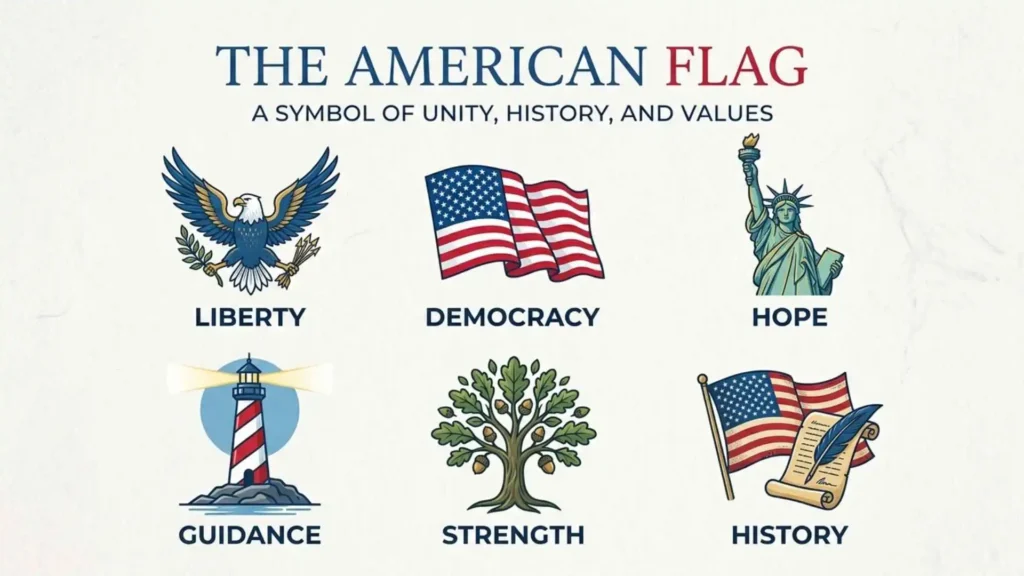
The American flag is the most widely recognized symbol of the United States. Its 50 white stars represent the 50 states, while its 13 alternating red and white stripes represent the original colonies.
The flag commonly symbolizes national unity, independence, citizenship, military service, and constitutional government. It appears at inaugurations, schools, sporting events, memorials, military funerals, international meetings, and public demonstrations.
The colors have acquired traditional associations with courage, purity, vigilance, perseverance, and justice. However, the original Flag Act did not formally assign meanings to the colors. Interpretations often draw from the symbolism later explained for the Great Seal.
The Bald Eagle
The bald eagle represents freedom, power, watchfulness, independence, and national sovereignty. It is native to North America, which helped distinguish it from traditional European heraldic animals.
On the Great Seal, the eagle holds an olive branch in its right talon and thirteen arrows in its left. The olive branch signifies a preference for peace, while the arrows show readiness to defend the country. The eagle’s head faces the olive branch, reinforcing the symbolic priority given to peace.
The shield on its breast has thirteen stripes representing the original states. Above the eagle is a constellation of thirteen stars, and the banner in its beak carries “E Pluribus Unum,” meaning “Out of many, one.”
The Great Seal
The Great Seal symbolizes the legal authority, unity, and sovereignty of the federal government. It functions as an official mark rather than merely a decorative national logo.
The unfinished pyramid on the reverse represents strength and duration, while its incomplete form suggests that the nation remained a work in progress. The year 1776 appears in Roman numerals at the pyramid’s base.
The eye above the pyramid has traditionally been interpreted as the Eye of Providence, indicating divine oversight. “Annuit Coeptis” is generally translated as “He has favored our undertakings,” while “Novus Ordo Seclorum” refers to a new order of the ages.
The Statue of Liberty
The Statue of Liberty represents political liberty, enlightenment, democracy, hope, and freedom from oppression. For many immigrants, it also became a symbol of arrival, safety, possibility, and a new beginning.
Its meaning is broader than immigration alone. The statue has been associated with the American Revolution, friendship between France and the United States, the abolition of slavery, democratic ideals, and campaigns seeking expanded civil rights.
Because its meanings developed through public use, Lady Liberty can appear in patriotic celebrations as well as protests. Artists and activists often adapt her image to ask whether freedom is equally available to everyone. The Smithsonian notes that the statue has represented abolition, Franco-American friendship, welcome, democracy, and dissent.
The Liberty Bell
The Liberty Bell represents American independence and the continuing pursuit of freedom. It was originally associated with the Pennsylvania State House, now Independence Hall, rather than created as a national symbol.
Its inscription comes from Leviticus 25:10: “Proclaim Liberty Throughout All the Land Unto All the Inhabitants Thereof.” During the 19th century, abolitionists adopted the bell and helped popularize the name “Liberty Bell.”
Its famous crack has added an unplanned layer of meaning. The bell is sometimes interpreted as a symbol of liberty that is precious but incomplete, durable but imperfect. This interpretation is modern and philosophical rather than an official meaning.
Uncle Sam
Uncle Sam is the personification of the United States federal government. He often represents national authority, taxation, military recruitment, public duty, and government policy.
His meaning depends strongly on context. In patriotic posters, he may call citizens to service. In political cartoons, he may represent government decisions, national strengths, public anxieties, or criticism of federal power.
Unlike the bald eagle, Uncle Sam behaves like a human character. Artists can make him proud, worried, angry, tired, generous, or demanding, allowing complicated national issues to be communicated quickly.
The American Bison
The American bison represents endurance, strength, natural heritage, conservation, and ecological recovery. It is also deeply connected to the cultures, histories, economies, and spiritual traditions of many Indigenous nations.
Its near destruction during the 19th century is closely tied to westward expansion, commercial hunting, habitat loss, and campaigns that harmed Native communities dependent on bison. Its later recovery makes the animal a symbol of both historical loss and conservation success.
The U.S. Department of the Interior describes the bison as inseparable from Indigenous culture, grassland ecology, and American history. Therefore, its symbolism should not be reduced to a simple image of frontier toughness.
The Rose and Oak Tree
The rose, the national floral emblem, represents beauty, love, devotion, remembrance, and the diversity of American landscapes and communities. Because roses appear in many colors and varieties, the flower can communicate celebration, romance, grief, honor, or friendship.
The oak, the national tree, symbolizes strength, longevity, stability, shelter, and endurance. Oaks grow across much of the country and have played important roles in ecosystems, construction, local history, and community landscapes.
Cultural Significance of American Symbols
American symbols create a shared vocabulary across a culturally diverse country. Citizens may differ in ancestry, religion, language, region, politics, and personal experience, yet they often recognize the same national images.
At civic ceremonies, symbols help create continuity. Flags, anthems, seals, monuments, and public oaths connect present-day events with earlier generations. Schools use them to introduce children to government and history. The military uses them to communicate service, command, sacrifice, and national responsibility.
However, interpretations vary. For some people, the flag primarily represents military sacrifice. For others, it represents constitutional rights, democratic participation, immigration, family history, or protest. Some Native Americans may view the bison through living cultural and spiritual traditions rather than merely as a federal emblem.
African American history also gives symbols such as the Liberty Bell and Statue of Liberty additional significance. Abolitionists and civil rights advocates used the language of liberty to expose the difference between national ideals and unequal realities.
Internationally, the Statue of Liberty and American flag may represent opportunity, cultural influence, democracy, military power, consumer culture, or foreign policy. The same emblem can inspire admiration in one context and criticism in another.
This variation does not make a symbol meaningless. It shows that national symbols remain active parts of public life rather than frozen historical objects.
Religious and Spiritual Meaning
Some American symbols contain religious language or imagery, but the United States does not have an official national religion. The First Amendment protects religious exercise while preventing the federal establishment of religion.
The phrase “In God We Trust” became the official national motto in 1956, although it had appeared on U.S. coins beginning during the Civil War. Supporters often interpret it as an expression of faith, humility, or dependence on divine guidance. Others debate its relationship to religious diversity and church-state separation.
The Great Seal’s Eye of Providence and the phrase “Annuit Coeptis” reflect the religious vocabulary familiar to many people in the founding era. These elements express providential guidance but do not identify a single denomination.
The Liberty Bell’s inscription is biblical, yet its public meaning became political and moral. Abolitionists applied its call to “proclaim liberty” to the struggle against slavery.
The bison also has sacred importance within numerous Indigenous traditions. These meanings are specific to living Tribal cultures and should not be generalized into a single “Native American” interpretation. Respectful discussion recognizes that ceremonial knowledge and spiritual relationships differ among nations.
Where the Symbols of USA Are Used
American symbols appear wherever people need to communicate national identity, authority, memory, or civic values.
Government and Legal Documents
The Great Seal is impressed on selected official documents, including treaties, commissions, and certain presidential communications. The Department of State maintains the authorized seal and applies it thousands of times each year.
The coat of arms from the seal also appears on passports, embassy signs, courtrooms, federal websites, agency materials, and diplomatic spaces.
Currency and Coins
The one-dollar bill displays both sides of the Great Seal. Coins frequently feature presidents, the bald eagle, the Statue of Liberty, American landscapes, the bison, and national mottos.
Currency turns national symbolism into an everyday experience. People may handle images of the seal, eagle, and motto without consciously thinking about their historical meanings.
Government Buildings and Public Architecture
Flags, eagles, shields, stars, columns, and allegorical figures decorate courthouses, capitols, post offices, memorials, and federal buildings.
Classical architecture is common because early American leaders connected Greek and Roman forms with republican government, civic duty, law, and public virtue.
Schools and Civic Ceremonies
Schools display the flag and teach the national anthem, Pledge of Allegiance, and major historical symbols. Naturalization ceremonies, inaugurations, military events, memorial services, and national holidays also use symbolic imagery.
Art, Literature, and Political Cartoons
Artists often reinterpret the flag, eagle, Statue of Liberty, and Uncle Sam. A familiar symbol allows viewers to understand the subject immediately, while changes to its pose, color, condition, or surroundings create new meanings.
Political cartoons may show an injured eagle, a divided flag, a worried Uncle Sam, or a dimmed torch to comment on national events.
Logos, Jewelry, Clothing, and Tattoos
Stars, eagles, flags, liberty torches, and “1776” designs appear on clothing, jewelry, sports branding, commercial products, and tattoos.
Personal use may express patriotism, military service, family heritage, political beliefs, remembrance, or identification with ideals such as freedom and resilience.
Common Variations and Modern Adaptations
The American flag has official proportions and arrangements, but stylized versions appear in monochrome, distressed, circular, heart-shaped, or regional designs. Such adaptations may be patriotic, artistic, commercial, commemorative, or political.
The bald eagle may appear naturalistically or as a simplified heraldic figure. Government agencies, military units, sports teams, and companies often use different eagle poses, wing shapes, shields, and color schemes.
The Statue of Liberty is frequently reduced to a torch, crown, silhouette, or raised arm. These shortened forms remain recognizable because each preserves a distinctive visual feature.
Uncle Sam’s appearance has changed more than most national symbols. Artists have altered his age, expression, clothing, body language, and ethnic appearance to suit different audiences and messages.
The number thirteen is another recurring variation. It appears in the Great Seal’s arrows, stars, shield stripes, olive leaves, and other features, recalling the original states.
Modern digital communication also uses the U.S. flag emoji, 🇴? No single emoji represents every American symbol, but 🇺🇸 is the standard emoji for the United States. Eagle, rose, bison, bell, and Statue of Liberty emojis may provide informal equivalents: 🦅, 🌹, 🦬, 🔔, and 🗽.
Common Misconceptions About Symbols of USA
The Statue of Liberty Was Not Originally an Immigration Monument
The statue became strongly connected with immigration because of its location and the experiences of arriving migrants. However, its original themes included liberty, republican ideals, Franco-American friendship, and the end of slavery.
The Flag’s Colors Did Not Receive Official Meanings in the First Flag Act
Red, white, and blue are often said to mean valor, purity, and justice. Those associations are traditional and relate closely to the Great Seal, but they were not defined in the first law establishing the flag.
Benjamin Franklin Did Not Officially Choose the Turkey
Franklin criticized the bald eagle’s character in a private letter and described the turkey more favorably. He did not lead an official campaign to replace the eagle as the national emblem.
The Eye on the Great Seal Is Not Proven to Be a Secret-Society Code
The Eye of Providence existed in religious and artistic traditions before the modern conspiracy theories attached to it. Claims that the seal proves secret control of the government are unsupported by the documented design process.
The Liberty Bell Did Not Ring on July 4, 1776, to Announce Independence
Popular stories describe the bell ringing immediately after the Declaration was adopted. Historians lack reliable evidence for that dramatic event. Bells likely rang during the public reading of the Declaration on July 8.
The Bald Eagle Is Not Literally Bald
The word “bald” comes from an older usage referring to its white-marked head. Adult bald eagles have white head feathers rather than bare skin.
Uncle Sam Is Not the Same as Every American Personification
Brother Jonathan and Columbia also represented America at different times. Uncle Sam became the dominant personification of the federal government, while Columbia generally appeared as a female allegory of the nation.
Interesting Facts About American Symbols
- The Great Seal took six years to complete. Three committees worked on proposals between 1776 and 1782 before Congress approved the final design.
- Only one authorized Great Seal is officially used. The Department of State operates the seal and applies it to important government documents.
- The flag has changed 27 times. New stars were added as states joined the Union, producing the present 50-star version in 1960.
- The number thirteen appears repeatedly on the Great Seal. It recalls the original states through arrows, shield stripes, stars, and other grouped elements.
- The Statue of Liberty has broken shackles at her feet. This detail reinforces emancipation and liberation but is difficult for visitors below to see.
- The Liberty Bell’s crack helped strengthen its visual identity. Instead of destroying its symbolic value, the damage made it more recognizable and encouraged interpretations involving imperfect freedom.
- The bald eagle recovered from severe population decline. Conservation laws, habitat protection, and restrictions on harmful pesticides helped restore the species.
- The bison represents both conservation and historical trauma. Its recovery is encouraging, but its near extermination remains connected to the displacement and suffering of Indigenous peoples.
- “E Pluribus Unum” is not the current official national motto. It remains a major traditional motto, while federal law identifies “In God We Trust” as the national motto.
- The oak was selected through public participation before receiving legal recognition. Its wide distribution and associations with strength helped make it a suitable national tree.

I am Ethan Mitchell, an English writer and lifelong learner who is fascinated by words and the way language changes over time. At LearnNestly, I share practical explanations designed for readers who want to improve their understanding of English without complicated terminology. I enjoy researching meanings, usage, grammar, and common language mistakes, then presenting the information in a simple and useful format. My purpose is to make every article a small learning experience that readers can actually apply.
Books:
- The Smart Learner’s English Guide
- English in Real Life
 Daniel Brooks
 Amelia Carter