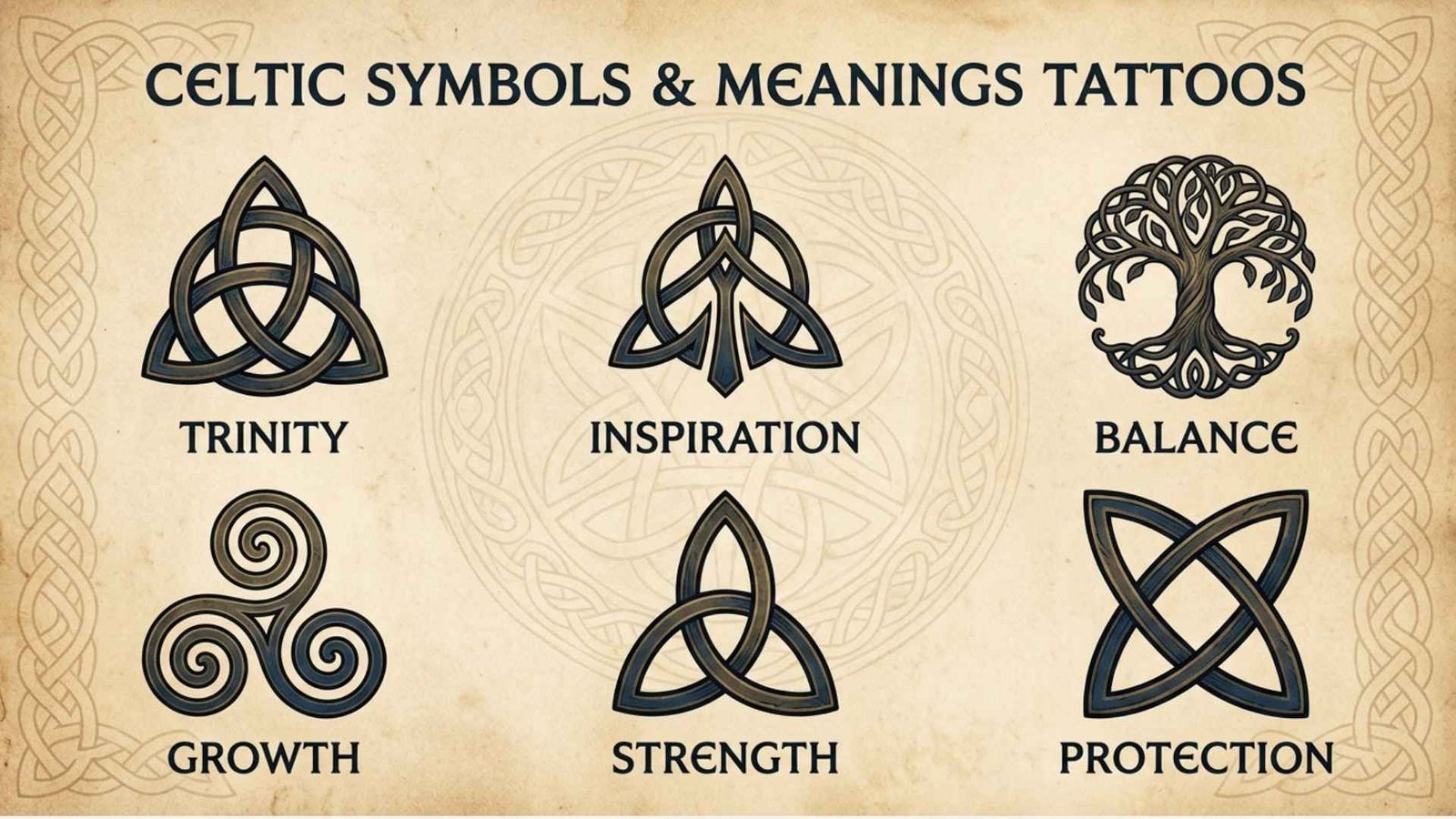
Celtic symbols and meanings tattoos often represent ancestry, faith, protection, love, strength, transformation, or the unbroken flow of life. Their interlaced lines, spirals, crosses, animals, and three-part forms draw inspiration from Iron Age Celtic art, early medieval Irish and British artwork, Christian monuments, folklore, and modern Celtic revival designs.
You may encounter these symbols on ancient stone carvings, illuminated manuscripts, metal jewelry, church monuments, family emblems, wedding rings, and contemporary tattoos. Yet not every design sold as “ancient Celtic” has a single proven historical meaning.
Understanding the difference between archaeological evidence, later tradition, and modern interpretation helps you choose a tattoo that is both meaningful and culturally respectful.
Quick Meaning
Celtic tattoos commonly symbolize continuity, interconnectedness, spiritual growth, courage, loyalty, protection, and cultural heritage. Knots often suggest enduring bonds, spirals express movement or transformation, crosses represent Christian faith, and animal motifs reflect admired qualities. However, exact meanings depend on the symbol’s historical context and the wearer’s personal interpretation.
Celtic Tattoo Symbol Overview
| Symbol | Primary Meaning | Historical Context | Common Tattoo Use | Important Note |
| Celtic knot | Continuity and connection | Early medieval interlace art | Love, family, eternity | No single universal knot meaning exists |
| Triquetra | Threefold unity | Medieval Insular decoration | Faith, family, life cycles | Many modern meanings are later interpretations |
| Triskele | Movement, threefold order | Ancient European and Insular art | Growth, progress, transformation | Its precise ancient meaning is uncertain |
| Celtic cross | Christian faith and heritage | Early medieval Britain and Ireland | Faith, remembrance, identity | Primarily a Christian symbol |
| Claddagh | Love, loyalty, friendship | Early modern Irish ring tradition | Relationships and Irish identity | Not an ancient Iron Age Celtic symbol |
| Tree of life | Connection and renewal | Inspired by sacred-tree traditions and modern revival art | Family, roots, balance | Most symmetrical knot-tree designs are modern |
| Shield knot | Protection | Modern name for knot-like protective designs | Safety, resilience, boundaries | Ancient use as a named shield knot is unproven |
| Spiral | Growth and cycles | Prehistoric and Celtic-period art | Change, energy, rebirth | Spirals predate Celtic cultures |
| Celtic animals | Strengths associated with animals | Metalwork, manuscripts, myths | Courage, wisdom, freedom | Meanings vary by species and story |
| St. Brigid’s cross | Blessing and household protection | Irish Christian folk tradition | Faith, healing, home | Traditionally woven from rushes or straw |
What Do Celtic Tattoo Symbols Mean?
Celtic tattoo symbols usually communicate relationships rather than isolated ideas. Interlaced lines connect with one another, spiral forms move outward or inward, and three-part designs unite separate elements into one composition. This visual structure naturally lends itself to themes such as family, spiritual connection, life’s journey, and the relationship between past, present, and future.
The word “Celtic” does not describe one unified ancient nation with a single symbol dictionary. It refers broadly to peoples and cultures linked through Celtic languages and related artistic traditions across parts of ancient and medieval Europe. Celtic languages form a branch of the Indo-European language family, while surviving Celtic cultural traditions became especially visible in Ireland, Scotland, Wales, Cornwall, Brittany, and the Isle of Man.
As a result, a symbol’s meaning may come from several layers:
- Its original archaeological setting
- Medieval Christian art and literature
- Irish, Scottish, Welsh, or Breton folklore
- Nineteenth-century Celtic revival movements
- Modern spiritual or personal interpretation
A responsible interpretation clearly separates these layers instead of presenting every popular tattoo meaning as an ancient fact.
History and Origin of Celtic Symbols
Celtic-inspired tattoo art developed from several historical traditions rather than from ancient tattoo flash sheets. Ancient Celtic artists decorated weapons, jewelry, vessels, chariots, mirrors, and ceremonial objects with curves, spirals, trumpet shapes, animal forms, and balanced geometric patterns.
Iron Age Celtic art flourished in regions of central and western Europe. Its artists favored flowing forms and visual movement instead of rigid realism. Torcs, brooches, shields, and metal fittings could express social rank, wealth, identity, or spiritual significance. Torcs, for example, were worn across Celtic Europe and likely served as signs of status, while some may also have carried protective or sacred associations.
Later, Christianity transformed artistic traditions in Ireland and Britain. Early medieval artists combined crosses, biblical figures, interlace, spirals, animals, and elaborate lettering in manuscripts, stone monuments, reliquaries, and fine metalwork. The National Museum of Ireland notes that scribes and craftspeople used interlace, knotwork, and spirals to decorate manuscripts, metal objects, and high crosses.
The Book of Kells is among the best-known examples of this Insular artistic world. Its pages contain intricate lettering, Christian imagery, interlace, animals, and decorative patterns. Although it is often casually labeled “Celtic,” scholars more precisely describe it as an early medieval Insular Christian manuscript.
A renewed interest in Celtic heritage emerged during the nineteenth century. Archaeological discoveries, nationalism, Romanticism, and the Celtic Revival encouraged artists and jewelers to reinterpret ancient and medieval designs. These revival styles helped shape many of the knot trees, pendants, wedding rings, logos, and tattoos now recognized as “Celtic.”
Major Celtic Symbols and Their Tattoo Meanings
Celtic Knot Tattoos
A Celtic knot tattoo generally represents continuity, connection, or a bond that endures. Its lines weave over and under one another, often without an obvious beginning or endpoint. This makes knotwork an effective visual metaphor for marriage, friendship, ancestry, faith, or the interconnected nature of life.
Historically, interlace was a decorative method used in early medieval manuscripts, sculpture, and metalwork. There is no surviving ancient guide assigning a fixed meaning to every knot pattern. Names such as “motherhood knot,” “sister knot,” and “family knot” are usually modern labels rather than documented ancient classifications.
A knot tattoo can still hold deep meaning. Its significance becomes more trustworthy when described as a personal interpretation inspired by historical art rather than as a secret message universally used by ancient Celts.
Triquetra Tattoo
The triquetra consists of three pointed, interconnected arcs. Its name comes from Latin words associated with “three-cornered.” In modern tattoos, it may symbolize:
- Mind, body, and spirit
- Past, present, and future
- Birth, life, and death
- Three members of a family
- The Christian Trinity
- The threefold nature of a personal belief
The symbol appears in medieval Insular decoration, sometimes by itself and sometimes within Christian artwork. A circle is often added to represent unity, eternity, or wholeness.
The triquetra should not automatically be labeled a purely pre-Christian goddess symbol. Some modern Pagan and Wiccan traditions use it that way, but medieval examples frequently occur in Christian artistic contexts. Its meaning depends on period, setting, and the community using it.
Triskele or Triskelion Tattoo
The triskele has three curved arms, legs, or spirals extending from a shared center. It often represents movement, progress, transformation, balance, or three forces working together.
Three-armed spiral forms appeared in ancient European art and continued into later Celtic and Insular designs. Museum collections preserve triskele decorations on pins, brooches, bowls, mounts, and other objects.
Its rotating shape makes it a powerful tattoo for someone moving through change. It can represent refusing to remain emotionally still, learning from the past, or continuing forward after loss.
The exact ancient meaning of every triskele is unknown. Claims that it always represented land, sea, and sky or a specific named deity should be treated as interpretations unless supported by a particular historical source.
Celtic Cross Tattoo
A Celtic cross tattoo symbolizes Christian faith, Irish or Scottish heritage, remembrance, sacrifice, and spiritual identity. Its familiar form combines a cross with a ring around the intersection of the arms.
Ringed stone crosses became important monuments in early medieval Ireland and Britain. They could carry biblical scenes, saints, animals, interlace, and decorative panels. Surviving examples date from the early medieval period; Scotland’s Keills Cross, for instance, dates to the 700s.
The ring has inspired several explanations. It may provide structural support in stone, emphasize the cross’s center, suggest a halo, or evoke cosmic and solar imagery. No single explanation accounts for every cross.
Because the Celtic cross is a Christian sacred symbol, it deserves thoughtful placement and treatment. In some modern political contexts, simplified cross designs have also been misused by extremist groups. A clearly traditional, detailed Christian or heritage design helps distinguish it from hateful adaptations.
Celtic Tree of Life Tattoo
A Celtic tree of life tattoo represents roots, growth, family, balance, nature, and connection between generations. Modern versions often show roots and branches forming a circle, sometimes woven into knotwork.
Trees held practical and symbolic importance in many ancient societies, including Celtic-speaking communities. They provided food, shelter, fuel, landmarks, and meeting places. Irish and Welsh literature also contains sacred, magical, or culturally important trees.
However, the symmetrical knotwork “Celtic tree of life” commonly seen in tattoo catalogs is largely a modern artistic construction. It draws from genuine tree traditions and interlace art, but it should not be treated as one standardized ancient emblem.
As a tattoo, the roots can represent ancestry, the trunk personal strength, and the branches future possibilities.
Claddagh Tattoo
The Claddagh combines a heart, crown, and two hands. It means love, loyalty, and friendship:
- Heart: love
- Crown: loyalty
- Hands: friendship
It developed from the Irish ring tradition associated with Galway and the fishing village of Claddagh. It is Irish, but it is not an ancient Iron Age Celtic symbol.
Claddagh tattoos are especially meaningful for couples, close friends, family members, and people honoring Irish heritage. Initials, dates, birth flowers, or knot borders can make the design personal without changing its core message.
Celtic Spiral Tattoo
A spiral tattoo commonly represents growth, energy, inward reflection, expansion, or the recurring patterns of nature. A single spiral can suggest a personal journey. Double spirals may express balance or opposing movements. Triple spirals connect visually with the triskele.
Spiral designs are much older than historically defined Celtic cultures. They appear on prehistoric monuments, including sites built long before the Iron Age Celts. Later Celtic artists also used spiral and curvilinear forms extensively.
For that reason, it is more accurate to call many examples “spiral motifs found in Celtic art” rather than inventions exclusive to the Celts.
St. Brigid’s Cross Tattoo
St. Brigid’s cross represents faith, blessing, protection of the home, healing, and the arrival of spring. In Ireland, these crosses have traditionally been woven around St. Brigid’s Day from rushes, straw, reeds, and other available materials.
The tradition blends Christian devotion to St. Brigid with seasonal customs associated with the beginning of spring. Some designs have four arms, while others have three. The National Museum of Ireland preserves several regional forms, including a three-armed example.
A tattoo of the cross can honor Irish family traditions, caregiving, resilience, hospitality, or protection.
Celtic Animal Tattoos
Animals in Celtic-inspired tattoos usually represent qualities associated with their behavior, mythology, or role in traditional life.
Stag: dignity, renewal, wilderness, leadership
Boar: courage, strength, ferocity, hospitality
Horse: sovereignty, travel, vitality, freedom
Hound: loyalty, protection, hunting skill
Salmon: wisdom, knowledge, inspiration
Raven: prophecy, battle, mystery, intelligence
Swan: beauty, transformation, love, the Otherworld
Serpent: renewal, healing, hidden power
Bull: strength, wealth, fertility, status
These meanings are not identical across all Celtic regions. A hound in one tale may represent loyalty, while in another it signals elite hunting or a hero’s identity. The strongest animal tattoo connects to a specific story, artwork, or quality rather than relying on a generic symbol chart.
Symbolism and Interpretation
Celtic tattoos often carry positive meanings because their visual structure emphasizes continuity and relationship. Common themes include:
Eternity and Enduring Bonds
Continuous interlace has become a modern symbol of relationships that survive change. Couples may use it for marriage, while relatives may choose matching knots to represent shared ancestry.
Transformation and Movement
Spirals and triskeles create visible motion. They suit tattoos marking recovery, migration, parenthood, spiritual development, or a new stage of life.
Protection and Boundaries
Dense knotwork and circular forms can suggest enclosure, defense, and wholeness. Modern “shield knots” often express emotional boundaries or protection, even though the claim that one exact knot served as a universal ancient protective device is not historically established.
Identity and Heritage
For members of the Irish, Scottish, Welsh, Cornish, Breton, or Manx diasporas, Celtic imagery may connect the body to language, family history, place, and inherited culture.
Negative or Difficult Meanings
Celtic designs can also express grief, conflict, mortality, exile, or sacrifice. A broken knot may represent separation. A dark raven scene may symbolize war or loss. A thorned cross may focus on suffering rather than comfort.
These negative meanings are usually personal or artistic, not fixed historical definitions.
Cultural and Regional Significance
Celtic symbolism differs across regions because Celtic-speaking cultures developed distinct languages, legends, saints, artistic traditions, and political histories.
In Ireland, common tattoo imagery includes the Claddagh, shamrock, harp, St. Brigid’s cross, high crosses, Irish-language words, and designs inspired by illuminated manuscripts. The harp and shamrock became major national and cultural symbols over time, although neither functions as a universal emblem of all Celtic peoples.
In Scotland, tattoos may incorporate thistles, Highland animals, clan-related imagery, Gaelic phrases, Pictish stones, or ringed crosses. Pictish symbols belong to the history of northern and eastern Scotland and should not be casually assigned meanings that scholars have not confirmed. Historic Environment Scotland notes that interpretations of some Pictish monuments remain uncertain.
In Wales, designs often draw from the Welsh dragon, red kite, daffodil, Celtic interlace, medieval Welsh poetry, and the Welsh language.
In Brittany, the triskel is a widely recognized regional design, while Breton cultural imagery may also include black-and-white flag patterns and maritime themes.
A person does not need Celtic ancestry to appreciate this art. However, researching the specific regional source prevents the cultures from being treated as interchangeable.
Religious and Spiritual Meaning
Celtic-inspired tattoos may be Christian, Pagan, secular, or personally spiritual. Their meaning depends on the wearer’s belief and the historical source of the design.
Christian symbols include the Celtic cross, St. Brigid’s cross, manuscript-inspired crosses, saints, biblical animals, and Trinity interpretations of the triquetra. Early medieval Irish artists placed Christian narratives within elaborate local decorative traditions. The cross remained the central sign of Christ’s crucifixion and sacrifice in Irish Christian art.
Modern Pagan and reconstructionist communities may use spirals, triskeles, trees, seasonal symbols, or triads to express nature spirituality and pre-Christian inspiration. These uses are valid modern religious meanings, but they should not automatically be projected backward onto every archaeological object.
Some wearers choose Celtic designs without religious intent. For them, a knot may simply represent family, resilience, or an appreciation of historic art.
Where Celtic Symbols Are Used Today
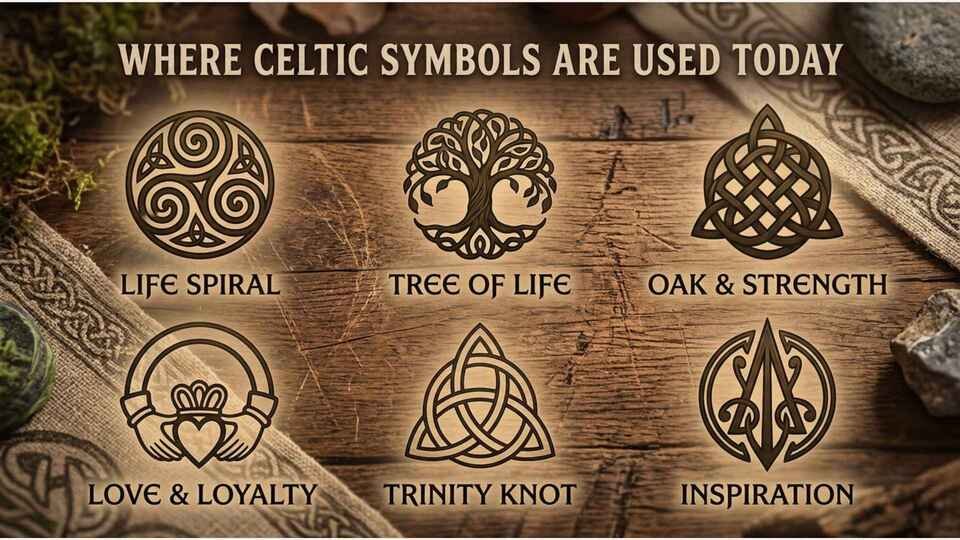
Celtic imagery appears in:
- Tattoos and body art
- Wedding bands and engagement jewelry
- Pendants, brooches, and bracelets
- Church decoration and memorial stones
- Book covers and fantasy illustrations
- Family and heritage logos
- Sports branding
- Music artwork
- Clothing and embroidery
- Public monuments
- Cultural festivals
- Film, television, and video games
Tattoo artists often adapt historical patterns to fit the shoulder, forearm, chest, spine, calf, or wrist. Bands work well around limbs, while circular knots suit the shoulder blade or upper arm. Large crosses and trees need enough space to preserve clean negative space and prevent the lines from merging as the tattoo ages.
Common Design Variations
Blackwork Knot Tattoos
Black ink provides strong contrast and resembles carved stone or manuscript linework. It also tends to remain readable when the design uses adequate spacing.
Colored Celtic Tattoos
Green is popular because of its association with Ireland, but historical Insular art used a wider range of colors. Blue, red, gold, and earthy pigments can create a manuscript-inspired effect.
Zoomorphic Interlace
Zoomorphic designs turn knot lines into birds, snakes, hounds, or other animals. Early medieval artists used intertwined beasts and ribbon-bodied creatures in metalwork and religious objects.
Celtic Tattoo Bands
Bands symbolize connection, commitment, or an unbroken cycle. The artist must plan the repeat carefully so the knot closes cleanly around the limb.
Minimalist Designs
Small triquetras, spirals, and Claddagh outlines offer subtle symbolism. Fine-line work should not be overcrowded, because tiny gaps may blur over time.
Combined Symbols
Common combinations include:
- Tree of life with family initials
- Triquetra inside a heart
- Celtic cross with knotwork
- Claddagh with a wedding date
- Triskele with waves or mountains
- Raven with interlaced wings
- Stag framed by a circular knot
Each added element should support one clear story rather than creating a crowded collection of unrelated symbols.
Common Misconceptions
Every Celtic Knot Has an Ancient Name
Most named knots sold online do not come from a verified ancient symbol dictionary. Many titles were created by modern jewelers, illustrators, tattoo designers, or spiritual writers.
Celtic Knots Were Always Pagan
Interlace appears prominently in Christian manuscripts, crosses, and church metalwork. A knot can be used in Pagan practice today, but that does not make every historical example Pagan.
The Claddagh Is an Ancient Celtic Emblem
The Claddagh is a historic Irish symbol, but it belongs to a much later ring tradition. It should not be described as an Iron Age design.
The Celtic Cross Was Originally Only a Sun Symbol
The surviving monumental tradition is fundamentally Christian. Solar or cosmic interpretations of the ring may be considered, but they do not erase the cross’s Christian identity.
All Spiral Art Is Celtic
Spirals appear in cultures around the world and long predate Celtic-speaking societies. Context determines whether a spiral should be called Celtic.
Every Pictish Symbol Has Been Decoded
Many Pictish symbols remain debated. Confident modern meanings often go beyond the available evidence.
Celtic and Norse Symbols Are the Same
Celtic and Norse cultures interacted, but their symbols are not interchangeable. The valknut, Mjölnir, Helm of Awe, and Vegvísir belong to Norse or Icelandic traditions, not Celtic tradition.
Interesting Facts About Celtic Tattoo Symbols
- Ancient Celts did not leave a universal symbol handbook. Most exact meanings must be inferred from archaeology, art, literature, and context.
- Knotwork became especially famous through medieval Christian art. Its strongest surviving examples appear in manuscripts, metalwork, and stone crosses rather than in preserved ancient tattoos.
- A symbol may have several historical identities. The triquetra can function as decoration, a Christian Trinity emblem, or a modern Pagan symbol.
- Many “Celtic” tattoo designs are revival art. Nineteenth-century artists reworked ancient and medieval forms for modern jewelry, illustration, architecture, and national identity.
- Triskeles appeared on everyday and elite objects. Archaeological collections contain them on pins, bowls, brooches, fittings, and decorative mounts.
- Celtic art is known for controlled visual movement. Curves, spirals, and interlace lead the eye through the design instead of focusing on one static center.
- Animals could be integrated into the knot itself. A line that appears geometric at first may end in a beak, jaw, serpent head, or curled body.
- St. Brigid’s crosses have regional forms. Not every example uses the familiar four-armed woven shape.
- The ringed cross is not limited to one modern nation. Related monuments survive in both Ireland and Britain.
- Tattoo placement changes interpretation. A knot around the wedding finger suggests commitment, while the same design over a scar may represent healing or continuity after trauma.
- Irish, Scottish, and Welsh symbols are not synonyms. They belong to related but distinct cultural histories.
- Historical uncertainty can make a tattoo more personal. When no fixed ancient meaning exists, the wearer can state an honest modern meaning without inventing false history.
Related Symbols
Norse Knotwork
Norse art also uses interlace and animals, but it developed through distinct Scandinavian artistic styles. It should not automatically be labeled Celtic.
Ouroboros
A serpent biting its tail symbolizes cycles, renewal, and eternity. Unlike Celtic knots, it comes from broader ancient Mediterranean and later esoteric traditions.
Infinity Symbol
The infinity sign directly expresses endlessness. It is simpler and historically unrelated to medieval Celtic interlace.
Labyrinth
A labyrinth represents a journey toward a center and back outward. A knot stresses connection, while a labyrinth emphasizes navigation and transformation.
Sacred Tree Symbols
World trees appear in many traditions, including Norse, Mesopotamian, biblical, and modern spiritual systems. Their stories should not be merged into one generic “Celtic tree” meaning.
Pictish Symbols
Pictish stones feature animals, geometric forms, mirrors, combs, crescents, and rods. They are historically connected to Scotland, but many meanings remain uncertain.
Frequently Asked Questions
What is the most meaningful Celtic tattoo?
The most meaningful design is one connected to a specific relationship, belief, place, or life event. A knot may honor family, a triskele may mark personal growth, and a Celtic cross may express Christian faith. Historical accuracy and personal relevance matter more than choosing the symbol with the most dramatic online definition.
Which Celtic symbol means strength?
No single symbol universally meant “strength” throughout all Celtic cultures. Modern tattoos often use the boar, bull, stag, oak tree, shield-style knot, or warrior imagery to express strength. The best choice depends on whether you mean physical courage, emotional endurance, leadership, protection, or recovery.
Which Celtic tattoo represents family?
Interlaced knots and tree-of-life designs commonly represent family because their connected lines suggest shared roots and lasting bonds. A triquetra can symbolize three relatives, while a Claddagh emphasizes love, loyalty, and friendship. Names, birth dates, or birth flowers can make the family connection clearer.
What Celtic symbol represents eternal love?
A continuous knot, heart-shaped knot, or Claddagh is commonly used for eternal love. Continuous interlace visually suggests a bond without a clear endpoint. However, “eternal love knot” is usually a modern descriptive name, not a documented title shared by every ancient Celtic community.
Is the triquetra Christian or Pagan?
It can be either, depending on context. Triquetra-like forms appear in medieval Christian art and are often interpreted as symbols of the Trinity. Modern Pagan and Wiccan communities also use the design for triple goddesses, life stages, or natural cycles. The shape does not have one exclusive religious ownership.
Are Celtic tattoos appropriate without Celtic ancestry?
Yes, when they are chosen respectfully and represented accurately. Learn where the design comes from, avoid false claims about ancient meanings, and do not combine unrelated cultures carelessly. A person can appreciate Celtic art without claiming an identity or family connection they do not possess.
What does a Celtic knot tattoo mean?
A Celtic knot tattoo usually represents continuity, connection, loyalty, eternity, or the interwoven nature of life. Its specific meaning comes from the wearer and design context. Historical knotwork often served decorative and religious artistic purposes, so modern emotional meanings should be identified as interpretations rather than universal ancient codes.
What does a Celtic spiral tattoo represent?
A Celtic-style spiral commonly represents movement, growth, energy, transformation, or recurring natural cycles. An inward spiral may suggest reflection, while an outward spiral can suggest expansion. Because spiral art predates Celtic cultures, its meaning should be connected to the specific design and tradition rather than assumed from shape alone.
Is the Celtic cross a religious tattoo?
The Celtic cross is primarily a Christian symbol associated with faith, Christ’s sacrifice, memorial traditions, and the Christian heritage of Ireland and Britain. Some people also use it to express ancestry or national identity. Its religious origin should still be recognized even when the wearer emphasizes cultural heritage.
How do I choose an authentic Celtic tattoo?
Start with a documented artifact, manuscript page, stone monument, folk object, or regional tradition. Ask your tattoo artist to adapt rather than directly distort the source. Check that the interlace closes correctly, confirm any language spelling with a fluent speaker, and separate proven history from your personal symbolism.
Key Takeaways
- Celtic tattoos may represent continuity, family, faith, courage, protection, heritage, or transformation.
- “Celtic” covers several related cultures and historical periods, not one uniform civilization.
- Knotwork became especially prominent in early medieval Christian manuscripts, stonework, and metalwork.
- Exact meanings for many knots are modern interpretations rather than ancient documented definitions.
- The triquetra and triskele can carry different meanings depending on religious, historical, and personal context.
- The Celtic cross is fundamentally connected to Christianity.
- The Claddagh is Irish but not an ancient Iron Age Celtic symbol.
- Spirals and sacred-tree images are not exclusive to Celtic culture.
- Regional traditions from Ireland, Scotland, Wales, Brittany, Cornwall, and the Isle of Man should not be treated as identical.
- The best tattoo combines accurate research, a clear personal story, and a design that will remain readable over time.
Conclusion
Celtic symbols and meanings tattoos are powerful because they join visual beauty with layered histories. A knot can express an enduring relationship, a triskele can mark forward movement, a cross can affirm faith, and an animal can embody a quality you hope to carry through life.
Their real value does not depend on exaggerated claims about secret ancient codes. It comes from understanding how Iron Age art, early medieval Christianity, regional folklore, cultural revival, and modern creativity shaped the symbols people wear today. Choose a design with evidence, respect, and personal purpose, and it can become more than decoration: it can serve as a lasting statement of connection, identity, memory, and growth.

I am Amelia Carter, an English language educator and educational writer who enjoys making difficult ideas simple and easy to understand. At LearnNestly, I write about English words, grammar, everyday expressions, and language questions that people often find confusing. I believe learning should feel practical, clear, and enjoyable rather than overwhelming. Through my writing, I try to give readers explanations they can understand and use in real life.
Books:
- The Everyday English Handbook
- Words Made Simple
 Daniel Brooks