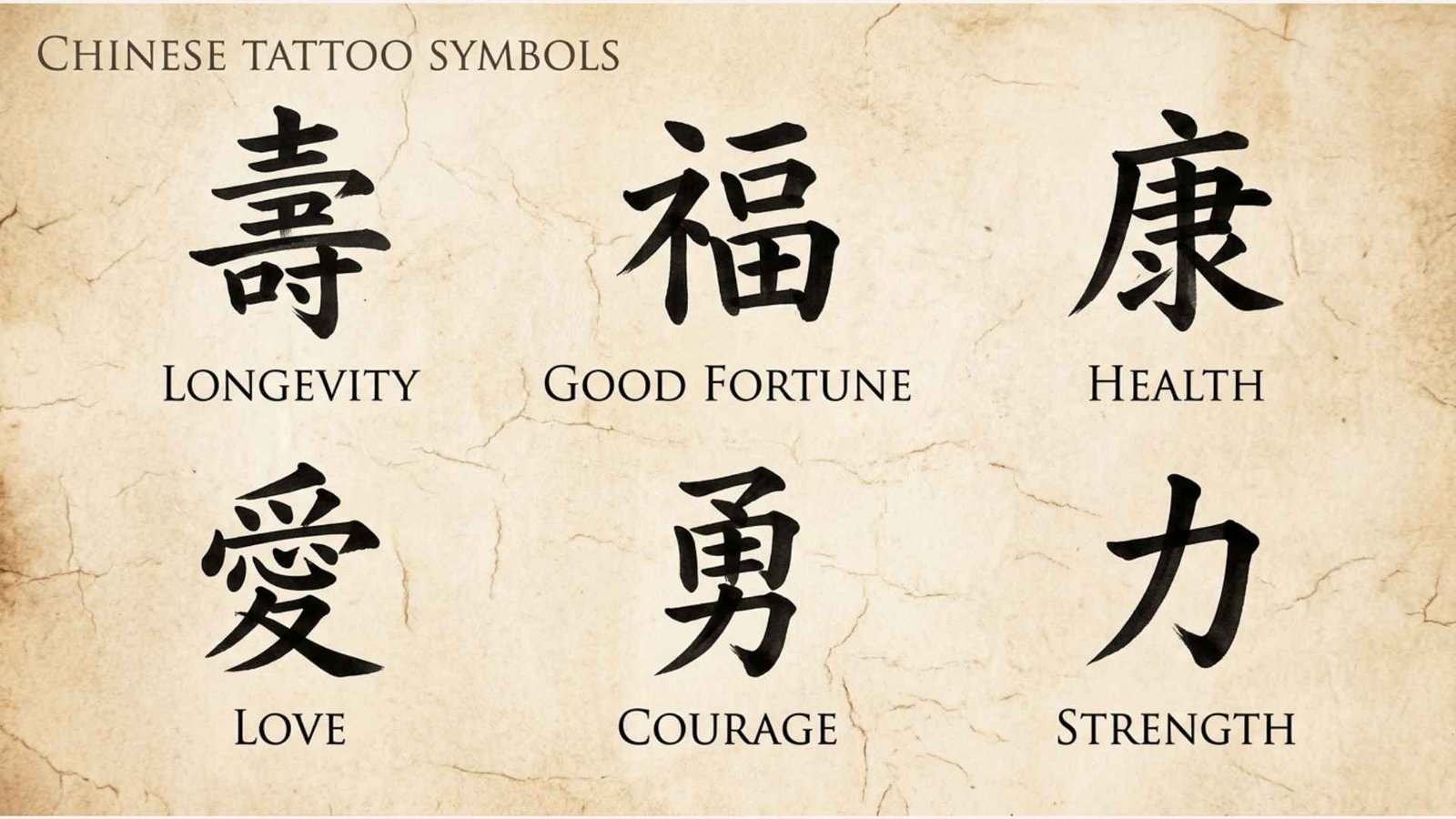
Chinese tattoo symbols are written characters, words, phrases, or traditional images chosen to express ideas such as love, strength, peace, courage, family, luck, and personal growth. Their beauty comes from more than appearance. Each character belongs to a living language and may carry cultural, historical, phonetic, and contextual meanings.
You may encounter Chinese symbols on tattoos, jewelry, clothing, paintings, martial arts logos, restaurant signs, and home décor. However, a design that looks attractive may be grammatically incorrect, poorly translated, or written in the wrong script style.
Understanding the language and culture behind the design is therefore essential before placing it permanently on the body.
Quick Meaning of Chinese Tattoo Symbols
Chinese tattoo symbols usually represent a personal quality, relationship, belief, or life experience through Chinese characters or culturally meaningful images. Popular choices include 愛 for love, 家 for family, 勇 for courage, and 福 for good fortune. Their exact meaning depends on language, character form, context, calligraphy, and cultural usage.
Chinese Tattoo Symbols Overview
| Field | Details |
| Symbol type | Chinese characters, phrases, calligraphy, animals, plants, and traditional motifs |
| Primary purpose | To express identity, values, relationships, protection, memory, or aspiration |
| Cultural origin | Chinese language, history, art, philosophy, religion, and folklore |
| Writing system | Han characters, commonly called Hanzi in Chinese |
| Earliest writing tradition | Ancient inscriptions, including writing associated with the Shang period |
| Common scripts | Seal, clerical, regular, running, and cursive script |
| Modern character forms | Simplified Chinese and traditional Chinese |
| Popular tattoo meanings | Love, strength, courage, family, peace, loyalty, wisdom, luck, and freedom |
| Common risks | Mistranslation, reversed characters, poor grammar, decorative gibberish, and cultural confusion |
| Unicode | Each modern encoded character has its own Unicode code point |
| Related traditions | Chinese calligraphy, seal carving, brush painting, Taoist imagery, and Buddhist art |
Chinese calligraphy developed through several major script forms over thousands of years. Museums commonly identify seal, clerical, regular, running, and cursive writing as important stages or styles in that development.
What Do Chinese Tattoo Symbols Mean?
Chinese tattoo symbols mean different things depending on the exact characters selected and how they are combined. A single character may express a broad concept, while a two-character or four-character phrase may communicate a more complete and natural idea.
For example:
- 愛 or 爱 (ài) means love.
- 家 (jiā) means home or family.
- 勇 (yǒng) means courage or bravery.
- 力 (lì) means physical strength, force, or power.
- 心 (xīn) means heart, mind, intention, or inner feeling.
- 福 (fú) refers to good fortune, blessing, or happiness.
- 和 (hé) can express harmony, peace, or agreement.
- 忠 (zhōng) means loyalty or faithfulness.
- 智 (zhì) means wisdom, intelligence, or knowledge.
- 自由 (zìyóu) means freedom.
These translations are useful starting points, but English and Chinese do not map onto each other perfectly. A word such as “strength” may refer to physical power, emotional resilience, influence, ability, or inner determination. Each idea may require a different character or phrase.
The strongest tattoo designs are not chosen by matching one English word to the first character found online. They are developed by defining the intended message, selecting natural Chinese wording, confirming the character form, and choosing an appropriate calligraphic style.
History and Origin of Chinese Symbols
Chinese tattoo symbols come from one of the world’s oldest continuously used writing traditions. The earliest surviving forms of Chinese writing include inscriptions on oracle bones and ritual bronzes. These ancient forms gradually developed into more standardized scripts.
Seal script is an early formal style known for balanced structures and thin, even lines. Large-seal forms developed from inscriptions used on bronze ritual objects, while small-seal script became associated with greater standardization during the Qin period.
Clerical script developed as a more practical form for administration and recordkeeping. It became especially important during the Han dynasty. Its broader, flatter forms and distinctive strokes influenced the later development of regular script.
Regular script established clear, structured character forms. Running script allowed faster, more connected writing, while cursive script became highly abbreviated and expressive. In cursive writing, strokes may be omitted, merged, or linked, making the result difficult for an untrained reader to identify.
Chinese calligraphy eventually became much more than a way to record information. It developed into a respected visual art through which writers could reveal rhythm, discipline, personality, emotion, and technical control. The Metropolitan Museum of Art describes calligraphy as a central form of Chinese visual expression, historically valued alongside or even above painting.
Modern Chinese character tattoos inherit this artistic tradition, but they are not automatically examples of authentic calligraphy. A computer font, traced image, handwritten character, and master calligrapher’s work may all display the same word very differently.
Symbolism and Interpretation
Traditional Meanings
Traditional Chinese symbols often reflect values shaped by family ethics, philosophy, government, literature, folklore, and religion. Harmony, filial devotion, longevity, learning, loyalty, good fortune, and balance appear frequently in Chinese visual culture.
Characters may also gain symbolic force through their use in poetry, idioms, New Year decorations, temples, family names, official seals, and historical inscriptions. A character’s cultural meaning can therefore extend beyond its dictionary definition.
Modern Meanings
Today, people often select Chinese tattoo symbols to represent:
- Surviving hardship
- Honoring parents or children
- Remembering a loved one
- Expressing spiritual growth
- Celebrating Chinese ancestry
- Marking martial arts training
- Representing a personal philosophy
- Creating a visually minimal design
Modern wearers may give a traditional character a deeply personal interpretation. That personal meaning is valid for the wearer, but it should not be confused with the character’s established linguistic meaning.
Positive Symbolism
Positive Chinese tattoo ideas commonly focus on hope, courage, protection, balance, love, and prosperity. Characters such as 福, 愛, 和, and 勇 are popular because their central meanings are widely recognized and emotionally clear.
Images may also carry positive associations. The dragon can suggest authority, vitality, auspicious power, and transformation. The phoenix may represent virtue, harmony, renewal, or elevated status. Bamboo often suggests resilience because it bends without breaking.
Negative or Ambiguous Symbolism
Some symbols can have unwanted meanings when removed from context. A character chosen for “wild” might suggest savagery or lack of discipline. A supposed symbol for “warrior” may actually mean soldier, fighter, military person, or combatant, each carrying different associations.
A design can also become negative through poor execution. Missing strokes may transform one character into another. Incorrect spacing can separate a phrase in an unnatural way. Combining individually attractive characters may create nonsense rather than a meaningful sentence.
Psychological Interpretation
A tattoo often functions as a visible identity statement. A person may choose a Chinese symbol because it feels private to those who cannot read it, yet meaningful to those who can. This combination of concealment and expression can make the tattoo feel intimate.
However, unfamiliar writing can also be treated as decoration rather than language. Responsible design begins by recognizing that Chinese characters communicate real words, ideas, sounds, and grammatical relationships.
Cultural Significance of Chinese Character Tattoos
Chinese characters are not simply pictograms. Most modern characters belong to a complex writing system in which visual components may contribute meaning, sound, structure, or historical information.
A common misconception claims that every character is a tiny picture of an object. Some early characters did develop from simplified images, but many modern characters are compound forms whose components cannot be interpreted literally.
Chinese writing also varies by region. Simplified characters are standard in mainland China and Singapore, while traditional characters remain widely used in Taiwan, Hong Kong, and Macau. Both systems are legitimate, but they may create different visual impressions.
For example:
| Meaning | Simplified | Traditional |
| Love | 爱 | 愛 |
| Dragon | 龙 | 龍 |
| Luck or blessing | 福 | 福 |
| Strength | 力 | 力 |
| Country | 国 | 國 |
| Peace | 和 | 和 |
Some characters remain identical in both systems, while others differ significantly. Traditional forms often contain more strokes and may appeal to people seeking a complex, historic-looking design. Simplified forms may appear cleaner and more compact.
Chinese-derived characters also appear in Japanese and, historically or selectively, in Korean and Vietnamese writing traditions. Shared origins do not guarantee identical pronunciation, usage, or meaning. Unicode documentation notes that related Han characters may display differently depending on whether a Chinese or Japanese font is used.
A tattoo copied from Japanese media may therefore be a Japanese word written with kanji rather than a naturally used Chinese expression.
Religious and Spiritual Meanings
Chinese tattoo symbols may draw from Buddhism, Taoism, folk religion, ancestor traditions, and philosophical ideas. These systems overlap historically, but they should not be treated as one single belief system.
Taoist-Inspired Symbols
The taijitu, widely called the yin-yang symbol, represents complementary forces and dynamic balance. Yin and yang are not simply “good and evil.” They describe interdependent qualities such as dark and light, rest and activity, inward and outward, or receptive and active forces.
The bagua, or Eight Trigrams, is another Taoist-associated system. Each trigram consists of broken or unbroken lines and relates to patterns of change, nature, direction, family roles, and cosmological relationships.
Buddhist Symbols
The lotus commonly represents purity, awakening, and spiritual development because it rises from muddy water yet produces a clean blossom. Buddhist tattoos may also include the Dharma wheel, endless knot, mantra-based calligraphy, or images of bodhisattvas.
Sacred words and images deserve careful treatment. A design placed on the feet, legs, or other body areas considered disrespectful in some traditions may offend practitioners even when the wearer has positive intentions.
Fu, Shou, and Auspicious Blessings
The character 福 expresses blessing or good fortune. It frequently appears in Chinese New Year decorations. 壽 or 寿 represents longevity and is associated with birthday celebrations, elder respect, and long life.
These characters are cultural and auspicious rather than belonging exclusively to one religion.
Digital and Technical Meaning
Chinese tattoo symbols also exist as digital characters. Modern computers encode Han characters through Unicode, an international standard that assigns code points to written characters.
Unicode groups many Chinese, Japanese, and Korean Han characters under CJK Unified Ideographs. The Unihan database stores readings, mappings, definitions, and other information related to these encoded characters.
Unicode does not guarantee that every device will show a character in exactly the same artistic form. The displayed glyph depends on the font. For tattoo planning, copying a character from a phone screen is not enough. The artist should work from a verified reference prepared in the intended language, regional form, and calligraphic style.
Where Chinese Symbols Are Used
Chinese symbols appear in many settings beyond tattoos:
Calligraphy and Painting
Brush calligraphy turns writing into visual art. Stroke direction, pressure, speed, balance, spacing, and ink density affect the emotional quality of the work.
Seals and Stamps
Traditional name seals use carved characters, often in seal script. The resulting red impression may identify an artist, collector, owner, or institution.
Architecture and Temples
Characters appear on gates, plaques, pillars, memorials, shrines, and ancestral halls. Paired inscriptions may communicate blessings, moral teachings, or historical information.
Jewelry and Clothing
Characters for love, fortune, longevity, and protection frequently appear on pendants, bracelets, rings, shirts, and fashion accessories.
Martial Arts
Schools may use characters representing their style, lineage, values, or training philosophy. A martial arts term should be verified within its specific Chinese linguistic and historical tradition.
Festivals
Characters and phrases decorate lanterns, banners, doorways, red envelopes, and paper cuttings during Lunar New Year, weddings, birthdays, and other celebrations.
Tattoos
Tattoo designs range from a single small character to full compositions involving dragons, clouds, mountains, flowers, waves, seals, and poetry.
Common Chinese Tattoo Symbol Variations
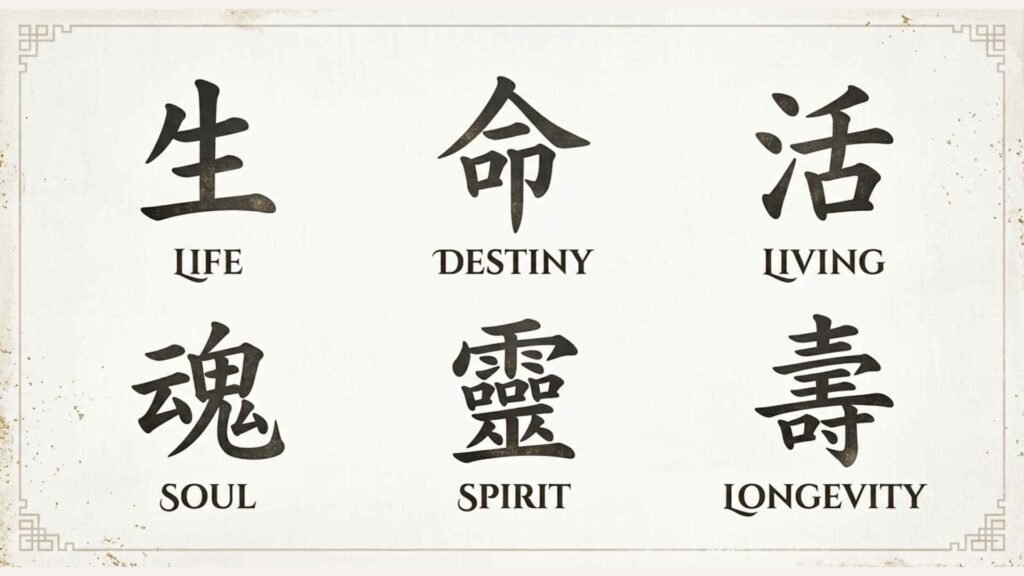
Single Characters
Single-character tattoos are compact and visually striking. They work best when the intended idea genuinely has a natural one-character expression.
Examples include:
- 愛 or 爱: love
- 夢 or 梦: dream
- 道: way, path, or principle
- 禪 or 禅: Chan or Zen
- 龍 or 龙: dragon
- 忍: endurance, restraint, or patience
Two-Character Words
Two-character words often communicate ideas more naturally than isolated characters.
Examples include:
- 和平: peace
- 希望: hope
- 勇氣 or 勇气: courage
- 智慧: wisdom
- 自由: freedom
- 家庭: family or household
- 命運 or 命运: fate or destiny
Four-Character Idioms
Four-character idioms, known as chengyu, can express stories, moral lessons, or complex ideas in a compact form. However, they are risky tattoo choices because their meanings may depend on literary history and established usage.
A phrase that looks poetic in a machine translation may not be a real idiom. Always ask a qualified native speaker to explain both the literal wording and implied meaning.
Calligraphic Styles
The same characters may appear in:
- Seal script
- Clerical script
- Regular script
- Running script
- Cursive script
- Modern printed fonts
- Hand-brushed contemporary styles
Regular script is usually easiest to verify. Seal and cursive styles offer stronger visual character but require expert knowledge because unfamiliar forms may be misread or copied incorrectly.
Vertical and Horizontal Layouts
Chinese may be arranged horizontally or vertically. Traditional writing was often vertical, with columns progressing from right to left, while horizontal left-to-right writing is now common in modern contexts.
A vertical tattoo should preserve the correct character order from top to bottom. Rotating a horizontal phrase is not always the same as typesetting it vertically.
Common Misconceptions
“Every Chinese Character Is a Symbol”
Chinese characters can function symbolically, but they are first elements of a writing system. Calling them “symbols” is convenient in tattoo culture, yet it can hide their grammatical and linguistic complexity.
“One English Word Always Equals One Character”
English words often have several meanings. “Power” could mean physical force, political authority, electrical power, ability, or control. Different Chinese terms may be needed for each.
“Traditional Characters Are Always More Authentic”
Traditional forms are historically important and remain standard in several regions. Simplified characters are also legitimate modern Chinese. Authenticity depends on context, not simply stroke count.
“A Native Speaker Can Verify Any Calligraphy”
A fluent reader may recognize standard print but struggle with highly stylized seal or cursive forms. Historical calligraphy may require specialized expertise.
“Reversing the Image Does Not Matter”
Reversing a Chinese character can make it incorrect or unreadable. Tattoo transfer paper, mirrors, and image-editing software can accidentally flip a design.
“Online Translation Is Enough”
Translation tools can provide general vocabulary, but they may miss tone, grammar, cultural associations, regional forms, and idiomatic meaning. Permanent body art deserves human verification.
Interesting Facts About Chinese Tattoo Symbols
- The same word can look dramatically different across scripts.
A regular-script character may appear square and clear, while its cursive form may flow into only a few connected movements. - Stroke order influences appearance.
Chinese characters follow conventional stroke sequences. Correct order helps create balanced proportions and natural brush movement. - A missing line can change the character.
Characters are built from exact structures. Omitting, adding, or shortening a stroke may create another word or an invalid form. - Calligraphy communicates personality.
Traditional criticism examines energy, rhythm, control, spacing, and movement, not just whether the character is readable. - Chinese characters are not confined to one language.
Related Han characters have been used in Chinese, Japanese, Korean, and historical Vietnamese writing, but their readings and meanings may differ. - The character 福 is sometimes displayed upside down.
This New Year custom involves wordplay suggesting that fortune has “arrived.” A permanent upside-down tattoo may not communicate the same festive context. - Dragon symbolism differs from many Western traditions.
Chinese dragons are often associated with water, rain, authority, vitality, and auspicious power rather than simply destruction or evil. - Not all decorative writing is readable.
Fashion products sometimes combine real strokes into meaningless pseudo-characters designed only to look “Asian.” - Fonts can introduce regional differences.
A single encoded Han character may display with Chinese or Japanese glyph conventions depending on the font and device. - Names require special translation care.
A foreign name may be represented phonetically, translated by meaning, or given an established Chinese form. These methods produce very different results.
Related Chinese Symbols
Yin-Yang
The yin-yang symbol represents complementary forces and changing balance. Unlike a single written character, it is a visual cosmological diagram.
Chinese Dragon
The dragon represents power, vitality, transformation, rain, and auspicious authority. Its meaning differs from the hostile dragon image common in some European legends.
Phoenix
The Chinese phoenix, or fenghuang, is associated with virtue, harmony, renewal, and high status. It is not identical to the fire-reborn phoenix of Greek tradition.
Lotus
The lotus represents purity, spiritual awakening, and growth through difficulty. It is especially important in Buddhist art.
Bamboo
Bamboo symbolizes flexibility, endurance, upright character, and resilience.
Double Happiness
The character 囍 combines two forms of 喜, meaning joy or happiness. It is strongly associated with weddings and marital celebration rather than general everyday happiness.
Fu Dog or Guardian Lion
Chinese guardian lions represent protection, authority, and the safeguarding of important buildings. The English term “fu dog” is misleading because the figures are lions.
Red Seal Mark
A seal-style tattoo may resemble a traditional carved stamp. It can contain a name, studio title, motto, or artistic identity.
Frequently Asked Questions
What are the most popular Chinese tattoo symbols?
Popular choices include 愛 for love, 家 for family, 勇 for courage, 福 for good fortune, 和 for harmony, and 力 for strength. Two-character words such as 和平 for peace and 自由 for freedom are also common. Popularity does not guarantee suitability, so each design should be checked for context, form, and natural usage.
What Chinese symbol means strength?
The character 力 means strength, force, power, or physical effort. However, “inner strength,” “emotional resilience,” and “personal ability” may require other words or phrases. Someone seeking a tattoo about surviving hardship may need wording closer to perseverance, endurance, or resilience rather than the broad character 力.
What Chinese symbol means love?
The traditional character for love is 愛, while the simplified form is 爱. Both are pronounced ài in Mandarin. Traditional 愛 is standard in places such as Taiwan and Hong Kong, while simplified 爱 is standard in mainland China and Singapore. Either can be correct when chosen with awareness of regional style.
Should I use simplified or traditional Chinese?
Choose according to the cultural connection, region, visual preference, and intended audience. Traditional characters often contain more strokes and remain standard in Taiwan, Hong Kong, and Macau. Simplified characters are standard in mainland China and Singapore. Neither system is automatically superior; the important issue is consistency and accuracy.
Can I trust a Chinese tattoo translation found online?
Online translations can help with early research, but they should not be the final authority. A word may have several possible Chinese equivalents, and automated systems may produce unnatural or overly literal phrasing. Ask at least one qualified native speaker, and preferably a professional translator or calligrapher, to review the completed design.
Why do some Chinese tattoos become embarrassing?
Problems usually result from mistranslation, reversed images, missing strokes, unrelated characters placed together, incorrect grammar, or copying a decorative font without verification. Sometimes the tattoo technically says a real word but not the meaning the wearer intended. Careful review before tattooing prevents most of these mistakes.
Is a Chinese character tattoo cultural appropriation?
The answer depends on intent, knowledge, presentation, and context. Using Chinese writing respectfully after researching its meaning is different from treating the language as an exotic decoration. Sacred imagery, stereotypes, jokes about Asian languages, and careless mistranslations are more likely to be viewed as disrespectful.
How can I verify a Chinese tattoo design?
Write down the exact idea in a complete sentence, not just one English keyword. Ask a professional translator or educated native speaker to suggest natural wording. Confirm whether the characters are simplified or traditional, verify the calligraphy with a specialist, and check that the final stencil has not been reversed.
Are Chinese and Japanese tattoo characters the same?
Chinese hanzi and Japanese kanji share historical roots, and many forms overlap. However, pronunciation, vocabulary, grammar, simplified forms, and cultural associations may differ. A compound that is natural in Japanese may sound unusual in Chinese. The intended language must therefore be identified before the tattoo is designed.
What is the safest Chinese tattoo style?
Clear regular script is generally easiest to read and verify. Running, cursive, seal, and highly decorative styles can be beautiful, but they require greater expertise. The safest process is to obtain the wording from a translator, commission the final form from a skilled calligrapher, and give the tattoo artist a clean, approved reference.
Key Takeaways
- Chinese tattoo symbols are elements of a living written language, not merely decorative pictures.
- A character’s meaning depends on wording, grammar, region, context, and calligraphic form.
- Popular choices include love, family, courage, harmony, wisdom, fortune, and freedom.
- Simplified and traditional Chinese are both valid but should not be mixed carelessly.
- Chinese, Japanese, and Korean character traditions overlap without being interchangeable.
- Regular script is easier to verify than cursive or ancient seal forms.
- Machine translation should never be the only source for a permanent tattoo.
- Every final design should be checked for correct strokes, order, layout, and orientation.
- Sacred religious imagery should be used with cultural awareness.
- A thoughtful, verified design carries more meaning than an attractive but inaccurate character.
Conclusion
Chinese tattoo symbols can create powerful and elegant body art when language, culture, and design work together. A single character may express love, courage, harmony, or good fortune, while a longer phrase can preserve a life lesson, family bond, or personal commitment.
Their visual beauty comes from thousands of years of writing and calligraphic development. That history also creates responsibility. Characters should not be selected only because they look mysterious or exotic.
Before choosing Chinese tattoo symbols, define the exact message, verify the translation, select the correct regional form, and consult someone who understands both Chinese language and calligraphy. A careful process transforms a decorative mark into a meaningful design that can be worn with confidence.

I am Daniel Brooks, a language researcher and writer with a strong interest in how people use English in everyday conversations. I contribute to LearnNestly because I enjoy turning confusing language topics into straightforward lessons. My goal is to help readers understand not only what a word or phrase means, but also when and how to use it naturally. I focus on clear examples, practical explanations, and useful language knowledge that readers can remember.
Books:
- The Practical English Guide
- Understanding Everyday Words
 Amelia Carter