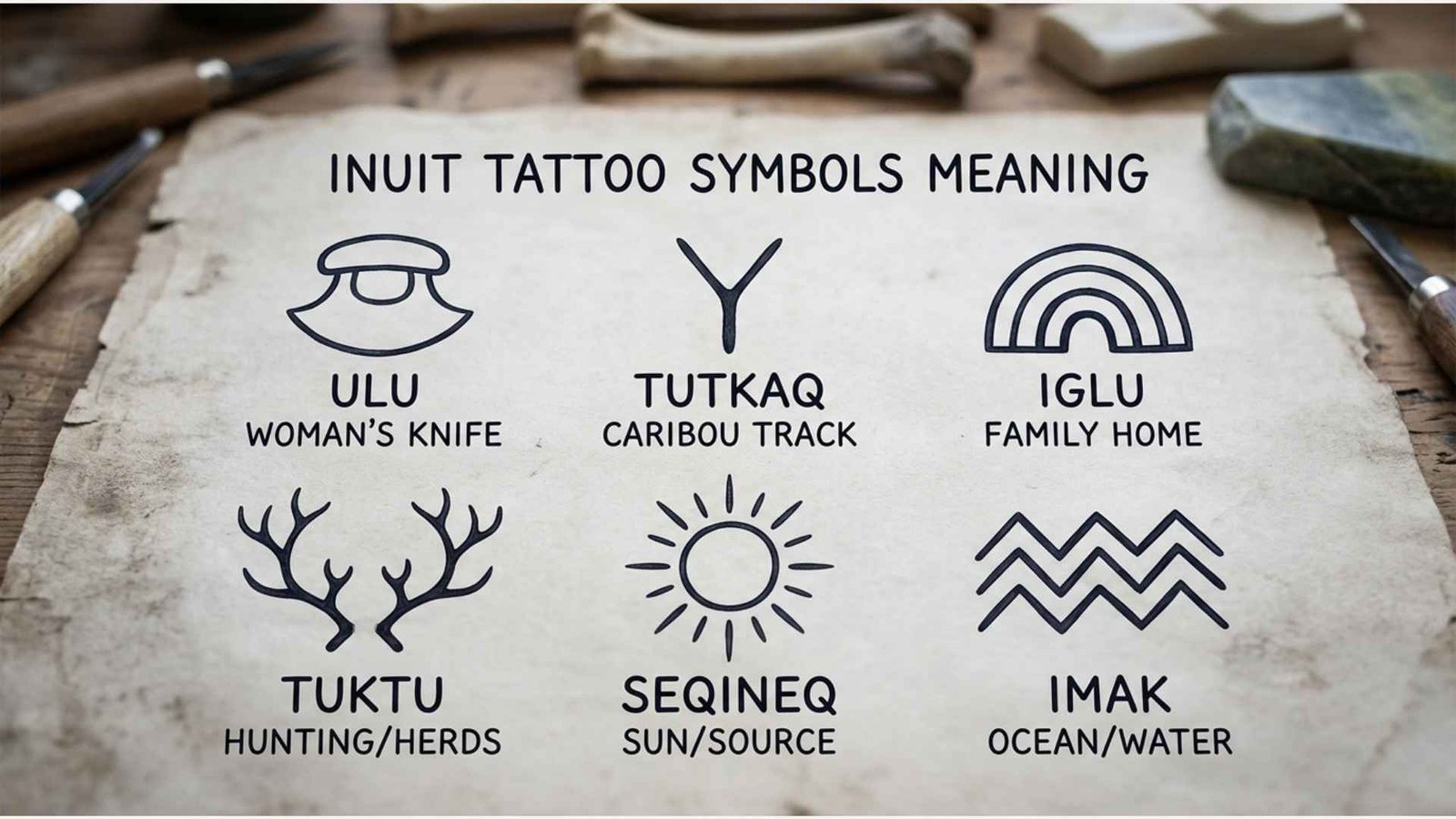
Inuit tattoo symbols carry meanings connected to identity, womanhood, family, skill, spirituality, survival, and belonging. Known in parts of the Canadian Arctic as kakiniit, with women’s facial markings often called tunniit, these tattoos are not simply decorative patterns. Their meanings can differ by region, community, family, placement, and the person who wears them.
You may encounter Inuit tattoo designs in historical photographs, museum collections, documentaries, contemporary art, or on Inuit women participating in cultural revitalization. Although familiar forms include chin lines, forehead marks, finger patterns, and wrist bands, there is no single universal chart that translates every line.
Understanding Inuit tattoo symbols meaning requires attention to Inuit voices, regional traditions, and the history of colonial suppression and cultural renewal.
Quick Meaning of Inuit Tattoo Symbols
Inuit tattoo symbols traditionally express cultural identity, maturity, family connections, life achievements, spiritual beliefs, and a person’s role within the community. Common patterns include lines, dots, V shapes, Y shapes, and geometric bands. Their meanings vary across Inuit regions, so a design should not be interpreted without cultural and personal context.
Inuit Tattoo Symbols Overview
| Field | Details |
| Traditional names | Kakiniq, kakiniit, tunniit and other regional terms |
| Primary meanings | Identity, womanhood, skill, family, protection, spirituality and life experience |
| Cultural origin | Inuit societies across the Arctic |
| Geographic regions | Alaska, Arctic Canada, Greenland and parts of the circumpolar North |
| Common wearers historically | Primarily women, although some men also received particular markings |
| Common placements | Chin, forehead, cheeks, hands, fingers, wrists, arms, chest and thighs |
| Common forms | Parallel lines, dots, V shapes, Y shapes, bands, crosses and geometric patterns |
| Traditional techniques | Skin stitching, hand poking and related regional methods |
| Materials historically used | Bone or ivory needles, sinew thread, soot, oil and other locally available pigments |
| Traditional purposes | Beauty, maturity, social identity, spiritual responsibility, healing and commemoration |
| Period of major decline | Mainly the nineteenth and twentieth centuries under missionary and colonial pressure |
| Modern meaning | Cultural reclamation, Inuit pride, healing, continuity and self-determination |
| Unicode | Not applicable |
| Emoji equivalent | None |
| Related traditions | Greenlandic Inuit tattooing, Iñupiat tattooing and distinct neighboring Indigenous tattoo traditions |
What Do Inuit Tattoo Symbols Mean?
Inuit tattoo symbols do not have one fixed meaning shared by every Inuit person. They form a visual language whose interpretation depends on geography, kinship, oral teaching, personal experience, and the circumstances in which a tattoo was received.
Some markings historically indicated that a girl had reached womanhood or had learned skills needed to care for herself, contribute to her household, and participate in community life. Others could celebrate marriage, motherhood, sewing ability, hunting-related work, endurance, or another important transition.
A pattern might also connect its wearer to a particular family or place. In communities spread across the Arctic, differences in line thickness, arrangement, location, or technique could communicate regional belonging. However, surviving evidence is incomplete because many teachings were disrupted before they could be recorded.
Today, an Inuit woman may receive traditional markings to honor an ancestor, recognize her children, celebrate sobriety, remember a relative, reclaim control over her body, or affirm her identity as an Inuk. These personal meanings are valid parts of the living tradition rather than lesser versions of an ancient system.
The most accurate interpretation therefore begins with a simple principle: the wearer and her community are the primary authorities on what her tattoos mean.
History and Origin of Inuit Tattoos
Inuit tattooing developed across the Arctic long before modern national borders divided Alaska, Canada, Greenland, and Russia. Archaeological evidence and early historical records show that tattooing was deeply established among Arctic peoples, although dates, patterns, and customs varied considerably from one region to another.
The English phrase “Inuit tattoos” can hide this diversity. Inuit are not one uniform community. They include many regional peoples with distinct dialects, histories, artistic traditions, and bodies of knowledge. Even the terminology changes. In parts of the Canadian Arctic, kakiniq is a singular word for a tattoo and kakiniit is plural, while tunniit commonly refers to women’s facial tattoos. Usage is not identical in every dialect. Inuit Tapiriit Kanatami’s Inuktitut magazine identifies kakiniq or kakiniit as words for tattoo and discusses tunniit as women’s facial markings.
Traditional tattooing was often performed by women for women. One method involved pulling pigment-coated sinew beneath the skin with a needle, creating a line through a process similar to sewing. Another method placed pigment through repeated hand poking. Parks Canada describes the use of caribou sinew, seal oil, soot, and a caribou-bone needle in one documented tradition.
These materials reflected Arctic knowledge rather than technological simplicity. Practitioners understood how to prepare thread, produce pigment, control depth, place lines, and care for healing skin using the resources available in their environment.
Suppression During Colonization
Inuit tattoo practices declined sharply under colonial rule and Christian missionary influence. Missionaries often treated tattoos as non-Christian, shameful, or spiritually dangerous. Settlement policies, residential and day schools, medical intervention, religious conversion, and pressure to adopt southern customs weakened the networks through which tattoo knowledge had passed.
The practice was not erased because Inuit people freely decided that it lacked meaning. It was interrupted within a much wider campaign that discouraged or punished Indigenous languages, ceremonies, clothing, beliefs, and forms of self-expression.
Alethea Arnaquq-Baril’s documentary Tunniit: Retracing the Lines of Inuit Tattoos follows her effort to recover knowledge from elders after the tradition had been forbidden and driven toward disappearance. The film’s research included conversations across Inuit communities and revealed both surviving knowledge and painful gaps created by rapid cultural change.
Modern Revitalization
The late twentieth and early twenty-first centuries brought a strong revival. Inuit artists, filmmakers, researchers, elders, and tattoo practitioners began documenting oral histories and returning the markings to living bodies.
Modern revitalization is not simply an attempt to copy old photographs. It reconnects generations, supports cultural pride, and allows Inuit people to decide how their traditions should continue. Contemporary practitioners may use skin stitching, hand-poking techniques, or tattoo machines, depending on their training and the wishes of the recipient.
Inuit women involved in this movement describe their markings as expressions of identity, bodily autonomy, healing, and resistance to colonial shame. Writer Jana Angulalik, for example, explains that she wears kakiniit to identify proudly as an Inuk woman and to reclaim agency over her body.
Symbolism and Interpretation
Chin Lines
Vertical chin lines are among the most recognized Inuit facial tattoo forms. They are often associated with womanhood, maturity, responsibility, and cultural identity.
In some historical settings, a girl received chin markings as she entered a new stage of life. The tattoos could acknowledge that she was learning or had mastered important responsibilities. Yet the exact number, length, spacing, and meaning of the lines differed among communities.
Modern chin tattoos may represent cultural survival, pride, family, personal healing, or renewed connection to ancestors. It is inaccurate to claim that three chin lines always mean one specific thing.
Forehead Markings
Forehead tattoos may appear as vertical lines, angled forms, V shapes, or branching patterns. Some interpretations connect them with maturity, womanhood, spiritual awareness, or a major life transition.
Their location makes them highly visible, turning the face into a declaration of belonging. A forehead marking may therefore carry both inward and outward meaning: it can remind the wearer of her responsibilities while allowing others to recognize her identity.
Cheek Tattoos
Cheek markings include lines, small crosses, dots, angled forms, and regional geometric arrangements. They may be connected to family, place, beauty, personal accomplishments, or protection.
Because photographs often show cheek tattoos without names or explanations, modern viewers sometimes assign meanings based only on appearance. That method is unreliable. Similar-looking shapes can have different meanings in separate communities.
Finger and Hand Tattoos
Finger, hand, and wrist tattoos are commonly linked to women’s work, skill, spiritual responsibility, and relationships with animals and the environment. Hands were essential to preparing food, sewing waterproof clothing, working hides, caring for children, and sustaining family life.
Some interpretations connect hand and finger markings with stories of the sea woman known by regional names, including Sedna in widely circulated versions. In those narratives, the severed parts of the sea woman’s fingers become marine animals. The story expresses relationships among human conduct, animals, food, and the spiritual order of the sea.
These markings should not be reduced to a generic “ocean symbol.” Their significance emerges from a larger ethical and spiritual relationship among Inuit, sea mammals, hunting, sharing, and survival.
Wrist and Arm Bands
Bands around the wrists or forearms may symbolize skill, protection, achievement, life transitions, or community identity. Parallel lines and repeated geometric forms can also create visual balance while following the natural shape of the body.
Arms and hands are active parts of the body. Placing markings there can connect symbolism with work and capability rather than with abstract decoration alone.
Chest and Body Tattoos
Historical accounts record tattoos on the chest, breasts, thighs, arms, and other parts of the body. Some were associated with marriage, childbirth, motherhood, physical well-being, or personal milestones.
Body placement could give a design private meaning. Unlike facial tattoos, which were visible to the community, tattoos under clothing might relate more closely to intimate experiences, reproductive life, or spiritual protection.
Lines, Dots, V Shapes, and Y Shapes
Simple geometry does not mean simple symbolism.
A straight line may suggest a path, boundary, connection, tool, body seam, or stage of life. Dots can mark events, create protective arrangements, or complete a larger design. V and Y shapes may resemble tools, body forms, animal features, or practical objects.
However, popular online charts often give each form a universal definition without identifying an Inuit region or source. Such charts should be treated cautiously. Traditional meaning comes from relationships, not from shape alone.
Positive, Difficult, and Personal Meanings
Most Inuit tattoo meanings are not neatly divided into positive and negative categories. A tattoo may carry pride and grief at the same time.
Positive associations include:
- Cultural belonging
- Maturity and responsibility
- Beauty and confidence
- Family continuity
- Skill and capability
- Motherhood
- Spiritual connection
- Resilience and survival
- Healing from colonial harm
More difficult associations can include:
- Memories of cultural suppression
- Grief for lost relatives or interrupted traditions
- Responsibilities attached to adulthood
- Painful personal experiences
- Fear of judgment or discrimination
- Disagreement within families about cultural revival
A modern tattoo may transform pain into strength without erasing the history behind it. This layered meaning is one reason Inuit tattoo revitalization is often described as both cultural and personal healing.
Cultural Significance Across Inuit Regions
Inuit tattooing belongs to a vast geographic world rather than a single village or country. Inuit homelands extend across the circumpolar Arctic, and each region developed its own designs, terms, and social practices.
Inuit Nunangat in Canada
Inuit Nunangat includes the four Inuit regions of Canada: the Inuvialuit Settlement Region, Nunavut, Nunavik, and Nunatsiavut. Inuit Tapiriit Kanatami states that Canadian Inuit live primarily in 53 communities throughout this homeland.
Within these regions, tattoo traditions differ by community and language. Contemporary Canadian Inuit practitioners often combine elder testimony, family photographs, archival research, and personal consultation when developing designs.
Greenland
Greenlandic Inuit tattoo traditions include facial, hand, finger, wrist, and body markings. The designs can vary between West and East Greenland and among individual communities.
The Greenlandic revival has emphasized research, responsible teaching, and the return of traditional hand-applied methods. Visit Greenland describes tunniit as traditions with deep spiritual and cultural roots that are now being renewed by younger generations.
Alaska
Alaska is home to Iñupiat, Yupik, Cup’ik, Unangax̂, Gwich’in, and other Indigenous peoples with distinct tattoo traditions. These groups should not all be labeled Inuit merely because their designs may look similar to outsiders.
Iñupiat are Inuit, while Yupik peoples belong to related but distinct cultural and linguistic communities. Gwich’in are Athabascan people, not Inuit. Using accurate nation and community names respects differences that broad labels can erase.
Chukotka and the Western Arctic
Related tattoo traditions also existed among Indigenous peoples of Chukotka in northeastern Russia. Political borders, language loss, colonial documentation, and restricted travel have made some regional histories less accessible to the public.
Similarities across the Arctic may reflect ancient relationships, shared environments, migration, trade, and related languages. Similarity does not prove that every pattern carried the same meaning everywhere.
Religious and Spiritual Meaning
Traditional Inuit tattooing could have spiritual meaning, but it should not be described as a single organized religion with a fixed book of symbols.
Historically, Inuit spiritual life centered on relationships among humans, animals, weather, land, sea, ancestors, and unseen powers. Survival required more than practical skill. It also required proper behavior, respect, sharing, and attention to rules that maintained balance.
Tattoos could participate in this spiritual world by protecting the wearer, marking readiness for adult responsibilities, honoring powerful beings, or helping secure a favorable existence after death. Some historical traditions connected women’s tattoos with recognition in the spirit world.
Stories involving the sea woman are particularly important. Although “Sedna” is the best-known name outside Inuit communities, she has different names and narratives across regions. Her story often explains the origin of sea mammals and the consequences of broken relationships or improper behavior.
Modern Inuit do not all interpret these traditions in the same way. Some understand their tattoos through ancestral spirituality. Others combine them with Christianity, secular identity, family remembrance, or personal healing. Cultural identity does not require one uniform religious belief.
Psychological Meaning and Cultural Healing
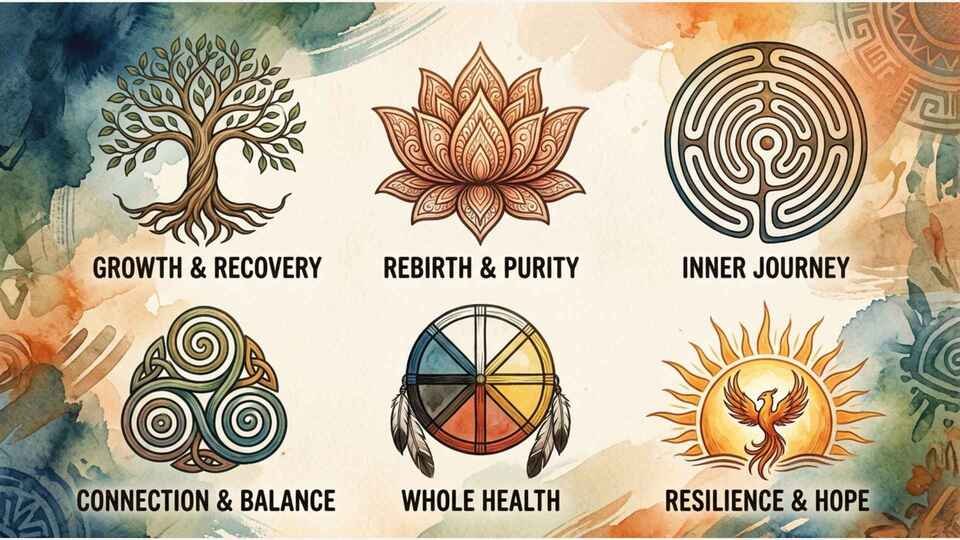
Inuit tattoos can support psychological healing by reversing messages of shame imposed through colonization.
For generations, Inuit people were told that visible Indigenous practices were backward or unacceptable. Wearing kakiniit today can transform the body from a site controlled by outside institutions into a site of self-definition.
This does not mean tattooing automatically heals trauma. Healing depends on the individual and may involve family, ceremony, language, counseling, community support, or other practices. Still, many wearers describe a stronger sense of identity after receiving traditional markings.
The permanence of a tattoo can also create accountability. A marking may remind its wearer of her children, values, responsibilities, or promise to herself. Its psychological power comes partly from being carried through ordinary life rather than displayed only during special events.
Where Inuit Tattoo Symbols Are Used Today
On Living Bodies
The most important place for Inuit tattoo symbols is on Inuit people. Their return to faces, hands, arms, and bodies demonstrates that the tradition is living rather than confined to museum collections.
Documentary Film
Films such as Tunniit: Retracing the Lines of Inuit Tattoos have helped preserve elder knowledge and introduced wider audiences to the history of suppression and revival.
Photography and Archives
Historical photographs provide evidence of regional designs, placement, and individual variation. However, an image alone rarely reveals the wearer’s full story or the exact meaning of every mark.
Contemporary Inuit Art
Artists use tattoo lines in prints, paintings, sculpture, fashion, performance, and digital art. In these settings, the markings may symbolize presence, sovereignty, gender, memory, or resistance.
Jewelry and Clothing
Tattoo-inspired lines appear on earrings, pendants, garments, and accessories made by Inuit designers. When created within Inuit communities, these works can extend traditional visual language into new forms.
Public Institutions and Commemorative Design
Inuit markings sometimes appear in exhibitions, educational programs, public art, and commemorative objects. Their use requires care so that sacred or identity-specific designs are not turned into anonymous decoration.
Common Variations of Inuit Tattoo Designs
Skin-Stitched Lines
Skin stitching creates lines by drawing pigmented thread beneath the skin. The result may look slightly softer or more irregular than a machine-made tattoo.
Hand-Poked Tattoos
Hand poking places pigment through repeated punctures. This method allows the practitioner to build dots, lines, and shapes gradually.
Machine Tattoos
Some Inuit practitioners use modern tattoo machines. The tool does not automatically determine cultural authenticity. Community knowledge, relationships, permission, purpose, and design context matter more than whether the needle is powered by hand or machine.
Facial and Body Variations
Facial designs can include chin lines, forehead marks, cheek patterns, temple lines, and eye-area dots. Body designs may include finger marks, wrist bands, forearm patterns, chest markings, and thigh tattoos.
Regional and Personal Adaptations
A modern wearer may choose a historically documented regional design, adapt a family pattern, or create a new composition with an Inuit practitioner. Revitalization includes recovery, but it also includes responsible creativity.
Common Misconceptions About Inuit Tattoos
“Every Inuit Tattoo Has One Universal Meaning”
Meanings vary by region, family, era, and wearer. A symbol chart without cultural context cannot provide a complete translation.
“All Arctic Facial Tattoos Are Inuit”
They are not. Gwich’in, Yupik, Iñupiat, Inuit, and other Indigenous peoples have their own identities and tattoo traditions. Some are related, but they are not interchangeable.
“Chin Lines Always Mean Marriage”
Chin tattoos may relate to womanhood, maturity, identity, responsibility, or a personal experience. Marriage is not the universal explanation.
“Traditional Designs Are Just Geometric Decoration”
The forms may appear simple, but they can carry family, spiritual, social, and historical meaning. Their simplicity also reflects the effectiveness of lines and dots when using skin-stitching or hand-poking techniques.
“The Tradition Disappeared Naturally”
Colonial and missionary pressure played a major role in its decline. Inuit writers describe the markings as having survived attempts to ban, shame, and erase them.
“Anyone Can Copy a Design Respectfully”
Many Inuit practitioners and writers state that traditional kakiniit are specifically for Inuit people. Admiration does not create cultural belonging. A respectful non-Inuit person can learn about the tradition, support Inuit artists, and avoid copying identity-specific markings.
“Old Designs Are More Authentic Than Modern Ones”
Historical designs are important, but living cultures change. A contemporary tattoo can be culturally authentic when it emerges from Inuit knowledge, relationships, and experience.
10 Interesting Facts About Inuit Tattoo Symbols
- Tattooing was often women-led. Women commonly tattooed other women, making the practice a form of artistic and ceremonial knowledge shared across generations.
- The body acted as a cultural record. A person’s markings could communicate maturity, abilities, relationships, achievements, and regional identity without written text.
- Traditional tattooing resembled sewing. In skin stitching, the practitioner pulled pigment-coated thread beneath the skin, linking tattoo knowledge with expert sewing skills.
- Not all facial marks had the same purpose. Chin, cheek, and forehead tattoos could perform different roles, and their interpretation changed across communities.
- Hands carried special importance. Finger and hand markings appeared on body parts essential to sewing, food preparation, family care, and relationships with hunted animals.
- The familiar name “Sedna” is regional rather than universal. Related sea-woman stories exist throughout the Arctic, but her name and narrative vary among Inuit communities.
- Historical silence does not mean a design lacked meaning. Colonial disruption caused many explanations to be lost or hidden. Missing documentation often reflects interrupted transmission.
- Modern tattoos may commemorate survival. Some wearers use their markings to honor relatives who endured residential schools, relocation, discrimination, or cultural suppression.
- Traditional tools and modern tools can coexist. Contemporary Inuit tattooists may use skin stitching, hand poking, or machines while grounding their work in cultural teaching.
- Revitalization can include new meanings. A tattoo may follow an ancestral form while representing a modern experience such as recovery, education, motherhood, or language reclamation.
Related Indigenous Tattoo Symbols and Traditions
Iñupiat Tattoos
Iñupiat are Inuit people from northern and northwestern Alaska. Their tattoo traditions share broader Arctic relationships while maintaining distinct local designs and terminology.
Greenlandic Tunniit
Greenlandic tattooing includes regional facial, hand, wrist, and body patterns. It is part of the wider Inuit world but should be interpreted through Greenlandic history and community knowledge.
Yupik and Cup’ik Tattoos
Yupik and Cup’ik peoples have important tattoo traditions of their own. Their cultures and languages are related to Inuit cultures but are distinct.
Gwich’in Yidįįłtoo
Yidįįłtoo are traditional Gwich’in facial markings. They may include chin lines and other facial patterns, but they are Gwich’in rather than Inuit symbols.
Māori Tā Moko
Tā moko is a Māori practice from Aotearoa New Zealand. Like Inuit tattooing, it can express identity, genealogy, responsibility, and status, but its visual language and cultural laws are entirely different.
Amazigh Facial Tattoos
Traditional Amazigh tattoos from North Africa include dots, lines, crosses, and geometric designs. Visual similarity to Arctic tattoos does not indicate shared meaning or origin.
Frequently Asked Questions
What is the meaning of Inuit chin tattoos?
Inuit chin tattoos commonly represent womanhood, maturity, responsibility, cultural identity, and connection to ancestors. Their exact meaning differs by community and wearer. The number or spacing of the lines does not have one reliable universal translation, so the wearer’s explanation should take priority over generalized symbol charts.
What are traditional Inuit tattoos called?
In parts of the Canadian Arctic, a tattoo may be called a kakiniq, while the plural is kakiniit. The word tunniit is often used for women’s facial tattoos. Terms and definitions vary among Inuit languages and dialects, so no single vocabulary rule applies everywhere in the Arctic.
What do Inuit finger tattoos mean?
Finger tattoos may relate to women’s skills, spiritual responsibilities, hunting culture, sea animals, family life, or stories of the sea woman. Because hands prepared clothing and food and supported household survival, the placement itself carried practical significance. Specific designs still require regional or personal context.
Did Inuit men wear tattoos?
Women historically wore the most extensive and widely documented Inuit tattoos, especially on the face, hands, arms, chest, and thighs. Some men also received tattoos in particular regions or circumstances, but their patterns and purposes could differ. It is therefore inaccurate to describe Inuit tattooing as completely exclusive to women.
How were traditional Inuit tattoos made?
Practitioners used methods such as skin stitching and hand poking. Skin stitching involved drawing pigment-coated sinew beneath the skin with a needle. Hand poking inserted pigment through repeated punctures. Materials could include bone needles, animal sinew, soot, oil, and other locally prepared substances.
Why were Inuit tattoos banned or discouraged?
Missionaries and colonial authorities often viewed Inuit tattoos as incompatible with Christianity and European social norms. Tattooing declined alongside wider pressures against Inuit language, spirituality, dress, and ceremony. Shame, forced assimilation, institutional schooling, and settlement policies interrupted the transmission of knowledge between generations.
Why are Inuit tattoos returning today?
Their revival allows Inuit people to reclaim cultural identity, honor ancestors, rebuild intergenerational knowledge, and reject colonial shame. Wearers may also mark motherhood, recovery, grief, achievement, or personal renewal. The return of kakiniit demonstrates that Inuit culture remains active, adaptable, and self-determined.
Can a non-Inuit person get traditional Inuit tattoos?
Many Inuit tattoo practitioners and cultural advocates say that traditional kakiniit and tunniit should be worn by Inuit people because they communicate Inuit identity and survived attempts at colonial erasure. Non-Inuit admirers can show respect by learning from Inuit sources, supporting Inuit artists, and avoiding the copying of culturally specific markings.
Are Inuit tattoos religious symbols?
Some tattoos carried spiritual or ceremonial meaning, including protection, relationships with animals, passage into adulthood, and beliefs about the afterlife. Others expressed beauty, skill, family, or regional identity. Modern wearers may understand them spiritually, culturally, personally, or through a combination of these perspectives.
Do all Inuit tattoo designs have known meanings?
No. Some meanings survive through elders, oral histories, family knowledge, photographs, and written records. Others were lost, concealed, or fragmented during colonization. Responsible researchers distinguish documented knowledge from modern interpretation instead of inventing exact meanings for every historical line or pattern.
Key Takeaways
- Inuit tattoo symbols can represent identity, womanhood, family, skill, spirituality, protection, and major life events.
- Kakiniit is a common term for Inuit tattoos, while tunniit often refers to women’s facial markings in parts of the Canadian Arctic.
- Chin lines, forehead marks, dots, finger patterns, and wrist bands do not have one universal meaning.
- Regional, family, historical, and personal context determines interpretation.
- Traditional methods included skin stitching and hand poking with locally prepared materials.
- Missionary and colonial pressure caused a major decline in tattoo knowledge.
- The modern revival expresses cultural pride, healing, bodily autonomy, and continuity.
- Iñupiat, Yupik, Gwich’in, and other Arctic peoples should not be treated as one interchangeable culture.
- Many Inuit cultural advocates consider traditional kakiniit identity-specific and inappropriate for non-Inuit wearers.
- The wearer and her community remain the most reliable sources for a tattoo’s meaning.
Conclusion
The meaning of Inuit tattoo symbols cannot be reduced to a simple list in which one line means strength and another means protection. Kakiniit and tunniit belong to living systems of identity, memory, responsibility, spirituality, family, and place.
Their lines survived a period when Inuit people were pressured to hide or abandon them. Today, those same markings appear openly on faces, hands, artwork, film, and clothing as declarations of continuity.
Understanding Inuit tattoo symbols meaning therefore requires more than recognizing geometric patterns. It requires listening to Inuit wearers, respecting differences among Arctic communities, acknowledging the damage caused by colonization, and recognizing cultural revitalization as an expression of Inuit authority over Inuit bodies and traditions.

I am Ethan Mitchell, an English writer and lifelong learner who is fascinated by words and the way language changes over time. At LearnNestly, I share practical explanations designed for readers who want to improve their understanding of English without complicated terminology. I enjoy researching meanings, usage, grammar, and common language mistakes, then presenting the information in a simple and useful format. My purpose is to make every article a small learning experience that readers can actually apply.
Books:
- The Smart Learner’s English Guide
- English in Real Life
 Daniel Brooks
 Amelia Carter