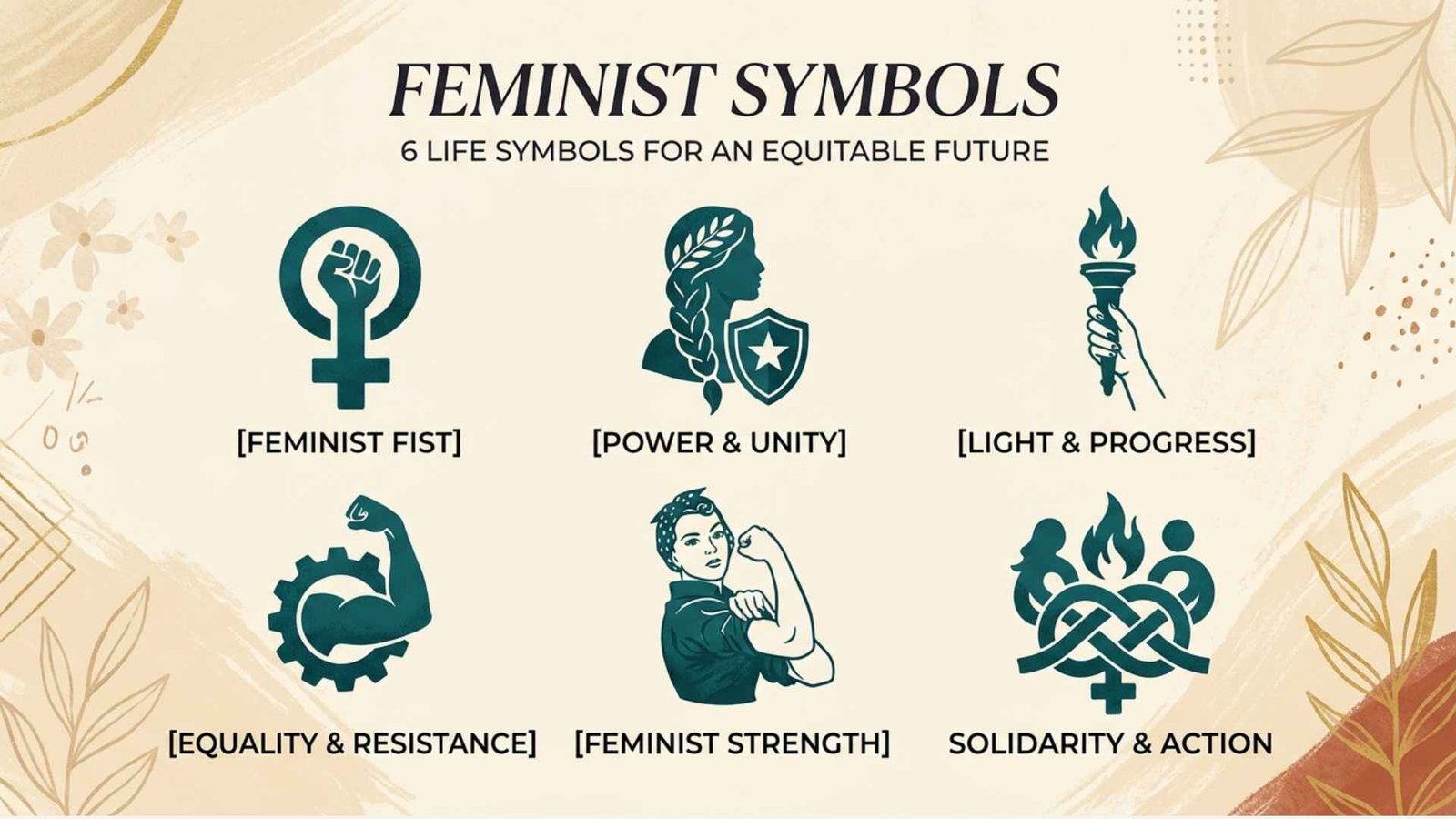
Feminist symbols have become powerful ways to represent equality, freedom, strength, and the fight for women’s rights. From the classic Venus symbol to raised fists, flowers, and modern feminist imagery, these symbols carry stories shaped by generations of activism and social change. Each one can express a different idea, emotion, or movement.
The history of feminist symbols is closely connected to major struggles for voting rights, education, equal opportunities, reproductive rights, and freedom from discrimination. Some symbols emerged from organized women’s movements, while others gained meaning through art, protests, literature, and popular culture. Over time, they have become recognizable signs of resistance and empowerment.
In this guide, we’ll explore feminist symbols and their meanings, including their history, cultural significance, and connection to equality and women’s empowerment. Whether you’re researching a symbol for a project, looking for meaningful imagery, or simply curious about feminist history, you’ll discover what these symbols represent and why they continue to matter today.
Quick Meaning of Feminist Symbols
Feminist symbols communicate women’s strength, solidarity, resistance to gender-based oppression, and commitment to equal rights. The best-known symbol places a clenched fist inside the female or Venus sign. Other important symbols include suffrage colors, the labrys, the raised fist, interlocking gender signs, flowers, and protest slogans.
Feminist Symbols Overview Table
| Symbol | Primary Meaning | Historical Connection | Common Modern Use |
| Fist inside the female symbol | Feminist resistance and empowerment | Women’s liberation movement | Posters, clothing, tattoos, social media |
| Female or Venus symbol: ♀ | Women, femininity, and female identity | Astronomy, alchemy, and biology | Gender labeling, activism, education |
| Raised clenched fist | Unity, resistance, and collective power | Labor, civil rights, anti-colonial, and liberation movements | Marches, campaigns, logos |
| Purple, white, and green | Dignity, purity or integrity, and hope | British suffragette movement | Flags, ribbons, clothing |
| Purple, white, and gold | Loyalty, purity of purpose, and enlightenment | American suffrage organizations | Historical commemorations and campaigns |
| Labrys | Women’s independence and lesbian feminism | Ancient Mediterranean religious imagery and 20th-century activism | Art, jewelry, flags, tattoos |
| Interlocking female signs | Women’s solidarity and lesbian identity | Women’s and LGBTQ+ movements | Pride designs, community groups |
| Venus mirror | Female identity and womanhood | Greco-Roman mythology and astronomy | Art, gender symbols, feminist graphics |
| Broken chains | Freedom from oppression | Abolition, suffrage, and liberation campaigns | Posters, murals, protest art |
| Equality sign | Equal status and opportunity | Human-rights advocacy | Campaigns, digital media, education |
| White clothing | Public visibility and political seriousness | Women’s suffrage demonstrations | Marches and commemorative events |
| Green bandanna or scarf | Reproductive rights and bodily autonomy | Latin American abortion-rights activism | Demonstrations and international campaigns |
What Do Feminist Symbols Mean?
Feminist symbols express the belief that women and girls should enjoy equal rights, opportunities, safety, representation, and freedom from discrimination. Their meanings often center on empowerment, resistance, solidarity, justice, and control over one’s own life.
Feminism is not represented by a single official emblem. It includes many movements, communities, historical periods, and political traditions. As a result, feminist imagery changes according to place, generation, identity, and cause.
The familiar fist-and-female-sign design combines two visual ideas. The female sign identifies the movement’s connection to women, while the fist adds determination, organized resistance, and collective strength. Together, they transform a gender marker into a political statement.
Feminist imagery may also communicate specific goals, such as:
- Voting rights
- Equal pay
- Access to education
- Reproductive freedom
- Protection from violence
- Workplace equality
- Political representation
- Racial and economic justice
- LGBTQ+ inclusion
- Freedom from restrictive gender roles
The meaning of a feminist symbol therefore depends on its context. A purple sash may refer to voting rights, while a green scarf may represent reproductive autonomy. A raised fist may express broad solidarity rather than a women-specific political position.
History and Origin of Feminist Symbols
The Female Symbol and the Sign of Venus
The female symbol, ♀, existed long before modern feminism. It is associated with Venus, the Roman goddess of love, beauty, fertility, and desire, and with Aphrodite, her Greek counterpart.
The sign was also used in astronomy and astrology to identify the planet Venus. In alchemy, it represented copper, a metal historically connected with the planet and goddess. Later, natural scientists adopted it as a biological marker for the female sex.
The symbol is often described as a simplified hand mirror associated with Venus. However, historians have debated whether that familiar explanation accurately describes its earliest graphic origin. What is certain is that the sign accumulated several connected meanings through astronomy, mythology, alchemy, biology, and gender classification.
During the 20th century, feminist activists reclaimed the female sign from its scientific and traditional associations. Instead of treating womanhood as merely a biological category, they used it to demand political recognition and social power.
The Raised Fist
The clenched or raised fist did not begin as an exclusively feminist image. It has appeared across labor organizing, socialist movements, anti-fascist campaigns, anti-colonial resistance, Black liberation, civil rights activism, and other struggles against oppression.
Its visual power comes from the difference between an open and closed hand. A single finger may appear vulnerable, but fingers pressed together form a fist. This makes the gesture an effective metaphor for unity, organization, protection, and collective action.
The raised fist became especially influential in 20th-century political graphics. Feminist groups adopted it because women’s liberation was connected to wider movements involving labor rights, racial justice, peace activism, sexuality, and economic equality.
The Fist Inside the Female Symbol
The combined feminist emblem places a clenched fist inside the circle of the female sign, with the cross extending below it. It became widely associated with the women’s liberation movement during the late 1960s and 1970s.
Graphic versions differed from group to group. Some showed a bold black fist, while others used purple, red, white, or multicolored designs. The emblem appeared on newsletters, banners, buttons, pamphlets, posters, and book covers.
Its effectiveness came from instant recognition. The female sign established the subject, and the fist changed the image from a passive category marker into a declaration of political agency.
Suffrage Symbols Before Modern Feminism
Long before the women’s liberation movement, suffragists used colors, clothing, flowers, animals, banners, and badges to make their cause visible.
British members of the Women’s Social and Political Union became associated with purple, white, and green. American organizations used several combinations, including purple, white, and gold or yellow. These color systems helped supporters show allegiance at meetings, marches, and public events.
American suffragists also used yellow roses and sunflowers. Yellow became especially connected with the Kansas suffrage campaign of 1867, and the sunflower later appeared on suffrage pins and promotional materials.
White dresses created a disciplined, respectable, and visually unified appearance in photographs and public demonstrations. Wearing white remains one of the most recognizable ways of honoring the history of women’s suffrage.
Symbolism and Interpretation
Strength and Empowerment
The most direct interpretation of feminist symbols is women’s power. A fist, upright posture, bold typeface, or broken chain communicates the rejection of helplessness and enforced silence.
Empowerment does not mean that every woman must appear physically strong or politically confrontational. In feminist thought, power may also mean the ability to make informed choices, earn an income, receive an education, participate in government, leave an unsafe relationship, or define one’s own identity.
Unity and Solidarity
Many feminist symbols emphasize connection between individuals. Interlocking female signs, circles, linked hands, and groups of raised fists suggest that social change depends on cooperation.
Solidarity is especially important because women do not experience inequality in identical ways. Race, disability, class, nationality, sexuality, religion, age, immigration status, and other factors can affect a person’s access to rights and opportunities.
Modern feminist imagery often reflects this diversity through multiple skin tones, inclusive figures, rainbow colors, disability symbols, and designs that include transgender and nonbinary people.
Resistance and Liberation
Broken chains, open cages, raised fists, flames, and marching figures symbolize freedom from restrictive systems.
These systems may include discriminatory laws, gender-based violence, forced marriage, workplace exclusion, sexual harassment, unequal property rights, limited educational access, or social expectations that confine people to predetermined roles.
In this context, liberation means more than individual confidence. It involves changing institutions, policies, cultural attitudes, and distributions of power.
Equality and Justice
Scales, equal signs, balanced figures, and parallel gender symbols communicate fairness. However, feminist equality does not necessarily mean treating every person in exactly the same way.
Equal rights may require removing barriers that affect some groups more heavily than others. For example, equal access to employment may involve parental-leave policies, protection from pregnancy discrimination, accessible workplaces, and measures against sexual harassment.
UN Women describes gender equality as equal rights, responsibilities, and opportunities for people of all genders, rather than a demand that everyone become identical.
Positive Interpretations
Feminist symbols can represent:
- Courage
- Mutual support
- Independence
- Bodily autonomy
- Political participation
- Education
- Dignity
- Social progress
- Freedom of expression
- Equal opportunity
Negative or Contested Interpretations
Opponents sometimes interpret feminist symbols as hostile to men, family life, religion, or tradition. Those interpretations usually result from political disagreement, misunderstanding, or the behavior of particular groups rather than from the basic meaning of feminism.
Feminist movements also debate their own symbols. Some people view the female sign as too closely tied to biological sex. Others believe older feminist imagery does not adequately represent women of color, transgender women, disabled women, Indigenous women, or women outside Europe and North America.
These debates do not make the symbols meaningless. Instead, they show that symbols evolve as communities reconsider whom they represent.
Cultural Significance of Feminist Symbols
United Kingdom
British suffragette imagery strongly influenced later feminist design. Purple, white, and green appeared on sashes, banners, jewelry, printed materials, and event decorations connected with the Women’s Social and Political Union.
The colors helped turn political identity into a visible public style. Supporters could wear a ribbon or piece of jewelry without carrying a protest sign.
United States
American suffrage groups commonly used white clothing, stars, banners, yellow flowers, and purple, white, and gold. The National Woman’s Party employed banners and highly organized public demonstrations to attract press attention and pressure political leaders.
Later American feminist movements adopted bolder imagery, including clenched fists, the female sign, protest buttons, peace symbols, and handmade posters. Black feminist organizations also developed language and imagery that connected sexism with racism and economic injustice.
Latin America
One of the most influential contemporary feminist emblems from Latin America is the green scarf associated with reproductive-rights activism.
The symbol became especially prominent in Argentina’s movement for legal abortion. Green scarves spread through public demonstrations and were later adopted by activists in other Latin American countries and beyond.
The color allows participants to communicate support immediately, even without words. It also shows how a regional movement can create imagery with international meaning.
Europe
European feminist symbols frequently combine older suffrage imagery with modern themes such as workplace equality, reproductive rights, anti-violence campaigns, and political representation.
Purple is widely used in International Women’s Day events and gender-equality campaigns, although its exact meaning varies among organizations.
Africa, Asia, and the Middle East
Feminist activism across Africa, Asia, and the Middle East cannot be reduced to one symbol. Local campaigns use traditional textiles, national colors, handwritten slogans, portraits of activists, indigenous motifs, religious imagery, and symbols of education or freedom.
In some settings, a schoolbook may represent girls’ education. In others, an empty chair may represent women excluded from government. A piece of clothing may symbolize either personal freedom or resistance to state control, depending on the political and cultural context.
The most accurate interpretation therefore considers who created the symbol, where it appeared, and what demand accompanied it.
Religious and Spiritual Meaning
Feminist symbols do not have one universal religious meaning. Feminism includes secular, religious, spiritual, and nonreligious traditions.
Some feminist theologians reinterpret established religious symbols to emphasize women’s spiritual authority. They may focus on female biblical figures, goddesses, saints, mothers, wisdom figures, or traditions of divine femininity.
Goddess-centered spiritual movements often use spirals, moons, circles, trees, chalices, and the Venus symbol. These images may represent fertility, natural cycles, intuition, birth, creativity, and female sacred power.
Religious feminists may also challenge interpretations that have been used to justify women’s exclusion from leadership. In this setting, familiar sacred symbols are not necessarily rejected. Instead, they are examined through questions of authority, language, representation, and equality.
It is important not to assume that all goddess, moon, or fertility imagery is feminist. Such images become feminist when people use them specifically to affirm women’s dignity, challenge gender hierarchy, or recover neglected female spiritual traditions.
Scientific, Biological, and Digital Meanings
Biological Use
In biology, medicine, genetics, and zoology, ♀ commonly identifies a female organism or patient category. Its use is descriptive rather than automatically political.
The same mark becomes feminist when designers place it in a political context, combine it with a fist, add slogans, or use it in campaigns for women’s rights.
Astronomy and Astrology
The Venus sign identifies the planet Venus in astronomical and astrological traditions. Astrologically, Venus is associated with attraction, beauty, affection, relationships, harmony, and values.
These interpretations should not be confused with the political meaning of the feminist emblem, even though both use the same basic shape.
Digital Communication
There is a Unicode character for the female sign: ♀, officially encoded as U+2640. It may appear differently depending on the device, font, or platform.
There is no single universal emoji showing a fist inside the female sign. Users often approximate feminist symbolism by combining characters and emojis such as ♀️, ✊, ✊🏽, ✊🏿, 💜, or ⚖️.
Hashtags, profile frames, digital stickers, and simplified logos have made feminist symbols easier to share internationally. However, digital use can also remove historical context, causing people to repeat symbols without knowing their origin.
Where Feminist Symbols Are Used
Protest Signs and Banners
Marches remain one of the most visible settings for feminist imagery. Signs often combine historic symbols with direct messages about equality, safety, voting, healthcare, education, or bodily autonomy.
Books and Literature
Publishers use the female sign, raised fist, bold typography, and suffrage colors on books about women’s history, gender studies, political theory, biographies, and social activism.
In literature, symbols such as cages, mirrors, doors, domestic rooms, restrictive clothing, and silenced voices may represent the limitations placed on female characters.
Jewelry and Clothing
Necklaces, pins, earrings, bracelets, shirts, and patches allow people to display feminist beliefs in daily life. Suffragists also used wearable objects, making political jewelry part of a much older activist tradition.
Tattoos
Common feminist tattoos include the fist-and-female-sign emblem, Venus symbols, labryses, flowers, quotes, broken chains, Medusa, and portraits of influential women.
A tattoo’s meaning remains personal. For one wearer, a Medusa image may represent survival after abuse. For another, it may symbolize rage, protection, or the rejection of beauty standards.
Logos and Organizations
Women’s shelters, legal organizations, healthcare networks, student groups, political campaigns, and advocacy organizations often use circles, female figures, hands, doves, flames, or equality signs.
Art and Murals
Artists use feminist symbols to preserve overlooked histories, honor activists, address violence, challenge stereotypes, and question how women’s bodies are represented.
Contemporary art may deliberately alter traditional symbols. An artist might break the Venus mirror, multiply it, merge it with other gender signs, or replace the fist with a pen, flower, tool, or microphone.
Common Variations of Feminist Symbols
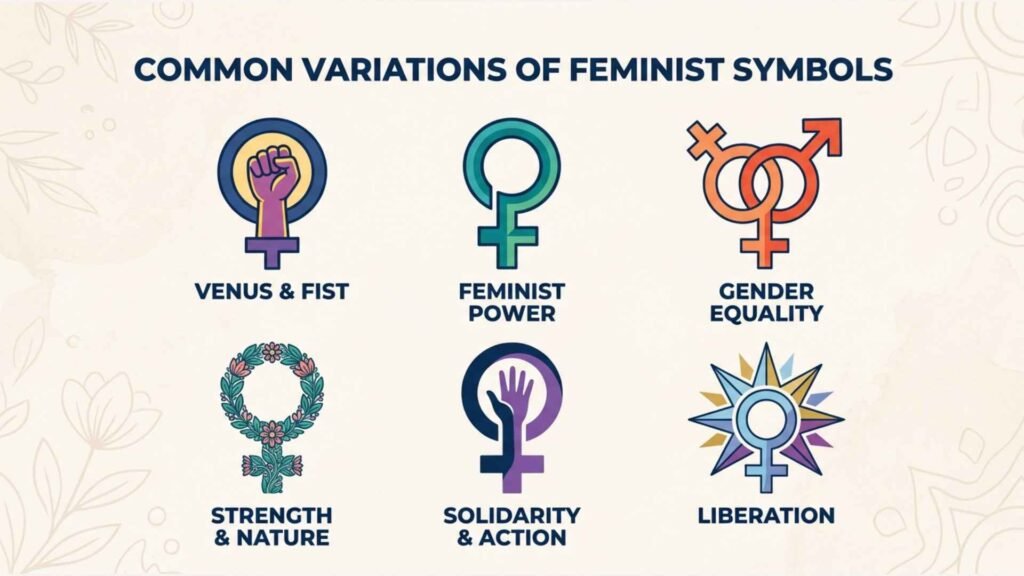
Plain Female Sign
The unmodified ♀ sign may represent women generally rather than feminism specifically. Context determines whether it is biological, social, commercial, or political.
Fist Inside the Female Sign
This is the clearest general emblem of feminist activism. Variations differ in line thickness, fist style, color, and visual detail.
Double Female Symbol
Two linked female signs may represent lesbian identity, relationships between women, or women’s solidarity. It should not automatically be treated as a general symbol for all feminism.
Labrys
The labrys is a double-headed axe found in ancient Mediterranean imagery, especially in archaeological and mythological contexts connected with Crete. In the 20th century, some lesbian feminists adopted it as a symbol of independence, strength, and resistance.
Its modern activist meaning should be distinguished from claims about ancient matriarchal societies, many of which are debated or unsupported by firm historical evidence.
Suffrage Color Variations
British suffragette colors are generally remembered as purple, white, and green. American groups used combinations that included purple, white, and gold or yellow.
These systems should not be treated as interchangeable. Their histories overlap, but they belonged to different organizations and national settings.
Green Scarf
The green scarf represents reproductive rights, especially the campaign for legal and accessible abortion in Latin America. It is a cause-specific feminist symbol rather than a replacement for every feminist emblem.
Intersectional Adaptations
Modern designs may combine feminist imagery with rainbow colors, transgender symbols, disability emblems, Black liberation imagery, Indigenous patterns, or multiple skin tones.
These adaptations emphasize that gender inequality interacts with other forms of exclusion.
Common Misconceptions About Feminist Symbols
“The Female Sign Has Always Been Feminist”
The female sign predates modern feminism by centuries. It has astronomical, mythological, alchemical, and biological uses. It becomes feminist through political context or modification.
“The Raised Fist Belongs Only to Feminism”
The raised fist is shared by many social and political movements. Feminists adapted it because it already communicated solidarity and resistance.
“Feminist Symbols Express Hatred of Men”
The central meaning of feminist symbolism is opposition to gender-based inequality, not hostility toward men. Individual activists may hold different opinions, but those opinions do not redefine the movement’s basic symbols.
“All Feminists Use the Same Symbol”
Feminist movements vary widely. Some focus on law, labor, racial justice, disability, peace, sexuality, religion, education, healthcare, or economic systems. Their visual languages differ accordingly.
“Purple Is the Only Feminist Color”
Purple is prominent, but it is not the only feminist color. White, green, gold, yellow, red, and black have all appeared in women’s movements.
“Ancient Female Images Prove Ancient Societies Were Feminist”
A goddess statue or female religious image does not automatically prove that women held equal social or political power. Religious reverence for female deities can exist alongside restrictions on actual women.
Historical claims must therefore distinguish archaeological evidence from modern interpretation.
10 Interesting Facts About Feminist Symbols
- There is no official worldwide feminist logo.
Feminism is a broad family of movements, so different communities use different symbols. - The most famous feminist emblem combines two older signs.
The fist contributes resistance, while the Venus sign contributes female identification. - Political colors functioned like early visual branding.
Suffrage organizations used coordinated colors to make marches, banners, badges, and clothing instantly recognizable. - Flowers once carried strong political messages.
Yellow roses and sunflowers were not merely decorative. In American suffrage history, they could signal support for voting rights. - White clothing made demonstrations more visible.
Coordinated white dresses created striking newspaper photographs and challenged negative portrayals of suffragists. - The same symbol can have scientific and political meanings.
The female sign may label biological sex in one setting and represent feminist resistance in another. - Wearable activism existed before social media.
Suffragists used pins, ribbons, sashes, jewelry, and buttons to show support publicly. - Some feminist symbols come from other liberation movements.
The raised fist demonstrates how political movements borrow and reinterpret shared images of resistance. - Regional symbols can become global.
The green scarf grew from Latin American reproductive-rights activism into an internationally recognized emblem. - Symbol debates reveal changes within feminism.
Criticism of older designs has encouraged more inclusive imagery representing race, disability, sexuality, and gender diversity.
Related Symbols and Their Differences
Peace Symbol
The peace sign represents opposition to war and nuclear weapons. It often appears in feminist peace movements, but it does not specifically represent women’s rights.
Equality Sign
The equal sign communicates equal treatment or status. It is broader than feminist symbolism and may be used in racial justice, disability rights, LGBTQ+ advocacy, and other movements.
Transgender Symbol
The transgender symbol combines elements associated with male, female, and mixed gender signs. It represents transgender identity rather than feminism generally, although the two may appear together in inclusive feminist advocacy.
Rainbow Flag
The rainbow flag represents LGBTQ+ pride and diversity. It may be incorporated into feminist graphics when addressing sexuality, gender identity, or discrimination against LGBTQ+ women.
Black Power Fist
A raised fist in Black liberation contexts represents resistance to racial oppression and solidarity among Black communities. Black feminist imagery may combine this tradition with female or gender symbols.
Broken Chains
Broken chains represent liberation from oppression. Their meaning is broad and historically connected with abolition, emancipation, suffrage, independence, and human-rights campaigns.
Scales of Justice
Scales represent fairness, law, and balanced judgment. Feminist legal organizations may use them when focusing on equal protection, workplace rights, violence, custody, or political representation.
Frequently Asked Questions
What is the main feminist symbol?
The most widely recognized feminist symbol is a clenched fist placed inside the female or Venus sign. The female sign connects the emblem to women, while the fist represents strength, unity, resistance, and organized action against gender-based inequality.
What does the female symbol with a fist mean?
It means feminist empowerment and resistance. The design expresses the idea that women are not passive subjects but active participants in political, social, legal, and cultural change. It is commonly associated with women’s liberation movements that became highly visible during the late 1960s and 1970s.
Is the Venus symbol the same as the feminist symbol?
Not exactly. The plain Venus sign, ♀, can identify the planet Venus, the female sex, women, or femininity. The feminist version often modifies it by adding a raised fist or placing it within an activist design. Context determines its intended meaning.
Why is purple associated with feminism?
Purple became strongly associated with women’s political activism through suffrage organizations. British suffragettes used purple with white and green, while American groups used purple with white and gold or yellow. Today, purple frequently represents dignity, justice, women’s rights, and International Women’s Day.
What do white, purple, and green mean?
In the British suffragette tradition, purple was associated with dignity or loyalty, white with purity, and green with hope. Exact wording can differ among historical descriptions, but the combination became an unmistakable visual identity for the Women’s Social and Political Union.
What is the meaning of the green feminist scarf?
The green scarf symbolizes reproductive rights and bodily autonomy, especially the movement for legal abortion in Latin America. It became closely associated with activists in Argentina before spreading to campaigns in other countries.
Is the raised fist always a feminist symbol?
No. The raised fist is a broad political symbol used by labor organizers, civil rights movements, anti-colonial groups, racial-justice campaigns, socialists, anti-fascists, and other activists. It becomes specifically feminist when paired with women’s imagery, feminist language, or a women’s-rights campaign.
What does the labrys mean in feminism?
The labrys, or double-headed axe, has been adopted by some lesbian feminists as a symbol of independence, strength, self-sufficiency, and resistance. Its modern political use draws inspiration from ancient Mediterranean imagery, though claims about its original social meaning should be treated cautiously.
Can men wear feminist symbols?
Yes. Feminist symbols express support for gender equality rather than membership in a single biological group. Men and people of any gender may wear or display them to show solidarity with women’s rights, provided they understand and respect the symbol’s meaning.
Are feminist symbols anti-religious?
No. Feminism includes secular, religious, and spiritual traditions. Some feminists criticize religious institutions that restrict women, while others work within their faiths to support equality. The meaning depends on the individual, community, and symbol being used.
Key Takeaways
- Feminist symbols represent equality, empowerment, solidarity, resistance, and women’s rights.
- The best-known emblem combines a clenched fist with the female or Venus sign.
- The raised fist originated in broader traditions of political resistance and collective action.
- The plain female sign has astronomical, mythological, alchemical, biological, and social meanings.
- Suffrage movements used colors, flowers, clothing, banners, badges, and jewelry as political symbols.
- British suffragettes are associated with purple, white, and green.
- American suffrage organizations often used purple, white, and gold or yellow.
- The green scarf is closely associated with reproductive-rights movements in Latin America.
- Symbols must be interpreted according to their historical, regional, and political context.
- Modern feminist imagery increasingly reflects intersectional and gender-inclusive perspectives.
Conclusion
Feminist symbols turn complex ideas about power, identity, freedom, and equality into memorable visual forms. From suffrage banners and white dresses to raised fists, green scarves, labryses, and digital icons, each design reflects a particular history and purpose.
The most familiar feminist emblem, a fist inside the female sign, remains powerful because it combines identity with action. It does not simply identify women. It presents women as organized, determined, and capable of transforming society.
Understanding feminist symbols requires more than recognizing their shapes. Their full meaning emerges from the movements, cultures, debates, and historical struggles that gave them life.

I am Amelia Carter, an English language educator and educational writer who enjoys making difficult ideas simple and easy to understand. At LearnNestly, I write about English words, grammar, everyday expressions, and language questions that people often find confusing. I believe learning should feel practical, clear, and enjoyable rather than overwhelming. Through my writing, I try to give readers explanations they can understand and use in real life.
Books:
- The Everyday English Handbook
- Words Made Simple
 Daniel Brooks