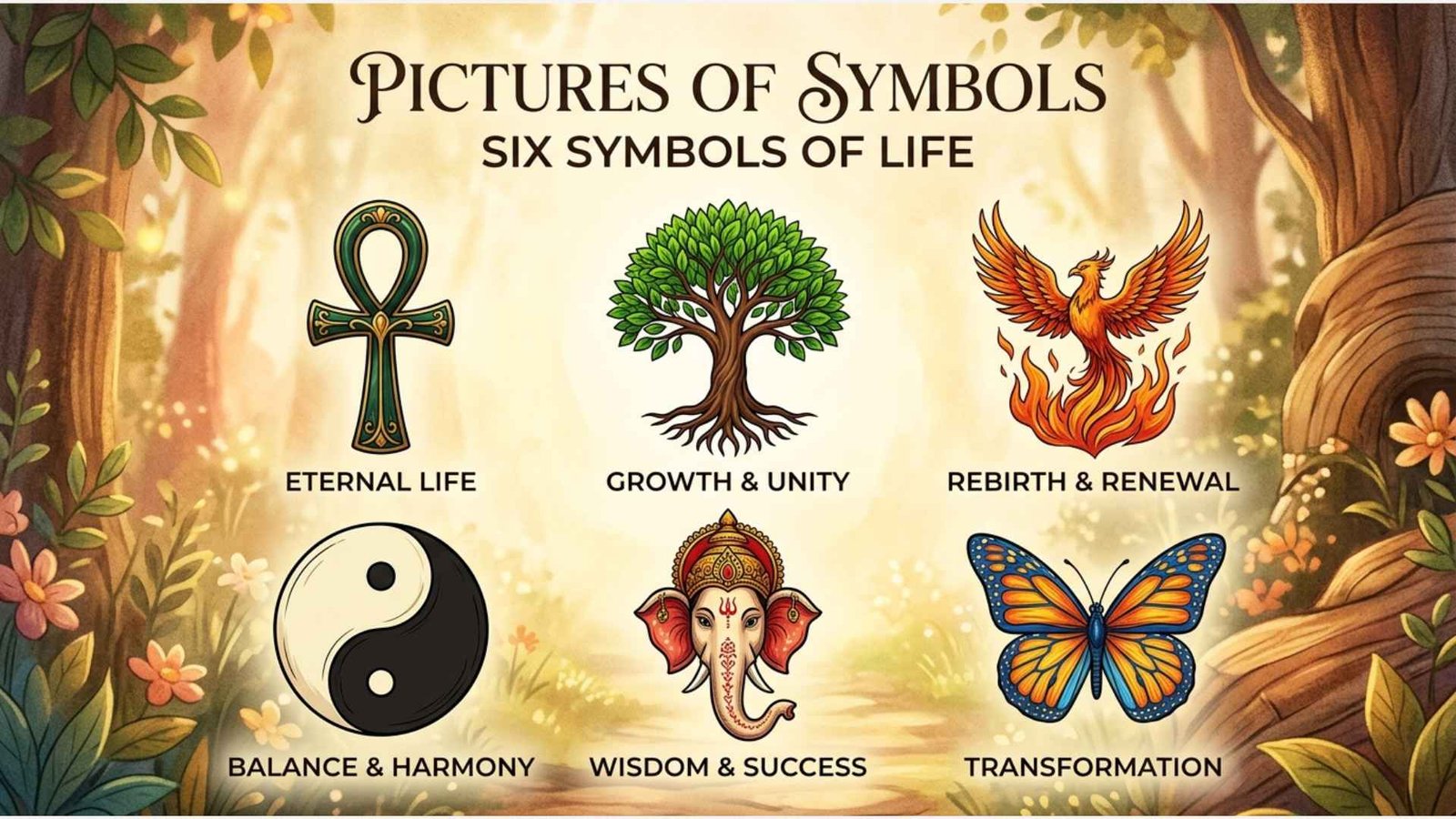
Pictures of symbols appear everywhere, from road signs and phone screens to religious buildings, maps, jewelry, mathematics, and national flags. A single image can communicate a warning, belief, direction, identity, or emotion faster than a full sentence.
Some symbols have clear, standardized meanings. Others change depending on culture, history, religion, or context. A heart may represent love, a dove may suggest peace, and a skull may warn of danger, yet each image can carry additional meanings in art, spirituality, science, or popular culture.
This guide explains how to understand pictures of symbols, where common symbols came from, how their meanings evolved, and why the same design may be interpreted differently around the world.
Quick Meaning
Pictures of symbols are visual signs that represent ideas, instructions, beliefs, objects, emotions, or identities. Their meanings may be universal, culturally specific, religious, technical, or personal. To understand a symbol correctly, examine its shape, color, location, historical background, and the setting in which it appears.
Symbol Overview Table
| Symbol | Primary Meaning | Category | Historical or Cultural Origin | Common Modern Use | Related Symbols |
| Heart | Love, affection, compassion | Emotional | Medieval European art and earlier heart-like forms | Messages, jewelry, health, social media | Rose, Cupid, infinity |
| Cross | Christianity, sacrifice, faith | Religious | Ancient execution symbol adopted by Christians | Churches, jewelry, memorials | Crucifix, ichthys, dove |
| Crescent and star | Islam, night, guidance | Religious and cultural | Ancient Near Eastern and later Ottoman use | Flags, mosques, Islamic identity | Moon, star, calligraphy |
| Star of David | Judaism and Jewish identity | Religious and cultural | Medieval Jewish communities; wider use later | Synagogues, flags, jewelry | Menorah, chai |
| Om | Sacred sound and ultimate reality | Spiritual | Ancient Indian religious traditions | Hindu worship, meditation, yoga | Lotus, chakra, mandala |
| Yin-yang | Balance of complementary forces | Philosophical | Ancient Chinese philosophy | Taoism, wellness, design | Taijitu, trigrams |
| Peace sign | Peace and nuclear disarmament | Political and social | Britain, 1958 | Activism, fashion, popular culture | Dove, olive branch |
| Skull and crossbones | Poison, death, danger | Warning | European maritime and funerary imagery | Hazard labels, piracy imagery | Biohazard, warning triangle |
| Infinity sign | Endlessness, eternity | Mathematical and symbolic | Introduced mathematically in the 17th century | Mathematics, jewelry, relationships | Ouroboros, circle |
| Recycling symbol | Reuse and material recovery | Environmental | United States, 1970 | Packaging and waste systems | Green dot, compost symbol |
| Lightning bolt | Electricity, energy, speed | Natural and technical | Ancient storm symbolism | Electrical warnings, logos, comics | Thunderbolt, spark |
| Eye | Awareness, protection, observation | Spiritual and cultural | Ancient Egypt and other early cultures | Amulets, surveillance, art | Eye of Horus, evil eye |
| Anchor | Stability, hope, maritime life | Maritime and religious | Ancient seafaring cultures | Tattoos, naval insignia, jewelry | Ship, rope, compass |
| Lotus | Purity, rebirth, spiritual awakening | Religious and natural | Ancient Egypt, India, and Asia | Buddhism, Hinduism, art | Mandala, water lily |
| Arrow | Direction, movement, purpose | Practical and symbolic | Ancient weapon and pictorial sign | Maps, signs, digital interfaces | Compass, chevron |
What Do Pictures of Symbols Mean?
Pictures of symbols communicate meaning through visual association. Instead of spelling out an idea, they use a recognizable shape, object, color, or pattern to represent it.
A picture becomes symbolic when people agree that it stands for something beyond its literal appearance. A drawing of a flame may refer to actual fire, but it can also represent passion, danger, purification, anger, spiritual power, or popularity. Context determines which meaning applies.
Most symbols fall into several broad groups:
- Representational symbols resemble what they identify, such as a bicycle sign marking a bike lane.
- Abstract symbols use shapes with learned meanings, such as a red octagon meaning stop.
- Religious symbols express beliefs, sacred stories, divine figures, or spiritual principles.
- Cultural symbols represent nations, communities, traditions, or social identities.
- Technical symbols provide standardized instructions in science, engineering, medicine, and technology.
- Personal symbols hold meaning for an individual, family, or small group.
The clearest way to interpret a symbol is to ask what it represents, who uses it, where it appears, and whether its meaning is official, traditional, or personal.
History and Origin of Visual Symbols
Visual symbols are older than written language. Early humans used marks, carvings, handprints, animal figures, and geometric patterns to record experiences and communicate ideas.
Prehistoric cave art found in Africa, Europe, Asia, and Australia includes animals, hand stencils, dots, lines, and repeated geometric forms. Scholars can identify the images, but the exact meanings of many ancient marks remain uncertain. They may have related to hunting, ritual, storytelling, group identity, memory, or spiritual belief.
As settlements and governments developed, pictures became more organized. Ancient Mesopotamian scribes used pictographs that gradually developed into cuneiform writing. Egyptian hieroglyphs combined pictures, sounds, and ideas. Chinese characters also developed from early pictorial and symbolic forms, although modern characters are part of a complex writing system rather than simple pictures.
Civilizations used symbols to mark authority, trade, religion, military power, and social status. Crowns represented rulership. Seals authenticated documents. Animals stood for gods, dynasties, cities, or human qualities. Colors and clothing identified rank.
During the medieval period, heraldry created formal systems of shields, colors, animals, and objects. These designs helped identify families, rulers, military groups, and territories. Religious art also became a major source of symbolic imagery. Saints, halos, crosses, flowers, and animals allowed viewers to recognize sacred stories even when they could not read.
The industrial age produced new technical and safety symbols. Railroads, factories, electrical systems, medicine, and transportation needed signs that people could recognize quickly. In the modern world, international organizations have attempted to standardize many public symbols for airports, roadways, workplaces, digital devices, and emergency systems.
Today, symbols continue to evolve through logos, emojis, interface icons, memes, tattoos, and social movements. A modern symbol can spread globally in hours, yet its interpretation may still depend on language, age, and culture.
Symbolism and Interpretation
Traditional Meanings
Traditional symbolism develops through repeated cultural use. A lion commonly represents courage, royalty, or strength because many societies admired its power. A crown represents authority because rulers wore crowns. An olive branch represents peace because of its historical role in Mediterranean culture, literature, and diplomacy.
These meanings are not automatic. People learn them through stories, religion, education, art, and social customs.
Modern Meanings
Modern symbols often gain new meanings through technology and popular culture. The cloud once mainly represented weather, dreams, or the heavens. Today, it can also represent online data storage.
A hashtag began as a number or pound sign in certain contexts. On social media, it became a tool for grouping topics and organizing public conversations. The heart symbol now communicates affection through a single click on digital platforms.
Positive Symbolism
Many pictures of symbols express hope, protection, growth, and connection. Common positive examples include:
- A sunrise for new beginnings
- A tree for growth and family
- A butterfly for transformation
- A rainbow for hope and diversity
- An open hand for welcome or peace
- A key for opportunity or knowledge
- A bridge for connection and transition
Positive meaning often comes from the natural behavior or practical purpose of the object. A bridge connects separated places, so it naturally represents unity.
Negative Symbolism
Symbols may also communicate danger, loss, conflict, or harmful beliefs. A broken chain can represent liberation, but it may also suggest a damaged relationship. A black flag can represent mourning, protest, piracy, or political movements depending on the setting.
Some symbols have been appropriated by extremist organizations or oppressive governments. In such cases, a design with an older religious or cultural history may acquire a highly negative modern association. Context and historical awareness are essential.
Psychological Interpretation
Psychologists and artists often examine how basic shapes influence perception.
Circles may feel complete, unified, or protective because they have no visible beginning or end. Squares can suggest order and stability because of their equal sides and firm structure. Triangles may communicate movement, hierarchy, danger, or direction depending on their position.
Color also affects interpretation. Red can suggest danger, love, urgency, blood, or power. Blue often communicates calm, trust, water, or sadness. These associations are common but not universal. Cultural traditions and individual experiences can change how a person reacts.
Cultural Significance of Common Symbols
Symbols rarely mean exactly the same thing everywhere. Cultural background can change whether a picture is viewed as sacred, ordinary, lucky, offensive, or dangerous.
Animals
The owl is associated with wisdom in many Western settings, partly because of its connection with Athena in Greek mythology. In other cultures, owls may be linked with death, mystery, or supernatural forces.
Dragons often appear as dangerous creatures in European legends. In Chinese culture, dragons traditionally represent power, good fortune, authority, and control over water or weather.
The snake can represent danger because some snakes are venomous. It can also represent healing, rebirth, wisdom, fertility, or temptation. The shedding of its skin supports its association with renewal.
Colors
White often represents purity and weddings in Western societies. In parts of East and South Asia, white is strongly associated with mourning and funerals.
Red may represent love or danger in the United States. In China, it commonly symbolizes luck, celebration, happiness, and prosperity.
Black can suggest elegance and authority, but it can also express death, rebellion, secrecy, or grief.
Hand Gestures
A hand sign that seems friendly in one country may be insulting in another. The thumbs-up gesture is widely understood as approval, but interpretations vary by region and situation.
The raised open hand may mean stop, greeting, honesty, blessing, resistance, or solidarity. Because gestures depend heavily on cultural context, travelers should avoid assuming that every hand symbol is universal.
Plants and Flowers
The rose often represents love, but its color changes the message. Red roses suggest romantic love, white roses can suggest purity or remembrance, and yellow roses may represent friendship.
The chrysanthemum is associated with joy and longevity in some Asian traditions. In several European countries, it is strongly connected with funerals and graves.
Religious and Spiritual Meaning
Religious symbols make beliefs visible. They may identify a faith, represent a sacred event, express a theological idea, or support prayer and ritual.
The Cross
The cross is the central symbol of Christianity. It represents the crucifixion of Jesus Christ, sacrifice, redemption, suffering, and hope of resurrection. Different Christian traditions use different forms, including the Latin cross, Greek cross, Orthodox cross, and crucifix.
The Crescent and Star
The crescent and star are widely associated with Islam today, especially through flags, mosques, and historical Ottoman influence. However, they are not universal theological symbols required by Islamic scripture. Their connection with Muslim identity developed historically and varies across regions.
The Star of David
The Star of David, or Magen David, is a six-pointed figure formed by two overlapping triangles. It became a widely recognized symbol of Judaism and Jewish identity, especially during the modern period. It appears on synagogues, ceremonial objects, jewelry, and the flag of Israel.
Om
Om, also written Aum, is a sacred sound and written symbol in Hinduism. It is also important in Buddhism, Jainism, and several Indian philosophical traditions. It can represent ultimate reality, consciousness, the universe, or the unity of existence.
The Lotus
The lotus grows in muddy water while producing a clean, striking flower. This natural process supports its symbolism of purity, awakening, spiritual growth, and liberation. It is important in Hindu, Buddhist, Jain, and ancient Egyptian traditions.
The Mandala
A mandala is a geometric arrangement representing spiritual order, sacred space, or the universe. Mandalas appear in Hindu and Buddhist practice, especially in meditation, ritual, and sacred art. The term is sometimes used loosely in modern coloring books, but traditional mandalas have specific religious purposes.
The Evil Eye
The evil eye belief appears across the Mediterranean, Middle East, South Asia, and other regions. It holds that envy or a harmful gaze can cause misfortune. Eye-shaped amulets are worn or displayed for protection, although designs and beliefs vary widely.
Scientific and Technical Meanings
Pictures of symbols play a practical role in mathematics, science, medicine, engineering, and technology. Unlike flexible artistic symbolism, technical symbols usually require precise definitions.
Mathematical Symbols
Mathematics uses signs such as:
- + for addition
- − for subtraction
- × or · for multiplication
- ÷ or a fraction bar for division
- = for equality
- < and > for comparison
- ∞ for infinity
- π for the ratio of a circle’s circumference to its diameter
- √ for a square root
These symbols allow complex relationships to be expressed clearly across many languages.
Scientific Symbols
Science uses letters and icons to represent elements, measurements, forces, processes, and hazards. Chemical element symbols include H for hydrogen, O for oxygen, and Fe for iron.
Laboratories and workplaces also use hazard pictograms for toxic substances, flammable materials, corrosive chemicals, compressed gases, and environmental dangers.
Medical Symbols
The Rod of Asclepius, a staff with one snake, is traditionally associated with medicine and healing. It comes from the Greek healing figure Asclepius.
It is often confused with the caduceus, which has two snakes and wings. The caduceus is historically associated with Hermes and commerce, although some medical organizations have used it.
Electrical Symbols
Electrical diagrams use standardized signs for batteries, switches, resistors, capacitors, lamps, motors, and grounding. A lightning bolt commonly warns of electrical danger or high voltage.
Digital Symbols
Modern interfaces rely on icons such as:
- A magnifying glass for search
- A gear for settings
- A trash can for delete
- A house for the home page
- Three horizontal lines for a menu
- A bell for notifications
- A paper clip for attachments
- A padlock for security
These icons save space, but they still depend on learned conventions. A symbol that feels obvious to an experienced user may confuse someone unfamiliar with digital systems.
Where Pictures of Symbols Are Used
Road Signs
Road signs use color, shape, and imagery to communicate quickly. Red often signals prohibition or stopping. Yellow frequently warns of hazards. Triangles, circles, diamonds, and octagons help drivers identify the type of message before reading the details.
Maps
Maps use symbols for roads, railways, hospitals, airports, parks, borders, elevation, rivers, and landmarks. A map legend explains what each mark means.
Books and Literature
Authors use symbolic objects to add deeper meaning. A storm may reflect conflict. A journey may represent personal growth. A locked door may suggest secrecy or restriction.
Not every repeated object is automatically symbolic. Interpretation should be supported by the text, historical context, or the author’s established themes.
Architecture
Buildings use symbols in carvings, floor plans, stained glass, domes, arches, columns, and decorative patterns. Religious architecture often directs attention toward sacred stories or cosmic order.
Jewelry and Tattoos
People wear symbols to express belief, memory, protection, relationships, heritage, or personal goals. Popular designs include crosses, anchors, hearts, infinity signs, zodiac symbols, flowers, feathers, and names.
Before using a cultural or religious image, it is wise to understand its history and whether members of that tradition consider it sacred.
Logos and Branding
Companies use symbols to create recognition and emotional associations. Arrows may suggest progress. Shields may imply safety. Leaves may suggest nature or sustainability. Logos can become so familiar that people recognize a company without seeing its name.
Flags and National Emblems
Flags use stars, stripes, animals, plants, weapons, colors, and geometric patterns to represent history, geography, political ideals, or national identity.
Art
Artists may preserve traditional meanings, challenge them, or create new ones. The same symbol can express different ideas depending on composition, period, and audience.
Common Variations of Symbols
Symbols often change in shape while keeping a related meaning.
A heart may appear as a simple outline, a broken heart, a heart with an arrow, or an anatomical heart. Each variation changes the message.
Arrows may point left, right, up, down, or in a circle. A straight arrow gives direction, while circular arrows may represent repetition, refresh, or recycling.
Stars can have five, six, seven, eight, or more points. Their meaning depends on the number of points, orientation, cultural tradition, and surrounding design.
Crosses also have many forms, including the Latin cross, Greek cross, Celtic cross, Maltese cross, tau cross, and Orthodox cross. Similar appearance does not always indicate identical meaning.
Digital adaptation creates another layer of variation. A hand-drawn symbol, an emoji, and a standardized interface icon may refer to the same general idea but communicate different levels of emotion or formality.
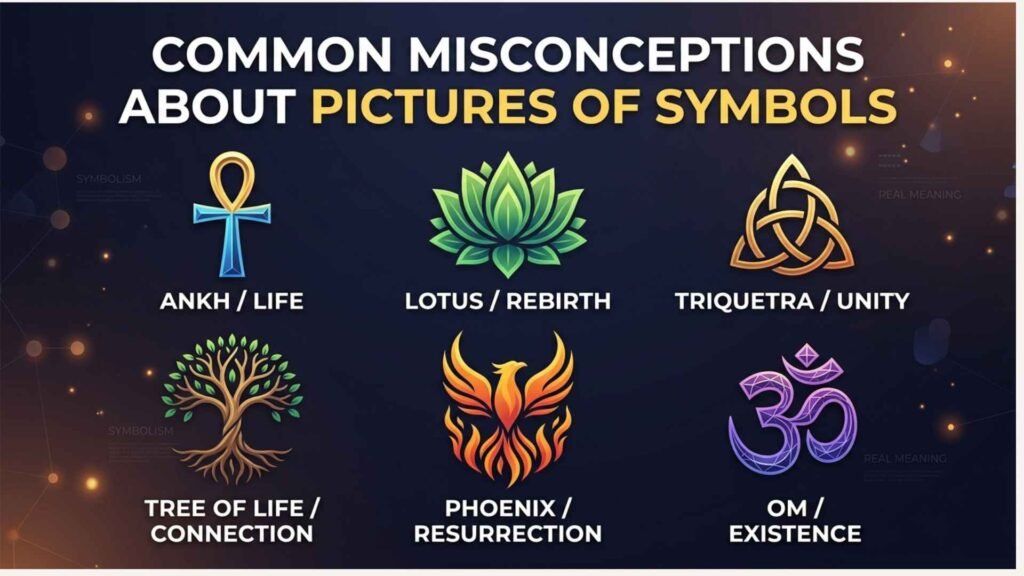
Common Misconceptions About Pictures of Symbols
Every Symbol Has One Fixed Meaning
Most symbols have several meanings. A snake may represent danger, medicine, renewal, wisdom, or evil. The correct interpretation depends on context.
Ancient Meanings Are Always Known
Many ancient pictures survive without written explanations. Scholars may offer informed interpretations, but certainty is not always possible.
Similar Shapes Have the Same Origin
Two cultures may develop similar designs independently. A spiral, cross, circle, or star can appear in many places because these forms are easy to create and reflect common natural patterns.
Symbols Are Universal
Some safety and transportation signs are internationally standardized, but many cultural, religious, and emotional symbols are not universal.
A Modern Meaning Erases the Older Meaning
A symbol may carry several historical layers at once. However, modern political or hateful use can become so powerful that it changes how the public responds to the image. Both older and newer contexts should be acknowledged.
Emojis Have Identical Meanings Everywhere
Emoji design varies by platform, and users interpret them differently by age, culture, and relationship. A gesture intended as friendly may appear sarcastic, formal, or offensive to someone else.
Interesting Facts About Symbols
- The peace sign was designed for nuclear disarmament.
It combines semaphore positions for the letters N and D, referring to nuclear disarmament. - The infinity symbol has a mathematical name.
Its sideways figure-eight form is sometimes called a lemniscate. - The recycling symbol came from a student design contest.
Gary Anderson created the three-arrow design in 1970, and it became one of the world’s most familiar environmental marks. - The heart symbol does not closely match an anatomical heart.
Its familiar shape developed through artistic convention rather than medical accuracy. - A skull and crossbones did not belong to every pirate.
Pirate flags varied. Some included skeletons, weapons, hourglasses, or solid colors. - The medical staff with one snake differs from the caduceus.
The Rod of Asclepius has one snake and is linked with healing. The caduceus has two snakes and is historically linked with Hermes. - Red does not mean danger in every setting.
It can also represent celebration, luck, marriage, power, or prosperity. - The ampersand began as a combined letterform.
The symbol “&” developed from a stylized combination of the Latin letters in “et,” meaning “and.” - The @ symbol existed before email.
Merchants used it in accounting and trade before it became central to email addresses and social media usernames. - Some symbols function without language.
Airport icons, restroom signs, and emergency pictograms help people navigate even when they cannot read the local language. - The same animal can carry opposite meanings.
A raven may symbolize wisdom and prophecy in one tradition but death or bad luck in another. - Context can transform an ordinary object into a symbol.
A key is simply a tool, but in art, dreams, and storytelling it may represent access, freedom, authority, or hidden knowledge.
Related Symbols and How They Differ
| Related Symbols | Shared Meaning | Main Difference |
| Dove and olive branch | Peace | The dove is an animal image; the olive branch comes from plant and diplomatic symbolism |
| Heart and rose | Love | The heart is a general emotional sign; the rose often carries romantic and color-specific meanings |
| Circle and infinity sign | Continuity | A circle suggests wholeness; infinity explicitly suggests endlessness |
| Skull and warning triangle | Danger | The skull often indicates poison or death; the triangle gives a broader warning |
| Eye of Horus and evil eye amulet | Protection | The Eye of Horus comes from ancient Egyptian religion; evil eye amulets belong to wider regional protective traditions |
| Cross and crucifix | Christianity | A crucifix includes the figure of Jesus; a cross may appear without a figure |
| Lotus and water lily | Purity and awakening | “Lotus” may refer to specific sacred traditions, while water-lily imagery may be botanical or cultural |
| Arrow and compass | Direction | An arrow points toward a path; a compass represents orientation and navigation |
| Tree of life and family tree | Connection and growth | The tree of life is spiritual or philosophical; a family tree records ancestry |
| Sun and halo | Light and sacred power | The sun is a natural body; a halo marks holiness or spiritual radiance |
Frequently Asked Questions
What are pictures of symbols?
Pictures of symbols are visual designs that represent ideas, objects, beliefs, directions, emotions, or identities. They include road signs, religious icons, mathematical signs, logos, emojis, map markers, and artistic images. Their meanings may be officially standardized or shaped by cultural tradition and personal interpretation.
How can I identify an unknown symbol?
Begin by noting its shape, color, number of points, surrounding objects, and where you found it. Determine whether it appears on jewelry, a device, a vehicle, a map, a religious object, or a safety label. Reverse-image search, official manuals, museum sources, and cultural reference works can help confirm its meaning.
Why do symbols have different meanings?
Symbols gain meaning through history, religion, language, politics, art, and shared social experience. Different communities may connect the same image with different stories. Meanings also change over time as symbols enter new settings, such as advertising, activism, technology, fashion, or entertainment.
Are all symbols universal?
No. Some technical and public-safety symbols are designed for international recognition, but many are culturally specific. Colors, animals, flowers, gestures, and religious images can have very different meanings across regions. Always consider location, audience, and historical context before interpreting a symbol.
What is the difference between a sign and a symbol?
A sign usually gives direct information, such as “stop,” “exit,” or “no smoking.” A symbol often represents a broader idea, such as freedom, faith, love, or justice. The categories overlap because many public signs use symbolic pictures to communicate instructions.
Can a symbol have both positive and negative meanings?
Yes. Fire can symbolize warmth, passion, purification, destruction, or danger. A snake may represent healing and renewal or fear and deception. Symbols often contain contrasting meanings because people interpret them through different beliefs, events, and personal experiences.
What are the most common symbols in everyday life?
Common examples include hearts, arrows, stars, crosses, warning triangles, recycling signs, Wi-Fi icons, power buttons, locks, search icons, check marks, currency signs, road symbols, and emojis. People encounter these images on phones, packaging, vehicles, buildings, clothing, and public signs.
How are symbols used in literature?
Writers use symbols to suggest ideas beyond the literal story. Seasons may represent stages of life, light may represent knowledge, and a journey may represent personal change. Strong literary interpretation depends on repeated patterns, context, character development, and the work’s wider themes.
Is it safe to use any symbol as a tattoo?
Not always. Some designs are sacred, culturally restricted, politically charged, or associated with extremist groups. Research the symbol’s origin, modern use, and regional interpretation before making it permanent. A qualified artist may also help identify design variations that change the meaning.
How do emojis differ from traditional symbols?
Emojis are digital pictographs designed for electronic communication. Traditional symbols may come from religion, history, writing systems, or formal technical standards. Emojis change appearance across platforms and often depend on tone, relationship, and online culture, making their meanings more flexible.
Key Takeaways
- Pictures of symbols communicate ideas through recognizable visual forms.
- Meaning depends on culture, history, color, location, and context.
- Some symbols are standardized, while others allow several interpretations.
- Religious symbols should be understood within their specific traditions.
- Technical symbols require precise meanings for safety and accuracy.
- Similar designs do not always share the same origin.
- Colors and gestures can mean different things in different regions.
- Symbols evolve as societies, technologies, and political movements change.
- Ancient symbol meanings are not always known with certainty.
- Research is important before using sacred or culturally sensitive symbols.
Conclusion
Pictures of symbols form a visual language that connects history, belief, science, art, technology, and everyday life. They help people communicate quickly, preserve cultural memory, express identity, and give visible form to ideas that may be difficult to explain in words.
Yet no symbol should be interpreted by shape alone. Its color, location, cultural background, historical period, and modern associations all influence its meaning. A heart on a message, a star on a flag, and an eye on an amulet each belong to a different system of communication.
By learning how pictures of symbols develop and how their meanings change, you can understand signs more accurately, avoid common misconceptions, and recognize the deeper stories hidden inside familiar images.

I am Daniel Brooks, a language researcher and writer with a strong interest in how people use English in everyday conversations. I contribute to LearnNestly because I enjoy turning confusing language topics into straightforward lessons. My goal is to help readers understand not only what a word or phrase means, but also when and how to use it naturally. I focus on clear examples, practical explanations, and useful language knowledge that readers can remember.
Books:
- The Practical English Guide
- Understanding Everyday Words
 Amelia Carter