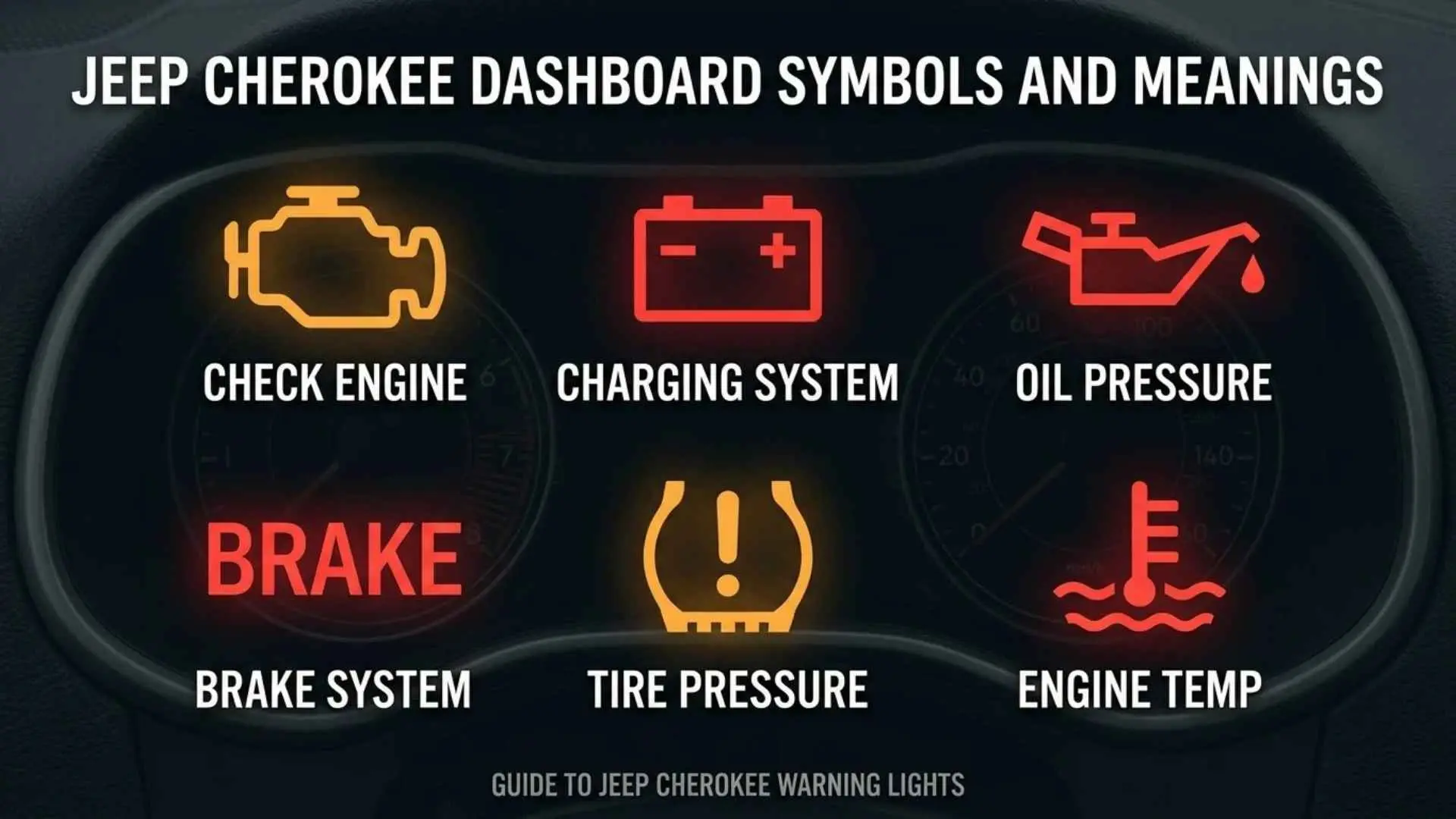
Jeep Cherokee dashboard symbols communicate the condition of your engine, brakes, tires, safety systems, four-wheel drive, and driver-assistance features. A red light usually signals an urgent problem, while yellow or amber often means a system needs attention. Green, blue, and white indicators generally confirm that a feature is operating.
Understanding these lights matters because the same symbol can represent anything from an engaged parking brake to dangerously low oil pressure. You may see them during startup, while driving, after changing road conditions, or when a sensor detects a malfunction.
This guide explains the most common Jeep Cherokee dashboard symbols and meanings, what actions to take, and when you should stop driving. Exact symbols vary by model year, trim, engine, drivetrain, and installed equipment, so always compare any warning with your Cherokee owner’s manual.
Quick Meaning
Jeep Cherokee dashboard symbols use colors and recognizable icons to report vehicle conditions. Red warnings often require immediate action, amber lights indicate faults or disabled systems, and green or blue lights show active features. A light that remains on, flashes, or appears with a message should be checked promptly.
Jeep Cherokee Dashboard Symbol Overview
| Dashboard light category | Typical color | Primary meaning | Recommended response |
| Critical warning | Red | Serious safety or mechanical problem | Stop safely and investigate immediately |
| Caution warning | Yellow or amber | Fault, reduced function, or maintenance issue | Drive cautiously and arrange diagnosis |
| Active feature | Green | A system is operating normally | No corrective action normally needed |
| Lighting indicator | Blue | High-beam headlights are active | Dim lights when approaching traffic |
| General information | White or gray | Vehicle status or selected setting | Review the displayed message |
| Flashing warning | Varies | Active intervention or urgent malfunction | Reduce speed and follow the message |
| Startup bulb check | Multiple colors | System self-test after ignition | Normal if lights turn off shortly afterward |
Dashboard lights are technically called warning lights, indicator lights, or telltales. Many appear with a chime or a written message in the instrument-cluster display. Some symbols are optional and will only appear on Cherokees equipped with the related system.
What Do Jeep Cherokee Dashboard Symbols Mean?
Jeep Cherokee dashboard symbols translate electronic sensor data into quick visual instructions. They tell you whether a system is active, temporarily unavailable, malfunctioning, or operating outside a safe range.
The icon identifies the system, while its color and behavior communicate urgency. For example, a solid amber engine symbol normally permits cautious driving while you arrange service. A flashing engine symbol can indicate a severe misfire that may damage the catalytic converter.
Never interpret a dashboard icon by shape alone. Consider:
- The symbol’s color
- Whether it is solid or flashing
- Any accompanying message
- Chimes or unusual vehicle behavior
- Fluid levels and gauge readings
- Recent repairs, battery work, or weather conditions
A symbol that briefly illuminates when the ignition is switched on is often part of the normal system check. It becomes important when it stays on after the engine starts, appears while driving, or repeatedly returns.
Why Dashboard Warning Symbols Exist
Modern Jeep Cherokees contain electronic control modules, sensors, switches, and communication networks that monitor the vehicle continuously. These systems track engine operation, brake pressure, wheel speed, tire pressure, steering assistance, emissions, airbags, transmission performance, temperature, battery charging, and four-wheel-drive operation.
Dashboard icons give the driver an immediate warning without requiring technical knowledge. Their shapes follow widely recognized automotive conventions, such as an oil can for lubrication pressure, a battery for charging performance, and an exclamation mark inside a tire outline for low tire pressure.
Over time, Cherokee instrument panels have evolved from basic mechanical gauges and a small group of warning lamps to digital displays capable of presenting detailed messages. Newer models may report the exact affected tire, display oil life, identify a blocked driver-assistance sensor, or show the current Selec-Terrain mode.
Although the design has changed, the purpose remains the same: help the driver identify risk before a minor condition becomes a breakdown or safety hazard.
Dashboard Light Colors and Their Urgency
Red Dashboard Symbols
A red symbol usually represents a serious condition, a major safety reminder, or a system requiring immediate attention.
Do not continue driving normally when a red oil-pressure, brake-system, battery-charge, or overheating warning remains illuminated. Move to a safe location, stop the engine when appropriate, and inspect the cause.
Some red lights, such as the seat-belt symbol or open-door warning, identify a condition that can be corrected immediately without mechanical service.
Yellow or Amber Dashboard Symbols
Yellow and amber lights indicate caution. The vehicle may remain drivable, but a system could be malfunctioning, unavailable, switched off, or operating with reduced capability.
Examples include the check-engine light, anti-lock brake warning, tire-pressure warning, electronic stability control warning, and service four-wheel-drive message.
An amber warning should not be ignored simply because the vehicle appears to drive normally. Some faults do not produce noticeable symptoms until they become more serious.
Green Dashboard Symbols
Green symbols normally confirm that a feature is engaged. Common examples include turn signals, front fog lights, cruise control, and certain driver-assistance indicators.
These lights are informational rather than warnings.
Blue Dashboard Symbols
The blue headlight symbol indicates that the high beams are on. It is not a malfunction, but drivers should switch to low beams when approaching or following another vehicle.
White or Gray Dashboard Symbols
White and gray indicators typically display selected settings, informational states, or systems that are ready but not actively controlling the vehicle.
Red Jeep Cherokee Dashboard Symbols and Meanings
Brake Warning Light
Appearance: The word “BRAKE,” an exclamation mark inside a circle, or a similar brake icon.
The red brake warning light may indicate that the parking brake is engaged, brake fluid is low, or the hydraulic braking system has detected a problem.
First, verify that the parking brake is completely released. If the light remains on, stop in a safe place and check the brake-fluid level if you can do so safely. A soft pedal, longer stopping distance, fluid leak, or persistent warning requires immediate professional inspection.
Do not confuse this with the amber ABS light. The red brake warning can indicate a more serious problem with basic braking capability.
Engine Oil Pressure Warning Light
Appearance: A red oil can, sometimes with a drop at the spout.
This symbol means engine oil pressure is dangerously low. It does not simply mean that an oil change is due.
Pull over safely and shut off the engine as soon as possible. Check the oil level after allowing the vehicle to rest on level ground. Even if the oil level appears normal, do not keep driving with the warning illuminated because a pump, sensor, filter, internal leak, or lubrication problem may be responsible.
Running the engine without adequate oil pressure can cause severe internal damage within a short distance.
Engine Coolant Temperature Warning
Appearance: A thermometer above wavy lines.
The coolant-temperature warning means the engine is overheating or the cooling system has reached an unsafe temperature.
Turn off the air conditioner, pull over safely, place the transmission in Park, and shut off the engine if the temperature does not fall. Never remove a hot radiator or coolant-reservoir cap because pressurized coolant can cause serious burns.
Possible causes include low coolant, a leak, cooling-fan failure, thermostat trouble, water-pump failure, or restricted airflow.
Battery Charge Warning Light
Appearance: A rectangular battery with plus and minus signs.
This light indicates a charging-system problem. It does not necessarily mean the battery itself is defective.
The alternator may not be charging, the drive belt could be damaged, a cable may be loose, or an electrical fault may be draining the system. Reduce unnecessary electrical loads and arrange service promptly. The engine may eventually stall once stored battery power is exhausted.
Air Bag Warning Light
Appearance: A seated person with a circular airbag in front.
The airbag warning means the Supplemental Restraint System has detected a malfunction. One or more airbags or seat-belt pretensioners may not operate correctly in a collision.
The vehicle may still drive, but its occupant-protection system requires prompt diagnosis. Do not attempt to inspect airbag wiring or connectors yourself.
Electronic Throttle Control Warning
Appearance: A red lightning bolt between two curved brackets.
The electronic throttle control, or ETC, light signals a fault involving the electronic accelerator, throttle body, sensors, wiring, or engine-control system.
If it remains solid, the Cherokee may enter a reduced-power mode. If it flashes, stop safely and cycle the ignition only if the owner’s manual permits. Avoid hard acceleration and have the vehicle inspected as soon as possible.
Seat Belt Reminder Light
Appearance: A seated person wearing a belt.
This light means the driver or an occupied passenger seat has an unfastened seat belt. It may flash and sound a chime until the belt is secured.
A bag or heavy object on the passenger seat can sometimes activate the occupant sensor. Move the item to the floor or cargo area rather than fastening a belt around loose cargo.
Door, Hood, or Liftgate Open Warning
Appearance: A vehicle diagram showing an open panel.
This warning means a door, the hood, or the rear liftgate is not fully latched. Stop safely and close the indicated panel.
An improperly latched hood or liftgate can create a serious driving hazard. A warning that remains after everything is closed may point to a latch switch or alignment problem.
Power Steering Warning
Appearance: A steering wheel, sometimes with an exclamation mark.
This warning indicates a fault in the electric power-steering system. Steering may become noticeably heavier, especially at low speeds.
Maintain firm control, reduce speed, and stop safely. Restarting the vehicle may clear a temporary fault, but a warning that returns requires service.
Yellow and Amber Jeep Cherokee Dashboard Symbols
Check Engine Light
Appearance: An engine-shaped icon.
The malfunction indicator light means the engine or emissions-control system has stored a fault.
A solid light may result from a loose or damaged fuel cap, sensor problem, ignition fault, fuel-system issue, or emissions malfunction. Tighten the fuel cap when safe and see whether the light clears after several normal trips.
A flashing check-engine light is more urgent. It commonly indicates a severe misfire that can overheat and damage the catalytic converter. Reduce speed, avoid heavy acceleration, and obtain service immediately.
Anti-Lock Brake System Warning
Appearance: “ABS” inside a circle.
The ABS warning means the anti-lock braking system is unavailable or malfunctioning. Normal hydraulic braking may remain available, but the wheels can lock during hard braking.
Drive cautiously, allow extra stopping distance, and arrange an inspection. If the red brake warning appears at the same time, stop driving and seek assistance.
Tire Pressure Monitoring System Warning
Appearance: An exclamation mark inside a tire-shaped outline.
A solid TPMS light means one or more tires may be underinflated. Check pressures when the tires are cold and inflate them to the specification on the driver-door placard, not the maximum pressure molded into the tire sidewall.
A flashing light that later stays on usually means the monitoring system itself has a fault. A damaged sensor, incompatible wheel, weak sensor battery, or communication problem may be responsible.
Cold weather can lower tire pressure enough to trigger the warning even when no tire is punctured.
Electronic Stability Control Active Light
Appearance: A car with curved skid lines.
When this symbol flashes, electronic stability control is actively helping correct wheel slip or loss of directional control. Ease off the accelerator and steer smoothly.
If it stays on, the system may have a fault. Stability assistance may be limited until the problem is corrected.
Electronic Stability Control Off Light
Appearance: A skidding-car icon with “OFF.”
This symbol indicates that all or part of the stability-control system has been manually disabled or is unavailable.
Some off-road conditions may justify reducing traction intervention, but the system should normally remain enabled during public-road driving. Restore it when the special driving condition ends.
Low Fuel Warning
Appearance: A fuel-pump symbol.
The low-fuel light means the fuel level has reached the reserve range. Refuel soon rather than relying on the remaining-distance estimate.
Repeatedly driving with very little fuel may cause the pump to run hotter and increases the chance of becoming stranded if traffic, terrain, or weather changes.
Low Washer Fluid Indicator
Appearance: A windshield with spray above it.
This symbol means the windshield-washer reservoir is low. Refill it with suitable washer fluid.
In freezing climates, use a product rated for the expected temperature. Plain water can freeze and damage the reservoir, lines, or pump.
Service Four-Wheel Drive Warning
Appearance: “SERV 4WD,” a drivetrain icon, or a related message.
This warning means the four-wheel-drive system has detected a fault. The Cherokee may lose certain terrain modes, low-range operation, or rear-axle functions, depending on its equipment.
Avoid demanding off-road conditions and have the system diagnosed. If the warning appears with grinding, vibration, loss of power, or a change in driving behavior, stop and seek assistance.
Four-Wheel Drive Low Indicator
Appearance: “4WD LOW.”
This indicator confirms that low-range four-wheel drive is engaged. It is designed for slow driving in demanding conditions such as deep mud, loose terrain, steep grades, or situations requiring greater low-speed torque.
It is not intended for normal highway driving. Follow the correct shift procedure shown in the owner’s manual.
Forward Collision Warning Off
Appearance: Two vehicles with an impact star, often accompanied by “OFF.”
This indicator means Forward Collision Warning is switched off, temporarily unavailable, or unable to operate.
A dirty windshield, blocked radar area, heavy rain, snow, fog, glare, or system fault can interfere with detection. Clean the relevant sensor areas and remember that the feature does not replace attentive braking.
LaneSense Warning or Unavailable Indicator
Appearance: A vehicle between lane markings.
The LaneSense icon communicates whether lane assistance is ready, actively correcting, unable to detect markings, switched off, or malfunctioning. Its color may change according to system status.
Faded road lines, construction zones, snow, sharp curves, dirty cameras, and poor visibility can limit operation. Keep both hands on the wheel regardless of the indicator.
Service Stop/Start System Warning
Appearance: The letter “A” inside a circular arrow, sometimes with an exclamation mark.
This symbol means the automatic engine stop/start feature is unavailable or requires service.
The system may also remain inactive for normal reasons, including battery condition, engine temperature, cabin climate demand, steering angle, or an open door. A service message indicates a fault rather than an ordinary operating restriction.
Fuel Cap Warning
Appearance: A fuel-cap symbol or “Check Gas Cap” message.
This warning indicates that the fuel cap may be loose, missing, or unable to seal the evaporative-emissions system.
Stop safely, remove the cap, reinstall it until properly tightened, and inspect its seal. The check-engine light may remain on temporarily even after the cap is secured.
Transmission Temperature Warning
Appearance: A thermometer, gear, or transmission-temperature message.
This light means the transmission fluid is overheating. Towing, steep grades, deep sand, slow off-road driving, or a mechanical problem can create excessive heat.
Stop safely, shift to Park, and allow the transmission to cool according to the instructions displayed. Continuing to drive can damage internal transmission components.
Service Shifter Warning
Appearance: A “Service Shifter” message, sometimes with gear-position indicators illuminated.
This warning indicates a problem involving the electronic gear selector, its wiring, the transmission-control system, or related components.
Make sure the vehicle is securely in Park before exiting. Because the fault may affect gear selection or gear-position confirmation, arrange professional diagnosis promptly.
Green, Blue, and White Indicator Symbols
Turn Signal Indicators
Green arrows flash to show that the left or right turn signal is operating. Both arrows flash when the hazard lights are active.
Rapid flashing can indicate an exterior turn-signal bulb or circuit fault.
High-Beam Indicator
A blue headlamp symbol with straight horizontal beams means the high beams are on.
Switch to low beams when approaching other road users to prevent glare.
Front Fog Light Indicator
A green lamp symbol with angled beams and a wavy vertical line means the front fog lights are active.
Fog lights improve low-level illumination in reduced visibility but should be used according to local traffic laws.
Cruise Control Ready Indicator
A white cruise-control symbol means the system is switched on and ready, but no speed has been set.
Cruise Control Set Indicator
A green cruise icon means a cruising speed has been selected. The vehicle will attempt to maintain that speed until the driver brakes, cancels the system, or changes the setting.
Adaptive Cruise Control Indicator
An adaptive cruise icon may display a speedometer, vehicle, or distance bars. White often means the system is ready, while green usually means it is actively controlling speed.
A target-vehicle symbol indicates that the system has detected traffic ahead. The driver remains responsible for steering, braking, and monitoring road conditions.
Parking and Exterior Light Indicators
Green lighting symbols may show that the parking lights, low beams, or exterior lamps are switched on.
These are normal status indicators, not fault warnings.
Hill Descent Control Indicator
A vehicle descending a slope indicates Hill Descent Control status. When active, the system manages braking to maintain a controlled low speed on steep terrain.
The driver must still steer and remain prepared to intervene.
Selec-Terrain Mode Indicators
Cherokee models with Selec-Terrain may display Auto, Snow, Sport, Sand/Mud, or Rock modes.
These indicators confirm the selected calibration for throttle response, traction management, transmission behavior, and four-wheel-drive operation. They do not guarantee traction, so speed must still match the surface.
Technical Meaning of Dashboard Symbols
Dashboard symbols form part of the Jeep Cherokee’s onboard diagnostic and driver-information network. Sensors measure physical conditions such as wheel speed, fluid pressure, temperature, steering angle, acceleration, tire pressure, and battery voltage.
Electronic control modules compare those readings with programmed limits. When a reading falls outside the expected range, a control module may:
- Illuminate a warning light.
- Store a diagnostic trouble code.
- Display a written message.
- Sound a chime.
- disable the affected feature.
- Place the vehicle in a reduced-performance mode.
A warning light does not always identify the failed part. For example, an ABS light can result from a wheel-speed sensor, damaged wiring, a tone ring, low voltage, or an ABS control-module issue. Diagnostic scanning and physical testing are often needed before replacing components.
The Cherokee instrument-cluster display can also provide information such as tire pressures, oil life, fuel economy, coolant temperature, stored warning messages, trip data, and driver-assistance status.
Where Jeep Cherokee Dashboard Symbols Are Used
Dashboard symbols appear in several locations and systems:
- The instrument cluster behind the steering wheel
- The digital driver-information display
- The tachometer and speedometer area
- The Uconnect touchscreen
- Overhead-console indicators
- Climate-control panels
- Four-wheel-drive and Selec-Terrain controls
- Buttons for stability control and parking assistance
- Warning messages and maintenance reminders
- The Jeep Owner’s Manual and digital owner resources
Some symbols appear only briefly as status confirmations. Others remain visible until the condition is corrected.
Common Variations Between Cherokee Models
Jeep Cherokee dashboard symbols vary because the model has been produced across different generations, markets, trims, and equipment packages.
A basic front-wheel-drive Cherokee will not display the same four-wheel-drive indicators as a Trailhawk. A vehicle without adaptive cruise control cannot show ACC target indicators. Diesel-powered versions sold in some markets may have a glow-plug or “wait to start” symbol that gasoline models lack.
The same function may also appear in several forms:
- A standalone icon
- An icon plus a written message
- An abbreviation such as ABS or 4WD LOW
- A color-changing graphic
- A vehicle diagram highlighting the affected area
- A temporary pop-up stored in the messages menu
Because of these variations, use the manual for the exact model year and market. Jeep and Mopar provide owner-manual resources tailored to selected vehicles.
Common Misconceptions About Jeep Dashboard Lights
Every Red Light Means the Engine Is Failing
Red indicates urgency, but not every red symbol represents engine damage. A seat-belt reminder, open-door warning, or engaged parking brake can also appear red.
The correct response depends on the icon and accompanying message.
The Oil Light Means an Oil Change Is Due
The red oil-can light usually warns about oil pressure, which can be an immediate engine-safety issue. The maintenance reminder normally appears as “Oil Change Required” or an oil-life percentage.
These warnings should never be treated as interchangeable.
A Check Engine Light Always Means an Expensive Repair
A check-engine light can result from something as simple as a loose fuel cap, but it can also signal a damaging misfire or emissions failure.
The light’s behavior and diagnostic code determine its seriousness.
The Battery Symbol Means Replace the Battery
The battery icon usually represents charging-system performance. The battery, alternator, belt, wiring, or control system could be responsible.
Testing is more reliable than replacing the battery based only on the symbol.
The ABS Light Means There Are No Brakes
An illuminated ABS light usually means anti-lock control is unavailable, while conventional braking may remain. However, stopping performance under emergency braking can change.
A simultaneous red brake warning is more serious.
A Dashboard Light Can Be Cleared by Disconnecting the Battery
Disconnecting the battery may temporarily erase certain warnings, but it does not repair the cause. It can also reset settings, erase useful diagnostic data, and trigger additional calibration issues.
A proper diagnosis identifies why the light appeared.
Driver-Assistance Symbols Mean the Vehicle Can Drive Itself
Adaptive cruise control, Forward Collision Warning, and LaneSense support the driver. They do not replace attentive steering, braking, or observation.
Weather, dirty sensors, poor lane markings, and complex traffic can limit these systems.
Interesting Facts About Jeep Cherokee Dashboard Symbols
- Most warning lights illuminate briefly during startup. This bulb check helps confirm that the instrument cluster and monitored systems can activate their indicators.
- A flashing warning is usually more urgent than a solid one. A flashing check-engine light, for example, can indicate a severe active misfire.
- Cold weather commonly triggers the TPMS light. Tire pressure falls as air temperature drops, even when the tire has no puncture.
- Several warnings can share one cause. Low system voltage can disrupt communication between control modules and produce multiple seemingly unrelated dashboard messages.
- The symbol may be less specific than the stored fault code. A diagnostic scanner can identify the system or circuit that requested the warning.
- Oil life is calculated rather than directly measured. The system estimates remaining service life from operating conditions and driving patterns. The message must be reset after the oil is changed.
- Some lights represent system intervention rather than failure. A flashing stability-control icon means the system is actively responding to wheel slip.
- Sensor obstruction can disable safety features. Snow, mud, heavy rain, glare, or dirt can temporarily interfere with cameras and radar.
- Four-wheel-drive indicators describe different conditions. “4WD LOW” confirms a selected operating mode, while “SERV 4WD” indicates a fault.
- The written message is often more useful than the icon. Newer Cherokee displays can identify a low tire, open panel, disabled feature, or required service more precisely.
- Optional symbols depend on installed equipment. A Cherokee cannot display a functional warning for hardware it does not have, such as rear-axle lock or adaptive cruise control.
- Clearing a light is not the same as completing a repair. The warning may return as soon as the system repeats its self-test.
Related Dashboard Symbols
Jeep Grand Cherokee Symbols
The Grand Cherokee uses many familiar Jeep icons, but it may include additional indicators for air suspension, more advanced four-wheel-drive systems, night vision, trailer functions, and expanded driver assistance.
Jeep Compass Symbols
The Compass shares many Stellantis warning conventions with the Cherokee, including ETC, ESC, TPMS, brake, engine, and stop/start indicators. Equipment-specific icons may differ.
Jeep Renegade Symbols
The Renegade uses similar color logic and standardized warning shapes, but its drivetrain, transmission, and market-specific indicators should be checked in its own manual.
Maintenance Reminder Symbols
Maintenance reminders report scheduled service needs, such as oil changes. They differ from critical mechanical warnings like low oil pressure or overheating.
Diagnostic Trouble Codes
Dashboard symbols alert the driver, while diagnostic trouble codes provide technicians with more detailed electronic information about the affected system.
Frequently Asked Questions
What is the most serious Jeep Cherokee dashboard warning light?
The red oil-pressure, brake-system, overheating, and battery-charge warnings can all signal serious conditions. The most urgent response depends on the vehicle’s behavior and message. Stop safely when one remains illuminated, especially if you notice unusual noise, loss of power, heavy steering, steam, braking changes, or rising temperature.
Can I drive my Jeep Cherokee with the check engine light on?
You may be able to drive cautiously with a solid check-engine light if the Cherokee runs normally. Check the fuel cap and arrange diagnosis soon. Do not continue normal driving with a flashing light, severe shaking, smoke, overheating, or major power loss because those signs may indicate a damaging fault.
Why did all my Jeep Cherokee warning lights come on at once?
Multiple warnings may appear because of low battery voltage, charging trouble, damaged wiring, a communication-network fault, a failing wheel-speed sensor, or another shared system problem. The lights do not necessarily mean every component has failed. A full battery test and diagnostic scan can identify the common cause.
What does the lightning bolt mean on a Jeep Cherokee?
The lightning bolt represents the Electronic Throttle Control system. It can indicate trouble with the throttle body, accelerator-pedal sensors, wiring, or engine-management electronics. The vehicle may limit acceleration. Avoid demanding driving and arrange prompt inspection, especially when the light flashes or the engine runs poorly.
Why is the tire-pressure light on when my tires look normal?
A tire can be significantly underinflated without appearing flat. Temperature changes can also reduce pressure enough to trigger the light. Measure all tires when cold and use the pressure listed on the driver-door placard. If the symbol flashes before staying on, the monitoring system may need service.
What does the skidding-car symbol mean?
The skidding-car symbol represents Electronic Stability Control. Flashing means the system is actively reducing wheel slip or helping maintain direction. A steady light can indicate that the system is disabled or malfunctioning. Slow down on slippery surfaces and have a persistent warning checked.
What does “Service 4WD” mean on a Jeep Cherokee?
“Service 4WD” means the four-wheel-drive system has detected a fault. Some drivetrain modes may become unavailable. Avoid difficult terrain, towing stress, or aggressive driving until the system is inspected. Stop driving if the message appears with vibration, grinding, loss of drive power, or other severe symptoms.
How do I reset a Jeep Cherokee dashboard warning light?
Correct the underlying condition before resetting anything. Maintenance reminders may have a specific reset procedure, while fault warnings usually clear only after the system passes its self-test or a technician erases verified diagnostic codes. Disconnecting the battery is not a reliable repair and may create additional issues.
Why does a dashboard symbol appear and then disappear?
A brief symbol may be a startup self-test, temporary traction-control intervention, momentary sensor obstruction, or a condition that corrected itself. Check the stored-messages menu when available. Repeated warnings still deserve attention, even when the light turns off before you reach a repair facility.
Where can I find the exact symbols for my Cherokee model year?
Use the owner’s manual matched to your exact year, trim, drivetrain, and country. Printed manuals, Mopar’s owner resources, and the Jeep Owner’s app may provide model-specific descriptions. This is important because equipment and icon designs can differ between Cherokee generations and markets.
Key Takeaways
- Red Jeep Cherokee dashboard symbols usually require immediate attention.
- Yellow or amber lights indicate faults, disabled features, or conditions needing diagnosis.
- Green, blue, and white symbols normally report active features or vehicle status.
- Stop the engine for a persistent oil-pressure or overheating warning.
- A flashing check-engine light is more urgent than a solid one.
- The red brake warning and amber ABS warning represent different systems.
- “4WD LOW” is an operating indicator, while “Service 4WD” signals a fault.
- TPMS warnings require pressure checks with an accurate gauge.
- Written cluster messages provide important context for dashboard icons.
- Symbol availability varies by model year, market, trim, and equipment.
- Never assume that clearing a light has repaired the underlying problem.
- Consult the exact owner’s manual whenever a symbol is unfamiliar.
Conclusion
Jeep Cherokee dashboard symbols and meanings become easier to understand when you read the icon, color, flashing pattern, and written message together. Red warnings typically demand immediate action, amber symbols call for caution or service, and green or blue indicators confirm active equipment.
Responding early can protect the engine, transmission, brakes, tires, and safety systems while reducing the risk of a roadside breakdown. When a warning remains illuminated or the Cherokee behaves unusually, rely on the model-specific owner’s manual and qualified diagnosis rather than guessing or replacing parts unnecessarily.

I am Amelia Carter, an English language educator and educational writer who enjoys making difficult ideas simple and easy to understand. At LearnNestly, I write about English words, grammar, everyday expressions, and language questions that people often find confusing. I believe learning should feel practical, clear, and enjoyable rather than overwhelming. Through my writing, I try to give readers explanations they can understand and use in real life.
Books:
- The Everyday English Handbook
- Words Made Simple
 Ethan Mitchell
 Daniel Brooks