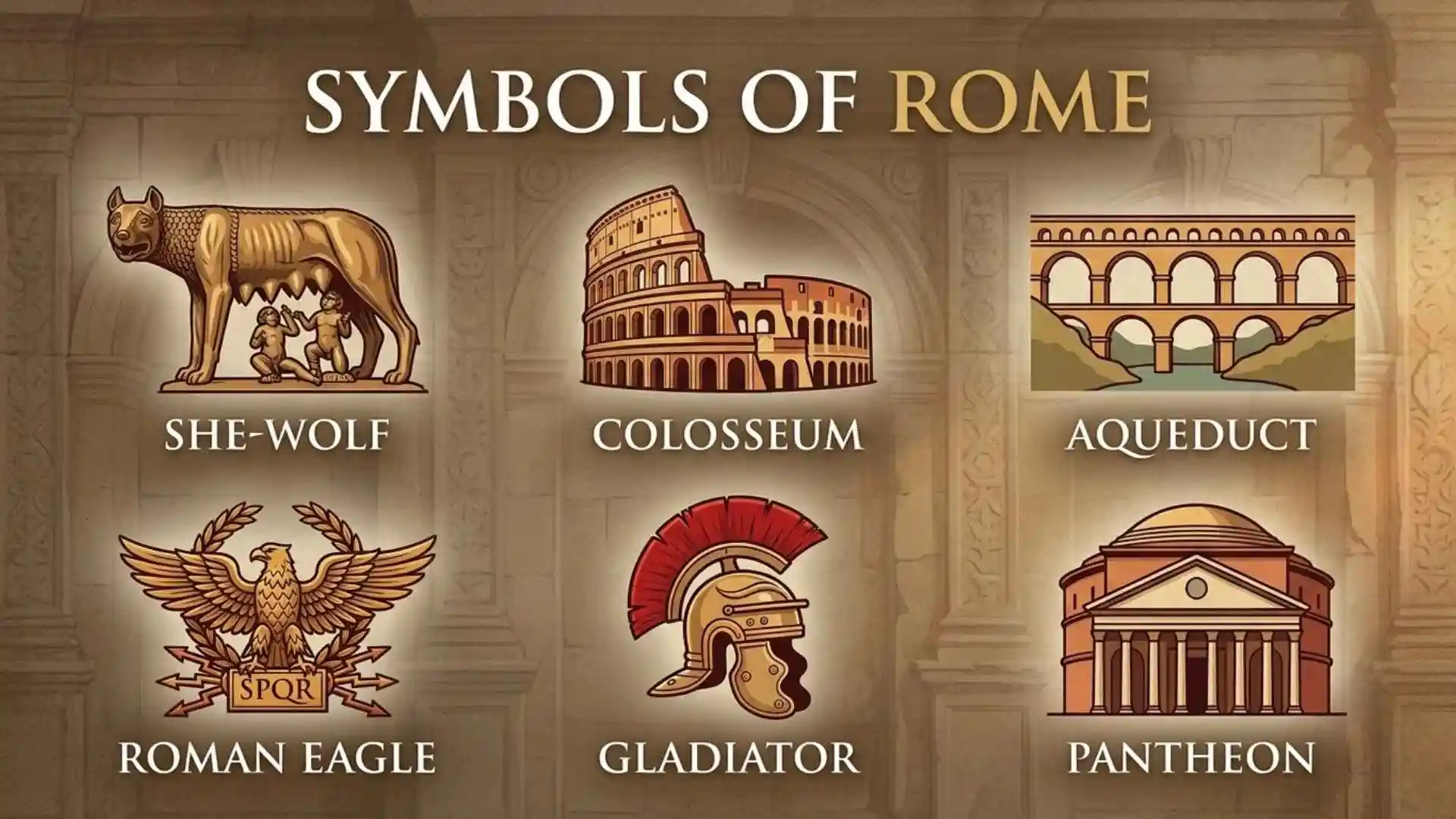
The symbols of Rome tell the story of a small settlement that became an ancient republic, a vast empire, the center of the Roman Catholic Church, and the modern capital of Italy. These symbols represent foundation myths, military power, political authority, religious faith, civic identity, and cultural endurance.
The most recognizable symbol is the Capitoline She-Wolf nursing Romulus and Remus, which represents Rome’s legendary birth. Other important Roman symbols include SPQR, the Roman eagle, the fasces, laurel wreaths, the Colosseum, and the keys of Saint Peter.
You may encounter these images on monuments, government buildings, coins, military emblems, museum objects, city seals, sports logos, souvenirs, tattoos, and works of art. Each symbol reveals a different chapter in Rome’s long and complex history.
Quick Meaning of the Symbols of Rome
The symbols of Rome collectively represent foundation, strength, civic unity, military authority, victory, law, religion, and endurance. The she-wolf symbolizes Rome’s legendary origins, SPQR represents the Senate and Roman people, the eagle signifies imperial power, and Christian symbols reflect Rome’s later importance as the center of the Catholic Church.
Symbols of Rome Overview Table
| Symbol | Primary Meaning | Historical Origin | Common Usage | Modern Meaning |
| Capitoline She-Wolf | Foundation, protection, survival | Legend of Romulus and Remus | Statues, city emblems, art | Identity of Rome |
| Romulus and Remus | Rome’s legendary founders | Traditional founding myth | Sculpture, coins, paintings | Origins and brotherhood |
| SPQR | Senate and People of Rome | Roman Republic | Monuments, inscriptions, city property | Civic authority |
| Roman Eagle | Military strength and imperial rule | Roman legions | Standards, coins, emblems | Power and ambition |
| Fasces | Legal authority and collective strength | Earlier Italian and Roman traditions | Magistrates, public imagery | Governmental power |
| Laurel Wreath | Victory, honor, achievement | Greek and Roman ceremonies | Art, coins, awards | Success and excellence |
| Colosseum | Roman engineering and public life | Imperial Rome | Tourism, logos, media | Rome’s global identity |
| Keys of Saint Peter | Spiritual authority | Christian Rome | Vatican emblems, religious art | Papal authority |
| Chi-Rho | Christ and Christian victory | Late Roman Empire | Churches, manuscripts, monuments | Christian faith |
| Roman Numerals | Order, measurement, continuity | Ancient Roman notation | Clocks, dates, architecture | Tradition and prestige |
What Do the Symbols of Rome Mean?
The symbols of Rome express the city’s changing identity across more than two thousand years. They do not communicate one single message. Instead, they represent several connected ideas: legendary ancestry, republican citizenship, military expansion, imperial government, Christian authority, artistic achievement, and the survival of Roman influence.
Ancient Roman symbols often linked political power with sacred tradition. Military standards were not merely identification markers; soldiers treated them as objects of honor and loyalty. Civic inscriptions presented Rome as a community governed through its Senate and people. Mythological images connected political institutions to gods, heroes, and legendary founders.
Modern Rome continues to use ancient imagery, especially the she-wolf and SPQR. However, their meanings have changed. They now represent municipal identity, historical memory, and pride in the city rather than the government of an ancient empire.
The Capitoline She-Wolf
The Capitoline She-Wolf, or Lupa Capitolina, is the most famous symbol of Rome. It depicts a female wolf standing over the twins Romulus and Remus as they drink her milk.
According to Roman tradition, the twins were sons of the god Mars and the priestess Rhea Silvia. King Amulius ordered them to be abandoned in the Tiber River because he feared they might challenge his rule. Their basket came to rest near the riverbank, where a she-wolf found and nursed them. A shepherd named Faustulus later raised the boys.
Romulus eventually founded Rome after a fatal conflict with Remus. The traditional date of Rome’s foundation is April 21, 753 BC, although historians treat this as a legendary date rather than a proven historical event.
The she-wolf symbolizes:
- Protection during vulnerability
- Survival against danger
- Maternal care
- Rome’s wild and powerful beginnings
- The city’s ability to endure
- Divine or extraordinary destiny
The Capitoline Museums officially describe the she-wolf as the symbol of the city. The famous bronze statue became especially connected with Rome after figures of the twins were added during the Renaissance.
Romulus and Remus
Romulus and Remus symbolize Rome’s foundation, shared ancestry, rivalry, and the human cost of political ambition.
The twins appear together beneath the she-wolf in sculptures, coins, mosaics, paintings, and civic emblems. Their shared infancy represents unity and brotherhood. Their later conflict, however, introduces a darker theme: Rome’s greatness emerged through competition, violence, and the struggle for authority.
In the traditional story, Romulus and Remus disagreed over where to establish their city. The dispute ended with Remus’s death, usually at the hands of Romulus or one of his followers. Romulus then became Rome’s first king.
Because of this story, the twins can symbolize both cooperation and division. They remind viewers that political communities may share a common origin while still experiencing internal conflict.
SPQR
SPQR is one of the most enduring political symbols of Rome. The letters stand for the Latin phrase Senatus Populusque Romanus, meaning “The Senate and the Roman People.”
The phrase represented the Roman state, particularly during the Republic. It expressed the idea that public authority belonged to both the Senate and the citizens of Rome. In practice, Roman political power was unequal and often controlled by elite families, but the formula still presented government as a civic partnership.
SPQR appeared on:
- Public inscriptions
- Military standards
- Coins
- Monuments
- Official documents
- Public works
- Government property
Roman military standards sometimes carried SPQR to show that the army acted in the name of the Roman state and its citizens.
Today, SPQR remains part of Rome’s municipal identity. Residents and visitors can see it on manhole covers, fountains, public buildings, street furniture, and city vehicles. Its modern use connects the present-day capital with the institutions and public life of ancient Rome.
The Roman Eagle
The Roman eagle, known as the aquila, represented military honor, strength, victory, and the authority of Rome.
Each Roman legion carried an eagle standard. The soldier responsible for carrying it was called the aquilifer. Losing the eagle in battle brought deep humiliation because the standard represented the legion’s identity and loyalty. Roman armies sometimes launched campaigns to recover standards captured by enemies.
The eagle was associated with Jupiter, the highest Roman god. Its ability to fly high in the sky connected it with divine authority, courage, and supremacy. Under imperial rule, the eagle also became associated with the emperor and Rome’s control over conquered territories.
Roman legions used other animal emblems, including wolves, boars, horses, serpents, and mythical creatures. Nevertheless, the eagle became the most prestigious and widely remembered military symbol.
Later European empires adopted eagle imagery to claim a connection with Roman power. As a result, the Roman eagle influenced heraldry, national emblems, military insignia, and imperial symbolism far beyond ancient Italy.
The Fasces
The fasces consisted of a bundle of wooden rods, usually tied around an axe. In ancient Rome, it symbolized a magistrate’s legal authority and the state’s power to punish.
The rods represented strength through unity. A single rod could break easily, while a bundle was much harder to break. The axe represented the power to impose severe punishment, including execution under certain legal conditions.
Officials known as lictors carried the fasces before Roman magistrates. The number and arrangement of the fasces could indicate the official’s rank and authority.
The fasces originally communicated:
- Lawful authority
- Public office
- Discipline
- Unity
- Judicial power
- The enforcement of order
Its meaning became more controversial in the twentieth century because Benito Mussolini’s Fascist movement adopted the image and derived its name from the Italian word fascio, meaning a bundle or political group.
Therefore, the fasces must be interpreted according to context. In ancient Roman art, it usually represents magistracy and legal authority. In modern political imagery, it may carry associations with authoritarianism and fascism.
The Laurel Wreath
The laurel wreath symbolized victory, honor, achievement, divine favor, and high status.
Romans inherited much of its symbolic meaning from Greek culture, where the laurel was associated with Apollo. In Rome, victorious commanders, emperors, poets, athletes, and respected public figures could be represented wearing laurel crowns.
A Roman general celebrating a triumph might wear a laurel wreath as he entered the city. Imperial coins frequently showed emperors with laurel crowns, presenting them as victorious and worthy of authority.
The laurel’s evergreen leaves also suggested lasting fame. Unlike plants that lose their leaves seasonally, evergreen plants appeared to preserve their vitality. This made laurel appropriate for achievements intended to be remembered.
Its influence survives in words such as “laureate,” including “poet laureate.” Today, laurel wreaths appear in university seals, award designs, sports emblems, medals, logos, and decorative borders.
The Colosseum
The Colosseum has become a modern visual symbol of Rome’s engineering, entertainment, imperial wealth, and endurance.
Built mainly during the Flavian dynasty in the first century AD, the amphitheater hosted gladiatorial contests, animal hunts, executions, and public spectacles. It could hold tens of thousands of spectators, although exact estimates vary.
As a symbol, the Colosseum has several layers of meaning:
- Architectural innovation
- Imperial public entertainment
- Social hierarchy
- Political spectacle
- Human courage and suffering
- The survival of ancient Rome
Its damaged but recognizable structure makes it especially powerful. It shows both the achievements of Roman engineering and the destructive effects of earthquakes, stone removal, neglect, and time.
Today, the Colosseum appears in tourism campaigns, films, books, logos, souvenirs, posters, and educational materials. For many people, its arches provide the fastest visual shorthand for Rome.
History and Origin of Roman Symbols

Roman symbolism developed through centuries of cultural exchange. Rome did not create every image independently. Its people absorbed and adapted ideas from neighboring Latin communities, the Etruscans, Greek colonies, conquered territories, and religious traditions from across the Mediterranean.
Early symbols focused on kinship, warfare, agriculture, divine protection, and political authority. As Rome expanded, symbols helped unite people who spoke different languages and worshiped different gods.
During the Republic, SPQR, military standards, magistrates’ insignia, and civic monuments reinforced loyalty to the state. Under the emperors, portraits, eagles, victory figures, crowns, and divine associations promoted imperial legitimacy.
After Christianity gained official support in the fourth century, crosses, Christograms, saints, and biblical imagery became increasingly prominent. Rome’s symbolic identity shifted again after the fall of the Western Roman Empire, when the papacy became one of the city’s most influential institutions.
Renaissance artists and political leaders later revived classical symbols. Ancient columns, arches, laurel wreaths, Roman lettering, and mythological scenes became models for European art and public architecture.
Symbolism and Interpretation
Roman symbols often combine positive ideals with uncomfortable historical realities.
Positive Meanings
The most common positive interpretations include:
- Courage
- Civic responsibility
- Protection
- Resilience
- Unity
- Victory
- Discipline
- Law
- Cultural continuity
- Architectural achievement
The she-wolf can represent care and survival. SPQR can symbolize citizenship and shared public identity. The eagle can stand for courage and determination. Laurel wreaths communicate excellence and earned recognition.
Negative Meanings
Some Roman symbols may also suggest:
- Conquest
- Militarism
- Authoritarian rule
- Social inequality
- Political violence
- Imperial domination
- Public punishment
- Propaganda
The eagle, for example, can express bravery, but it also recalls Rome’s military expansion. The Colosseum represents engineering skill, yet it was also a setting for violence and state-sponsored spectacle.
Psychological Interpretation
Psychologically, Roman symbols often appeal to the desire for belonging, permanence, and strength. Images such as the eagle, monumental architecture, and SPQR create a sense of order larger than the individual.
The she-wolf offers a different emotional message. It emphasizes protection during helplessness and suggests that survival can arise from unexpected sources.
These psychological readings are modern interpretations rather than fixed meanings recognized by every ancient Roman.
Cultural Significance
Roman symbols influenced cultures throughout Europe, North Africa, Western Asia, and later the Americas.
European monarchies and empires adopted Roman eagles, triumphal arches, columns, Latin mottos, and laurel wreaths to present themselves as disciplined, lawful, and powerful. Governments built capitol buildings inspired by Roman architecture because Rome became associated with republican government and public authority.
The Byzantine Empire preserved Roman political and religious traditions in the eastern Mediterranean. The Holy Roman Empire later used Roman language and eagle imagery to claim imperial continuity, although it was a separate medieval political system.
During the Renaissance, Italian artists and scholars treated ancient Rome as a source of intellectual and artistic renewal. In the eighteenth and nineteenth centuries, neoclassical architecture carried Roman symbols into courthouses, museums, universities, banks, and national legislatures.
Modern Italians may view the she-wolf and SPQR primarily as symbols of Rome itself. International audiences often associate the Colosseum, Roman helmet, eagle, and laurel wreath with the wider civilization of ancient Rome.
Religious and Spiritual Meaning
Religion shaped Roman symbolism from the city’s earliest traditions to its later Christian identity.
Symbols of Ancient Roman Religion
Ancient Romans used images of gods, sacred animals, ritual objects, temples, household spirits, and protective signs.
Jupiter’s eagle represented divine authority and the power of the sky. Mars, the god of war and traditionally the father of Romulus and Remus, represented military courage and Rome’s legendary ancestry. The wolf was also associated with Mars in Roman tradition.
The Vestal flame represented the security and continuity of Rome. The Vestal Virgins maintained the sacred fire in the Temple of Vesta. Allowing it to go out was considered a dangerous sign for the state.
The lararium, a household shrine, honored the Lares and other protective spirits. These domestic symbols show that Roman religion operated not only in great temples but also within family life.
Christian Symbols of Rome
After Christianity became deeply established in the Roman Empire, the city acquired new religious symbols.
The Chi-Rho combines the first two Greek letters of Christos, meaning Christ. It became especially associated with Emperor Constantine and Christian victory.
The cross became the central symbol of Christianity and now appears throughout Rome’s churches, monuments, cemeteries, and religious art.
The keys of Saint Peter represent the spiritual authority traditionally given to the apostle Peter. Crossed gold and silver keys appear in the emblem of the Holy See and Vatican City. They symbolize authority to bind and loose in spiritual matters.
The combination of pagan, imperial, and Christian imagery makes Rome symbolically distinctive. Classical temples, imperial monuments, early Christian churches, Renaissance basilicas, and modern civic emblems exist within the same urban landscape.
Where the Symbols of Rome Are Used
Symbols of Rome appear in both historical objects and modern visual culture.
Architecture and Monuments
SPQR inscriptions, eagles, laurel wreaths, columns, and mythological figures decorate arches, temples, government buildings, fountains, and memorials.
Coins and Medals
Ancient Roman coins carried emperors’ portraits, gods, personifications, military victories, buildings, animals, and political messages. Modern commemorative medals continue to use Roman imagery.
Military Emblems
Eagles, standards, wreaths, shields, and Roman-style lettering appear in military insignia and historical reenactments.
Tattoos and Jewelry
Popular tattoo designs include the she-wolf, SPQR, Roman numerals, legionary eagles, helmets, laurel wreaths, and the Colosseum. Their meanings may include strength, heritage, discipline, family, or survival.
Literature and Film
Novels, television programs, films, and video games use Roman symbols to establish setting and communicate authority quickly. Eagles and standards often identify legions, while laurel crowns distinguish emperors or victorious commanders.
Modern Rome
The city still displays SPQR on public property. The Capitoline She-Wolf appears in civic imagery, sports culture, tourism materials, and reproductions across Rome.
Common Variations of Roman Symbols
Roman symbols vary according to artistic period, political purpose, and modern adaptation.
The she-wolf may appear alone or with Romulus and Remus. Some designs show the twins clearly beneath her body, while simplified logos use only the animal’s outline.
The eagle may be shown with open wings, closed wings, a wreath, lightning bolts, an imperial standard, or the letters SPQR. These details can change the symbol’s meaning from general strength to specifically military or imperial authority.
Laurel wreaths may form a full crown, a semicircular border, or two branches surrounding a name or emblem.
SPQR appears in several Roman-style typefaces and may be placed inside a shield, beneath an eagle, or beside the she-wolf.
Roman numerals vary less in form, but modern uses do not always follow ancient inscription practices consistently.
Common Misconceptions About the Symbols of Rome
Rome Had One Official Ancient Symbol
Ancient Rome did not rely on one universal emblem comparable to a modern national logo. Different symbols represented the city, Senate, people, emperor, military units, gods, and public offices.
The Capitoline Wolf Is Entirely Ancient
The famous sculpture has a complicated history. The bronze wolf and the figures of the twins were not necessarily created at the same time. The twins were added during the Renaissance, and scholars have debated the date of the wolf itself. The statue’s symbolic importance is certain even though aspects of its dating remain disputed.
SPQR Means “The Roman Empire”
SPQR literally refers to the Senate and Roman people. It represented the Roman state and continued to be used in different periods, but it is not a direct Latin translation of “Roman Empire.”
Every Eagle Is a Roman Eagle
Eagles appear in many cultures. Context matters. A Roman eagle is usually identified through accompanying features such as a legionary standard, Latin letters, Roman military equipment, or imperial imagery.
The Fasces Has Only a Fascist Meaning
The symbol existed long before modern fascism. In ancient Rome, it represented magisterial and legal authority. Its twentieth-century political adoption added a powerful and controversial modern association.
Roman Numerals Were Used Exactly as They Are Today
Ancient notation was not completely uniform. Modern conventions often standardize forms that varied across Roman inscriptions and historical periods.
10 Interesting Facts About the Symbols of Rome
- The she-wolf is also linked with Siena. Siena has its own tradition connecting the city to the sons of Remus, so images of the nursing wolf appear there as well.
- A legion’s eagle was treated as more than equipment. It embodied the legion’s honor, making its capture a political and emotional disaster.
- SPQR remains visible in everyday Rome. It appears not only on monuments but also on drains, utility covers, public vehicles, and street fixtures.
- The twins transformed the meaning of the famous wolf statue. Their Renaissance addition made the bronze clearly represent the foundation myth and helped establish it as the “Mother of the Romans.”
- Roman symbols acted as visual propaganda. Coins could carry political messages across vast territories, reaching people who might never see the emperor in person.
- The eagle influenced later imperial emblems. Medieval and modern rulers adopted eagle imagery to suggest continuity with Roman authority.
- Laurel wreaths shaped modern academic language. The term “laureate” preserves the ancient connection between laurel and public honor.
- The Colosseum was not its original official name. Romans knew it as the Flavian Amphitheater. The later name may be connected with a colossal statue once located nearby.
- Roman symbols changed as Rome’s religion changed. Images associated with Jupiter, Mars, and imperial worship gradually shared the city with crosses, Christograms, saints, and papal emblems.
- Many modern government buildings imitate Roman design. Domes, columns, pediments, Latin inscriptions, and wreaths communicate stability and civic authority.
Related Symbols
The Roman Helmet
The helmet represents the Roman soldier, discipline, defense, and military organization. Unlike the eagle, it identifies the individual warrior rather than the legion’s sacred standard.
The Gladius
The short Roman sword symbolizes combat, military training, and conquest. Modern designs often use it to communicate courage or readiness.
The Vexillum
The vexillum was a flag-like military standard suspended from a horizontal crossbar. It differs from the aquila, which featured an eagle mounted on a pole.
The Chi-Rho
The Chi-Rho represents Christ and the Christian transformation of the Roman world. It belongs primarily to late Roman and Christian symbolism rather than Rome’s earliest religious traditions.
The Triumphal Arch
A triumphal arch symbolizes victory, public memory, and state-sponsored commemoration. Later rulers across the world copied the Roman form.
The Goddess Roma
Roma was the personification of Rome and the Roman state. Artists often portrayed her as a helmeted woman, representing civic power, military readiness, and imperial identity.
The Hand of Power
An upright hand appeared on some Roman military standards. It could represent authority, loyalty, oaths, or the commanding power of the state.
The Crown of Rays
A radiate crown appeared on certain emperors and was associated with solar imagery, divine status, or specific types of coinage. It differs from the laurel wreath, which emphasized victory and honor.
Frequently Asked Questions
What is the main symbol of Rome?
The Capitoline She-Wolf nursing Romulus and Remus is generally considered the main symbol of Rome. It represents the city’s legendary foundation, protection, survival, and ancient identity. The image appears in civic art, museums, public monuments, sports culture, souvenirs, and modern representations of the Italian capital.
What does SPQR mean?
SPQR stands for Senatus Populusque Romanus, usually translated as “The Senate and the Roman People.” It represented the Roman state and the shared public authority of its Senate and citizens. Today, the abbreviation remains an official and highly visible symbol of the city of Rome.
Why was the eagle important to Roman soldiers?
The eagle represented a Roman legion’s identity, honor, and loyalty. An appointed standard-bearer carried it into battle, and soldiers were expected to defend it at great cost. Losing an eagle brought disgrace, while recovering a captured standard could become an important military and political achievement.
What does the Roman she-wolf symbolize?
The Roman she-wolf symbolizes maternal protection, survival, strength, destiny, and the legendary origin of Rome. By nursing the abandoned twins Romulus and Remus, she protects the future founders when they are most vulnerable. The image therefore combines wild power with life-giving care.
Is the Colosseum an official symbol of Rome?
The Colosseum functions as one of Rome’s most recognizable cultural symbols, although it is not the city’s only emblem. Its distinctive arches represent ancient engineering, imperial entertainment, historical endurance, and Rome’s global influence. It appears frequently in tourism, media, education, advertising, and popular culture.
What did the laurel wreath mean in ancient Rome?
The laurel wreath represented victory, honor, achievement, and lasting fame. Victorious generals and emperors were often shown wearing it, particularly in triumphal and political imagery. Its association with excellence survives in modern awards, university emblems, ceremonial designs, and the word “laureate.”
Did ancient Rome have a flag?
Ancient Rome did not use a national flag in the modern sense. Roman military units carried several types of standards, including the eagle, signa, and vexilla. These objects identified units, communicated commands, represented loyalty, and served ceremonial or religious functions within the army.
Why is the fasces controversial today?
The fasces began as an ancient symbol of magisterial authority, law, and collective strength. It became controversial after Italian Fascism adopted it in the twentieth century. Modern viewers may therefore interpret it as either a classical governmental emblem or a symbol connected with dictatorship and authoritarian ideology.
What symbols represent Christian Rome?
The cross, Chi-Rho, keys of Saint Peter, papal tiara, images of Saints Peter and Paul, and symbols of the Vatican represent Christian Rome. These emblems reflect the city’s role in early Christianity and its continuing importance as the center of the Roman Catholic Church.
What do Roman numeral tattoos symbolize?
Roman numeral tattoos often record meaningful dates, anniversaries, names converted into numbers, or personal milestones. Their classical appearance can also suggest permanence, heritage, discipline, and timelessness. However, wearers should verify the numeral carefully because incorrect subtractive forms and reversed sequences are common tattoo mistakes.
Key Takeaways
- The Capitoline She-Wolf is the most widely recognized symbol of Rome.
- Romulus and Remus represent Rome’s legendary foundation and internal rivalry.
- SPQR means “The Senate and the Roman People.”
- The Roman eagle symbolized legionary honor, military strength, and imperial authority.
- The fasces originally represented lawful power but gained controversial modern associations.
- Laurel wreaths communicated victory, honor, and lasting fame.
- The Colosseum symbolizes engineering achievement, public spectacle, and historical endurance.
- Christian symbols reflect Rome’s later role as the center of the Catholic Church.
- Roman symbols changed meaning as the city evolved from kingdom to republic, empire, Christian center, and modern capital.
- Historical context is essential because the same symbol can carry positive, negative, civic, military, or religious meanings.
Conclusion
The symbols of Rome form a visual history of one of the world’s most influential cities. The she-wolf recalls a legendary rescue beside the Tiber, SPQR expresses civic government, the eagle represents military power, and the laurel wreath celebrates victory. The Colosseum preserves the memory of imperial spectacle, while crosses and the keys of Saint Peter reveal Rome’s Christian transformation.
These symbols endure because they communicate ideas that remain meaningful: protection, identity, authority, ambition, achievement, sacrifice, and survival. Understanding their historical setting helps separate ancient meanings from modern assumptions and reveals how Rome continues to shape politics, art, architecture, religion, language, and popular culture.

I am Ethan Mitchell, an English writer and lifelong learner who is fascinated by words and the way language changes over time. At LearnNestly, I share practical explanations designed for readers who want to improve their understanding of English without complicated terminology. I enjoy researching meanings, usage, grammar, and common language mistakes, then presenting the information in a simple and useful format. My purpose is to make every article a small learning experience that readers can actually apply.
Books:
- The Smart Learner’s English Guide
- English in Real Life
 Daniel Brooks
 Amelia Carter