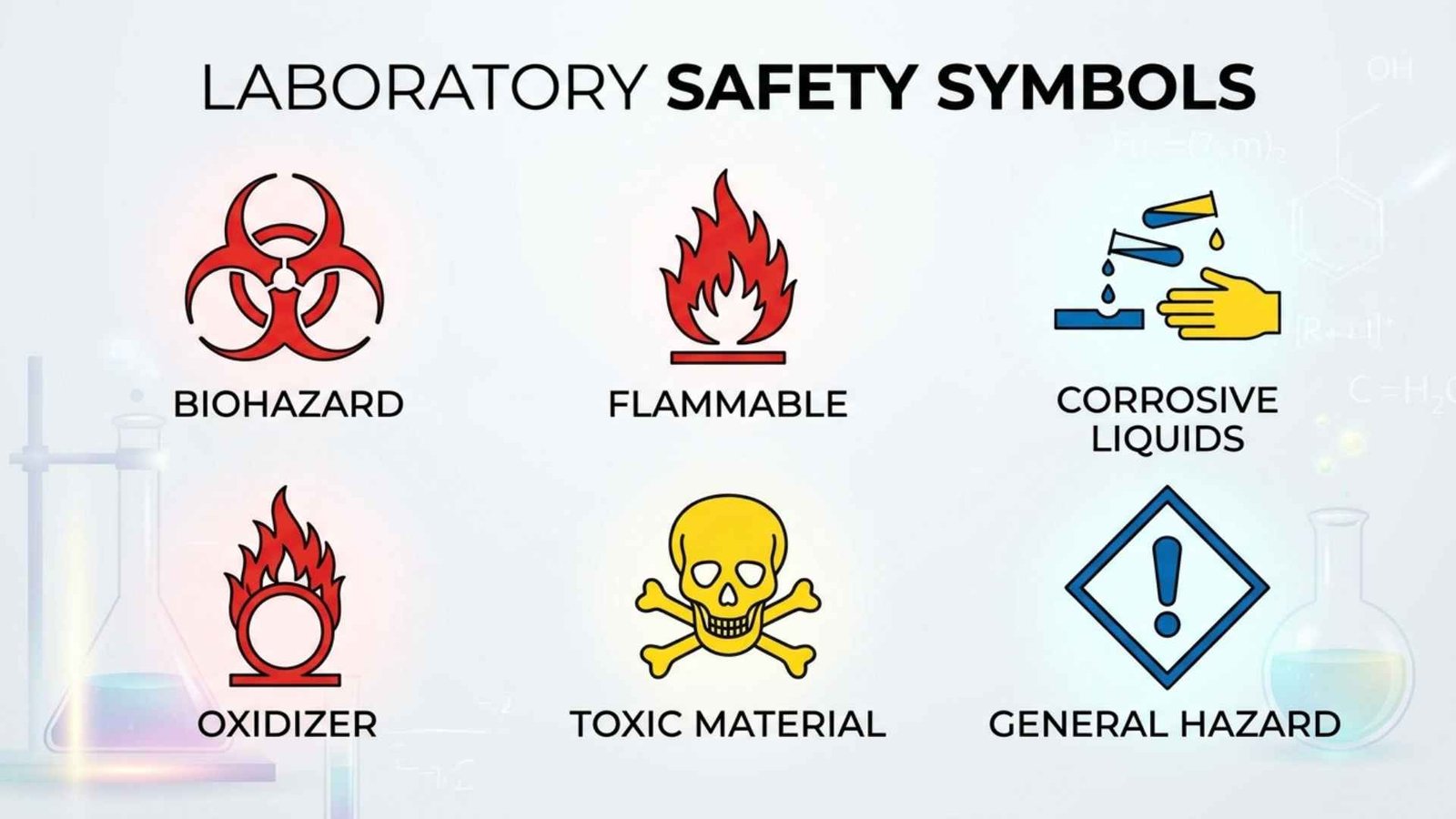
Laboratory safety symbols are visual warnings that identify chemical, biological, physical, electrical, radiation, and equipment-related hazards. You may see them on chemical containers, laboratory doors, storage cabinets, instruments, waste bins, Safety Data Sheets, and emergency equipment.
These symbols matter because laboratory hazards are not always visible. A clear pictogram can warn you that a substance may ignite, burn skin, damage organs, spread infection, release radiation, or react violently before you touch or open it. Understanding the symbol is only the first step.
You must also read the label, review the Safety Data Sheet, wear the required protective equipment, and follow your laboratory’s procedures.
Quick Meaning
Laboratory safety symbols communicate hazards, required precautions, prohibited actions, and emergency information. They help people quickly recognize dangers such as toxic chemicals, fire, corrosion, biohazards, radiation, lasers, electricity, and compressed gases. A symbol does not provide every safety instruction, so it should always be interpreted with the complete label and laboratory guidance.
Laboratory Safety Symbols Overview
| Symbol or System | Primary Meaning | Category | Common Appearance | Common Usage |
| GHS pictograms | Chemical health, physical, and environmental hazards | Chemical safety | Black image inside a red diamond | Chemical labels and Safety Data Sheets |
| Biohazard | Infectious or potentially infectious material | Biological safety | Three interlocking curved forms | Specimen areas, waste containers, laboratory doors |
| Radiation trefoil | Ionizing-radiation hazard | Radiation safety | Black or magenta trefoil on yellow | X-ray equipment, radioactive materials, controlled areas |
| Laser warning | Hazardous laser radiation | Optical safety | Starburst or beam striking a surface | Laser laboratories and equipment |
| Electrical hazard | Risk of electrical shock or high voltage | Electrical safety | Lightning bolt in a triangle | Electrical panels, instruments, power supplies |
| NFPA 704 diamond | Emergency hazard severity information | Emergency response | Blue, red, yellow, and white diamond | Buildings, tanks, rooms, and storage areas |
| Mandatory PPE signs | Protective equipment must be worn | Personal protection | White image on a blue circle | Laboratory entrances and work zones |
| Prohibition signs | An action is forbidden | Behavioral safety | Black image crossed by a red slash | No flames, no food, no unauthorized entry |
| Emergency signs | Location of safety or escape equipment | Emergency response | White image on green | Eyewashes, exits, first aid, safety showers |
| General warning | A hazard is present | General safety | Exclamation mark in a yellow triangle | Equipment, doors, and mixed-risk areas |
The United Nations developed the Globally Harmonized System of Classification and Labelling of Chemicals, or GHS, to create a more consistent approach to chemical hazard classification, labels, and Safety Data Sheets. OSHA incorporated GHS elements into the United States Hazard Communication Standard.
What Do Laboratory Safety Symbols Mean?
Laboratory safety symbols answer one of four basic questions:
- What danger is present?
Examples include flammable chemicals, infectious organisms, radiation, and electricity. - What action is required?
A sign may require goggles, gloves, respiratory protection, or a laboratory coat. - What action is prohibited?
A crossed-out flame means no open flames. A crossed-out cup may prohibit eating or drinking. - Where is emergency help located?
Green signs commonly identify exits, eyewashes, safety showers, first-aid supplies, or emergency assembly points.
A symbol communicates a category of information, not a full risk assessment. The actual danger depends on the material, concentration, quantity, exposure route, equipment, and procedure involved.
Major Chemical Laboratory Safety Symbols
Exploding Bomb
The exploding-bomb pictogram warns of materials that may explode or undergo a violent reaction. It can apply to certain explosives, self-reactive substances, and organic peroxides.
Heat, impact, friction, contamination, or improper storage may initiate a reaction. Anyone working with such material should use approved quantities, protective barriers, temperature controls, and written procedures.
Flame
The flame symbol identifies substances that can ignite or contribute to fire-related incidents. It may appear on flammable gases, aerosols, liquids, solids, pyrophoric materials, self-heating chemicals, materials that release flammable gas, and some self-reactive substances or organic peroxides.
Keep these materials away from flames, sparks, hot surfaces, and incompatible chemicals. Storage in an approved flammable-liquid cabinet may be required.
Flame Over Circle
A flame above a circle identifies an oxidizer. Oxidizing materials may not burn by themselves, but they can start, intensify, or accelerate the burning of other substances.
Oxidizers must be separated from fuels, organic materials, reducing agents, and many flammable chemicals. A common mistake is treating the symbol as another general flammability sign. Its central warning is that the substance can make a fire more severe.
Gas Cylinder
The gas-cylinder pictogram warns that a container holds gas under pressure. This category includes compressed, liquefied, dissolved, and refrigerated liquefied gases.
A damaged valve can turn a cylinder into a dangerous projectile. Refrigerated gas can cause severe cold burns, while some released gases may displace oxygen. Cylinders should be secured upright, transported with proper carts, and stored with compatible gases.
Corrosion
The corrosion pictogram shows liquid damaging a hand and a metal surface. It warns of chemicals that can cause severe skin burns, serious eye damage, or corrosion of metals.
Examples may include strong acids and bases, although a chemical’s classification depends on its tested properties and concentration. Appropriate gloves, eye protection, protective clothing, ventilation, and immediate access to washing facilities are essential.
Skull and Crossbones
The skull and crossbones represents acute toxicity severe enough to cause serious poisoning or death after relatively short exposure.
Exposure may occur through inhalation, swallowing, or skin contact. Work with these substances may require a fume hood, restricted access, specialized storage, spill planning, and strict contamination controls.
Exclamation Mark
The exclamation mark identifies several less severe but still important health hazards. Depending on the substance, it may indicate skin or eye irritation, skin sensitization, harmful acute toxicity, respiratory irritation, or narcotic effects such as dizziness.
It should never be interpreted as “minor” or “safe.” Repeated exposure to an irritant or sensitizer can still produce serious consequences.
Health Hazard
The health-hazard pictogram shows a person’s silhouette with a star-like shape on the chest. It warns of chronic or severe health effects such as carcinogenicity, respiratory sensitization, reproductive toxicity, germ-cell mutagenicity, specific target-organ toxicity, or aspiration hazard.
This pictogram often represents effects that may not appear immediately. A worker may feel normal during exposure even though long-term damage is possible.
Environment
The environmental pictogram shows a dead tree and fish. It indicates a substance that may be hazardous to aquatic life.
The GHS includes nine principal pictograms, but OSHA requires eight for covered workplace chemical hazards. OSHA does not mandate the environmental pictogram because environmental hazards fall outside OSHA’s workplace safety authority, although manufacturers may include it as supplementary information.
Biological, Radiation, and Physical Hazard Symbols
Biohazard Symbol
The biohazard symbol identifies biological materials that may threaten human or animal health. It may mark cultures, contaminated sharps, human blood, clinical specimens, infectious waste, or areas where microorganisms are handled.
The sign does not prove that every item is infectious. It indicates that workers must treat the material according to biological-safety procedures. OSHA permits the biological-hazard symbol or wording such as “BIOHAZARD” on applicable accident-prevention signs and tags.
Ionizing-Radiation Symbol
The radiation trefoil warns of ionizing radiation or radioactive material. It can appear near X-ray devices, sealed radioactive sources, isotope-storage areas, and controlled radiation zones.
Ionizing radiation has enough energy to remove electrons from atoms. Safety programs control exposure through three core principles: reducing time near the source, increasing distance, and using appropriate shielding.
The trefoil should not be confused with symbols for radio waves, Wi-Fi, microwaves, or non-ionizing radiation.
Laser-Radiation Symbol
The laser warning symbol identifies equipment capable of emitting hazardous laser radiation. Depending on wavelength and power, a laser can injure the eyes, burn skin, ignite materials, or create dangerous reflections.
Laser eyewear must match the wavelength and optical density required for the device. Ordinary sunglasses and general safety glasses are not substitutes for rated laser protection.
Ultraviolet-Radiation Symbol
An ultraviolet warning indicates exposure to UV light from germicidal lamps, transilluminators, curing systems, or other sources.
UV radiation can harm the eyes and skin. Enclosures, interlocks, face protection, gloves, and covering exposed skin may be necessary. A lamp may remain hazardous even when its light appears dim.
Electrical Hazard
The lightning-bolt symbol warns of exposed energized parts, high voltage, or electrical-shock risk.
Users should not remove covers, bypass interlocks, use damaged cords, or work on energized equipment without authorization and proper controls. Wet hands, conductive jewelry, and incorrect grounding can increase the danger.
Hot Surface
The hot-surface symbol shows heat waves rising from a hand or surface. It appears on hot plates, ovens, furnaces, heating blocks, autoclaves, and recently heated equipment.
A surface can remain hot after the device is turned off. Heat-resistant gloves or tools may be required, but the correct protection depends on temperature and the object being handled.
Cryogenic Hazard
Cryogenic warnings identify extremely cold liquids, gases, equipment, or surfaces. Liquid nitrogen, for example, can cause frostbite, embrittle materials, and rapidly expand into gas.
In a poorly ventilated space, evaporating cryogenic liquid may reduce the oxygen level. Sealed containers are also dangerous because pressure can build as the liquid warms.
Magnetic-Field Hazard
A magnetic-field symbol warns of strong magnets, particularly around nuclear magnetic resonance and magnetic resonance systems.
Ferromagnetic objects can become projectiles. Magnetic fields may also affect implants, medical devices, watches, cards, and electronic equipment. Access restrictions are often based on screening and distance from the magnet.
History and Origin of Laboratory Safety Symbols
Laboratory symbols developed from several different safety traditions rather than from one ancient emblem. Early laboratories relied heavily on written labels, local conventions, and recognizable images such as the skull and crossbones.
As science, manufacturing, and international trade expanded, inconsistent labels became a serious problem. A chemical might carry different warnings in different industries or countries. Modern systems therefore use standardized shapes, colors, pictograms, signal words, and hazard statements.
The United Nations adopted the GHS in 2003 to harmonize chemical classification and hazard communication across national systems. The system continues to be revised as technical knowledge and implementation needs develop. The eleventh revised edition was published in 2025.
ISO 7010 provides standardized safety signs for accident prevention, fire protection, health-hazard communication, and emergency evacuation. Its system uses consistent sign shapes, colors, and graphical designs to improve recognition across language barriers.
The NFPA 704 system developed separately for rapid emergency recognition. Its colored diamond gives emergency responders a general indication of health, flammability, instability, and special hazards associated with materials at a facility.
Symbolism and Visual Interpretation
Laboratory symbols use visual features deliberately.
- Red attracts attention and is associated with prohibition, fire, or serious hazard communication.
- Yellow commonly signals caution or warning.
- Blue often identifies a mandatory action, such as wearing eye protection.
- Green identifies safe conditions, emergency exits, or first-aid equipment.
- Triangles usually warn.
- Circles often require or prohibit an action.
- Diamonds commonly classify chemical hazards.
- Squares and rectangles often provide information or identify equipment.
These meanings are practical rather than spiritual. Their purpose is to produce fast recognition under ordinary and emergency conditions. OSHA notes that the red frame around Hazard Communication Standard pictograms makes warnings more noticeable and supports nonverbal hazard communication.
Psychologically, pictograms reduce dependence on long written explanations. However, no symbol is universally self-explanatory. Training remains necessary because people may misread unfamiliar images or apply everyday meanings to technical signs.
Cultural and International Significance
Laboratory safety symbols have international value because laboratories often include multilingual teams, imported chemicals, shared equipment, and visiting researchers.
Standardization reduces language barriers, but implementation is not identical everywhere. Countries may adopt different parts or editions of the GHS, establish different concentration limits, or apply separate transport, workplace, consumer, and environmental rules.
A symbol’s general meaning may therefore be internationally recognizable while the legal requirements connected to it remain jurisdiction-specific. Laboratories must follow the laws, institutional policies, and current standards applicable to their location.
Scientific and Technical Meaning

Laboratory symbols support a larger hazard-control system. They connect visual warnings to technical information such as:
- Chemical classification and concentration
- Exposure routes and toxicological effects
- Required engineering controls
- Personal protective equipment
- Storage compatibility
- Spill and fire response
- Waste-disposal requirements
- Medical and first-aid measures
For chemicals, the most detailed source is usually the Safety Data Sheet. GHS-based labels also include a product identifier, signal word, hazard statements, precautionary statements, pictograms, and supplier information when applicable.
The words Danger and Warning describe relative hazard severity within a hazard class. “Danger” is generally used for more severe categories, but the signal word does not replace the specific hazard statement.
Where Laboratory Safety Symbols Are Used
You may encounter laboratory safety symbols on:
- Original chemical containers
- Secondary workplace containers
- Safety Data Sheets
- Laboratory and storage-room doors
- Refrigerators and freezers
- Fume hoods and biological safety cabinets
- Compressed-gas cylinders
- Radioactive-material containers
- Laser equipment
- Electrical panels
- Waste and sharps containers
- Autoclaves, centrifuges, and ovens
- Emergency showers and eyewash stations
- Personal protective equipment stations
- Shipping packages and transport containers
Symbols should be positioned where people can see them before exposure. A warning hidden behind equipment or placed only inside a cabinet may not provide timely information.
Common Variations and Related Sign Systems
GHS Diamonds
GHS pictograms use a black symbol on a white background within a red diamond-shaped border. They identify hazard classes but do not assign a simple overall numerical score.
NFPA 704 Diamond
The NFPA diamond uses four colored sections:
- Blue: Health hazard
- Red: Flammability
- Yellow: Instability
- White: Special hazard information
Numbers generally range from 0 for minimal hazard to 4 for severe hazard. These ratings are intended primarily for emergency response and must not be interpreted as GHS hazard categories.
Mandatory Signs
Mandatory signs commonly use a blue circle with a white image. Examples include wear safety goggles, wear gloves, use hearing protection, or wear a laboratory coat.
Prohibition Signs
Prohibition signs typically show a black action symbol inside a red circle with a diagonal slash. Examples include no smoking, no open flames, no food or drink, and no unauthorized entry.
Emergency Signs
Emergency signs are commonly green and white. They identify safe routes or emergency resources rather than hazards.
Common Misconceptions About Laboratory Safety Symbols
“One symbol tells me everything I need to know.”
A pictogram shows a hazard category, not every handling instruction. Read the complete label, Safety Data Sheet, procedure, and risk assessment.
“The exclamation mark means the chemical is only slightly dangerous.”
It can represent harmful acute toxicity, sensitization, or respiratory irritation. These effects may require significant controls.
“The skull and crossbones appears on every toxic chemical.”
It applies to particular acute-toxicity classifications. A chemical associated with cancer, organ damage, or reproductive harm may instead carry the health-hazard pictogram.
“The flame and flame-over-circle symbols mean the same thing.”
The flame usually identifies a material that can burn. The flame over a circle identifies an oxidizer that can intensify combustion.
“The NFPA number is the same as a GHS hazard category.”
They are different systems developed for different purposes. A higher NFPA number indicates greater severity, while lower-numbered GHS categories often represent greater severity within a class.
“Gloves make every chemical safe to handle.”
Glove materials differ in chemical resistance and breakthrough time. The correct glove must be selected for the substance, concentration, task, and duration.
“A familiar symbol replaces laboratory training.”
Symbols improve recognition, but training is necessary to understand the required response, protective equipment, emergency procedures, and local rules.
Interesting Facts About Laboratory Safety Symbols
- OSHA uses eight mandatory chemical pictograms.
The GHS includes an environmental pictogram, but OSHA does not require it under its workplace Hazard Communication Standard. - A single chemical may display several pictograms.
A solvent could be flammable, acutely harmful, and capable of causing long-term organ damage. - Not every hazard category requires a pictogram.
Classification rules determine when pictograms, signal words, and statements appear. - The same image can warn about several related effects.
The health-hazard silhouette covers hazards ranging from respiratory sensitization to carcinogenicity. - Laboratory safety signs use color and shape together.
This redundancy helps people recognize the type of message even when wording is unreadable. - Emergency symbols communicate safety rather than danger.
A green eyewash or exit sign points toward assistance or escape. - Transport labels are not identical to workplace labels.
Shipping regulations may use related diamond symbols but apply different formats and requirements. - The biohazard sign concerns controlled biological risk, not general dirt.
It should be reserved for materials or locations that meet applicable biological-hazard criteria. - The radiation trefoil does not measure radiation intensity.
It identifies a radiation hazard or controlled area; instruments and posted information provide quantitative details. - A pictogram’s absence does not prove a material is harmless.
Some hazards fall outside a particular classification system, and laboratory procedures may create additional risks.
Related Laboratory Safety Symbols
General Warning Triangle
An exclamation mark inside a yellow triangle indicates a general or unspecified hazard. Unlike the GHS exclamation-mark diamond, it may refer to machinery, heat, trip hazards, or other nonchemical dangers.
Safety Goggles Required
This mandatory sign means approved eye protection must be worn. It differs from a hazard pictogram because it tells the user what action to take.
Gloves Required
This symbol requires protective gloves, but it does not identify the correct glove material. Chemical compatibility information must guide selection.
Laboratory Coat Required
The laboratory-coat sign directs workers to wear protective clothing. ISO includes a registered safety sign specifically for wearing a laboratory coat.
No Open Flame
A flame crossed by a red slash prohibits flames or ignition sources. It is a behavioral instruction rather than a chemical classification.
Emergency Eyewash
This green-and-white sign identifies equipment used to rinse the eyes after exposure. Workers should know its location before beginning hazardous work.
Emergency Safety Shower
The safety-shower symbol identifies a station for rapid whole-body rinsing after chemical contamination or clothing ignition.
First Aid
The white cross on green commonly marks first-aid equipment or facilities. It should not be confused with medical product branding or national emblems.
Frequently Asked Questions
What are the most common laboratory safety symbols?
The most common symbols include the nine GHS chemical pictograms, biohazard, ionizing radiation, laser radiation, electrical hazard, hot surface, cryogenic hazard, mandatory eye protection, emergency eyewash, safety shower, and fire-extinguisher signs. The symbols used in a particular laboratory depend on its chemicals, organisms, instruments, and procedures.
What do the red diamond symbols mean in a laboratory?
Red diamond pictograms are GHS-style chemical hazard symbols. They identify hazards such as flammability, oxidation, corrosion, acute toxicity, compressed gas, explosive reactivity, irritation, and chronic health effects. The symbol must be read with the signal word, hazard statements, precautionary statements, and other information on the label.
What does the biohazard symbol mean?
The biohazard symbol warns that biological material may contain infectious agents or other potentially harmful biological substances. It commonly appears on specimen containers, contaminated waste, sharps bins, laboratory doors, and equipment. The required precautions depend on the organism, material, procedure, exposure route, and assigned containment practices.
What is the difference between toxic and harmful symbols?
The skull and crossbones generally identifies severe acute toxicity that can cause serious poisoning or death after short exposure. The exclamation mark can indicate less severe acute toxicity or effects such as irritation and sensitization. “Less severe” does not mean harmless, and both symbols require careful handling.
What does the corrosion symbol mean?
The corrosion symbol warns that a substance may cause severe skin burns, serious eye damage, or corrosion of metals. Avoid direct contact and splashing. Wear compatible gloves, suitable eye and face protection, and protective clothing. Use the chemical only where appropriate washing facilities and spill-response measures are available.
Why can one chemical have multiple safety symbols?
A chemical can present more than one type of hazard. For example, a substance may be flammable, harmful when inhaled, and capable of damaging organs after repeated exposure. Each applicable pictogram communicates a different classified hazard, helping users select suitable storage, handling, ventilation, and emergency controls.
Are laboratory safety symbols universal?
Many are internationally standardized or widely recognized, especially GHS and ISO signs. However, legal adoption, wording, color requirements, classifications, and workplace practices can vary by country. Users should learn the general symbol meanings while also following the regulations and institutional procedures that apply locally.
What should I do when I see an unfamiliar laboratory symbol?
Stop before handling the material or operating the equipment. Read the complete sign and container label, consult the Safety Data Sheet or operating manual, and ask a qualified supervisor or safety professional. Do not guess based only on the picture, particularly when dealing with chemicals, radiation, biological agents, or high-energy equipment.
Do safety symbols replace personal protective equipment?
No. Symbols communicate hazards or required actions, while personal protective equipment provides a physical barrier against exposure. PPE is usually the final layer of protection after elimination, substitution, engineering controls, and safe procedures. The appropriate equipment must be selected for the exact hazard and task.
How should students learn laboratory safety symbols?
Students should connect each symbol with three practical questions: What is the hazard? How can exposure happen? What action is required? Learning is more effective when symbols are paired with real labels, laboratory scenarios, Safety Data Sheets, demonstrations, emergency-equipment locations, and supervised practice rather than memorization alone.
Key Takeaways
- Laboratory safety symbols warn about chemical, biological, radiation, electrical, thermal, mechanical, and equipment hazards.
- GHS pictograms classify chemical hazards, while ISO signs also communicate warnings, mandatory actions, prohibitions, and emergency information.
- The biohazard, radiation, laser, and electrical symbols represent distinct hazards that require specialized controls.
- A symbol gives a rapid warning but cannot replace a complete label, Safety Data Sheet, risk assessment, or training.
- The GHS and NFPA 704 systems serve different purposes and should not be interpreted as interchangeable.
- Colors and shapes help classify messages: yellow warns, blue requires action, red prohibits or highlights serious danger, and green identifies safety resources.
- The correct response depends on the material, concentration, quantity, equipment, procedure, and possible exposure route.
- When a symbol is unfamiliar, stop and obtain reliable safety information before continuing.
Conclusion
Laboratory safety symbols turn complex hazard information into visual warnings that can be recognized quickly. Their real value comes from connecting each image to a safe response: preventing ignition, avoiding exposure, wearing suitable protection, controlling contamination, or locating emergency equipment.
Learning the meanings of laboratory safety symbols is not simply an exercise in memorization. It is a practical skill that helps students, researchers, technicians, and visitors make safer decisions before an incident occurs. Treat every symbol as a prompt to identify the hazard, read the supporting information, and follow the required precautions.

I am Amelia Carter, an English language educator and educational writer who enjoys making difficult ideas simple and easy to understand. At LearnNestly, I write about English words, grammar, everyday expressions, and language questions that people often find confusing. I believe learning should feel practical, clear, and enjoyable rather than overwhelming. Through my writing, I try to give readers explanations they can understand and use in real life.
Books:
- The Everyday English Handbook
- Words Made Simple
 Daniel Brooks