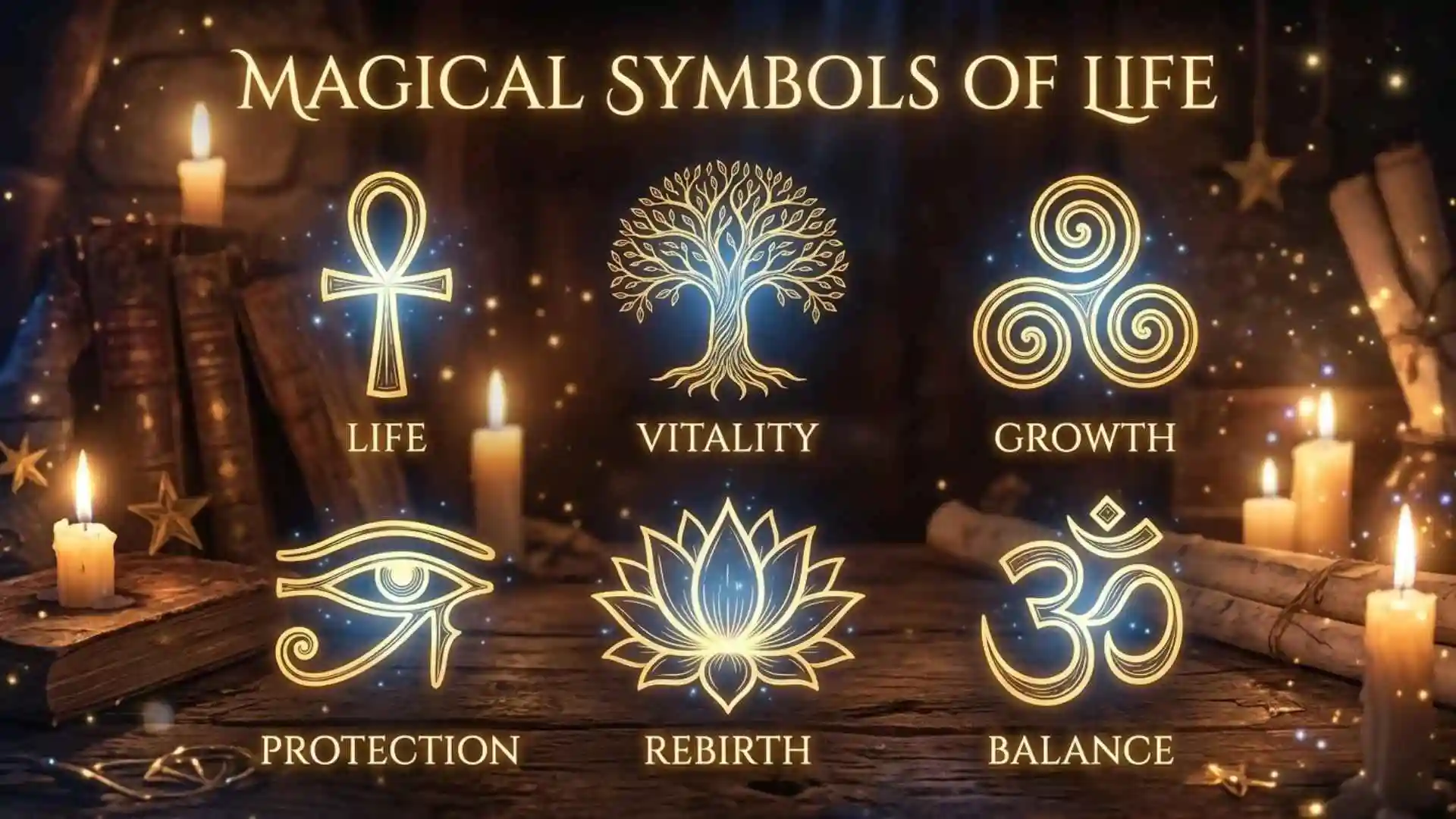
Magical symbols are visual signs believed to represent spiritual forces, protective powers, sacred ideas, supernatural beings, or a person’s intentions. They appear in ancient amulets, religious manuscripts, ritual tools, architecture, jewelry, tattoos, fantasy stories, and modern spiritual practices.
A magical symbol does not have one universal meaning. A pentagram, eye, spiral, knot, rune, or geometric seal may represent protection in one tradition, divine order in another, and danger in popular entertainment. Its meaning depends on its direction, design, cultural origin, historical period, and intended use.
Understanding magical symbols therefore requires more than recognizing their shapes. Their real significance comes from the stories, beliefs, rituals, and communities connected to them.
Quick Meaning
Magical symbols are images, marks, letters, or geometric designs used to represent invisible powers, spiritual beliefs, protection, transformation, identity, or intention. Some come from established religions, while others belong to folklore, ceremonial magic, modern occult traditions, or fictional worlds. Their meanings vary widely and should always be interpreted in context.
Magical Symbols Overview Table
| Field | Details |
| Collective Name | Magical symbols, occult symbols, sacred signs, ritual symbols |
| Primary Meaning | Protection, power, intention, transformation, spiritual connection, or cosmic order |
| Main Categories | Amulets, talismans, sigils, seals, sacred geometry, runes, planetary signs |
| Earliest Origins | Prehistoric markings and ancient religious imagery |
| Major Cultures | Egyptian, Mesopotamian, Greek, Roman, Jewish, Christian, Islamic, Celtic, Norse, African, Asian, and Indigenous traditions |
| Common Historical Uses | Healing, protection, divination, burial, prayer, ritual, authority, and identification |
| Modern Uses | Jewelry, tattoos, art, meditation, spirituality, gaming, film, literature, and branding |
| Unicode | Varies by individual symbol |
| Emoji Equivalent | No single equivalent; stars, eyes, moons, hands, and geometric emojis are sometimes used |
| Related Symbols | Pentagram, Eye of Horus, ankh, triquetra, runes, sigils, hexagram, spiral, ouroboros |
What Do Magical Symbols Mean?
Magical symbols generally represent the idea that a visible form can communicate with, embody, or influence an invisible reality. A symbol may stand for a deity, planet, element, spirit, protective force, personal goal, or principle such as balance, rebirth, wisdom, or transformation.
In many traditions, the symbol is not considered powerful merely because of its appearance. Its effectiveness may depend on several factors:
- Who created or blessed it
- The materials used
- The words or prayers connected to it
- Where it is placed
- When it is used
- The intention of the practitioner
- The religious or ritual tradition behind it
This distinction is important. A museum photograph of an ancient amulet and an amulet worn during a ceremony may display the same image, but their functions are not identical. One is being observed as an artifact; the other is participating in a living system of belief.
Magical symbols can serve four major purposes.
Protection
Protective signs are intended to guard people, homes, children, travelers, animals, or possessions from illness, misfortune, hostile spirits, envy, or the evil eye.
Ancient Egyptian amulets, for example, represented gods, animals, sacred objects, and hieroglyphic forms. Their materials, colors, and shapes could contribute to their intended protective or regenerative function.
Representation
Some symbols identify supernatural beings or cosmic powers. Planetary signs represent celestial bodies, while seals and sigils may identify angels, spirits, demons, or divine names within particular magical texts.
Transformation
Symbols may express a desired change, such as healing, prosperity, courage, love, knowledge, or spiritual growth. In modern sigil practices, a person may transform a written intention into an abstract design used for concentration.
Connection
Sacred and magical signs can connect practitioners with ancestors, deities, natural forces, mythic stories, or a larger spiritual order. Their role may be devotional rather than controlling.
History and Origin of Magical Symbols
Magical symbols did not begin in one place or civilization. They developed independently in many societies as people used images, marks, gestures, objects, and written signs to communicate with forces they believed shaped life.
Prehistoric Beginnings
Prehistoric rock art contains handprints, animals, geometric patterns, spirals, dots, and human-animal figures. Scholars cannot confidently label all such images “magical,” because their creators left no written explanations.
Some may have recorded hunting, territory, identity, memory, ritual, storytelling, or spiritual experience. The safest interpretation is that early visual symbols often carried social and ceremonial meaning, but their exact purposes remain uncertain.
Ancient Mesopotamia
In Mesopotamia, ritual specialists used figurines, inscriptions, cylinder seals, amulets, and images of supernatural beings. These objects could be placed in homes, worn on the body, or used in ceremonies intended to prevent disease and spiritual attack.
First-millennium BCE Mesopotamian protective traditions included amulets associated with Lamashtu, a feared figure believed to threaten pregnant women and infants. Related ritual images were designed not simply as decoration but as part of a system of protection and healing.
Ancient Egypt
The ancient Egyptians did not sharply separate religion, medicine, and magic in the modern Western sense. The concept called heka referred to a power involved in creation, ritual practice, healing, and divine activity.
Egyptian amulets took the forms of animals, gods, body parts, plants, royal objects, and hieroglyphic signs. The Eye of Horus, scarab, ankh, djed pillar, and tyet knot are among the best-known examples.
The wedjat, commonly called the Eye of Horus, represented the restored eye of Horus and became associated with healing, wholeness, rebirth, and protection.
Greece and Rome
Greek and Roman communities used inscribed gems, curse tablets, protective charms, divine names, astrological signs, and combinations of letters and images. Some magical gems blended Egyptian, Greek, Roman, Jewish, and Near Eastern elements.
These objects demonstrate that magical traditions often crossed cultural and linguistic boundaries. A single artifact could combine Greek writing, Egyptian deities, planetary imagery, and names derived from other religious traditions.
Medieval and Renaissance Europe
During the medieval and Renaissance periods, magical symbolism became closely linked with astrology, alchemy, Christian prayer, Jewish mystical traditions, Arabic scientific writing, and ceremonial manuals.
Diagrams represented planets, angels, elements, metals, divine names, and mathematical relationships. Some users viewed these designs as lawful expressions of divine order, while religious authorities sometimes condemned other practices as superstition, heresy, or demonic magic.
The Rise of the Sigil
The word sigil comes from a term related to a seal or sign. Historically, sigils often functioned as symbolic signatures associated with particular spiritual beings.
In twentieth-century occult practice, artist and writer Austin Osman Spare helped popularize a different method. A written desire could be reduced and rearranged into a personal abstract mark intended to focus the subconscious mind.
This modern approach greatly influenced later chaos magic and contemporary personal-symbol practices.
Magical Symbols Today
Today, magical symbols circulate through books, online communities, tattoos, fashion, jewelry, music, film, games, and social media. Some users approach them as sacred signs. Others value them as psychological tools, cultural heritage, artistic motifs, or fictional imagery.
As symbols move between communities, their meanings often change. A sign that once belonged to a specific ritual tradition may become a general symbol of mystery, rebellion, protection, or personal identity.
Symbolism and Interpretation
Magical symbols are interpreted through several overlapping systems. The same design can carry historical, religious, psychological, artistic, and popular meanings at once.
Traditional Meanings
Traditional meanings develop within established communities. They may be preserved through ritual texts, oral teachings, myths, religious art, or repeated ceremonial use.
Examples include:
- The Eye of Horus as healing and restored wholeness
- The ankh as life
- The djed pillar as stability
- The pentagram as harmony, protection, or the five elements
- The ouroboros as recurring time, renewal, and unity
- Runes as letters that may also carry symbolic associations
A traditional interpretation should be connected to evidence from the culture that used the symbol. Modern meanings should not automatically be projected backward onto ancient objects.
Modern Meanings
Modern spiritual movements frequently reinterpret older signs. Pentagrams may represent the elements, nature, human wholeness, or contemporary Pagan identity. Spirals may signify personal growth. Moon phases may represent cycles, change, or feminine spirituality.
These meanings can be meaningful to modern users even when they differ from ancient interpretations. The key is to identify them honestly as later developments rather than timeless facts.
Positive Symbolism
Many magical symbols are associated with:
- Protection
- Healing
- Wisdom
- Balance
- Fertility
- Courage
- Good fortune
- Transformation
- Spiritual awakening
- Connection with nature
Protective symbols are especially common because illness, uncertainty, childbirth, warfare, travel, and death have always created a desire for reassurance and control.
Negative Symbolism
A magical symbol may also represent danger, destruction, binding, cursing, death, forbidden knowledge, or hostile spiritual forces.
However, negative interpretations are often shaped by outsiders, religious conflict, political propaganda, or horror entertainment. A symbol that appears frightening in a film may have a peaceful or protective meaning in its original tradition.
Psychological Interpretation
From a psychological perspective, symbols condense complex emotions and ideas into memorable images. A person may use a symbol to focus attention, reinforce a goal, manage fear, express identity, or make an abstract belief feel tangible.
This does not prove that the sign has supernatural power. It explains why symbols can influence thought and behavior even for people who interpret them nonreligiously.
A protective charm, for example, may provide comfort because it reminds the wearer of family, faith, survival, or personal resilience.
Cultural Significance of Magical Symbols
Different cultures do not divide religion, magic, medicine, science, and superstition in the same way. The label “magical” may therefore reflect an outsider’s classification rather than the community’s own understanding.
Egyptian Traditions
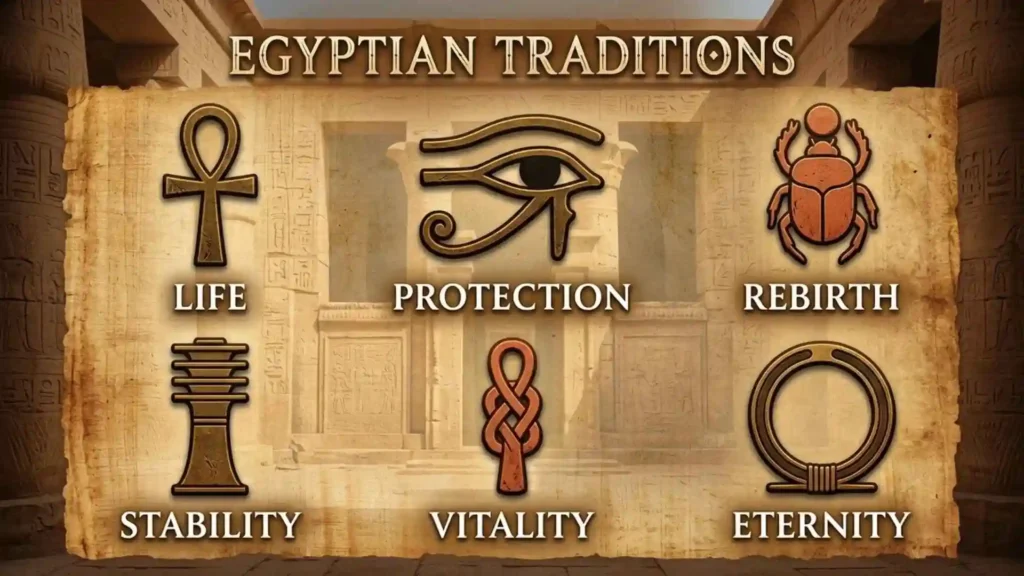
Egyptian sacred images often connected mythology with practical protection. Amulets were worn in life, placed on mummies, or included in funerary settings. Their forms referred to gods, bodily restoration, royal power, regeneration, and safe passage into the afterlife.
Mesopotamian Traditions
Mesopotamian protective images frequently addressed specific threats. Rituals could identify a harmful being, represent it visually, and use prayers or objects to restrict its influence.
The symbol’s power came from its place within a complete ritual system, not from its shape alone.
Jewish Traditions
Jewish communities historically used biblical verses, divine names, angelic names, protective texts, and geometric designs in some amuletic traditions. Practices varied widely by region and period.
The hexagram became strongly associated with Jewish identity relatively late compared with many older Jewish symbols. It should not be treated as an exclusively magical sign or as an eternal emblem with one unchanging meaning.
Christian Traditions
Crosses, sacred monograms, images of saints, relics, medals, and written prayers have served protective or healing purposes for many Christians. Participants usually understand these objects through divine grace and faith rather than independent magical force.
The boundary between devotional object and magical charm has often been debated. The same object may be called sacramental by one person and superstitious by another.
Islamic Cultures
In different Islamic societies, calligraphy, Qur’anic verses, numerical arrangements, geometric patterns, and written amulets have sometimes been used for protection or healing.
Islamic scholars have disagreed about such practices. Some permitted limited uses involving scripture and prayer, while others rejected amulets because they could encourage superstition or reliance on something other than God.
European Folk Traditions
European homes, barns, tools, and household objects sometimes carried carved circles, crosses, daisy-wheel patterns, initials, or protective inscriptions. These marks are often called apotropaic symbols, meaning signs intended to turn away harm.
Not every unusual mark in an old building is magical, however. Some may be builders’ marks, ownership signs, decorations, measurements, or later scratches.
Asian Traditions
Asian cultures contain many protective written and visual traditions, including Daoist talismans, Buddhist seed syllables, mandalas, Japanese temple amulets, Hindu yantras, and sacred calligraphy.
These systems should not be collapsed into a single category. A yantra, mandala, mantra syllable, and protective paper charm differ in theology, design, ritual use, and cultural setting.
Indigenous Traditions
Indigenous symbols belong to living communities with their own histories, rules, and sacred responsibilities. Designs described by outsiders as magical may represent ancestors, clans, landscapes, ceremonial knowledge, or relationships with nonhuman beings.
Copying such symbols without understanding permission, ownership, or meaning can be disrespectful. Some designs are public, while others may be restricted to particular families, roles, or ceremonies.
Religious and Spiritual Meaning
Magical symbols often stand at the meeting point of religion, spirituality, ritual, and personal belief. Their spiritual meanings usually fall into several broad categories.
Divine Presence
A symbol may represent a deity, sacred name, angel, spirit, or cosmic principle. It serves as a visual reminder of a presence that cannot be shown directly.
Protection and Blessing
Protective signs may be worn, carried, displayed above doors, placed near beds, buried beneath buildings, or included in funerary rites.
Prayer and Meditation
Geometric designs, written characters, or repeated patterns can guide concentration. The user may trace, visualize, contemplate, or arrange the symbol during prayer.
Initiation and Identity
Some symbols identify membership in a religious, magical, or esoteric group. Their full meanings may be taught gradually through initiation.
Ritual Authority
Seals, staffs, rings, robes, and diagrams can signal a practitioner’s role or define a sacred space. In ceremonial traditions, drawing a boundary may symbolically separate ordinary space from ritual space.
Scientific, Mathematical, and Digital Meanings
Magical symbolism often borrows from mathematics, astronomy, medicine, and technology, but the same image may have a completely nonmagical technical meaning.
Geometry
Circles, triangles, squares, stars, and intersecting lines are common because geometry creates order, symmetry, proportion, and visual boundaries.
A circle may represent unity or protection in a ritual context, yet in mathematics it is simply the set of points at a fixed distance from a center.
Astronomy and Astrology
Planetary symbols identify celestial bodies in astronomy and planets in astrology. Their visual forms may be identical, but their functions differ.
Astronomy studies physical objects and processes using scientific evidence. Astrology interprets celestial positions symbolically. Confusing the two can create misleading claims.
Alchemy and Chemistry
Alchemy used symbols for metals, planets, substances, and processes. Some early chemical notation developed within environments influenced by alchemical writing.
Modern chemistry, however, uses standardized element symbols such as Au for gold and Fe for iron. These are scientific abbreviations, not magical signs.
Medicine
The rod of Asclepius, showing one serpent around a staff, is associated with medicine through Greek tradition. It is sometimes confused with the caduceus, which has two snakes and wings.
Neither image is inherently magical in modern medical use, although the serpent and staff have ancient mythological and healing associations.
Digital Culture
In digital spaces, magical symbols appear in usernames, game interfaces, fantasy art, profile designs, and Unicode character combinations. Their visual similarity to historical signs does not guarantee that their online use preserves the original meaning.
A symbol used in a video game may be invented, modified, or combined with unrelated traditions for dramatic effect.
Where Magical Symbols Are Used
Magical symbols appear in both sacred and everyday environments.
Amulets and Talismans
An amulet is generally worn or carried for protection. A talisman is often understood as an object prepared to attract a particular benefit, although historical usage varies.
Jewelry
Pendants, rings, bracelets, and earrings may feature eyes, stars, moons, crosses, knots, hands, runes, or sacred geometric designs. Wearers may choose them for faith, heritage, protection, fashion, or personal meaning.
Tattoos
Magical-symbol tattoos can express transformation, grief, resilience, spirituality, identity, or fascination with mythology. Before choosing one, the wearer should research orientation, cultural origin, religious significance, and possible extremist appropriation.
Architecture
Protective marks may appear near doors, windows, fireplaces, foundations, or roof beams. Sacred geometry can also shape temples, churches, mosques, shrines, gardens, and ceremonial spaces.
Books and Manuscripts
Grimoires, prayer books, astrological manuals, alchemical works, and ritual texts contain circles, seals, diagrams, alphabets, and coded signs.
Art and Literature
Artists and writers use magical symbols to suggest mystery, hidden knowledge, destiny, danger, transformation, or contact with another world.
Film, Television, and Games
Entertainment frequently invents symbols or alters historical ones. These designs may look ancient while having no authentic historical source.
Logos and Branding
Stars, eyes, triangles, spirals, and alchemical-looking forms appear in branding because they communicate mystery, vision, energy, transformation, or exclusivity. A resemblance to an occult sign does not prove secret religious involvement.
Common Types and Variations
Pentagram and Pentacle
A pentagram is a five-pointed star formed by intersecting lines. A pentacle is often a pentagram enclosed within a circle, although historical terminology varies.
Upright versions may symbolize harmony, protection, humanity, or the elements in modern Pagan traditions. Inverted forms have acquired different meanings in occult movements and popular culture. Orientation alone does not provide a complete interpretation.
Hexagram
The hexagram consists of two overlapping triangles. It appears in Jewish identity as the Star of David, but similar forms also occur in Islamic, Hindu, Buddhist, alchemical, and decorative contexts.
Sigils and Seals
A sigil may identify a spiritual being or encode a personal intention. A seal may authenticate, authorize, contain, or represent something. In magical texts, the terms sometimes overlap.
Runes
Runes were letters used in Germanic writing systems. Later traditions assigned divinatory and magical meanings to them.
Because runes are also historical letters, not every runic inscription is magical. Some were ordinary records, names, memorials, or ownership marks.
Sacred Eyes
Eye symbols include the Eye of Horus, Eye of Providence, evil-eye charms, and modern stylized eyes. Although visually related, they come from different histories.
Spirals and Knots
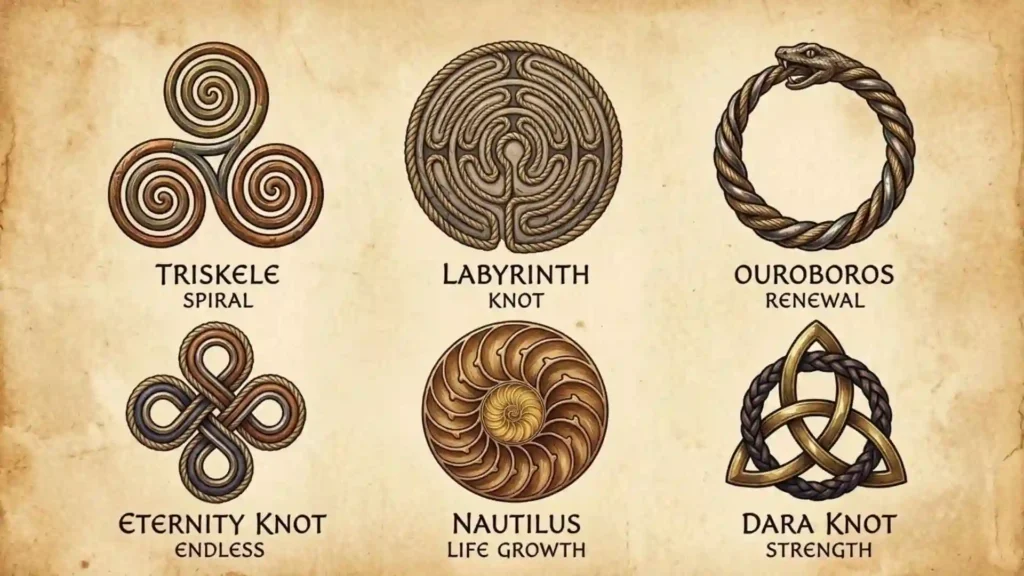
Spirals may represent movement, cycles, life, or growth in modern interpretation. Knots can signify continuity, binding, protection, eternity, or interconnectedness.
Specific meanings must be based on a documented tradition rather than the shape alone.
Circles and Triangles
Circles may define sacred space, unity, eternity, or containment. Triangles may represent groups of three, elements, ascent, descent, or divine relationships.
Their meaning changes according to orientation, surrounding text, color, and context.
Common Misconceptions About Magical Symbols
Every Ancient Symbol Was Magical
Ancient people also used symbols for writing, trade, decoration, government, ownership, measurement, and storytelling. An old or mysterious appearance does not prove magical use.
One Symbol Has One Universal Meaning
Symbols change across cultures and centuries. The same star, eye, hand, cross, or spiral may have unrelated meanings in different settings.
The Pentagram Is Always Satanic
The pentagram existed long before modern Satanic movements. It has been used in mathematical, philosophical, Christian, protective, occult, and modern Pagan contexts.
Its meaning depends on period, orientation, surrounding imagery, and community.
All Sigils Are Ancient
Many online sigils are newly created. Some derive from early modern ceremonial texts, while others come from twentieth-century occultism, fictional media, or individual artists.
Similar Appearance Proves Cultural Connection
Two cultures may independently create circles, spirals, crosses, hands, or stars because these are simple and visually powerful forms. Similarity does not automatically prove contact or shared origin.
Symbols Work Independently of Context
In historical practice, symbols were often combined with spoken words, written prayers, rituals, materials, timing, and social authority. Treating the design as an isolated code oversimplifies its function.
A Symbol in a Logo Reveals a Secret Group
Companies often use geometric shapes because they are memorable and easy to reproduce. Claims of secret affiliation require reliable evidence beyond visual resemblance.
Magical Means Evil
Magic has been associated with healing, protection, blessing, divination, cursing, entertainment, fraud, and religious devotion. The term covers too many practices to carry one moral meaning.
Interesting Facts About Magical Symbols
- Many magical objects combined text and image. Ancient and medieval amulets could include divine names, prayers, drawings, numbers, and unfamiliar words because multiple forms of sacred authority were believed to strengthen the object.
- Materials could carry meaning. Gold, iron, stone, bone, clay, colored glass, plants, and animal materials were selected not only for appearance but also for durability, rarity, mythic associations, or supposed protective qualities.
- Placement was often as important as design. A mark above a doorway served a different purpose from the same image placed in a grave, worn on the neck, or hidden beneath a floor.
- Protective magic often addressed ordinary fears. Historical charms focused on childbirth, disease, travel, crop failure, dangerous animals, nightmares, theft, and uncertain weather.
- Some symbols were deliberately difficult to read. Secret alphabets, compressed letters, mirrored writing, and complex seals could create authority, conceal knowledge, or distinguish trained practitioners from outsiders.
- Magical traditions frequently borrowed from one another. Trade, conquest, migration, translation, and religious contact allowed names and images to move between Egyptian, Greek, Roman, Jewish, Christian, Islamic, and other communities.
- The Eye of Horus represented restoration, not merely observation. Its mythic association with an injured eye made whole helps explain its links to healing and rebirth.
- A symbol can remain stable while its meaning changes. The five-pointed star has appeared in mathematical, religious, political, military, magical, and entertainment settings.
- Museums classify thousands of amulets from many regions. Such collections show that protective objects are not limited to one religion or civilization. The British Museum’s collections include amuletic objects from Africa, Asia, Europe, the Middle East, and the Americas.
- Modern fantasy often creates false antiquity. Designers combine weathered textures, geometric forms, invented alphabets, and familiar sacred motifs to make new symbols appear historically ancient.
Related Magical and Sacred Symbols
Eye of Horus
An ancient Egyptian symbol connected with healing, restoration, protection, and rebirth. It differs from the evil-eye charm, which is intended to repel harmful envy or hostile attention.
Ankh
An Egyptian hieroglyphic sign commonly interpreted as life. Gods are often shown holding it in religious imagery.
Ouroboros
A serpent or dragon biting its tail. It commonly represents cycles, renewal, unity, and self-contained existence.
Triquetra
A three-part interlaced design used in various decorative and religious contexts. Modern interpretations include eternity, interconnectedness, and triple spiritual concepts.
Hamsa
A hand-shaped protective symbol found in Jewish, Muslim, Middle Eastern, and North African settings. It is often associated with blessing and defense against the evil eye.
Evil Eye
An eye-shaped charm intended to repel harmful envy or misfortune. Its best-known modern forms often use blue-and-white concentric circles.
Valknut
A design of three interlocking triangles associated with Viking Age imagery and the god Odin in modern interpretation. Its precise historical meaning remains uncertain.
Yantra
A geometric diagram used in Hindu ritual and meditation. Yantras represent particular deities, cosmic principles, or spiritual processes and should not be treated as generic occult decorations.
Mandala
A structured sacred diagram associated especially with Hindu and Buddhist traditions. It may represent the cosmos, a sacred realm, or a path of contemplation.
Planetary Symbols
Signs for the Sun, Moon, Mercury, Venus, Mars, Jupiter, and Saturn appear in astronomy, astrology, alchemy, gender notation, and esoteric traditions.
Frequently Asked Questions
What are magical symbols?
Magical symbols are visual signs used to represent spiritual forces, protective powers, supernatural beings, sacred ideas, or personal intentions. They include amulets, sigils, seals, runes, geometric diagrams, divine names, and planetary marks. Their meanings depend on the culture, historical period, ritual system, and purpose in which they appear.
What is the most powerful magical symbol?
There is no objectively most powerful magical symbol. Different traditions consider different signs sacred or effective. A symbol’s importance may depend on faith, ritual preparation, cultural authority, prayer, intention, and community teaching. Claims that one design is universally strongest usually come from modern marketing, fiction, or personal belief rather than historical agreement.
What symbol represents protection?
Common protective symbols include the Eye of Horus, hamsa, evil-eye charm, pentacle, cross, protective runes, sacred names, and various amulets. These signs do not belong to one universal system. Each has its own cultural history, and some are religious symbols rather than magical symbols in the eyes of their users.
What is the difference between a sigil and a symbol?
A symbol communicates an idea through a recognizable form. A sigil is a more specific type of sign, historically associated with a spiritual being, authority, or seal. In modern occult practice, a sigil may encode a person’s intention in an abstract design. Every sigil is a symbol, but not every symbol is a sigil.
Are magical symbols connected to witchcraft?
Some magical symbols are used in witchcraft, but many are not. They may come from ancient religion, folk healing, ceremonial magic, astrology, alchemy, modern Paganism, household protection, or fictional entertainment. Witchcraft itself includes diverse traditions, so no single collection of signs represents every practitioner.
Is the pentagram an evil symbol?
The pentagram is not inherently evil. It has appeared in ancient geometry, philosophy, Christian symbolism, ceremonial magic, modern Paganism, and other settings. Some inverted forms are used by particular Satanic or occult groups, but shape and orientation must be interpreted alongside the symbol’s cultural and historical context.
Can magical symbols be used as tattoos?
They can be used as tattoos, but careful research is essential. A design may have religious, cultural, political, or funerary meanings that are not obvious online. Check its original source, correct orientation, spelling, historical use, and modern associations. Avoid copying restricted sacred imagery or symbols connected with extremist movements.
Are runes magical symbols or an alphabet?
Runes are first and foremost letters from historical Germanic writing systems. Some inscriptions had religious or magical purposes, while others recorded names, ownership, memorials, or ordinary messages. Modern divination systems assign symbolic meanings to individual runes, but those systems should not be confused with every historical use of runic writing.
Do magical symbols have scientifically proven supernatural power?
Scientific research has not established that drawn symbols independently produce supernatural effects. Symbols can still have psychological, cultural, artistic, and social power. They may focus attention, reinforce identity, reduce anxiety, support ritual participation, or remind people of deeply held beliefs, even when their effects are explained without supernatural claims.
How can I identify an unknown magical symbol?
Begin by recording its exact shape, orientation, colors, surrounding letters, material, location, and source. Use museum databases, academic references, religious authorities, or specialist symbol dictionaries. Avoid relying on image similarity alone because simple geometric forms appear in many unrelated cultures and may also be decorative, technical, or fictional.
Key Takeaways
- Magical symbols represent protection, intention, spiritual forces, transformation, identity, or cosmic order.
- No single meaning applies to every culture, religion, or historical period.
- Ancient Egypt and Mesopotamia used amulets and ritual images for healing and protection.
- Sigils may identify spiritual beings or encode modern personal intentions.
- Pentagrams, eyes, runes, circles, and triangles must be interpreted in context.
- Religious symbols should not automatically be labeled occult or evil.
- Similar-looking designs do not always share a common origin.
- Historical evidence should be separated from modern spiritual interpretation.
- Symbols may have psychological and cultural influence without scientifically proven supernatural power.
- Respectful use requires research into cultural ownership, sacred meaning, and modern associations.
Conclusion
Magical symbols are visual bridges between human experience and the unseen ideas people use to explain protection, danger, healing, destiny, identity, and spiritual power. Their importance does not come from shape alone. It comes from the myths, prayers, rituals, materials, communities, and historical circumstances that give the shape meaning.
From Egyptian amulets and Mesopotamian protective images to medieval seals, personal sigils, sacred geometry, jewelry, tattoos, and fantasy art, these signs reveal a lasting human desire to make invisible forces visible.
The best way to understand magical symbols is therefore not to search for one secret universal code. It is to examine each symbol carefully, identify its culture and period, distinguish documented history from later interpretation, and respect the people for whom it remains sacred.

I am Amelia Carter, an English language educator and educational writer who enjoys making difficult ideas simple and easy to understand. At LearnNestly, I write about English words, grammar, everyday expressions, and language questions that people often find confusing. I believe learning should feel practical, clear, and enjoyable rather than overwhelming. Through my writing, I try to give readers explanations they can understand and use in real life.
Books:
- The Everyday English Handbook
- Words Made Simple
 Ethan Mitchell
 Daniel Brooks