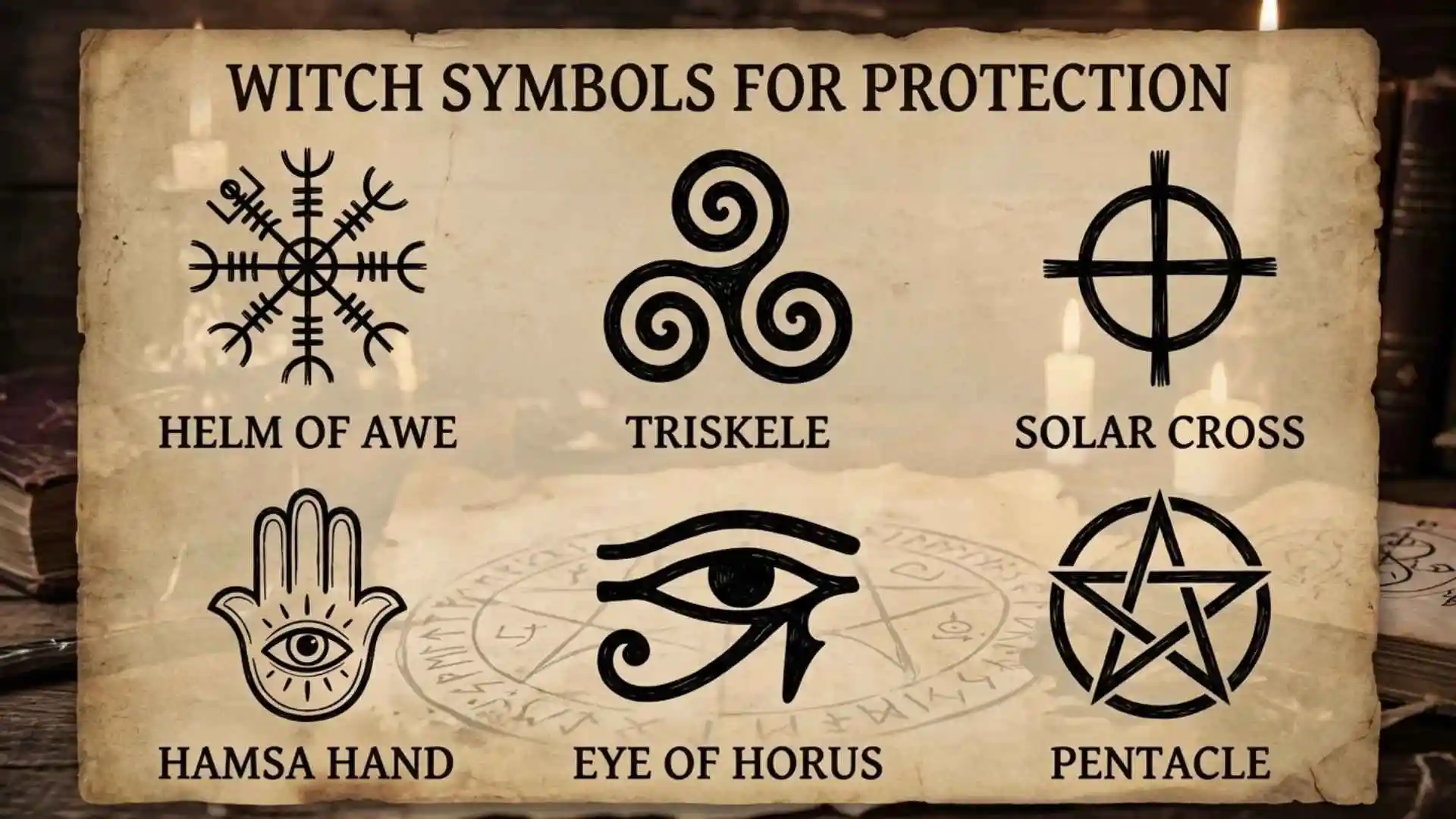
Witch symbols for protection are visual signs used to represent safety, boundaries, spiritual defense, balance, and the removal of harmful influences. Common examples include the pentacle, protective circle, witch’s knot, hexafoil, triquetra, evil eye, hamsa, and personalized sigils.
You may encounter these symbols on jewelry, altar cloths, doors, candles, tattoos, historic buildings, books, or modern spiritual artwork. However, they do not all come from the same religion or historical period. Some belong to modern witchcraft, while others originated in Christianity, Judaism, Islam, ancient Mediterranean cultures, European folk traditions, or contemporary occult practices.
Understanding their differences helps prevent cultural confusion and reveals how people across history have used geometry, sacred signs, and repeated patterns to create a sense of protection.
Quick Meaning of Witch Symbols for Protection
Witch symbols for protection represent spiritual boundaries, safety, balance, and resistance to harmful forces. Practitioners may draw, wear, carve, or display them as reminders of protective intentions. Their meanings vary widely: some come from modern witchcraft, while others developed as religious emblems, folk charms, architectural marks, or symbols against misfortune.
Witch Protection Symbols Overview
| Symbol | Primary Meaning | Cultural or Spiritual Background | Common Modern Use |
| Pentacle | Balance, wholeness, protection | Western esotericism, Wicca, modern Paganism | Jewelry, altars, ritual tools |
| Pentagram | Fivefold harmony, spiritual order | Ancient geometry, Western magic | Ritual diagrams, art, amulets |
| Protective Circle | Sacred boundary and containment | Ceremonial magic, folk magic, modern witchcraft | Meditation and ritual spaces |
| Witch’s Knot | Binding or blocking harmful influence | European-inspired folk symbolism | Charms, jewelry, door decorations |
| Hexafoil or Daisy Wheel | Protective order and endless movement | European architectural folk tradition | Buildings, crafts, modern talismans |
| Triquetra | Interconnection and threefold unity | Insular art, Christianity, modern Paganism | Necklaces, tattoos, spiritual art |
| Evil Eye or Nazar | Defense against envy and harmful attention | Mediterranean, Middle Eastern, Balkan traditions | Amulets, home decor, jewelry |
| Hamsa | Blessing and protection from harm | Jewish, Islamic, and Middle Eastern traditions | Wall hangings, jewelry, amulets |
| Protective Sigil | Personalized protective intention | Modern occultism and chaos magic | Paper charms, candles, digital art |
| Bindrune | Combined symbolic intention | Modern rune-based spirituality | Jewelry, carvings, artwork |
| Solar Cross | Life, cycles, light, cosmic order | Prehistoric and historic cultures | Pagan art, seasonal symbolism |
| Crossed Spears or Arrows | Defense and guarded boundaries | Modern symbolic design | Protective emblems and tattoos |
What Do Witch Symbols for Protection Mean?
Witch symbols for protection generally express the intention to create safety, establish boundaries, or turn away unwanted influence. Their protective meaning may be spiritual, emotional, psychological, social, or symbolic.
In modern witchcraft, protection rarely has one universal definition. One practitioner may use a pentacle to represent balanced elemental forces. Another may draw a circle to mark a calm, focused space. Someone else may create a sigil as a private reminder to maintain emotional boundaries.
Historically, protective signs were often apotropaic. The word apotropaic describes something intended to avert, repel, or turn away evil or misfortune. People placed such marks near doors, windows, roofs, barns, fireplaces, and other vulnerable points.
Historic England documents ritual protection marks in medieval and later churches, homes, barns, and caves. These marks were commonly placed around entrances and fireplaces, where harmful spirits were believed to enter.
Protection symbols can therefore serve several related purposes:
- Marking a boundary
- Representing spiritual balance
- Blocking harmful intentions
- Deflecting envy or misfortune
- Invoking divine or sacred protection
- Focusing the mind on safety
- Expressing membership in a spiritual tradition
- Decorating an object with protective meaning
A symbol does not have one automatic power or interpretation. Its meaning depends on its history, cultural setting, orientation, design, and the intention of the person using it.
History and Origins of Protective Witch Symbols
Protective symbolism is much older than modern witchcraft. Human communities have used carved marks, amulets, sacred names, geometric patterns, animal images, hand gestures, and religious emblems for thousands of years.
Ancient protective signs appeared on pottery, coins, jewelry, buildings, burial objects, household items, and ritual tools. These signs were not necessarily called “witch symbols.” Instead, they belonged to local religious systems, magical customs, healing traditions, or everyday folk beliefs.
Ancient Geometric Protection
Circles, stars, crosses, spirals, and interwoven lines appear in many civilizations. Their repeated geometry often suggested completeness, continuity, celestial order, or controlled space.
The pentagram, for example, existed long before Wicca. Archaeological and museum collections show five-pointed stars on ancient objects, including Greek coins and stamped artifacts from the ancient Near East. A Greek silver coin from approximately the fifth century BCE includes a linear pentagram, while a jar handle associated with Persian-period Jerusalem bears a five-pointed star.
These examples prove the symbol’s antiquity, but they do not show that every ancient pentagram had the same protective meaning. Symbols can serve administrative, decorative, religious, mathematical, or identifying purposes in different settings.
Medieval and Early Modern Europe
In medieval and early modern Europe, people carved protective designs into buildings. Common examples included overlapping circles, mesh-like patterns, crosses, initials, and hexafoils known as daisy wheels.
These marks often appeared close to thresholds, fireplaces, windows, roof beams, and concealed spaces. Their locations suggest that many were intended to guard places thought to be vulnerable.
Historic England identifies “egg-timer” shapes and daisy wheels among the apotropaic marks found in seventeenth-century buildings. Such designs were traditionally believed to protect structures from witches, spirits, or supernatural harm.
Importantly, these historical “witch marks” were usually marks against witchcraft, not signs used by self-identified witches.
Nineteenth- and Twentieth-Century Occult Revival
Interest in ceremonial magic, folklore, spiritualism, secret societies, ancient religions, and esoteric philosophy grew during the nineteenth and early twentieth centuries. Writers and occult organizations reinterpreted older symbols and placed them within new ritual systems.
The pentagram became especially prominent in Western ceremonial magic. Its points were assigned to elements, directions, divine names, or stages of spiritual development.
Modern Wicca and Contemporary Witchcraft
Wicca developed publicly in Britain during the twentieth century and helped popularize the pentacle as a symbol of modern Pagan identity. In many Wiccan traditions, the five points represent earth, air, fire, water, and spirit, while the surrounding circle represents unity or wholeness.
Contemporary witchcraft is highly diverse. It includes Wiccan traditions, folk-inspired practices, secular witchcraft, reconstructionist Pagan paths, ceremonial systems, eclectic spirituality, and personal symbolic practices. As a result, no single protective symbol represents every witch.
Major Witch Symbols for Protection and Their Meanings
1. Pentacle
The pentacle is one of the most widely recognized witch protection symbols. It usually consists of an upright five-pointed star enclosed within a circle.
In many modern Pagan and Wiccan interpretations, the points represent:
- Earth
- Air
- Fire
- Water
- Spirit
The enclosing circle can represent unity, eternity, interconnection, or a protective boundary. Together, the design symbolizes balanced forces held within an ordered whole.
The pentacle may be worn as a necklace, placed on an altar, engraved on ritual tools, or displayed as an emblem of faith. It is not automatically a symbol of evil or harmful magic.
Modern reference works identify the pentacle as one of Wicca’s most visible symbols and distinguish it from common assumptions that every pentacle is Satanic.
2. Pentagram
A pentagram is a five-pointed star drawn with five connecting lines. Technically, a pentagram does not require an enclosing circle. When a circle surrounds it, many modern users call the design a pentacle.
Mathematically, the regular pentagram is the star polygon {5/2}. Its lines produce symmetrical relationships, including proportions connected with the golden ratio.
Symbolically, an upright pentagram may represent harmony, humanity, health, elemental balance, or spiritual authority over material forces.
Its exact meaning depends on context. A pentagram on an ancient coin, medieval manuscript, ceremonial diagram, national emblem, or modern necklace may carry completely different meanings.
3. Protective Circle
The protective circle represents a defined sacred boundary. It is one of the simplest and most universal forms used in ritual symbolism.
In modern witchcraft, a practitioner may visualize, trace, or physically mark a circle before meditation or ceremonial work. The circle can represent:
- A protected spiritual space
- Separation from distraction
- Containment of ritual energy
- Unity and completeness
- The cycle of life and nature
- A boundary between ordinary and sacred activity
A protective circle should not be understood as a scientific barrier. Its value is religious, ritual, symbolic, and psychological. Creating a boundary can help a person focus, feel grounded, and approach a ceremony with intention.
4. Witch’s Knot
The witch’s knot is usually shown as an interwoven four-loop design. It is commonly interpreted today as a symbol that binds, traps, or blocks harmful influence.
Its unbroken lines may symbolize continuity, while the overlapping loops suggest that negative forces become confused or caught within the pattern.
Modern practitioners use the witch’s knot on:
- Door charms
- Jewelry
- Protective drawings
- Embroidery
- Candle designs
- Home decorations
- Personal sigils
Claims that one standardized witch’s knot was universally used by ancient witches are difficult to support. The familiar modern form draws from broader traditions of knot magic, interlaced ornament, folk charms, and contemporary occult design.
5. Hexafoil or Daisy Wheel
The hexafoil is a six-petaled geometric flower created with overlapping circles. In British architectural history, similar marks are often called daisy wheels.
Daisy wheels have been found carved into beams, walls, churches, barns, and domestic buildings. Their endless, repeating geometry may have been viewed as a trap for harmful forces or as a sign of order that resisted chaos.
They were often positioned near entrances, fireplaces, or other structural openings. This placement supports their interpretation as apotropaic marks, although not every carved rosette necessarily had a magical purpose.
Today, the daisy wheel has been adopted into modern folk magic and witchcraft as a sign of household protection.
6. Triquetra
The triquetra consists of three connected arcs or pointed loops. Its name comes from Latin and refers to a three-cornered form.
The symbol appears in Insular art and medieval Christian decoration. Christian interpretations may connect it with the Trinity. Modern Pagans and witches may associate it with:
- Earth, sea, and sky
- Life, death, and rebirth
- Maiden, mother, and crone
- Mind, body, and spirit
- Past, present, and future
Because the line appears continuous, the triquetra can also symbolize eternal connection and protection through unity.
It should not be described as exclusively Celtic, Christian, Wiccan, or witch-related. Its meaning has changed across artistic and religious settings.
7. Evil Eye and Nazar
The evil eye is the belief that envy, jealousy, or hostile attention can bring misfortune. Protective eye-shaped amulets developed in numerous Mediterranean, Middle Eastern, North African, Balkan, and South Asian societies.
The blue-and-white glass charm often called a nazar is intended to deflect the evil eye. Contemporary witches may use eye imagery in protection work, but the tradition is not originally or exclusively a form of witchcraft.
The eye symbol can represent:
- Watchfulness
- Awareness
- Protection against envy
- Reflection of harmful intentions
- Divine observation
People should respect the living cultures in which evil-eye beliefs and amulets remain socially and religiously meaningful.
8. Hamsa
The hamsa is a hand-shaped protective emblem found in Jewish, Islamic, Middle Eastern, and North African cultural settings. It may be called the Hand of Fatima, Hand of Miriam, or simply hamsa, depending on the community.
An eye sometimes appears in the center of the palm. The symbol may represent blessing, divine guardianship, good fortune, patience, or defense against the evil eye.
Modern spiritual shops often market the hamsa as a “witch symbol,” but that label can erase its Jewish, Muslim, and regional cultural histories. Witches may adopt it respectfully, yet it should be identified as a cross-cultural protective amulet rather than an invention of modern witchcraft.
9. Protective Sigil
A sigil is a designed mark that represents a word, goal, name, spirit, or intention. Historical magical texts contain seals and characters associated with planets, angels, spirits, and sacred names.
In modern occultism, especially chaos magic, practitioners often create personalized sigils by simplifying a written intention into an abstract design.
A protective sigil might symbolize an idea such as:
- “This home is safe.”
- “My boundaries remain strong.”
- “Harm is turned away.”
- “I move with awareness.”
- “Peace surrounds this space.”
Personal sigils have no universal dictionary meaning. Their significance belongs to the creator or the system in which they were formed.
10. Bindrunes
A bindrune combines two or more rune shapes into one design. Historical bindrunes existed primarily as combined letters, abbreviations, decorative forms, names, or inscriptions.
Modern practitioners often combine runes symbolically to represent protection, success, courage, or healing. For example, Algiz is frequently interpreted in modern rune spirituality as a sign of defense or guarded awareness.
However, modern symbolic meanings do not always match historical runic evidence. A contemporary protection bindrune should be described as a modern spiritual construction unless its design can be traced to a documented inscription.
Some runic symbols have also been appropriated by extremist organizations. Context, orientation, and added imagery should therefore be examined before displaying an unfamiliar design.
11. Solar Cross
The solar cross consists of an equal-armed cross within a circle. Circle-and-cross designs have appeared in many archaeological and artistic settings.
Modern Pagan interpretations may connect the symbol with:
- The sun
- Seasonal cycles
- The four directions
- The four elements
- The wheel of the year
- Natural balance
Because the design appears in many unrelated traditions, it does not have one universal origin or meaning. It may function as a solar emblem, decorative form, astronomical sign, territorial mark, or religious motif.
12. Crossed Arrows or Spears
Crossed arrows, spears, staffs, or blades can symbolize active defense and guarded territory. Unlike the pentacle or hamsa, crossed weapons do not belong to one major protective tradition.
Modern witches and tattoo artists sometimes use them to represent:
- Readiness
- Courage
- Mutual protection
- Defense of boundaries
- Strength through cooperation
Their meaning depends largely on the surrounding design. Arrows pointing outward may suggest repelling danger, while arrows pointing inward may suggest concentrated focus.
Symbolism and Interpretation
Traditional Protection
Traditional protective symbols often worked by invoking sacred authority, confusing harmful forces, guarding an opening, reflecting danger, or trapping evil within an endless pattern.
A mark placed on a fireplace was meaningful because the chimney was considered an entry point. A charm worn on the body traveled with its owner. A sign carved above a door guarded the boundary between the public world and the household.
Modern Protection
Modern practitioners may interpret protection more broadly. Instead of focusing only on spirits or curses, they may use symbols to represent:
- Emotional boundaries
- Confidence
- Personal safety
- Recovery from stress
- Privacy
- Clear judgment
- Freedom from manipulation
- Protection from unwanted attention
This development reflects a shift from literal supernatural defense toward a combination of spiritual practice, self-reflection, and psychological grounding.
Positive Symbolism
Positive protective symbolism includes balance, stability, courage, foresight, community, sacred order, and respect for personal boundaries.
A protection symbol can remind someone to make thoughtful decisions, leave unsafe situations, secure their home, or seek support.
Negative Interpretations
Protective signs may be misunderstood as symbols of fear, danger, Satanism, or harmful magic. In some cases, they have also been used in manipulative spiritual claims or sold with promises of guaranteed supernatural results.
No symbol should replace medical care, legal assistance, safety planning, cybersecurity, or practical precautions.
Cultural Significance
Protection symbols reveal how cultures understand danger. Some communities emphasize divine guardianship. Others use geometric order, sacred text, watchful eyes, ancestral signs, or household rituals.
European architectural marks often guarded doors and fireplaces. Mediterranean traditions developed amulets against the evil eye. Jewish and Muslim communities used the hamsa in overlapping yet distinct ways. Modern Wiccans use the pentacle as a symbol of balanced elements and religious identity.
These traditions should not be blended into one fictional “ancient witch religion.” Similar purposes do not prove that symbols share the same origin.
Cultural respect begins with accurate naming. A nazar should be recognized as a culturally rooted evil-eye amulet. A hamsa should not be stripped of its Jewish, Islamic, Middle Eastern, and North African associations. A medieval Christian apotropaic mark should not automatically be described as Wiccan.
Religious and Spiritual Meaning
Modern witchcraft includes both religious and nonreligious practices. Wiccans may understand protection through sacred circles, deities, elemental balance, ritual tools, and ethical responsibility. Other Pagans may seek protection through ancestors, local spirits, household gods, or reconstructed traditions.
Christian communities historically used crosses, sacred monograms, prayers, relics, holy names, and church blessings for protection. Jewish traditions include protective prayers, sacred texts, the mezuzah, and culturally specific amulets. Islamic communities may use Quranic recitation, supplication, and regional protective imagery, although beliefs about amulets vary among Muslims.
Symbols therefore operate within larger systems of faith. Their meaning cannot always be separated from prayer, ethics, community, ritual, and theology.
Scientific, Mathematical, and Psychological Meaning
Protective symbols do not create scientifically proven supernatural shields. Their measurable effects are more likely to involve attention, expectation, identity, emotion, memory, or behavior.
A symbol may help someone feel calmer because it serves as a grounding cue. It may strengthen commitment to a boundary because it represents a clear personal decision. Ritual repetition can also create structure during uncertainty.
Mathematically, several protective designs are notable for symmetry and repetition. Pentagrams contain regular star geometry. Hexafoils can be constructed with a compass through repeated circles. Knots and interlaced designs create visual continuity.
These properties may help explain why people associate them with order, completeness, and resistance to chaos. However, mathematical beauty does not prove a supernatural effect.
Where Witch Protection Symbols Are Used
Jewelry
Pentacles, hamsas, nazars, triquetras, runes, and sigils commonly appear on necklaces, bracelets, rings, and earrings.
Tattoos
Protective tattoos may express faith, identity, survival, remembrance, emotional boundaries, or connection to a spiritual path. Permanent designs should be researched carefully, especially when they involve culturally specific or politically appropriated imagery.
Home Protection
Symbols may be displayed near doors, windows, fireplaces, gates, and bedrooms. Historic architectural marks were often carved directly into wood or stone, while modern users may hang plaques or framed artwork.
Altars and Ritual Tools
Pentacles, circles, sigils, and elemental signs may appear on altar tiles, cloths, candles, bowls, cards, and ritual diagrams.
Books and Literature
Fantasy novels, films, and games often use pentagrams, runes, circles, and knots as visual shorthand for magic. Fictional portrayals may combine unrelated traditions or reverse their historical meanings.
Digital Spaces
People now use protective symbols in wallpapers, profile images, digital art, virtual altars, and social media graphics. These adaptations show how symbolic practice changes with technology.
Common Variations
Upright and Inverted Pentagrams
An upright pentagram has one point at the top. An inverted pentagram has two points at the top.
The upright form commonly represents balance or spirit governing the elements in modern Wiccan interpretation. The inverted form has different meanings in ceremonial magic, modern Satanism, popular culture, and personal practice.
Orientation alone does not reveal a wearer’s beliefs.
Open and Enclosed Stars
A pentagram is usually the star itself. A pentacle often refers to a star enclosed by a circle, although terminology varies across books and traditions.
Simple and Interwoven Knots
Protective knots may have four loops, three loops, circular borders, sharp corners, or woven bands. Not every interlaced design is historically a witch’s knot.
Six-Petaled and Multi-Petaled Rosettes
Daisy wheels may contain six petals, multiple rings, or additional lines. Similar rosettes can be decorative, geometric, architectural, or protective.
Traditional and Personal Sigils
Traditional seals follow established occult systems. Personal sigils are created by individuals. Two similar-looking sigils may therefore have unrelated meanings.
Common Misconceptions
“Every Pentagram Is Satanic”
This is false. Pentagrams have appeared in ancient artifacts, mathematics, Christian symbolism, ceremonial magic, modern Paganism, national imagery, literature, and decorative art.
“Witch Marks Were Left by Witches”
Historical witch marks were often intended to repel witches or harmful spirits. The term can therefore be misleading.
“All Protection Symbols Come From One Ancient Religion”
Protective symbols developed in many independent cultures. Similar designs can emerge because circles, stars, hands, eyes, and repeated lines are visually simple and symbolically powerful.
“The Hamsa and Evil Eye Are Wiccan Symbols”
They may be used by individual witches, but their cultural roots are broader and older than modern Wicca.
“Runes Have One Fixed Magical Meaning”
Historical runes were letters used to write Germanic languages. Modern spiritual meanings often combine historical evidence, later rune poems, occult interpretation, and personal symbolism.
“A Symbol Guarantees Safety”
A symbol can support spiritual or psychological practice, but it cannot guarantee protection from crime, illness, accidents, abuse, or online threats.
Interesting Facts About Witch Protection Symbols
- Many witch marks were actually anti-witch marks.
People carved them into buildings to keep witches or spirits away rather than to identify themselves as magical practitioners. - Fireplaces were considered vulnerable spaces.
Protective carvings often appeared near chimneys because smoke openings connected the household to the outside world. - The pentagram is also a mathematical object.
Its lines form a regular star polygon and contain repeating geometric proportions. - Not every daisy wheel was magical.
Craftspeople could create the design with a compass, so some examples may have been practice marks, decoration, or construction guides. - Protective symbols frequently appear at boundaries.
Doors, gates, windows, roof spaces, and property edges represent transitions, making them natural locations for protective signs. - The evil eye is both a symbol and a belief.
The eye-shaped amulet is designed to defend against a broader belief that envy or hostile attention can cause harm. - The pentacle has been used as a religious identity symbol.
Many contemporary Wiccans wear it in a way comparable to how followers of other religions wear recognizable emblems. - Personal sigils may be unreadable to everyone except their creator.
Their privacy can be part of their appeal because the design hides the original written intention. - Interlaced patterns suggest protection through continuity.
Designs without a visible beginning or end can symbolize endurance, eternity, or a path that harmful forces cannot easily escape. - Popular media often mixes unrelated traditions.
A fictional magical seal may combine Hebrew letters, runes, pentagrams, alchemical signs, and invented scripts without historical accuracy. - One symbol can have opposite meanings in different settings.
Orientation, color, religion, location, and surrounding imagery may transform how a sign is interpreted. - Protection symbolism remains active rather than purely historical.
People continue to create new sigils, tattoo designs, digital charms, and personal emblems based on modern concerns.
Related Protection Symbols
Ankh
The Egyptian ankh primarily represents life rather than witchcraft protection. Modern spiritual users may connect life, vitality, and divine continuity with protective meaning.
Eye of Horus
This ancient Egyptian eye symbol is associated with restoration, health, wholeness, and protection. It is historically distinct from the Mediterranean evil-eye amulet.
Thor’s Hammer
Mjölnir is associated with the Norse god Thor. Historically and in modern Heathen practice, it can represent protection, strength, blessing, and religious identity.
Cross
The Christian cross represents the crucifixion and resurrection of Jesus Christ. In many Christian settings, it also symbolizes divine protection and faith.
Strophalos or Hecate’s Wheel
Modern Pagans sometimes associate a circular labyrinth-like design with Hecate. Claims about its exact ancient origin require caution because modern designs and historical objects are frequently conflated.
Ouroboros
The ouroboros shows a serpent consuming its tail. It usually represents cycles, eternity, renewal, or self-contained unity rather than direct protection.
Shield Symbol
A shield is a straightforward sign of defense. It appears in heraldry, military imagery, cybersecurity interfaces, family crests, and modern protection sigils.
Frequently Asked Questions
What is the strongest witch symbol for protection?
There is no objectively strongest symbol. The pentacle is among the most recognized protective emblems in modern witchcraft, while circles, sigils, knots, and culturally specific amulets serve different purposes. A symbol’s importance depends on the practitioner’s tradition, beliefs, ethical framework, and understanding of its history.
What symbol protects a home from negative energy?
Modern practitioners often use pentacles, protective sigils, witch’s knots, or daisy wheels near doors and windows. Historically, apotropaic marks were carved around entrances, fireplaces, and roof spaces. These symbols can express a protective intention, but practical home security and personal safety measures remain essential.
Is the pentacle a symbol of evil?
No. An upright pentacle commonly represents elemental balance, unity, and protection in Wicca and modern Paganism. Five-pointed stars have also appeared in ancient, Christian, mathematical, artistic, military, and national contexts. Its meaning must be determined from orientation, surrounding imagery, cultural context, and the user’s stated beliefs.
What is the difference between a pentacle and a pentagram?
A pentagram is a five-pointed star drawn with connecting lines. A pentacle commonly refers to a pentagram enclosed within a circle, especially in modern Pagan and Wiccan usage. Historical occult texts sometimes use the terms differently, so the distinction is helpful but not completely universal.
Can I create my own protection symbol?
Yes. A personal protection sigil can be created from a written intention, meaningful shapes, initials, or abstract lines. It should remain visually distinct from sacred cultural emblems or extremist imagery. The design can act as a private reminder of boundaries, awareness, courage, or spiritual commitment.
What is the witch’s knot used for?
The witch’s knot is commonly used in contemporary folk magic as a symbolic binding device. Its interwoven lines are believed to block, confuse, or contain harmful influence. People place it on jewelry, doors, candles, artwork, or charms, although claims of one universal ancient version are historically uncertain.
Are protection runes historically accurate?
Some historical rune inscriptions may have had religious, commemorative, or magical functions, but many modern “protection runes” are contemporary interpretations. Bindrunes designed for specific intentions are often modern creations. Researching documented inscriptions and avoiding symbols appropriated by extremist groups can prevent misunderstanding.
Is the evil eye a witch symbol?
The evil eye is not exclusively a witch symbol. It belongs to widespread cultural beliefs found across the Mediterranean, Middle East, North Africa, the Balkans, South Asia, and other regions. Some modern witches incorporate evil-eye imagery, but its traditional cultural and religious meanings should be acknowledged.
Can protective symbols be worn as tattoos?
Yes, but research is important before choosing a permanent design. Check its cultural origin, religious meaning, orientation, historical use, and possible political appropriation. A qualified tattoo artist should also adapt fine geometric lines so the symbol remains clear as the tattoo ages.
Do witch protection symbols really work?
There is no scientific evidence that a drawn symbol creates a supernatural barrier. Symbols can still hold religious, cultural, emotional, and psychological value. They may help people focus, remember boundaries, feel connected to a tradition, or approach uncertainty calmly, but they should complement rather than replace practical protection.
Key Takeaways
- Witch symbols for protection represent safety, balance, boundaries, awareness, and the removal of harmful influence.
- The pentacle is one of the most recognized protective symbols in modern Wicca and Paganism.
- Historic witch marks were usually carved to repel witchcraft, not identify witches.
- Protective circles symbolize controlled sacred space and focused intention.
- Witch’s knots and daisy wheels use repeating geometry to suggest containment or defense.
- The hamsa and evil-eye amulet have distinct Jewish, Islamic, Middle Eastern, Mediterranean, and regional histories.
- Many modern bindrunes and sigils are personal or contemporary creations.
- Similar-looking symbols can carry different meanings across religions and cultures.
- Symbols can support spiritual practice and psychological grounding, but they do not guarantee physical safety.
- Accurate cultural context is essential when wearing, drawing, or tattooing protective imagery.
Conclusion
Witch symbols for protection reflect a deep human desire to create safety, order, and meaning in an uncertain world. From the balanced geometry of the pentacle to the endless lines of a knot, each design communicates protection in a different way.
Some symbols emerged from modern witchcraft, while others came from ancient art, medieval buildings, living religious traditions, regional amulets, or contemporary occult systems. Treating them as one universal collection hides the history that makes each symbol meaningful.
The most thoughtful approach is to learn where a symbol comes from, understand how its meaning evolved, and use it with respect. Whether displayed as spiritual art, worn as a religious emblem, or created as a personal reminder, witch symbols for protection remain powerful expressions of boundaries, resilience, awareness, and hope.

I am Daniel Brooks, a language researcher and writer with a strong interest in how people use English in everyday conversations. I contribute to LearnNestly because I enjoy turning confusing language topics into straightforward lessons. My goal is to help readers understand not only what a word or phrase means, but also when and how to use it naturally. I focus on clear examples, practical explanations, and useful language knowledge that readers can remember.
Books:
- The Practical English Guide
- Understanding Everyday Words
 Ethan Mitchell
 Amelia Carter