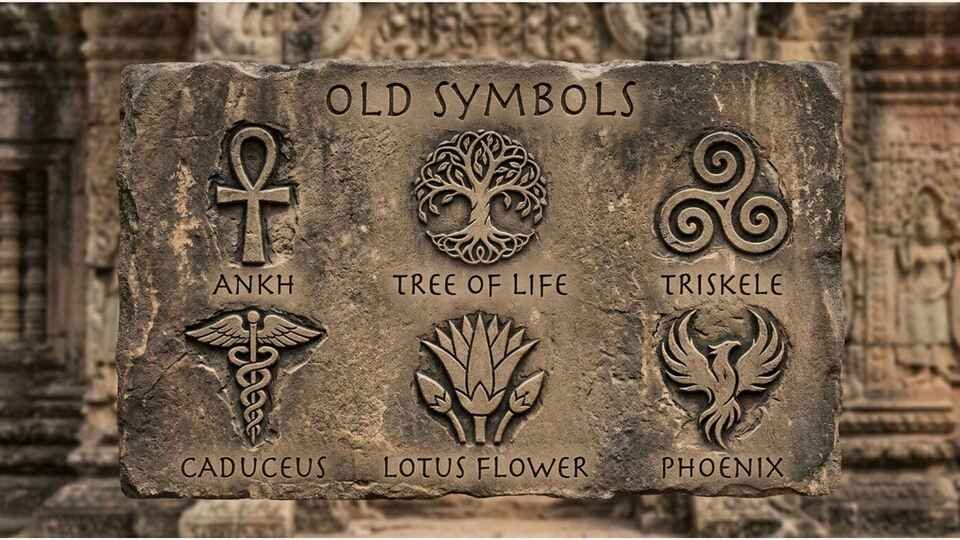
Long before people had modern languages, books, or digital communication, they used symbols to express ideas, beliefs, emotions, and stories. From ancient Egyptian signs to Celtic knots, sun symbols, sacred animals, and mysterious geometric marks, these old symbols helped people communicate meanings that words could not always capture.
Many of these old symbols and their meanings are still recognized today. Some represent protection, strength, wisdom, love, life, death, good fortune, or spiritual connection, while others were closely tied to ancient religions, cultures, and daily life. Their meanings could also change from one civilization to another, making each symbol part of a much larger historical story.
In this guide, we’ll explore ancient signs and symbols from different cultures, uncover what they meant in their original contexts, and explain how people interpret them today. Whether you’re interested in ancient history, mythology, art, tattoos, spirituality, or simply curious about mysterious old signs, these symbols offer a fascinating look into how humans have communicated meaning for thousands of years.
Quick Meaning of Old Symbols
Old symbols are ancient visual forms used to communicate religious beliefs, social identity, authority, natural forces, protection, and philosophical ideas. Their meanings depend on culture and historical context. A circle might represent eternity, while a serpent could symbolize healing, danger, renewal, wisdom, or divine power.
Old Symbols Overview Table
| Old Symbol | Primary Meaning | Culture or Origin | Earliest Known Context | Common Modern Use |
| Ankh | Life and divine vitality | Ancient Egypt | Early Dynastic Egypt | Jewelry, art, spirituality |
| Eye of Horus | Protection and restoration | Ancient Egypt | Old Kingdom traditions | Amulets, tattoos, logos |
| Scarab | Rebirth and transformation | Ancient Egypt | Old Kingdom | Jewelry and decorative art |
| Djed pillar | Stability and endurance | Ancient Egypt | Early Egyptian religion | Museum art and symbolism |
| Ouroboros | Eternity and recurring cycles | Egypt and Mediterranean world | Ancient Egyptian funerary imagery | Philosophy and esotericism |
| Yin-yang | Interdependent opposites | Ancient China | Classical Chinese thought | Philosophy, wellness, design |
| Om | Sacred sound and ultimate reality | South Asia | Vedic religious tradition | Hindu, Buddhist, and Jain practice |
| Lotus | Purity, rebirth, and enlightenment | Egypt, India, and Asia | Ancient religious art | Meditation and spiritual design |
| Triskelion | Motion, cycles, or threefold unity | Ancient Europe | Neolithic and Iron Age art | Regional identity and jewelry |
| Tree of Life | Cosmic order and connection | Multiple civilizations | Ancient Mesopotamian imagery | Religion, family art, jewelry |
| Spiral | Growth, movement, or cycles | Prehistoric cultures | Neolithic rock art | Art, tattoos, psychology |
| Swastika | Well-being, luck, or sacred order | Eurasia and other regions | Prehistoric archaeology | Hinduism, Buddhism, and Jainism |
| Caduceus | Trade, negotiation, and Hermes | Ancient Greece | Classical mythology | Commerce; sometimes misused medically |
| Rod of Asclepius | Healing and medicine | Ancient Greece | Cult of Asclepius | Medical organizations |
What Do Old Symbols Mean?
Old symbols represent ideas that communities considered important enough to preserve. Before widespread literacy, images offered an effective way to communicate beliefs across generations. Even in literate societies, symbols remained powerful because they could condense complex meanings into a single recognizable form.
An old symbol does not always have one universal definition. Its meaning depends on where it appears, who created it, and how it was used. A serpent beside a healing god is different from a serpent representing chaos. A circle around a ruler’s name may express royal protection, while a circle in a spiritual diagram may represent unity or wholeness.
Symbols also worked on several levels at once. The Egyptian ankh functioned as a written sign meaning “life,” an artistic object held by deities, and an amulet associated with vitality. The lotus could be a real plant, an artistic motif, and a metaphor for spiritual awakening.
Understanding old symbols therefore requires more than recognizing their shapes. Historical setting, religious practice, language, materials, and surrounding images all help reveal what a symbol originally communicated.
History and Origin of Old Symbols
Old symbols emerged long before formal writing. Prehistoric people carved lines, spirals, handprints, animals, and geometric patterns onto rocks, cave walls, tools, and ritual objects. Archaeologists can identify their age and location, but their precise meanings often remain uncertain because no written explanations survive.
As urban civilizations developed, symbols became more organized. Mesopotamian communities used pictorial marks that contributed to the development of cuneiform. Egyptian hieroglyphic writing appeared near the end of the fourth millennium BCE and remained in use for more than 3,000 years. Egyptian signs could represent objects, sounds, entire words, or information that clarified a word’s meaning.
Religious institutions, royal courts, and trading networks helped symbols spread. The winged sun disk, for example, appeared in several ancient Near Eastern societies, although its exact meaning varied by location and period. Symbols could be borrowed, redesigned, or connected with new gods and political systems.
Empires also combined symbolic traditions. Greek, Egyptian, Persian, Roman, Celtic, and Near Eastern imagery frequently influenced one another through migration, warfare, commerce, and diplomacy. A symbol adopted by another culture did not necessarily retain its original interpretation.
Over time, some old symbols survived because religious communities continued using them. Others were rediscovered through archaeology, translated inscriptions, museum collections, and the study of ancient art.
Symbolism and Interpretation
Traditional Meanings
Traditional old symbols commonly represented survival, fertility, protection, authority, cosmic order, and the passage between life and death. These themes mattered because ancient communities faced uncertain harvests, disease, warfare, childbirth risks, and environmental dangers.
The ankh expressed life. The djed pillar represented stability or endurance. The scarab was linked with becoming, regeneration, and the solar deity Khepri. Egyptian objects sometimes combined these signs to create a concentrated message of life, stability, protection, or royal power.
Modern Meanings
Modern users often simplify ancient symbols into personal ideas such as strength, peace, balance, transformation, or individuality. These meanings may be inspired by history, but they are not always identical to the original interpretation.
A person may wear an Eye of Horus necklace for protection without participating in ancient Egyptian religion. The Tree of Life may represent family connections in modern wall art, while older versions could express cosmic structure, divine abundance, kingship, or sacred geography.
Positive Symbolism
Many old symbols carry positive associations:
- Circles suggest unity, completeness, or continuity.
- Trees express growth, ancestry, and connection.
- Suns represent life, authority, illumination, or renewal.
- Lotus flowers suggest purity and spiritual development.
- Knots can represent bonds, continuity, or protection.
- Scarabs express rebirth and transformation.
Negative Symbolism
Some symbols also possess darker meanings. Serpents can represent poison, chaos, deception, or destructive power. Skulls may warn of death, danger, or mortality. Inverted or damaged sacred signs can communicate disorder, defeat, or desecration.
Negative meanings are not necessarily universal. A symbol feared in one tradition may be protective or sacred in another.
Psychological Interpretation
Modern psychology sometimes treats ancient geometric forms as expressions of shared human experiences. Circles can feel complete because they have no visible beginning or end. Spirals naturally suggest movement because the eye follows their expanding or contracting line.
These observations can explain why similar forms appear in distant societies. However, visual resemblance does not prove that every culture assigned the same meaning to a design. Historical evidence must take priority over modern speculation.
Cultural Significance of Old Symbols
Old symbols reveal how civilizations understood themselves and the universe. They marked social rank, religious identity, territory, family lineage, occupation, and political loyalty.
Ancient Egypt
Egyptian symbolic art connected earthly life with divine order. The ankh signified life, the djed expressed stability, and the was scepter represented authority or dominion. The Eye of Horus was associated with protection, healing, and restoration.
Scarabs became especially popular amulets. They appeared on seals, jewelry, burial objects, and inscriptions. Their connection with Khepri and the rising sun made them suitable images of renewal.
Mesopotamia
Mesopotamian art used stars, horned crowns, rosettes, trees, lions, and winged figures. Symbols could identify deities, express royal authority, or show divine support for a ruler. Cylinder seals combined images and inscriptions to mark ownership and authenticate transactions.
South Asia
The lotus, Om, mandala, wheel, and swastika hold long religious and philosophical histories in South Asia. Their meanings vary among Hindu, Buddhist, and Jain traditions.
The swastika traditionally represents well-being, auspiciousness, good fortune, or sacred order in several Asian religions. Its ancient religious use must be distinguished from the Nazi emblem, which turned a version of the sign into a symbol of racial hatred and genocide.
China
Chinese symbolism frequently emphasizes harmony, ancestry, natural cycles, and moral order. The yin-yang diagram represents complementary forces that depend on and transform into each other. It does not simply mean “good versus evil.”
Dragons traditionally carried associations with rain, vitality, authority, and imperial power. This differs from many European stories in which dragons are dangerous creatures defeated by heroes.
Greece and Rome
Greek and Roman symbols included laurel wreaths, owls, thunderbolts, cornucopias, serpents, and staffs. The laurel expressed victory and honor. Athena’s owl suggested wisdom, while Zeus’s thunderbolt represented divine authority.
The Rod of Asclepius, showing one serpent around a staff, became a lasting medical symbol. The caduceus, featuring two serpents and often wings, belonged to Hermes and was more closely connected with messengers, trade, and negotiation.
Northern and Western Europe
Spirals, knotwork, triskelions, animals, ships, trees, and solar designs appeared across prehistoric, Celtic, Germanic, and Norse contexts. Meanings must be assigned carefully because many modern claims about “Celtic” or “Viking” symbols lack strong historical evidence.
The World Tree in Norse tradition represents the connected structure of the cosmos. However, not every modern tree pendant marketed as a Viking symbol reproduces an authenticated Viking Age design.
Religious and Spiritual Meaning
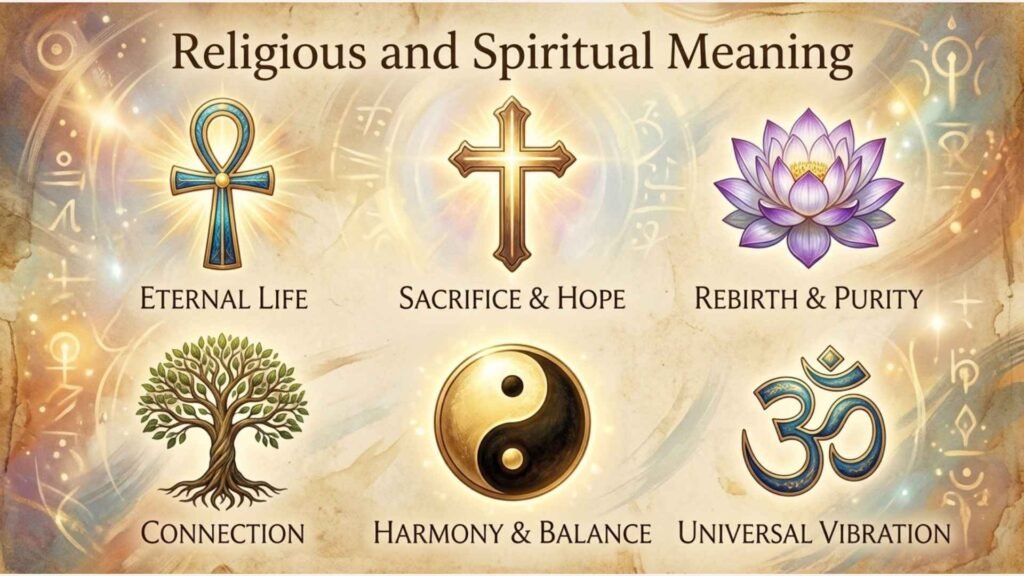
Old symbols gave visible form to invisible beliefs. They could represent gods, cosmic principles, sacred sounds, protective powers, or stages of spiritual development.
In Egyptian temple and funerary art, gods may hold the ankh toward a ruler or deceased person, suggesting divine life. Symbols such as the djed and scarab supported hopes for stability, protection, and renewed existence after death.
In Hindu traditions, Om represents a sacred sound connected with ultimate reality and spiritual consciousness. In Buddhist traditions, the lotus can represent awakening because a clean flower rises from muddy water. The dharma wheel represents the Buddha’s teaching and the path toward liberation.
Mandalas are geometric sacred arrangements used in several Asian religious traditions. They may represent an ordered cosmos, a sacred palace, or a focus for meditation. The word “mandala” comes from Sanskrit and is commonly translated as “circle,” although actual mandalas may contain complex squares, gates, deities, and symbolic landscapes.
Religious symbols should not be treated as decorative designs alone. Their use may carry ceremonial rules, community identity, and deep theological meaning.
Scientific, Medical, and Digital Meanings
Some old symbols have entered modern technical systems.
The Rod of Asclepius remains an internationally recognized sign of medicine and healing. Its serpent may reflect ancient beliefs about renewal, sacred healing, or the cult of Asclepius. The caduceus is sometimes used by medical organizations, especially in the United States, but historically it is the staff of Hermes rather than the principal Greek symbol of healing.
Ancient astronomical symbols also influenced later scientific notation. Signs connected with the Sun, Moon, planets, and zodiac became part of astrology, astronomy, alchemy, calendars, and early chemistry.
Digital encoding has given many ancient writing signs a new form. Unicode includes Egyptian hieroglyphs so scholars and institutions can represent ancient texts electronically. The standard classifies and encodes individual signs, while specialized formatting controls help arrange hieroglyphs in traditional groups.
Not every old symbol has an ordinary emoji equivalent. Similar-looking emojis may lack the historical meaning of the original sign.
Where Old Symbols Are Used Today
Old symbols remain visible in many settings:
- Museums: On artifacts, labels, replicas, and educational displays.
- Religious spaces: In temples, shrines, churches, meditation rooms, and ceremonial objects.
- Architecture: On columns, gates, floors, tombs, memorials, and public buildings.
- Jewelry: As pendants, rings, charms, bracelets, and amulets.
- Tattoos: To express protection, ancestry, faith, rebirth, or personal identity.
- Books and films: To create historical, mystical, or supernatural themes.
- Logos: To suggest wisdom, endurance, authority, healing, or tradition.
- Flags and emblems: To communicate national, regional, religious, or organizational identity.
- Technology: In fonts, digital archives, games, interfaces, and Unicode text.
- Medicine: Especially through the Rod of Asclepius and related imagery.
Modern use should consider cultural context. Wearing a symbol without understanding its religious or historical importance can create confusion or offense.
Common Variations of Old Symbols
Old symbols often appear in several forms because artists adapted them to different materials and purposes.
A lotus may be shown open, closed, viewed from above, or combined with a throne or deity. A spiral may turn clockwise or counterclockwise, appear alone, or form a triple pattern. A Tree of Life may have symmetrical branches, intertwined roots, animals, fruit, or divine figures.
Regional differences also matter. The swastika appears in left-facing and right-facing forms, with curved or straight arms, dots, decorative borders, or sacred inscriptions. These variations do not all have identical meanings.
Modern adaptations frequently simplify detailed historical designs. Tattoo artists, fashion brands, and entertainment media may combine unrelated signs or alter their proportions. Such versions can be visually attractive without being archaeologically authentic.
Common Misconceptions About Old Symbols
Every Ancient Symbol Has One Fixed Meaning
Most old symbols changed across centuries and cultures. Context is essential.
Similar Shapes Must Share an Origin
Two societies can independently create circles, crosses, spirals, or triangles. Visual similarity alone does not prove cultural contact.
All Viking Symbols Are Historically Verified
Several designs advertised as ancient Norse signs come from later magical manuscripts or modern reconstruction. Their popularity does not prove Viking Age use.
Hieroglyphs Are Simple Pictures
Egyptian hieroglyphs formed a complex writing system. Signs could represent words, sounds, or grammatical and semantic information rather than functioning only as illustrations.
The Caduceus Is the Original Medical Emblem
The caduceus belongs to Hermes. The single-serpent Rod of Asclepius has the stronger historical connection with medicine.
The Swastika Has Always Meant Nazism
The sign existed for thousands of years before the twentieth century and remains sacred in several religions. Nevertheless, its Nazi use created an unavoidable association with antisemitism, racism, violence, and genocide in much of the Western world.
Interesting Facts About Old Symbols
- Some symbols were also words. The ankh was not merely decorative; it functioned within the Egyptian writing system as a sign connected with life.
- Ancient symbols were often combined. Egyptian artists placed the ankh, djed, and was signs together to express life, stability, and dominion.
- Color could change meaning. In ancient art, color choices often carried symbolic value related to life, death, divinity, fertility, or geography.
- Orientation may be important. A figure’s direction, a spiral’s movement, or the position of an animal can affect interpretation.
- Symbols traveled with merchants. Trade routes carried objects, religious ideas, artistic styles, and symbolic designs between distant regions.
- Amulets joined art with action. People did not always view protective symbols as passive decorations. They could be worn, buried, blessed, or placed in buildings to perform a spiritual purpose.
- Writing preserved some meanings but not all. Even when an ancient culture left texts, scholars may still debate the origin or exact interpretation of a symbol.
- The same animal could carry opposite meanings. Lions could represent protective strength or destructive danger. Serpents could express healing, wisdom, chaos, poison, or rebirth.
- Modern technology preserves ancient scripts. Unicode encoding allows hieroglyphic signs to appear in searchable databases, digital publications, and academic communication.
- Some “ancient meanings” are modern inventions. Internet lists sometimes assign precise meanings to poorly understood designs without archaeological or textual evidence.
Related Old Symbols
- Ankh and djed: The ankh means life, while the djed primarily represents stability.
- Eye of Horus and Eye of Ra: Both are Egyptian eye symbols, but their mythological roles and associations differ.
- Ouroboros and spiral: Both can suggest cycles, although the ouroboros specifically depicts a serpent consuming its tail.
- Caduceus and Rod of Asclepius: The caduceus has two serpents and relates to Hermes; the Rod of Asclepius has one serpent and represents healing.
- Triskelion and triskele: These names commonly describe a three-armed rotating design associated with movement or threefold patterns.
- Lotus and Tree of Life: The lotus often represents purity or awakening, while the tree emphasizes growth, connection, and cosmic structure.
- Sun disk and solar wheel: Both relate to solar imagery, but their cultural meanings depend on region and period.
- Pentagram and pentacle: A pentagram is a five-pointed star; a pentacle usually refers to a star enclosed within a circle, especially in modern esoteric usage.
Frequently Asked Questions
What are the oldest symbols in history?
The oldest known symbolic markings include geometric engravings, handprints, pigment designs, and animal images from prehistoric contexts. Scholars debate whether every early mark had a symbolic purpose. Without accompanying writing or continuous cultural traditions, archaeologists cannot always determine what a prehistoric design meant.
Why did ancient people use symbols?
Ancient people used symbols to communicate identity, authority, religion, danger, ownership, protection, and collective memory. Symbols could be recognized quickly and repeated on buildings, tools, clothing, seals, weapons, and ritual objects. They also helped express abstract concepts that were difficult to explain through ordinary images.
Do old symbols have universal meanings?
Most old symbols do not have completely universal meanings. Circles, trees, animals, and stars appear in many societies, but each culture may interpret them differently. A reliable explanation should identify the symbol’s location, approximate date, surrounding imagery, and cultural tradition before assigning meaning.
Which old symbol represents protection?
Several old symbols represent protection, including the Eye of Horus, certain knot designs, protective hands, guardian animals, and divine emblems. Their meanings are culture-specific. The Eye of Horus, for example, was associated in ancient Egypt with protection, healing, restoration, and royal power.
Which ancient symbol means life?
The ankh is one of the best-known ancient symbols of life. Egyptian art often shows gods holding it, offering it, or placing it near a person’s face. Other cultures used trees, water, eggs, seeds, solar signs, and fertility figures to represent life and renewal.
What old symbol represents rebirth?
The scarab, lotus, phoenix, spiral, and ouroboros can all represent forms of rebirth or renewal. They express different ideas. The scarab is connected with becoming and the rising sun, while the ouroboros emphasizes continuous destruction and recreation within an endless cycle.
Can one symbol have both positive and negative meanings?
Yes. Serpents can represent healing, wisdom, fertility, danger, or chaos. Fire can symbolize purification and divine presence, but it can also mean destruction. Meaning depends on the culture, story, setting, and relationship between the symbol and other figures.
Is it respectful to use ancient symbols as tattoos?
It can be respectful when the wearer studies the symbol’s origin, understands its religious significance, and avoids sacred designs restricted to certain communities or ceremonies. Problems arise when a symbol is misidentified, removed from context, or used in a way that mocks living traditions.
How can I identify an unknown old symbol?
Record where the symbol appears, its material, direction, surrounding images, and any nearby writing. Compare it with museum databases, archaeological publications, and academic reference works. Avoid relying solely on commercial tattoo charts or social-media posts, which often repeat unsupported interpretations.
Are ancient symbols still used today?
Yes. Old symbols appear in religions, medical emblems, national imagery, jewelry, architecture, literature, films, games, tattoos, and digital writing systems. Their modern meanings may preserve ancient ideas, simplify them, or transform them to fit new cultural settings.
Key Takeaways
- Old symbols communicate ideas such as life, protection, authority, balance, death, and renewal.
- A symbol’s meaning depends on its culture, period, location, and surrounding imagery.
- Ancient signs could function as writing, religious objects, political emblems, and protective devices.
- Similar-looking symbols do not necessarily share the same origin.
- Modern interpretations often differ from historically documented meanings.
- Sacred symbols deserve careful and respectful use.
- Archaeology, language, art history, and religious studies help explain ancient imagery.
- Some popular claims about old symbols lack reliable historical evidence.
Conclusion
Old symbols are more than attractive shapes left behind by forgotten civilizations. They preserve evidence of how people understood life, death, nature, authority, community, and the sacred.
Their meanings have never remained completely still. Symbols traveled across borders, entered new religions, changed under empires, and gained modern associations through politics, scholarship, fashion, and popular culture.
Studying old symbols with attention to evidence and context allows us to see both the differences between civilizations and the human questions they shared. These ancient signs continue to speak because the search for protection, belonging, balance, purpose, and renewal remains part of human life.

I am Daniel Brooks, a language researcher and writer with a strong interest in how people use English in everyday conversations. I contribute to LearnNestly because I enjoy turning confusing language topics into straightforward lessons. My goal is to help readers understand not only what a word or phrase means, but also when and how to use it naturally. I focus on clear examples, practical explanations, and useful language knowledge that readers can remember.
Books:
- The Practical English Guide
- Understanding Everyday Words
 Amelia Carter