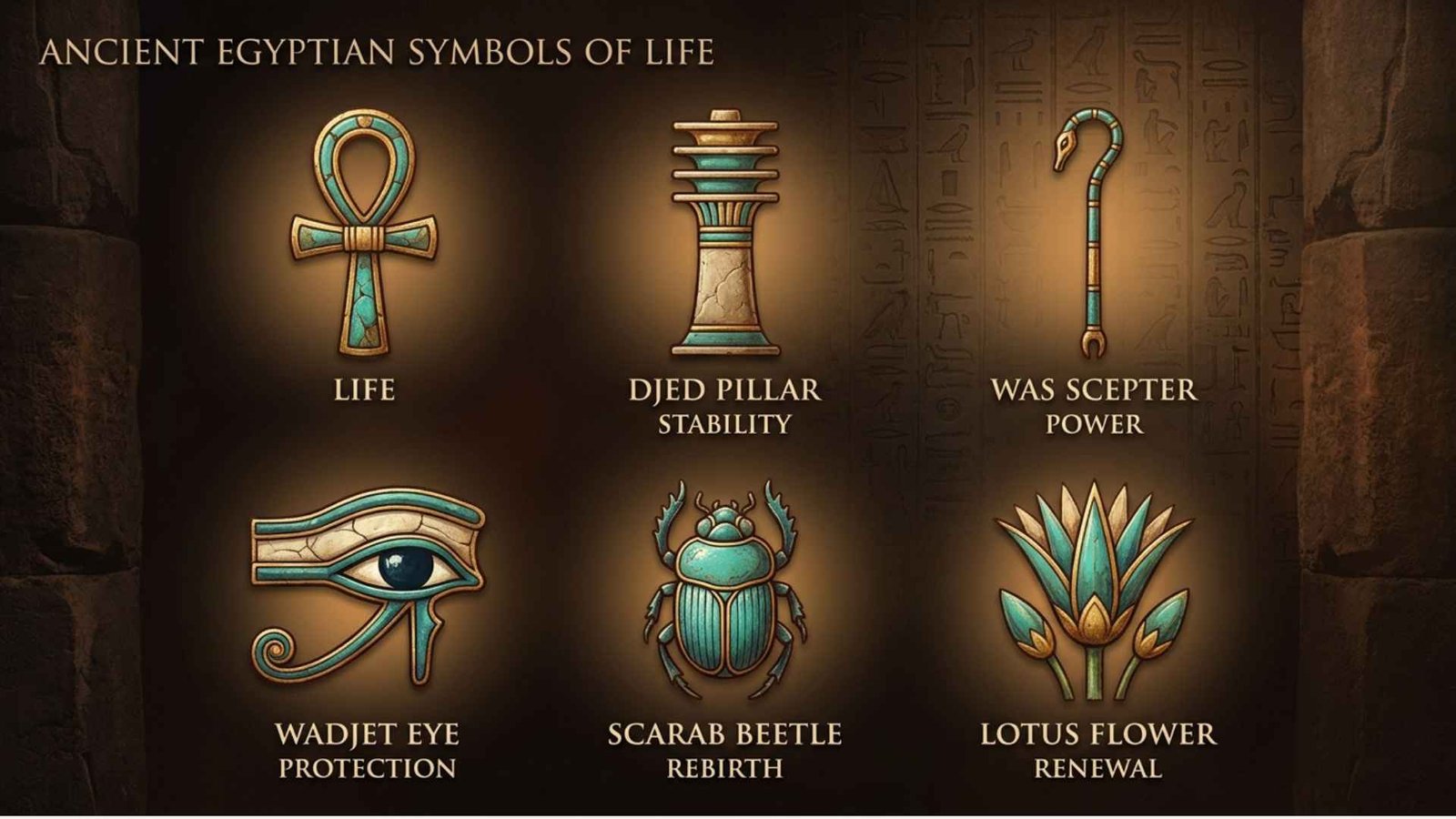
Isis symbols represent protection, motherhood, healing, royal authority, magic, mourning, and the renewal of life. In ancient Egyptian religion, Isis was a powerful goddess who restored her murdered husband Osiris, protected their son Horus, and helped preserve rightful kingship.
Her symbolism appears on temple walls, coffins, statues, amulets, jewelry, papyri, and later Greek and Roman artworks. Some images show Isis wearing a throne-shaped crown, while others depict her with wings, a solar disk, cow horns, an ankh, or the distinctive tyet knot.
Understanding these symbols reveals how Isis evolved from an Egyptian royal and funerary goddess into one of the ancient Mediterranean world’s most widely worshipped divine figures.
Quick Meaning of Isis Symbols
Isis symbols mainly represent divine protection, magical power, motherhood, healing, royal legitimacy, and rebirth. Her best-known emblems include the throne hieroglyph, the tyet or Knot of Isis, protective wings, the ankh, cow horns and solar disk, the sistrum, and images of Isis nursing Horus.
Isis Symbols Overview Table
| Field | Details |
| Goddess’s Egyptian name | Aset or Eset |
| Greek and modern name | Isis |
| Primary meanings | Protection, motherhood, magic, healing, kingship, resurrection |
| Cultural origin | Ancient Egypt |
| Earliest clear evidence | Old Kingdom, especially the Pyramid Texts |
| Main identifying symbol | Throne-shaped hieroglyph worn on the head |
| Sacred amulet | Tyet, also called the Knot of Isis |
| Common attributes | Wings, ankh, throne, solar disk, cow horns, sistrum |
| Family connections | Wife and sister of Osiris; mother of Horus |
| Sacred roles | Mourner, healer, protector, royal mother, funerary guardian |
| Common animals | Kite or falcon-like bird, cow, scorpion, snake |
| Major later influence | Greek, Roman, Nubian, and Mediterranean religious traditions |
| Unicode or emoji | No official Unicode character or emoji represents Isis specifically |
| Related symbols | Ankh, djed pillar, Eye of Horus, was scepter, solar disk |
What Do Isis Symbols Mean?
Isis symbols communicate the goddess’s many interconnected roles. Ancient Egyptian divine imagery rarely had only one meaning. A crown, gesture, animal, or object could identify a deity while also expressing a theological idea.
The throne sign identifies Isis by name and links her to royal authority. Her wings show her protecting the dead and restoring life. The tyet knot expresses safeguarding power, especially in funerary settings. Images of Isis nursing Horus represent motherhood, divine kingship, and the transfer of sacred strength from mother to child.
Many Isis symbols also relate to the Osiris myth. According to Egyptian religious tradition, Osiris was murdered and dismembered by his brother Set. Isis searched for his body, reassembled it, and used her knowledge and magical ability to restore him sufficiently to conceive Horus.
This story made Isis a model of devotion, intelligence, grief, healing, and resistance against disorder. Her symbols therefore express more than affection or motherhood. They represent the active power to protect life, repair what has been broken, and preserve legitimate order.
History and Origin of Isis Symbols
The symbols of Isis developed over thousands of years. Isis first appears clearly in surviving religious texts from Egypt’s Old Kingdom, particularly the Pyramid Texts of the late third millennium BCE. In these royal funerary writings, she already belongs to the divine family surrounding Osiris and participates in protecting and reviving the deceased king.
Her Egyptian name was written with a hieroglyph resembling a throne or seat. This sign became her earliest and most distinctive visual emblem. Artists placed it above her head, allowing viewers to identify her even when her body looked similar to those of other goddesses.
During the Middle and New Kingdoms, her religious importance expanded. She became increasingly associated with healing, protective spells, mourning rituals, royal motherhood, and the afterlife. Her mythology connected the pharaoh with Horus, whose mother was Isis. As a result, she symbolically supported the king’s divine legitimacy.
In later periods, Isis absorbed features associated with other goddesses, especially Hathor. She began to appear wearing a solar disk between cow horns, a crown originally characteristic of Hathor. This shared iconography reflected the Egyptian practice of combining or closely linking deities whose functions overlapped.
Under the Ptolemies, Greek rulers governed Egypt and promoted religious forms that could appeal to both Egyptian and Greek communities. Isis became increasingly universal in character. Her worship spread throughout the Mediterranean and later across the Roman Empire, reaching parts of Europe, North Africa, and western Asia.
The British Museum notes that Isis was commonly depicted with either the throne hieroglyph or Hathor’s horned solar crown. Museum objects also show her wrapping her wings protectively around Osiris or nursing Horus, two of her most recognizable sacred roles.
Major Isis Symbols and Their Interpretations
The Throne Symbol
The throne-shaped hieroglyph is the clearest identifying symbol of Isis. It forms part of the writing of her Egyptian name, Aset or Eset, and often appears as a crown on her head.
The symbol connects Isis with kingship because a throne represents the position from which royal authority is exercised. Through her son Horus, who represented the living king, Isis became the divine mother and protector of legitimate rule.
The throne does not simply mean that Isis was a queen sitting beside Osiris. It expresses the theological idea that royal power depends on a sacred foundation. Isis supports, protects, and legitimizes the ruler, just as a physical throne supports the person seated upon it.
Surviving statues show the throne sign modeled as a three-dimensional headdress. In some examples, Isis also sits on an actual throne while nursing Horus, reinforcing the relationship among motherhood, royal succession, and divine authority.
The Tyet or Knot of Isis
The tyet, also spelled tiet or tjet, is an ancient Egyptian amulet closely associated with Isis. It resembles an ankh with its horizontal arms bent downward.
Its exact original form remains uncertain. Some researchers have compared it to a knotted piece of cloth, a sash, a girdle, or a folded textile. Egyptian funerary texts connect it with the “blood of Isis,” although this phrase was symbolic and ritualistic rather than a literal anatomical description.
The tyet represented protection, life, welfare, and the safeguarding power of the goddess. It was often made from red stone, red glass, or red glazed material, probably because red strengthened its association with divine blood and protective energy.
Amulets shaped like the tyet were placed with the dead. Ritual texts instructed that the object should protect the deceased through the power of Isis and help the person enter the afterlife safely. The Metropolitan Museum of Art describes the tyet as the knot of Isis and a symbol of protection.
The Wings of Isis
When Isis appears with outspread wings, they symbolize protection, breath, mourning, and the restoration of life. She may stretch her wings over Osiris, a deceased person, a coffin, or a sacred object.
The winged image relates partly to the kite, a bird of prey whose cries may have reminded Egyptians of ritual mourning. In myth, Isis and her sister Nephthys mourned Osiris and took birdlike forms around his body.
Wings could also suggest air moving across a lifeless body. Symbolically, Isis fanned breath and vitality back into Osiris. This made her wings appropriate decorations for coffins and funerary equipment, where they guarded the deceased and supported renewal.
Modern jewelry and tattoos sometimes use the winged form as a general image of feminine strength. Historically, however, it had a more specific religious meaning involving funerary protection, magical revival, and the goddess’s guardianship.
The Ankh
The ankh is not exclusive to Isis, but she frequently carries it. The looped cross represented life, vitality, and divine power.
In Egyptian art, gods may hold the ankh or extend it toward a person’s nose, suggesting the gift of life or breath. When Isis carries it, the symbol complements her identity as a healer and restorer.
The ankh also connects with her role in reviving Osiris and protecting Horus. It does not mean that Isis alone controlled life. Rather, it shows that she possessed the divine life-giving power shared by major Egyptian deities.
Cow Horns and the Solar Disk
Later images often show Isis wearing a round solar disk between curved cow horns. This crown originally belonged especially to Hathor, the goddess of motherhood, music, fertility, joy, and the sky.
As Isis became more prominent, her identity overlapped with Hathor’s. The shared crown emphasized maternal care, celestial power, fertility, and divine femininity.
The solar disk links Isis with the sun’s creative and renewing force. The horns may recall the cow as a nurturing animal and a symbol of heavenly motherhood. Together, the crown presents Isis as a cosmic mother whose protection extends beyond the royal family.
Viewers should not assume every horned goddess is Isis. Context matters. Inscriptions, accompanying figures, gestures, and other attributes help distinguish Isis from Hathor and related deities.
Isis Nursing Horus
The seated image of Isis breastfeeding the infant Horus is one of the most influential representations of divine motherhood from antiquity.
The scene symbolizes nourishment, protection, royal succession, and the transmission of divine power. Horus is not merely a helpless baby. He is the future avenger of Osiris and the divine model of the living pharaoh.
Isis protects him from Set, illness, venomous creatures, and other dangers while raising him secretly in the marshes of the Nile Delta. Her nursing gesture therefore combines tenderness with political and cosmic significance.
Numerous bronze and stone figures show Isis holding Horus, also called Harpocrates in Greek contexts, on her lap. Some wear the throne crown, while others display the solar disk and horns.
The Sistrum
The sistrum was a sacred rattle used in Egyptian religious ceremonies. It is more strongly associated with Hathor but also appears in the worship and imagery of Isis, especially after their identities became closely connected.
Its shaking produced a metallic sound believed to please deities, drive away harmful forces, and create ritual order. The instrument could symbolize joy, divine presence, purification, and protection.
In Greco-Roman images, the sistrum became an important marker of Isis. Worshippers and priestesses carried it during festivals and processions, making it both a musical object and a sign of devotion.
The Kite or Falcon-Like Bird
Isis and Nephthys could appear as kites, birds associated with mourning and the protection of the dead. In some artistic scenes, the sisters stand or hover near Osiris in bird form.
The kite symbolizes Isis’s search for Osiris, her laments, and her ability to revive him. The bird’s wings reinforce themes of guardianship and renewed breath.
It should not be confused automatically with the falcon of Horus. Although the artistic forms can appear similar, Horus’s falcon imagery mainly represents kingship, sky power, and divine vision, while Isis’s bird form relates more strongly to mourning and restoration.
The Scorpion
Scorpions are connected with Isis through magical stories in which protective scorpion goddesses accompany her while she hides with Horus.
This association has a double meaning. A scorpion can represent danger, venom, and death, but it can also symbolize the control of those threats. Isis’s power included the ability to heal poisoning and command dangerous creatures.
In protective magical traditions, stories about Isis curing Horus or another victim from venom were recited as models. By repeating the divine event, a healer hoped to reproduce the goddess’s successful cure in the human world.
The Was Scepter
Isis sometimes holds the was scepter, a long staff with a forked base and a stylized animal head. Egyptian gods commonly carried it as a symbol of divine power, authority, and dominion.
Like the ankh, the was scepter is not unique to Isis. Its presence shows her status as a powerful deity rather than identifying her by itself.
When shown with the ankh, the scepter creates a balanced visual message: Isis possesses both life-giving power and divine authority.
Positive and Negative Interpretations
Most traditional Isis symbolism is protective and restorative. It celebrates faithful love, cleverness, healing, endurance, motherhood, and the defeat of chaos.
Her mourning for Osiris expresses grief, but it is not passive despair. Isis searches, acts, speaks magical words, and restores order. For this reason, modern readers often interpret her as a figure of resilience after loss.
Her magic could also appear dangerous to opponents. Egyptian religion did not divide power into the modern categories of harmless “good magic” and automatically evil “dark magic.” Divine power could protect one person while defeating a threatening enemy.
The scorpion, snake, mourning imagery, and funerary associations may seem negative today. In their original setting, however, they frequently represented protection against danger, mastery over death, and safe passage into renewed existence.
Psychologically, Isis may be interpreted as an archetype of the protective mother, the healer, the devoted partner, or the person who restores order after trauma. These are modern interpretive frameworks, not meanings proven to have been consciously used by every ancient worshipper.
Cultural Significance of Isis Symbols
Ancient Egyptian Culture
In Egypt, Isis belonged to the mythic family of Osiris, Horus, Set, and Nephthys. Her imagery supported beliefs about kingship, death, rebirth, family continuity, and magical protection.
She was both a royal goddess and an accessible protector. Kings could associate themselves with her son Horus, while ordinary people invoked her in healing spells and wore protective amulets.
Nubia and the Temple of Philae
Isis became especially important in southern Egypt and Nubia. Her temple complex at Philae remained a major center of worship into late antiquity.
In this regional setting, her symbolism interacted with Nubian rulers, local traditions, Nile geography, and pilgrimage practices. Her identity could include royal, maternal, healing, and cosmic functions at the same time.
Greek Culture
Greek speakers identified Isis with familiar divine qualities while preserving her Egyptian name and many of her visual attributes.
She became associated with navigation, fortune, fertility, salvation, and universal divine care. Greek-language hymns sometimes praised her as a goddess with many names and powers.
Her Egyptian features were not simply erased. Instead, throne imagery, the sistrum, distinctive dress, and myths of Osiris and Horus blended with Hellenistic religious language.
Roman Culture
The cult of Isis spread widely through the Roman Empire. Temples, inscriptions, paintings, statues, and household objects related to her have been found far beyond Egypt.
Roman-era worship emphasized public festivals, initiation, protection at sea, healing, and hope for divine assistance. The British Museum notes that Isis became popular in Rome and across the empire, including Roman Britain.
Religious and Spiritual Meaning
Isis symbols served sacred rather than merely decorative purposes. Images and amulets could make the goddess’s protective presence available within a temple, tomb, household, or ritual.
The tyet defended the dead. Winged images guarded bodies and coffins. Nursing statues expressed the divine continuity of life and kingship. The sistrum helped create sacred sound during ceremonies.
Isis was also a model of effective ritual knowledge. Egyptian stories describe her as exceptionally skilled in speech, names, medicines, and magical formulas. Her wisdom allowed her to overcome dangers that physical strength alone could not defeat.
In modern spiritual movements, Isis may represent sacred femininity, personal transformation, intuition, or empowerment. These interpretations can be meaningful to contemporary practitioners, but they should not be presented as exact copies of ancient Egyptian belief.
Where Isis Symbols Are Used
Temples
Temple reliefs and statues show Isis participating in offerings, protecting rulers, mourning Osiris, or caring for Horus. These images formed part of active sacred spaces.
Tombs and Coffins
Winged Isis figures and tyet amulets protected the deceased. Funerary texts invoked her assistance in restoration and passage into the afterlife.
Jewelry and Amulets
People wore images of Isis, Horus, the tyet, and related protective forms. Materials, colors, inscriptions, and ritual preparation could add meaning to an amulet.
Sculpture
Small bronzes of Isis nursing Horus were especially common in later Egyptian history. Larger temple statues portrayed her standing, enthroned, winged, or protecting Osiris.
Literature and Religious Texts
Isis appears in the Pyramid Texts, Coffin Texts, funerary compositions, magical healing texts, Greek hymns, Roman literature, and later religious discussions.
Tattoos and Modern Art
Contemporary designs often feature the wings of Isis, the throne crown, the tyet, or a stylized goddess figure. Their meanings commonly include protection, motherhood, feminine power, healing, or rebirth.
Modern users should recognize that combining unrelated Egyptian symbols may create an attractive design without accurately reproducing ancient iconography.
Common Variations of Isis Symbols
Isis does not have one fixed appearance. Her iconography changed according to period, location, function, and artistic context.
Common forms include:
- A woman wearing the throne hieroglyph
- A woman wearing cow horns and a solar disk
- A seated mother nursing Horus
- A winged woman protecting Osiris
- A kite or falcon-like bird mourning the dead
- A goddess holding an ankh and was scepter
- A Greco-Roman woman holding a sistrum
- A tyet-shaped protective amulet
- A crowned goddess accompanied by serpents or scorpions
These variations do not necessarily contradict each other. Egyptian deities could possess multiple forms because each image emphasized a different divine role.
Common Misconceptions About Isis Symbols
Isis Has Only One Official Symbol
Isis has several identifying attributes. The throne sign is her clearest name symbol, but the tyet, wings, nursing pose, sistrum, and horned solar crown are also strongly connected with her.
The Ankh Belongs Only to Isis
The ankh appears with many Egyptian gods and goddesses. Isis carries it because she possesses divine life-giving power, not because she exclusively owns the symbol.
Every Winged Egyptian Woman Is Isis
Other goddesses, including Nephthys, Nut, and Ma’at, can appear with wings. Inscriptions, crowns, nearby figures, and the scene’s purpose must be considered.
The Horned Crown Always Identifies Isis
The cow horns and solar disk are particularly associated with Hathor and were later adopted by Isis. Either goddess may wear the crown.
Isis Is Connected to the Modern Extremist Group
The ancient goddess Isis has no historical or religious connection to the modern organization commonly abbreviated ISIS. The shared English spelling is accidental. The goddess’s name entered English through Greek, while the modern acronym stands for a political and militant organization.
Isis Worship Was Always the Same
Her worship changed greatly over time. Old Kingdom funerary roles, later Egyptian healing traditions, Ptolemaic temple theology, and Roman mystery practices did not all interpret her identically.
10 Interesting Facts About Isis Symbols
- Her crown writes her name.
The throne on Isis’s head is not simply decorative. It reproduces the hieroglyph associated with her Egyptian name. - Her most personal amulet resembles an ankh.
The tyet looks similar to the ankh but has downward-curving arms and a stronger association with Isis and funerary protection. - Red was an important tyet color.
Red materials linked the amulet with the ritual phrase “blood of Isis” and protective vitality. - Her wings could symbolize breath.
The motion of wings suggested air and renewed life, helping explain their use in scenes of Isis restoring Osiris. - Her maternal image had political meaning.
Isis nursing Horus represented not only motherhood but also the formation and protection of legitimate kingship. - She shared symbols with Hathor.
The solar disk and cow horns show how Egyptian divine identities could overlap rather than remain completely separate. - Her symbols traveled across the Roman Empire.
Isis imagery appeared in regions far from Egypt as merchants, soldiers, officials, enslaved people, and travelers carried religious practices across the Mediterranean. - Dangerous animals could become protective symbols.
Scorpions and snakes represented threats, but stories of Isis controlling them transformed danger into evidence of her healing power. - Her imagery united grief and hope.
Mourning scenes did not end with death. They pointed toward restoration, continuity, and renewed existence. - No single modern image captures all her ancient roles.
Isis was simultaneously a mother, mourner, healer, magician, royal guardian, wife, and funerary protector.
Related Symbols
Ankh
The ankh represents life and divine vitality. Isis often holds it, but it belongs to the wider Egyptian religious system.
Djed Pillar
The djed represents stability and endurance and is closely connected with Osiris. It complements Isis’s role in restoring and supporting him.
Eye of Horus
The Eye of Horus symbolizes healing, protection, restored wholeness, and royal power. It relates to Isis through her son Horus.
Knot of Nephthys
Symbols and imagery associated with Nephthys may resemble those of Isis because the sisters jointly mourn and protect Osiris. Their crowns and inscriptions usually distinguish them.
Sistrum of Hathor
The sistrum represents sacred sound, joy, protection, and ritual celebration. Isis inherited or shared this attribute through her close association with Hathor.
Uraeus Cobra
The upright cobra represents royal and divine protection. It may appear on the crowns of Isis and other deities, especially in royal or solar contexts.
Frequently Asked Questions
What is the main symbol of Isis?
The main identifying symbol of Isis is the throne-shaped hieroglyph worn as a crown. It writes or represents her Egyptian name, Aset or Eset, and connects her with royal authority. The tyet knot is her best-known amuletic symbol, while wings, the ankh, and the horned solar disk are also common.
What does the Knot of Isis mean?
The Knot of Isis, known as the tyet, represents protection, welfare, life, and the safeguarding power of the goddess. It was commonly placed with the dead as a funerary amulet. Its red color and association with the “blood of Isis” emphasized divine vitality and protection in the afterlife.
What do the wings of Isis symbolize?
The wings of Isis symbolize protection, mourning, breath, and restoration. In funerary art, she spreads them over Osiris or the deceased to guard the body. Their movement may also suggest the life-giving air through which she helps revive Osiris and renew the dead.
Why does Isis wear cow horns?
Isis wears cow horns and a solar disk because her identity became closely associated with Hathor, an older goddess of motherhood, fertility, music, and the sky. The shared crown presents Isis as a celestial and maternal deity, but it does not identify her without additional context.
What animal represents Isis?
The kite, a bird of prey, is one of the animals most strongly associated with Isis. She could take bird form while mourning and protecting Osiris. Cows, scorpions, snakes, and sometimes falcon-like imagery also appear in her mythology, although none functions as her only universal animal symbol.
Why is Isis shown breastfeeding Horus?
Isis breastfeeding Horus represents nourishment, maternal protection, divine inheritance, and royal succession. Horus was the divine model of the living pharaoh, so the image showed Isis giving life and legitimacy to future kingship while protecting her child from disease, venom, and the hostility of Set.
Is the ankh an Isis symbol?
The ankh is associated with Isis but is not exclusive to her. It represents life and divine vitality and appears in the hands of many Egyptian deities. When Isis carries it, the ankh supports her roles as healer, protector, magical restorer, and giver of renewed life.
Are Isis symbols still used today?
Yes. Isis symbols appear in museum art, academic publications, jewelry, tattoos, spiritual practices, films, games, and modern Egyptian-inspired designs. Contemporary meanings often focus on protection, feminine power, healing, and motherhood, although these uses do not always reproduce ancient religious meanings accurately.
Is the Isis goddess related to ISIS?
No. The ancient Egyptian goddess Isis has no connection to the modern extremist organization abbreviated ISIS. Her name comes through Greek from the Egyptian name Aset or Eset. The modern term is an English acronym referring to a completely separate political and militant entity.
What does an Isis tattoo mean?
An Isis tattoo commonly represents protection, motherhood, healing, devotion, feminine strength, or rebirth. A winged Isis design emphasizes guardianship, while a tyet emphasizes protection. A throne crown refers to divine authority, and Isis with Horus expresses maternal care and the continuation of life.
Key Takeaways
- Isis symbols represent protection, magic, motherhood, healing, kingship, and renewal.
- The throne-shaped crown is the clearest symbol of her name and royal role.
- The tyet, or Knot of Isis, served as a powerful protective funerary amulet.
- Her wings express guardianship, mourning, breath, and restored life.
- Isis nursing Horus symbolizes maternal care and legitimate royal succession.
- The ankh and was scepter show life-giving power and divine authority.
- Cow horns and the solar disk reflect her close connection with Hathor.
- Her symbolism changed as her worship spread from Egypt into Greek and Roman cultures.
- Modern interpretations should be separated from historically documented ancient meanings.
- The goddess Isis has no relationship to the modern group known by the acronym ISIS.
Conclusion
Isis symbols formed a rich visual language through which ancient people understood protection, grief, healing, motherhood, royal authority, and the possibility of renewed life. The throne identified the goddess and connected her with kingship, while the tyet guarded the vulnerable, her wings sheltered the dead, and her nursing image preserved the future through Horus.
As her worship spread beyond Egypt, her symbols gained new cultural layers without losing their central themes of care, wisdom, and restoration. Studying Isis symbols therefore offers more than a catalog of ancient objects. It reveals how one goddess came to embody the human desire to protect loved ones, repair loss, preserve order, and find life beyond destruction.

I am Amelia Carter, an English language educator and educational writer who enjoys making difficult ideas simple and easy to understand. At LearnNestly, I write about English words, grammar, everyday expressions, and language questions that people often find confusing. I believe learning should feel practical, clear, and enjoyable rather than overwhelming. Through my writing, I try to give readers explanations they can understand and use in real life.
Books:
- The Everyday English Handbook
- Words Made Simple
 Daniel Brooks