Symbols of death in art help artists express mortality, grief, time, loss, spiritual transition, and the fragile nature of human life. Common examples include skulls, skeletons, extinguished candles, hourglasses, dead flowers, ravens, tombs, and decaying fruit.
These images are not always frightening or negative. In many paintings, sculptures, religious works, and memorial objects, death symbols encourage viewers to live wisely, remember loved ones, prepare spiritually, or accept the natural cycle of life.
You may encounter these symbols in ancient tombs, medieval manuscripts, Renaissance portraits, Dutch still-life paintings, religious art, Gothic literature, tattoos, films, photography, and modern installations. Their meanings depend on the surrounding objects, historical period, and cultural setting.
Quick Meaning of Symbols of Death in Art
Symbols of death in art represent mortality, the passage of time, physical decay, grief, judgment, remembrance, or spiritual transformation. A skull may warn that everyone dies, while a butterfly may suggest the soul’s release. Artists combine such symbols to explore both the fear of death and the value of life.
Symbol Overview Table
| Symbol | Primary Meaning | Historical Association | Common Artistic Use | Possible Modern Meaning |
| Skull | Mortality and human equality | Memento mori and vanitas art | Portraits, still lifes, religious scenes | Danger, rebellion, identity |
| Skeleton | Death personified | Medieval Dance of Death imagery | Murals, prints, allegories | Fear, humor, social criticism |
| Hourglass | Limited time | European moral and religious art | Vanitas paintings and tombs | Deadlines and life passing |
| Extinguished candle | Life ended | Christian and vanitas symbolism | Still lifes and memorial art | Loss, silence, absence |
| Dead flower | Beauty and life fading | Still-life painting | Floral arrangements and portraits | Broken love or grief |
| Decaying fruit | Physical decline | Dutch vanitas painting | Banquet and still-life scenes | Excess, waste, impermanence |
| Raven or crow | Death, prophecy, or mourning | Folklore and battlefield imagery | Literature, paintings, film | Mystery or psychological darkness |
| Tomb or grave | Death and remembrance | Funerary art | Landscapes, monuments, religious art | Memory and unresolved grief |
| Coffin | Finality and burial | Funeral traditions | Religious, Gothic, and modern art | Confrontation with mortality |
| Poppy | Sleep, death, and remembrance | Classical mythology and war memorials | Memorial paintings and public art | Sacrifice and remembrance |
| Butterfly | Soul and transformation | Classical and Christian symbolism | Funerary and spiritual art | Renewal after loss |
| Weeping willow | Mourning and sorrow | Eighteenth- and nineteenth-century memorial art | Gravestones, jewelry, landscapes | Emotional grief and remembrance |
What Do Symbols of Death in Art Mean?
Symbols of death in art make an invisible idea visible. Death cannot be directly experienced by a living viewer, so artists use familiar objects, animals, plants, colors, and human figures to represent it.
The clearest meaning is mortality. A skull shows what remains after individual identity, beauty, status, and wealth disappear. Because every person has a skeleton, it may also communicate equality in death.
Other symbols focus on time rather than the body. Clocks, watches, hourglasses, smoke, bubbles, and burning candles show that life is temporary. These objects suggest that death is not only a future event. It approaches with every passing moment.
Some images represent grief. Tombs, black clothing, drooping flowers, empty chairs, and weeping figures express the emotional absence left by someone who has died.
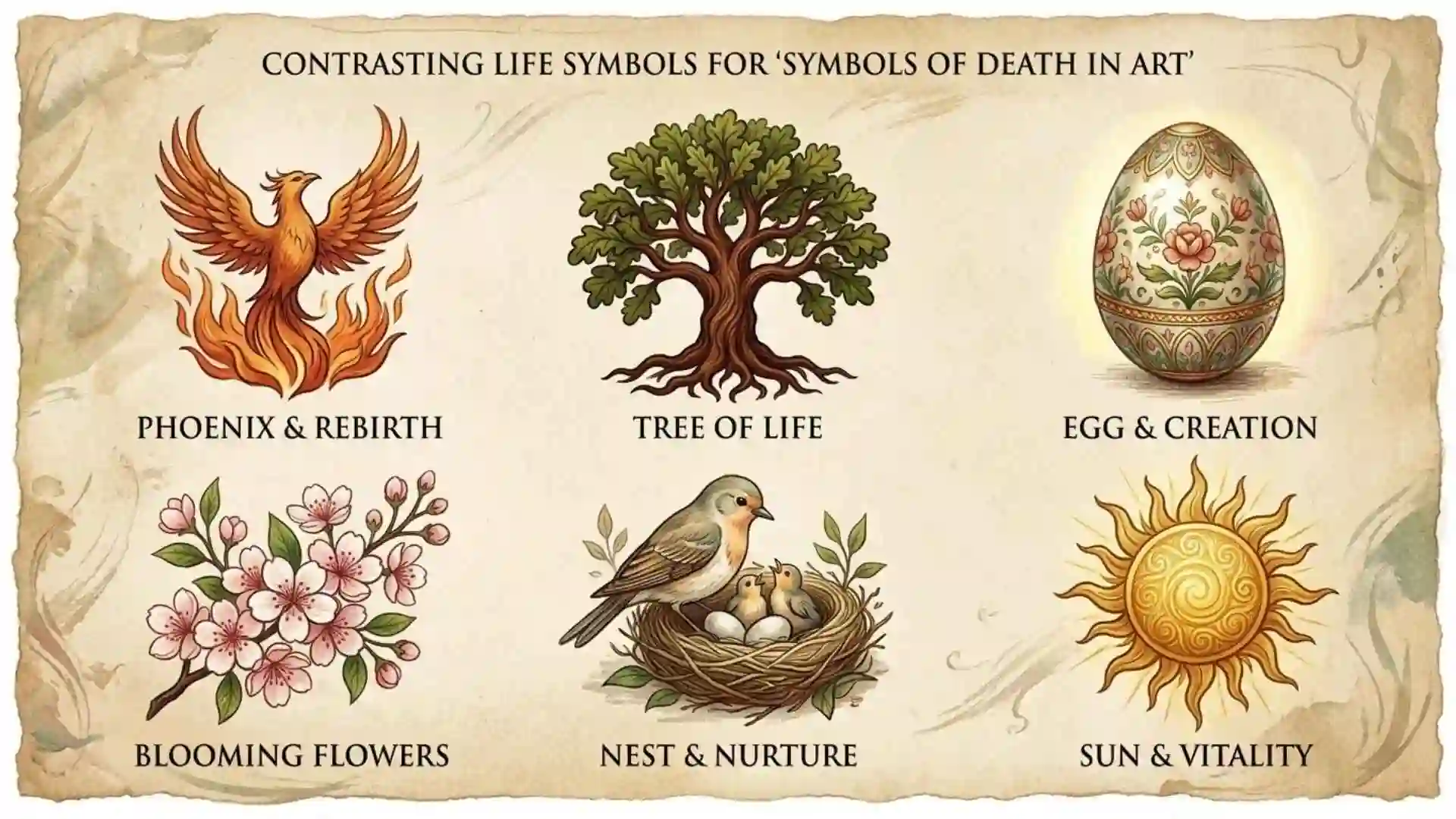
Death symbolism can also carry hopeful meanings. Butterflies, birds, dawn, evergreen plants, and light breaking through darkness may represent resurrection, the soul, memory, or renewal. Therefore, viewers should not assume that every death symbol communicates despair.
History and Origin of Death Symbolism in Art
Death imagery developed wherever people created burial objects, religious images, monuments, or stories about the afterlife. It does not have one single place of origin.
Ancient Funerary Art
Ancient civilizations frequently connected art with burial and remembrance. Egyptian tomb paintings, funerary masks, coffins, amulets, and images of gods helped communicate beliefs about death and the afterlife. Such works were not simply decorations. They formed part of a larger religious system involving preservation, judgment, protection, and continued existence.
Ancient Greek and Roman artists portrayed tombs, funerary processions, underworld figures, fading flowers, and mythological stories about death. The butterfly later became associated with the soul partly because the Greek word psyche could refer to both the soul and a butterfly.
Medieval Christian Art
In medieval Europe, death symbolism became strongly connected with moral instruction, judgment, heaven, hell, and salvation. Skeletons and decomposing bodies reminded viewers that earthly rank and wealth could not prevent death.
One influential theme was the Dance of Death, or Danse Macabre. Artists showed skeletons leading kings, clergy members, merchants, laborers, and children toward death. The message was direct: no social class could escape mortality.
Images of the Crucifixion, martyrs, tombs, and the Last Judgment gave death both painful and spiritual meanings. Death could represent punishment and human frailty, but it could also lead to resurrection and eternal life.
Renaissance Memento Mori
During the Renaissance, artists continued religious traditions while developing more complex visual puzzles and realistic studies of the human body.
The Latin phrase memento mori means “remember that you must die.” In art, it describes images intended to remind viewers of mortality. Skulls appeared in portraits, prayer objects, jewelry, books, and paintings.
Hans Holbein the Younger’s The Ambassadors contains a famous distorted skull. It appears unclear from the front but becomes recognizable when viewed from a sharp angle. The effect forces viewers to change their position before they can fully see death within the image. The National Gallery identifies such skull imagery as a classic form of memento mori.
Seventeenth-Century Vanitas Painting
Vanitas art became especially important in seventeenth-century Dutch and Flemish still-life painting. The term comes from the biblical idea that earthly achievements and pleasures are temporary.
Vanitas paintings often contain books, musical instruments, coins, jewelry, food, wine, weapons, maps, and scientific tools. These objects represent knowledge, pleasure, wealth, power, and human achievement. Artists then place them beside skulls, extinguished lamps, watches, bubbles, or decaying fruit.
The contrast creates the message: worldly success may be impressive, but it cannot stop time or death. The National Gallery describes vanitas painting as a still-life tradition in which objects such as a skull and snuffed lamp point to mortality and the temporary nature of human action.
Jacques de Gheyn II’s Vanitas Still Life, dated around 1603, is often identified as one of the earliest independent still-life paintings devoted entirely to the vanitas theme. Its skull, bubble, cut flowers, and smoking urn all suggest life’s brevity.
Mourning Art and Memorial Objects
From the seventeenth through the nineteenth centuries, death imagery also appeared in mourning jewelry, portrait miniatures, gravestones, embroidery, and household memorials.
Earlier mourning rings could feature explicit skulls, skeletons, coffins, and hourglasses. By the later eighteenth century, many designs became gentler. Weeping willows, urns, broken columns, clouds, and grieving figures replaced more graphic reminders of decay.
Modern and Contemporary Art
Modern artists often use death symbols to address war, disease, violence, consumer culture, identity, and mass media.
A skull in contemporary art may still function as a memento mori, but it can also represent political oppression, environmental destruction, rebellion, celebrity culture, or the commercialization of death. Artists may deliberately combine beauty and horror so that viewers question why death attracts, frightens, or fascinates them.
Symbolism and Interpretation
Traditional Meanings
Traditional symbols of death usually emphasize four ideas:
- Every human being will die.
- Time passes quickly.
- Physical beauty and wealth do not last.
- People should consider how they live.
These messages appear most clearly in moral, religious, and funerary art.
Modern Meanings
Modern artists often use death imagery less as a religious warning and more as a psychological or political tool. A skeleton may represent victims hidden by official history. A dead landscape may symbolize ecological collapse. An empty bed may communicate private loss without showing a body.
Contemporary audiences may also associate skulls with music, fashion, motorcycles, piracy, protest, or youth subcultures. Context determines whether the image means literal death, danger, resistance, or style.
Positive Symbolism
Death symbols can carry constructive meanings, including:
- Acceptance of life’s natural limits
- Appreciation of the present moment
- Equality among human beings
- Remembrance of loved ones
- Spiritual renewal
- Freedom from pride and materialism
- Transformation into another state
A memento mori does not always tell viewers to fear death. It may tell them to live more honestly.
Negative Symbolism
In darker settings, death symbols can represent:
- Violence
- War
- Disease
- Despair
- Moral corruption
- Punishment
- Social collapse
- Fear of the unknown
An artist may intensify these meanings through darkness, distorted bodies, ruined architecture, blood, smoke, or threatening animals.
Psychological Interpretation
Psychologically, death imagery allows viewers to confront a reality they often avoid. A skull is familiar enough to recognize but unsettling because it reflects the hidden structure inside every living face.
Some works create anxiety by showing death entering ordinary life. Others reduce fear by making mortality understandable, symbolic, or even beautiful. Humor can also appear. Cartoon skeletons and playful dances may weaken death’s power by turning it into a companion rather than an enemy.
Cultural Significance
European Traditions
European death symbolism is strongly shaped by Christianity, classical mythology, plague experiences, warfare, and changing funeral customs.
Skulls, skeletons, candles, clocks, tombs, and decaying objects appear throughout medieval, Renaissance, Baroque, Romantic, Gothic, and modern art. Their meanings often combine moral warning with personal remembrance.
Mexican Art and Día de los Muertos
In Mexican Día de los Muertos traditions, skulls and skeletons do not simply represent terror. Decorated sugar skulls, skeletal figures, marigolds, candles, food, and family altars honor people who have died.
Colorful skeleton imagery may express affection, humor, continuity, and the closeness of the dead to the living. It should not be interpreted as identical to the severe skull symbolism of European vanitas art.
East Asian Traditions
In Chinese, Japanese, and other East Asian artistic traditions, death may be suggested through seasonal change, falling blossoms, withered plants, empty landscapes, ghosts, or scenes of impermanence.
Cherry blossoms are especially associated with beauty that lasts only briefly. Although they do not always mean death, they can symbolize the fragile and temporary nature of life.
Indigenous and Ancestral Traditions
Many Indigenous cultures create images connected with ancestors, burial, spiritual journeys, and the relationship between living communities and the dead. These works must be understood within their own cultural systems.
It is inaccurate to treat every ancestral figure, bone image, mask, or funerary object as a general “death symbol.” Some represent protection, lineage, authority, healing, or continued spiritual presence.
Religious and Spiritual Meaning
Christianity
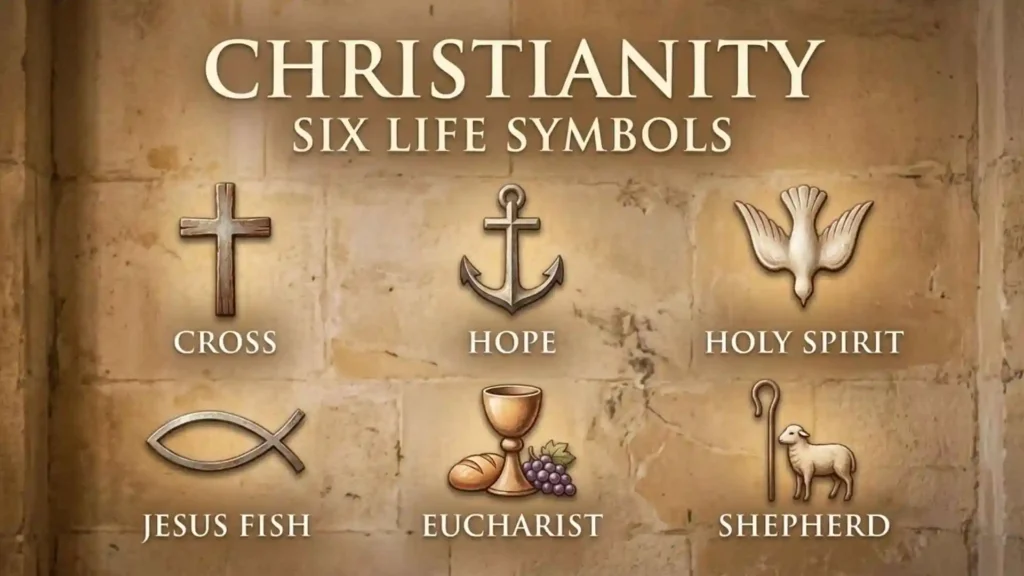
Christian art gives death a dual meaning. It represents the result of human mortality, but it can also lead toward resurrection and salvation.
The skull may accompany saints who meditate on mortality. It may appear below the Crucifixion, near a cross, or beside prayer books. In such settings, it encourages repentance and spiritual preparation.
Extinguished candles represent life ending, while candles that remain lit may represent faith or the continuing soul. Tombs can symbolize both burial and resurrection, especially when connected with Christ’s empty tomb.
Buddhism
Buddhist art may use skeletons, corpses, charnel-ground imagery, or decaying bodies to encourage meditation on impermanence and detachment.
The purpose is not necessarily to produce horror. Such images can help practitioners understand that the body changes and that attachment to permanent identity causes suffering.
Hindu Traditions
In Hindu art, death imagery can appear with deities associated with time, destruction, cremation grounds, and transformation. Kali may wear a garland of severed heads, while Shiva may be connected with ash and cremation sites.
These symbols do not mean meaningless violence. They may represent the destruction of ego, the power of time, liberation, or the ending necessary before renewal.
Islam
Islamic religious art generally avoids using death as a fixed sacred icon in the same way that some Christian traditions use the skull. However, mortality, judgment, graves, the temporary nature of worldly life, and the afterlife remain important themes in literature, calligraphy, architecture, and funerary spaces.
Interpretation should distinguish theological ideas about death from decorative symbols that developed in other traditions.
Scientific and Medical Uses
Death imagery sometimes overlaps with technical communication, but its meaning changes outside fine art.
The skull and crossbones is widely used as a warning for poison or acute toxicity. In this context, it is not primarily a philosophical memento mori. It communicates immediate danger.
Anatomical skulls and skeletons also appear in medical illustration, education, forensic science, and museum displays. Their purpose may be scientific rather than symbolic, although artists can deliberately blur the boundary between anatomical study and reflection on mortality.
Where Symbols of Death Are Used
Death symbols appear across many creative and public settings:
- Painting: Vanitas still lifes, portraits, religious scenes, battle paintings, and memorial works
- Sculpture: Tomb figures, angels, skeletal forms, funerary monuments, and public memorials
- Literature: Ravens, graveyards, ghosts, winter, darkness, and fading flowers
- Architecture: Tombs, mausoleums, crypts, memorial arches, and cemetery gates
- Jewelry: Mourning rings, lockets, skull watches, hair jewelry, and memorial pendants
- Tattoos: Skulls, clocks, ravens, poppies, candles, and memorial names
- Photography: Empty rooms, abandoned objects, bodies, shadows, and ruined landscapes
- Film: Crows, clocks, mirrors, funerals, dead trees, and color changes
- Logos and warnings: Toxicity symbols, hazard labels, military imagery, and subcultural branding
- Public monuments: Eternal flames, broken columns, poppies, names, and empty chairs
Common Variations of Death Symbols
Human Skull and Skull With Crossbones
A human skull commonly represents mortality. A skull with crossed bones may suggest poison, danger, piracy, or death in battle. The additional bones make the warning more active and public.
Full Skeleton and Grim Reaper
A skeleton shows the entire body reduced to its basic structure. The Grim Reaper adds a hood, scythe, and humanlike role. It personifies death as a figure that arrives to collect the living.
Burning and Extinguished Candles
A burning candle may represent life still continuing. A short candle suggests little time remains. Smoke rising from an extinguished wick usually indicates that life has just ended.
Fresh and Wilted Flowers
Fresh flowers suggest youth, beauty, love, or life. Wilted flowers show that those conditions are fading. Broken stems may communicate sudden death or interrupted potential.
Clock, Watch, and Hourglass
All three represent time, but they create different effects. A clock suggests measured time, a watch makes mortality personal, and an hourglass visually shows time running out.
Raven, Crow, and Vulture
These birds are often grouped together, but their meanings differ. Ravens and crows can symbolize prophecy, memory, intelligence, battle, or mourning. Vultures more directly suggest decay and the consumption of dead bodies, although some cultures also connect them with purification.
Common Misconceptions
Every Skull Means Evil
A skull does not automatically represent evil. It may express humility, equality, remembrance, anatomy, wisdom, spiritual meditation, or acceptance of mortality.
Black Always Represents Death
Black often communicates mourning in Western traditions, but mourning colors vary. White is associated with death and mourning in several Asian cultures. Color meanings depend on geography, religion, and historical custom.
Death Symbols Always Express Despair
Many death symbols encourage meaningful living rather than hopelessness. Vanitas paintings criticize pride and excess, while memorial art preserves memory and love.
Butterflies Always Mean Rebirth
Butterflies can suggest transformation or the soul, but they may also represent beauty, fragility, or short life. Their meaning depends on the artwork’s broader visual language.
Ravens Predict Literal Death
A raven in art usually functions as a symbolic or atmospheric device. It may suggest mystery, grief, war, memory, prophecy, or intelligence rather than an actual prediction.
Interesting Facts About Symbols of Death in Art
- A distorted skull can change how viewers move.
Holbein’s anamorphic skull requires the viewer to stand at an unusual angle, turning mortality into a physical act of looking. - Soap bubbles were once serious death symbols.
Their beauty lasts only seconds, making them effective images of fragile human life. - Musical instruments can imply silence after death.
In vanitas art, a lute or flute may represent pleasure and talent, but also the moment when music permanently stops. - Mirrors can represent both vanity and self-knowledge.
A mirror may criticize obsession with appearance, yet it can also invite viewers to examine their own lives. - Smoke often represents a life that has just disappeared.
Unlike a cold candle, a smoking wick suggests that the flame ended only moments earlier. - Broken columns commonly symbolize life cut short.
They became especially popular on graves and memorial monuments. - Fruit may contain a hidden timeline.
Fresh fruit, bruised fruit, and rotting fruit can show different stages of aging within one image. - Skeletons can create comedy as well as fear.
Dance of Death scenes sometimes use exaggerated movement to mock social pride. - Death imagery can preserve love.
Mourning jewelry often held names, dates, portraits, or hair from the deceased. - Ruins symbolize more than individual death.
They may represent the decline of empires, cultures, institutions, or human ambition. - Empty spaces can become death symbols without showing death.
An unoccupied chair, abandoned shoe, or silent room may communicate absence more powerfully than a body. - Modern artists often turn luxury into a mortality symbol.
Precious materials placed around skulls can question whether wealth defeats death or merely decorates it.
Related Symbols and Their Differences
| Related Symbol | Connection to Death | Main Difference |
| Phoenix | Death followed by rebirth | Emphasizes renewal rather than finality |
| Ouroboros | Endless cycle of destruction and creation | Represents continuity and repetition |
| Lotus | Spiritual awakening from difficult conditions | Focuses on purity and enlightenment |
| Winter | Dormancy, aging, and endings | May also promise spring and return |
| Setting sun | End of life or a completed stage | Often calm rather than threatening |
| Empty chair | Absence of a person | Expresses grief indirectly |
| Broken column | A life interrupted | Common in memorial and cemetery art |
| Eternal flame | Memory that continues after death | Emphasizes lasting honor |
| Poppy | Sleep, sacrifice, and remembrance | Closely associated with war memorials |
| Cypress tree | Mourning and cemeteries | Represents enduring sorrow and immortality |
Frequently Asked Questions
What is the most common symbol of death in art?
The skull is the most recognizable symbol of death in art. It represents the physical remains shared by all humans and reminds viewers that beauty, status, and wealth are temporary. Depending on context, it can also symbolize danger, wisdom, spiritual reflection, rebellion, or remembrance.
What flowers symbolize death in art?
Poppies, chrysanthemums, lilies, marigolds, and wilted roses may symbolize death, mourning, remembrance, or funerals. Their meanings vary by culture. A flower’s condition is also important. A fresh bloom may represent life, while fading petals suggest aging, loss, or the temporary nature of beauty.
Why do artists use hourglasses to represent death?
Hourglasses make the passage of time visible. As sand falls from the upper chamber, the remaining amount steadily decreases. In vanitas and memento mori art, this process suggests that every person has limited time and that death moves closer even when life appears calm.
What does an extinguished candle symbolize?
An extinguished candle usually represents a life that has ended. A trail of smoke may suggest that death occurred recently. In religious or memorial art, the candle can also refer to the soul, faith, memory, or the boundary between physical life and spiritual existence.
Are ravens always symbols of death?
No. Ravens can symbolize death, battle, prophecy, memory, intelligence, magic, or mystery. Their dark feathers and feeding behavior contributed to their association with death, especially in battlefield and Gothic imagery. However, some cultural traditions view ravens as creators, messengers, guides, or protectors.
What is the difference between memento mori and vanitas?
Memento mori is a broad artistic reminder that every person must die. Vanitas is a more specific tradition that emphasizes the emptiness or temporary value of wealth, pleasure, knowledge, beauty, and achievement. A vanitas work often combines luxury objects with skulls, clocks, bubbles, or extinguished candles.
Can symbols of death have positive meanings?
Yes. Death symbols can encourage gratitude, humility, remembrance, spiritual preparation, and acceptance. Butterflies may suggest the soul’s transformation, while eternal flames represent memory that survives physical death. Even skulls can remind viewers to use their limited time wisely.
What symbolizes sudden death in art?
Broken flowers, fallen glasses, spilled liquids, stopped clocks, shattered objects, weapons, extinguished flames, and interrupted music can symbolize sudden death. Artists often show ordinary activities abruptly disturbed to communicate how quickly life can change or end.
Why is decaying fruit used in paintings?
Decaying fruit shows that pleasure and physical beauty do not last. In vanitas still lifes, ripe food may appear attractive at first, but bruises, insects, or rot reveal the beginning of decline. The fruit becomes a small-scale image of aging, consumption, and bodily mortality.
How can viewers correctly interpret death symbols?
Viewers should study the symbol’s cultural setting, historical period, nearby objects, color, composition, and intended audience. A skull beside a Bible may suggest spiritual meditation, while the same skull on a warning label indicates poison. Meaning comes from context, not from the isolated image alone.
Key Takeaways
- Symbols of death in art express mortality, time, grief, remembrance, judgment, and transformation.
- Skulls, skeletons, hourglasses, candles, dead flowers, tombs, and ravens are among the most common examples.
- Memento mori art reminds viewers that death is unavoidable.
- Vanitas art emphasizes the temporary nature of wealth, beauty, knowledge, and pleasure.
- Death symbols are not always negative; they may encourage humility, gratitude, renewal, or spiritual reflection.
- Meanings change across religions, cultures, historical periods, and artistic movements.
- Context determines whether an image represents literal death, danger, memory, rebirth, or social criticism.
- Modern artists use traditional death imagery to discuss war, identity, consumerism, disease, and environmental loss.
Conclusion
Symbols of death in art do more than represent life’s ending. They help artists explore how people respond to time, grief, faith, beauty, memory, and uncertainty. A skull can warn against pride, an hourglass can reveal the value of time, and a fading flower can turn private loss into a universal experience.
Understanding these symbols requires attention to culture and context. The same image may communicate fear in one artwork, spiritual renewal in another, and affectionate remembrance in a third. By studying symbols of death in art, viewers gain a deeper understanding not only of mortality, but also of the ways human beings search for meaning within a limited life.

I am Ethan Mitchell, an English writer and lifelong learner who is fascinated by words and the way language changes over time. At LearnNestly, I share practical explanations designed for readers who want to improve their understanding of English without complicated terminology. I enjoy researching meanings, usage, grammar, and common language mistakes, then presenting the information in a simple and useful format. My purpose is to make every article a small learning experience that readers can actually apply.
Books:
- The Smart Learner’s English Guide
- English in Real Life
 Daniel Brooks
 Amelia Carter