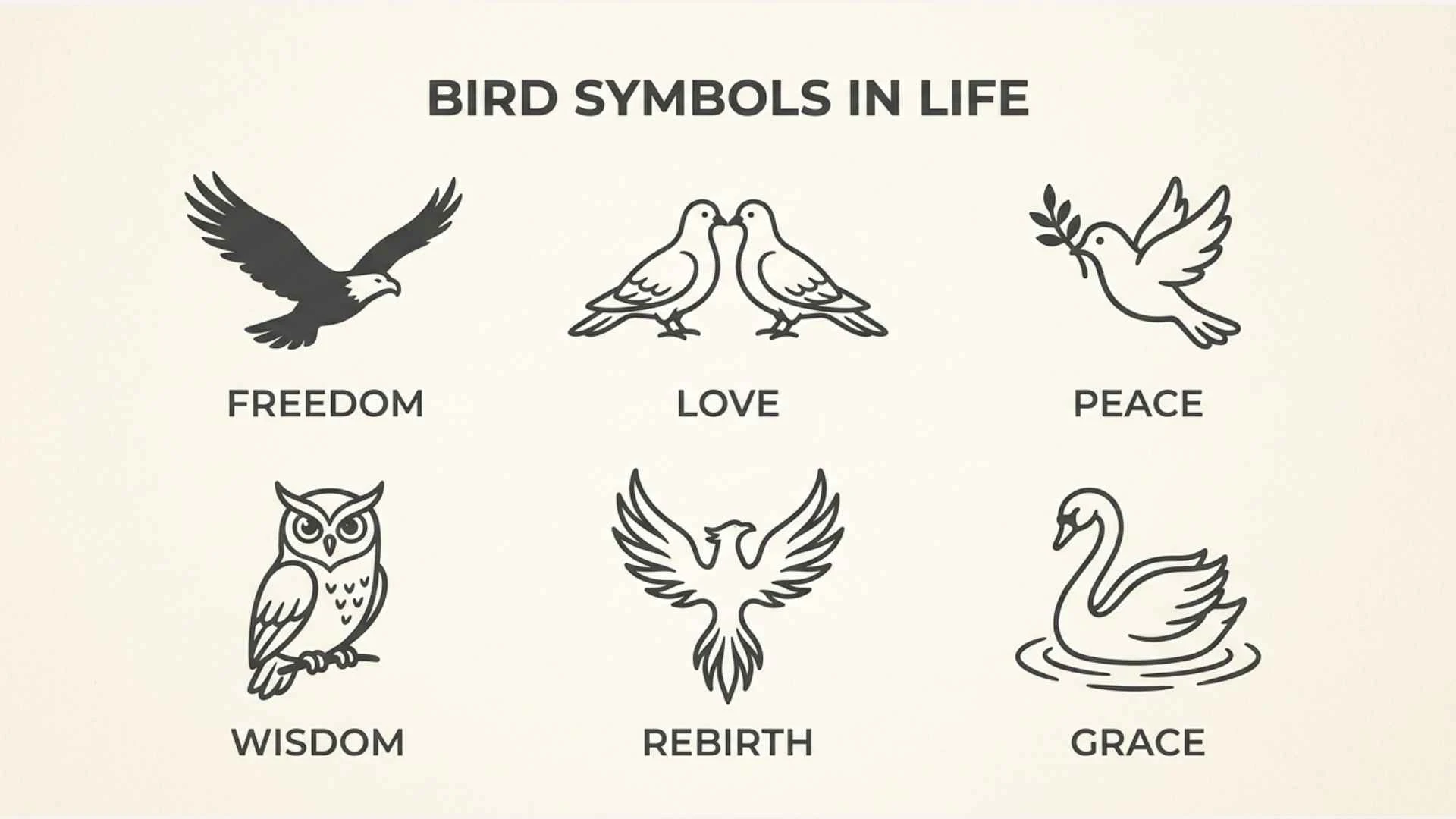
Birds have fascinated people for centuries because they seem to connect the earth with the sky. Across different cultures, religions, myths, and traditions, birds are often seen as symbols of freedom, hope, peace, spirituality, and transformation. Their ability to fly, migrate, and rise above the ground gives them powerful symbolic meanings that still appear in art, literature, dreams, tattoos, and everyday life.
The meaning of a bird symbol can change depending on the species, color, behavior, and cultural context. For example, an eagle may represent strength and courage, while a dove is commonly associated with peace and purity. A phoenix can symbolize rebirth and transformation, while an owl is often connected with wisdom and mystery. These different meanings make bird symbolism a fascinating way to explore human emotions, beliefs, and life experiences.
In this guide, we’ll explore the most common bird symbols and their meanings, including what different birds represent spiritually, emotionally, and culturally. You’ll discover birds associated with freedom, love, hope, protection, death, new beginnings, and personal transformation, along with the deeper symbolism behind popular bird images and species.
Quick Meaning of Bird Symbols
Bird symbols generally represent freedom, higher perspective, spiritual communication, hope, and transformation. Because birds move between the ground and sky, many cultures view them as messengers between humans and divine or unseen realms. However, their meanings vary widely by species, behavior, color, cultural tradition, and historical context.
Bird Symbol Overview
| Field | Details |
| Symbol Name | Bird symbol |
| Primary Meanings | Freedom, spirit, hope, transformation, wisdom |
| Symbol Category | Natural, cultural, spiritual, mythological |
| Earliest Contexts | Prehistoric art, ancient myths, burial practices, religious traditions |
| Major Cultures | Egyptian, Greek, Roman, Celtic, Norse, Native American, Chinese, Japanese, Hindu, Christian, Islamic |
| Common Uses | Art, literature, religion, flags, coats of arms, tattoos, jewelry, logos |
| Modern Meaning | Independence, ambition, peace, personal growth, travel |
| Emoji Equivalents | 🐦, 🦅, 🕊️, 🦉, 🐦⬛, 🦢, 🦚 |
| Related Symbols | Wings, feathers, nests, eggs, sky, flight |
| Meaning Depends On | Species, color, direction, number, behavior, cultural setting |
What Do Bird Symbols Mean?
Bird symbols most often express the human desire to rise above limits. Flight allows birds to escape barriers that confine land animals, so people naturally associate them with independence, possibility, ambition, and liberation.
Birds also symbolize perspective. From high above the ground, a bird can see a wider landscape. This gives birds symbolic connections to wisdom, foresight, awareness, and the ability to understand a situation from a broader viewpoint.
Their seasonal movements add another layer of meaning. Migratory birds disappear and return according to natural cycles. As a result, they may represent change, homecoming, renewal, survival, and the passage of time.
Birds can also embody the soul. Many religious and mythological traditions describe the spirit as winged, light, or capable of rising after death. In these contexts, a bird may stand for immortality, divine guidance, or the soul’s journey beyond the physical world.
Not every bird meaning is positive. Scavenging birds may symbolize death or destruction, while nocturnal birds may suggest secrecy or danger. Yet these meanings are rarely simple. A raven, for example, can represent death in one story and intelligence, creation, or prophecy in another.
History and Origin of Bird Symbolism
Bird symbolism does not come from one civilization. It developed independently in many societies because people everywhere observed birds flying, migrating, singing, hunting, nesting, and appearing at important seasonal moments.
Birds in Prehistoric Life
Birds appear in prehistoric art, carved objects, ritual items, and early decorative designs. Archaeologists cannot always determine exactly what these images meant. However, their repeated appearance suggests that ancient people noticed the unusual qualities of birds, especially flight, feathers, eggs, and seasonal movement.
Feathers may have been valued for decoration, ceremony, status, and practical use. Bird bones were also shaped into tools and musical instruments. These physical uses likely existed alongside symbolic beliefs.
Ancient Egypt
In ancient Egyptian religion, several birds had sacred meanings. The ba, one aspect of a person’s spiritual identity, was often shown as a human-headed bird. This form could travel between the tomb, the world of the living, and the divine realm.
The falcon was strongly associated with Horus, a god connected with kingship and the sky. The ibis was linked to Thoth, the god of writing, learning, and wisdom. Vultures could represent protection and motherhood, partly because of ancient beliefs about their reproductive behavior.
Ancient Greece and Rome
Greek and Roman traditions connected birds with gods, prophecy, and political authority. The eagle became associated with Zeus in Greece and Jupiter in Rome. It represented divine power, victory, kingship, and military strength.
Bird behavior was also studied as a possible sign of divine will. Roman augurs interpreted the flight, calls, direction, or feeding behavior of birds before major decisions. This practice did not treat every bird as automatically meaningful. Interpretation followed religious rules and depended on the species and circumstances.
Northern European Traditions
In Norse mythology, ravens were associated with Odin. His two ravens, commonly known as Huginn and Muninn, traveled through the world and brought information back to him. They are often interpreted as symbols of thought, memory, knowledge, and watchfulness.
Celtic traditions also included birds in stories about transformation, sovereignty, warfare, music, and journeys to the Otherworld. Swans, ravens, cranes, and other species carried different meanings in different tales.
Asian Traditions
In Chinese culture, birds may symbolize rank, virtue, good fortune, marriage, longevity, or harmony. The crane is strongly associated with long life and transcendence. The mandarin duck commonly symbolizes marital affection, while the phoenix represents harmony, renewal, and imperial dignity.
In Japanese art and folklore, cranes represent longevity, good fortune, and hope. The red-crowned crane has become especially meaningful in visual culture. Other birds, including crows, sparrows, and owls, may carry meanings shaped by language, folklore, and regional beliefs.
Bird Symbols in the Modern World
Modern bird symbolism combines older traditions with newer ideas. Birds now appear in conservation campaigns, brand identities, sports logos, political emblems, memorial art, tattoos, and social media.
A flying bird may represent leaving a difficult past. A flock may symbolize community or shared direction. An endangered bird may represent environmental responsibility. Modern interpretations often focus on personal freedom, emotional healing, travel, independence, and resilience.
Bird Symbolism and Interpretation
Freedom and Independence
Freedom is the most widely recognized meaning of bird symbols. A bird in open flight suggests movement without visible boundaries. It may express independence, escape, self-determination, or the courage to leave a restrictive situation.
A caged bird creates the opposite message. It often symbolizes oppression, limited potential, emotional confinement, or a voice that cannot be freely expressed.
Spiritual Connection
Birds frequently represent a link between the physical and spiritual worlds. Their upward flight makes them natural images of prayer, ascension, divine presence, and communication with heaven.
This interpretation appears in religious art, funeral symbolism, memorial jewelry, and personal tattoos. It is usually symbolic rather than a universal religious teaching.
Hope and Renewal
Birdsong at dawn and the return of migratory birds in spring connect birds with fresh beginnings. A bird may therefore symbolize hope after hardship, recovery, a new stage of life, or trust in the future.
The phoenix develops this theme dramatically by rising from destruction and beginning again.
Wisdom and Higher Perspective
Birds that fly high or observe quietly may symbolize insight and clear judgment. Eagles are associated with sharp vision, while owls are linked to wisdom in many modern Western settings.
This symbolism reflects human interpretation of bird behavior. It does not mean that every culture gives the same bird the same qualities.
Love, Loyalty, and Partnership
Bird pairs often represent romantic devotion. Swans, doves, albatrosses, and mandarin ducks appear in imagery related to love and partnership.
Such meanings partly come from observations of pair bonding. However, bird mating behavior varies greatly by species, so symbolic ideas should not be treated as exact scientific descriptions.
Transformation
Birds symbolize transformation because they hatch from eggs, grow feathers, learn to fly, migrate, and repeatedly renew their plumage. Their life cycles offer powerful images of development and transition.
A bird leaving its nest may represent adulthood, personal independence, graduation, or the start of a new journey.
Death and the Afterlife
In some settings, birds represent the departure of the soul. A bird appearing near a death may be viewed as a messenger, guide, or sign of spiritual continuation.
Ravens, crows, and vultures may symbolize death because of their dark coloring, scavenging habits, or presence near battlefields and remains. Yet they can also represent intelligence, purification, protection, or renewal.
Negative Bird Symbolism
Negative bird meanings can include bad omens, predation, greed, chaos, captivity, or death. These meanings usually depend on context.
An owl may symbolize wisdom in one culture and fear or misfortune in another. A crow may represent loss in a poem but cleverness in folklore. Symbolism is flexible, not fixed.
Cultural Significance of Bird Symbols
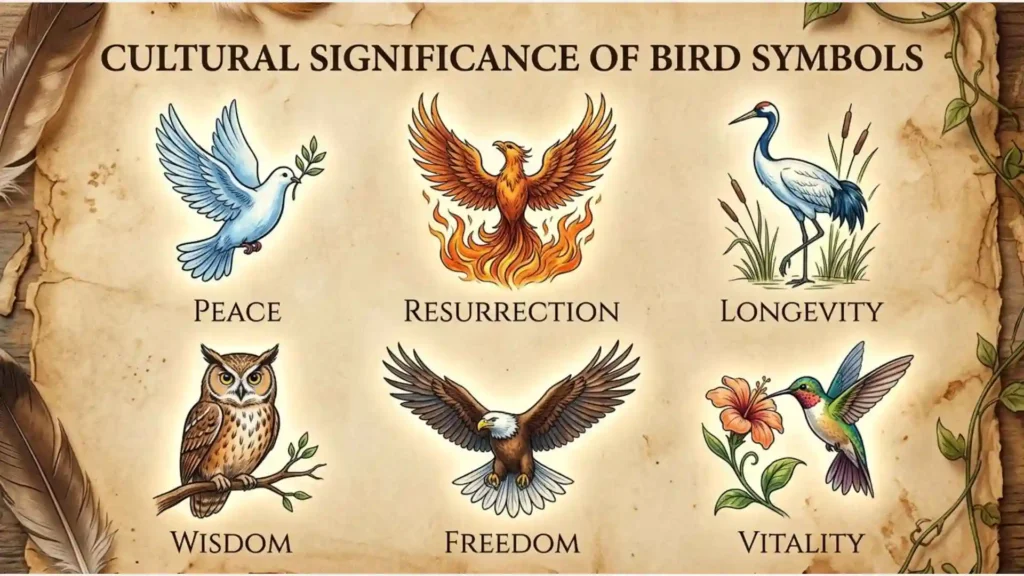
Native American Traditions
Bird meanings differ among Native nations, communities, and ceremonial systems. It is inaccurate to speak of one universal Native American interpretation.
Eagles hold sacred importance in many Indigenous traditions and may be connected with prayer, honor, courage, leadership, or spiritual responsibility. Eagle feathers have ceremonial and legal significance in the United States, and their possession is regulated.
Other birds, such as ravens, thunderbirds, owls, cranes, and hummingbirds, appear in specific regional stories and artistic traditions. Their meanings should be understood within the culture that created them.
European Symbolism
European bird symbolism draws from Greek, Roman, Celtic, Norse, Christian, and medieval traditions. Eagles became signs of empire and military authority. Doves represented peace and sacred presence. Ravens and crows were often linked with battle, prophecy, death, and intelligence.
Medieval bestiaries sometimes assigned moral lessons to birds. These writings reflected religious interpretation rather than modern zoology.
African Traditions
Africa contains thousands of cultural traditions, so bird symbolism varies widely. Birds may be associated with ancestors, kingship, fertility, prophecy, rain, death, or communication with spiritual forces.
In some West African artistic traditions, birds appear on royal objects as symbols of wisdom, authority, or the influence of powerful women. Specific meanings depend on the people, location, object, and historical setting.
Middle Eastern Traditions
Birds appear throughout Middle Eastern poetry, storytelling, religion, and decorative art. Falcons may represent nobility, skill, courage, and prestige. The hoopoe appears in religious and literary traditions as a messenger or guide.
In Persian literature, birds often symbolize spiritual travelers. The journey of birds can represent the soul’s search for truth, unity, or self-knowledge.
South Asian Traditions
Hindu traditions connect particular birds with deities and sacred stories. Garuda, a powerful birdlike being, serves as the mount of Vishnu and symbolizes strength, speed, protection, and victory over harmful forces.
The peacock is associated with beauty, royalty, rain, and divine figures, including Kartikeya and Krishna in different contexts. Saraswati is often shown with a swan or hamsa, a bird connected with wisdom and spiritual discrimination.
East Asian Traditions
In China, birds often form part of a larger visual language. Cranes symbolize longevity, magpies may represent happiness or good news, and pairs of birds can symbolize marriage.
The fenghuang, sometimes called the Chinese phoenix, differs from the Western phoenix. It represents harmony, virtue, peace, and balanced rule rather than simply rebirth through fire.
In Japan, the crane is associated with long life, good fortune, and wishes. Paper cranes have also become international symbols of peace.
Religious and Spiritual Meaning of Birds
Christianity
Birds appear throughout Christian scripture and art. The dove is associated with peace, purity, reconciliation, and the Holy Spirit. In the New Testament accounts of Jesus’ baptism, the Spirit descends in a form compared to a dove.
The eagle may symbolize spiritual elevation, renewal, strength, or John the Evangelist in Christian artistic tradition. The pelican became a symbol of self-sacrifice in medieval Christian imagery because of a legend that it fed its young with its own blood.
Not all traditional bird symbolism reflects scientific fact. Religious art often uses animals allegorically.
Judaism
Birds appear in the Hebrew Bible in stories, laws, poetry, and sacrifice. Noah sends out birds after the flood, and the returning dove with an olive leaf becomes a lasting sign of safety and restoration.
The eagle can symbolize speed, protection, strength, or divine care. Bird imagery in Jewish interpretation depends on the biblical passage and its literary purpose.
Islam
Birds appear in the Quran as creatures that praise God, follow divinely ordered patterns, and demonstrate signs within creation. The hoopoe plays an important role in the account of Solomon and the Queen of Sheba.
Islamic literature also uses bird journeys as spiritual metaphors. These works may describe the search for divine truth, the purification of the self, or the difficulty of spiritual growth.
Hinduism and Buddhism
Hindu traditions include sacred birds and birdlike beings such as Garuda, the peacock, owl, swan, and parrot. Each has different associations based on deity, story, and region.
In Buddhist art, birds can represent freedom from attachment, awakened awareness, harmony, or spiritual teaching. The meaning varies among Buddhist cultures and artistic traditions.
Scientific Meaning Behind Bird Symbolism
Bird symbolism often begins with real biological traits, although cultural interpretations may simplify those traits.
Flight inspires ideas about freedom because birds can move vertically and cross difficult landscapes. Migration suggests endurance, navigation, seasonal change, and return. Nest building inspires ideas of home, care, and family.
Birdsong is associated with communication, courtship, territorial defense, and group behavior. Humans often interpret it as joy, beauty, warning, or the arrival of morning.
Modern science also adds new meanings. Birds are used as indicators of environmental health because changes in bird populations can reflect habitat loss, pollution, climate shifts, invasive species, or altered food supplies.
However, scientific facts should not be confused with symbolic claims. An owl is not biologically “wise,” and a dove is not naturally committed to human ideas of peace. People create these meanings by interpreting visible behavior and cultural history.
Where Bird Symbols Are Used
Literature and Poetry
Writers use birds to express freedom, grief, identity, hope, exile, and confinement. A singing bird may represent a person’s voice, while a silent or wounded bird may suggest repression or lost innocence.
Art and Architecture
Birds appear in paintings, mosaics, carvings, stained glass, pottery, textiles, monuments, and architectural decoration. Their meanings may be religious, political, decorative, or memorial.
National Flags and Emblems
Eagles, falcons, cranes, and other birds appear on national symbols, coats of arms, military insignia, and government seals. They commonly represent sovereignty, courage, vision, authority, or historical identity.
Tattoos
Bird tattoos may symbolize independence, survival, travel, transformation, remembrance, or spiritual belief. A single bird, flock, feather, cage, or open wing creates a different message.
Jewelry
Bird-shaped pendants, earrings, brooches, and rings often represent love, hope, freedom, or protection. Lockets with birds may serve as memorial pieces.
Logos and Branding
Companies use birds to suggest speed, communication, flight, precision, elegance, or global reach. The species and pose help shape the brand message.
Funerals and Memorials
Doves, cardinals, robins, and flying birds are common in memorial art. They may express peace, continuing love, release from suffering, or the soul’s journey.
Environmental Campaigns
Bird symbols are widely used in conservation because birds are visible, familiar, and sensitive to environmental change. A threatened species can become a symbol of an entire habitat.
Common Bird Symbol Variations
A Bird in Flight
A flying bird represents freedom, ambition, progress, or spiritual elevation. Upward flight often suggests hope, while downward flight may suggest return, decline, or arrival.
A Flock of Birds
A flock can symbolize community, cooperation, shared purpose, migration, or collective movement. It may also represent change when birds appear to scatter suddenly.
A Caged Bird
A caged bird symbolizes restriction, oppression, emotional imprisonment, or silenced expression. An open cage may represent escape, healing, or regained independence.
A Bird and Nest
A bird with a nest represents home, parenthood, safety, responsibility, and care. An empty nest can symbolize children leaving home, loneliness, maturity, or transition.
A Bird with an Olive Branch
This design symbolizes peace, reconciliation, and hope. It draws strongly from the flood story associated with Noah.
Two Birds Together
Two birds commonly represent partnership, loyalty, friendship, romance, or balance. The exact meaning depends on the species and design.
Black Birds
Black birds may symbolize mystery, death, intelligence, prophecy, protection, or transformation. The color alone does not determine the meaning.
White Birds
White birds often represent peace, purity, innocence, sacred presence, or the soul. These meanings are common but not universal.
Common Misconceptions About Bird Symbols
Every Bird Has One Universal Meaning
No bird has one meaning in every culture. Owls, ravens, eagles, and doves carry different interpretations across regions and historical periods.
Seeing a Bird Predicts an Event
Folklore often treats unusual bird encounters as omens. There is no scientific evidence that a bird sighting predicts death, marriage, wealth, or another personal event.
All Eagles Symbolize Freedom
Eagles frequently represent freedom, but they also symbolize empire, warfare, kingship, divine authority, and national power.
Owls Always Represent Wisdom
The owl’s link with wisdom is especially strong in traditions influenced by ancient Greece and modern Western education. In other cultures, owls may represent danger, secrecy, death, or protection.
Ravens and Crows Are Evil
Ravens and crows are highly intelligent birds with complex social behavior. Their negative reputation often comes from dark plumage, scavenging, and associations with battlefields. Many traditions instead view them as creators, guides, tricksters, or bringers of knowledge.
A Phoenix Is a Real Bird Species
The phoenix is a mythological bird. Its appearance and story vary across traditions, and it should not be confused with real birds or with every sacred fire bird from world mythology.
10 Interesting Facts About Bird Symbols
- Bird symbolism appears on every inhabited continent.
Human societies repeatedly connected flight with spiritual power, freedom, and communication. - The eagle can symbolize both liberty and empire.
Its meaning changes depending on whether the focus is independence, military strength, kingship, or state authority. - The dove became a peace symbol through several traditions.
Biblical imagery, Christian art, and modern peace movements all helped shape its present meaning. - Ravens can represent memory as well as death.
Norse mythology connects Odin’s ravens with thought and memory, showing how one bird can carry several meanings. - Cranes symbolize long life in East Asian art.
Their elegant appearance and cultural associations made them popular in paintings, textiles, ceramics, and celebrations. - The phrase “bird’s-eye view” has symbolic depth.
It means more than seeing from above. It suggests understanding the larger pattern of a situation. - A broken wing often symbolizes wounded potential.
In art and literature, it may represent trauma, lost freedom, vulnerability, or temporary inability to move forward. - Migrating birds inspired ideas of homecoming.
Their regular return links them with memory, belonging, seasonal renewal, and emotional attachment to place. - Bird eggs symbolize potential before flight begins.
They represent birth, hidden possibility, protection, and the early stage of transformation. - Modern conservation gives bird symbols ecological meaning.
Birds now represent habitat protection, biodiversity, climate awareness, and shared responsibility for nature.
Related Bird Symbols and Their Meanings
| Bird Symbol | Common Meaning | How It Differs |
| Eagle | Strength, authority, vision | Emphasizes leadership and power |
| Dove | Peace, purity, reconciliation | Focuses on gentleness and harmony |
| Owl | Wisdom, mystery, night | Connected with knowledge and secrecy |
| Raven | Intelligence, prophecy, change | Often carries darker or more complex meanings |
| Crow | Adaptability, cleverness, transformation | Commonly linked with survival and social intelligence |
| Swan | Love, grace, transformation | Emphasizes beauty and partnership |
| Crane | Longevity, hope, good fortune | Strongly connected with East Asian traditions |
| Phoenix | Rebirth, immortality, renewal | Mythical rather than biological |
| Peacock | Beauty, pride, royalty, immortality | Known for display and brilliant color |
| Hummingbird | Joy, energy, resilience | Suggests lightness and rapid movement |
| Falcon | Focus, nobility, victory | Often linked with hunting skill and status |
| Robin | Renewal, spring, remembrance | Frequently represents new beginnings |
| Sparrow | Humility, community, simplicity | Emphasizes ordinary life and belonging |
| Vulture | Death, purification, renewal | Transforms decay into ecological cleansing |
| Albatross | Endurance, ocean travel, burden | Also linked with guilt through literature |
Frequently Asked Questions About Bird Symbols
What do birds symbolize spiritually?
Spiritually, birds often symbolize the soul, divine communication, freedom from earthly limits, prayer, and movement toward a higher state of awareness. The exact interpretation depends on the religion or tradition. A dove, eagle, raven, crane, or mythical phoenix may each communicate a very different spiritual idea.
What does a flying bird symbolize?
A flying bird usually symbolizes freedom, ambition, progress, hope, or spiritual elevation. It may represent leaving limitations behind and moving toward a new goal. In memorial imagery, upward flight can also symbolize release from suffering or the soul’s journey beyond physical life.
What do two birds symbolize?
Two birds commonly symbolize love, partnership, loyalty, friendship, or emotional balance. Wedding art often uses paired doves, swans, or lovebirds. However, the meaning depends on their behavior. Birds facing each other suggest connection, while birds flying apart may represent separation or independence.
What does a flock of birds symbolize?
A flock of birds can symbolize community, cooperation, shared direction, migration, and collective freedom. In art, a flock moving across the sky may also suggest rapid change or the passage of time. A scattered flock can represent disorder, fear, or the breaking apart of a group.
What does a bird in a cage mean?
A caged bird represents restriction, oppression, lost freedom, silenced expression, or unrealized potential. It may describe a person trapped by social rules, fear, relationships, work, or circumstances. An open cage with a departing bird usually symbolizes liberation, healing, or personal independence.
Which bird symbolizes hope?
Doves, robins, cranes, swallows, and phoenixes can all symbolize hope. The dove suggests peace after conflict, the robin suggests the return of spring, and the crane represents good fortune and long life. The phoenix symbolizes hope through complete destruction followed by renewal.
Which bird symbolizes death?
Ravens, crows, vultures, and owls have been associated with death in some cultures. These meanings often come from nocturnal behavior, scavenging, dark coloring, or appearances near battlefields. Yet none of these birds universally symbolizes death, and many traditions give them protective or positive meanings.
What bird symbolizes freedom?
The eagle is one of the most recognized symbols of freedom because of its powerful flight and wide range. Swallows, falcons, and birds shown flying from cages can also express liberation. In personal art, almost any bird in open flight may represent independence.
Do bird colors change their symbolic meaning?
Yes. White birds often suggest peace, purity, or spiritual presence, while black birds may suggest mystery, intelligence, death, or transformation. Red birds can represent passion, life, or remembrance. However, color meanings vary by culture and should be interpreted with the species and context.
What does it mean when birds appear in dreams?
Birds in dreams may reflect freedom, goals, communication, fear, hope, or a desire for change. A flying bird can suggest possibility, while an injured bird may reflect vulnerability. Dream symbolism is personal and psychological, not a reliable prediction of future events.
Key Takeaways
- Bird symbols commonly represent freedom, hope, spirit, wisdom, and transformation.
- Their meanings come from flight, migration, song, nesting, color, and behavior.
- No bird has one universal meaning across every culture.
- Eagles often symbolize power, while doves commonly represent peace.
- Owls, ravens, and crows have both positive and negative interpretations.
- Religious traditions use birds to express divine presence, prayer, and the soul.
- A bird’s species, position, number, and surroundings affect its meaning.
- Flying birds suggest freedom, while caged birds suggest restriction.
- Modern bird symbolism appears in tattoos, logos, memorials, art, and conservation.
- Symbolic interpretations should be separated from scientific facts about real birds.
Conclusion
Bird symbols remain powerful because they connect ordinary life with humanity’s largest questions. A bird can belong to the earth while rising into the sky, making it a natural image of freedom, spirit, perspective, and change.
Yet bird symbolism is never completely universal. An eagle may suggest freedom or empire. A raven may represent death, wisdom, memory, or creation. A dove may express peace, sacred presence, or hope after disaster.
To understand bird symbols accurately, consider the species, color, action, culture, religious tradition, and artistic setting. When these details are examined together, birds reveal a rich symbolic language shaped by nature, history, belief, and human imagination.

I am Daniel Brooks, a language researcher and writer with a strong interest in how people use English in everyday conversations. I contribute to LearnNestly because I enjoy turning confusing language topics into straightforward lessons. My goal is to help readers understand not only what a word or phrase means, but also when and how to use it naturally. I focus on clear examples, practical explanations, and useful language knowledge that readers can remember.
Books:
- The Practical English Guide
- Understanding Everyday Words
 Amelia Carter
 Ethan Mitchell