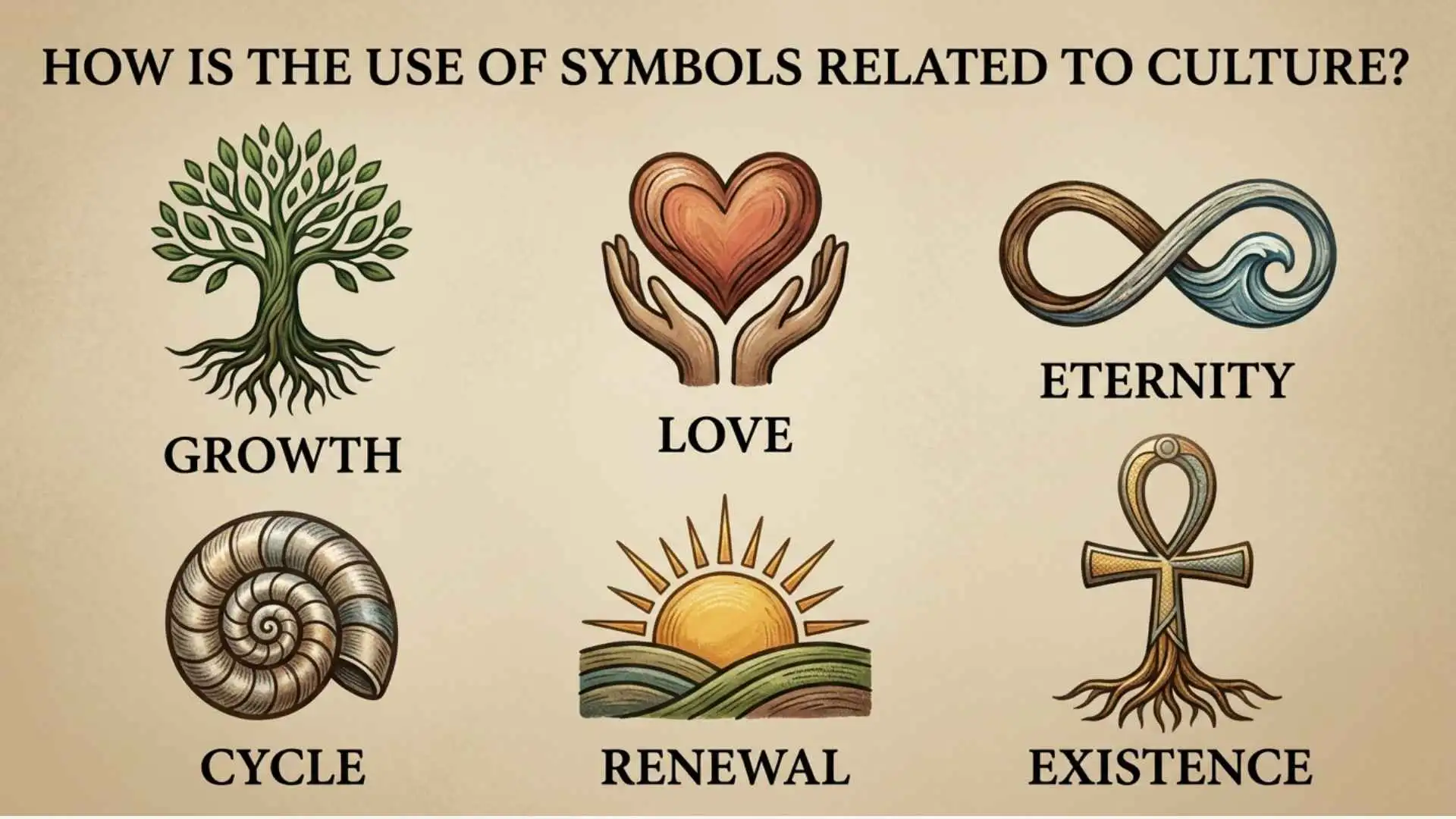
Symbols are closely related to culture because they allow communities to express shared beliefs, values, identities, and experiences through recognizable signs. A flag can represent a nation, a color can communicate mourning, and a religious image can connect worshippers to sacred teachings.
Understanding how is the use of symbols related to culture? requires more than identifying what a symbol looks like. Its meaning depends on the people who use it, the history behind it, and the setting in which it appears. The same gesture, animal, color, or shape may communicate respect in one society and something entirely different in another.
Symbols appear everywhere, including language, clothing, architecture, rituals, art, advertisements, road signs, national ceremonies, digital communication, and everyday social behavior. By studying them, we learn how cultures preserve memory, organize society, express identity, and pass meaning from one generation to the next.
Quick Meaning
The use of symbols is related to culture because symbols communicate meanings that members of a community learn and share. They represent ideas such as identity, faith, authority, belonging, danger, honor, or remembrance. Cultural context determines how a symbol is interpreted, used, preserved, and sometimes changed over time.
Symbol Overview Table
| Field | Explanation |
| Topic | Cultural symbols and symbolic communication |
| Primary Meaning | Shared signs that represent cultural ideas, values, identities, or traditions |
| Category | Culture, communication, anthropology, language, religion, and art |
| Origin | As old as human communication and organized social life |
| Earliest Forms | Body markings, ritual objects, cave art, burial practices, gestures, and carved signs |
| Cultural Function | Communicating identity, beliefs, status, memory, rules, and group membership |
| Common Examples | Flags, colors, religious icons, gestures, clothing, animals, monuments, and emblems |
| Modern Usage | Branding, politics, social media, national identity, fashion, activism, and digital communication |
| Related Concepts | Signs, icons, language, rituals, myths, emblems, metaphors, and visual communication |
| Key Principle | A symbol gains meaning through cultural agreement and context |
What Does the Use of Symbols Mean in Culture?
Symbols give visible or recognizable form to ideas that may otherwise be difficult to express. A symbol can be an image, object, sound, word, color, movement, place, or repeated action that stands for something beyond itself.
For example, a national flag is physically a piece of fabric, but culturally it may represent independence, sacrifice, shared history, government, territory, and collective identity. Its power comes not from the material itself but from the meaning people attach to it.
Culture teaches people how to interpret symbols. Children learn that certain colors are appropriate for celebrations, specific gestures show politeness, and particular objects belong in religious or national ceremonies. Over time, these meanings become familiar enough that people may respond to them without consciously analyzing them.
Symbols perform several cultural functions:
- They communicate complex ideas quickly.
- They distinguish one community from another.
- They preserve historical memories.
- They reinforce religious and moral values.
- They identify social roles and status.
- They create feelings of unity and belonging.
- They help communities organize rituals and ceremonies.
A symbol does not always have one permanent meaning. Its interpretation may depend on location, social group, historical period, or personal experience. This flexibility explains why symbols can unite people, cause disagreement, or change meaning as society evolves.
History and Origin of Cultural Symbols
The use of symbols began long before written language. Early humans used marks, objects, images, gestures, and ritual behavior to communicate information and express relationships with nature, ancestors, animals, and unseen forces.
Prehistoric cave paintings are among the earliest surviving examples of visual symbolism. Images of animals, handprints, hunting scenes, and geometric marks may have served social, spiritual, educational, or ceremonial purposes. Scholars cannot know the exact meaning of every prehistoric image, so interpretations must remain cautious. However, their repeated patterns suggest that they carried meaning beyond simple decoration.
Burial customs also reveal early symbolic thinking. The placement of tools, ornaments, pigments, food, or flowers with the dead may have expressed beliefs about identity, status, remembrance, or an afterlife. These practices show that objects could represent emotional and spiritual ideas.
As civilizations developed, symbols became part of organized systems. Ancient Mesopotamian seals identified individuals and authorities. Egyptian hieroglyphs combined visual and linguistic functions. Royal crowns, temple designs, military standards, and sacred animals communicated power, social order, and religious belief.
Written language itself grew from symbolic representation. Early pictorial signs often referred to recognizable objects. Over time, many writing systems became more abstract, representing sounds, syllables, or concepts rather than only physical things.
Symbols also became essential to political life. Rulers used thrones, robes, staffs, monuments, and official seals to make authority visible. Religious institutions used sacred images, architecture, music, and ceremonial objects to communicate beliefs to both literate and nonliterate populations.
Trade, migration, warfare, and cultural exchange carried symbols between societies. A design could be adopted, modified, or given a new meaning. This process continues today through travel, global media, fashion, entertainment, and the internet.
Symbolism and Interpretation
Cultural symbolism depends on the relationship between a visible sign and the meaning assigned to it. That relationship may be traditional, emotional, religious, political, or practical.
Traditional Meanings
Traditional symbols often survive because communities repeat them in ceremonies, stories, clothing, architecture, and family customs. Wedding rings, ceremonial dances, mourning clothes, harvest decorations, and national emblems all gain strength through repetition.
Tradition does not make a meaning universal. A practice may be deeply significant within one community while remaining unfamiliar to outsiders.
Modern Meanings
Modern societies constantly create new symbols. Company logos represent brands. Colored ribbons support public causes. Hashtags organize movements and conversations. Profile badges communicate identity or membership in digital communities.
Older symbols may also receive new interpretations. An ancient pattern may become a fashion design, political emblem, or commercial logo. Its modern use may preserve, simplify, or completely transform its earlier meaning.
Positive Symbolism
Symbols can represent:
- Hope
- Peace
- Courage
- Fertility
- Protection
- Wisdom
- Unity
- Freedom
- Healing
- Renewal
A tree, for example, may symbolize growth, ancestry, life, stability, or the connection between different realms. Its precise meaning depends on the cultural tradition and context.
Negative Symbolism
Symbols can also represent:
- Danger
- Death
- Disorder
- Betrayal
- Oppression
- Exclusion
- Fear
- Misfortune
- Social shame
- Conflict
A symbol that inspires pride in one group may remind another group of violence or injustice. Political and historical symbols often carry these competing interpretations.
Psychological Interpretation
People respond strongly to symbols because they connect abstract ideas with familiar images and experiences. A home may symbolize safety. Darkness may suggest uncertainty. A path may represent choice or personal development.
Some symbolic associations arise from common human experiences, but culture shapes how people organize and express them. Water may be connected with life because humans depend on it, yet different traditions may emphasize purification, danger, rebirth, chaos, or spiritual blessing.
Personal memory also affects interpretation. A cultural symbol can carry a widely shared meaning while producing different emotional responses in different individuals.
Why Are Symbols Culturally Significant?
Symbols are culturally significant because they turn shared ideas into forms that people can recognize, repeat, and pass on. They help communities maintain continuity even as individual members and social conditions change.
Symbols Create Group Identity
Flags, languages, clothing styles, songs, foods, and monuments help people identify with nations, religions, ethnic groups, professions, schools, and local communities.
Displaying a symbol may communicate, “I belong to this group,” or “These values matter to me.” This function can strengthen solidarity, especially during ceremonies, celebrations, protests, or times of crisis.
Symbols Preserve Collective Memory
Monuments, memorials, anniversaries, and historical emblems preserve public memory. They encourage communities to remember particular events, leaders, tragedies, victories, or sacrifices.
However, collective memory is selective. The choice of what to memorialize reflects cultural priorities and political power. As values change, societies may debate whether a monument should remain, be removed, or be reinterpreted.
Symbols Establish Social Rules
Cultures use symbols to organize behavior. Uniforms identify professions. Traffic lights regulate movement. Wedding clothing marks a social ceremony. Titles, badges, and official seals indicate authority.
These symbols reduce the need for lengthy explanations because community members already understand the associated rules.
Symbols Express Values
A culture’s symbols reveal what it honors, fears, protects, or considers sacred. National animals may represent strength or independence. Religious architecture may emphasize humility, transcendence, order, or divine presence.
Studying symbols can therefore reveal a society’s ideals, even when daily behavior does not always match those ideals.
Symbols Can Include or Exclude
Symbols unite insiders, but they may also separate insiders from outsiders. Specialized clothing, language, gestures, or rituals can show membership in a community. People unfamiliar with those codes may feel excluded or misunderstand what is happening.
This dual function is important. Symbols can create belonging while also marking boundaries.
How Different Cultures Interpret Symbols
The same symbol may carry different meanings because cultures develop through different histories, environments, religious traditions, and social experiences.
Colors
Color symbolism varies widely.
White is commonly linked with purity, peace, cleanliness, or weddings in many Western settings. In several East Asian traditions, however, white has also been strongly associated with mourning and funerals.
Red may symbolize love, passion, danger, revolution, celebration, luck, prosperity, or life force. Its meaning changes according to the event and cultural setting.
Black may communicate elegance and formality, but it can also represent grief, death, authority, secrecy, or rebellion.
These meanings are not fixed rules. Regional, religious, and generational differences exist within every large culture.
Animals
Animals become symbols through their natural traits, myths, religious stories, and relationships with human communities.
The lion often represents courage, royalty, strength, or protection. The owl may symbolize wisdom in some Western traditions, while other communities connect it with death, secrecy, or supernatural danger.
The snake offers an especially clear example of symbolic diversity. It may represent healing, rebirth, wisdom, fertility, danger, temptation, or evil. Its ability to shed its skin encourages associations with renewal, while its venom creates associations with death and fear.
Gestures
Gestures can be highly culture-specific. A hand movement considered friendly or harmless in one country may be disrespectful elsewhere.
Eye contact may show honesty and confidence in some settings. In others, prolonged eye contact with an elder or authority figure may appear challenging or impolite.
Because gestures are learned through social experience, travelers and international organizations must avoid assuming that body language is universal.
Numbers
Numbers often carry cultural meanings beyond mathematics.
Seven is considered lucky, sacred, or complete in many traditions. Eight is associated with prosperity in Chinese cultural contexts partly because of its favorable sound associations. Thirteen is viewed as unlucky in parts of Europe and North America, although that belief is not universal.
Numerical symbolism may come from religion, language, astronomy, historical events, or wordplay.
Plants and Flowers
Flowers communicate messages in ceremonies, art, literature, and gifts.
The lotus represents purity, spiritual development, or enlightenment in several Asian religious traditions because it rises from muddy water while producing a clean blossom.
Roses can symbolize love, beauty, secrecy, grief, or political identity. Their color and context influence the message.
Religious and Spiritual Meaning of Symbols
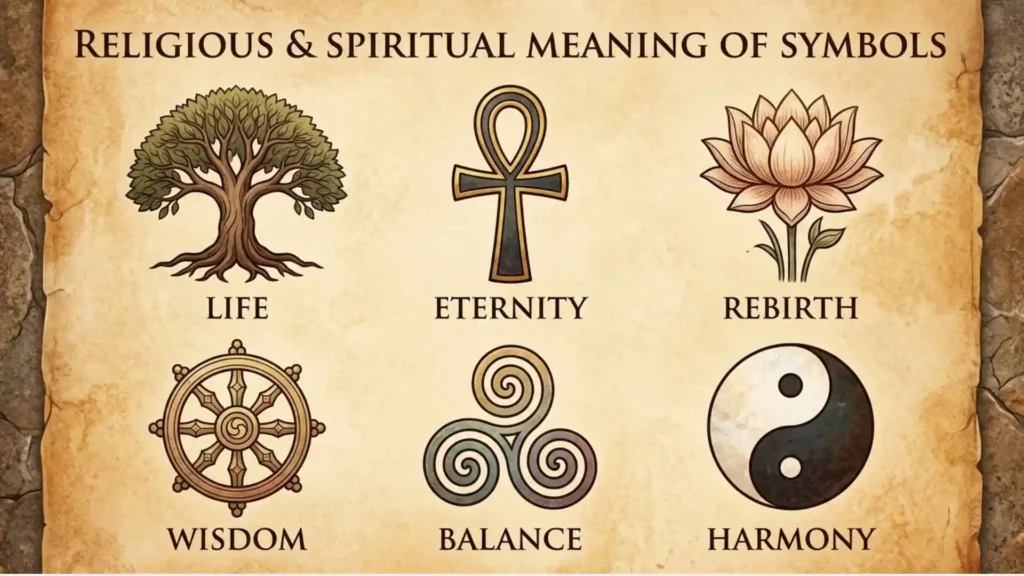
Religions use symbols to communicate teachings that involve sacred history, moral principles, divine beings, spiritual transformation, and the relationship between human life and ultimate reality.
A religious symbol may identify a faith community, support worship, teach doctrine, protect sacred space, or help believers focus during prayer and meditation.
Examples include the Christian cross, the Islamic crescent as a widely recognized cultural emblem, the Jewish menorah and Star of David, the Hindu Om, the Buddhist Dharma wheel, and the Sikh Khanda. Each has a distinct history, and not every symbol holds the same theological status within its tradition.
Sacred symbols often appear in:
- Houses of worship
- Religious clothing
- Manuscripts
- Jewelry
- Prayer objects
- Ceremonial art
- Festivals
- Funerals
- Weddings
- Pilgrimage sites
Religious symbols should not be interpreted only through appearance. Their meaning comes from scripture, tradition, worship, community practice, and historical development.
Spiritual symbolism also extends beyond formal religion. People may use circles to represent wholeness, light to represent truth, mountains to represent transcendence, or journeys to represent inner development. These interpretations may be personal, philosophical, or influenced by multiple traditions.
Care is necessary when borrowing sacred imagery. Using a religious symbol as decoration without understanding its significance may be viewed as disrespectful, especially when the symbol is restricted to specific rituals, leaders, or community members.
Symbols in Language, Science, and Technology
Symbols are not limited to religion and art. They are essential to language, mathematics, science, engineering, medicine, and digital communication.
Language and Writing
Letters are symbols that represent sounds or linguistic units. Punctuation marks organize meaning, emotion, rhythm, and sentence structure.
Words are also symbolic. The word “tree” is not the physical plant itself. It is a shared linguistic sign that English speakers learn to associate with a category of living things.
Because languages divide and describe reality differently, symbolic meaning is closely connected to cultural thought and communication.
Mathematics and Science
Mathematics uses symbols such as +, −, =, π, and √ to express relationships efficiently. Scientific fields rely on standardized notation so researchers from different language backgrounds can share information.
Chemical symbols such as H and O identify elements. Medical symbols can mark healthcare services, hazards, prescriptions, or emergency information. Engineering diagrams use agreed signs to represent components and processes.
These systems aim for precision, but users must still learn their conventions. A technical symbol has meaning because a professional community defines and follows it.
Digital Communication
Digital culture has produced emojis, icons, reaction buttons, hashtags, and interface symbols. A heart icon may express affection, approval, support, or saved content depending on the platform.
Emojis demonstrate how quickly symbolic meaning can change. Their interpretation depends on age, region, online community, platform design, and conversational tone. A symbol intended as friendly may appear sarcastic or dismissive in another context.
Global communication does not eliminate cultural difference. It often creates new layers of meaning.
Where Cultural Symbols Are Used
Cultural symbols appear wherever people communicate identity, values, instructions, memories, or emotions.
Art and Literature
Artists and writers use symbols to suggest ideas without explaining them directly. A storm may represent conflict, a locked door may suggest exclusion, and changing seasons may reflect stages of life.
Readers interpret these symbols through both textual evidence and cultural knowledge.
Architecture
Buildings communicate authority, belief, wealth, memory, and social purpose. Domes, towers, gates, columns, courtyards, and sacred directions may carry symbolic meaning.
Government buildings often use scale and symmetry to suggest stability. Religious architecture may direct attention upward, inward, toward an altar, or toward a sacred geographical direction.
Clothing and Jewelry
Clothing can communicate occupation, religion, social status, gender expectations, regional identity, mourning, celebration, or resistance.
Jewelry may display family heritage, marriage, faith, protection, achievement, or personal identity.
Flags and National Emblems
Flags use colors, stars, animals, plants, weapons, and geometric patterns to represent nations and political communities. Their designs often refer to geography, independence movements, dynasties, religious heritage, or national ideals.
Rituals and Ceremonies
Repeated actions can function as symbols. Bowing, exchanging rings, lighting candles, sharing food, saluting, or observing silence may express respect, commitment, remembrance, unity, or sacred participation.
Advertising and Logos
Companies use symbols to create recognition and emotional association. A logo may communicate speed, trust, innovation, tradition, luxury, or environmental responsibility.
Commercial symbols can become so familiar that people recognize them without reading the company name.
Tattoos
Tattoos may represent ancestry, faith, grief, survival, personal transformation, group membership, or artistic preference. Meanings differ by culture and individual experience.
Some traditional tattoo practices belong to specific communities and carry social or spiritual responsibilities. Copying such designs without context may remove or distort their meaning.
Common Variations in Cultural Symbols
Symbols change in shape, color, placement, and interpretation as they move across regions and historical periods.
Design Variations
A symbol may appear in highly detailed ceremonial art, simplified graphic design, handwritten form, jewelry, or digital icons. Simplification can make it easier to recognize, but it may remove important features.
Regional Variations
Neighboring regions may use similar symbols differently. A plant may serve as a national emblem in one country and a religious symbol in another.
Local histories often create meanings that outsiders do not immediately understand.
Modern Adaptations
Traditional symbols are frequently adapted for fashion, activism, entertainment, and branding. These adaptations can keep a symbol visible, but they may also cause controversy when commercial use conflicts with sacred or historical significance.
Similar Symbols
Two symbols may look alike without sharing the same origin. Simple geometric forms such as circles, crosses, spirals, and stars appeared in many societies because they are easy to create and observe in nature.
Visual similarity alone does not prove direct cultural connection.
Common Misconceptions About Cultural Symbols
Every Symbol Has One Universal Meaning
Most symbols do not have a single meaning that applies everywhere. Context, history, religion, location, and social group influence interpretation.
Ancient Meanings Never Change
Symbols evolve. Communities reinterpret them as political systems, beliefs, technologies, and social values change.
Similar Designs Must Share an Origin
Different cultures can independently create similar shapes. A spiral may appear in unrelated societies because it is visible in shells, storms, plants, and movement.
Dictionaries Can Explain Every Symbol Completely
A dictionary may provide a general definition, but it cannot capture every historical, emotional, regional, or ceremonial meaning.
Personal Interpretation Is Always Culturally Correct
Individuals may assign private meanings to symbols, but personal interpretation should not be confused with a tradition’s documented cultural meaning.
Using a Symbol Means Supporting Everything Connected to It
People may use the same symbol for different reasons. Historical, political, religious, and personal interpretations can overlap or conflict.
All Members of a Culture Interpret Symbols Identically
Cultures are internally diverse. Age, region, class, religion, education, politics, and personal experience produce different interpretations within the same society.
Interesting Facts About Symbols and Culture
- Human beings can turn almost anything into a symbol. Objects, sounds, colors, places, foods, gestures, and even periods of silence can carry shared meanings.
- Symbols can communicate without words. A uniform, warning sign, or facial expression may deliver information before anyone speaks.
- Meaning often depends on contrast. A white garment may suggest celebration in one ceremony and mourning in another because the surrounding cultural system gives it meaning.
- National symbols are often modern constructions. Many emblems presented as ancient traditions were standardized or popularized during periods of nationalism and state-building.
- Ritual actions are symbols too. Standing for an anthem, lighting a memorial candle, or exchanging rings communicates values through action rather than images.
- Symbols can outlive the societies that created them. Archaeologists often find ancient signs whose exact meanings have been lost, showing that physical forms can survive longer than cultural knowledge.
- Commercial branding uses the same basic process as traditional symbolism. Repetition connects a visual mark with values, stories, expectations, and emotional reactions.
- Digital symbols develop cultural dialects. The same emoji can communicate sincerity, irony, flirtation, embarrassment, or passive aggression in different online communities.
- Controversy often increases symbolic power. Public debate can make a symbol more emotionally charged because people connect it with identity, history, and moral judgment.
- Symbols can unite strangers. Shared clothing, flags, songs, or gestures allow people who have never met to recognize a common identity.
- Translation does not solve every symbolic difference. A word may be translated accurately while its emotional and cultural associations remain difficult to reproduce.
- Context can reverse meaning. An object that represents peace in a religious ceremony may communicate protest, grief, or political opposition when displayed elsewhere.
Related Symbols and Concepts
| Related Concept | How It Differs |
| Sign | Usually communicates a more direct message, such as a traffic instruction |
| Icon | Resembles the thing it represents, such as a phone image on a screen |
| Emblem | Identifies a group, institution, nation, or idea |
| Logo | A designed mark used to identify a company or organization |
| Metaphor | Describes one thing through comparison with another |
| Myth | A traditional narrative that expresses cultural beliefs or origins |
| Ritual | A repeated action with social, religious, or symbolic meaning |
| Totem | A being or object connected with a group’s identity in certain cultural traditions |
| Allegory | A story in which characters and events represent broader ideas |
| Archetype | A recurring pattern or character type found across stories and traditions |
Frequently Asked Questions
How is the use of symbols related to culture?
Symbols are related to culture because communities assign shared meanings to objects, images, gestures, colors, sounds, and actions. These meanings help people communicate values, identity, beliefs, history, and social rules. Cultural learning teaches individuals how to recognize and interpret symbols correctly within a particular setting.
Why do different cultures interpret the same symbol differently?
Different cultures develop through distinct histories, environments, religions, languages, and political experiences. These influences shape symbolic meaning. A color associated with celebration in one society may be linked with mourning elsewhere. Neither interpretation is naturally universal; each comes from learned cultural traditions and social context.
Can a symbol change its cultural meaning?
Yes. Symbols change when societies experience migration, political conflict, religious change, technological development, or generational shifts. A symbol may gain a new meaning, lose an older one, or carry several meanings at once. Modern media can accelerate this process by spreading symbols to new audiences.
What is the difference between a sign and a symbol?
A sign usually gives direct information, such as a stop sign telling drivers to stop. A symbol often represents a broader idea, identity, or emotion, such as a flag representing a nation. The categories can overlap, but symbols generally require more cultural interpretation than practical signs.
Are all symbols visual?
No. Symbols can be visual, verbal, physical, musical, or behavioral. A national anthem, moment of silence, handshake, ceremonial meal, title, or style of dress can function symbolically. What matters is not the form but the shared meaning people attach to it.
Why are symbols important in religion?
Religious symbols make sacred teachings, histories, and spiritual ideas easier to recognize and remember. They can identify a faith community, structure worship, mark sacred spaces, and support prayer or meditation. Their meanings come from religious texts, traditions, ceremonies, and community interpretation.
How do symbols influence human behavior?
Symbols influence behavior by communicating expectations and triggering learned responses. Uniforms may encourage obedience to authority, warning symbols create caution, and ceremonial objects inspire respectful behavior. Their effect depends on social learning, emotional association, and trust in the community or institution using them.
Can symbols cause cultural conflict?
Yes. Conflict occurs when groups assign opposing meanings to the same symbol or when one community uses another community’s sacred imagery without understanding it. Political symbols are especially sensitive because they may represent pride to some people and oppression, exclusion, or historical trauma to others.
What role do symbols play in cultural identity?
Symbols help individuals recognize and express membership in a cultural group. Language, flags, clothing, food, music, religious objects, and traditional designs can strengthen belonging. They also preserve shared memory by connecting present-day communities with ancestors, historical events, and inherited customs.
How should people interpret unfamiliar cultural symbols?
People should examine the symbol’s cultural source, historical setting, traditional use, and present context. Reliable museum resources, academic works, cultural institutions, and explanations from community members are more useful than assumptions based only on appearance. Respectful interpretation requires acknowledging that meanings may be complex or disputed.
Key Takeaways
- Symbols communicate cultural beliefs, values, identities, memories, and social rules.
- Their meanings are learned through family, education, religion, media, and community life.
- A symbol can be an image, word, sound, gesture, object, place, color, or ritual action.
- The same symbol may have different meanings across cultures.
- Symbols evolve as societies experience historical and technological change.
- Cultural context is essential when interpreting religious, political, or traditional imagery.
- Symbols can create unity, but they can also mark boundaries or cause conflict.
- Visual similarity does not always prove that two symbols share the same origin.
- Modern logos, emojis, and hashtags continue the human tradition of symbolic communication.
- Respectful use requires understanding a symbol’s history and importance to the people connected with it.
Conclusion
The answer to how is the use of symbols related to culture? lies in the human need to share meaning. Cultures use symbols to make beliefs visible, preserve memory, organize behavior, express identity, and connect individuals with a larger community.
A symbol is never only a shape, color, gesture, or object. Its deeper meaning comes from the stories, customs, institutions, and experiences surrounding it. That is why the same image may inspire devotion, pride, grief, resistance, or confusion among different groups.
Learning to interpret cultural symbols carefully helps us understand both the diversity and the shared creativity of human societies. It also reminds us that meaningful communication requires more than seeing a symbol. We must understand the cultural world that gives it life.

I am Amelia Carter, an English language educator and educational writer who enjoys making difficult ideas simple and easy to understand. At LearnNestly, I write about English words, grammar, everyday expressions, and language questions that people often find confusing. I believe learning should feel practical, clear, and enjoyable rather than overwhelming. Through my writing, I try to give readers explanations they can understand and use in real life.
Books:
- The Everyday English Handbook
- Words Made Simple
 Ethan Mitchell