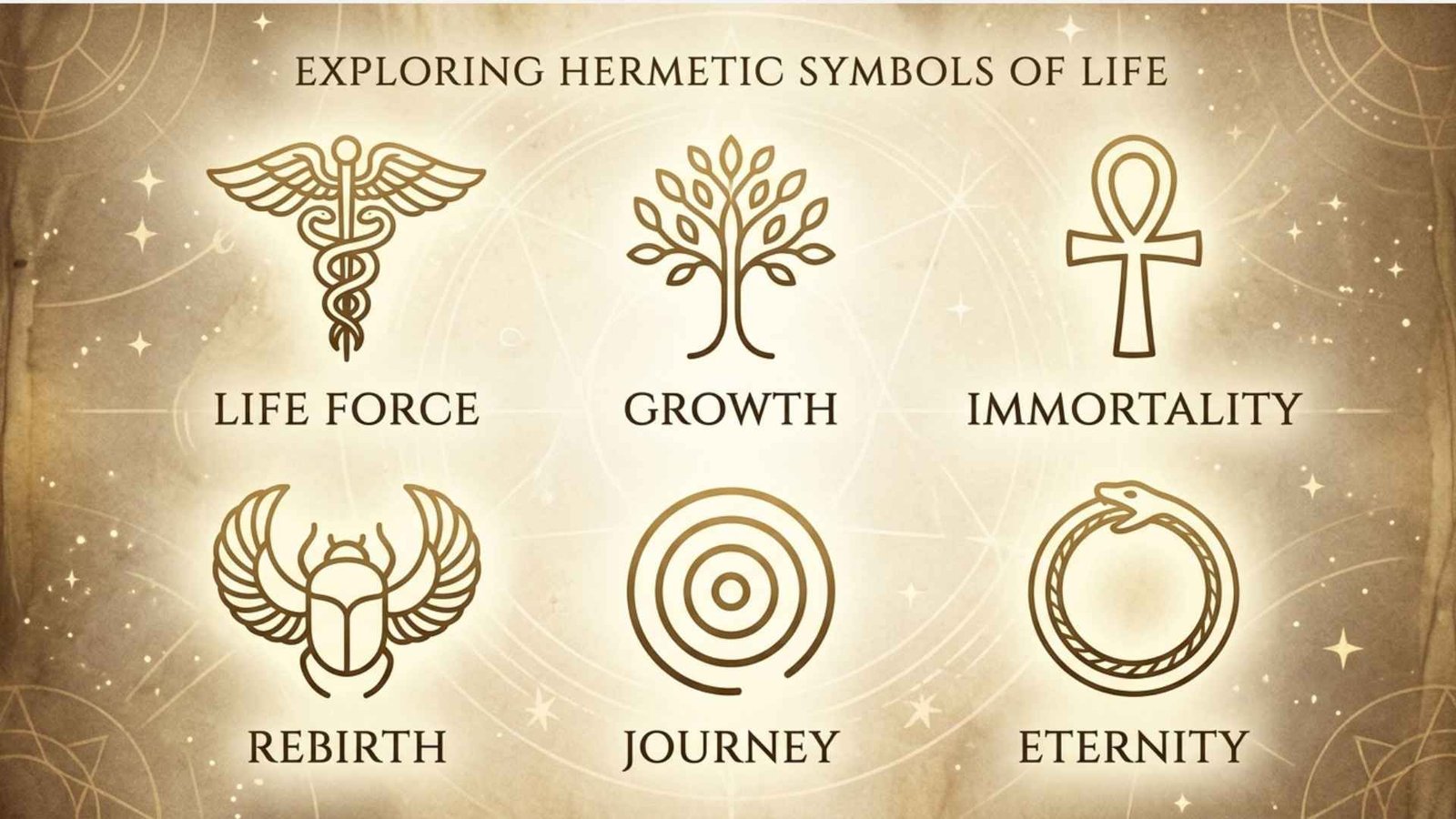
Hermetic symbols are visual signs used to express ideas about spiritual awakening, cosmic order, transformation, alchemy, astrology, and the relationship between humanity and the universe.
You may encounter them in old manuscripts, alchemical illustrations, occult books, tarot decks, jewelry, tattoos, architecture, and modern spiritual art.
These symbols do not belong to one fixed alphabet or single historical system. Instead, they developed across Egyptian, Greek, Hellenistic, Arabic, medieval European, and Renaissance traditions. Each image acts as a compact teaching tool, turning complex philosophical ideas into memorable visual forms.
Quick Meaning of Hermetic Symbols
Hermetic symbols represent the hidden relationships between spirit, mind, nature, and the cosmos. Common examples include the ouroboros, caduceus, planetary signs, alchemical glyphs, the sun and moon, the hexagram, and the rebis. Together, they communicate transformation, unity, balance, correspondence, spiritual rebirth, and the search for divine knowledge.
Hermetic Symbols Overview Table
| Field | Details |
| Symbol Group | Hermetic symbols |
| Primary Meaning | Spiritual transformation, cosmic unity, hidden wisdom, and correspondence |
| Category | Philosophical, religious, mystical, astrological, and alchemical symbolism |
| Historical Background | Greco-Egyptian Hermetic writings and later alchemical traditions |
| Key Figure | Hermes Trismegistus |
| Major Cultural Influences | Ancient Egypt, Hellenistic Greece, the Roman world, the Islamic world, medieval Europe, and Renaissance Europe |
| First Major Textual Setting | Greco-Roman Egypt during the early centuries CE |
| Common Examples | Ouroboros, caduceus, sun and moon, planetary glyphs, hexagram, pentagram, rebis, philosopher’s stone |
| Traditional Uses | Manuscripts, diagrams, ritual art, alchemical texts, astrology, and philosophical instruction |
| Modern Uses | Tattoos, jewelry, logos, tarot art, esoteric study, fiction, and spiritual practice |
| Central Principle | The visible world reflects deeper spiritual and cosmic realities |
| Unicode | Some individual symbols have Unicode characters, but Hermetic symbolism has no single Unicode sign |
| Emoji Equivalent | No exact equivalent |
| Related Traditions | Alchemy, astrology, Neoplatonism, Gnosticism, ceremonial magic, and Rosicrucian symbolism |
What Do Hermetic Symbols Mean?
Hermetic symbols mean that reality contains interconnected levels that can be understood through observation, contemplation, and inner transformation. They often show relationships between opposites, including heaven and earth, spirit and matter, light and darkness, masculine and feminine, and life and death.
The word Hermetic comes from Hermes Trismegistus, a legendary wisdom figure who combines qualities associated with the Greek god Hermes and the Egyptian god Thoth. Ancient and late-antique writings attributed to Hermes discuss divine mind, the human soul, nature, spiritual rebirth, and the possibility of knowing God. Modern scholars generally place the philosophical Hermetic writings in Greco-Roman Egypt between approximately the first and third centuries CE.
Hermetic symbols should therefore be understood as teaching images rather than simple decorative marks. A circle may indicate perfection or eternity. A serpent may suggest renewal, danger, wisdom, or self-contained power. The union of the sun and moon may represent the reconciliation of opposites.
Their exact meaning depends on the image, historical period, surrounding text, and tradition using it.
History and Origin of Hermetic Symbols
Hermetic symbolism developed through centuries of cultural exchange rather than appearing at one specific moment.
Greco-Egyptian Origins
The historical foundation of Hermetic thought emerged in Hellenistic and Roman Egypt, where Egyptian religious ideas interacted with Greek philosophy, astrology, medicine, and ritual practices. Hermes Trismegistus became a symbolic master of divine knowledge by blending Hermes, the Greek messenger and interpreter, with Thoth, the Egyptian deity associated with writing, wisdom, measurement, and sacred knowledge.
The philosophical texts now collected as the Corpus Hermeticum were composed in Egypt during the Roman period. They commonly present conversations in which Hermes teaches disciples about God, mind, creation, the soul, and spiritual purification.
These early writings did not provide one official catalog of Hermetic symbols. Instead, later readers connected their teachings with astrological diagrams, alchemical imagery, planetary signs, sacred geometry, and symbolic illustrations.
Arabic and Medieval Development
From late antiquity onward, works attributed to Hermes circulated in Greek, Syriac, Arabic, and Latin intellectual settings. In the medieval Islamic world, Hermes was sometimes viewed as an ancient sage connected with philosophy, astrology, medicine, and alchemy.
The Emerald Tablet, one of the most influential texts associated with Hermes Trismegistus, is first securely known from medieval Arabic literature. It later entered Latin Europe and became central to alchemical interpretations of nature. The familiar phrase “as above, so below” is a modern summary of its teaching that corresponding patterns connect different levels of reality.
Renaissance Revival
Hermetic thought gained new influence in Renaissance Europe after Marsilio Ficino translated the Corpus Hermeticum into Latin during the fifteenth century. Renaissance scholars initially believed these writings were extremely ancient and perhaps older than many Greek philosophers.
Thinkers such as Giovanni Pico della Mirandola, Cornelius Agrippa, Giordano Bruno, and others incorporated Hermetic ideas into broader discussions of theology, natural philosophy, astrology, memory, and magic. Agrippa, for example, lectured on the Hermetic Pimander, while editions of the Hermetic corpus circulated widely across Europe.
During this period, symbolic diagrams became increasingly elaborate. Artists and writers combined biblical imagery, classical mythology, planetary signs, numbers, geometric forms, animals, metals, and chemical processes.
Early Modern Alchemy
Between the sixteenth and seventeenth centuries, illustrated alchemical books transformed Hermetic symbolism into a complex visual language. Images of kings, queens, dragons, lions, birds, vessels, weddings, deaths, and resurrections described laboratory operations and inner spiritual processes at the same time.
The Ripley Scrolls, associated with English alchemist George Ripley, are famous examples of long illustrated alchemical manuscripts filled with symbolic figures and transformation scenes. Surviving examples show how images helped preserve and communicate alchemical teachings.
Symbolism and Interpretation
Hermetic symbols usually operate on several levels at once. A single image can refer to matter in a laboratory, a planet in astrology, a stage of personal growth, and a theological principle.
Transformation
Transformation is the central theme of many Hermetic symbols. Alchemists described the conversion of base substances into purified or perfected forms. Spiritually, the same process could represent the refinement of character, knowledge, and consciousness.
The philosopher’s stone symbolizes this ideal of perfection. It was associated with transmutation, healing, purification, and the completion of the alchemical work. Whether understood as a physical substance, spiritual state, or both, it represented the possibility that imperfect matter could reach a higher form.
Correspondence
Hermetic symbolism often expresses correspondence between different layers of existence. The human being may reflect the cosmos, metals may correspond with planets, and visible processes may reveal invisible principles.
This idea does not mean that every object has one universal secret meaning. Instead, Hermetic thinkers used networks of analogy to explore connections among nature, the body, the heavens, and the soul.
Unity
Circles, interlocking triangles, joined figures, and self-contained serpents frequently express unity. They suggest that apparent opposites belong to a larger whole.
Unity does not erase difference. In many Hermetic images, perfection arises when distinct forces become balanced, reconciled, or consciously integrated.
Death and Rebirth
Blackening, burial, dismemberment, dissolution, and decay appear often in alchemical art. These images can look negative, but they usually represent a necessary stage of transformation.
Old forms must break down before a new form can emerge. This principle appears in the symbolism of seeds, eggs, tombs, eclipses, winter, and the phoenix.
Positive and Negative Meanings
Hermetic imagery can express both constructive and dangerous possibilities.
Positive meanings include wisdom, renewal, balance, self-knowledge, purification, creativity, and spiritual awakening.
Negative meanings include pride, obsession, deception, confusion, uncontrolled power, and the misuse of knowledge. Historical Hermetic and alchemical traditions often warned that knowledge without discipline or moral development could become destructive.
Psychological Interpretation
Modern readers sometimes interpret Hermetic symbols psychologically. In this approach, the symbols represent unconscious forces, conflicts, fears, desires, and stages of inner development.
The union of the sun and moon may suggest integration between conscious and unconscious qualities. The dragon may represent instinctive energy. The sealed vessel may symbolize a protected inner space where change occurs.
These psychological readings can be meaningful, but they are modern interpretations rather than the only meanings intended by historical alchemists.
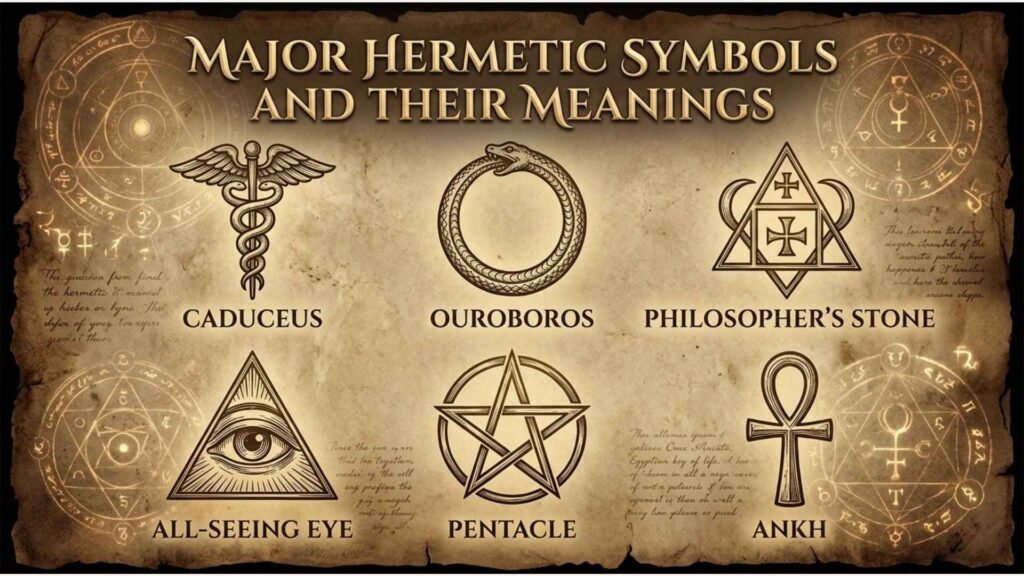
Major Hermetic Symbols and Their Meanings
Ouroboros
The ouroboros is a serpent or dragon biting its own tail. It symbolizes eternity, cyclic renewal, self-containment, unity, destruction, and rebirth.
The image has ancient Egyptian roots and later entered Greek magical, Gnostic, Hermetic, and alchemical traditions. Its name comes from Greek words meaning “tail-devouring.”
In alchemy, the ouroboros can represent matter repeatedly dissolving and reforming. It may also suggest that beginning and ending are parts of one continuous process.
Caduceus
The caduceus is a staff entwined by two serpents, often topped with wings. It is traditionally associated with Hermes.
In a Hermetic setting, it can symbolize mediation, communication, balance, movement between levels of reality, and the reconciliation of opposing forces. The two serpents may be interpreted as complementary energies arranged around a central axis.
The caduceus is frequently confused with the Rod of Asclepius, which has one serpent and is the more historically appropriate medical emblem.
Sun and Moon
The sun and moon represent paired cosmic forces. The sun commonly signifies active power, light, consciousness, gold, heat, and a masculine principle. The moon often signifies receptivity, reflection, silver, moisture, change, and a feminine principle.
Their symbolic marriage represents the union of opposites. It may also refer to the combination of substances or qualities required to complete the alchemical work.
These associations are symbolic categories, not statements that all men or women possess fixed qualities.
Hexagram
The hexagram consists of two overlapping triangles. One points upward, while the other points downward.
In Western esoteric interpretation, the upward triangle may represent fire, ascent, or spirit, while the downward triangle may represent water, descent, or matter. Together, they can symbolize the union of above and below.
The hexagram also has major meanings in Jewish tradition, especially as the Star of David. Its use in a Hermetic image should not be assumed to represent Judaism unless the historical context supports that reading.
Pentagram
The pentagram is a five-pointed star associated with proportion, the human form, the elements, protection, and microcosmic order.
In some Renaissance and esoteric systems, its five points represent spirit and the four classical elements: earth, water, air, and fire. An upright pentagram often signifies ordered harmony.
The claim that every inverted pentagram is inherently evil is a modern oversimplification. Orientation and meaning vary by period, group, and artistic setting.
Rebis
The rebis is an alchemical figure combining male and female characteristics, frequently shown with two heads on one body. It may stand on a dragon and hold tools such as a compass and square.
The rebis represents the completed union of opposing principles. Its name is commonly explained through the Latin expression res bina, meaning “double thing.”
Rather than depicting an ordinary human identity, the traditional rebis symbolizes a perfected state in which divided forces have become integrated.
Philosopher’s Stone
The philosopher’s stone is represented in many ways, including circles, squares, triangles, crowned figures, red stones, or geometric emblems.
It symbolizes perfection, transmutation, healing, wisdom, and completion. In laboratory alchemy, it was believed to enable the transformation of base metals into gold. In spiritual interpretation, it represents the purified or awakened self.
Hermetic Seal
A Hermetic seal is not one universal sign. The term may describe an emblem used to represent Hermes, an esoteric organization, or a symbolic diagram made from planetary, alchemical, and geometric elements.
The phrase also relates to the broader meaning of hermetically sealed, which refers to something completely closed. That modern expression comes from the legendary association of Hermes Trismegistus with secret knowledge and securely sealed alchemical vessels.
Planetary and Metal Symbols
Hermetic and alchemical systems linked seven traditional heavenly bodies with seven metals:
| Planetary Body | Traditional Metal | Common Symbolism |
| Sun | Gold | Perfection, vitality, authority |
| Moon | Silver | Reflection, change, receptivity |
| Mercury | Mercury | Movement, communication, transformation |
| Venus | Copper | Attraction, harmony, beauty |
| Mars | Iron | Force, conflict, energy |
| Jupiter | Tin | Expansion, order, prosperity |
| Saturn | Lead | Limitation, age, heaviness, transformation |
These correspondences were part of premodern cosmology and symbolic natural philosophy. They should not be treated as conclusions of modern chemistry or astronomy.
Alchemical Elements
Alchemy used symbols for substances and processes such as sulfur, mercury, salt, fire, water, air, earth, gold, silver, and various compounds.
In later interpretive systems, sulfur often represents active or fiery energy, mercury represents fluid or transformative energy, and salt represents stability or embodiment. However, the meanings differ among texts and should not be reduced to one rigid formula.
Cultural Significance
Hermetic symbols reflect continuous exchange among several cultures.
Egyptian Influence
Egypt contributed the sacred prestige of Thoth, temple wisdom, cosmic order, funerary transformation, and symbolic imagery involving serpents, solar cycles, and divine knowledge.
However, historical Hermeticism was not simply a preserved form of ancient pharaonic religion. It developed in the multicultural environment of Greco-Roman Egypt.
Greek Influence
Greek philosophy supplied concepts from Platonism, Stoicism, cosmology, logic, and metaphysics. Hermes also contributed themes of language, interpretation, travel, mediation, and movement between worlds.
The result was a Greco-Egyptian religious and philosophical synthesis rather than a purely Greek or purely Egyptian system.
Islamic Intellectual Traditions
Arabic-speaking scholars preserved, translated, adapted, and expanded many works connected with astrology, alchemy, medicine, mathematics, and natural philosophy. Hermes appeared in some Islamic intellectual traditions as an ancient prophet, sage, or culture-bearing figure.
These traditions played an important role in transmitting Hermetic and alchemical materials into medieval Latin Europe.
European Christian Culture
Renaissance Christians sometimes treated Hermes Trismegistus as a wise pagan who had anticipated aspects of Christian truth. Others criticized Hermetic magic, astrology, or religious speculation.
Christian, classical, Jewish, and Hermetic imagery frequently overlapped in Renaissance art. This mixture makes context essential when identifying a symbol’s intended meaning.
Modern Esoteric Culture
Modern occult orders, New Age writers, tarot artists, ceremonial magicians, and spiritual communities have adapted Hermetic symbols for new purposes.
Contemporary meanings may draw from psychology, self-development, comparative religion, fantasy literature, and popular culture. These modern adaptations are historically connected to older traditions but are not always identical to them.
Religious and Spiritual Meaning
Hermetic symbols spiritually represent the soul’s movement from ignorance toward knowledge of divine reality.
The philosophical Hermetic texts describe the human being as having both earthly and divine dimensions. Spiritual growth involves recognizing the divine source of mind, freeing oneself from ignorance, and living with greater reverence and understanding.
Some Hermetic teachings describe the soul’s descent through planetary spheres and its return toward a higher intellectual condition. Similar ideas also appeared in Middle Platonism and later philosophical traditions.
Hermetic practice has never been one unified religion with a central authority. Historical Hermetic texts, Renaissance Christian Hermeticism, modern Hermetic orders, alchemy, and contemporary spiritual practice can differ greatly.
Therefore, a symbol’s spiritual meaning should be identified through its source rather than assumed from its appearance alone.
Scientific and Technical Meaning
Hermetic symbols belong mainly to historical natural philosophy, alchemy, and astrology rather than modern experimental science.
Alchemy combined practical work with metals, minerals, dyes, medicines, furnaces, and chemical substances with philosophical and spiritual interpretations. Some alchemical procedures contributed to the development of laboratory techniques, but alchemical symbolic systems do not function as modern scientific notation.
Planetary glyphs still appear in astronomy and related fields. Chemical element symbols, however, now use internationally standardized letter abbreviations such as Au for gold, Ag for silver, Fe for iron, and Hg for mercury.
The word hermetic also has a technical meaning. A hermetic seal prevents air, moisture, or gas from entering or escaping. The term is used in packaging, engineering, electronics, laboratory equipment, and storage systems. This technical usage refers to complete closure, not necessarily to mystical symbolism.
Where Hermetic Symbols Are Used
Hermetic symbols appear in many historical and modern settings:
Manuscripts and Books
Alchemical manuscripts use symbolic diagrams to describe substances, operations, cosmic relationships, and stages of transformation. Images could communicate ideas that authors considered difficult, sacred, or deliberately concealed.
Art and Engravings
Renaissance and early modern prints often combine biblical scenes, classical gods, animals, geometric shapes, and laboratory equipment. These works function as visual puzzles that encourage interpretation.
Architecture
Some buildings contain planetary signs, geometric patterns, solar imagery, or emblems connected with patrons interested in alchemy, astrology, or Renaissance philosophy. However, geometric decoration alone does not prove a Hermetic purpose.
Jewelry
Ouroboros rings, caduceus pendants, planetary charms, and sun-and-moon necklaces are popular forms of symbolic jewelry. Wearers may choose them for personal meanings such as renewal, wisdom, balance, or protection.
Tattoos
Hermetic tattoos often include the ouroboros, philosopher’s stone emblem, rebis, alchemical elements, or “as above, so below.” Their meanings vary according to the wearer and may be philosophical, spiritual, artistic, or personal.
Tarot and Divination
Modern tarot decks frequently use Hermetic, astrological, kabbalistic, and alchemical imagery. The Magician card is commonly shown with symbols of the elements and the relationship between higher intention and earthly action.
Literature and Popular Culture
Fantasy novels, films, anime, video games, and graphic art use alchemical signs to suggest secret knowledge, immortality, forbidden experiments, transformation, or ancient societies.
These portrayals often mix authentic historical symbols with fictional inventions.
Common Variations and Similar Designs
Hermetic symbols vary because there was no single institution controlling their design.
The ouroboros may appear as a snake, dragon, winged serpent, circular figure, or figure-eight shape.
The philosopher’s stone may be shown as a red stone, geometric diagram, crowned child, sacred vessel, or completed rebis.
The sun and moon may appear as human faces, royal figures, animals, metals, circles, or celestial bodies.
Mercury may be represented by a planet sign, liquid metal, winged god, serpent, bird, or androgynous figure.
Color also changes meaning. Black may represent decay or the nigredo stage. White can suggest purification or albedo. Yellow may indicate awakening or citrinitas. Red often represents completion or rubedo. Not every alchemical text uses the same sequence or interpretation.
Common Misconceptions About Hermetic Symbols
They All Come From Ancient Egypt
Hermetic traditions have important Egyptian roots, but most familiar Hermetic symbols developed through Greek, Roman, Arabic, medieval, Renaissance, and early modern European influences.
Every Symbol Has One Fixed Meaning
Hermetic symbols are intentionally layered. Their meanings change according to the author, image, operation, and historical context.
They Are All Satanic Symbols
Hermetic symbols are not automatically Satanic. Many concern philosophy, astrology, cosmology, alchemy, spiritual purification, or Christian esotericism. A symbol should be interpreted through evidence, not fear-based assumptions.
Alchemists Only Wanted to Make Gold
Some alchemists pursued metallic transmutation, but alchemy also involved medicine, laboratory work, theories of matter, religious philosophy, and spiritual symbolism.
“As Above, So Below” Explains All Hermeticism
The phrase captures the idea of correspondence, but Hermetic thought includes many additional themes, including divine mind, creation, rebirth, knowledge, ethics, and the soul’s relationship with God.
The Caduceus Is the Original Medical Symbol
The caduceus belongs to Hermes and traditionally represents roles such as mediation, trade, communication, and travel. The Rod of Asclepius, featuring one serpent and no wings, has the stronger historical connection with medicine.
Interesting Facts About Hermetic Symbols
- Hermes Trismegistus was a composite wisdom figure. He combined characteristics of the Greek Hermes and Egyptian Thoth rather than representing a single verifiable historical author.
- There is no official Hermetic symbol dictionary. Meanings must be studied through manuscripts, captions, cultural context, and related texts.
- The ouroboros is older than historical Hermeticism. Hermetic and alchemical writers adopted an already ancient image and gave it new philosophical meanings.
- Alchemical pictures can describe several processes simultaneously. A royal wedding may represent chemical combination, cosmic balance, and spiritual integration.
- The Emerald Tablet became more influential in the Middle Ages. Its surviving textual history is connected with Arabic literature before its later fame in Latin European alchemy.
- Renaissance readers misdated the Hermetic texts. Many believed they came from remote antiquity, while modern scholarship places the major philosophical treatises in the Roman imperial period.
- Animals often represented substances or operations. Lions, ravens, eagles, dragons, pelicans, and phoenixes could describe colors, reactions, volatility, destruction, or renewal.
- Hermetic images were not always designed to be easily understood. Their ambiguity could protect specialized knowledge while encouraging contemplation.
- A sealed vessel had both practical and symbolic value. It controlled material during heating while also representing a contained space of transformation.
- Modern psychology changed how people read alchemical images. Twentieth-century psychological interpretations emphasized personal integration and unconscious development, adding a new layer to older religious and laboratory meanings.
Related Symbols
Rod of Asclepius
This symbol has one serpent wrapped around a staff. It is primarily associated with healing and medicine, unlike the two-serpent caduceus of Hermes.
Ankh
The Egyptian ankh represents life and divine vitality. It influenced modern esoteric imagery but is not automatically a Hermetic symbol in every context.
Infinity Symbol
The sideways figure eight represents endlessness in mathematics and popular symbolism. It resembles some modern ouroboros designs but has a different formal history.
Phoenix
The phoenix represents destruction followed by renewal. In alchemical imagery, it can symbolize purification, rebirth, or completion after a fiery transformation.
Yin-Yang Symbol
The yin-yang expresses complementary forces within Chinese philosophy. It resembles Hermetic ideas of balanced opposites, but it belongs to a distinct Chinese intellectual and cultural tradition.
Tree of Life
Tree symbols connect different levels of existence in several traditions. Hermetic and occult systems sometimes combine them with planetary or elemental correspondences.
Egg
The cosmic or philosophical egg symbolizes potential, origin, containment, and new creation. In alchemy, it may also represent the vessel in which transformation takes place.
Labyrinth
The labyrinth can symbolize initiation, inner searching, confusion, and the difficult path toward a spiritual center.
Frequently Asked Questions
What are the main Hermetic symbols?
The best-known Hermetic symbols include the ouroboros, caduceus, sun and moon, planetary glyphs, alchemical element signs, hexagram, pentagram, rebis, philosopher’s stone, cosmic egg, and Hermetic vessel. No single list is official because Hermetic imagery developed across many periods and traditions.
What is the most important Hermetic symbol?
The ouroboros is often considered one of the most recognizable Hermetic symbols because it represents unity, eternity, self-renewal, and the repeated transformation of matter. However, the philosopher’s stone may be more important as a symbol of the completed alchemical work and perfected state.
What does “as above, so below” mean?
“As above, so below” means that patterns found at one level of reality may correspond to patterns at another. In Hermetic interpretation, the heavens, nature, the human body, and the soul can reflect one another. The phrase is a modern formulation associated with teachings from the Emerald Tablet.
Are Hermetic symbols religious?
Some Hermetic symbols have religious or spiritual meanings, but others relate to astrology, alchemy, philosophy, or historical theories of nature. Hermeticism has influenced religious thought without becoming one centralized religion. The same sign may be spiritual in one source and technical or artistic in another.
Are Hermetic symbols evil?
Hermetic symbols are not inherently evil. Most represent transformation, cosmic relationships, wisdom, balance, mortality, or spiritual development. Some traditions have viewed occult practices critically, but a symbol’s meaning depends on its origin, purpose, and context rather than its mysterious appearance.
What does the ouroboros mean in Hermeticism?
In Hermetic and alchemical contexts, the ouroboros represents unity, eternity, self-containment, cyclic renewal, and the transformation of matter. Because it consumes and regenerates itself, it can also symbolize the idea that destruction and creation are interconnected stages of one continuous process.
Is the caduceus a Hermetic symbol?
Yes. The caduceus is closely connected with Hermes and can symbolize mediation, communication, balance, and movement between different worlds or states. Its two intertwined serpents are often interpreted as opposing forces arranged around a central principle. It should not be confused with the one-serpent medical staff of Asclepius.
What do the sun and moon mean in Hermetic symbolism?
The sun and moon represent complementary forces. The sun is commonly linked with gold, activity, clarity, and illumination, while the moon is linked with silver, receptivity, reflection, and change. Their union symbolizes balance and the reconciliation of qualities that appear separate or opposed.
Can anyone wear Hermetic symbols?
Anyone can wear Hermetic symbols, but understanding their histories helps prevent misleading or insensitive interpretations. A person may choose an ouroboros for renewal, a planetary sign for personal symbolism, or a sun-and-moon design for balance. Personal meaning should still be distinguished from historical meaning.
Are alchemical and Hermetic symbols the same?
They overlap but are not identical. Hermetic symbolism includes philosophical, religious, astrological, and cosmological ideas associated with Hermes Trismegistus. Alchemical symbols focus more specifically on substances, laboratory processes, transmutation, purification, and spiritual transformation. Many later alchemists blended both traditions.
Key Takeaways
- Hermetic symbols express transformation, unity, correspondence, and hidden wisdom.
- They developed through Greco-Egyptian, Arabic, medieval, Renaissance, and early modern traditions.
- Hermes Trismegistus combines associations of the Greek Hermes and Egyptian Thoth.
- The ouroboros, caduceus, rebis, sun and moon, planetary glyphs, and philosopher’s stone are major examples.
- Most Hermetic symbols carry several meanings at the same time.
- Historical context is essential because no universal symbol dictionary exists.
- Hermetic imagery influenced alchemy, astrology, religious philosophy, art, literature, and modern spirituality.
- Similar-looking symbols from other religions should not automatically be labeled Hermetic.
- Modern psychological interpretations can add meaning but should not replace historical evidence.
- Hermetic symbolism is best understood as a visual language of cosmic and personal transformation.
Conclusion
Hermetic symbols turn complex questions about nature, divinity, matter, and human consciousness into powerful visual forms. Their serpents, stars, planets, vessels, royal figures, and geometric shapes invite readers to look beyond surface appearances and consider how opposite forces may belong to a larger unity.
Understanding these symbols requires more than memorizing definitions. Their meanings developed through cultural exchange, philosophical debate, religious reflection, laboratory practice, and artistic imagination. A symbol may describe a chemical process in one manuscript, spiritual rebirth in another, and psychological integration in a modern interpretation.
For that reason, Hermetic symbols remain fascinating today. They preserve the human desire to understand transformation, discover order within complexity, and connect the visible world with deeper dimensions of meaning.

I am Daniel Brooks, a language researcher and writer with a strong interest in how people use English in everyday conversations. I contribute to LearnNestly because I enjoy turning confusing language topics into straightforward lessons. My goal is to help readers understand not only what a word or phrase means, but also when and how to use it naturally. I focus on clear examples, practical explanations, and useful language knowledge that readers can remember.
Books:
- The Practical English Guide
- Understanding Everyday Words
 Amelia Carter