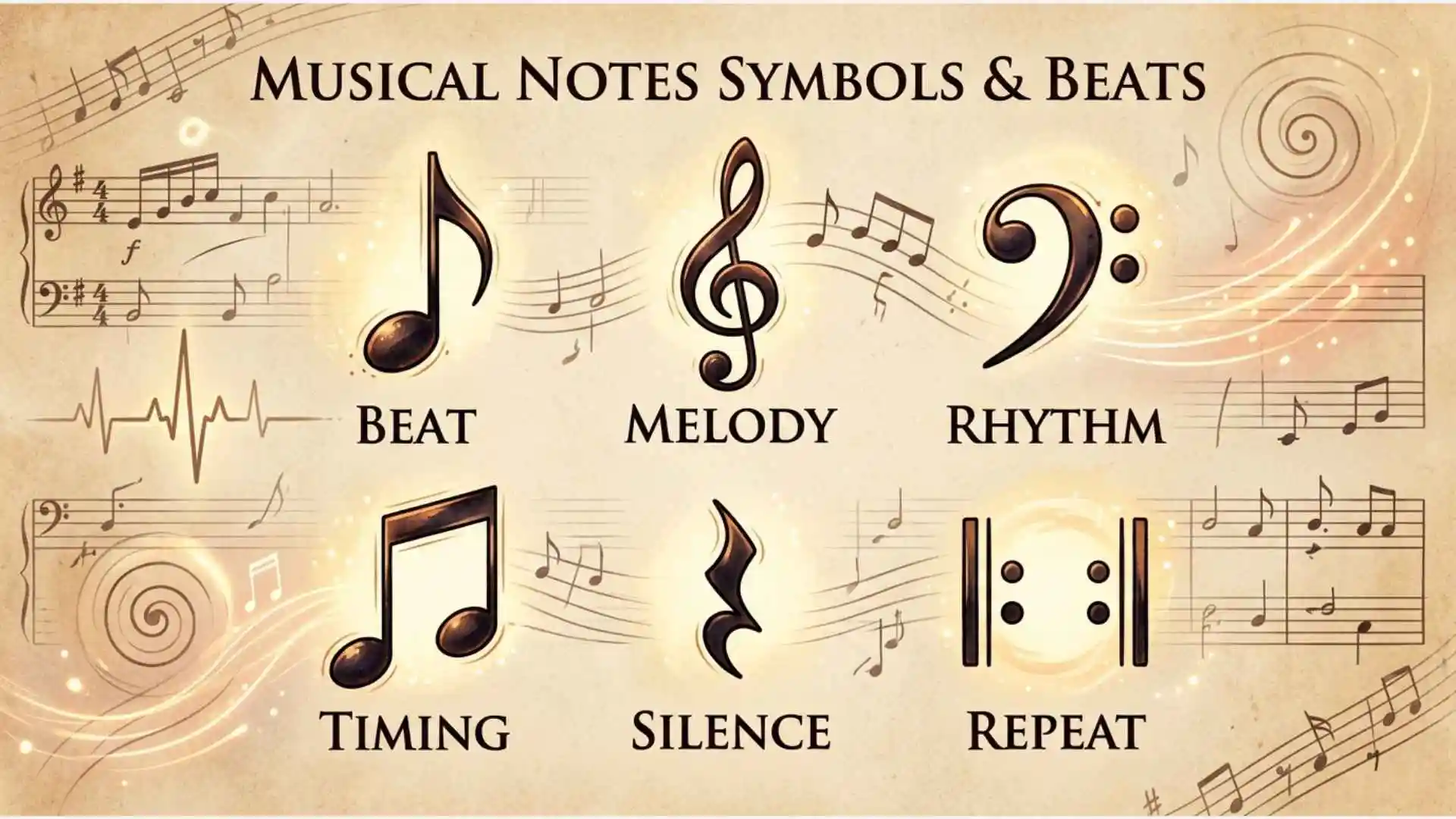
Music becomes easier to understand when you know what its notes, symbols, and beats mean. Musical notes tell you which sounds to play and how long to hold them, while rhythm shows how those sounds fit together in time. From whole notes and half notes to quarter notes and eighth notes, each symbol has a specific value that helps musicians read and perform music correctly.
Understanding musical notes symbols and beats is an important first step for anyone learning to read sheet music. A note’s shape, stem, flag, or dot can change its duration, while symbols such as rests, time signatures, and bar lines help organize the rhythm. Once these basics become familiar, written music starts to look less complicated and more like a clear set of instructions.
In this guide, you’ll learn the most common music note symbols, their names, meanings, and beat values in a simple way. You’ll also see how notes and rests work together, how beats are counted in different time signatures, and how these symbols appear in real sheet music. Whether you are a beginner, student, singer, or aspiring musician, this guide will help you build a strong foundation in musical rhythm.
Quick Meaning
Musical note symbols represent sounds of different pitches and lengths, while beat symbols organize those sounds in time. A filled or open notehead, stem, flag, beam, dot, rest, time signature, and tempo mark tells the performer when a sound begins, how long it lasts, and how it fits within the rhythm.
Musical Notes Symbols and Beats Overview Table
| Symbol or Concept | Primary Meaning | Typical Value in 4/4 Time | Common Use |
| Whole note | Long sustained sound | 4 beats | Holding a note for a full measure |
| Half note | Medium-long sound | 2 beats | Dividing a measure into two parts |
| Quarter note | Basic pulse value | 1 beat | Counting the main beat |
| Eighth note | Half of a quarter note | 1/2 beat | Faster rhythmic movement |
| Sixteenth note | One-quarter of a quarter note | 1/4 beat | Detailed or rapid rhythms |
| Whole rest | Full-measure silence in many contexts | Usually 4 beats | Silence for an entire measure |
| Half rest | Medium-length silence | 2 beats | Resting for half a 4/4 measure |
| Quarter rest | One-beat silence | 1 beat | Pausing for one beat |
| Eighth rest | Brief silence | 1/2 beat | Syncopated or fast rhythms |
| Dotted note | Adds half the note’s original value | Varies | Creating uneven divisions |
| Tie | Joins durations of matching pitches | Varies | Extending a note |
| Time signature | Organizes beats in each measure | Varies | Defining meter |
| Barline | Divides music into measures | Not a duration | Organizing written rhythm |
| Tempo marking | Shows performance speed | Beats per minute | Controlling pace |
| Accent | Emphasizes a note | No added beats | Creating rhythmic stress |
What Do Musical Notes Symbols and Beats Mean?
Musical notes symbols and beats explain two essential parts of music: what sound should be produced and when it should occur.
A note placed higher or lower on a staff usually represents pitch. Its shape helps indicate duration. The surrounding symbols provide further instructions about rhythm, articulation, loudness, expression, tempo, repetition, and phrasing.
A beat is the steady pulse listeners often tap with a foot or clap with their hands. Rhythm is the pattern created when long notes, short notes, sounds, accents, and silences are arranged around that pulse.
For example, in 4/4 time:
- A quarter note normally receives one beat.
- A half note normally receives two beats.
- A whole note normally receives four beats.
- Two eighth notes fit within one beat.
- Four sixteenth notes fit within one beat.
These relationships are proportional. A whole note is twice as long as a half note, a half note is twice as long as a quarter note, and a quarter note is twice as long as an eighth note.
However, note values do not have fixed durations in seconds. Their actual length depends on tempo. A quarter note at 60 beats per minute lasts about one second, while a quarter note at 120 beats per minute lasts about half a second.
History and Origin of Musical Note Symbols
Written music developed because people needed a way to remember, teach, organize, and transmit musical ideas beyond a single performance.
Ancient cultures used several methods of musical notation. Some systems employed letters, numbers, words, or marks to indicate melodic movement. These early traditions did not all develop into modern Western staff notation, but they demonstrate that many civilizations sought ways to preserve music.
From Neumes to Staff Notation
In medieval Europe, singers used marks called neumes above sacred texts. Early neumes often indicated whether a melody moved upward, downward, or followed a particular shape. They did not always identify exact pitches or precise rhythmic values.
Over time, scribes began placing neumes at different heights. Horizontal staff lines were then added to make pitch relationships clearer. Surviving medieval chant manuscripts document the gradual development of staffless neumes, heightened neumes, clefs, square notation, and staffs containing different numbers of lines.
The five-line staff eventually became the standard framework for much Western music. Clefs established reference pitches, while note placement showed whether a sound was higher or lower.
Development of Rhythmic Values
Early chant notation focused more heavily on melodic direction and vocal delivery than on exact measured rhythm. As European music became increasingly complex and multiple voices were written together, musicians needed clearer ways to coordinate duration.
Different note shapes gradually came to represent measured values. Medieval and Renaissance mensural notation used shapes and relationships that later evolved into familiar whole, half, quarter, eighth, and shorter notes.
The modern system preserves this mathematical hierarchy. Each undotted note value is normally twice as long as the next smaller value.
Printed and Digital Music
The invention of music printing encouraged greater visual consistency, although publishers continued to use different engraving traditions. In the modern era, notation programs can position notes, rests, beams, lyrics, dynamics, and articulations automatically.
Unicode includes many musical symbols for digital text, while the Standard Music Font Layout, known as SMuFL, provides a much larger standardized mapping for the thousands of glyphs required by music-notation applications and fonts.
Basic Musical Note Symbols and Their Beat Values
Whole Note
A whole note has an open oval notehead and no stem.
In 4/4 time, it normally lasts four beats:
Count: 1, 2, 3, 4
The performer begins the note on beat one and sustains it through the entire measure.
Despite its name, a whole note does not always fill a complete measure. It fills one measure in 4/4, but meter determines how note values fit within each bar.
Half Note
A half note has an open notehead and a stem.
In 4/4 time, it receives two beats:
Count: 1, 2
Two half notes fill one measure of 4/4.
Quarter Note
A quarter note has a filled notehead and a stem.
It normally receives one beat in 4/4 time. Musicians often use the quarter note as the reference value when learning to count:
Count: 1, 2, 3, 4
Each number marks the beginning of a new quarter note.
Eighth Note
An eighth note has a filled notehead, a stem, and one flag. When several eighth notes appear together, their flags are often replaced by a connecting beam.
Each eighth note receives half a beat in 4/4 time:
Count: 1-and-2-and-3-and-4-and
The numbers mark the beats, while “and” marks the midpoint between beats.
Sixteenth Note
A sixteenth note has a filled notehead, a stem, and two flags. Groups of sixteenth notes are commonly joined with two beams.
Four sixteenth notes fit within one quarter-note beat:
Count: 1-e-and-a
A full 4/4 measure of sixteenth notes may be counted:
1-e-and-a, 2-e-and-a, 3-e-and-a, 4-e-and-a
Thirty-Second and Shorter Notes
A thirty-second note has three flags or beams. It is half the duration of a sixteenth note.
Sixty-fourth notes and even shorter values also exist, although they appear less frequently in ordinary beginner music. These symbols are useful in fast ornamentation, detailed instrumental passages, cadenzas, and highly complex scores.
Musical Rest Symbols and Beat Values
Rests represent measured silence. Silence is not an empty gap in notation. It has a specific duration and remains part of the rhythm.
Whole Rest
A whole rest resembles a small rectangle hanging below a staff line.
It often represents four beats in 4/4 time. It can also indicate an entire silent measure in many notational contexts, even when the measure contains a different number of beats.
Half Rest
A half rest resembles a small rectangle sitting on top of a staff line.
It receives two beats in 4/4 time. The visual difference between whole and half rests is important:
- Whole rest hangs.
- Half rest sits.
Quarter Rest
A quarter rest represents one beat of silence in 4/4. Its curved shape looks different from the rectangular whole and half rests.
Eighth Rest
An eighth rest represents half a beat. It usually has one hook, visually matching the single flag of an eighth note.
Sixteenth Rest
A sixteenth rest represents one-quarter of a beat in 4/4 and normally has two hooks. Additional hooks indicate progressively shorter rests.
Dotted Notes and Dotted Rhythms
A dot placed immediately after a note increases its duration by half of its original value.
This rule can be expressed as:
Dotted value = original value + half of original value
Examples include:
| Dotted Note | Original Value | Added Value | Total in 4/4 |
| Dotted half note | 2 beats | 1 beat | 3 beats |
| Dotted quarter note | 1 beat | 1/2 beat | 1 1/2 beats |
| Dotted eighth note | 1/2 beat | 1/4 beat | 3/4 beat |
A dotted half note followed by a quarter note fills one measure of 4/4:
3 beats + 1 beat = 4 beats
A double-dotted note adds half of the original value and then half of the first dot’s value. Therefore, a double-dotted half note equals:
2 + 1 + 1/2 = 3 1/2 beats
Ties, Slurs, and Beams
These curved lines and connectors may look similar, but they perform different functions.
Tie
A tie is a curved line connecting two notes of the same pitch. The performer attacks the first note and holds it for the combined duration of both notes.
For example, a half note tied to a quarter note lasts three beats.
Ties are especially useful when a sound continues across a barline or when the required duration is difficult to show with a single note symbol.
Slur
A slur is a curved line connecting notes of different pitches. It indicates that the notes should be played or sung smoothly as a phrase.
A slur affects articulation rather than mathematical duration. Unlike a tie, it does not combine the beat values into one sustained pitch.
Beam
A beam joins eighth notes or shorter notes into readable rhythmic groups. Beams help performers see how notes fit within beats and measures.
A beam does not automatically change a note’s value. One beam usually connects eighth notes, two beams connect sixteenth notes, and three beams connect thirty-second notes.
Time Signatures and Beat Organization
A time signature appears near the beginning of a piece and may also appear later when the meter changes. It contains two numbers arranged vertically.
The top number usually shows how many beats or beat subdivisions belong in each measure. The bottom number identifies the note value represented by the denominator.
Common lower numbers include:
- 2 for a half note
- 4 for a quarter note
- 8 for an eighth note
4/4 Time
In 4/4 time, each measure contains the equivalent of four quarter notes.
Possible combinations include:
- Four quarter notes
- Two half notes
- One whole note
- Eight eighth notes
- One dotted half note and one quarter note
The symbol C is sometimes used for common time, which is equivalent to 4/4.
3/4 Time
In 3/4 time, each measure contains three quarter-note beats.
This meter is strongly associated with waltzes, although it appears in many other musical styles.
The count is:
1, 2, 3
Beat one often receives the strongest emphasis.
2/4 Time
In 2/4 time, each measure contains two quarter-note beats.
The count is:
1, 2
Marches, dances, folk tunes, and simple teaching pieces often use this meter.
6/8 Time
In 6/8 time, each measure contains six eighth-note subdivisions. These are commonly grouped into two main beats, with three eighth notes in each beat.
The count may be felt as:
1-la-li, 2-la-li
This produces a rolling compound-meter feeling rather than six equally strong pulses.
Cut Time
Cut time is shown as a C with a vertical line through it. It represents 2/2 meter.
The measure contains two half-note beats. Cut time often helps musicians feel fast music in two larger pulses rather than four smaller ones.
Tempo and Beats Per Minute
Tempo tells performers how fast the beat should move. It may be expressed with an Italian term, a metronome marking, or both.
A marking such as:
Quarter note = 120
means that 120 quarter-note beats occur each minute.
Common tempo terms include:
| Tempo Term | General Meaning |
| Largo | Broad and very slow |
| Adagio | Slow |
| Andante | At a walking pace |
| Moderato | Moderate speed |
| Allegro | Fast and lively |
| Presto | Very fast |
These terms describe more than exact speed. They may also suggest character and style. Their interpretation can vary according to historical period, genre, composer, and performance tradition.
Symbolism and Interpretation
Musical note symbols are primarily practical signs rather than universal spiritual emblems. However, they have gained broader symbolic meanings through art, popular culture, and personal expression.
Traditional Meaning
Traditionally, a musical note represents an organized sound with a particular pitch and duration. A sequence of notes represents melody, while their durations contribute to rhythm.
Modern Meaning
Today, note symbols commonly represent:
- Music and musicianship
- Creativity
- Singing
- Celebration
- Entertainment
- Emotional expression
- Harmony
- Artistic identity
A single eighth-note symbol may be used in a logo or social media profile to communicate a general love of music without referring to a particular pitch.
Positive Symbolism
Musical notes often symbolize joy, freedom, harmony, communication, and shared experience. They may represent the idea that people can connect through sound even when they speak different languages.
Negative or Somber Symbolism
Musical symbols can also appear in contexts involving grief, loneliness, protest, or remembrance. Their emotional meaning depends on the music, imagery, colors, words, and cultural setting surrounding them.
A note symbol itself is not inherently happy or sad.
Psychological Interpretation
Music notation transforms sound, which disappears immediately after performance, into a visible structure. This makes abstract musical relationships easier to study, repeat, compare, and communicate.
For learners, written symbols can reduce memory demands by showing rhythm and pitch externally. At the same time, notation does not capture every detail of expression. Tone color, subtle timing, improvisation, and emotional interpretation still depend heavily on the performer.
Cultural Significance
Musical notation is not a single universal system. Cultures have developed different ways of recording melodies, rhythms, instruments, and performance practices.
Western staff notation uses staffs, clefs, noteheads, rests, accidentals, and meter signs. Indian classical music may be written with systems of swara syllables. Chinese music has used character-based and numbered notation traditions. Indonesian gamelan traditions have developed cipher systems, while many musical cultures rely strongly on oral transmission.
Tablature shows performers where to place their fingers rather than displaying pitch only through staff position. Guitar tablature, for example, uses lines for strings and numbers for frets.
These systems reflect different musical priorities. A notation designed for chant may emphasize melodic contour. A drum chart may emphasize attacks and rhythmic patterns. A tablature system may emphasize physical position. A modern orchestral score must coordinate many instruments at once.
Religious and Spiritual Meaning
Musical notes have no single sacred meaning, but music notation has played an important role in religious communities.
Medieval European notation developed partly through the need to preserve and teach liturgical chant. Written symbols helped religious communities coordinate melodies across generations and geographic regions.
Other religious traditions preserve sacred music through oral instruction, mnemonic syllables, manuscripts, specialized notation, or combinations of written and oral practice.
In modern spiritual art, note symbols may represent praise, devotion, transcendence, harmony, or the belief that music connects human experience with the sacred. These are interpretations rather than fixed meanings built into the symbols themselves.
Scientific, Mathematical, and Digital Meaning
Mathematical Relationships
Standard note values form proportional relationships based largely on division by two:
1 whole note = 2 half notes = 4 quarter notes = 8 eighth notes = 16 sixteenth notes
This structure makes rhythm measurable. Fractions in note names describe relationships within the system, although the values must always be interpreted within a meter and tempo.
Tuplets temporarily divide a beat in an unusual way. A triplet, for example, places three equal notes in the time normally occupied by two notes of the same written value.
Acoustics and Timing
Pitch relates to sound-wave frequency, while rhythm relates to events unfolding over time. Music notation represents these properties symbolically rather than drawing the actual sound wave.
A written A does not display its frequency directly. It tells a trained performer which pitch to produce according to the relevant clef, staff position, tuning system, and performance context.
Digital Music Technology
Digital notation programs treat musical symbols as structured information. A note may contain data for pitch, duration, voice, staff, articulation, accidental, lyric, and playback instructions.
Unicode provides characters for many musical symbols, but complete score layout requires contextual positioning. For example, stem direction may depend on surrounding notes and voices rather than being permanently defined by a character.
MusicXML allows notation programs to exchange structured score information, while SMuFL provides standardized glyph names and mappings used by music fonts and scoring applications.
Where Musical Note Symbols Are Used
Musical note symbols appear in many settings beyond traditional printed sheet music.
Sheet Music and Instruction Books
Their most direct use is in scores, instrumental parts, method books, exercises, hymnals, songbooks, and classroom materials.
Music Software
Notation applications use digital note glyphs to create professional scores. Digital audio workstations may also display note events in piano-roll editors, drum grids, or standard notation views.
Logos and Branding
Music schools, streaming services, radio stations, choirs, bands, clubs, and instrument shops often use note symbols in logos.
Tattoos and Jewelry
People may choose music-note tattoos or pendants to represent a favorite song, career, memory, relationship, or personal connection to music.
Art and Literature
Artists use notes to suggest sound, movement, celebration, romance, or atmosphere. In comics and illustrations, floating notes often indicate that a character is singing, whistling, or hearing music.
User Interfaces
A note icon may identify music libraries, audio settings, playlists, ringtones, recordings, or sound-related features.
Common Variations and Similar Symbols
Stem Direction
Notes may have stems pointing upward or downward. Stem direction improves readability and helps distinguish voices. It does not normally change pitch or duration.
Flags and Beams
A single isolated eighth note usually has one flag, while grouped eighth notes often share a beam. The rhythmic value remains the same.
Notehead Shapes
Standard notation uses open and filled oval noteheads, but other shapes also appear. Percussion notation, shape-note singing, contemporary composition, and specialized techniques may use crosses, diamonds, triangles, slashes, or squares.
Grace Notes
Grace notes are printed smaller than ordinary notes. They represent ornaments or decorative notes performed in relation to a main note.
Accidentals
Sharp, flat, and natural signs affect pitch rather than duration:
- Sharp raises a pitch by a semitone in common Western practice.
- Flat lowers a pitch by a semitone.
- Natural cancels a previous sharp or flat within the applicable context.
Dynamic and Articulation Marks
Symbols such as accents, staccato dots, fermatas, and dynamic letters change how notes are performed. They should not be confused with basic beat values.
Common Misconceptions
“A Quarter Note Always Lasts One Second”
A quarter note lasts one beat in meters where the quarter note carries the beat, but its duration in seconds depends on tempo.
“The Bottom Number Shows the Tempo”
The bottom number of a time signature identifies a note value. It does not show beats per minute.
“A Whole Note Always Fills the Measure”
A whole note equals four quarter notes, but not every measure contains four quarter-note beats. Meter determines whether it fills the bar.
“Beamed Notes Are Faster”
Beaming groups short notes for readability. The tempo and note value determine speed, not the beam alone.
“Every Dot Means Staccato”
A dot after a notehead increases duration. A dot placed above or below a note is generally a staccato articulation mark. Position changes meaning.
“Music Notes Are a Universal Language”
Music can cross language barriers, but notation systems and musical interpretations differ across cultures. Western staff notation is influential, not universal.
“Rests Mean Nothing Happens”
A rest is an active part of rhythm. Performers must count it accurately and reenter at the correct moment.
Interesting Facts About Musical Notes and Beats
- Note values describe relationships, not fixed seconds. A quarter note may be brief or long depending on tempo.
- Silence has its own complete symbol system. Whole, half, quarter, eighth, and shorter rests mirror the duration hierarchy of notes.
- Beams function as visual rhythm guides. Their grouping can reveal where beats begin and how subdivisions are organized.
- The five-line staff was not created all at once. Medieval manuscripts show staffs developing through stages that used different numbers of lines.
- A tie can create a duration that crosses a barline. This preserves the visual structure of the meter while allowing the sound to continue.
- The same rhythm can be written in more than one valid way. Good notation chooses the version that makes the beat structure easiest to understand.
- Percussion notes may not represent conventional pitch. Their staff positions and notehead shapes can identify drums, cymbals, or playing techniques.
- Unicode contains a dedicated Musical Symbols block. It includes clefs, rests, notes, accidentals, ornaments, and other signs used in digital text.
- SMuFL contains far more specialized glyphs than ordinary text fonts. It was created to support the broad symbol requirements of professional notation software.
- Music notation cannot capture every performance choice. Musicians still interpret phrasing, tone, balance, timing, and emotional character.
Related Musical Symbols
Treble Clef
The treble clef establishes the position of G above middle C and is commonly used for higher ranges.
Bass Clef
The bass clef establishes the position of F below middle C and is commonly used for lower ranges.
Sharp Sign
A sharp raises a pitch by one semitone in standard chromatic notation.
Flat Sign
A flat lowers a pitch by one semitone.
Natural Sign
A natural cancels a sharp or flat that would otherwise apply.
Fermata
A fermata indicates that a note or rest should be held longer than its written value, according to musical judgment or direction.
Repeat Sign
A repeat sign instructs the performer to return to an earlier point and play a section again.
Metronome Mark
A metronome mark links a note value with a number of beats per minute, providing a measurable tempo reference.
Dynamic Symbols
Marks such as p, f, crescendo, and diminuendo control loudness and changes in intensity rather than beat length.
Frequently Asked Questions
What are the main musical note symbols and beats?
The main note symbols are whole, half, quarter, eighth, and sixteenth notes. In 4/4 time, they usually equal four, two, one, one-half, and one-quarter beat. Matching rest symbols represent silence for the same lengths.
How do you count musical notes?
Begin by identifying the time signature and the note value carrying the main beat. Count quarter notes with numbers, eighth notes with “and” between numbers, and sixteenth notes with “e-and-a.” Keep the pulse steady while giving every note and rest its full value.
What does a dot beside a musical note mean?
A dot immediately after a note adds half of that note’s original duration. A dotted quarter note therefore equals one quarter-note beat plus one eighth-note subdivision. Do not confuse a duration dot with a staccato dot placed above or below a note.
What is the difference between beat and rhythm?
Beat is the steady underlying pulse of music. Rhythm is the changing pattern of sounds and silences placed around that pulse. A song may maintain the same beat while its melody, accompaniment, and percussion perform several different rhythms.
What is the difference between tempo and time signature?
Tempo describes how fast the beat moves, often in beats per minute. A time signature describes how beats or subdivisions are organized into measures. Two pieces can share the same time signature but use very different tempos.
How many beats does an eighth note receive?
In 4/4 time, an eighth note normally receives half of one quarter-note beat. Two eighth notes fit into one beat. In compound meters such as 6/8, eighth notes are often grouped in sets of three within larger dotted-quarter-note beats.
Why are some musical notes connected?
Eighth notes and shorter values are often connected with beams to make rhythmic groups easier to read. Notes of the same pitch may also be connected by ties, which combine their durations. A slur connects different pitches and indicates smooth articulation.
Does a rest count as a beat?
Yes. A rest occupies measured time even though no note is played. Musicians must count rests as carefully as sounded notes so that entrances, ensemble coordination, and rhythmic structure remain accurate.
Can the same note symbol have different meanings?
Its basic duration remains proportional, but context matters. Meter affects how it is counted, tempo affects its length in seconds, staff position affects pitch, clef changes pitch interpretation, and surrounding markings may alter articulation, emphasis, or expression.
Are musical note symbols available in Unicode?
Yes. Unicode includes a Musical Symbols block containing many notes, rests, clefs, accidentals, and related signs. Full score engraving still requires specialized layout systems because musical symbols must be positioned according to context, staff structure, voices, stems, beams, and spacing.
Key Takeaways
- Musical notes represent pitch and duration.
- Beats create the steady pulse behind rhythm.
- Whole, half, quarter, eighth, and sixteenth notes form proportional values.
- Rests represent measured silence.
- Dots add half of a note’s original duration.
- Ties extend notes, while slurs shape articulation.
- Time signatures organize beats into measures.
- Tempo determines how quickly beats pass.
- Beams make rhythmic groupings easier to read.
- Musical notation has evolved from early marks and neumes into printed and digital systems.
- Note symbols can represent music, creativity, harmony, and personal identity outside written scores.
- Accurate reading depends on context, not on symbol shape alone.
Conclusion
Musical notes symbols and beats provide a structured way to turn sound and silence into readable patterns. Noteheads, stems, flags, beams, rests, dots, ties, barlines, time signatures, and tempo marks work together to show what should happen and when.
Learning the system begins with simple mathematical relationships: two half notes equal one whole note, two quarter notes equal one half note, and two eighth notes equal one quarter note. From there, dotted rhythms, tuplets, syncopation, articulation, and complex meters become easier to understand.
Whether you are learning an instrument, singing in a choir, producing digital music, studying rhythm, or simply trying to read sheet music, understanding musical notes symbols and beats gives you the foundation needed to follow music with greater accuracy and confidence.

I am Ethan Mitchell, an English writer and lifelong learner who is fascinated by words and the way language changes over time. At LearnNestly, I share practical explanations designed for readers who want to improve their understanding of English without complicated terminology. I enjoy researching meanings, usage, grammar, and common language mistakes, then presenting the information in a simple and useful format. My purpose is to make every article a small learning experience that readers can actually apply.
Books:
- The Smart Learner’s English Guide
- English in Real Life
 Amelia Carter